
What Are Employee Strengths and Why a Strengths-Based Approach Works
by Ryan Stoltz
Last updated
13 min read
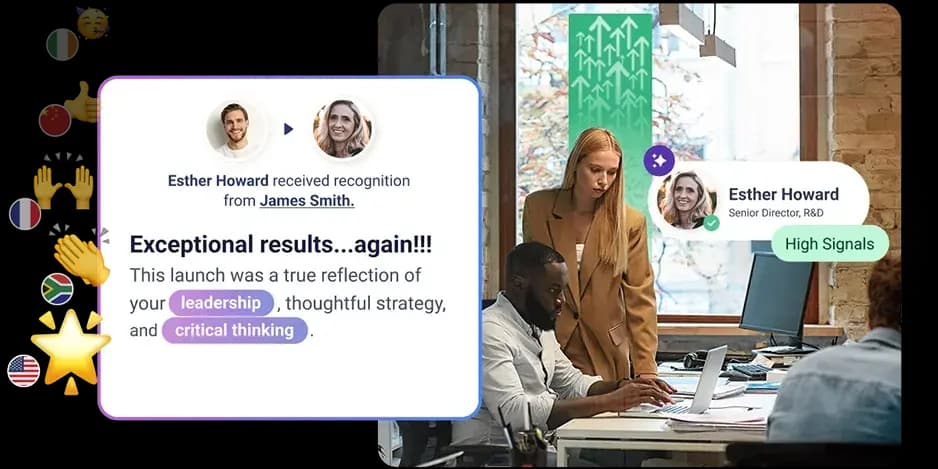
Many companies strive to fix their employees' shortcomings rather than capitalize on their strengths, only to see staff with high potential disengage with their work or even leave for a job that they feel better suited to.
An organization that focuses on developing employee strengths can instead nurture talent, making its workforce more productive and engaged while minimizing turnover.
HR leaders and managers can use the practical framework described here to identify their employees' strongest points and develop them through structured coaching and job design. Strengths should be central to performance reviews, team composition, and day-to-day management decisions.
This guide covers how to adopt a strengths-based approach to employee feedback and development, so your employees can produce their best work.
What are employee strengths?
Employee strengths are the intersection of innate talents, learned skills, and energizing tasks. They encompass an employee's soft skills (like organization and communication) and hard skills (like familiarity with certain software), along with their character strengths and the unique traits, talents, and characteristics that make them effective at their jobs.
Companies often consider the skills, competencies, and strengths of their staff to be interchangeable, but this simplification can hinder their development programs. Skills denote what someone has learned to do, while competencies outline the basic requirements for a role. Strengths go deeper than either by including the mental characteristics that help an employee perform well for a long time.
A simple, effective framework to consider for managing talent at scale is to divide employees' professional strengths into four broad categories:
- Leadership: Decision-making and alignment
- Execution: Dependability and delivery
- Relationship: Collaboration
- Cognitive: Analytical problem-solving and learning agility
Businesses that follow a strengths-based model frequently see improvements in employee engagement, productivity, and voluntary retention. In contrast, focusing on fixing weaknesses offers diminishing returns. Fixing a deficit can make a weak employee perform adequately, whereas building on existing strengths turns average employees into exceptional ones, maximizing the return on your talent investment.
Strengths vs. skills vs. talents: Clearing up the terminology
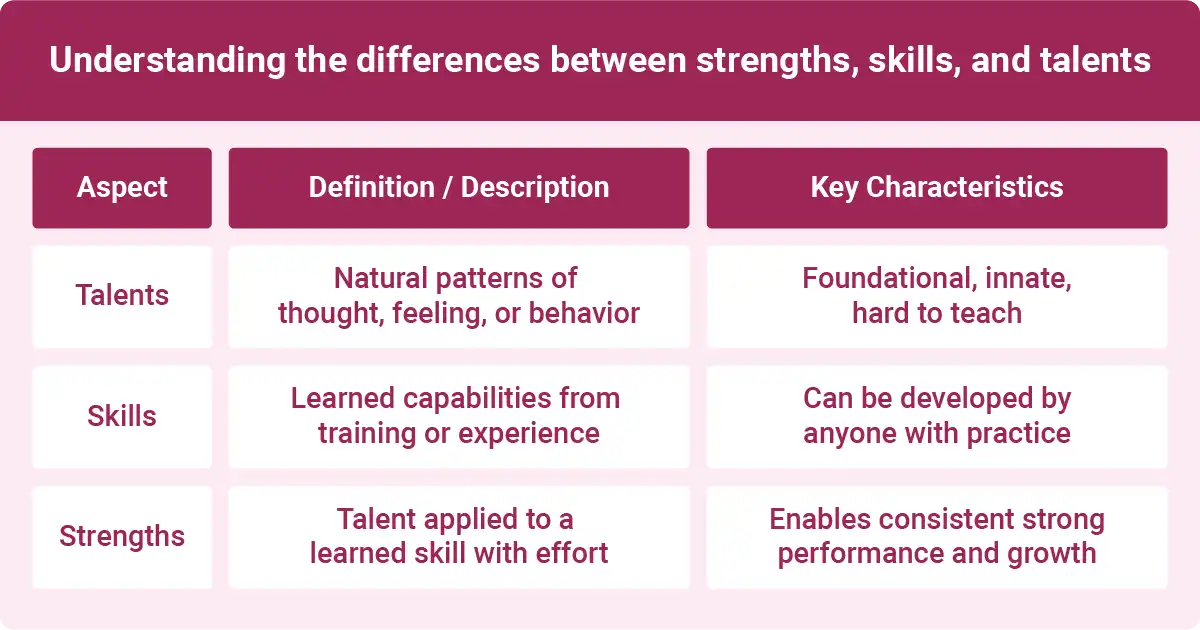
Building a reliable system for a strengths-based approach requires a clear distinction between strengths, skills, and talents. Talents make up the foundation of an employee's abilities. They represent the natural patterns of thought, feeling, or behavior that an individual can apply to their work. Talents aren't easy to teach or create.
Skills are the learned capabilities that employees pick up through formal training, repetition, and direct experience. Anyone can pick up most skills with enough time and the right training.
Strengths represent a combination of natural talent and focused effort that an employee has applied to a learned skill. An employee with a particular strength is capable of consistently strong performances in certain activities. As a result, you can use an employee's strengths to identify areas where they are most capable and driven to do well and consistently improve.
The business case for a strengths-based approach
Employees engage more with work in areas that they have an aptitude for. Employees whose roles match their strengths generally put in more effort, solving problems proactively instead of waiting for managerial direction. In addition, voluntary turnover often reduces as employee satisfaction rises — workers feel more fulfilled when they're improving and making meaningful contributions rather than just getting through assigned tasks.
Employee strengths examples and how they impact workplace performance
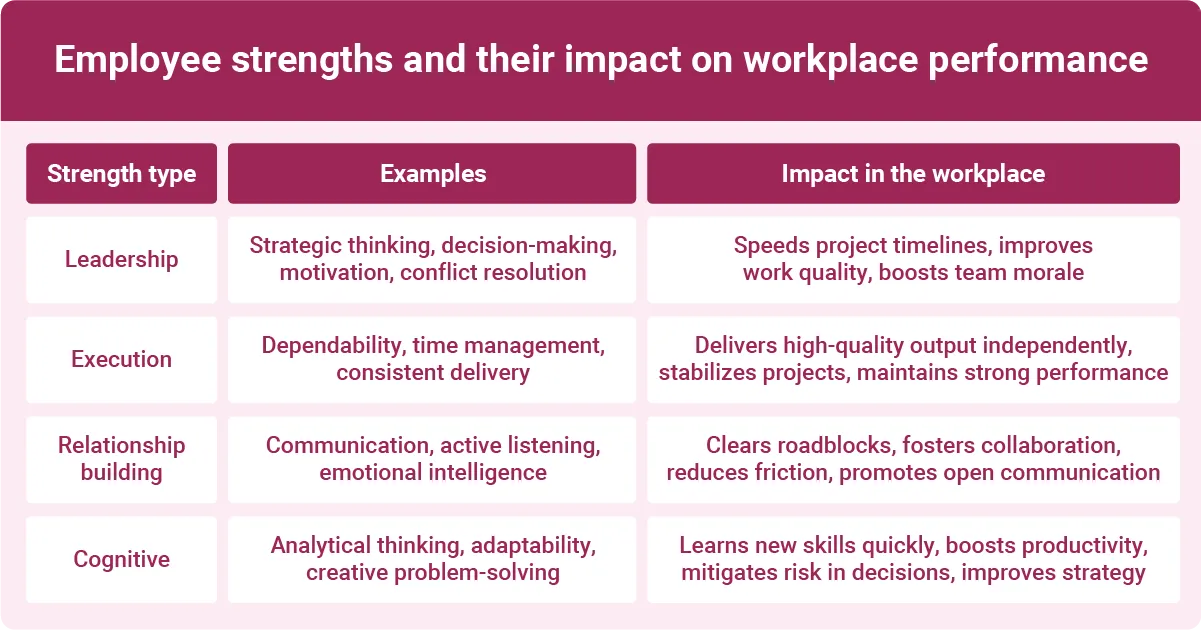
It can be easier to understand the four-category strength framework with examples of each one.
Leadership strengths
Leadership strengths revolve around an employee's ability to drive alignment, such as making key business-aligned decisions to guide their team. Employee strengths that fit this category include strategic thinking, strong decision-making capabilities, a capacity to motivate team members, and tactful conflict resolution.
At the individual level, employees strong in leadership take charge of their work, speeding up project timelines and improving work quality. At the team level, a decisive leader steers the team and boosts morale.
Execution strengths
Employees strong in execution display a high capability for turning plans and strategies into operational realities. Dependability and strong time management skills form the bedrock of this category.
Individually, these employees require minimal oversight, consistently delivering quality output in a timely fashion. This reliability gives managers the freedom to focus more on bigger-picture ideas, instead of worrying about keeping track of the team.
On a team level, execution strengths help steady the ship on volatile projects. Employees with execution strengths are resilient in the face of disruptions to business operations or changes to project scopes, helping form a high-performing team that consistently delivers.
Relationship building strengths
Relationship strengths are crucial for collaboration, helping to build psychological safety and cross-functional alignment throughout the organization. Two relationship strength examples are communication skills and active listening.
For individuals, relationship strengths help them navigate corporate politics to clear roadblocks in their projects and further their careers. These employees demonstrate high emotional intelligence, making them socially adept and capable of adapting their communication style to match any audience.
As a result, employees strong in relationships act as an organizational glue, binding together disparate teams. Teams with these strengths generally experience low friction, with open communication that eliminates duplicate work and fosters an environment where people enjoy collaborating.
Cognitive strengths
Cognitive strengths govern how someone processes data, solves problems, and adapts to unfamiliar challenges. Cognitively strong employees are proficient in problem-solving and critical thinking, making them better at breaking down a problem to tackle its root cause. They're also typically agile learners, helping organizations adapt to changes in the market.
Individually, employees with cognitive strengths pick up new skills, tools, and domains with minimal onboarding, allowing them to constantly improve their productivity as their industry evolves. Within teams, cognitive strengths help de-risk operational decisions. Employees who are cognitively strong are more likely to challenge lazy assumptions, stress-test strategic roadmaps, and propose creative alternatives to existing approaches.
From label to behavior
Understanding these four categories is just the first step to using them effectively. You also need to translate the generic strength labels into observable workplace behaviors you can identify in employees.
Such behaviors need to be more specific than "highly organized" or "good communicator." For example, a useful behavioral observation for leadership and execution strengths could be "Employee builds comprehensive milestone trackers that help the team members stay on target with their individual workloads and deadlines."
How to identify professional strengths
A 5-step process to surface key employee strengths
The first step is to observe your employee's behavior during their daily or recurring tasks. Track performance for two to three weeks, taking note of the assignments that the employee completes more quickly and effectively. If they seem enthusiastic about any projects, take note of that, too. This step needs to span a long enough period to get a few data points, rather than only one or two successful projects.
Second, conduct regular strengths-focused one-on-one conversations with the employee. You can use targeted questions during check-ins that invite the employee to reflect on which projects they felt most energetic about. Then, compare your behavioral observations with the employee’s responses. The conversation should explicitly focus on energy and performance, not just whether they feel like they can complete a task.
The third step is to look for additional opinions by gathering peer input through structured feedback. Formal annual reviews can provide some of this information, but it tends to be more helpful to see in real-time what colleagues naturally praise the employee for.
For example, Workhuman® iQ pairs with Social Recognition® to analyze recognition data. It then provides you with skills mapping, hidden top performers, and untapped potential, giving you a more holistic view of your employees.
The fourth step is to layer in a validated assessment. Once you feel you have a good idea of an employee's strengths, based on your own observations and peer feedback, you can deploy an assessment tool to verify your conclusion.
Finally, you need to document and validate your findings with the employee. Sit down with them to finalize their strengths profile. Together, both of you should agree on your top three to five key strengths to document as a foundation for future development goals and project assignments.
Choosing a strengths assessment: CliftonStrengths vs. VIA
The two most prominent strengths assessments in use today are CliftonStrengths and VIA.
CliftonStrengths has a strong focus on performance, efficiency, and professional development. Its assessment measures 34 different talent themes across four domains, showing how respondents process information, execute tasks, and influence others.
The VIA Character Strengths framework instead looks more at moral and psychological virtues, like grit, teamwork, and kindness. It helps you understand an employee's core identity and character more than their professional execution styles.
This distinction means that CliftonStrengths should be the first choice for managers trying to figure out how to optimize business outputs or reconfigure team roles. If you need a more holistic assessment, for instance, for career development, VIA becomes a more useful test to administer.
Also note that CliftonStrengths charges a fee per user, while offering a robust team-level reporting dashboard for managers to use. VIA provides a free baseline assessment, though individuals can sign up for a membership to take courses for improvement based on their results.
Role-specific strength examples
The context of an employee's role lets you know which strength categories will most directly map to business outcomes. A certain strength may be vital for one role but completely irrelevant, or even disruptive, for another.
In contrast, successful customer-facing professionals often have advanced relationship and leadership strengths. Their profiles may show high scores in interpersonal skills like communication, empathy, and active collaboration. In practice, you may see these employees be more successful at de-escalating angry clients and finding clear feature requests within sprawling customer complaints.
How to develop employee strengths once you've identified them
Strengths development requires more than sending employees to corporate training classes. Employees need to be encouraged to take advantage of their professional strengths within their roles.
Once you know an employee's strengths, you can encourage them to try job crafting – reshaping their responsibilities to align with their strengths. SHRM's whitepaper Creating a More Human Workplace Where Employees and Businesses Thrive notes that job-crafting employees perform significantly better than those who do not.
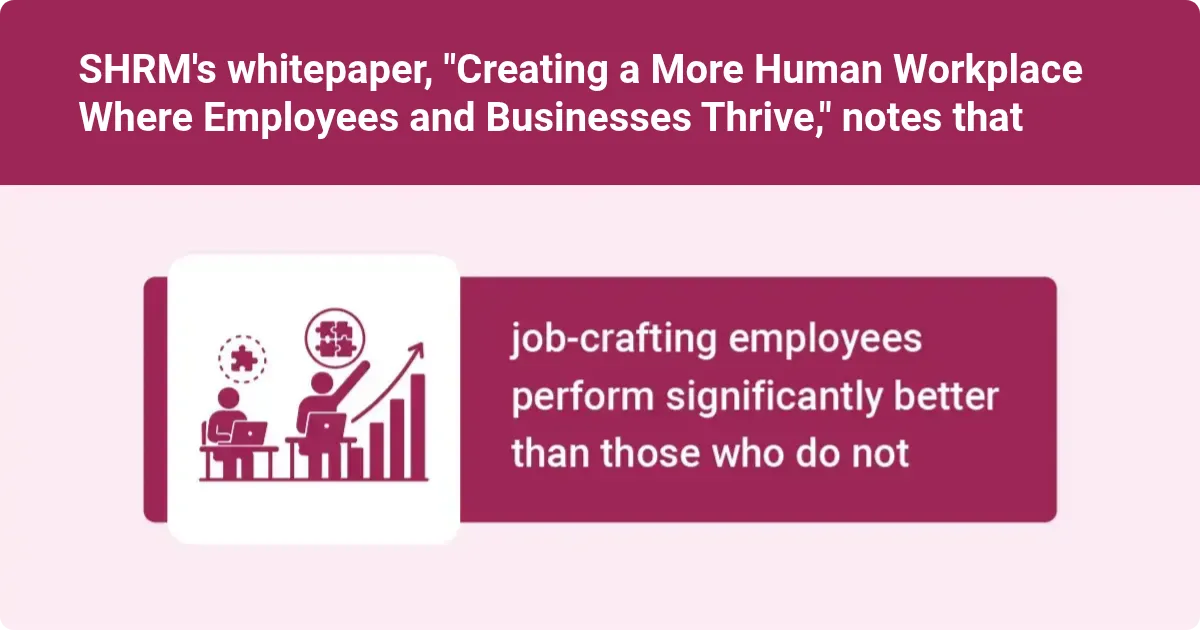
Moreover, job-crafting employees report higher job satisfaction and fewer absences, indicating that their wellbeing improves as they gain more autonomy to build on their strengths.
The report also describes manager-facing tactics that you can apply as a concrete playbook:
- Boost autonomy when employees understand their strategic goals.
- Examine how employees approach each task and identify which ones they focus on individually, which they collaborate on, and which they try to delegate away.
- Take note of who employees work with and the skills and development they seek out.
- Build job crafting into development plans and ask employees about changes they would like to make to see how you can better support them.
- Learn the right powerful coaching questions for managers to ask to identify the mentoring or training the employee needs to complement their strengths.
Another useful development method is stretch assignments. Assign employees to high-visibility projects that directly challenge and expand their primary strengths. For example, you could have an employee with strong cognitive skills diagnose and fix an inefficient workflow.
You can also pair up employees to make complementary partnerships. Match an employee who has a great big-picture strategy with a colleague who thrives on detailed execution. Such a pairing lets both of them work within their strength zones while delivering a better product together.
Finally, make sure you have set up a continuous performance management process and recognition programs that reinforce these behaviors. Keep up a regular coaching schedule that focuses on employee strengths. Targeted recognition for employees when they're applying their strengths to tough business problems further reinforces them.
From insight to action: Building a strengths-based development plan
The best way to capitalize on an employee's strengths in the workplace is to devise a strengths-based development plan for them. Rather than overwhelming them with a multi-year roadmap, encourage them to focus on setting just one or two strength-aligned goals each quarter. With a shorter timeline, development stays at the front of the employee's mind, and they aren't committed to a long-term plan that may get disrupted in a year or two due to changing business needs.
Maintain regular employee check-ins to keep track of their progress, so you can understand how they are progressing on the plan. The Workhuman Conversations® platform can help with this by enabling structured check-ins, crowdsourced real-time feedback, and goal setting that is tied directly to broader corporate objectives. Employees can also look back through the feedback they have received to chart their growth over time.
Developing strengths in remote and hybrid employees
Remote and hybrid teams pose an extra challenge, since you are unable to observe them in the office every day. As a result, you need to design more deliberate feedback channels to capture behavioral observations and information. For example, you can have remote employees submit brief end-of-week reflections that go over which tasks felt energizing and which ones they kept putting off.
You also need to be more intentional when designing virtual stretch opportunities and visibility moments. Remote workers could benefit from chances to lead high-profile presentations or webinars, for example.
The Workhuman guide How to Create a Culture of Connection in a Hybrid Work Environment further suggests running monthly employee pulse surveys of all staff to make sure your strength-based assignments and development plans are equally useful for both in-office and remote workers.
It also notes that leaders in a hybrid model have to be highly intentional about communicating how each individual's daily work ties directly to the corporate mission. Remote employees can easily feel like they are working in an isolated silo. Connecting distributed employees' strengths to the shared organizational purpose keeps them more engaged.
Applying CliftonStrengths across a team
To get the most out of CliftonStrengths, use it to understand your team's collective strengths, not just an individual's. You can build a matrix that plots each team member's top five strengths, divided into the four domains: Leadership, Execution, Relationship, and Cognitive.
This grid mapping reveals performance risks, concentration clusters, and skill gaps across your department.
For example, if your team has a heavy concentration of cognitive strengths but almost no execution capabilities, you may be struggling to hit deadlines. Identifying this lack, you can adjust your future hiring profile to find candidates who can fill in your team's gaps.
When assigning new projects, the strengths grid can also help you pair people who have complementary abilities and avoid pairing team members whose strengths may contradict. For example, while two highly analytical, cognitively strong profiles might find it difficult to agree on a solution for a project, you could instead introduce someone stronger in execution to ensure the project reaches completion.
Giving strengths-based feedback and managing around weaknesses
Gallup research shows that 67% of employees who believe their managers focus on their strengths are engaged, whereas only 31% engage when they feel their managers focus on their weaknesses, as noted in the SHRM paper. It further cites IBM's WorkTrends share-of-mind study, which found that employees who receive recognition display almost three times more engagement.
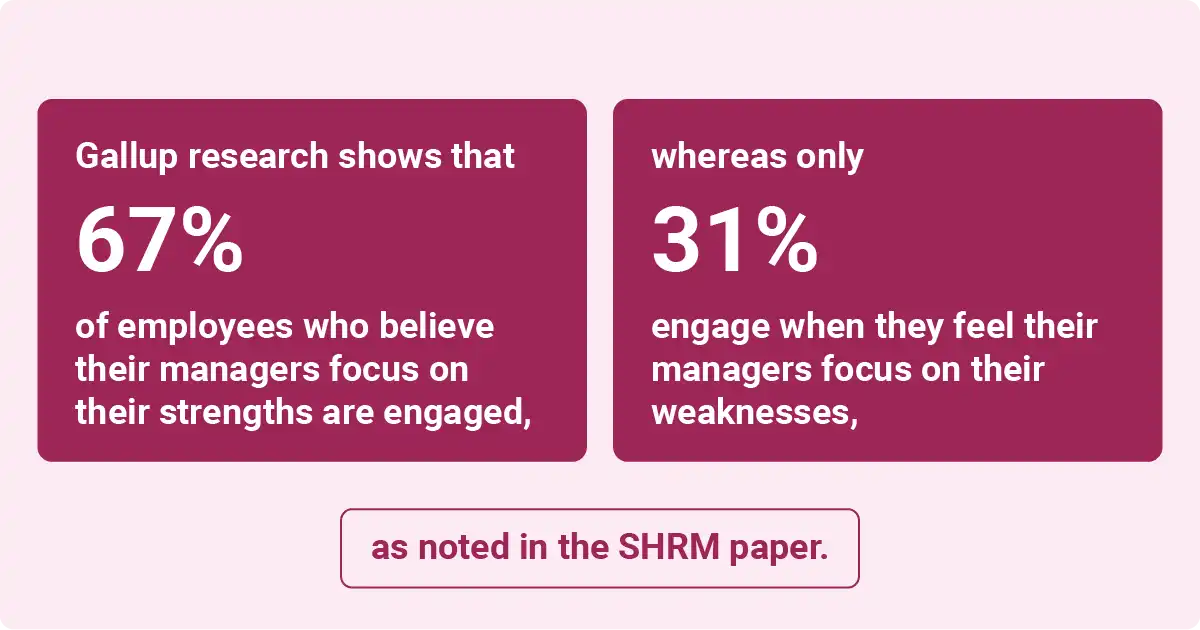
These numbers make clear the value of leaders offering strengths-based feedback to their employees to help them develop.
What effective strengths-based feedback sounds like
To be effective, strengths-based feedback needs to be specific and anchored to a clear behavior, not just the individual's personality. You should name the strength the employee used, describe the related behavior, and explain to them how their actions directly connect to business outcomes and values.
This feedback needs to be offered frequently and as soon as possible after the observed behavior to better reinforce positive behavioral patterns. In one-on-one discussions, you should also invite employees to identify where they can apply their work-related strengths next.
As outlined in Workhuman's whitepaper 5 Ways Feedback is a Gift, Gallup considers effective strengths-based feedback to focus on supporting professional growth and continuous learning, not just verifying that tasks have been completed. Such feedback reflects a positive attitude toward development and is delivered proactively and freely, whereas critical feedback alone can cause employees to tune out over time.
Another way to improve your feedback is to eliminate implicit biases from your assessments. Too often, implicit biases leak into the way managers speak with employees and can worsen engagement, especially if they feel they are receiving unfair criticism.
Workhuman's Inclusion Advisor uses a comprehensive database of implicit bias patterns to help improve on this by scanning feedback text, flagging potentially biased language, and providing real-time coaching to adjust.
A pilot program found that employees were able to change 75% of flagged language, making their communications more productive and professional. Managers can use the tool to ensure they deliver specific feedback that is free of unintended bias.
A pragmatic approach to weaknesses
It may feel like a strengths-based approach offers little room for addressing performance issues or poor results, but this is far from the case. No matter your framework, you must address employee weaknesses and development gaps – but to keep the focus on employee strengths, it's important to approach any gaps with an operational mindset.
First, figure out if you've observed a performance-blocking weakness or a non-essential gap. Performance blockers impede an employee from carrying out their primary roles – for example, if a salesperson has a short temper with customers. On the other hand, if you notice during a presentation that an engineer has trouble with public speaking, that gap is non-essential and should be easier to mitigate.
You should also be wary of employees overusing their strengths to the point that they create a bottleneck. For example, while an employee could have strong attention to detail that leads to better executed projects, if they over-index on this, they might delay a timeline severely, hindering the benefits. Managers need to coach employees to consider the context of the situation when exercising their strengths to get the best outcomes.
Documenting strengths in performance reviews and appraisals
Documentation can too easily become a mundane part of a talent review if it's full of generic, empty phrases that show little distinction between top performers, like "good team player" or "dedicated worker."
Documenting strengths well in performance reviews requires specific, behavior-anchored entries that pair every documented strength with a particular action or accomplishment as evidence. Each one should also connect to a next-cycle development goal, so employees have enough to clearly look forward to their next opportunity.
Your reviews will likely be more accurate if you conduct them more frequently. According to the Workhuman study “Peer Feedback for Growth and Development”, when you pair semiannual reviews with peer feedback, employees are almost twice as likely to consider the appraisal as accurate as compared to a standard annual review without peer feedback.
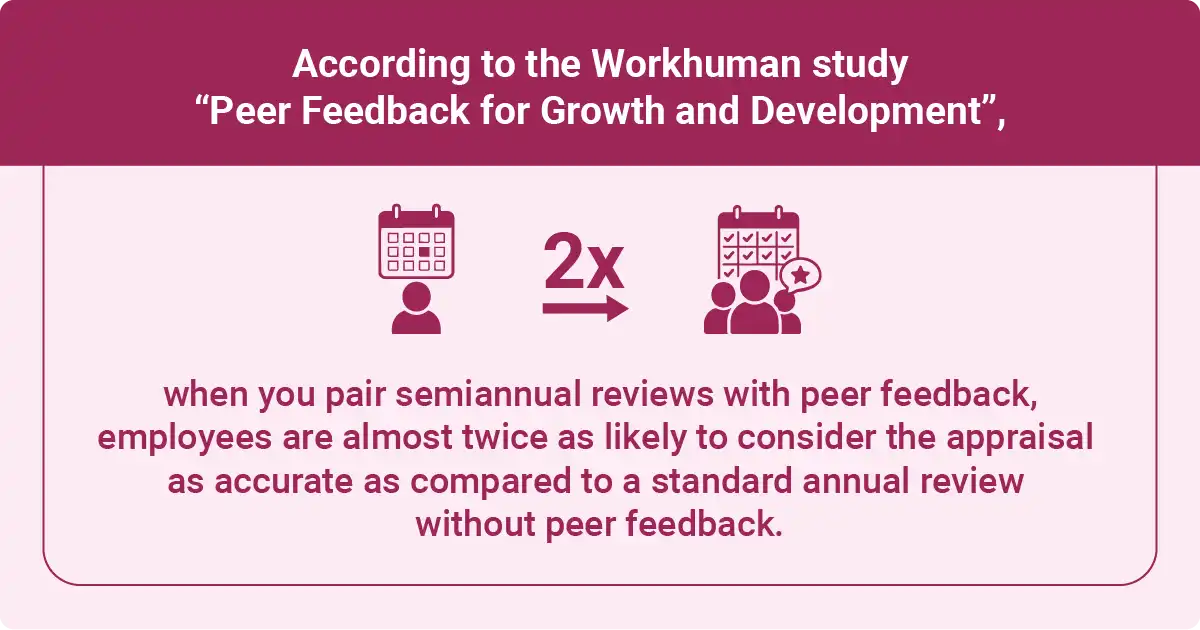
It also notes that ongoing peer feedback is 33% more likely to yield positive outcomes than occasional peer feedback, making it even more important to build continuous strengths documentation into your employee performance review process.
These examples of effective documentation can guide your own:
- Leadership: "Lara shows strong, decisive leadership during project pivots. During the platform migration this quarter, she noted our vendor risk assessment and took the initiative to set up a backup plan that saved 40 hours of potential downtime. Next quarter, we will leverage this strength by having her lead the cross-functional steering team for our infrastructure upgrade."
- Execution: "Jack demonstrates exceptional dependability in process management. He managed a complicated timeline across three vendor teams to launch 200 new SKUs on time for our Spring launch without any errors. In the upcoming season, we will apply this execution strength to streamlining our holiday inventory pipeline."
- Relationship: "Sally excels at developing relationships with prospective clients. She took over five qualified leads and closed long-term deals with each of them. In Q3, we will be assigning her more high-value enterprise clients to build on her capabilities."
- Cognitive: "Chris is adaptable and flexible when trying to identify problems and find solutions. He applied his learnings from a web design course to clean up the company website's customer journey, increasing conversions by 10%. For the upcoming season, he will apply this cognitive strength to our other touchpoints to optimize our marketing funnel."
FAQs
What are employee strengths?
Employee strengths are capabilities that an individual has as a combination of their natural talent, learned skills, and energizing tasks. A worker's professional strengths indicate the tasks they can consistently perform well at and that they find most enriching to complete, helping you figure out where the employee will be most effective.
What are the most common examples of employee strengths in the workplace?
The most common employee strengths fit into four key categories: leadership (decision-making and strategic alignment), execution (dependability), relationship (collaborative and client-facing skills), and cognitive (analytical problem-solving and learning agility).
How do employee strengths impact team performance?
Employees working in roles that align with their natural strengths showcase higher engagement, more discretionary effort, lower voluntary turnover, and better wellbeing. Team members can easily assemble into complementary partnerships that make the best use of each person's strengths to deliver effectively.
How do I identify my employees' strengths if I'm new to the team?
To identify key strengths, managers need a holistic approach that combines direct observation, employee self-reflection, peer feedback, and validated assessments.
Make your own observations about what projects each employee seems best at and most energized by, ask what they think, analyze their peer feedback and recognition data, and assign them a validated assessment such as CliftonStrengths or VIA to get a full picture of your team's strengths, both individually and collectively.
Should I focus on strengths or fix weaknesses?
Employers should focus on their staff's strengths. Building on existing capabilities turns an average worker into an exceptional one, while trying to improve weaknesses will at best yield an average employee. You can instead mitigate weaknesses by pairing up team members with complementary strengths and reallocating roles to employees whose strengths are in better alignment.

Ryan Stoltz
Ryan is a search marketing manager and content strategist at Workhuman where he writes on the next evolution of the workplace. Outside of the workplace, he's a diehard 49ers fan, comedy junkie, and has trouble avoiding sweets on a nightly basis.
Recommended for you