
Workhuman vs. Culture Amp: 2026 Comparison Guide
by Ryan Stoltz
Last updated
9 min read
Table of contents
- Workhuman vs. Culture Amp Platform Overview
- Feature Comparison: Workhuman vs. Culture Amp
- Recognition & Culture Building
- Integrations & Tech Ecosystem Fit
- Pricing & Cost-Effectiveness
- Impact on Engagement, Retention, and Morale
- AI and Product Innovation
- Global Reach and Capabilities
- Customer Support
- Ease of Use & Implementation
- Workhuman vs. Culture Amp: Strengths & Weaknesses
- Workhuman vs. Culture Amp: What Customers Say
- Workhuman vs. Culture Amp: Final Verdict
Share this article
Employee experience software has moved beyond engagement surveys and annual reviews to become a strategic lever for retention, productivity, and culture-building at scale.
As organizations face tighter budgets and higher expectations for their investments, EX platforms are no longer judged solely by participation rates. They must integrate seamlessly into workflows, drive sustained cultural change, and generate insights that lead to action — not just report after report.
The stakes are high. Gallup and Workhuman research show that only 33% of employees in the U.S. and 23% of employees globally are engaged at work. That leaves a massive opportunity gap, and the right employee experience strategy is one of the most effective ways to close it.
That's why Workhuman and Culture Amp are so often compared. Both platforms give HR leaders visibility into workplace culture, and both support a more connected employee experience.
But the similarities stop there. Culture Amp excels at measuring employee sentiment through surveys. Workhuman is built to change behavior through recognition, turning feedback into frequent, meaningful recognition that actually changes how people work together. Rather than treating it like an afterthought to an annual survey cycle, Workhuman puts employee recognition first.
For organizations evaluating these options, the question isn't about which platform collects better data. It's about which one is better positioned to help you act on it.
Here's how Workhuman vs. Culture Amp compare, so leaders can choose the employee experience platform that drives real results.
Workhuman vs. Culture Amp Platform Overview
Workhuman at a Glance
Culture Amp at a Glance
- Founded in 2009, with a primary focus on employee surveys and performance reviews, not continuous employee recognition
- Recognition is an add-on module, not a core offering — largely treated as a casual social feed rather than a strategic driver of engagement and retention
- Emphasizes listening and diagnostic analytics over action-oriented tools that change daily behavior
- Limited ability to surface meaningful data about:
- Which specific behaviors are being reinforced in real time
- How recognition connects to retention and productivity outcomes
- Where cultural strengths or gaps are emerging between teams
- Limited support for global rewards at scale, with no native marketplace (requires non-monetary recognition or separate integration with third-party reward providers)
At a basic level, both Culture Amp and Workhuman help organizations understand and improve the employee experience. But while one only scrapes the surface, Workhuman digs deeper to unearth the insights that matter most.
Feature Comparison: Workhuman vs. Culture Amp


*Workhuman’s proprietary Standard of Living Index (SOLI) automatically adjusts award values based on each award recipient’s location, ensuring global equity.
Recognition & Culture Building
Workhuman
Culture Amp
- Recognition is an add-on feature within a broader performance and engagement suite, not a core pillar of the platform
- Recognition activity tends to be lightweight and feed-style — more like social likes than meaningful, values-based behavior reinforcement
- Limited AI guidance to improve recognition quality over time, leaving managers and peers to craft messages without support or structure
- Culture-building relies heavily on survey diagnostics rather than daily recognition habits that actively shape behavior
- Better suited for measuring culture through annual or quarterly reviews than for building culture through continuous, strategic recognition
Here's the fundamental difference. One platform helps you measure culture. The other helps you build it, one moment of recognition at a time.
Integrations & Tech Ecosystem Fit
Workhuman
Culture Amp
- Offers robust integrations for survey distribution and performance review data, primarily with HRIS platforms like Workday, BambooHR, and Personio
- Integrations function largely as one-way data syncs for employee attributes and demographics — recognition data isn't the primary focus
- Recognition activity, where it exists, is separated from core people analytics, limiting its usefulness for retention modeling or culture reporting
- Heavy reliance on API-based connections for any rewards functionality, often requiring third-party vendors to fulfill even the most basic recognition moments
For organizations running on modern HR stacks, integration depth isn't a nice-to-have. It's a requirement. Workhuman's certified, bi-directional integrations ensure recognition flows seamlessly into the systems your people already use, while Culture Amp's recognition data remains largely siloed.
Pricing & Cost-Effectiveness
Workhuman
Culture Amp
- Pricing is structured as per-employee, per-month subscription tiers, with recognition features typically locked behind higher-tier plans
- As program needs grow, organizations pay more for access to basic recognition functionality that other platforms include as standard
- Minimal built-in recognition guidance shifts responsibility to internal teams to:
- Design and drive recognition adoption from scratch
- Integrate third-party reward vendors for awards
- Build manual reporting to connect recognition to retention or engagement
- Manage inconsistent recognition practices across teams and regions
What looks "cheaper" on a pricing page often ends up costing more in operational overhead. Workhuman's all-inclusive model means no surprise fees, no per-user up charge, and no hidden costs for the strategic support that makes recognition actually work.
Impact on Engagement, Retention, and Morale
Workhuman

“We’re really focused on outcomes. … And measuring who is getting recognized, the frequency of recognition, linking it to retention, linking it to turnover implications – all of that demonstrates the return on investment is significant.”
Culture Amp
- Success metrics are often drawn from survey completion rates and participation in performance review cycles, positioning listening volume as the primary indicator of employee health
- Engagement and morale are typically inferred from aggregate survey scores, such as employee engagement index, manager effectiveness ratings, and inclusion and belonging metrics
- Limited connection between survey data and daily recognition behavior, leaving leaders with a diagnosis but no built-in tool for treatment
- Recognition activity, when tracked, provides visibility into frequency but little insight into recognition quality, value alignment, or cultural reinforcement
- Impact tends to be diagnostic rather than prescriptive — organizations learn what's wrong but lack the mechanism to improve it through continuous recognition
Companies that invest strategically in the employee experience see measurable improvements in retention and productivity. Workhuman's customers don't just press a button and hope for better outcomes —they track, measure, and prove them.
AI and Product Innovation
Workhuman
Culture Amp
- AI development centers on text summarization and analysis for open-ended survey responses, not recognition intelligence
- Machine learning models predict attrition risk and highlight themes in employee feedback, helping leaders get to the root of cultural issues
- Technology is optimized for listening at scale — turning survey data into dashboards and trend lines
- Recognition receives minimal AI attention, with no equivalent to real-time quality coaching, bias detection, or skills insight
- No mechanism to deliver culture insights specifically from recognition behavior, as recognition is not a primary data source within the platform
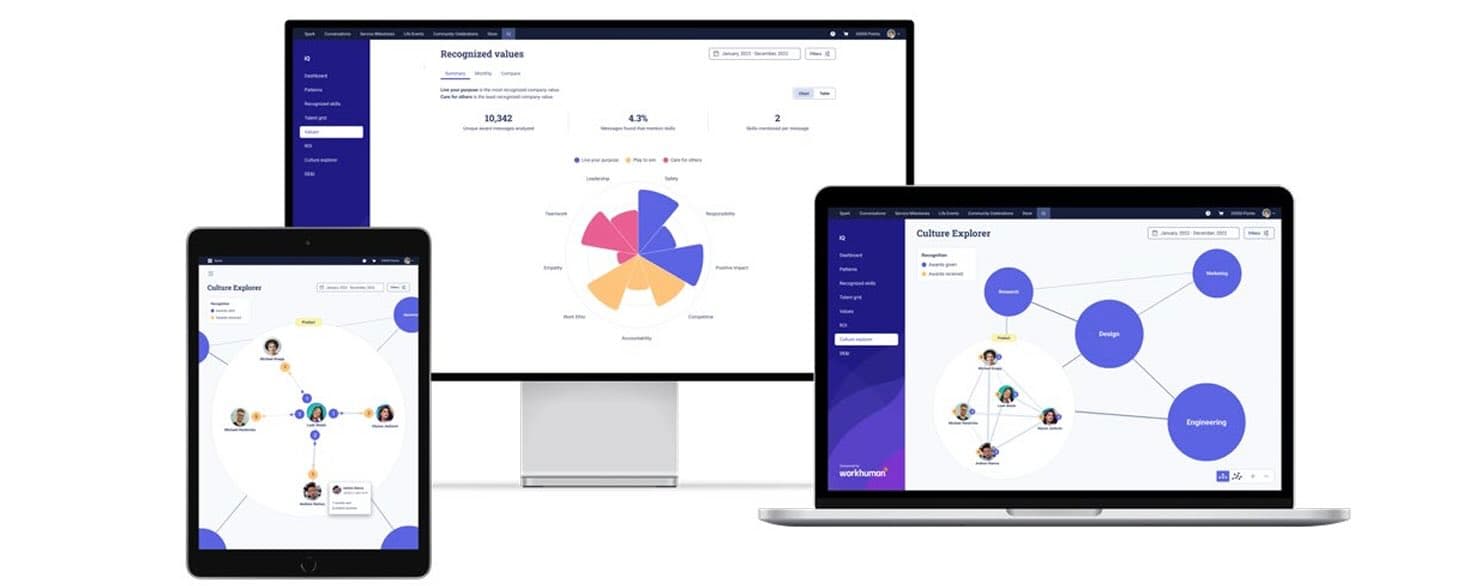
Generic AI is everywhere these days. But Workhuman's AI is different. It's trained on real human recognition data, not generic internet text. That means the insights it generates are relevant to your people, your culture, and your business.
Global Reach and Capabilities
Workhuman
Culture Amp
- Global footprint is strong for surveys and performance reviews, with multilingual questionnaires and region-specific benchmark data
- Recognition capabilities lack the global element, which means rewards require third-party vendors that can vary widely by country
- Key gaps in global recognition lead to:
- No local reward catalog in most regions
- No automatic purchasing parity or value equalization
- Employee experience depending entirely on which vendors are available
- The platform lacks built-in tools to ensure fair, equitable recognition across borders
- Global readiness applies to listening, not recognition — scaling recognition internationally would require significant manual effort
For organizations with employees in multiple countries, global equity isn't optional. Workhuman's SOLI™ technology ensures that a $50 reward in New York has the same perceived value as a $50 reward in Manila.
Culture Amp simply doesn't offer this capability. This leaves global companies with little choice — settle for less than what employees have earned or take on additional costs to fix the disparity.
Customer Support
Workhuman
Culture Amp
- Support follows a standard SaaS model focused on platform functionality, survey design, and performance review configuration
- Recognition-specific guidance is limited, and customers are often directed to third-party reward vendors for fulfillment or program setup questions
- No dedicated strategic consulting for recognition program design or optimization, as recognition sits outside the platform's core expertise
- Ongoing recognition success depends heavily on internal teams to troubleshoot adoption, manage vendor relationships, and prove value without proactive vendor support
When you buy software, all you get is a login. When you partner with Workhuman, you get a full team: Customer Success Managers, recognition consultants, data scientists, IT support, and store support specialists, all working to ensure your program delivers the results you're looking for.
Ease of Use & Implementation
Workhuman
Culture Amp
- Employees find survey participation intuitive, with a clean and modern interface designed for quick feedback cycles
- Setting up surveys and performance reviews is straightforward, with self-service options suitable for many organizations
- Adding recognition introduces significant friction:
- No strategic guidance for building an effective recognition program from the ground up
- Third-party reward vendors must be integrated for any tangible recognition, adding to the setup complexity
- What works smoothly for surveys becomes fragmented and under-supported when applied to recognition at scale — it takes custom workarounds and countless hours of manual labor to create a functioning recognition management system
The best technology is the one your people actually use. Workhuman embeds recognition into existing workflows, so adoption happens naturally. Culture Amp requires employees to learn new habits and navigate away from their daily tools.
Workhuman vs. Culture Amp: Strengths & Weaknesses
Workhuman Strengths
Workhuman Weaknesses
- Custom enterprise pricing reflects the depth of strategic support and global capabilities, which isn't a great fit for small teams or limited budgets
- The full platform's richness may exceed what organizations only seeking basic, point-based recognition actually need
- Implementation involves meaningful partnership, which takes more time than a purely self-service alternative
Culture Amp Strengths
- Elite survey and listening capabilities, with best-in-class analytics for engagement, inclusion, and manager effectiveness
- The user interface is clean, modern, and intuitive for employees completing surveys or performance reviews
- Mature performance management tools, incl
Culture Amp Weaknesses
- Recognition is a shallow add-on, lacking native rewards, quality insights, or any strategic framework
- No built-in rewards catalog means every recognition moment with tangible value requires third-party integration and maintenance
- AI ignores recognition entirely — no real-time coaching, no skill inference, no cultural diagnostics from recognition data
- Standard global recognition is nonexistent, with employee experience varying wildly by region based on available third-party vendors
- Lower upfront fees mask higher operational costs in integration work, vendor management, adoption effort, and missed strategic value
When you add it all up, the choice becomes clear. Workhuman is built for organizations that see the employee experience as a strategic investment — one that delivers real results. Culture Amp is built for organizations that see it as an afterthought.
Workhuman vs. Culture Amp: What Customers Say
Customer Feedback & Quotes
Workhuman:
Culture Amp:
- "I liked the prompts for the one-on-one sessions. They also had a slider that the employee could fill out during the feedback loop, which made the process feel more guided.... It sometimes felt like there was way too much to fill out, and a lot of it ended up being skipped or never used. Some of the menus and workflows also didn’t really match how we work in our industry, so it didn’t always fit our day-to-day process." (G2 reviewer)
- "I like the ability to look back at past reviews and compare them in the split panel to the current reviews. I think having that is useful. Another thing that is useful is being able to attach goals to the company's goals... I find that Culture Amp is not generally straightforward to use. To find what I need, I have to navigate across different categories and features, which seems harder than just using a Google Doc or Excel sheet." (G2 reviewer)
- "It is apparent that Culture Amp is not able to deliver the necessary workflows, tooling, and reporting to align with the requirements of a business of any large scale. Despite our efforts to raise concerns, and the limited resolutions to our challenges, it feels as though the only true solutions we have been offered is to "wait" for future changes or to compromise our performance initiatives to fit what is available." (Culture Amp customer)
- "As of now, the questions that I see are, like, very generic. I think they could be more intelligent or more interactive. And help build the case or help build the story a bit better. Right now, it's very static and then, like, there are very common questions." (G2 reviewer)
- "It sometimes felt like there was way too much to fill out, and a lot of it ended up being skipped or never used. Some of the menus and workflows also didn’t really match how we work in our industry, so it didn’t always fit our day-to-day process." (Culture Amp customer)
Their customer voices tell the story. Workhuman users consistently highlight meaningful recognition, cultural impact, and ease of use. Culture Amp users appreciate the clean interface and survey capabilities, but consistently point to generic questions, workflow friction, and limited strategic depth.
Workhuman vs. Culture Amp: Final Verdict
Both Workhuman and Culture Amp help organizations understand and improve the employee experience. The real decision comes down to what you need your platform to deliver: Diagnostic insights or actionable insights. One tells you what's wrong, while the other offers a path to fix it.
Choose Workhuman if:
Choose Culture Amp if:
You primarily want an engagement survey and performance management system. Culture Amp excels at listening. Through surveys, reviews, and other engagement metrics, you can diagnose the root of your work culture issues.
You prefer diagnostics to daily action. The platform is optimized for measurement and analysis, not for giving managers and peers a tool to improve culture in real time.
You're focused on understanding sentiment rather than changing behavior. Culture Amp emphasizes survey completion rates, engagement scores, and performance review data.
You have basic recognition needs and no expectations for native rewards, global equity, or intelligent insights. Culture Amp can handle lightweight social recognition, but it becomes constrained as programs grow in scale or expected ROI.
Final Verdict
Both Workhuman and Culture Amp can help organizations build better workplaces.
The difference between them, however, becomes critical after launch.
Culture Amp focuses on listening efficiently. But once programs are live, organizations often encounter limitations.
When recognition remains an afterthought, insight is limited to survey data rather than daily behavior. Not to mention, improving what you measure requires separate tools and manual effort. Over time, this can stunt impact and make it hard to demonstrate real workplace change beyond diagnostic reports.
The choice isn't between two recognition platforms. It's between a listening tool with a lightweight add-on and a complete, end-to-end recognition system that drives measurable outcomes for your workplace.
Bottom line
Culture Amp delivers feedback, with recognition as an under-powered add-on and no built-in mechanism to turn it into real change. You'll know exactly where your culture is falling short, but you won't have a tool to fix it. The diagnosis may be clear, but the solution is up to you.
Ready to see how a recognition-first software can drive measurable ROI? Request a demo today to see it work for yourself.
See also:

Ryan Stoltz
Ryan is a search marketing manager and content strategist at Workhuman where he writes on the next evolution of the workplace. Outside of the workplace, he's a diehard 49ers fan, comedy junkie, and has trouble avoiding sweets on a nightly basis.
Recommended for you