
Workhuman vs. Nectar: 2026 Comparison Guide
by Ryan Stoltz
Last updated
8 min read
Table of contents
- Workhuman vs. Nectar Platform Overview
- Feature Comparison: Workhuman vs. Nectar
- Recognition & Culture Building
- Integrations & Tech Ecosystem Fit
- Pricing & Cost-Effectiveness
- Impact on Engagement, Retention, and Morale
- AI and Product Innovation
- Global Reach and Capabilities
- Customer Support
- Ease of Use & Implementation
- Workhuman vs. Nectar: Strengths & Weaknesses
- Workhuman vs. Nectar: What Customers Say
- Workhuman vs. Nectar: Final Verdict
Share this article
Employee recognition has moved from a “nice-to-have” to a serious business lever. With leaner teams, distributed work, and constant change, recognition helps reinforce what “good” looks like, keep people connected, and sustain performance.
That shift also raises expectations. Platforms can’t just enable shout-outs or points—they need to support recognition done right: meaningful, values-connected recognition delivered consistently, with visibility leaders can use to understand what’s working and where support is needed.
That’s why Workhuman and Nectar are often evaluated side by side. Both enable peer-to-peer recognition and make appreciation more visible—but they’re built for different outcomes. Workhuman is designed as a strategic recognition program with measurable impact and deeper insight, while Nectar positions itself as a broader culture platform that pairs recognition with tools like communications and surveys.
If you’re comparing the two, the key question isn’t who generates more activity—it’s which approach turns recognition into sustained cultural and business advantage.
Workhuman vs. Nectar Platform Overview
Workhuman at a Glance
Nectar at a Glance
- Positions itself as an all-in-one “culture platform,” bundling recognition and rewards with internal communications and employee listening (surveys/eNPS).
- Recognition is centered on peer-to-peer shout-outs, with the option to “boost” recognitions with points that employees can redeem for rewards.
- Emphasizes lightweight engagement features (likes, comments, and “Meaningful Meter” coaching) to drive everyday participation.
- Extends beyond recognition with internal comms built to create and distribute announcements via text, email, and Teams, with open-rate and click analytics.
- Analytics are primarily described around program activity and engagement metrics (recognition trends/participation, comms engagement, and survey analytics including AI sentiment analysis).
- Limited ability to surface meaningful, enterprise-grade insight about:
- How work gets done
- Which behaviors are being reinforced at scale
- Where collaboration, leadership, or skills are emerging
- Offers “global rewards,” but organizations running complex multi-country programs will want to validate reward consistency, governance, and support coverage.
- Highlights common workplace integrations (e.g., Outlook, Teams, Slack, and HRIS connections like ADP, Rippling, BambooHR).
At a basic level, both Nectar and Workhuman let employees recognize one another and redeem rewards — but the difference isn’t in the mechanics, it’s in the purpose.
Nectar is built to make everyday appreciation easy and visible, while Workhuman is built to make recognition a strategic lever, with the rigor and insight to drive measurable culture and business outcomes at scale.
Feature Comparison: Workhuman vs. Nectar


*Workhuman’s proprietary Standard of Living Index (SOLI) automatically adjusts award values based on each award recipient’s location, ensuring global equity.
Recognition & Culture Building
Workhuman
Nectar
- Primarily peer-to-peer recognition in a social feed, with shout-outs that can include optional points.
- Designed to drive frequent participation through lightweight interactions (feed visibility, celebrations, and engagement-style features).
- Recognition can skew transactional when points become the primary motivator, especially in high-volume programs.
- Includes “Meaningful Meter” prompting to encourage more specific shout-outs, but the guidance is still fairly lightweight.
- Values can be tagged in recognition, but the impact depends on consistent adoption and reinforcement across teams—not just posting activity.
- Often positioned as a simpler option for small to midsize teams; organizations with complex culture goals may find customization and scalability more limited over time.
Integrations & Tech Ecosystem Fit
Workhuman
Nectar
- Integrates with collaboration tools like Slack and Microsoft Teams, so recognition can happen in the flow of work.
- Supports HRIS integrations (e.g., ADP, BambooHR, Rippling, Workday) to sync employee data and reduce manual admin.
- Offers SSO options to help streamline access and improve security/alignment with IT requirements.
- Provides an Open API (plan-dependent) and alternative sync methods (e.g., file-based/SFTP) for more custom setups.
- Overall, designed to plug into common workplace tools—but organizations with complex enterprise ecosystems should validate integration depth, governance, and scalability for their specific stack.
Pricing & Cost-Effectiveness
Workhuman
Nectar
- Pricing structure: Nectar typically sells on an annual basis, with Plus and Premium tiers (and custom options for larger organizations). Pricing is custom for both plans. Third-party listings like Capterra cite estimated annual minimums of approximately $4,000/year for Plus and $5,000/year for Premium, though these are not officially confirmed. Setup and implementation fees may apply.
- Cost complexity: Subscription fees are only part of the picture—reward redemptions are funded separately, with options like a rewards balance that auto-refills or a monthly post-pay model.
- Operational burden: The rewards-funding model can add admin considerations (setting refill thresholds, monitoring balances, and managing caps). If payment fails—or if post-pay redemptions exceed the deposit cap—reward redemptions can be paused until funding is resolved.
- Fees and budgeting: Nectar notes credit card processing fees for reward payments (not subscription payments), which can affect total cost depending on redemption volume and payment method.
- Long-term value: For smaller teams, the per-user approach can look straightforward. As programs scale (more geos, more governance, more reporting needs), organizations may want to validate what’s included by tier—and what requires Premium/custom—so TCO stays predictable.
Impact on Engagement, Retention, and Morale
Workhuman


“We’re really focused on outcomes. … And measuring who is getting recognized, the frequency of recognition, linking it to retention, linking it to turnover implications – all of that demonstrates the return on investment is significant.”
Nectar
- Activity-based success metrics: Often frames impact through participation, recognitions sent/received, trends over time, and survey participation—using usage as a primary signal of engagement and morale.
- Surface-level engagement indicators: Highlights movement in recognition-related measures (for example, “recognition scores” and other engagement-style tracking) to demonstrate improvement.
- Limited deeper outcome connections: While Nectar positions recognition as a driver of engagement and retention, the most visible metrics are still program activity and survey outputs, making it harder to tie recognition directly to sustained retention or performance without additional analytics.
- Visibility without full context: Trend dashboards can show where recognition is happening (and where it isn’t), but leaders still need to interpret why morale shifts are occurring and which behaviors are driving outcomes.
- Impact can plateau without program depth: Increased recognition volume can boost short-term morale, but long-term gains typically depend on how consistently recognition is tied to values, behaviors, and manager habits—not just feed activity.
AI and Product Innovation
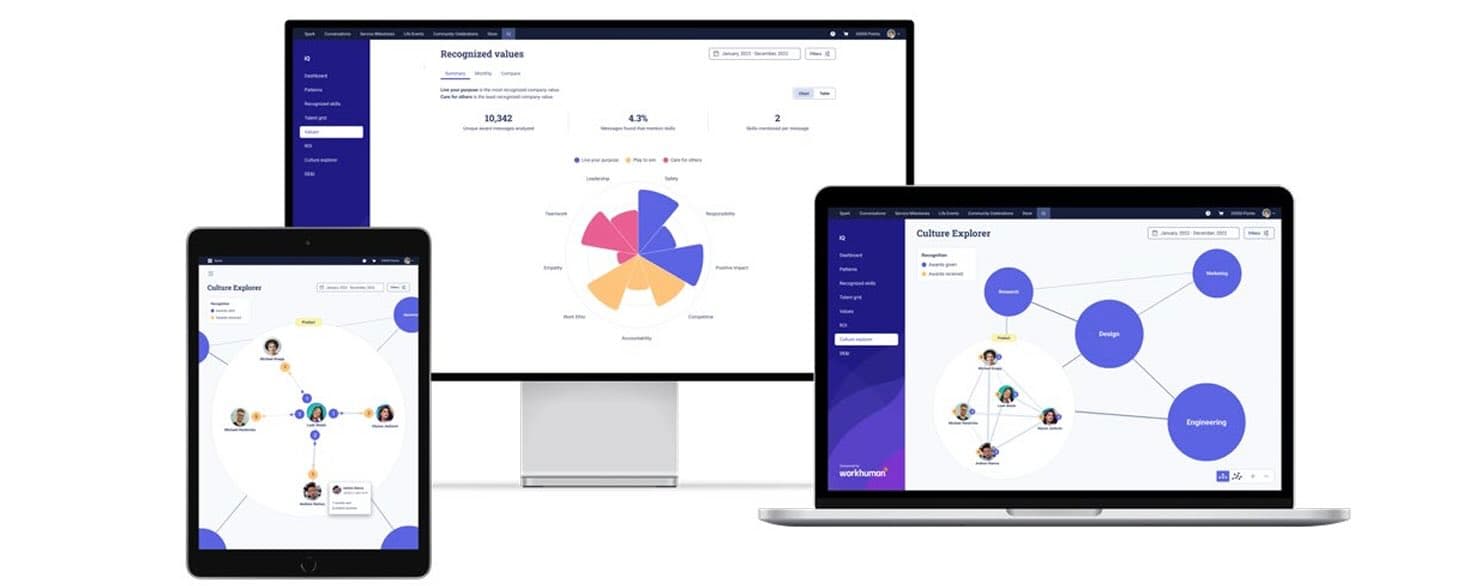
Workhuman
Nectar
- Product innovation is oriented around driving day-to-day participation and manager/peer adoption, pairing recognition with broader “culture” features like communications and surveys rather than positioning recognition intelligence as a core strategic layer.
- Uses lightweight guidance to improve recognition moments (for example, prompting to encourage more meaningful shout-outs), but the emphasis is on helping users post more easily, not on deeply coaching behavior change at scale.
- AI is typically applied to engagement listening (e.g., summarizing or interpreting feedback/sentiment) and to streamline basic workflows, rather than turning recognition into a robust source of culture, skills, or performance intelligence.
- Analytics and reporting tend to be descriptive—participation, trends, and activity—helpful for tracking usage, but less developed for connecting recognition patterns to outcomes like retention risk, collaboration dynamics, or capability growth.
- Recognition data is not generally presented as a structured “intelligence layer” for leaders (e.g., surfacing emergent skills, cultural strengths/weaknesses, or behavior signals over time), which can limit strategic decision support.
- Overall, Nectar functions primarily as an operational platform to run recognition and adjacent engagement activities, rather than a purpose-built, AI-native recognition system designed to deliver deep organizational insight.
Global Reach and Capabilities
Workhuman
Nectar
- Global reward options: Promotes a “global rewards” catalog with options like digital gift cards, company swag, charitable donations, Amazon products, and custom rewards.
- Regional availability varies: Reward availability is country-dependent—Nectar explicitly cautions employees to redeem gift cards available in their country of residence because cards for other countries may not work (and may not be refundable/exchangeable).
- Equity and parity: Because rewards are tied to country-specific availability, organizations operating globally may need to do extra work to ensure perceived fairness and consistency across regions (especially if reward options differ by location).
- Localization and global team features: Nectar highlights multi-language support, a global reward marketplace, location-based segmentation, and 24/7 support as part of its global-teams positioning.
- Consistency and fulfillment considerations: For some reward issues (like gift cards), Nectar directs users to the underlying provider listed in the delivery email—introducing a third-party handoff that can affect consistency of support and resolution.
Customer Support
Workhuman
Nectar
- Support model: Offers a self-serve Help Center plus ticket-based support through a Global Support Desk advertised as available 24/7/365 (with staffed hours supplemented by on-call coverage).
- Primarily operational assistance: Support is largely oriented around platform setup, troubleshooting, and “how-to” guidance versus an ongoing, consultative model for evolving recognition strategy.
- Some Customer Success coverage: Nectar references a Customer Success Manager for admin and implementation questions, but the model is not positioned around specialized recognition consulting teams.
- Reliance on external partners for rewards: For certain reward issues (e.g., gift cards), Nectar directs users to contact the underlying provider listed in the delivery email, introducing handoffs and potential variability in the support experience.
- Internal team dependency: Ongoing program optimization (adoption drives, governance, and proving impact) is typically dependent on internal owners to manage and mature the program over time.
Ease of Use & Implementation
Workhuman
Nectar
- User-friendly interface: Built for quick adoption, with a simple social feed that makes it easy for employees to give shout-outs, add points, and celebrate milestones.
- Lightweight implementation: Generally straightforward to stand up and roll out, especially for smaller teams—but provides less hands-on, strategic guidance for program design and long-term optimization.
- Administrative complexity: Easy to manage at a basic level, but as programs expand across business units, roles, and geographies, admins may run into limitations that require more manual work to keep experiences consistent.
- Operational burden at scale: Running more complex global programs can shift work to internal HR/finance/IT teams—especially around localization, governance, and consistency of rewards experience across regions.
- Customization constraints: Supports core configurations (values, points, celebrations, campaigns), but deeper customization for targeted experiences, multi-program governance, and advanced communications can be more limited.
- More manual effort over time: What starts as a simple platform can require increasing internal effort to maintain relevance, manage complexity, and demonstrate impact as the organization grows.
Workhuman vs. Nectar: Strengths & Weaknesses
Workhuman Strengths
Workhuman Weaknesses
- Best suited for organizations seeking strategic, culture-building recognition, not for those wanting a simple gift-card shop.
- The partnership model includes consultation and coaching, which some buyers may view as more robust than necessary.
Nectar Strengths
- Nectar positions itself as an all-in-one culture platform, combining recognition and rewards with communications and employee feedback tools.
- Peer-to-peer recognition is easy to adopt, built around a simple social feed and automated celebrations that help drive steady participation.
- Strong workflow fit through integrations with Microsoft Teams (and similar collaboration tools) so recognition can happen where employees already work.
- Broad HRIS ecosystem support is a common selling point, with third-party reviewers noting integrations across major HR and identity providers.
- Rewards flexibility includes gift cards and other common redemption options, giving teams multiple ways to use points.
- Support infrastructure is complemented by a robust self-serve Help Center for admins and end users.
Nectar Weaknesses
- Reward availability and usability can vary by country; Nectar explicitly warns that gift cards redeemed for the wrong country may not work and can’t be refunded or exchanged.
- Some reward troubleshooting involves third-party handoffs (contacting the provider listed in the delivery email), which can create variability in the resolution experience.
- The total cost of ownership can be harder to forecast at scale because reward funding and redemption volume add another layer of budgeting beyond subscription price.
- Analytics are often strongest for tracking participation and program activity; organizations seeking deeper, enterprise-grade insight into culture patterns and outcomes may need more advanced intelligence.
- As programs grow in complexity (more regions, more governance, more segmentation needs), teams may face increased internal effort to keep the experience consistent and strategically aligned.
Workhuman vs. Nectar: What Customers Say
Customer Feedback & Quotes
Workhuman:
Nectar:
- “It is nice to get a shout out for good work. | The value seems very very nominal. It seems like it would take a lot of shout outs to make this worthwhile.” - Verified G2 Mid-Market customer review in Government Relations
- "I think that the best thing about nectar is the informal praise that is very public. | I think that it is difficult to see what all is going on. My recommendation would be to have a way to filter out offices or being able to pin certain individuals." - Verified G2 Mid-Market customer review in Civil Engineering
- Limited points and reward flexibility: Multiple G2 reviewers highlight frustration with restricted monthly point allocations and redemption thresholds, making it harder to reward employees meaningfully or consistently.
- Confusing points structure and limited customization: Users note that point distribution and reward configuration can feel unclear or constrained, limiting how well the program adapts to specific team or company needs.
- Underdeveloped reporting and analytics: Reviewers frequently mention that insights are surface-level, with limited ability to analyze engagement trends or measure program impact beyond basic usage data.
Workhuman vs. Nectar: Final Verdict
Both Workhuman and Nectar support peer-to-peer recognition and rewards. The real decision is what you need recognition to do after launch: drive measurable culture and business outcomes at scale or provide a lighter-weight way to increase everyday appreciation.
Choose Workhuman if:
Choose Nectar if:
You want a simpler recognition program with fewer options.
Nectar can be a fit when the goal is lightweight peer recognition with basic rewards and celebrations.
Your primary success metric is participation and visibility.
If you mainly need more shoutouts and an easy-to-use recognition feed, a lighter approach may meet the need.
Your program requirements are less complex.
If you don’t need deep analytics, enterprise governance, or a high-touch strategic services model, Nectar may be sufficient.
You’re comfortable owning long-term optimization internally.
If your team plans to handle measurement, program evolution, and stakeholder reporting without an embedded strategic partner, a simpler platform can work.
Final Verdict
Both platforms can help employees recognize one another.
The difference shows up after launch.
Nectar is often best suited to organizations looking for a more lightweight recognition experience and doesn’t require the same depth of outcome measurement, global rigor, or strategic advisory support over time.
Bottom line
- Workhuman delivers strategic recognition built for measurable impact, global equity, and enterprise scale.
- Nectar delivers lightweight, participation-forward recognition with points-based rewards and add-on culture tools.
See also:

Ryan Stoltz
Ryan is a search marketing manager and content strategist at Workhuman where he writes on the next evolution of the workplace. Outside of the workplace, he's a diehard 49ers fan, comedy junkie, and has trouble avoiding sweets on a nightly basis.
Recommended for you