
Workhuman vs. WorkTango: 2026 Comparison Guide
by Ryan Stoltz
Last updated
7 min read

Table of contents
- Workhuman vs. WorkTango Platform Overview
- Feature Comparison: Workhuman vs. WorkTango
- Recognition & Culture Building
- Integrations & Tech Ecosystem Fit
- Pricing & Cost-Effectiveness
- Impact on Engagement, Retention, and Morale
- AI and Product Innovation
- Global Reach and Capabilities
- Customer Support
- Ease of Use & Implementation
- Workhuman vs. WorkTango: Strengths & Weaknesses
- Workhuman vs. WorkTango: What Customers Say
- Workhuman vs. WorkTango: Final Verdict
Share this article
Employee recognition software has moved well beyond its origins as a simple engagement perk. Today, it plays a central role in shaping culture, reinforcing behaviors, and driving measurable outcomes like retention, performance, and employee sentiment.
As organizations navigate leaner teams, distributed work, and rising expectations around employee experience, recognition platforms are being asked to do more. It’s no longer enough to enable quick thank-yous or distribute rewards. Platforms must help organizations operationalize recognition in a way that is consistent, meaningful, and aligned to company values — while also generating insights leaders can use to guide decisions.
That’s why Workhuman and WorkTango are often evaluated side by side. Both platforms support employee recognition and engagement, and both aim to increase participation and visibility across the organization.
But the similarities are largely surface-level. The platforms differ in how recognition is structured, how effectively it reinforces culture and values, and how much actionable insight organizations can extract from recognition data over time.
For organizations comparing these options, the key question isn’t just which platform drives more activity — it’s which one turns recognition into a sustained cultural and business advantage.
This guide breaks down Workhuman vs. WorkTango to help you determine which approach best aligns with your culture strategy, scalability needs, and expectations for long-term impact.
Workhuman vs. WorkTango Platform Overview
Workhuman at a Glance
WorkTango at a Glance
- Founded in 2015, formerly known as Kazoo
- Positions itself as an employee experience platform, with a strong emphasis on engagement measurement and feedback
- Recognition is one component within a broader suite, alongside surveys and performance tools
- Supports peer-to-peer recognition, milestones, and rewards to drive participation and visibility
- Engagement surveys are a core strength, enabling regular measurement of employee sentiment
- Recognition is often programmatic and campaign-driven, rather than continuously reinforcing behaviors
- Best suited for organizations looking to combine recognition with engagement surveys, with less focus on specialized recognition strategy or unified intelligence
At a high level, both platforms support recognition and engagement across the organization. The difference lies in what that recognition is designed to produce.
Workhuman focuses on using recognition to drive culture, reinforce behaviors, and generate measurable people and business insights.
WorkTango focuses on combining recognition with surveys and feedback to measure engagement and employee sentiment.
Feature Comparison: Workhuman vs. WorkTango


*Workhuman’s proprietary Standard of Living Index (SOLI) automatically adjusts award values based on each award recipient’s location, ensuring global equity.
Recognition & Culture Building
Workhuman
WorkTango
- Recognition is part of a broader employee experience platform, combined with engagement surveys, feedback, and performance tools
- Supports peer-to-peer recognition, milestones, and values-based programs to drive participation and visibility
- Recognition is often campaign-driven, with less emphasis on continuous, behavior-based reinforcement in daily workflows
- Limited in-the-moment guidance can lead to more variable recognition quality and less consistent alignment to desired behaviors
- Culture insights rely heavily on survey data, with recognition and sentiment signals not fully unified
- Best suited for organizations looking to pair recognition with engagement measurement, rather than using recognition as a primary driver of culture and behavior change
Integrations & Tech Ecosystem Fit
Workhuman
WorkTango
- Integrates with common HRIS platforms and collaboration tools like Slack and Microsoft Teams, supporting basic recognition and engagement workflows
- Integrations are generally functional and easy to deploy, but focused more on connectivity than deep, bi-directional data exchange
- Recognition and engagement data often remain siloed across modules, limiting how effectively data can be leveraged across systems
- Limited flexibility for complex enterprise ecosystems, particularly where governance, data consistency, and advanced reporting are priorities
- Best suited for organizations with straightforward integration needs, rather than those requiring deeply embedded, insight-driven workflows across their HR tech stack
Pricing & Cost-Effectiveness
Workhuman
WorkTango
- Pricing is typically bundled around broader employee experience functionality, combining recognition with surveys, feedback, and related tools rather than offering a purely recognition-specific model
- This can create value for organizations looking to consolidate vendors, especially when engagement measurement is a larger priority than recognition depth
- Cost effectiveness depends heavily on how many modules an organization actually uses, with value decreasing when recognition is the primary need
- Program success often requires more internal ownership to connect recognition, survey insights, and follow-up actions into a cohesive strategy
- Best suited for organizations seeking a multipurpose employee experience platform, rather than a specialized recognition investment designed to maximize long-term cultural and business impact
Impact on Engagement, Retention, and Morale
Workhuman


“We’re really focused on outcomes. … And measuring who is getting recognized, the frequency of recognition, linking it to retention, linking it to turnover implications – all of that demonstrates the return on investment is significant.”
WorkTango
- Survey-driven success metrics: Impact is primarily measured through engagement surveys, participation rates, and sentiment trends rather than recognition-specific outcomes
- Recognition as a supporting signal: Recognition contributes to morale and visibility, but is not the primary mechanism for understanding or driving engagement
- Limited outcome linkage: Harder to directly connect recognition activity to retention, performance, or behavior change without additional analysis
- Fragmented visibility: Survey insights and recognition activity are not fully unified, requiring leaders to interpret how day-to-day actions influence broader engagement trends
- Impact tied to program design: Gains in morale and engagement often depend on how well organizations connect recognition with survey insights and follow-through actions
AI and Product Innovation
Workhuman
WorkTango
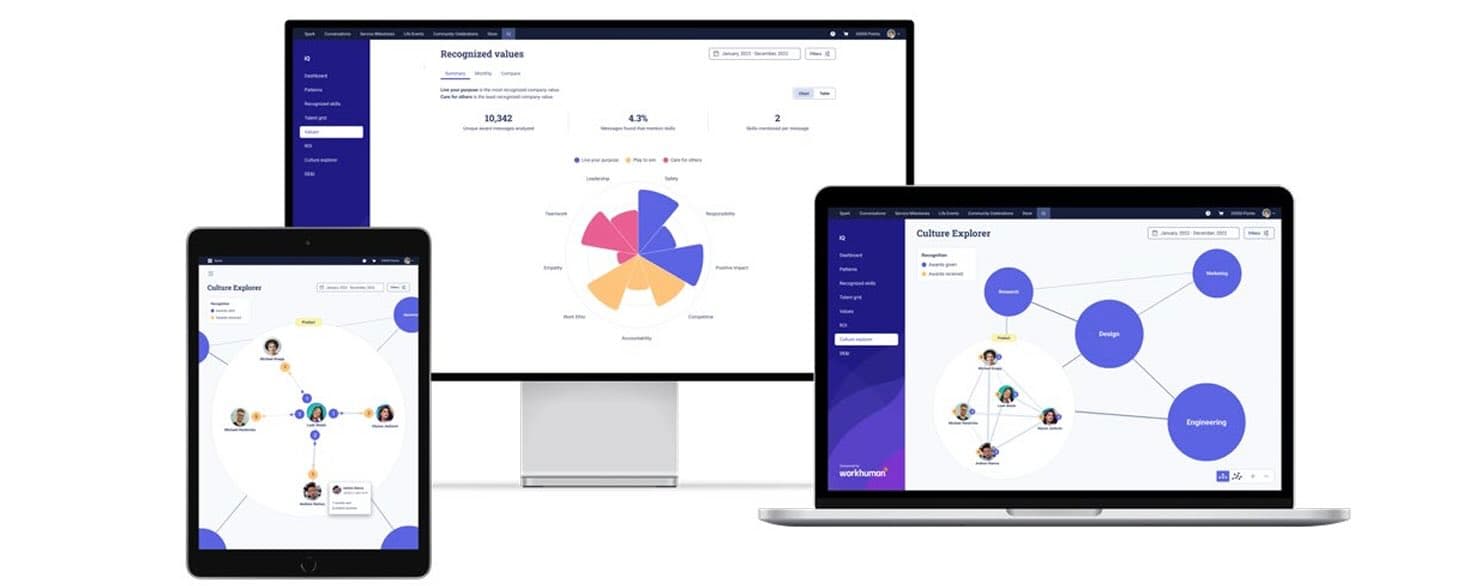
- AI focused on survey analytics: AI capabilities are primarily applied to engagement surveys, including sentiment analysis, theme extraction, and trend identification
- Limited AI in recognition workflows: Minimal use of AI to guide or improve recognition quality in real time, resulting in more variability in message depth and impact
- Descriptive rather than predictive insights: Analytics tend to summarize what has happened in surveys and program activity, with less emphasis on forecasting or behavior-based intelligence
- Separate intelligence layers: AI-driven insights are concentrated in engagement modules, with limited integration into recognition data or day-to-day employee interactions
- Manual interpretation required: Leaders often need to connect insights across surveys, recognition, and performance data without a unified intelligence layer
- Innovation centered on EX breadth: Product development emphasizes combining engagement, feedback, and recognition into a single platform, rather than advancing recognition-specific intelligence or culture analytics
Global Reach and Capabilities
Workhuman
WorkTango
- Global program support: Supports recognition and engagement programs across multiple regions, with availability suited for mid-market and enterprise organizations
- Rewards availability: Offers global rewards catalogs including gift cards, merchandise, and experiences, though selection and perceived value can vary by country
- Localization capabilities: Platform supports multiple languages and regional configurations, but depth of localization may differ across modules
- Inconsistent global equity: Lacks a built-in system to standardize reward value across regions, often requiring manual adjustments to ensure fairness
- Scalability considerations: Capable of supporting global deployments, but maintaining consistency in experience, reporting, and program design may require additional internal oversight
Customer Support
Workhuman
WorkTango
- Standard support model: Provides customer support focused on platform usage, troubleshooting, and general program administration
- Implementation guidance included: Offers onboarding support to help launch recognition and engagement programs, though depth of strategic guidance may vary
- Limited ongoing consulting: Less emphasis on continuous, data-driven program optimization or culture strategy support post-launch
- Shared ownership of success: Internal teams are typically responsible for connecting survey insights, recognition activity, and program improvements over time
- Support experience can vary: Quality and responsiveness may differ based on region, program complexity, and level of service purchased
Ease of Use & Implementation
Workhuman
WorkTango
- Easy to adopt at a basic level: The platform is generally intuitive for common tasks like sending recognition, completing surveys, and viewing feedback
- Simpler rollout for core use cases: Implementation is relatively straightforward for organizations deploying standard recognition and engagement programs
- Broader platform adds complexity: Because recognition sits alongside surveys, feedback, and performance tools, setup can require more coordination across stakeholders and use cases
- Limited depth for complex environments: As program requirements grow across regions, business units, or workflows, administration can become more dependent on internal management
- Ongoing optimization requires ownership: Long-term success often depends on internal teams to refine program design, drive adoption, and connect insights to action
Workhuman vs. WorkTango: Strengths & Weaknesses
Workhuman Strengths
Workhuman Weaknesses
- Best suited for organizations seeking strategic, culture-building recognition, not for those wanting a simple gift-card shop.
- The partnership model includes consultation and coaching, which some buyers may view as more robust than necessary.
WorkTango Strengths
- WorkTango positions itself as a broader employee experience platform, combining Recognition & Rewards with Surveys & Insights rather than offering recognition as a standalone tool.
- Recognition is supported by employee survey and feedback capabilities, which can appeal to organizations that want engagement measurement and recognition under one vendor.
- The platform integrates with common workplace tools including Microsoft Teams, Outlook, Slack, and HRIS systems to support recognition in the flow of work.
- Global rewards breadth is a visible selling point, with WorkTango promoting 10M+ rewards across 85 countries and a pre-configured marketplace.
- WorkTango emphasizes ease of use and accessibility across devices, including mobile apps and embedded workflows in collaboration tools.
- AI capabilities are more established on the survey side, where the platform highlights AI dashboards, analytics, and tools to help leaders analyze employee feedback and trends.
WorkTango Weaknesses
- Some workflows are not very intuitive. Users say customizing surveys, setting up dashboards, and finding certain features can take training or extra time to learn.
- Much of the platform’s differentiated intelligence is centered on surveys and feedback analytics, with less visible emphasis on recognition-specific intelligence, behavior insights, or in-the-moment guidance for better recognition quality.
- “Users feel that points redemption is challenging due to high point requirements and limited reward options.” - Based on G2 reviewsOpens in a new tab
- Reporting and integrations may be limited for some teams. Some users say advanced reporting needs extra support, and that third-party integrations are not as broad as they’d like.
- WorkTango's mobile apps have received mixed reviews, with users reporting issues such as regressions after updates, missing functionality, and stability problems, particularly on Android.
Workhuman vs. WorkTango: What Customers Say
Customer Feedback & Quotes
Workhuman:
WorkTango:
- “The simplicity of the platform for the user is great. | The reports we generate are cumbersome and not accurate for a handful of metrics.” - Verified G2 Enterprise customer review in Consumer Goods
- "I like the people who have been assigned to our account. They are always helpful and get back to us promptly. | We only use the Perform module. It is not intuitive and the reporting is not great." - Verified G2 Mid-Market customer review in IT and Services
- Reporting flexibility can be a limitation: Even positive reviews note gaps in reporting depth. A recent G2 review said the “reporting and data export features could be more customizable,” especially for teams needing detailed or specific report formats.
- Recognition is well-liked, but deeper analytics may need work: Public review snippets suggest the platform is appreciated for recognition and engagement workflows, while reporting and analysis are more likely to be flagged for improvement.
Workhuman vs. WorkTango: Final Verdict
Both Workhuman and WorkTango support employee recognition and engagement. The real decision is what you need recognition to do after launch: act as one component within a broader employee experience platform, or serve as a dedicated system for driving culture, behavior change, and measurable business outcomes at scale.
Choose Workhuman if:
Choose WorkTango if:
You want a unified employee experience platform.
WorkTango can be a strong fit if your priority is combining recognition with engagement surveys, feedback, and insights in a single system.
Your primary focus is measuring employee sentiment.
If engagement surveys, pulse checks, and sentiment tracking are central to your strategy, WorkTango provides strong capabilities in this area.
You prefer a programmatic, campaign-driven approach.
If your recognition strategy is tied to initiatives, engagement campaigns, or periodic programs rather than continuous behavior reinforcement, the platform aligns well.
Your program requirements are moderately complex.
If you need solid recognition and engagement functionality without deep specialization in recognition intelligence or advanced analytics, WorkTango may be sufficient.
You’re comfortable connecting insights and actions internally.
If your team plans to interpret survey data, align it with recognition activity, and drive follow-through without a highly embedded strategic partner, WorkTango can support that model.
Final Verdict
Both platforms can support recognition and engagement across the organization.
The difference shows up in how recognition is used over time.
WorkTango is often best suited to organizations looking to combine recognition with engagement surveys and feedback, without requiring the same depth of recognition-specific intelligence, global rigor, or embedded strategic support.
Bottom line
- Workhuman delivers strategic recognition built for measurable impact, cultural alignment, and enterprise scale.
- WorkTango delivers a broader employee experience platform, combining recognition with surveys and feedback, with less emphasis on recognition as a standalone driver of long-term cultural and business outcomes.
See also:

Ryan Stoltz
Ryan is a search marketing manager and content strategist at Workhuman where he writes on the next evolution of the workplace. Outside of the workplace, he's a diehard 49ers fan, comedy junkie, and has trouble avoiding sweets on a nightly basis.
Recommended for you