
9 Best Employee Experience Software Solutions in 2026 Reviewed
by Ryan Stoltz
Last updated
18 min read

Table of contents
- What is employee experience software?
- Comparison table
- 1. Workhuman
- 2. Culture Amp
- 3. Lattice
- 4. Sogolytics
- 5. Betterworks
- 6. 15Five
- 7. Leapsome
- 8. Microsoft Viva
- 9. Qualtrics EmployeeXM
- Key features to look for in an employee experience software
- How to choose the right employee experience platform
- Frequently asked questions
- Set your employees up for success with EX software
Share this article
The way workplace tools are scattered across organizations tends to be haphazard. On any given day, an employee might respond to a quick pulse survey and realize something’s been off. That reflection nudges them to update a goal, ask a colleague for feedback, and send a note of appreciation to a manager who’s been especially supportive.
It’s a natural flow, but in most organizations, the experience gets interrupted. The survey lives in one system. Goals sit in another. Feedback requires a separate process. Recognition happens somewhere else again. What could have been a single, meaningful experience turns into a series of disconnected tasks.
Employee engagement software is designed to support these moments. The platforms offer a central hub for communication, feedback, development, and analytics. It brings together all the resources and touchpoints your employees need to succeed throughout their time at your company. This helps engage team members and leads to more positive workplace cultures.
We've done the research to find the best employee experience solutions. This guide breaks down their key features and shares simple tips to help you pick the right tools to give your team more fulfilling, supportive experiences.
What is employee experience software?
Employee experience software is a category of HR technology designed to improve employee satisfaction and how employees feel about their work, from the moment they join an organization to the day they leave.
These platforms bring together tools for employee recognition, feedback, performance development, and workforce analytics under one roof, giving HR teams and managers a single system for understanding and improving the employee journey.
The category emerged in response to a growing realization in the HR world: engagement surveys and annual performance reviews weren't enough to boost employee engagement.
Organizations needed a more continuous, connected approach, one that could capture how employees were feeling in real time, surface meaningful employee insights from that data, and give managers and peers the tools to act on it.
What does an EX platform actually do?
At its core, an employee experience platform typically covers some combination of:
- Recognition and rewards – enabling peers and managers to acknowledge contributions in meaningful, visible ways
- Continuous feedback and performance development – replacing or supplementing annual reviews with ongoing conversations and goal tracking
- Employee listening – pulse surveys, lifecycle surveys, and other mechanisms for understanding employee sentiment at scale
- People analytics – turning employee data into actionable workforce insights around retention, engagement, and performance trends
- Communication and connection tools – keeping employees informed and connected, especially in distributed or hybrid environments
Not every platform covers all of these equally well. Some are built around listening and surveys; others lead with performance management or recognition. Understanding where a platform puts its emphasis matters, and it's one of the main factors we weighed in building this list.
Employee experience platform vs. point solution: what's the difference?
It's worth distinguishing a full EX platform from the point solutions many HR teams start with, such as standalone pulse survey tools, recognition programs, or performance apps that operate independently.
Point solutions can work well when you have a specific, contained need. But they come with real costs: data that doesn't talk to each other, fragmented employee experiences, and HR teams managing multiple vendors instead of one integrated system.
A full employee experience solution connects those capabilities so that recognition data informs performance conversations, employee engagement trends surface in analytics dashboards, and managers have a complete picture of their team, not a collection of disconnected reports.
For organizations at any meaningful scale, that integration is often what separates an EX strategy that delivers results from one that just generates data.
Why it matters now
Employee experience in the workplace has moved from an HR priority to a business one. Research consistently links higher employee engagement to lower turnover, stronger productivity, and better customer outcomes – and the cost of getting it wrong is measurable. Replacing an employee typically costs between 50% and 200% of their annual salary, depending on role and seniority.
The platforms on this list were evaluated on how well they address these realities: not just feature checklists, but their ability to genuinely improve how employees experience their work every day.
Comparison table
| Vendor | Core Strengths | Key Features | Target Teams | Pricing |
| Workhuman | Developed using the latest behavioral science research Focused on building more inclusive and positive workplace culturesRobust analytics | Global rewards storeMilestone rewards Peer-to-peer recognition | Global enterprises and large organizations with complex data | Custom pricing |
| Culture Amp | Action planning Data-driven support for professional development Engagement surveys | AI coach Performance Culture Quadrant toolPredictive analytics for turnover | Medium to large teams | Custom pricing based on the number of employees and features |
| Lattice | Combines performance management with statistical analysis Empowers managers to give real-time feedback | Benchmarking Goal tracking Individual growth plans | High-growth organizations and teams invested in improving performance | Starts at $11 per employee per month |
| Sogolytics | Action planning Continuous listening tools Predictive modeling | AI copilot Automated surveys Real-time dashboards | Organizations looking for actionable recommendations and advanced analytics tools | Free version; paid plans start at $39 per month |
| Betterworks | Goal managementPersonalized support for performance conversations | Benchmarking Employee engagement surveys Recognition system | Performance-focused teams and small to mid-sized businesses | Custom pricing based on the number of employees and features |
| 15Five | Encourages continuous feedbackFast adoptionUser-friendly | Action plansManager coachingSurvey templates | Small to mid-sized businesses | Starts at $4 per user per month |
| Leapsome | AI feedback Built-in learning hub People analytics | AI development coachCompetency frameworks OKR tracking | Teams focused on professional development | Custom pricing for individual modules or bundles |
1. Workhuman
G2 Rating: 4.7/5, based on more than 2,000 reviews
Best for: Mid-market and enterprise orgs prioritizing culture, retention, and authentic employee connection
Pricing: Custom
Integrations: Deep human resources information system (HRIS) integrations with Microsoft Teams, Outlook, Slack, Workday, SAP SuccessFactors, Oracle, ADP, and 50+ systems
Key features:
- Strong enterprise and global workforce credentials
- Remote team support via an always-on recognition layer
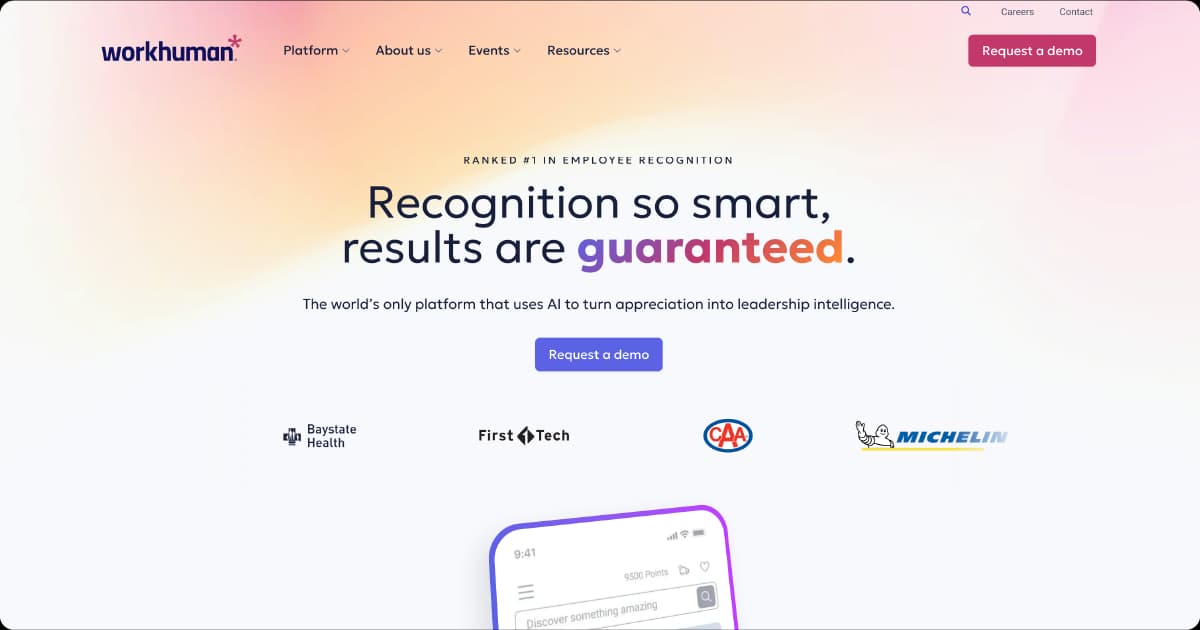
- Conversations®, a continuous performance management tool that combines check-ins, crowdsourced employee feedback, and recognition data to give managers a richer context for coaching and development
- Conversations® also functions as Workhuman's feedback management hub, giving managers a structured, continuous channel for two-way feedback that doesn't depend on annual review cycles.
- Reflections, which helps organizations conduct performance reviews more efficiently by pulling together check-ins, feedback, and recognition moments into one streamlined review experience
- Human Intelligence™ surfaces real-time insights into employee performance, engagement, collaboration, and emerging talent, drawn from continuous recognition data rather than periodic surveys.
- Workhuman iQ + the AI Assistant – applies sentiment analysis and pattern recognition to recognition and feedback data, helping HR leaders identify engagement trends, flag retention risk, and surface actionable insights without waiting for survey cycles
- Extensive integrations across HRIS, collaboration, and productivity platforms make it easier to embed continuous feedback into the flow of work.
That distinction matters more than it might initially appear. Recognition data, generated continuously through peer-to-peer moments and milestone celebrations, creates a real-time signal about team health, collaboration patterns, and emerging talent that no annual review or pulse survey can replicate.
Workhuman calls this Human Intelligence®. The idea is that how employees show up for each other is one of the richest, most underutilized sources of workforce insight available to HR teams.
Standout features
Anyone-to-anyone social recognition – Workhuman's core recognition experience lets employees celebrate each other publicly, in the flow of work. Recognition is tied to company values, creating a visible, ongoing record of the behaviors an organization actually wants to reinforce, not just the ones it says it values on a poster.
Global rewards network – Employees redeem recognition points through a global rewards marketplace spanning gift cards, merchandise, charitable donations, and travel experiences. The breadth matters: a reward that feels meaningful to someone in Dublin should feel equally meaningful to a colleague in São Paulo.
Milestone and life event recognition – Work anniversaries, onboarding completions, promotions, and personal milestones are surfaced automatically, so managers and peers never miss the moments that build lasting loyalty. For large, complex organizations where managers oversee distributed teams, this kind of automated visibility is the difference between recognition that happens consistently and recognition that depends on someone remembering.
Continuous Performance Development – Workhuman's performance module replaces the annual review cycle with ongoing check-ins, feedback exchanges, and goal tracking. Grounded in behavioral science developed over more than two decades of research, it's designed to reinforce the behaviors that actually drive performance, not just document them retrospectively.
Human Intelligence analytics – Recognition and performance data surfaces in real-time dashboards that give HR leaders an analytical view of employee engagement trends, retention risk, and culture health. Unlike engagement survey data, which captures a snapshot, this signal is always on.
Enterprise integrations – Workhuman connects with Microsoft Teams, Slack, Workday, SAP, and Oracle, meeting employees in the tools they already use rather than asking them to adopt another one.
Results
2. Culture Amp
G2 Rating: 4.5/5
Best for: data-driven HR teams focused on employee engagement benchmarking
Pricing: Starts at $5/month per user
Integrations: Workday, SAP SuccessFactors, Microsoft Teams, Slack
Culture Amp is an all-in-one employee experience management platform. Drawing on people analytics, it uses proven strategies to gather feedback and analyze employee data.
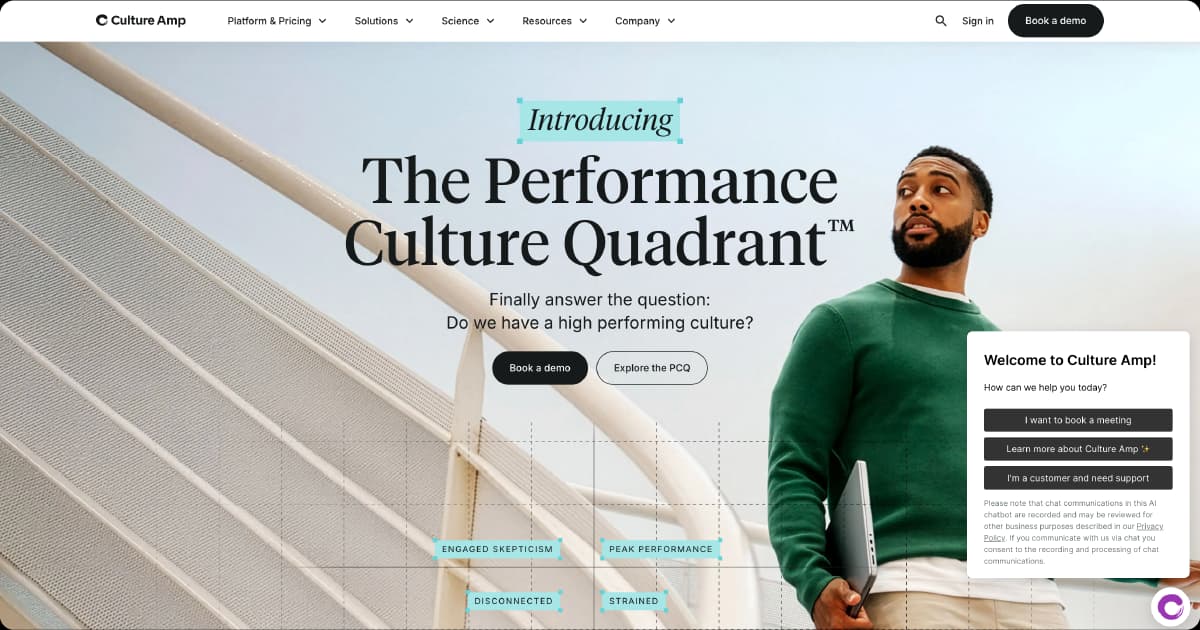
An AI Coach helps leaders understand their team's performance and plan development opportunities. For example, if your employees say they want more leadership training, the AI Coach will recommend an action plan. It also drafts performance reviews.
Here are a few more key features:
- 360° reviews that allow employees to get feedback from several perspectives
- Integrations with Slack and Microsoft Teams
- Micro-learning tools
- The Performance Culture Quadrant tool, which helps you understand how employees feel about your company
- Predictive analytics to spot flight risks and understand why they're likely to leave
- Survey library
These features make Culture Amp a strong choice for distributed or large teams. Managers can quickly gather data and adapt their support to each employee's needs. The software is also easy to fit into your everyday workflows, with consultant support available if you run into roadblocks.
Like many digital employee experience solutions, Culture Amp only offers custom quotes. Pricing varies based on the number of employees and the features.
3. Lattice
G2 Rating: 4.7/5
Best for: mid-market companies wanting an integrated performance + engagement suite
Pricing: Starts at $11/month per user
Integrations: Workday, BambooHR, Slack
Key features:
- 360-degree feedback tied to performance review cycles
- Objectives and Key Results (OKR) tracking with manager and peer visibility
- AI-powered coaching
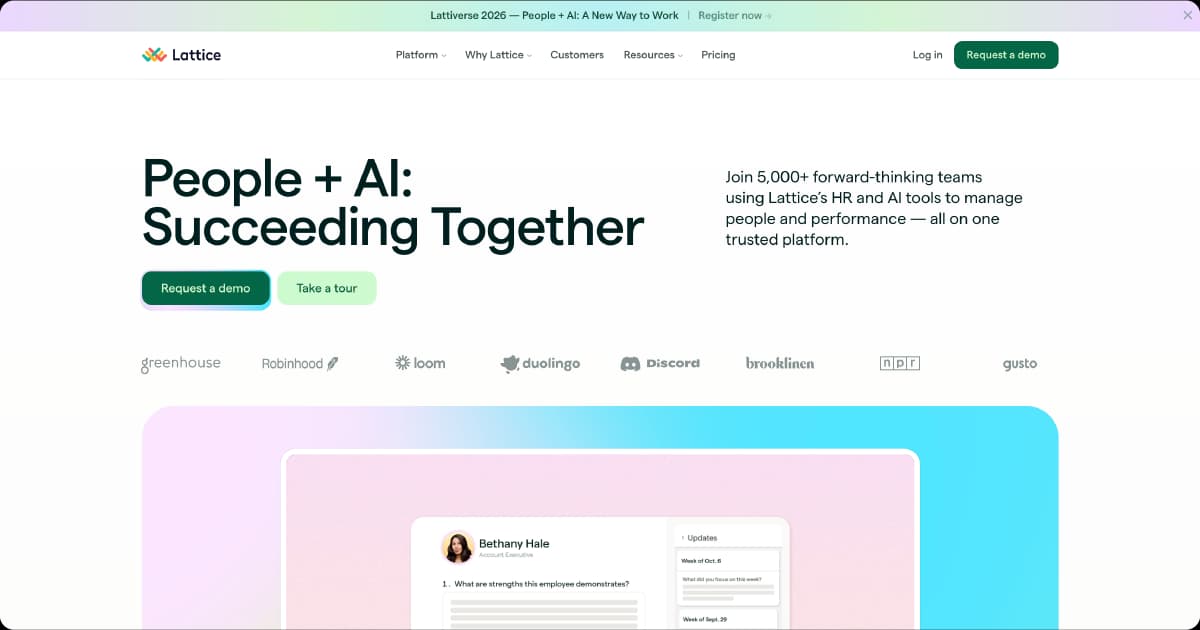
Lattice bills itself as "the HR platform that people love." This AI-powered people success software combines performance, engagement, and HR tools. Users can check their pay stubs and get feedback in the same place.
The AI tools are particularly useful for managers to get insights about each employee's performance and engagement level. The AI can recommend individual growth plans based on this data. For instance, if an employee struggles with communication, Lattice may suggest a public speaking workshop.
Employees can also communicate directly with the AI chatbot. For example, an ambitious new hire could ask the AI how to get promoted. The AI will create a personal action plan, giving them more control over their career.
Other notable features include:
- Benchmarks for employee engagement and compensation metrics
- Driver Analysis to interpret people data
- Objectives and key results (OKRs) for setting and tracking goals
- Onboarding and exit feedback
- Performance reviews
- Pulse surveys
- Succession planning
- Talent reviews
Lattice is built for high-growth, performance-focused organizations that want software that grows alongside their teams. Pricing starts at $11 per employee per month, with add-on packages for more advanced features.
4. Sogolytics
G2 Rating: 4.6/5
Best for: mid-market companies wanting to drive satisfaction and loyalty from customers and employees alike
Pricing: Custom
Integrations: Gmail, Slack, Zapier, Salesforce
Key features:
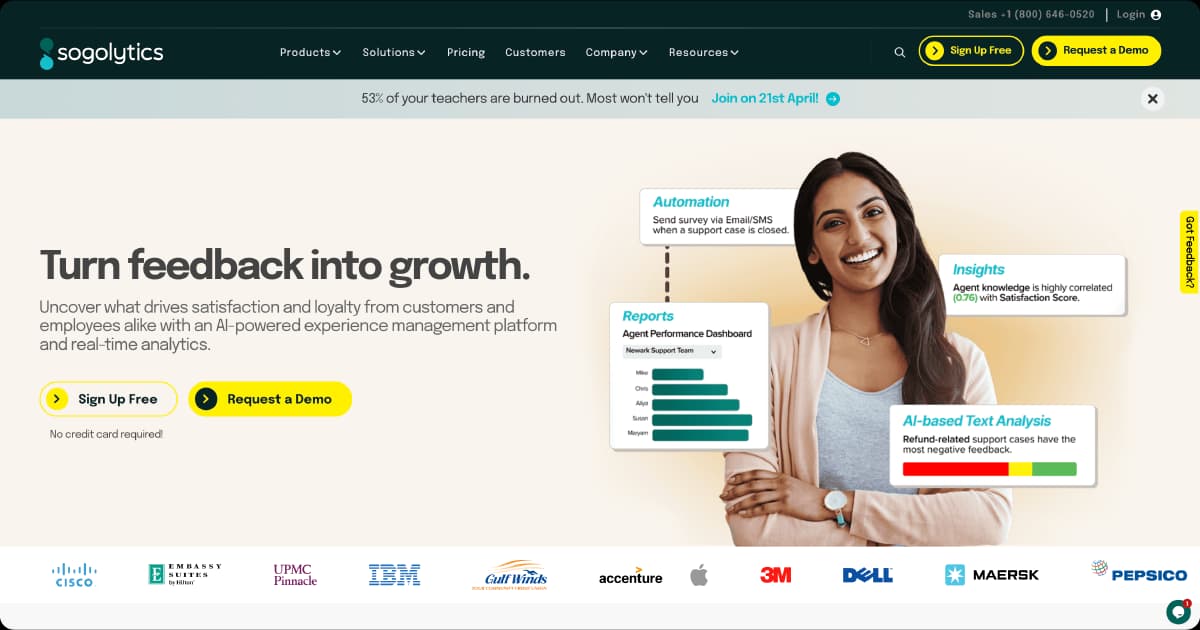
- Continuous listening tools with automated pulse surveys and follow-up workflows
- Key Driver Analysis and natural language processing (NLP) to surface what matters most to employees
- Real-time dashboards providing a 360-degree view of employee experience metrics
For instance, you could analyze the sentiment of feedback for subtle signs of burnout or disengagement. If one team seems checked out, you can step in early to provide support. Continuous listening is another strength. Sogolytics automatically sends surveys at key milestones. Find out how your employees feel during onboarding or after your monthly all-hands meetings.
Additional key features include:
- 360° feedback
- AI copilot
- AI-generated action plans
- Anonymous feedback mode
- Continuous feedback cycles
- Key driver analysis
- Real-time EX dashboards
- Speedy insight delivery
Sogolytics is an excellent choice for teams wanting more sophisticated analytics and practical next steps to improve their EX. The platform offers a free version with up to 200 survey responses per year. For larger projects, paid plans start at $39 per month.
5. Betterworks
G2 Rating: 4.4/5
Best for: Goal alignment
Pricing: Custom
Clients: Colgate-Palmolive, Intuit, University of Phoenix
Integrations: Microsoft Teams, Slack, Workday, Google Workspace
Key features:
- OKR and goal-setting tools that connect individual objectives to company strategy
- AI-assisted goal writing with automated nudges to keep updates consistent
- Continuous feedback and performance reviews in one system
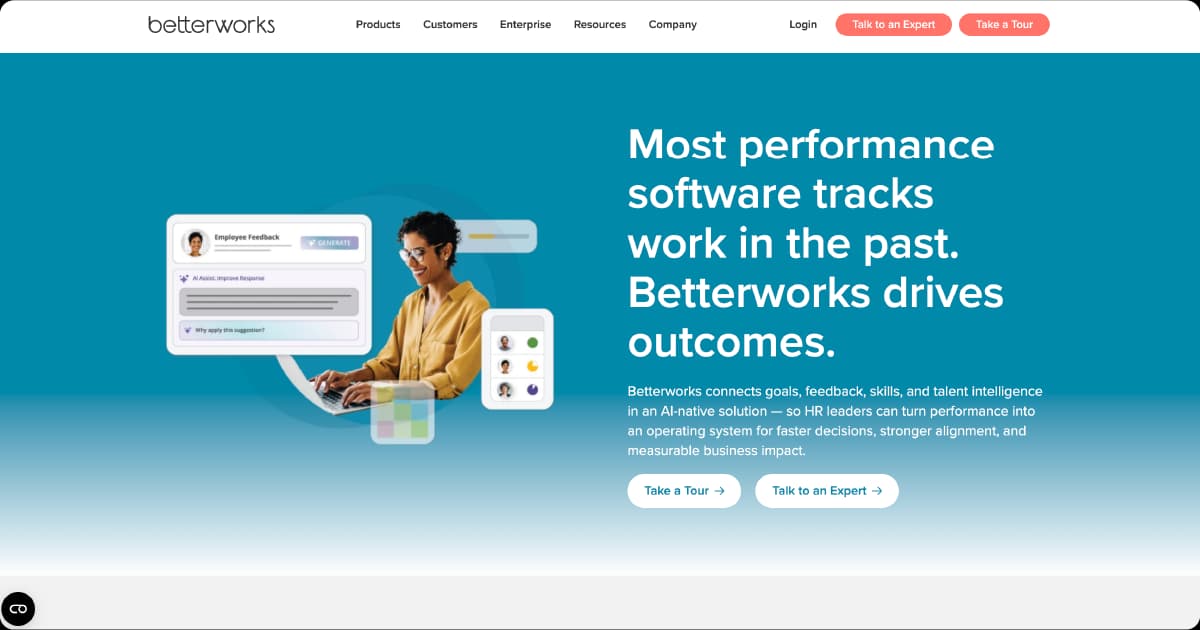
Performance management should involve more than an annual sit-down with a manager. With Betterworks, leaders can keep a close eye on their teams and offer regular feedback. The platform helps enterprises connect their big-picture goals to each employee's growth.
Standout features include:
- Benchmarking data for over 10 industries
- Employee engagement surveys
- Goal management software
- Integrations with popular workplace tools, including Slack and Workday
- Recognition system for scheduled and requested feedback
- Templates for performance conversations
Betterworks scales easily, so you can add as many employees and users as you need. Large organizations may consider investing in the enterprise plan for the highest ROI. While this tier is more expensive, it offers more advanced features, including feedback and employee engagement tools.
No matter which plan you go with, expect a longer implementation timeline. For instance, as per the “11 Powerful Stories of Performance Innovation”Opens in a new tab, it took HelloFresh six months to roll out Betterworks to its 7,000 employees.
6. 15Five
G2 Rating: 4.6/5
Best for: growth-stage companies, focused on goal alignment
Pricing: Starts at $4/month per user
Clients: Credit Karma, HubSpot, Spotify
Integrations: BambooHR, Slack, Microsoft 365
Key features:
- Weekly check-ins and guided 1-on-1s
- 360-degree reviews with OKR tracking
- AI-powered engagement surveys
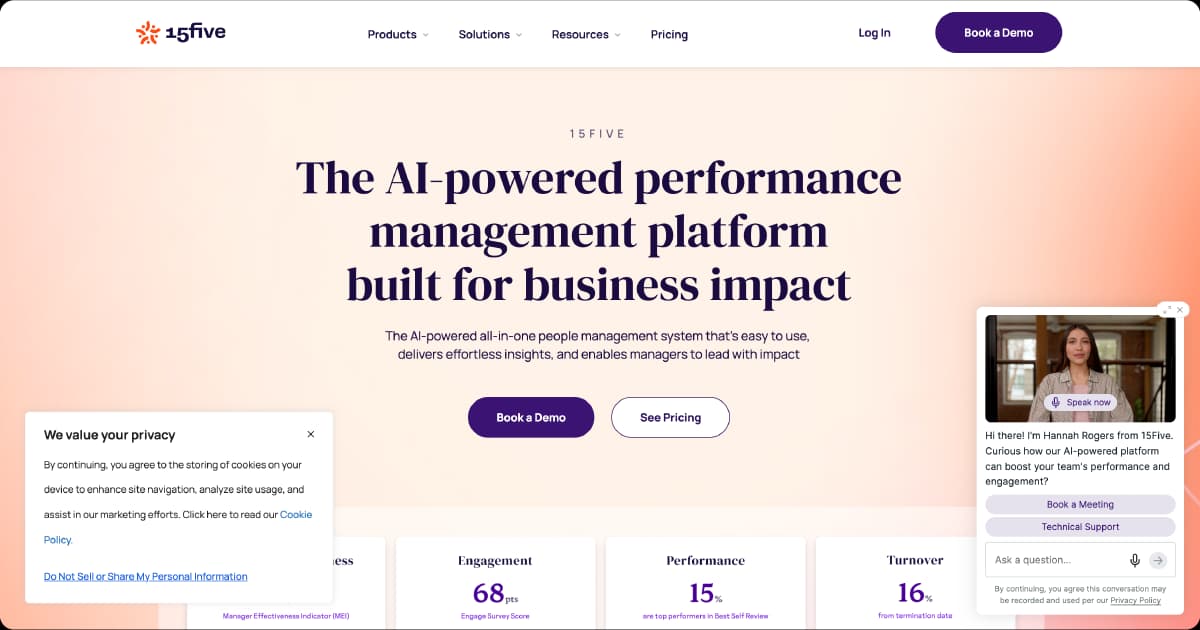
Small and mid-sized businesses often care more about simplicity than high-powered features. 15Five is a lightweight, user-friendly alternative to more complex solutions. It tracks employee performance and helps managers make talent decisions.
This software makes feedback as routine as checking your email. Managers can schedule weekly check-ins and regular performance assessments. This improves the employee experience because your team never has to wonder how they're doing. They can just ask or wait a few days for the next one-on-one chat with their manager.
15Five also supports real-time feedback and High Fives, which are short expressions of gratitude. This makes it a strong option for teams focusing on coaching and development.
15Five has a simple rollout process, so you can adopt it quickly. It's also affordable, with plans starting at $4 per month per user.
7. Leapsome
G2 Rating: 4.8/5
Best for: Small & mid-market companies
Pricing: Starts at $6,000/year
Clients: Spotify, monday.com, Bumble
Integrations: Workday, Microsoft Teams, Slack
Key features:
- 360-degree reviews with customizable competency frameworks
- Engagement surveys with AI-generated questions and benchmarking
- Built-in HRIS connecting employee records to performance
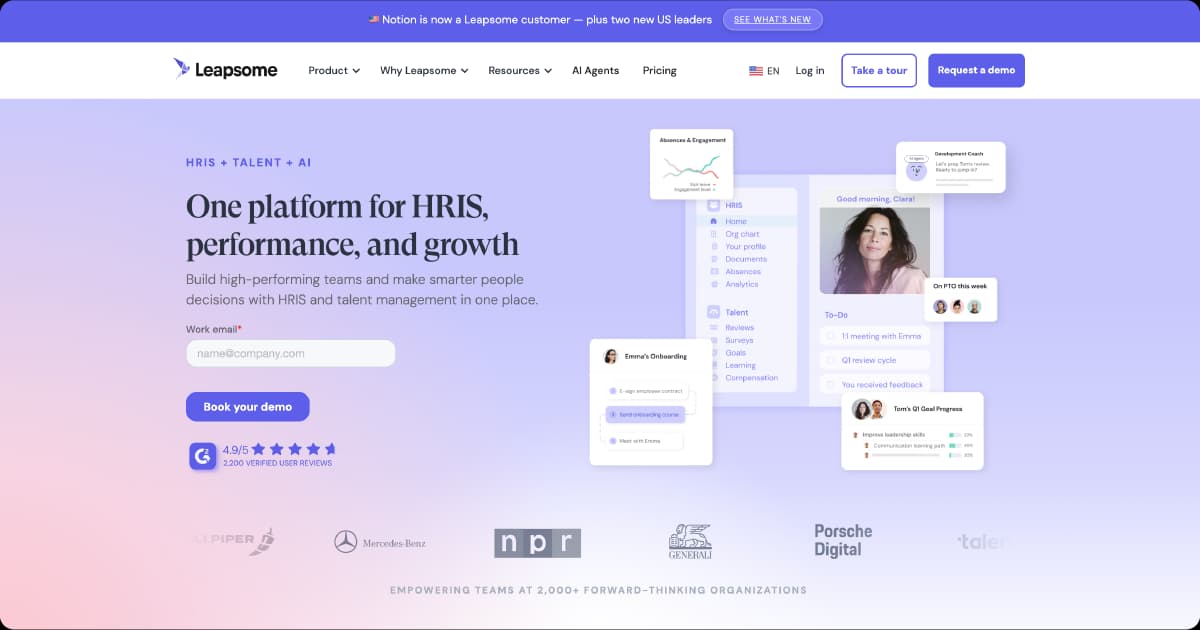
Leapsome is a learning-centric employee experience management platform that brings together engagement, learning, and performance tools. It also has a built-in human resource information system (HRIS) for everyday tasks, including time tracking and document signing.
One notable feature is the learning hub. Leapsome's content library helps employees strengthen must-have skills, from compliance to time management. You can also create custom courses with Leapsome AI for employees to build skills. OKRs help individuals and teams to set goals and track their progress, with AI-powered suggestions for setting milestones and brainstorming objectives.
Other features include:
- AI development coach
- AI-powered feedback and performance reviews
- Custom skills frameworks
- Engagement surveys
- People analytics with AI recommendations
- Q&A boards for more collaborative meetings
- Shared agendas for one-on-one and team meetings
These tools support continuous growth and feedback loops for organizations wanting to make learning and engagement the center of the employee experience. Your team can access all the skills-building resources they need in one hub.
Leapsome bundles features in modules, so you only pay for the tools you actually need. However, it doesn't publicly publish pricing. Your organization may also need change management support for advanced features, such as AI-powered performance reviews.
8. Microsoft Viva
G2 Rating: 4.2/5
Best for: Organizations already running Microsoft 365
Pricing: Starts at $2 per employee/month (individual modules); full Viva Suite at $12 per employee/month
Integrations: Microsoft 365, Teams, SharePoint, Glint, Workday, SAP
Key features:
- Employee listening and engagement surveys via Viva Glint
- Personalized learning recommendations via Viva Learning
- Workforce analytics and productivity insights via Viva Insights
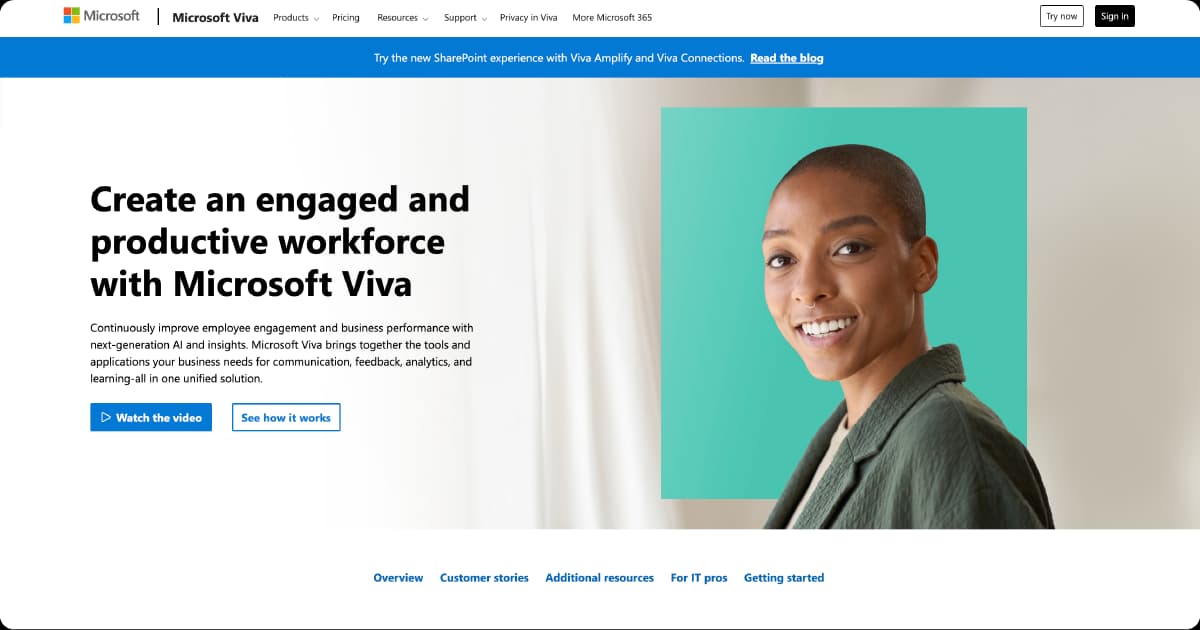
Microsoft Viva is a digital employee experience platform built natively into Microsoft 365 and Teams. Rather than a single unified product, Viva is a suite of modules, covering connections, learning, data-driven insights, and engagement, that sit on top of the Microsoft ecosystem most enterprise employees already work in every day.
The platform's central advantage is its integration depth. Because Viva lives inside Teams, employees don't need to adopt a new tool to access recognition, learning content, or company communications; it surfaces where they already are.
Viva Insights, the analytics module, draws on Microsoft 365 usage data to surface patterns around collaboration, meeting load, and focus time, giving managers a different lens on team health than traditional engagement surveys provide.
Viva Glint, acquired by Microsoft in 2023, adds robust employee listening capabilities, including pulse surveys, lifecycle surveys, and AI-assisted analysis of open-text responses. It's one of the strongest listening tools in the market and benefits from deep integration with the broader Viva suite.
The modular pricing model can also add up quickly: full access to the Viva Suite across a large workforce carries a meaningful cost, particularly for organizations already investing in separate performance or recognition tools.
9. Qualtrics EmployeeXM
G2 Rating: 4.4/5
Best for: Large enterprises with mature people analytics functions
Pricing: Custom
Integrations: Workday, SAP SuccessFactors, Oracle HCM, Salesforce, Microsoft Teams, Slack
Key features:
- Continuous listening engine with lifecycle, pulse, and ad hoc surveys
- AI-powered text analytics for open-ended feedback at scale
- Predictive analytics and driver analysis for retention and engagement
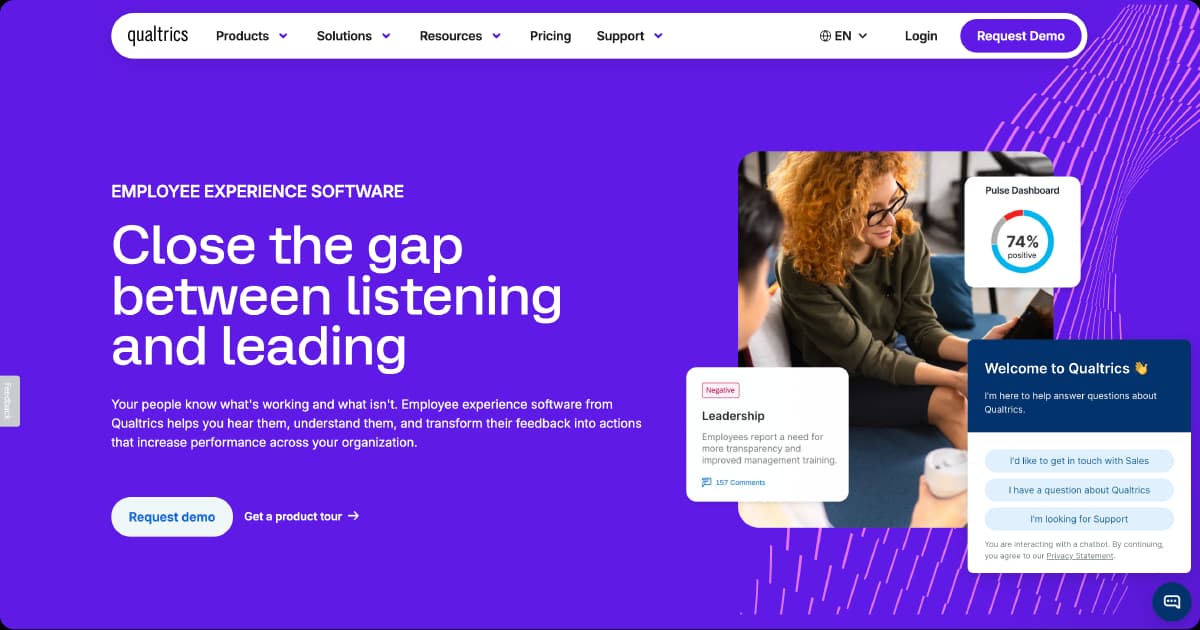
Qualtrics EmployeeXM is one of the most sophisticated employee listening softwares available, built on the same experience management infrastructure that Qualtrics uses across its broader XM product suite.
For large organizations that want to understand employee sentiment at scale and have the HR analytics capability to act on what they find, it's among the most powerful tools in the market.
The platform's standout capability is its listening engine. EmployeeXM supports the full spectrum of survey types, including:
- Onboarding surveys
- Pulse checks
- Exit interviews
- Manager effectiveness surveys
- Always-on feedback channels
It combines them into a continuous listening program rather than a series of disconnected point-in-time measurements. AI-powered text analytics can process open-ended responses at volume, surfacing themes and sentiment patterns that would take a human analyst weeks to identify manually.
Predictive analytics and driver analysis give HR leaders a clearer picture of what's actually influencing employee engagement and retention, not just what employees report feeling, but which factors have the highest statistical relationship to the outcomes the organization cares about. For people analytics teams that want to move from reporting to forecasting, this is a meaningful capability.
The platform's limitations reflect its origins as a survey and research tool. Employee recognition and rewards functionality is absent. EmployeeXM doesn't offer peer-to-peer social recognition or a rewards marketplace.
Performance management is also outside its scope. Organizations looking for an integrated platform that handles the full employee experience lifecycle, from recognition and development to listening and analytics, will need to supplement Qualtrics with additional tools, which reintroduces the data fragmentation problem that EX platforms are designed to solve.
Key features to look for in an employee experience software
Not all employee experience solutions are built the same way. Some lead with employee recognition, others with performance management or listening tools. Most offer some version of everything, but depth varies significantly, and the features that matter most depend on what you're trying to solve.
The following capabilities represent the core of what a mature EX platform should offer. Use them as a framework for evaluating any platform on this list.
Recognition and rewards
Recognition is the connective tissue of employee experience. Done well, it positively reinforces the behaviors an organization wants to see, creates visible moments of appreciation that employees actually remember, and generates a continuous signal about team culture that no survey can replicate.
Look for platforms where recognition is social and visible, not just a private message between manager and employee, and where rewards are flexible enough to feel meaningful across a global workforce.
Continuous feedback and performance development
The annual performance review is increasingly difficult to defend as a primary feedback mechanism. By the time feedback is formalized and delivered, the behaviors it's meant to address are months old.
The stronger platforms have moved toward continuous feedback models – ongoing check-ins, lightweight goal tracking, and structured development conversations that happen in the flow of work rather than once a year.
When evaluating this capability, look beyond whether it exists and ask how it connects to recognition and analytics. A feedback tool that operates in isolation from the rest of the platform is a missed opportunity.
Employee listening and surveys
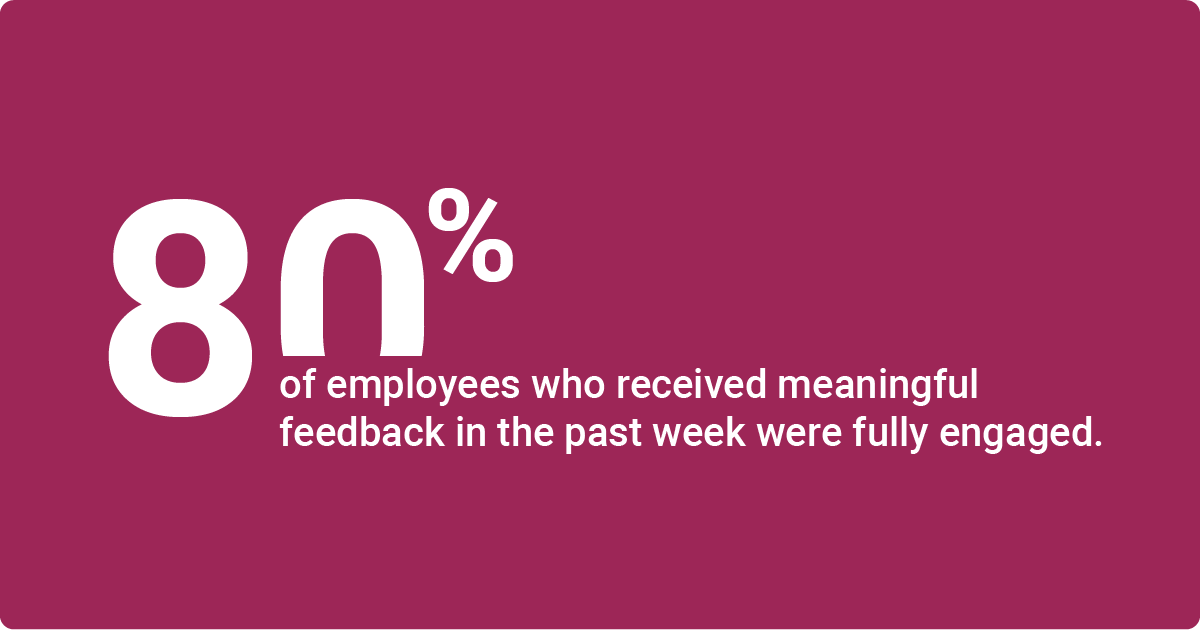
Understanding how employees feel at scale requires more than an annual engagement survey. Look for platforms that support multiple listening formats, including pulse surveys, lifecycle surveys tied to onboarding and exit, and always-on feedback channels, and that surface results in ways managers can actually act on, not just dashboards that HR reviews once a quarter.
The quality of the question library and the sophistication of the analytics matter as much as the survey delivery mechanism itself. Benchmarking capability, the ability to compare your results against industry or peer-group data, is also worth weighing, particularly for organizations that want to contextualize their engagement scores rather than read them in isolation.
People analytics and workforce insights
This is where EX platforms earn their keep at the executive level. The best platforms don't just collect employee data, they surface patterns that help HR leaders make better decisions about retention, talent development, and culture investment.
What to look for: real-time dashboards rather than static reports, the ability to segment data by team, tenure, location, and demographic, and – importantly – analytics that draw on recognition and feedback data rather than survey results alone.
Recognition-generated data has a significant advantage over survey data: it's continuous, behavioral, and not subject to the response bias that skews self-reported engagement scores.
Remote and distributed team support
For organizations with hybrid or fully remote workforces, EX software isn't optional infrastructure; it's how culture gets transmitted across distance. The informal moments of recognition and connection that happen naturally in shared physical spaces have to be deliberately recreated when teams are distributed.
Evaluate whether recognition and feedback tools work natively inside the collaboration platforms your employees already use (Slack, Microsoft Teams, email) or whether they require logging into a separate system.
That distinction has an outsized effect on adoption. Also, look at whether the platform supports multiple languages and currencies, and whether the rewards experience feels locally relevant rather than defaulting to a US-centric catalog.
HRIS integrations and enterprise scalability
An EX platform that doesn't connect to your existing HR technology stack creates more work than it saves. At minimum, look for native integrations with your HRIS (Workday, SAP SuccessFactors, Oracle HCM, ADP), your payroll system, and your primary collaboration tools.
These are the questions that separate platforms built for enterprise from those that claim to be.
Manager experience and ease of adoption
The most sophisticated EX platform in the world will underperform if managers don't use it. Managers are the primary delivery mechanism for a positive employee experience – recognition, feedback, development conversations, and performance support all flow through them – and a platform that adds friction to their workflow will be quietly abandoned.
When evaluating platforms, put the manager experience front and center:
- How easy is it to send a recognition or initiate a feedback conversation?
- Are there prompts or nudges that help managers who aren't naturally inclined toward frequent recognition build the habit?
- Does the platform surface the right information at the right moment, or does it require managers to go looking for it?
Ease of adoption is a feature. Weight it accordingly.
How to choose the right employee experience platform
The best employee experience platform isn't the one with the longest feature list; it's the one your employees will actually use, in a way that fits how your organization works. That means the evaluation process matters as much as the final decision.
Here's what to work through before you commit.
Start with your organization's size and structure
Scale shapes everything. A 200-person company and a 20,000-person global enterprise have fundamentally different needs; not just in terms of capacity, but in terms of how recognition, feedback, and analytics need to function.
For enterprise organizations, the questions to pressure-test include: Can the platform handle multiple geographies, languages, and currencies? Does it support complex org structures and custom permissions? How does it manage compliance across different regulatory environments?
For organizations on a growth trajectory, scalability is equally important. The platform you implement at 500 employees needs to still work at 5,000. Look for vendors, such as Workhuman, with documented enterprise references who also serve growing mid-market organizations, so the platform grows with you rather than requiring a rip-and-replace later.
Platforms that look polished in a demo can buckle under enterprise-grade requirements, so if you're evaluating at scale, ask vendors for references from organizations of comparable size and complexity.
Factor in how and where your people work
A platform designed primarily for in-office teams will feel hollow for a distributed workforce. Remote and hybrid employees are statistically more likely to feel invisible, disconnected from company culture, and uncertain about how their contributions are perceived, and the right EX platform should actively close that gap, not assume it away.
Get clear on where you're leading
Most EX platforms have a center of gravity – recognition, performance management, or employee listening – and build outward from there. Understanding your own priority helps you evaluate platforms on the dimension that matters most, rather than treating every feature as equal.
A few common starting points:
- Recognition-first: you want to build a culture of appreciation and connection, and tie that to business outcomes like retention and engagement
- Performance-first: you want to modernize how goals are set, feedback is given, and development conversations happen
- Listening-first: you want to understand employee sentiment at scale and use that data to drive HR strategy
The strongest platforms do all three. But knowing where you're starting tells you where to focus your evaluation, and which vendor's strengths align with your immediate needs.
Map your integration requirements
EX software works best when it connects to the systems your employees and HR teams already live in. Before evaluating platforms, map out the integrations you'd need on day one: your HRIS (Workday, SAP, Oracle, ADP), your payroll system, your collaboration tools (Slack, Teams), and any existing performance or survey tools you're not ready to replace.
A platform that requires employees to log into a separate system for recognition, another for feedback, and another for surveys will struggle with adoption, regardless of how good each tool is individually. Single-ecosystem platforms, or those with deep, native integrations, remove that friction.
Understand the real cost
Most EX platforms use per-seat pricing, though models vary. Some charge a flat annual fee; others price by module, with advanced analytics or custom survey capabilities priced separately. What looks affordable at the license level can grow significantly once implementation, training, and premium feature costs are added.
When comparing costs, the more useful question isn't "what does this cost?" but "what does it cost to achieve the outcomes we're trying to reach?"
A platform with a higher per-seat price that demonstrably reduces employee turnover by even a fraction of a percentage point typically pays for itself many times over. Some vendors, Workhuman among them, offer an ROI guarantee, which is worth weighing as a signal of how confident the vendor is in their own results.
Evaluate implementation and ongoing support
For large or multinational organizations, implementation is rarely straightforward. Data migrations, HRIS integrations, permission structures, and multi-region rollouts all introduce complexity that can extend timelines and strain internal resources if the vendor isn't set up to support them.
Before signing, understand what onboarding looks like:
- Is there a dedicated implementation team?
- What does the go-live timeline look like for an organization of your size?
- What does ongoing support look like after launch – a knowledge base, or human support with defined SLAs?
Build a structured comparison
Once you've narrowed your shortlist, a comparison table helps bring evaluation criteria into relief. Useful columns to include: core features and their depth, integrations, enterprise scalability, remote team support, pricing model, implementation timeline, and support tier.
Run a real pilot
Demos are designed to show platforms at their best. A 60- to 90-day pilot with a representative group of employees (ideally spanning different teams, seniority levels, and locations) gives you a signal that no product page can.
When designing the pilot, focus on manager-facing workflows first. Managers are typically the critical adoption vector for EX platforms: if recognition and feedback tools work for them, employees follow. Have pilot participants document specific moments where the platform helped or frustrated them, then use that structured feedback to inform your final decision rather than relying on general impressions.
Frequently asked questions
What are the key features to look for in employee experience software?
Must-have features include analytics, engagement surveys, recognition systems, and performance management. These tools help you listen to your employees' needs and create a more positive work environment. The best employee experience software also integrates with your HRIS and collaboration software.
How can employee experience software improve workforce engagement and retention?
EX software gives employees more control over their experience. It allows them to give feedback about your organization and trust that you'll put it into action. Recognition tools also show employees how much their peers and leaders value their contributions. When people feel heard and seen, engagement grows, and retention improves with it.
What integrations should I consider when selecting an employee experience platform?
Look for software that integrates with your existing HR tools and learning management systems. Combining these tools gives you a huge pool of performance data to analyze. Consider integrations with internal communication tools, too. For example, pairing EX software with Slack lets you share public recognition directly in chat threads.
How long does it typically take to implement an employee experience solution?
Expect to spend around 60 to 90 days piloting a new employee experience management platform. This timeline may be slightly shorter if you choose a user-friendly tool or only use a few features. A helpful vendor can also speed up the process.
How can organizations measure the return on investment from employee experience software?
You can measure ROI by tracking engagement survey scores, turnover, productivity, and performance ratings. For instance, the employee Net Promoter Score (eNPS) may increase once you start putting your team's feedback into action. As employee satisfaction grows, retention rates may also go up.
Set your employees up for success with EX software
Your organization's employee experience directly affects how your team performs and collaborates. When people have the resources and support they need, they can shine at work.
Workhuman helps you stay aware of your team's needs with surveys and analytics. It also offers tools to support their development, such as feedback loops through Conversations. And don't underestimate the power of recognition. When people feel appreciated, they're more likely to stick around.
See how recognition drives measurable ROI. Request a demo today.

Ryan Stoltz
Ryan is a search marketing manager and content strategist at Workhuman where he writes on the next evolution of the workplace. Outside of the workplace, he's a diehard 49ers fan, comedy junkie, and has trouble avoiding sweets on a nightly basis.
Recommended for you