
What Is the Digital Employee Experience? How Technology Shapes How Employees Feel, Work, and Connect
by Ryan Stoltz
Last updated
14 min read
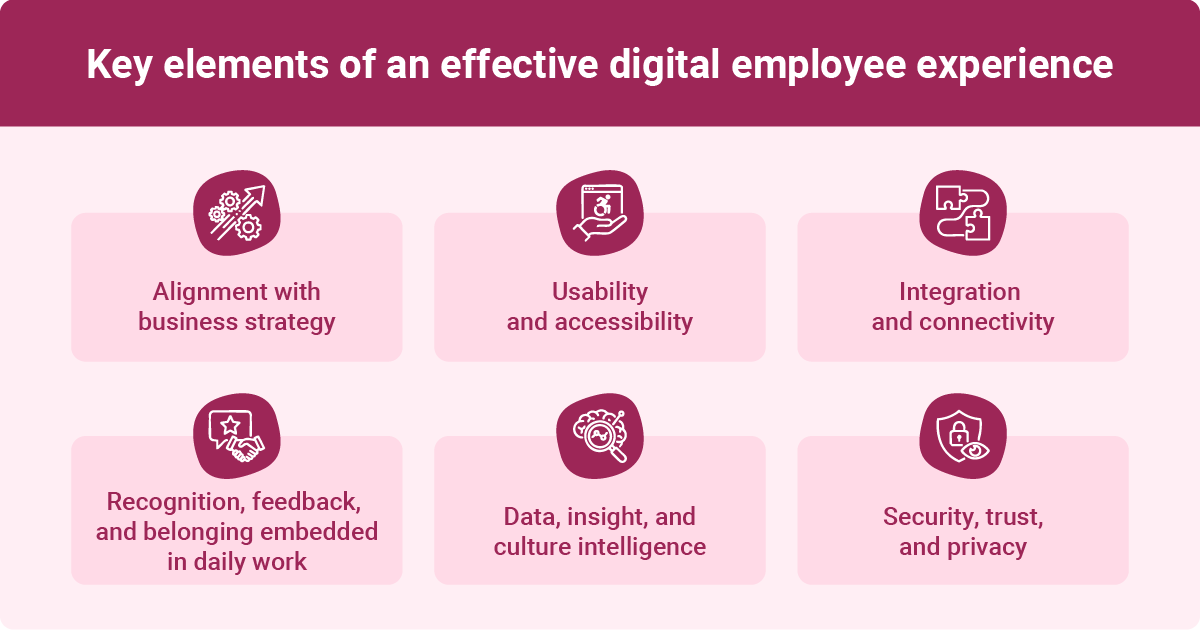
Table of contents
- What is digital employee experience (DEX)?
- DEX vs Employee Experience: Key differences
- Benefits of investing in a better digital employee experience
- Key elements of an effective digital employee experience
- Digital employee experience examples
- How to design a strong digital employee experience strategy
- How to measure DEX
- Calculating the ROI on your digital employee experience investment
- Understanding the DEX technology stack
- Overcoming common digital employee experience challenges
- The future of the digital employee experience
- FAQ
- Wrapping up
Share this article
Your employees log in, toggle between a dozen apps, wrestle with outdated systems, and lose 20 minutes just trying to find the right form. That friction compounds daily across your entire workforce.
Digital employee experience, or DEX, is the sum of every technology interaction your people have at work. It shapes how fast they onboard, how smoothly they collaborate, and whether they stay or leave.
In hybrid and remote environments, DEX isn't a nice-to-have. For many digital workers in hybrid and remote roles, it is one of the primary ways they experience your organization. Poor digital experiences drain productivity, spike support costs, and erode engagement. Strong ones do the opposite.
This guide walks you through what digital employee experience actually means, how to build a strategy that works, which metrics prove impact, and how to calculate ROI on your investment. You'll also get a step-by-step implementation plan, a look at the tech stack, and practical answers to the challenges most teams face when improving DEX.
What is digital employee experience (DEX)?
Digital employee experience (DEX) is the sum of employees’ day-to-day interactions with workplace technology and the perceptions they form as a result.
Forrester defines it as Opens in a new tab “the sum of all perceptions that employees have about working with the technology” to do their daily work and manage their relationship with their employer across the employment lifecycle.
In practice, DEX spans hardware, software, platforms, and the digital workflows that shape how work actually gets done, from onboarding portals to collaboration tools. Gartner also frames digital employee experience as a critical part of the broader employee experience, specifically tied to digital workplace technology experiences.
DEX (also called “digital work experience”) became a leadership priority as work moved decisively into digital channels. For example, Gartner’s Digital Worker Experience Survey found nearly 80% of workers were using collaboration tools in 2021, up from just over half in 2019.
That shift helps explain why many organizations now consider digital employee experience important and are moving from general HR conversations to a sharper focus on DEX from 2019 through 2024.
Core components of DEX
A strong DEX is usable (low friction), reliable (fast and stable), accessible (anywhere, approved devices), and well-supported (self-service plus human help).
Real-world examples
Great DEX looks like automated onboarding and device provisioning, mobile time-off requests with calendar sync, and chat-based IT support for common issues. Poor DEX looks like repeated logins, slow legacy apps, and confusing navigation.
DEX tools vs. DEX platforms
Digital employee experience tools solve a specific problem (adoption guidance, endpoint monitoring). Platforms combine monitoring, analytics, and remediation across the stack. Examples include Nexthink, 1E, and Lakeside Software (platforms), plus WalkMe and Pendo (tools).
DEX vs Employee Experience: Key differences
Employee experience (EX) is a broader term that encompasses the digital employee experience, along with other aspects of the job that make up employee satisfaction. Breaking down the difference between digital and traditional employee experiences will help you refine how employees collaborate, communicate, and interact with technology.
Traditional employee experience (EX)
The employee experience encompasses employees' overall feelings, experiences, and perspectives within their roles and your organization. A positive or negative EX is impacted by various factors, including your company culture, management, employees' well-being, and virtually every other aspect of the job.
This broad scope can make it somewhat challenging to track and improve employee experiences over time. Human resources (HR) and leadership teams must adopt multiple tools and strategies, such as surveys, events, and episodic reviews, to holistically gauge employees' feelings.
Digital employee experience (DEX)
Digital employee experience is a more specific aspect of the employee experience, focusing on how employees interact with digital technology. DEX has received greater focus in the 2020s as more businesses shift to remote, hybrid, and distributed work models that use digital collaboration tools.
Managing DEX is often easier than managing traditional experiences because the digital landscape supports continuous, embedded, and technology-enabled tracking. Tools and processes that contribute to the digital workplace experience include:
Where recognition and feedback fit into DEX
Digital experiences have become a massive aspect of many modern workplaces. As a result, recognition, feedback, and celebration are now often digital-first experiences. Digital signals and insights, such as changes in productivity, can reveal how employees actually feel beyond what they say or do.
Tracking the right data with modernized tools will support your peer recognition, real-time feedback, and value reinforcement.
Workhuman's® conceptual project, Recognition Done Right™, treats employee recognition as a digital-first experience, ensuring you don't overlook the DEX aspects of the employee experience. Consistent performance tracking enables continuous feedback rather than episodic performance reviews, providing reliable, real-time insights.
Benefits of investing in a better digital employee experience
Digital employee experience (DEX) has become a primary driver of how work gets done. When most workflows run through apps, portals, and collaboration tools, small points of friction (slow load times, repeated logins, unclear navigation, inconsistent mobile access) compound into meaningful productivity loss and employee frustration.
Tracking DEX helps leaders see where work stalls, where teams bypass approved tools, and where day-to-day experience is undermining engagement, performance, and retention.
Just as important, DEX is actionable. Unlike broad employee experience signals that can take months to interpret, digital signals can point to specific breakpoints you can fix: the workflow that’s causing rework, the tool that’s failing during peak usage, or the process that requires too many steps to complete routine tasks.
Increased productivity
A strong DEX reduces the “hidden tax” of context switching, workarounds, and interruptions. Clear, intuitive workflows help employees complete key tasks faster, with fewer errors, and with less reliance on training or manager support. The payoff is not just speed, but consistency: teams spend more time on value-creating work and less time troubleshooting basic processes.
Stronger engagement and connection
In hybrid environments, connection is increasingly mediated through digital moments. Recognition, feedback, and shared rituals can reinforce belonging and purpose for remote workers, who aren’t in the same room.
For example, Social Recognition® from Workhuman® makes appreciation visible across teams, helping leaders reinforce impact, collaboration, and values in the flow of work.
Real-time feedback and performance reinforcement
Modern digital work enables more frequent, in-the-moment coaching. Instead of waiting for scheduled review cycles, leaders can use timely feedback and recognition to reinforce effective behaviors and course-correct early.
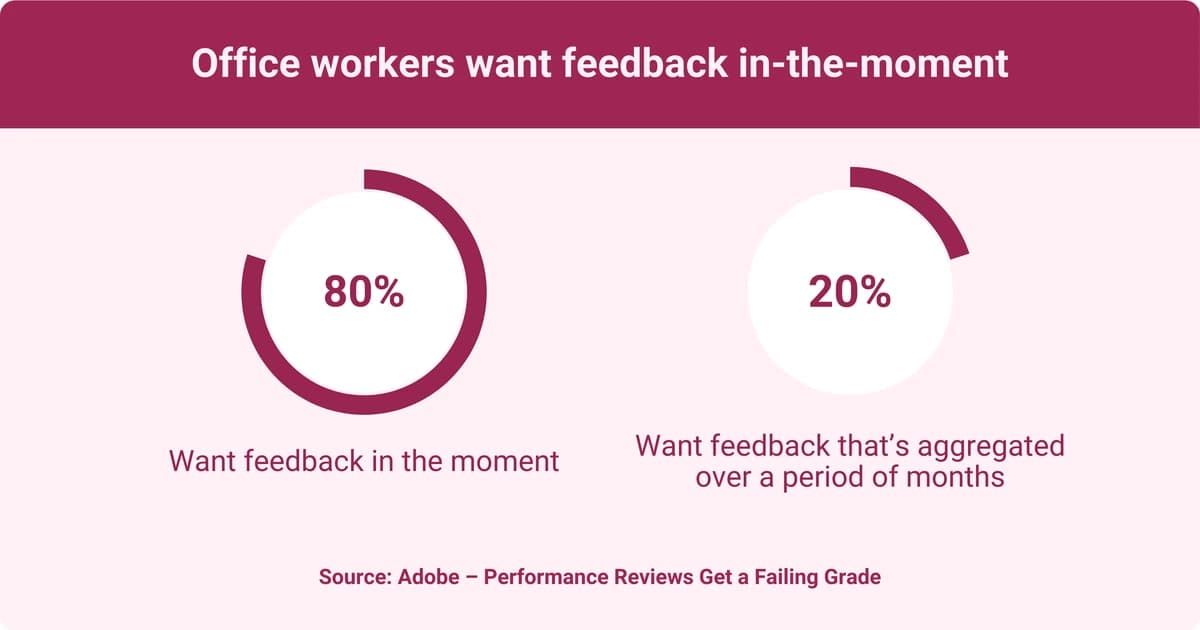
When paired with Human Intelligence™ (AI + recognition data), leaders can spot patterns that matter, like where collaboration is thriving, where recognition is uneven, or where teams may be at risk of disengagement.
Lower operational and people costs
DEX improvements can reduce ticket volume, cut time-to-productivity for new hires, and limit turnover driven by chronic friction. Strong digital experiences also reduce shadow IT by making the “right way to work” the easiest way to work, protecting security and compliance without slowing teams down.
Better cross-functional collaboration
When the digital workplace is coherent, collaboration scales. Employees can find information, align quickly, and contribute across boundaries without battling tool sprawl or inconsistent processes. Over time, that clarity supports faster execution, better decision-making, and more inclusive participation across locations and roles.
Key elements of an effective digital employee experience
A functional digital employee experience strategy must include several core elements, including easy accessibility, data security, and system-wide integrations.
Alignment with business strategy
DEX investments should complement your broader business goals, such as improving employee retention, performance, and company culture. For example, when investing in new hybrid work software, consider solutions that support both user experiences and your organization's scalability. When providing employees with feedback, keep recognitions and goals aligned with your business's values and strategic priorities.
Usability and accessibility
Integration and connectivity
To streamline your digital workplace experiences, use platforms and solutions that integrate with your other daily tools. Digital workplace platforms such as Workhuman offer integrations with Slack, Teams, Outlook, and email to keep all communication in one, easy-to-use interface. This supports collaboration while avoiding disconnected experience layers.
Recognition, feedback, and belonging are embedded in daily work
Employee recognition isn't just "nice to have." Recognition, feedback, and belonging are core elements of the digital employee experience when they are embedded directly into daily tools employees already use.
Recognition from leaders and peers can increase employees' visibility and equity, especially when supported by employee experience technology such as Workhuman Recognition Advisor™ and Social Recognition. Additionally, AI support can improve the quality of your recognition messages without adding friction.
Data, insight, and culture intelligence
Today's digital age requires leaders and HR to move beyond surveys and other traditional tools to track engagement and culture. Now you can use real-time signals and data points from experience technology to continuously track and develop strategies to improve employee engagement.
Data from recognition tools and Workhuman's Inclusion Advisor can reveal gaps and strengths in your team's engagement. Use these insights to refine your company culture and engagement based on your team's unique needs.
Security, trust, and privacy
The digital workplace tools you use should be secure enough to protect all sensitive data your organization may handle. Employee, client, and customer data are protected by the Privacy Act and other laws, depending on your industry.
Encryption and thorough cybersecurity will help you ethically manage data and maintain legal compliance. Additionally, disclosures of how data is collected and used support better transparency at work.
Digital employee experience examples
Digital workplace experiences vary based on your industry, organizational structure, employees, and business outcomes. Check out these examples of digital employee experiences in action.
Example 1: Embedding recognition into daily collaboration
A distributed workforce can leave you with various teams and workflows to track when providing feedback and recognition. It's easy to embed employee experience technology into collaboration tools for accurate, in-the-flow recognition. These personalized, actionable insights can increase participation, visibility, and engagement.
Example 2: Using recognition data to identify engagement gaps
Recognition data from digital workplace tools reveals gaps in engagement and performance. Leaders can track surface trends by team, region, and role to narrow down the exact issues contributing to low engagement. They can then enact targeted interventions to effectively improve retention, performance, and collaboration.
Example 3: Scaling meaningful feedback with AI support
Many AI-supported tools automatically analyze trends and patterns in employee engagement to provide a holistic understanding of their performance, backed by specific data. These insights can improve the quality of employee feedback at scale without risking manager overload.
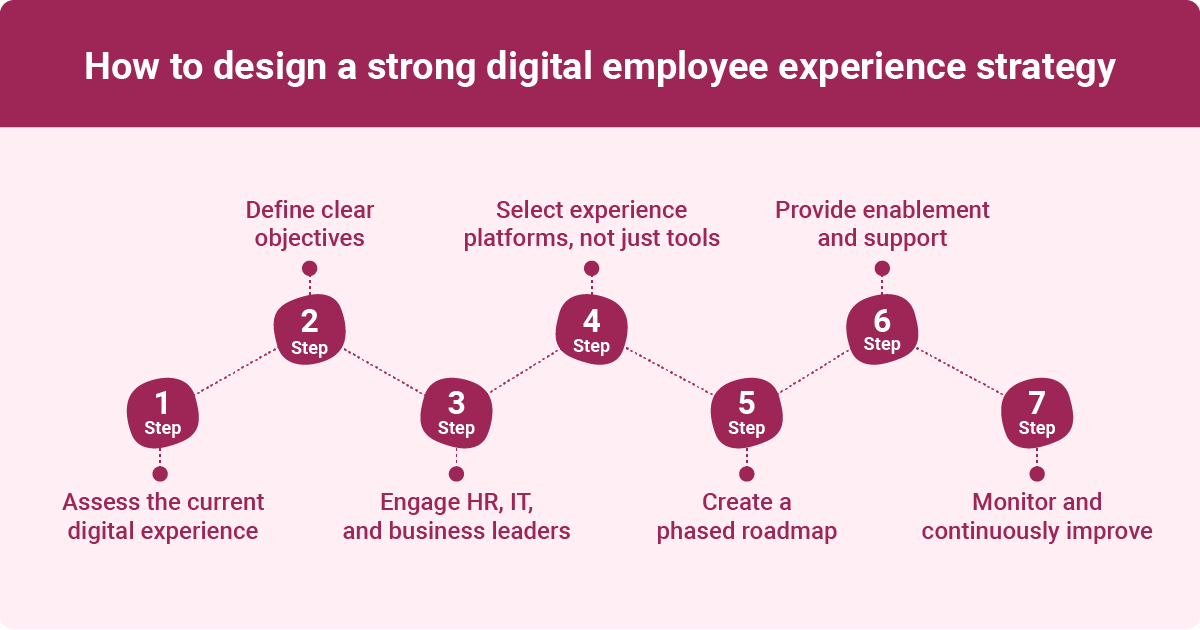
How to design a strong digital employee experience strategy
Follow these steps to develop a digital employee experience strategy based on your team's unique needs.
Step 1: Assess the current digital experience
Consider the different technologies employees already work with, such as inventory tools, email accounts, and cloud storage. Identifying your experience touchpoints and workflows can offer crucial insights into the variables impacting your team.
Analyzing recognition participation and sentiment signals using Workhuman helps you understand how employees genuinely feel about their digital workflows and systems.
Step 2: Define clear objectives
Once you understand the strengths and gaps of your current digital workplace experience, set clear and measurable goals for your new experience strategy. Consider objectives related to employee productivity, engagement, belonging, retention, and culture change.
Step 3: Engage HR, IT, and business leaders
Redefining your organization's digital landscape shouldn't be a one-person job. Get business leaders, HR, IT departments, and other relevant departments involved in the experience design. This can establish shared ownership and help you develop an employee experience strategy that aligns with everyone's interests.
Step 4: Select experience platforms, not just tools
Searching for files across multiple apps, programs, and tabs can slow down operations, cause anxiety, and contribute to data silos. As you upgrade your technology, look beyond individual, single-purpose tools. Instead, prioritize integrated platforms that combine experience delivery with insight, such as with Workhuman's embedded recognition and feedback.
Step 5: Create a phased roadmap
Step 6: Provide enablement and support
Everyone adapts to new company technology differently, so some employees may need a little more support than others. AI-assisted coaching reduces the burden of training and software onboarding while providing employees with the support they need. For example, Workhuman's Recognition Advisor supports in-the-moment coaching and guidance by providing actionable recognition and feedback.
Step 7: Monitor and continuously improve
Relying on only annual snapshots or periodic reviews limits your ability to monitor improvement or identify the specific factors impacting employee experiences.
On the other hand, tracking real-time signals maximizes your insights into how employees are managing and feeling in their digital workplace environments. You can identify and respond to issues as quickly as they appear to maintain a productive, stress-free culture.
How to measure DEX
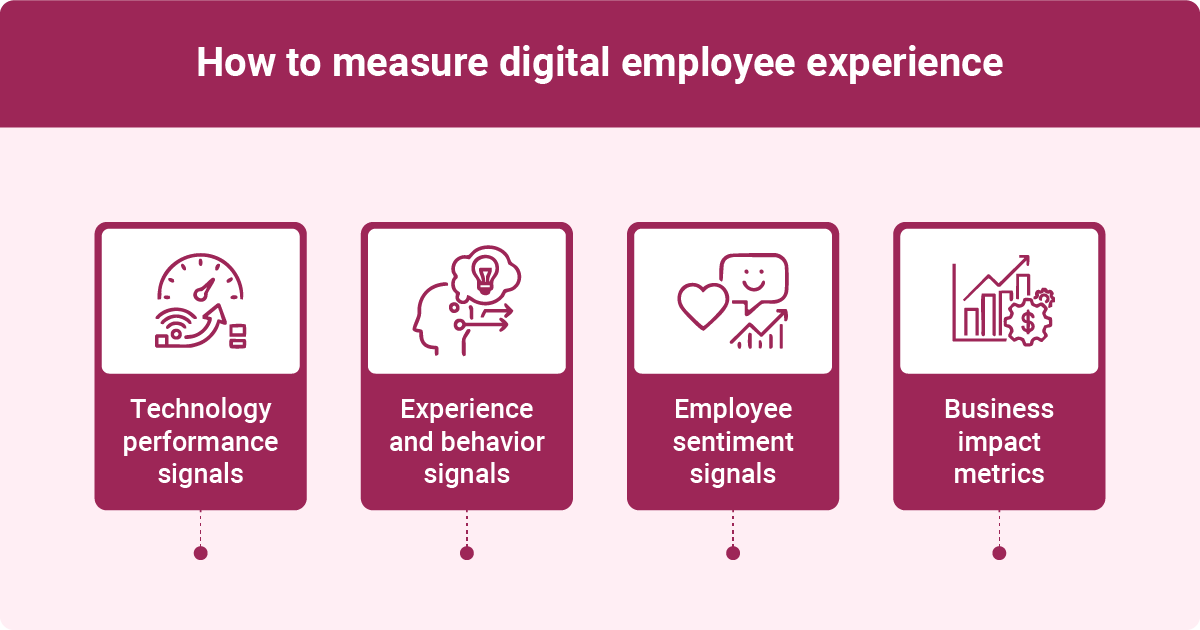
As you establish objectives for your digital employee experience strategy, ensure that your goals are tangibly measurable. For example, instead of saying you want employees to "work harder," consider the objective metrics, signals, and key performance indicators (KPIs) you can use to track productivity.
The following DEX metrics can be useful for measuring job satisfaction and refining employees' digital workflows.
Technology performance signals
KPIs related to technology performance gauge how your digital tools and solutions support or impair employees' experiences. For instance, an office's internet connection quality can significantly speed up or slow down its daily operations.
Examples of technology performance signals include:
- Platform stability and reliability
- Device uptime and health
- Access history
- Network latency
- Crash and error reports
- IT ticket volumes
Experience and behavior signals
Recognition data provides continuous, behavioral insight into engagement, connection, and belonging. Additionally, tracking the frequency of and participation in peer-to-peer recognition offers crucial insights into peer visibility and cross-team recognition.
Other examples of experience and behavior signals include:
- Software usage and adoption data
- Performance and workflow trends
- Time spent completing tasks
- Participation rates
Employee sentiment signals
Unlike traditional surveys, recognition data reflects lived experience in real time. Pulse surveys, in-the-moment feedback, and other employee sentiment strategies provide more accurate, up-to-date DEX data.
Information such as the changing trends in pulse survey scores over time gives you insight into understanding and managing the human side of employees' experiences. Solutions like Workhuman iQ™Opens in a new tab/Human Intelligence™Opens in a new tab can further help you turn employee sentiment signals into qualitative insights.
Business impact metrics
Connect DEX trends to retention, engagement, onboarding time-to-productivity, and operational productivity measures (output per employee, cycle time, project velocity). Where possible, run correlation analysis between DEX scores and business KPIs.
Finally, consider how AI-powered analytics can accelerate insight. Workhuman iQ and its AI Assistant surface cultural health signals, engagement patterns, retention risks, skills mapping, and on-demand reporting — along with personalized recommendations for managers and insights that link employee contributions to company values.
Calculating the ROI on your digital employee experience investment
A credible DEX ROI model starts with a baseline (current ticket volume, tool usage, downtime, time-to-proficiency, and key workflow cycle times). From there, quantify costs and benefits conservatively and show payback over 12–36 months.
Cost components
Include software licenses, devices and infrastructure, implementation and integration services, training/change management, ongoing support, and internal project time.
Hard benefit calculations
Prioritize savings you can validate in finance terms:
Soft benefit calculations
Model productivity gains carefully: minutes saved per day × employees × fully loaded hourly rate × workdays. TeamViewer found 80% of workers lose time to dysfunctional IT, averaging 1.3 days per month—use data like this to justify why small friction reductions add up.
Example: saving 5 minutes/day for 2,000 employees at $50/hour over 230 workdays ≈ $1.9M/year in capacity.
ROI formula and reporting
ROI % = (Total benefits − Total costs) ÷ Total costs × 100. Also report payback period and (for multi-year programs) NPV with a risk-adjusted discount rate.
Building a business case
Lead with hard savings, then layer in productivity and experience outcomes. Use scenarios (conservative/base/aggressive) and tie improvements back to the business processes leaders care about: onboarding speed, cycle time, and retention risk.
Understanding the DEX technology stack
For leaders building a business case, it helps to view DEX as a stack, not a single purchase. The goal is a great digital employee experience that removes friction from everyday business processes and helps empower employees to do their best work—whether they’re in the office, remote, or hybrid.
That’s why conversations around implementing a digital employee experience solution increasingly sit at the intersection of HR, IT, and security: the experience is shaped as much by integration and architecture as by any one tool.
And when the stack isn’t working, the cost is real—TeamViewer research, ‘The impact of digital frictionOpens in a new tab’ found 80% of employees lose productive time to dysfunctional IT, averaging 1.3 days per month.
Infrastructure layer
This foundation includes endpoint management (desktop computers, laptops, and mobile devices), connectivity (Wi-Fi/VPN), identity and security (SSO/MFA, endpoint protection), and digital workspace delivery (virtual desktops/browser-based workspaces). Reliability here is what makes a seamless digital employee experience possible.
Application layer
Next are the systems employees live in: communication (email/chat/video), collaboration, HR platforms (HRIS, learning, performance), and productivity suites. Tool sprawl and inconsistent access create detours in core business processes—and that’s where adoption and engagement often break down.
Experience and analytics layer
This is where DEX becomes measurable and manageable: digital adoption guidance, experience monitoring, sentiment signals, and virtual support. Gartner, in ‘Digital Employee Experience Management Tools Reviews and Ratings’, defines digital employee experience management tools as solutions that improve employee sentiment and technology performance using near-real-time data from endpoints, applications, and context, including self-healing automation.
Top DEX platform categories
Common categories include UEM, dedicated DEX platforms, EXP suites with DEX modules, ITSM with employee-focused experience features, and standalone analytics. As per ‘The Great DEX-pansion Of 2025’, Forrester predicts continued market growth and consolidation as buyers push for more unified capabilities.
How AI and automation enhance DEX
AI helps empower employees through predictive issue detection, automated remediation (“self-healing”), and 24/7 virtual agents that resolve common requests quickly—supporting a great digital employee experience without adding headcount.
DEX architecture: How components work together
A practical architecture connects data collection (agents/APIs/telemetry) to aggregation (lake/warehouse), analytics (patterns, anomalies, prediction), and action (workflow triggers, fixes, self-service), then surfaces insights in role-based dashboards.
Integration is the difference between “more tools” and a seamless digital employee experience: Workhuman Cloud® offers packaged integrations with Workday (including Workday Cloud Certified Connect), Microsoft Teams, and Slack, plus open APIs and a lightweight design that reduces logins and workflow friction.
Overcoming common digital employee experience challenges
No system is perfect, especially when it comes to new technology. Fortunately, a proactive strategy can overcome common DEX hurdles.
Here are some of the most significant challenges of digital employee experiences – and how you can address them.
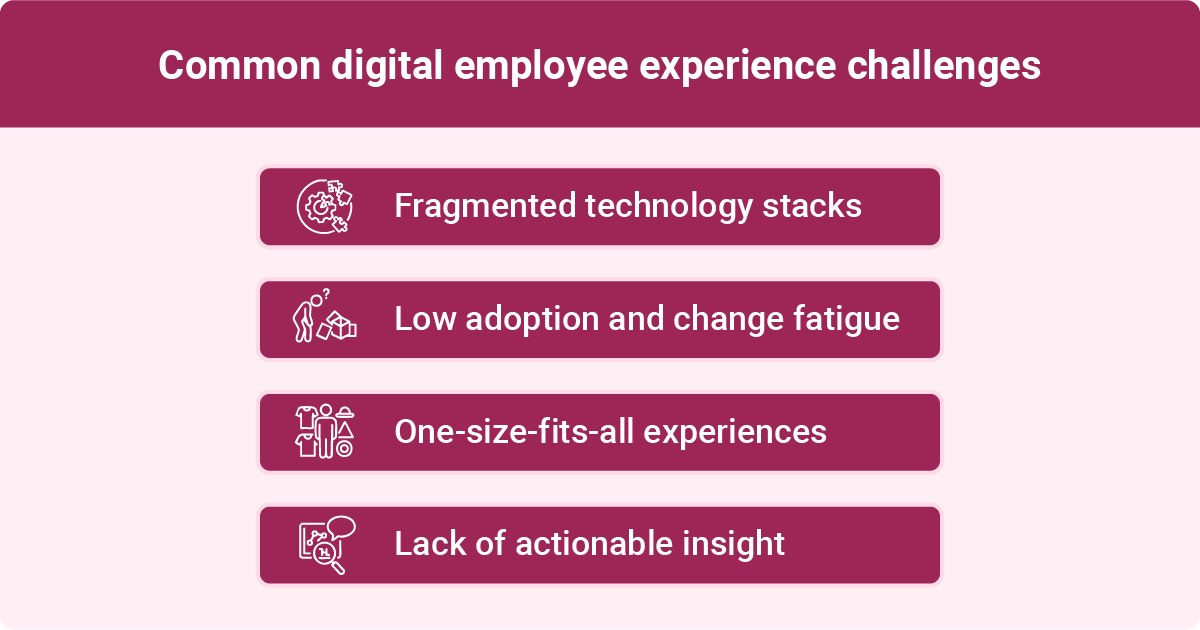
Fragmented technology stacks
Instead of continuously adding tools to expand your digital capabilities, consider integrating your experience layers to support unity, collaboration, and cohesiveness.
Low adoption and change fatigue
With new technologies being introduced seemingly constantly across industries, employees may eventually grow tired of change. Design digital experiences around workflows and processes that employees actually want to use, and prioritize platforms such as Workhuman that stay up to date with the latest DEX technology. Additionally, use employee recognition as a natural driver when adopting new tools.
One-size-fits-all experiences
While it might sound great to develop a single system that suits every employee's digital experience, this isn't always practical. Employees' needs vary by their role, location, strengths, preferences, at-home capabilities, and various other factors. While you may start your DEX strategy with a one-size-fits-all approach, you'll eventually need to tailor digital workplace employee experiences around each person's unique needs.
Lack of actionable insight
DEX metrics and KPIs aren't always directly measurable using traditional performance-tracking strategies. Instead, you will need to track various key DEX signals to record tangible data on employees' engagement, software adoption, and digital experiences. Move away from traditional surveys and towards continuous experience intelligence, such as with AI-powered tracking and analytics.
The future of the digital employee experience
Even if you develop the perfect digital employee experience for now, it will still need to evolve to keep up with industry changes, artificial intelligence, and new technologies. Following the latest trends in digital workplace experiences will help you future-proof your DEX strategy.
AI-driven personalization
AI-powered tools provide tailored recognition, feedback, and nudges based on each employee's unique responsibilities, goals, and needs. This level of AI-driven personalization can particularly support human resources by offering crucial tips for everyone on your team.
Strategies for implementing AI into HR include:
- Identifying upskilling opportunities
- Prioritizing security and privacy alongside AI innovation
- Promoting the benefits of your DEX strategy to drive adoption
- Using dependable systems for employee management and recognition, such as Workhuman
Continuous culture intelligence
According to ‘Organizational Culture - Cultural Change and Technology,’ a strong, adaptive company culture can support digital transformation and growth when adopting new practices. DEX tools are actively evolving to offer increasingly precise real-time visibility into engagement and belonging.
These insights can also support the continuous development of cultural intelligence to improve how your work culture interacts in diverse cultural settings and with individuals from different backgrounds.
Experience in the flow of work
Your digital workplace experiences should enable employees to easily complete their daily tasks without interruptions or friction.
Modern DEX strategies are prioritizing fewer platforms and more embedded experience moments to streamline your access to information while preserving security and privacy. Prioritize platforms with intuitive, user-friendly designs that let you easily access all relevant tools and information for every project.
From programs to ecosystems
Integration and synchronization are increasingly important for distributed, hybrid, and remote workforces. The right interconnected tools enable teams to easily share and access information, even when using different apps. This is especially crucial as technologies continue to evolve, as you may need to adopt more tools and workflows to keep up with industry trends.
FAQ
How do you measure the success of a digital employee experience initiative?
Use a balanced set of metrics: perception (DEX score, task effort), adoption (active use and proficiency), performance (uptime/latency/errors), digital friction (tickets, password resets, tool switching), and business impact (onboarding time, retention signals, productivity indicators). Segment by persona, location, and role so you can identify gaps that averages hide.
How does digital employee experience impact remote and hybrid teams specifically?
Remote and hybrid teams feel DEX more intensely because nearly every interaction is mediated through technology. When access is inconsistent, performance is unstable, or workflows require too many steps, it shows up as slower cycle times, more interruptions, and weaker connections. When DEX is strong, teams collaborate smoothly across locations, get help faster through self-service, and maintain shared rituals (like recognition) that reinforce belonging.
Who is responsible for digital employee experience—HR or IT?
Both. IT teams typically own infrastructure, security, and support operations; HR owns the employee experience principles, listening strategy, and change enablement. The best model is a shared governance structure (often a digital workplace or DEX steering group) that aligns standards, prioritizes journeys, and resolves trade-offs between experience, cost, and risk.
What is a reasonable timeline for seeing ROI from DEX investments?
Expect a phased curve. Quick wins (like SSO improvements, workflow simplification, and self-service enhancements) can show measurable friction reduction within 30–90 days. Hard savings (ticket reduction, tool rationalization) often become clearer in 3–6 months, while retention and productivity benefits typically require 6–18+ months to validate. Baseline first, then report payback and run-rate value over time.
What role do employees play in designing and improving DEX?
A central one. Employees should help map high-friction journeys, validate priorities, and pilot improvements. Treat them as co-design partners (not just survey respondents) through focus groups, champions, and feedback loops. This increases adoption, reduces rework, and ensures you’re improving the workflows that matter most.
How do you balance security requirements with a frictionless digital employee experience?
Start with a principle: “secure by design, simple by default.” Use SSO and strong identity controls to reduce logins, apply conditional access so you only add friction when risk is higher, and measure the employee impact of security steps (authentication failures, reset frequency, time-to-access). The aim is security that protects data without slowing down the work you’re trying to enable.
Wrapping up
In the modern, technological age, investing in digital employee experience means investing in how your workplace actually feels. Done right, re-strategizing your DEX can streamline operations, support employee engagement, and improve collaboration and feedback between leaders, peers, and teams.
Workhuman's digital solutions offer crucial, real-time insights to help you understand employees' thoughts, refine experiences, and support adoption with continuous recognition.

Ryan Stoltz
Ryan is a search marketing manager and content strategist at Workhuman where he writes on the next evolution of the workplace. Outside of the workplace, he's a diehard 49ers fan, comedy junkie, and has trouble avoiding sweets on a nightly basis.
Recommended for you