
Workhuman vs. Awardco: The 2026 Employee Recognition Comparison Guide
by Ryan Stoltz
6 min read
Table of contents
- Workhuman vs. Awardco Platform Overview
- Feature Comparison: Workhuman vs. Awardco
- Recognition & Culture Building
- Integrations & Tech Ecosystem Fit
- Pricing & Cost-Effectiveness
- Impact on Engagement, Retention, and Morale
- AI and Product Innovation
- Global Reach and Capabilities
- Customer Support
- Ease of Use & Implementation
- Workhuman vs. Awardco: Strengths & Weaknesses
- Workhuman vs. Awardco: What Customers Say
- Workhuman vs. Awardco: Final Verdict
Share this article
Employee recognition software has evolved from a feel-good perk into a critical system for driving engagement, retention, and performance at scale.
As organizations are under increasing pressure to do more with fewer resources — and to clearly prove ROI on people investments — recognition platforms are expected to deliver far more than points and prizes. They need to integrate seamlessly into daily work, drive sustained participation, and generate insights leaders can actually use.
That’s why Workhuman and Awardco are so often compared. Both platforms enable peer-to-peer recognition and rewards, and both support broad participation across organizations.
But the similarities largely stop there. The two platforms differ meaningfully in how recognition is designed, how deeply it connects to company values and culture, and what kind of data and insight leaders gain from recognition activity over time.
For organizations evaluating these options, the real question isn’t just which platform recognizes more people, but which one turns recognition into a long-term cultural and business advantage.
This guide breaks down how Workhuman and Awardco compare — so leaders can choose the platform that best aligns with their culture goals, scale requirements, and expectations for measurable impact.
Workhuman vs. Awardco Platform Overview
Workhuman at a Glance
Awardco at a Glance
- Founded in 2015, with a primary focus on reward distribution, not long-term culture transformation
- Recognition is largely points-driven and transactional, serving as a trigger to issue rewards rather than a mechanism to reinforce values or behaviors
- Emphasizes budget controls and administrative efficiency over strategic insight
- Limited ability to surface meaningful data about:
- How work gets done
- Which behaviors are being reinforced
- Where collaboration, leadership, or skills are emerging
- Limited support for global equity at scale, with rewards and value perception varying by country due to reliance on external marketplaces and currency-based models rather than a built-for-purpose global standard
At a basic level, both Awardco and Workhuman enable employees to send recognition and redeem rewards. But the similarity is largely functional, not foundational.
Feature Comparison: Workhuman vs. Awardco


Recognition & Culture Building
Workhuman
Awardco
- Recognition is primarily peer-to-peer and milestone-based, with an emphasis on participation and frequency.
- Recognition activity can be high, but messages often lack depth — focusing more on points and transactions than on values, behaviors, or cultural reinforcement.
- Limited mechanisms to guide or improve recognition quality in the moment, resulting in more generic recognition over time.
- Culture-building relies largely on volume rather than intentional reinforcement of what the organization wants more of.
- Better suited for driving recognition activity than for shaping culture in a deliberate, measurable way.
Integrations & Tech Ecosystem Fit
Workhuman
Awardco
- Offers surface-level integrations with tools like Slack, Teams, and HRIS platforms, primarily to support basic recognition actions.
- Integrations function largely as triggers and pass-throughs, with minimal depth beyond initiating or approving rewards.
- Recognition data flowing through integrations is thin and transactional, limiting its usefulness for reporting, analytics, or insight.
- Heavy reliance on standardized, one-size-fits-all integrations restricts flexibility as organizations mature or scale.
- As integration needs grow — especially around data, governance, and analytics — Awardco's ecosystem often becomes a constraint rather than an asset.
Pricing & Cost-Effectiveness
Workhuman
Awardco
- Pricing is positioned as simple and transparent, primarily tied to reward spend and platform access — which masks the true cost of running an effective program.
- As program needs grow, costs increase linearly with usage — without any corresponding increase in intelligence, effectiveness, or ROI.
- Minimal built-in guidance shifts responsibility to internal teams to:
- Design and refine recognition programs
- Troubleshoot adoption issues
- Curate rewards catalogs
- Manage global inconsistencies and equity gaps
- Build reporting workarounds outside the platform
- What looks “cheaper” on paper often results in higher operational cost, more manual effort, and weaker long-term returns.
Impact on Engagement, Retention, and Morale
Workhuman


“We’re really focused on outcomes. … And measuring who is getting recognized, the frequency of recognition, linking it to retention, linking it to turnover implications – all of that demonstrates the return on investment is significant.”
Awardco
- Success is often framed around recognition frequency and adoption rates, positioning volume of activity as the primary indicator of impact.
- Engagement and morale are typically inferred from surface metrics such as:
- Recognitions sent
- Logins
- Rewards redeemed
- Limited connection between recognition activity and deeper outcomes like sustained engagement, retention, or performance improvement.
- Recognition data provides visibility into usage, but little insight into why morale is rising or falling, or which behaviors are driving results.
- Impact tends to plateau over time, as increased activity does not necessarily translate into stronger culture, belonging, or long-term retention.
AI and Product Innovation
Workhuman
Awardco
- Product innovation is primarily focused on driving participation and simplifying reward delivery, rather than advancing recognition intelligence.
- Technology is used mainly to support standard workflows such as peer recognition, milestones, and reward fulfillment.
- Analytics are largely descriptive, centered on:
- Recognition volume
- Program usage
- Reward spend
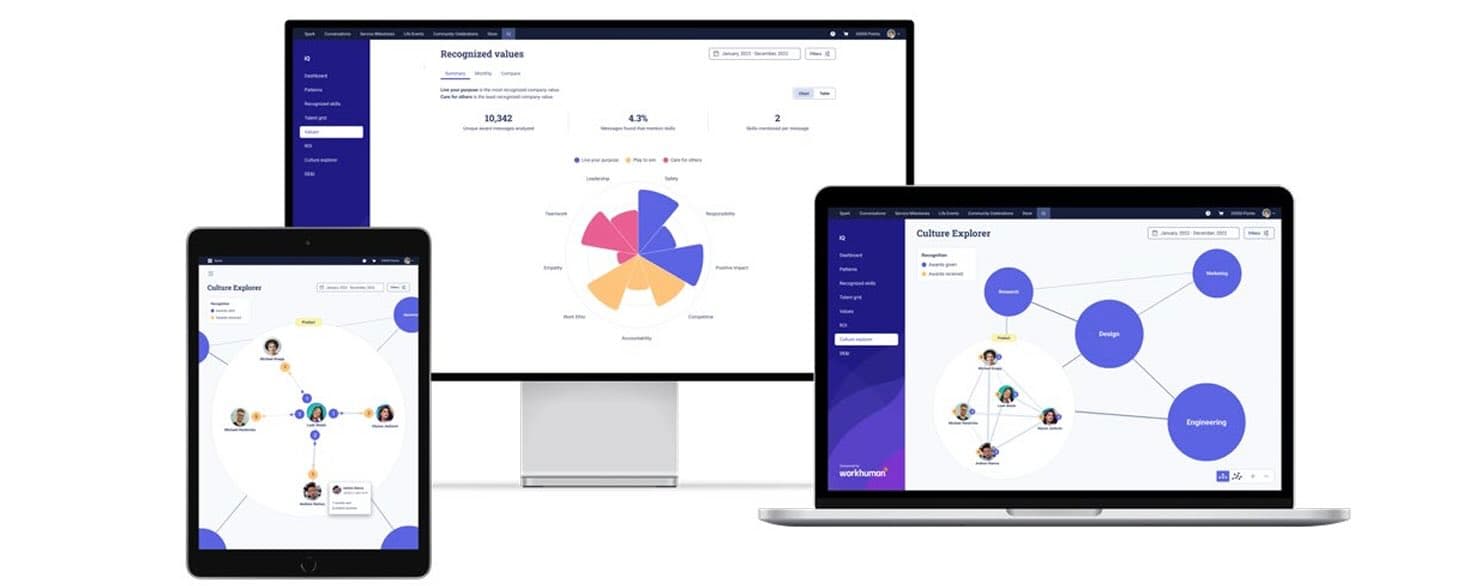
- Limited application of AI to improve recognition quality, surface behavioral insight, or translate recognition data into talent, culture, or business intelligence.
- Recognition data is not structured or leveraged in a way that supports skills intelligence, culture diagnostics, or strategic decision-making.
- As a result, recognition remains an operational system, not an intelligence layer leaders can learn from.
Global Reach and Capabilities
Workhuman
Awardco
- Global rewards are available, but experiences vary significantly by country and region.
- Equity mechanisms such as purchasing parity are not automatic and often require manual configuration or special requests.
- Heavy reliance on external marketplaces creates inconsistency in:
- Reward value perception
- Local relevance
- Overall employee experience
- Limited built-in systems to ensure fairness and consistency at scale, especially as programs expand globally.
- Global reach exists functionally, but global equity and experience consistency are not engineered into the platform.
Customer Support
Workhuman
Awardco
- Standard customer support model focused on platform usage and issue resolution.
- Limited access to strategic consulting or data-driven guidance beyond initial setup.
- Greater reliance on external partners for fulfillment, introducing handoffs and variability in the support experience.
- Ongoing success is largely dependent on internal teams to optimize, evolve, and prove value over time.
Ease of Use & Implementation
Workhuman
Awardco
- Easy to navigate at a surface level, but simplicity is largely limited to basic recognition and reward actions.
- Implementation is relatively lightweight upfront — but offers limited strategic guidance, leaving organizations to figure out program design, rollout strategy, and optimization on their own.
- Administrative experience becomes increasingly cumbersome as complexity grows:
- Limited segmentation by role, geography, or business unit
- Manual workarounds required to manage multiple programs or regions
- Global tax handling, compliance, and localization introduce significant operational burden, often falling entirely on internal HR, finance, and legal teams.
- Customization options for admin messaging, homepage content, and targeted communications are constrained, reducing agility and relevance over time.
- What initially feels “easy” often translates into more manual effort, more internal dependency, and more friction as programs scale.
Workhuman vs. Awardco: Strengths & Weaknesses
Workhuman Strengths
Workhuman Weaknesses
- Best suited for organizations seeking strategic, culture-building recognition, not for those wanting a simple gift-card shop.
- The partnership model includes consultation and coaching, which some buyers may view as more robust than necessary.
Awardco Strengths
- Simple points-and-redemption structure that’s easy to use, but offers little beyond a standard ecommerce-style experience.
- Amazon partnership offers broad product availability, but largely replicates an off-the-shelf ecommerce experience rather than delivering a differentiated or meaningful recognition journey.
- Meets minimum requirements for organizations with very basic recognition expectations and no need for intelligence, customization, or scale.
Awardco Weaknesses
- High perceived pricing, with users reporting overpriced rewards and inflexible pricing structures.
- Confusing points system with limited transparency into value and redemption.
- Limited product search functionality, making it harder for employees to find what they want quickly.
- Manual or shallow integrations, especially with Slack and Workday, requiring IT teams to maintain basic connectivity.
- No global equity system like SOLI™, so international programs may feel inconsistent.
- Limited analytics and minimal insight beyond transactional reporting.
Workhuman vs. Awardco: What Customers Say
Customer Feedback & Quotes
Workhuman:
Awardco:
- "Awardco lacks that 'extra' element that other programs capture really well. While you can recognize peers, you can't add those extra personalized touches with GIFs and emojis. The overall UI of Awardco is lackluster. Compared to others, the branding, company voice, and personality is missing." – Verified G2 User
- "We were promised hundreds of reward options but ended up with maybe 20-30 actually useful choices." – G2 Review
- "The system is down more often than it's up, which kills employee enthusiasm for the recognition program." – G2 Review
- Complex navigation: Multiple G2 reviews mention that the platform requires extensive training and has a steep learning curve that reduces organic adoption rates.
- Enterprise customers frequently mention 6-12 month implementation timelines with extensive change management requirements that strain internal resources.
Workhuman vs. Awardco: Final Verdict
Both Workhuman and Awardco support frequent recognition and broad participation. The real decision comes down to what you need recognition to deliver over time — not just at launch, but as your organization scales, globalizes, and expects proof of impact.
Choose Workhuman if:
Choose Awardco if:
You primarily want a reward distribution system.
Awardco works best when recognition is treated as a trigger for points and redemption rather than a tool for shaping culture or behavior.
You prefer a simple, transactional model over strategic depth.
The platform is optimized for ease and familiarity, not for insight, intelligence, or long-term evolution.
You’re focused on short-term engagement signals.
Awardco emphasizes participation rates, reward usage, and spend visibility — which may be sufficient if usage is the primary success metric.
You have basic recognition needs and limited expectations for customization, analytics, or global equity.
Awardco can meet minimum requirements, but becomes more constrained as programs grow in complexity or scale.
Final Verdict
Both Workhuman and Awardco can support frequent recognition and be rolled out across organizations.
The difference shows up after launch.
Awardco focuses on distributing rewards efficiently. But once programs are live, organizations often encounter limitations: recognition remains transactional, insight is limited to activity and spend, customization is constrained, and administrative effort increases as complexity grows. Over time, this can cap impact and make it harder to demonstrate real value beyond participation.
Bottom line
- Workhuman delivers efficiency plus insight and sustained impact.
- Awardco delivers rewards — with limited depth and diminishing strategic value over time.
See also:
Workhuman vs. Achievers: Which Employee Recognition Platform Is Better for Your Organization?
Nectar vs Workhuman Comparison Guide

Ryan Stoltz
Ryan is a search marketing manager and content strategist at Workhuman where he writes on the next evolution of the workplace. Outside of the workplace, he's a diehard 49ers fan, comedy junkie, and has trouble avoiding sweets on a nightly basis.
Recommended for you