
Workhuman vs. Terryberry: 2026 Comparison Guide
by Ryan Stoltz
Last updated
10 min read

Table of contents
- Workhuman vs. Terryberry Platform Overview
- Feature Comparison: Workhuman vs. Terryberry
- Rewards Experience
- Service Milestones Approach
- Recognition & Culture Building
- Integrations & Tech Ecosystem Fit
- Pricing & Cost-Effectiveness
- Impact on Engagement, Retention, and Morale
- AI and Product Innovation
- Global Reach and Capabilities
- Customer Support
- Ease of Use & Implementation
- Workhuman vs. Terryberry: Strengths & Weaknesses
- Workhuman vs. Terryberry: What Customers Say
- Workhuman vs. Terryberry: Final Verdict
Share this article
Employee recognition software is no longer just a tool for distributing points or celebrating service anniversaries.
Organizations increasingly expect recognition platforms to reinforce company values, reach employees across different work environments, simplify program administration, and provide evidence that recognition is influencing engagement and retention.
Workhuman and Terryberry both support peer-to-peer recognition, manager recognition, employee rewards, and milestone celebrations. Both also offer integrations intended to make recognition easier to access during the workday.
The platforms differ, however, in how those features are brought together.
Workhuman is built around a strategic social recognition program that uses recognition data to provide insight into culture, skills, collaboration, and performance.
Terryberry combines digital recognition with points-based rewards, service awards, employee surveys, and distinctive physical or symbolic awards.
For organizations comparing the two, the decision comes down to the type of recognition experience they want to create and what they expect the platform to deliver beyond participation.
This guide compares Workhuman and Terryberry across their most important recognition and rewards features.
Workhuman vs. Terryberry Platform Overview
Workhuman at a Glance
Terryberry at a Glance
- Recognition platform with peer-to-peer, manager-led, milestone, service award, and points-based reward capabilities.
- Strong historical emphasis on service anniversaries and physical awards, which may make the experience better suited to traditional milestone programs than continuous, behavior-based culture building.
- Recognition is closely connected to points, merchandise, custom awards, and fulfillment, placing greater emphasis on reward delivery than on the quality and strategic value of recognition messages.
- Deeper engagement and sentiment insights depend on Terryberry’s separate Be Heard capability and broader Be Engaged ecosystem rather than coming directly from recognition data alone.
- AI capabilities focus primarily on expanding recognition messages, changing their tone or length, and monitoring content.
- Manager reporting focuses largely on recognition frequency, participation, team comparisons, and employees who may be receiving less recognition.
- Some G2 reviewers report a clunky or unintuitive administrative interface, limited customization, and difficulty navigating certain areas of the platform.
At a functional level, both platforms cover the essential recognition and rewards use cases.
The difference is where each platform places its greatest emphasis.
Workhuman uses recognition as the foundation for culture reinforcement and workforce intelligence. Terryberry provides a broad combination of digital recognition, rewards, service awards, surveys, and tangible commemorative products.
Feature Comparison: Workhuman vs. Terryberry


*Workhuman’s proprietary Standard of Living Index (SOLI) automatically adjusts award values based on each award recipient’s location, ensuring global equity.
Rewards Experience
Workhuman
- Offers millions of reward choices through a global marketplace covering more than 150 localized country catalogs.
- Reward options include merchandise, gift cards, travel, experiences, charitable contributions, and other locally relevant choices.
- SOLI adjusts award values based on local purchasing power rather than relying only on currency conversion.
- The marketplace and recognition platform operate as one connected experience, from award creation through redemption and support.
- Global reward strategy is designed around consistency, localization, and equitable employee value.
- Rewards support the recognition moment but do not replace the message, behavior, or value being reinforced.
Terryberry
- Offers merchandise, gift cards, company swag, experiences, charitable giving, ecommerce products, and physical service awards.
- Maintains a particularly strong focus on jewelry, plaques, trophies, certificates, and other symbolic awards, which may be useful for milestone programs but less relevant to organizations prioritizing continuous social recognition.
- The Amazon Business integration expands product access for employees in the United States, but its primary fulfillment advantages do not necessarily extend consistently across a global workforce.
- Some G2 reviewers report that reward selections can feel limited or inexpensive, particularly when preferred products are unavailable.
- Catalog-based programs can create additional friction when an employee selects an item that has been discontinued or is out of stock.
- Reviewers also report that shipping charges may not be included in displayed gift prices, making the actual cost of redemption more difficult to anticipate.
Key Feature Difference
Terryberry provides several ways to deliver products and commemorate milestones. Workhuman provides a more consistent global rewards experience built around employee choice, local relevance, and equitable value.
Terryberry’s physical awards may appeal to organizations maintaining traditional service-award programs. However, those capabilities do not address the broader challenge of making rewards feel equally valuable across countries.
Workhuman’s SOLI adjusts award value based on local purchasing power. This gives Workhuman a structural advantage over systems that rely primarily on points, catalog tiers, or currency conversion.
The result is a rewards program that is not only broad, but designed to remain fair and consistent as the organization expands globally.
Service Milestones Approach
Service milestones can take different forms. Here’s how Workhuman and Terryberry compare across the employee experience, rewards, participation, and program administration.
Ready to give your people another reason to stay?
See how Workhuman’s Service Milestones recognizes the impact people have made while inspiring them to keep making it.

Recognition & Culture Building
Workhuman
Terryberry
- Supports peer-to-peer and manager-led recognition through a public social feed, although the experience remains closely linked to points and rewards.
- Allows recognition to be connected to organizational values, but provides less evidence of real-time guidance that helps employees explain which specific behaviors made a contribution valuable.
- AI can turn a short note into a longer message, but expanding message length does not necessarily make recognition more meaningful, behavior-specific, or culturally useful.
- Manager dashboards identify participation patterns and employees who may be receiving less recognition, but the insights remain largely focused on recognition activity rather than what the content reveals about culture.
- Recognition can be connected with eNPS and employee sentiment, but these insights require Terryberry’s Be Heard listening solution and are not generated solely from recognition activity.
- Be Recognized works as a standalone product, but Terryberry itself positions the experience as strongest when combined with its wider Be Engaged suite, potentially adding product and administrative complexity
Key Feature Difference
Terryberry makes it possible to send recognition and monitor whether employees are participating.
Workhuman is designed to improve what employees say, connect appreciation to specific values and behaviors, and turn those messages into a usable record of organizational culture.
This gives Workhuman a clearer advantage for organizations that want recognition to shape behavior rather than simply increase activity.
While Terryberry can combine recognition counts with survey data, Workhuman derives intelligence directly from the recognition experience itself. Leaders can understand not only whether recognition happened, but which skills, behaviors, relationships, and cultural priorities are emerging across the organization.
Integrations & Tech Ecosystem Fit
Workhuman
Terryberry
- Connects with Microsoft Teams, Outlook, mobile devices, ADP, Workday, and other HRIS systems.
- HRIS synchronization can automate birthdays, anniversaries, and employee milestone data.
- Integration capabilities appear focused primarily on enabling recognition actions and transferring employee information into the platform.
- Its published Slack and Microsoft Teams integration documentation focuses largely on notifications and links that direct employees back to Terryberry, which may create more workflow friction than a fully embedded recognition experience.
- Terryberry’s integration ecosystem is continuing to develop, with its native ADP Marketplace connection launching in June 2026; organizations using other enterprise systems should confirm whether each advertised connection is native, certified, or requires custom setup.
Key Feature Difference
Both platforms support the integrations most organizations expect from a modern recognition system.
Terryberry integrations help organizations populate the system, automate milestones, and make recognition accessible through familiar workplace tools.
Workhuman integrations are designed to do more than provide access.
Certified enterprise integrations support accurate data exchange, governance, adoption, and the ability to connect recognition information with the wider HR technology environment. Workhuman also embeds recognition across Teams, Slack, Outlook, and Workday without limiting the experience to milestone triggers or basic recognition actions.
For complex organizations, this makes Workhuman better positioned to support recognition as part of the enterprise data strategy rather than as a connected but largely self-contained program.
Pricing & Cost-Effectiveness
Workhuman
Terryberry
- Uses custom pricing based on workforce size, selected programs, and incentive structure, which can make it difficult to estimate costs or compare vendors without completing a demo and sales consultation.
- Packages its software into Core, Plus, and Pro tiers, with social recognition and engagement analytics reserved for Plus and performance incentives and feedback reserved for Pro. Organizations seeking a more comprehensive recognition program may therefore need a higher-priced tier.
- Offers zero-markup rewards and invoices for points when employees redeem them rather than when they are issued, but its platform and administrative fees are not publicly disclosed.
- Allows organizations to choose among recognition, rewards, listening, wellness, and other programs, but public materials do not show how combining these components affects the total price. Buyers may need an itemized quote to understand the full cost of a broader deployment.
Key Feature Difference
Terryberry’s invoice-upon-redemption model addresses one narrow area of reward budgeting: unused points.
Workhuman takes a broader approach to cost effectiveness by combining platform access, program strategy, global reward planning, customer success, technical support, and ongoing optimization.
Terryberry may appear economical when evaluated primarily on reward redemption. However, a complete comparison must also account for additional modules, shipping, physical fulfillment, international consistency, reporting requirements, and internal administrative effort.
Workhuman’s model is designed to increase in value as recognition participation and data accumulate. The organization gains not only a functioning rewards program, but progressively richer insight into culture, skills, engagement, and performance.
Impact on Engagement, Retention, and Morale
Workhuman


“We’re really focused on outcomes. … And measuring who is getting recognized, the frequency of recognition, linking it to retention, linking it to turnover implications – all of that demonstrates the return on investment is significant.”
Terryberry
- Success metrics are often drawn from participation across recognition, service awards, surveys, wellness, and incentive programs, making activity volume a primary indicator of program health.
- Engagement and morale are typically inferred from recognition participation, eNPS, employee sentiment, and retention-intent data rather than from a unified measure of how recognition changes employee behavior.
- Recognition activity can be connected with listening data, but capabilities are spread across multiple Terryberry modules, so organizations may need broader adoption to develop a complete view of the employee experience.
- Recognition analytics provide visibility into frequency and participation but place less emphasis on message quality, skills visibility, values alignment, and cultural reinforcement.
- Impact tends to be correlational rather than causal — leaders can compare recognition and sentiment trends, but these connections do not independently prove that recognition reduced turnover or improved performance.
Companies that take a strategic approach to employee experience can strengthen retention and productivity. Workhuman customers do more than launch a program and hope for results — they use data to measure impact, demonstrate value, and continuously improve outcomes.
AI and Product Innovation
Workhuman
Terryberry
- Uses AI to expand short recognition notes and adjust their tone or length.
- Provides content monitoring intended to detect inappropriate language before messages are published.
- Manager dashboards show recognition frequency, participation, team comparisons, and employees who have not recently been recognized.
- Deeper reporting connects recognition with sentiment, eNPS, belonging, retention, and engagement survey results. However, those insights depend on combining Be Recognized with Terryberry’s separate Be Heard employee-listening capability.
- The platform provides limited evidence that it can analyze recognition language to identify employee skills, emerging strengths, collaboration networks, or leadership behaviors.
Key Feature Difference
Terryberry applies AI to help employees write recognition. Workhuman applies AI before, during, and after recognition.
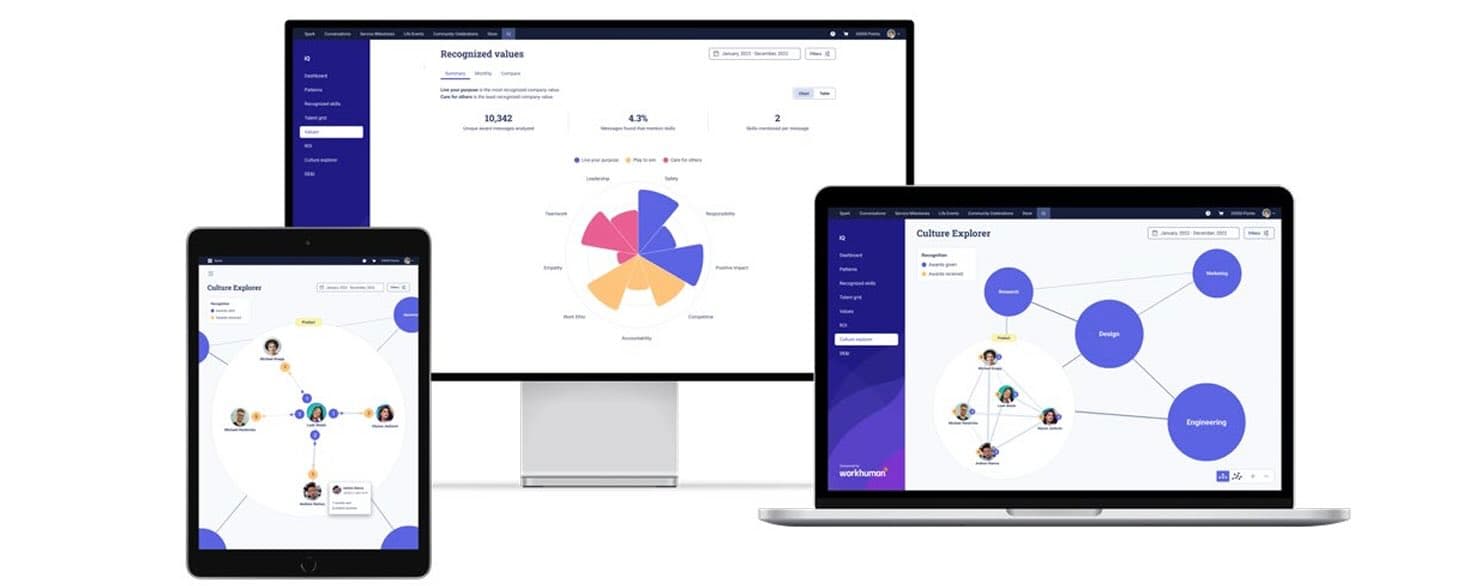
Workhuman’s Advisors help employees create more specific and inclusive appreciation in the moment. Workhuman iQ then analyzes the resulting recognition data to surface skills, cultural patterns, collaboration, and workforce signals.
Terryberry can show that one group receives more recognition than another or compare recognized employees with survey results. Workhuman can help explain what people are being recognized for, which capabilities are emerging, and how work is actually getting done.
This moves Workhuman beyond recognition reporting and into Human Intelligence™, giving leaders information they can use for culture, talent, and business decisions.
Global Reach and Capabilities
Workhuman
Terryberry
- Supports international recognition programs, multilingual materials, and reward fulfillment across numerous countries.
- Regional operations provide support for organizations running programs in North America and Europe.
- International availability alone does not ensure equity, particularly when employees receive the same number of points in markets with significantly different purchasing power.
- Terryberry does not publicly describe an automated standard-of-living adjustment comparable to SOLI.
- Its Amazon Business reward integration is most clearly designed around U.S. product availability and fulfillment.
- Organizations may need to evaluate country-by-country catalog availability, shipping, taxation, product relevance, and reward value rather than assuming a consistent global experience.
Key Feature Difference
Both providers can reach employees in multiple countries, but reach and equity are not the same.
Terryberry can fulfill international rewards. Workhuman is designed to ensure those rewards carry comparable value across locations.
SOLI adjusts recognition awards according to local purchasing power, reducing the inequity that occurs when a single points or currency model is applied globally.
This gives Workhuman a more mature global framework, particularly for enterprises that need fairness, consistency, and local relevance engineered into the program rather than managed through manual country-level decisions.
Customer Support
Workhuman
Terryberry
- Many customers praise Terryberry’s responsive implementation and account support.
- Support experiences appear inconsistent, with one recent reviewer naming support as the platform’s biggest issue.
- Phone and email support are available by region, but Terryberry does not publicly list 24/7 coverage or guaranteed response times.
- Technical issues are often resolved promptly, though some customers want clearer communication about product updates.
- Some G2 reviewers praise Terryberry’s service, while others report slow customer-service responses, billing issues, or limited customization.
Key Feature Difference
Workhuman’s customer success and consulting model brings together recognition experts, former HR leaders, researchers, data scientists, technical specialists, and in-house Store support.
This reduces the need for internal teams to interpret recognition data, resolve global reward inconsistencies, or determine how the program should evolve as the organization grows.
Ease of Use & Implementation
Workhuman
Terryberry
- Terryberry states that many implementations can be completed within a few weeks, although timelines depend on program configuration and HRIS complexity.
- A broad product portfolio can create additional decisions around recognition, rewards, listening, wellness, milestone awards, and physical fulfillment.
- Provides analytics that compare recognition activity with employee sentiment, eNPS, and stated retention intent. These dashboards can surface useful correlations, but they do not independently establish that Terryberry caused improvements in turnover, engagement, or performance.
- Some reviewers report a clunky administrative interface, multi-step workflows, technical glitches, and occasional reward availability issues — friction that may make consistent participation and program management more difficult over time.
- Review feedback also suggests that administrative navigation can become less intuitive when users move beyond basic recognition and reward actions.
Key Feature Difference
Terryberry can help organizations launch a recognition or service-award program.
Workhuman provides a deeper ongoing partnership focused on whether the program is driving sustained participation, cultural alignment, global consistency, and measurable business outcomes.
Workhuman vs. Terryberry: Strengths & Weaknesses
Workhuman Strengths
Workhuman Weaknesses
- Custom enterprise pricing reflects the depth of strategic support and global capabilities, which isn't a great fit for small teams or limited budgets
- The full platform's richness may exceed what organizations only seeking basic, point-based recognition actually need
- Implementation involves meaningful partnership, which takes more time than a purely self-service alternative
Terryberry Strengths
- Established experience in service awards and milestone recognition.
- Broad selection of physical and symbolic award formats.
- Peer-to-peer and manager-led social recognition capabilities.
- Invoice-upon-redemption reward funding.
- Recognition can be connected with Terryberry’s survey, wellness, and engagement products.
Terryberry Weaknesses
- Be Recognized can be purchased independently, but Terryberry states that it works best as part of the broader Be Engaged ecosystem.
- Organizations may need multiple connected Terryberry capabilities to gain the full recognition, sentiment, wellness, and engagement analytics experience.
- Public product information emphasizes survey correlations and participation analytics more than recognition-derived skills or talent intelligence.
- Global reach and international fulfillment are available, but Terryberry does not publicly describe a purchasing-power adjustment system equivalent to Workhuman’s SOLI.
- The Amazon Business integration’s expedited fulfillment benefits are specifically positioned around the United States.
When you add it all up, the distinction is clear. Workhuman is built for organizations that treat recognition and the employee experience as strategic drivers of culture, retention, and business performance. Terryberry is better suited to organizations seeking a more traditional, program-based approach centered on service awards, rewards, and participation.
Workhuman vs. Terryberry: What Customers Say
Workhuman vs. Terryberry: Final Verdict
Both Workhuman and Terryberry provide the core capabilities expected from a recognition and rewards platform.
Employees can recognize peers, managers can reward team members, milestones can be automated, and points can be redeemed for a wide range of rewards.
The most important differences are found in the features surrounding those basic actions.
Choose Workhuman if:
Choose Terryberry if:
You want digital and physical recognition in one program.
Terryberry combines social recognition and rewards with custom jewelry, plaques, trophies, certificates, and other symbolic awards.
Service anniversaries are a central part of your recognition strategy.
Its history and product capabilities make milestone and service-award programs a particularly visible part of the Terryberry offering.
You want recognition connected to employee surveys.
Terryberry can combine recognition patterns with eNPS, sentiment, belonging, and retention indicators.
You prefer reward billing at redemption.
The invoice-upon-redemption structure can help align reward costs with actual employee usage.
You want recognition as part of a broader engagement suite.
Terryberry connects Be Recognized with rewards, employee listening, wellness, and symbolic awards through its Be Engaged ecosystem.
Bottom line
Workhuman and Terryberry both offer more than a basic points-and-rewards system.
Terryberry stands out for bringing digital recognition, employee surveys, service awards, ecommerce rewards, and tangible symbolic awards into one connected product family.
Workhuman goes deeper into the recognition experience itself. It uses high-quality, values-based recognition to reinforce culture and generate intelligence about skills, behaviors, collaboration, and organizational performance.
The right choice depends on the outcome the organization values most.
Choose Terryberry when physical awards, service milestones, redemption-based billing, and a broader engagement suite are the priority.
Choose Workhuman when recognition needs to become a scalable source of culture, talent, and business intelligence.
Ready to see how a recognition-first software can drive measurable ROI? Request a demo today to see it work for yourself.
See also:

Ryan Stoltz
Ryan is a search marketing manager and content strategist at Workhuman where he writes on the next evolution of the workplace. Outside of the workplace, he's a diehard 49ers fan, comedy junkie, and has trouble avoiding sweets on a nightly basis.
Recommended for you