
Talent Analytics: Transforming HR Strategies with Data-Driven Insights
by Ryan Stoltz
Last updated
9 min read
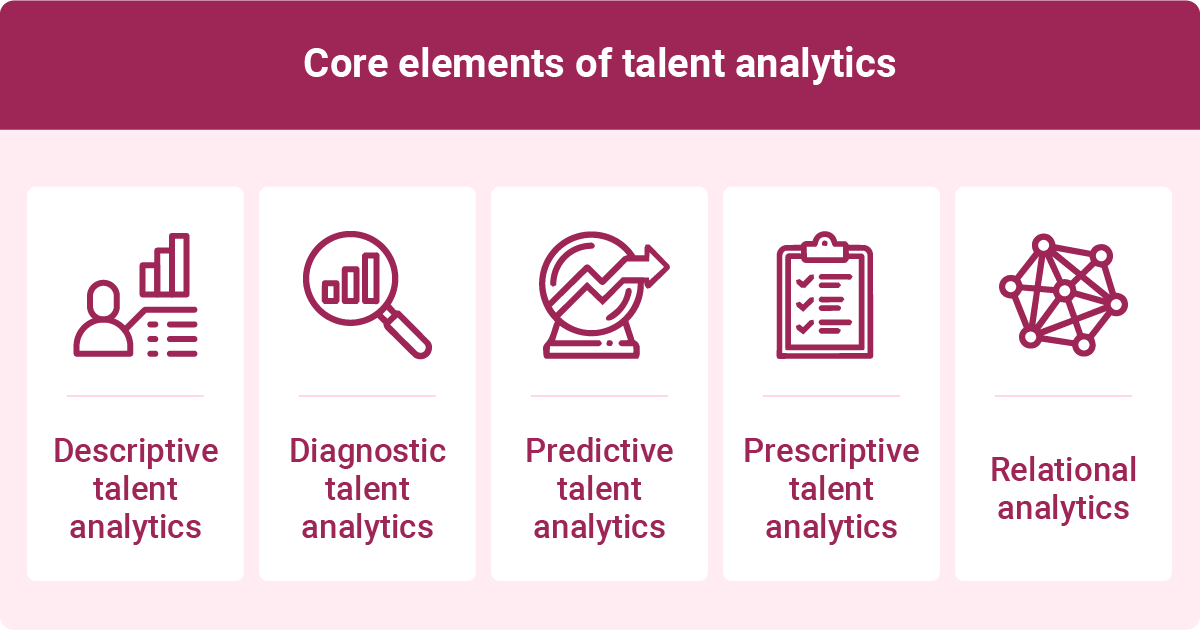
Table of contents
- What is talent analytics?
- Core elements of talent analytics
- Examples of talent analytics
- What is the difference between talent analytics and people analytics?
- Why is talent data crucial for HR?
- How to implement talent analytics effectively in your organization
- Overcoming challenges in implementing talent analytics
- Conclusion and implications
Share this article
Human resource strategies once relied heavily on the “intuition” side of hiring, but have become complex. Talent analytics allows companies to combine the expertise of hiring managers and interviewers with reliable data to improve employee engagement and decrease turnover.
A study run by Bain & Company titled “How to Focus Talent Analytics on the Right GoalsOpens in a new tab”, shows a 40% disparity between the productivity of the best organizations and that of the rest, based on the effective use of talent analytics.
Here, we’ll guide you through the basics of analytics and how to maximize it for your organization.
What is talent analytics?
Talent analytics transforms traditional HR practices by replacing assumptions with evidence. Instead of relying only on interview impressions, annual reviews, or lagging HR reports, organizations can use data to understand workforce patterns in real time and respond more strategically.
That picture becomes even more powerful when analytics includes human-centered data, not just system records. Platforms like Workhuman help organizations analyze recognition data to uncover how work actually happens across the business.
That can reveal patterns in employee skills, collaboration, engagement, performance, and retention risk that may not show up in traditional HR systems alone. In that sense, talent analytics is not just about counting people's outcomes. It is about understanding the behaviors, relationships, and signals that shape them.
Traditional talent analytics platforms rely heavily on structured HR data from systems like HRIS, ATS, and performance management tools. While these systems are essential, they often miss how work actually happens day to day.
Platforms like Workhuman offer a complementary approach to talent analytics by analyzing recognition data — the moments when employees’ contributions, skills, and behaviors are acknowledged by peers and managers in real time. This creates a different kind of talent insight: one rooted in observed behavior, collaboration, and impact, not just formal records.
Rather than replacing existing analytics systems, this type of human-centered data strengthens them, helping organizations better understand engagement, identify emerging skills, and uncover patterns that may not appear in traditional HR data alone.
Core elements of talent analytics
Talent analytics relies heavily on data collection and analysis, as well as actionable insights. Understanding the core elements of the idea improves hiring, training, and work experience.
Descriptive talent analytics
This element relies on collecting and analyzing historical data to understand “what’s happened” in an organization in relation to the workforce. While it doesn’t offer insight into future trends, it gives valuable information about the current state.
Key aspects include employee performance, turnover and retention, recruitment analysis, demographic analysis, employee engagement, learning and development, and compensation and benefits.
Example: Your company analyzes recruitment information and finds that 50% of applicants came from LinkedIn, and it takes an average of 30 days to fill a position.
Diagnostic talent analytics
While descriptive data helps you understand the what, diagnostic data gives you more information about the why, plus possible insight into how to fix the problem. Key factors include investigating patterns, understanding correlations, root cause analysis, and assessing interventions.
Example: Employee engagement and satisfaction are low in one department, and diagnostic analytics can tell you if that’s due to a pay issue, a lack of training, or problems with a specific leadership style.
Predictive talent analytics
Now that you understand what happened and why, predictive analytics in HR can help you predict future behaviors, promotions, and trends within your organization.
Example: When addressing turnover risk, a data model using career progression, tenure, engagement levels, compensation, and job satisfaction predicts that certain departments are more likely to lose employees, and those employees typically leave within six months.
Prescriptive talent analytics
Now that you understand what happened, why it happened, and what is likely to happen next, prescriptive analytics helps you decide what to do about it.
Example: Predictive analytics shows that employees in a specific department are at high risk of leaving within six months. Prescriptive analytics goes a step further by recommending targeted actions — such as adjusting compensation, introducing career development opportunities, or increasing recognition frequency — and estimating which interventions are most likely to reduce attrition.
Relational analytics
Relational analytics looks at interactions and interdependencies between parts of the workforce, and how factors like roles, teams, training, and engagement connect to each other. The hopeful outcome is insights into how these relationships influence things like overall effectiveness, job satisfaction, retention, and performance.
Example: The marketing department has high turnover rates. Relational analytics tells you that poor communication and low engagement are contributing factors. You can then implement actions like training for improved communication, team-building exercises, and feedback surveys to determine ways to lower turnover rates.
Examples of talent analytics
While you’ve learned about the different types of talent analytics, it can be helpful to see examples of how it can lead to actionable plans that address workforce challenges.
Employee training optimization: You aren’t sure whether the training you’ve invested heavily in is working. Descriptive analytics tracks employee participation in the training and informs you if productivity or performance changes afterward. The information allows you to focus on the most impactful training to optimize efforts and budget.
Finding high-potential employees: By analyzing performance, feedback, engagement, and progression data, organizations can identify the traits and behaviors associated with long-term success. But high-potential identification should not rely too heavily on a single manager’s opinion.
When succession and promotion decisions are based on limited visibility or informal nomination, bias can creep in, and organizations may overlook employees whose contributions are less obvious but no less valuable.
A stronger approach draws on input from multiple sources and contexts. That is where recognition data can be especially useful. Workhuman helps surface signals about leadership, collaboration, initiative, and problem-solving through the eyes of peers and colleagues who see those behaviors in action every day. This gives organizations a fuller picture of potential, including employees who may not always be the most visible in a formal review process.
Improve recruitment and hiring: You’re putting a lot of effort into recruiting and hiring, but your hires aren't staying long. Descriptive and predictive analytics give insight into performance metrics, candidate backgrounds, interview scores, and skills. The data shows that candidates with certain backgrounds or certifications stay long and perform better.
What is the difference between talent analytics and people analytics?
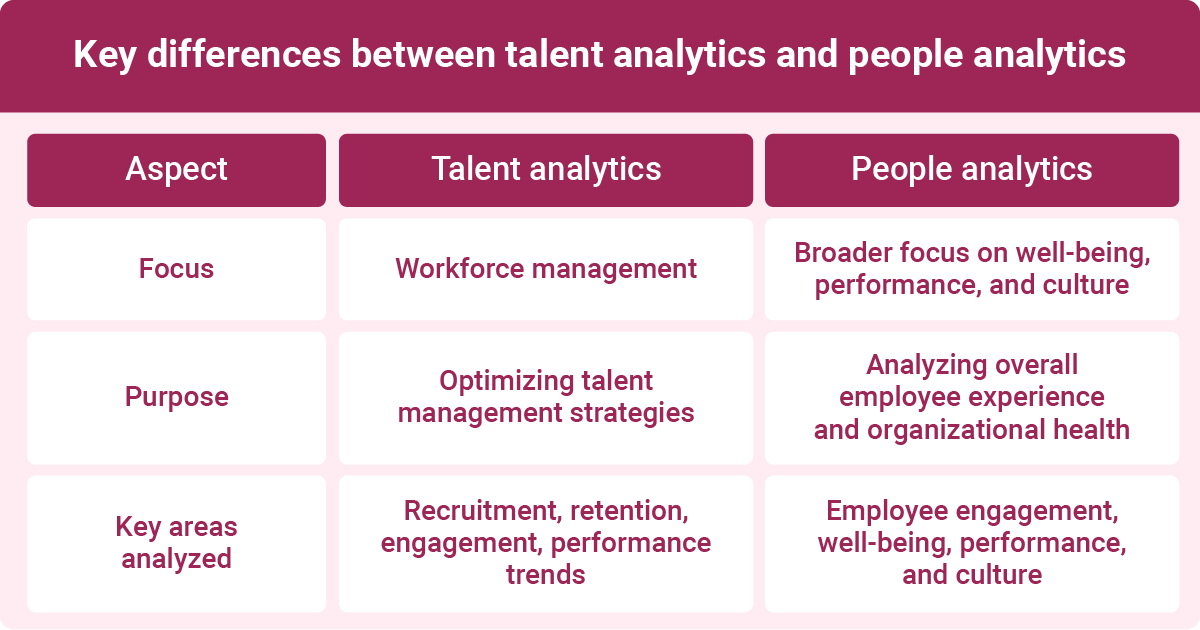
Although the two terms are often used interchangeably, subtle differences set them apart. Talent management analytics focuses on workforce management, while people analytics paints a broader picture of well-being, performance, and culture.
Why is talent data crucial for HR?
Today’s HR departments face challenges related to managing talent and retaining it, employee engagement and morale, workforce inclusion and diversity, law and regulation compliance, and training and development, just to name a few areas. Talent data is crucial to overcoming these challenges and adapts to organizations of every size.
Enhancing recruitment processes
Improving employee retention and engagement
Your turnover is rising, but the causes are not obvious. Analytics can connect engagement scores, tenure, manager relationships, career movement, and performance trends to identify patterns that often precede attrition.
For example, Workhuman’s recognition data can help organizations spot turnover risk earlier by surfacing signals about engagement, visibility, and connection that may not appear in HCM data alone.
See also: Talent Management Strategy: How to Attract, Develop, and Retain Top Talent
Identifying high-potential employees
By analyzing performance, feedback, engagement, and progression data, organizations can identify the traits and behaviors associated with long-term success. But high-potential identification should not rely too heavily on a single manager’s opinion.
When succession and promotion decisions are based on limited visibility or informal nomination, bias can creep in, and organizations may overlook employees whose contributions are less obvious but no less valuable.
A stronger approach draws on input from multiple sources and contexts. That is where recognition data can be especially useful. Workhuman helps surface signals about leadership, collaboration, initiative, and problem-solving through the eyes of peers and colleagues who see those behaviors in action every day.
This gives organizations a fuller picture of potential, including employees who may not always be the most visible in a formal review process.
Developing future leaders at scale
Identifying high-potential employees is only the first step. Organizations also need a structured way to develop those individuals into effective senior leaders — and to do so consistently across the business.
Workhuman supports executive leadership development through its Future Leaders approach, which helps organizations move from identifying potential to actively developing it. Instead of relying on informal or one-time nomination processes, Future Leaders programs use a combination of recognition data, feedback signals, and leadership-aligned behaviors to surface and support emerging talent over time.
By working with a company’s own data and its unique leadership footprint, organizations can identify employees who consistently demonstrate leadership behaviors such as collaboration, initiative, mentorship, and problem-solving — even if they are not yet in formal leadership roles.
These signals are then used to guide development opportunities, ensuring that leadership pipelines reflect how work actually happens across teams, not just how it is evaluated in formal reviews. It can also identify the managers most likely to attract these future leaders.
Importantly, Future Leaders programs are designed to complement existing talent processes, not replace them. HR leaders can combine recognition-based insights with performance data, manager input, and business needs to build a more inclusive, data-informed approach to leadership development.
This helps organizations expand their leadership pipeline, reduce bias in succession planning, and ensure that high-potential employees are identified and developed based on a broader, more accurate view of their impact.
Enhancing diversity and inclusion efforts
Unconscious bias exists in every hiring department. The thoughtful use of data helps you foster an organization that is diverse and inclusive. If there is inequality within your workforce, talent data allows you to identify where and provides practices and training to remove it.
How to implement talent analytics effectively in your organization
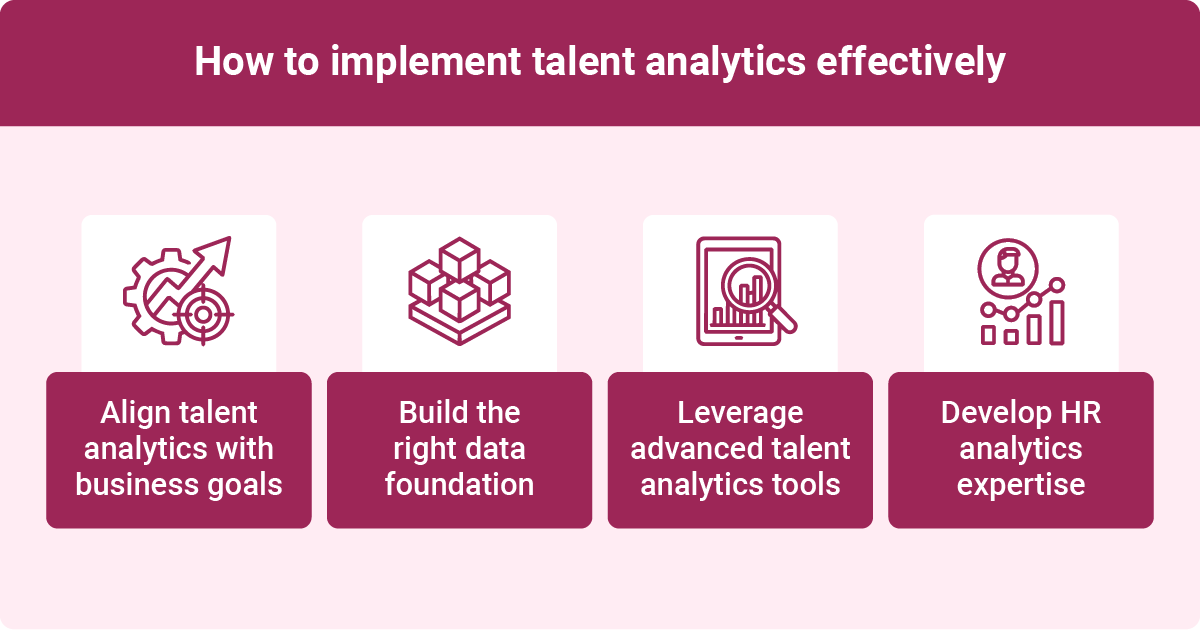
Align talent analytics with business goals
Determine your organization’s goals. This will determine what data you collect and what you do with it. Identify your challenges, set measurable goals to address them, and then apply these to broad company goals to make sure they contribute to business success.
Build the right data foundation
Decide what type of data you want to collect and what deserves your biggest focus. Data is only good if it’s comprehensive and accurate.
Important categories of data to focus on early are retention, employee performance, employee engagement, and recruitment. Look at qualitative (such as feedback and engagement) and quantitative (turnover rates, performance ratings) data.
Leverage advanced talent analytics tools
The task of analyzing data can quickly become overwhelming without the right technology. Advanced talent analytics tools help organizations organize workforce information, identify patterns faster, and turn data into more actionable insight.
Some platforms focus mainly on dashboards and reporting. Others go further by helping HR leaders understand how employees work, collaborate, grow, and stay engaged over time.
Workhuman is one example of a people analytics platform that expands talent analytics beyond traditional HR reporting. Through Workhuman iQ and the broader Human Intelligence approach, organizations can analyze recognition data to uncover insights into skills, engagement, performance patterns, retention risk, collaboration, and employee visibility. That gives HR and business leaders access to a richer view of talent, including signals that may not appear in HRIS or ATS data alone.
Other types of analytics tools can still play an important role, depending on your needs:
Tableau: Known for visual dashboards, Tableau helps teams analyze and present workforce data in an easy-to-understand format.
SAP: A broader cloud-based HR solution, SAP offers analytics capabilities within a larger enterprise platform.
Workday: Workday provides workforce insights tied to talent management, planning, finance, and HR operations.
The most effective analytics stack depends on your goals. If you only need reporting, a dashboard tool may be enough. But if you want to understand how talent, culture, and employee behavior connect, it helps to use tools that surface more human-centered insights and support action, not just analysis.
Choosing the right talent analytics tools
Aside from referrals and word of mouth, how do you determine which workforce analytics tool is best for your organization? Here are a few factors to consider.
- Ease of use: Choose a tool that saves you time, simplifies the data and solutions, and is adaptable to many people across the organization.
- Scalability: If you’re collecting large amounts of data, select a more comprehensive tool with deeper insight into your metrics.
- Integration with current systems: Tools are most effective if they’re integrated with your current HR system, so you don’t have to rewrite the handbook before you get started.
- Cost-effectiveness: Consider whether the software fits within your budget.
- Vendor support: During the initial learning curve and as your goals become more detailed, you'll need a vendor that offers reliable support and customer service.
Develop HR analytics expertise
All the data, metrics, and solutions in the world aren’t effective if you don’t know how to apply them. It’s important for all HR professionals to develop skills in data interpretation.
What are the key talent metrics to track?
There are several basic talent metrics you want to start with.
Recruitment metrics: The Society for Human Resource Management reports through “The Real Costs of RecruitmentOpens in a new tab” that hiring a new employee costs an average of $4,700. Quality of hire, time to hire, and cost per hire all influence hiring efficiency and success.
Employee engagement metrics: It’s difficult to identify problems related to employee satisfaction and morale, but concrete data can help. Track participation in engagement programs, feedback metrics, and employee satisfaction scores.
Turnover and retention metrics: Employees often leave jobs because of low pay, lack of recognition, or a poor work-life balance. Talent intelligence tools help you identify problem areas by tracking these reasons, retention rates, and turnover rates.
Productivity metrics: Even if retention is high, productivity is one of the most important metrics for identifying performance trends. Talent tools track things like goal achievement rates and output per employee.
Diversity and inclusion metrics: News from the Business Commission to Tackle Inequality identifies inequality as a systemic risk within private businesses. Talent analytics controls these problems by closing representation gaps, making promotion equity a key metric, and supporting the development of a diverse workforce.
Overcoming challenges in implementing talent analytics
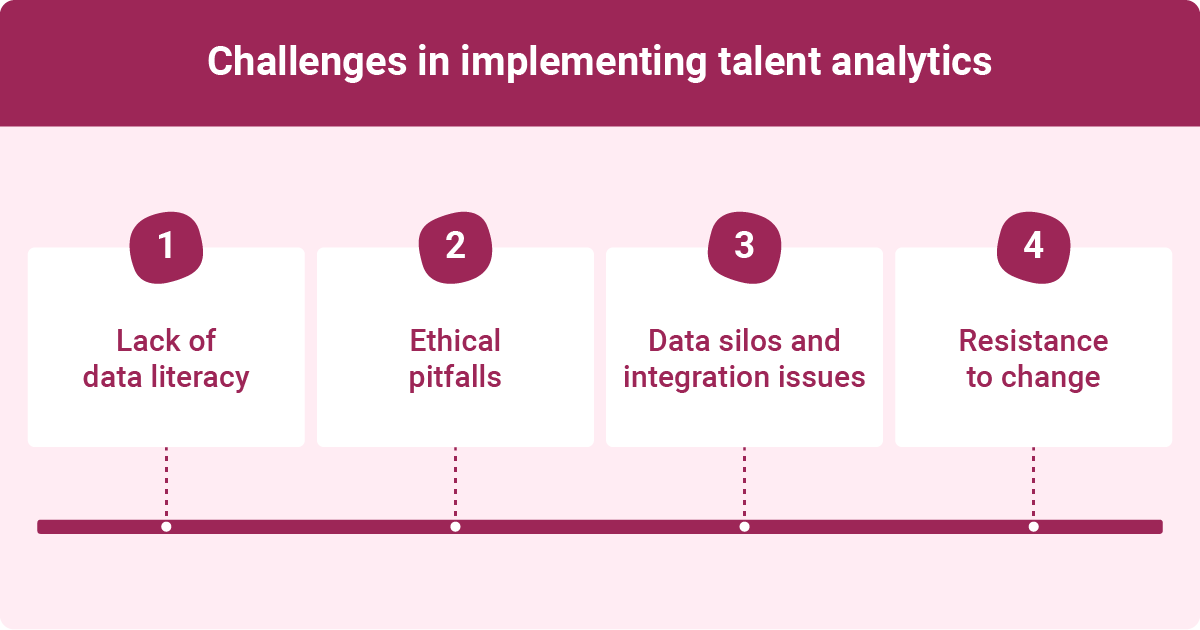
Implementing and developing talent analytics doesn’t come without its challenges. Overcoming those roadblocks involves firm but open conversations about why it’s important.
Lack of data literacy in HR teams is an old dog, new tricks, and some employees hate learning new technology and processes. Workshops, certifications, and mentoring are vital parts of ongoing professional development that encourage learning about talent analytics.
It’s hard to teach Ethical pitfalls. Informed consent, limited data access, transparent reporting, legal and ethical compliance, and employee control over data are all examples of policies that ensure fairness and protect employee privacy when you are collecting employee data and using talent analytics tools.
Data silos and integration challenges
When data is stored across several tools or departments, it can be difficult for your organization to access and integrate it. This can lead to fragmented or incomplete data, breaks in cross-departmental analysis, inefficient reporting, risk management issues, decreased collaboration, and difficulty accessing actionable insights.
Tools to fight these challenges include cloud-based solutions to centralize data, cross-departmental communication and collaboration, data integration tools, data governance, and integrated HR systems.
Resistance to change within the organization
If your organization experiences resistance, it’s likely because your employees don’t understand the benefits or fear new technologies. Provide succinct and productive regular training and use a hands-on approach to demonstrate the benefits of talent analytics tools.
Conclusion and implications
Humans are naturally resistant to change, and AI solutions have many professionals distrustful and skeptical. The truth is that while you don’t have to embrace every new idea or become a master talent analyst overnight, the best results come when you meet somewhere in the middle.
The strongest analytics strategies combine data with human judgment, helping leaders make more fair, timely, and more informed people decisions. Organizations that invest in better tools for spotting and measuring talent will see higher retention rates, lower hiring costs, better employee engagement, and a simplified HR system. The HR field is about to be revolutionized, and you want to be ahead of the game when it does.

Ryan Stoltz
Ryan is a search marketing manager and content strategist at Workhuman where he writes on the next evolution of the workplace. Outside of the workplace, he's a diehard 49ers fan, comedy junkie, and has trouble avoiding sweets on a nightly basis.
Recommended for you