
Upward Feedback for Managers in 2026: Examples and Best Practices
by Ryan Stoltz
Last updated
13 min read

Table of contents
- Why is it important to give feedback to your manager?
- Effective examples of constructive employee feedback for managers
- How to give effective feedback to your manager: Tips and best practices for employees
- Formal vs. informal feedback approaches
- When is the right time to give feedback to your manager (and when should you hold back)?
- How can leaders encourage employee feedback for managers?
- Conclusion: Build a culture of trust and feedback in your organization
- FAQ
Share this article
Clear, specific, and actionable feedback for managers is one of the most underutilized tools in the modern workplace.
Yet research in the European Journal of Training and Development, “Employee voice, engagement and organizational effectiveness”, shows that when employees feel their voice is heard, organizations see measurable improvements in engagement, trust, and performance.
This guide covers practical examples and best practices for delivering feedback to your manager, whether it’s positive reinforcement, constructive criticism, or addressing difficult behaviors.
You’ll learn how to communicate feedback effectively, when to deliver it, and how to foster a culture where honest dialogue flows in every direction.
Why is it important to give feedback to your manager?
Feedback is a two-way street. While managers are expected to guide and evaluate their teams, employees who share honest feedback with their managers drive meaningful change from the ground up.
Organizations with strong feedback cultures outperform peers on employee engagement and retention, according to a study titled “The Impact of Organizational Culture on Employee Retention and Performance in the Technology IndustryOpens in a new tab”. As such, providing feedback to your manager is essential to building a healthier, higher-performing workplace.

Improves communication
Regular feedback bridges communication gaps that quietly derail teams. When employees voice concerns or observations, it creates space for honest, transparent dialogue.
This openness helps align expectations between employees and managers before small misunderstandings grow into larger issues.
Builds trust and respect
When employees feel safe enough to share feedback, it signals a healthy working relationship. It shows that both the manager and the employee value honesty over comfort.
Over time, this mutual openness strengthens trust and respect between employees and their managers. Employees who feel genuinely heard are more likely to stay engaged and committed to their team’s success, as per a 2022 paper, “Employee Voice: A Mechanism to Harness Employees’ Potential for Sustainable Success”.
Enhances managerial effectiveness
No manager has a complete view of their own blind spots. Feedback from employees gives managers direct insight into how their decisions and behaviors impact the team.
With that insight, managers can adapt their leadership style, refine their decision-making, and better meet team needs.
A Harvard Business Review analysis, “Your Employees Want the Negative Feedback You Hate to Give”, found that most employees actually want more feedback, including critical feedback, to help them grow.
Drives higher employee engagement
Employees who know their opinions are valued show up to work differently. They’re more motivated, more committed, and more active contributors to their work.
According to Workhuman® research, “5 Ways (Effective) Feedback is a Gift”, employees who check in with their managers weekly are more than two times as likely to trust them. They’re also nearly just as likely to respect their supervisors and managers.
More importantly, they’re five times less likely to be disengaged, and their belief that they can grow in the organization doubles.
Facilitates problem-solving
Employees are often the first to notice friction in day-to-day workflows. Their feedback gives managers ground-level insight into challenges that may not be visible from a leadership position.
When managers act on that feedback, they can address and resolve issues before they escalate. This proactive approach saves time, reduces frustration, and keeps teams moving forward.
Promotes greater employee well-being
Workplaces where feedback is encouraged tend to be positive work environments overall. Employees who can openly communicate concerns are less likely to experience unaddressed stress or burnout.
Workhuman’s research on giving effective feedback proves that feedback done well creates a psychologically safer workplace. That safety directly supports employee well-being and long-term job satisfaction.
Effective examples of constructive employee feedback for managers
Knowing why feedback matters is only half the equation. The other half is knowing how to phrase it in a way that lands well and drives real change.
The examples below are organized by feedback type. Each one is designed to be specific, respectful, and actionable. These are the three qualities that separate useful feedback from vague commentary.
Positive feedback examples for managers
Look for opportunities to give positive feedback after a project milestone, a well-run meeting, or a moment where your manager went above and beyond.
Remember that specificity is key. General praise is forgettable, but detailed recognition sticks.
Positive feedback examples on leadership
- “Your decision to involve the team in setting project priorities made everyone feel ownership over the outcome. It boosted team morale noticeably.”
- “The way you handled the recent team restructure was transparent and considerate. It helped reduce uncertainty across the team.”
- “You consistently advocate for the team in leadership meetings. Knowing you have our backs makes a real difference to how we show up.”
- “When the project scope changed unexpectedly, your calm and decisive response kept the team focused and motivated throughout.”
Leadership feedback such as this helps managers understand which behaviors are actively strengthening the team. These are strong examples of positive feedback because they tie the behavior directly to its impact on the team.
Positive feedback examples on communication
- “Your weekly updates keep everyone aligned without overwhelming us with unnecessary detail. It saves a lot of back-and-forth.”
- “When you gave feedback on my last presentation, you were specific and encouraging. It helped me improve without feeling discouraged.”
- “You make it easy to raise concerns by always responding without judgment. That openness builds a lot of trust within the team.”
- “The way you summarized the leadership meeting for the team showed real consideration for keeping everyone in the loop.”
Strong communication from a manager sets the tone for how the entire team interacts. Recognizing it openly encourages that behavior to continue.
Positive feedback examples on delegation
- “Assigning me ownership of the client onboarding process showed you trust my judgment. It pushed me to develop communication skills I didn’t know I had.”
- “You delegate clearly: expectations, deadlines, and resources are always outlined upfront. That clarity makes execution much easier.”
- “You give autonomy without disappearing. Knowing you are available for guidance without micromanaging is the right balance.”
- “Trusting the team to lead the product demo independently was a great call. It gave everyone a confidence boost, and the client responded well.”
Effective delegation is one of the most impactful things a manager can do for the personal and professional development of the members of a team. Acknowledging it through feedback reinforces a leadership style that empowers rather than limits.
Constructive and honest feedback examples for managers
Constructive feedback addresses behaviors that need adjustment without being personal or punitive. It’s most effective when delivered calmly, with specific examples and a focus on improvement.
Use clear and constructive feedback when a pattern of behavior is affecting your team’s performance and productivity, the team’s dynamics, or project management. Remember to frame it around the situation, not the person.
Constructive feedback examples on decision-making
- “On the recent product launch, the timeline was adjusted without consulting the team. Earlier input from us could have flagged a few avoidable delays.”
- “Some decisions feel rushed under pressure. Taking a short pause to gather team input, even briefly, tends to lead to stronger outcomes.”
- “When priorities shift, a quick explanation of the reasoning helps the team adapt faster and with more confidence.”
- “Involving at least one team member in vendor selection discussions could bring useful ground-level insight to those decisions.”
Constructive feedback examples on work habits
- “Meetings sometimes run over the scheduled time, which affects the team’s ability to plan the rest of the day. A clearer agenda could help keep things on track.”
- “Response times on urgent requests have been unpredictable lately. Even a brief acknowledgment in the moment would reduce a lot of uncertainty.”
- “Some feedback on deliverables arrives very close to deadlines. Earlier reviews would give the team enough time to incorporate changes properly.”
- “Starting team meetings a few minutes late has become a pattern. A consistent start time would help the team use their time more effectively.”
Work habit feedback can feel personal, so grounding it in specific, observable patterns rather than character judgments keeps the conversation productive.
Constructive feedback examples on conflict resolution
- “During last month’s team disagreement, the situation lingered longer than it needed to. Stepping in earlier would have helped restore focus faster.”
- “When two team members are in conflict, a neutral one-on-one before a group discussion tends to de-escalate things more effectively.”
- “Addressing tension openly but constructively, rather than avoiding it, would help the team feel more supported during difficult moments.”
- “Bringing in a structured mediation approach for recurring conflicts could help the team move past disagreements more efficiently.”
Raising conflict resolution as a feedback topic requires sensitivity. Focusing on the impact of unresolved tension, rather than assigning blame, makes it easier for managers to hear and act on.
Negative feedback examples for managers
Negative feedback is sometimes necessary, particularly when a behavior is consistently harmful to the team’s well-being or performance. The goal isn’t to criticize, but to clearly name the impact and open a dialogue for change.
So, approach negative feedback with care. For starters, choose a private setting, stay calm, and focus on observable behaviors rather than character judgments.
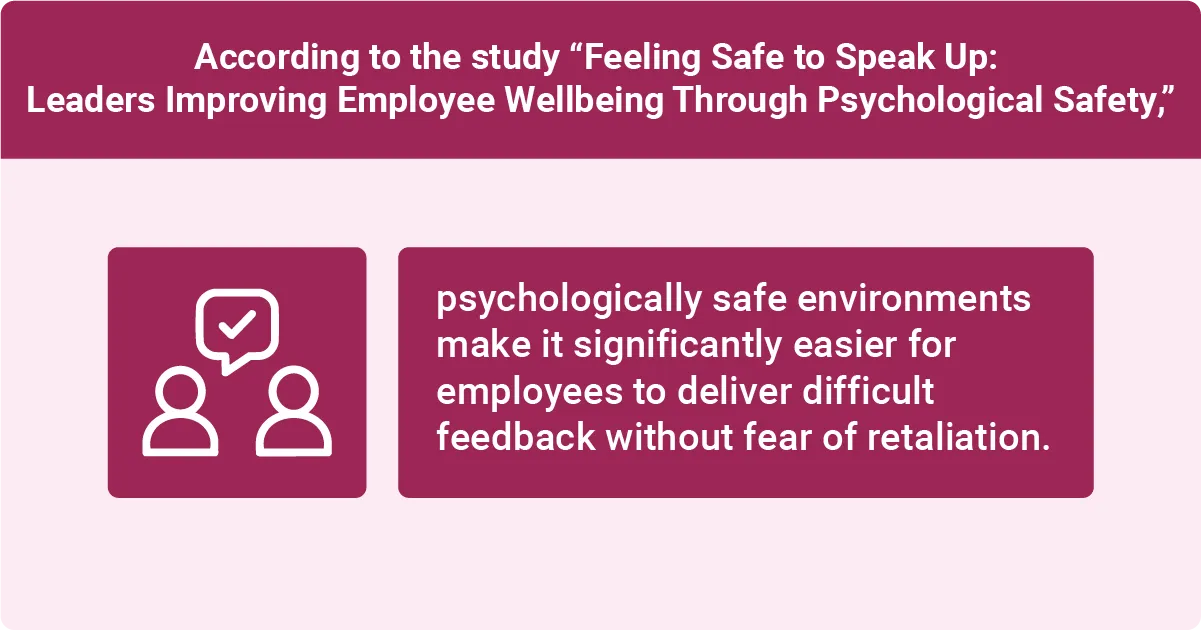
According to a study titled “Feeling safe to speak up: Leaders improving employee wellbeing through psychological safetyOpens in a new tab”, psychologically safe environments make it significantly easier for employees to deliver difficult feedback without fear or retaliation.
Negative feedback examples on micromanagement
- “Being asked to provide hourly updates on tasks makes it difficult to focus and signals a lack of trust in the team’s abilities.”
- “Revising completed work without explanation creates confusion about expectations and undermines the team’s confidence.”
- “When every decision requires your approval, it slows down progress and limits the team’s ability to take ownership of their work.”
- “Sitting in on every client call, even routine ones, makes it harder for the team to build independent relationships with clients.”
Negative feedback examples of inconsistent feedback
- “Receiving different feedback on similar work makes it hard to know what the actual standard is. Consistency would make it easier to improve.”
- “Positive feedback is shared publicly, but critical feedback is often delivered in group settings too. Private, direct conversations would feel more constructive.”
- “Feedback tends to come in clusters rather than regularly. More frequent check-ins would make it easier to course-correct in real time.”
- “When feedback changes direction between conversations, it creates uncertainty about priorities. Clearer and more consistent guidance would help the team stay on the same page.”
Inconsistent feedback is one of the most disorienting experiences for employees. Raising it directly, with specific examples, gives managers the clarity they need to recalibrate.
Negative feedback examples on failure to address team concerns
- “Several team members have raised concerns about workload distribution that have gone unaddressed for weeks. This is starting to affect morale.”
- “When issues are brought up in team meetings and then not followed up on, it signals that feedback isn’t being taken seriously.”
- “Unresolved interpersonal tensions within the team are affecting collaboration. A structured conversation to address them would help restore trust.”
- “Concerns about unclear role boundaries have been raised more than once. Addressing them directly would reduce friction and improve team efficiency.”
When team concerns go unaddressed, disengagement follows. Bringing this to your manager’s attention, respectfully and with evidence, is one of the most valuable forms of feedback to give your manager.
How to give effective feedback to your manager: Tips and best practices for employees
Knowing what to say is only part of the challenge. How and when you say it matters just as much.
The following best practices will help you approach feedback to your manager with clarity and confidence.
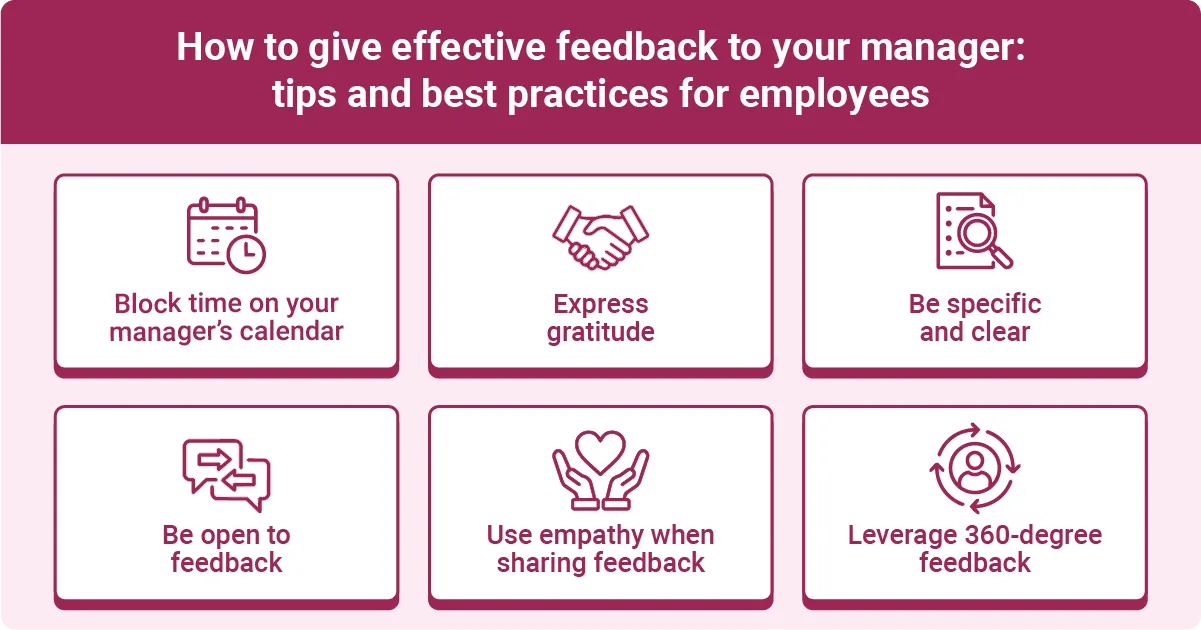
Block time on your manager’s calendar
Dropping feedback into a rushed hallway conversation rarely leads anywhere productive. Instead, schedule dedicated time on your manager’s calendar for a focused discussion.
This signals that the conversation is intentional and important. It also gives both parties time to prepare, which leads to a more thoughtful and constructive exchange.
Show your gratitude
Before raising areas of concern, take a moment to acknowledge what your manager is doing well.
According to Workhuman’s research, “9 Tips for Giving Feedback (Without the Stress)”, employees need to build a positive atmosphere before constructive feedback can be truly received.
Starting with genuine appreciation sets a respectful tone. Additionally, it makes it easier for your manager to remain open rather than becoming defensive.
Be specific and clear
Vague feedback creates confusion and is difficult to act on. Instead of saying “communication could be better,” try referencing a specific situation and its impact on your work.
As Workhuman’s guidance notes state, the closer feedback is tied to a specific event, the more likely it is to drive real change. This is also a core principle behind strong feedback for manager examples — specificity is what makes feedback useful.
Be open to feedback yourself
A productive feedback conversation rarely flows in just one direction. Being open to receiving feedback from your manager in return demonstrates maturity and a genuine commitment to mutual growth. Further, this two-way dynamic makes it easier for managers to engage honestly.
Use empathy when giving feedback to your manager
Understanding your manager’s perspective before you speak can shift the entire tone of the conversation. Managers face pressures that aren’t always visible to their teams, and acknowledging that context shows emotional intelligence.
Consider the timing carefully. Feedback delivered during a high-stress moment is far less likely to land well than feedback shared during a calm, focused setting.
Cultural sensitivity also matters here. Adjusting your tone and approach based on cultural context ensures your feedback is received in the spirit it was intended.
Doing so is especially relevant in diverse, global teams where the answer to how to give someone feedback can vary significantly across cultural norms.
360-Degree feedback
360-degree feedback gathers input from multiple directions: peers, direct reports, and managers alike. This comprehensive approach gives a well-rounded view of a manager’s performance that no single perspective can provide on its own.
For this method to work effectively, the environment must be transparent and non-judgmental. A study titled “Taking Your Team Behind the CurtainOpens in a new tab” backs up this claim. It found that psychological safety is a critical factor in whether employees feel comfortable contributing honest feedback in 360-degree processes.
Formal vs. informal feedback approaches
Not all feedback looks the same, and that’s by design. The most effective cultures of feedback use both formal and informal approaches, each serving a distinct purpose.
Formal feedback tends to be structured and documented. Informal feedback, on the other hand, is spontaneous and conversational.
Knowing when to use each approach is just as important as knowing what to say.
Here’s a clear breakdown of how the two approaches compare:
Both approaches complement each other well. Formal feedback creates a paper trail and ensures accountability, while informal communication keeps the feedback loop active between those structured touchpoints.
Valuable tools like Workhuman Conversations® make it easier to support both approaches within one platform. It enables managers and employees to document structured feedback while also keeping everyday check-in conversations flowing naturally.
So what’s the key here? Balance. Relying solely on annual reviews leaves too much unsaid for too long. Relying only on informal feedback risks important insights never being properly recorded or acted on.
When is the right time to give feedback to your manager (and when should you hold back)?
Timing can make or break a feedback conversation. Even the most well-crafted feedback can fall flat if it’s delivered at the wrong moment.
Understanding when your manager is likely to be receptive and when they are not is a skill in itself.
Best times to give feedback to a manager?
Some moments naturally lend themselves to open, productive feedback conversations. These include:
- After a project completion. Once a project wraps up, both you and your manager have shared context to draw from. Feedback shared at this stage feels relevant and grounded in recent experience.
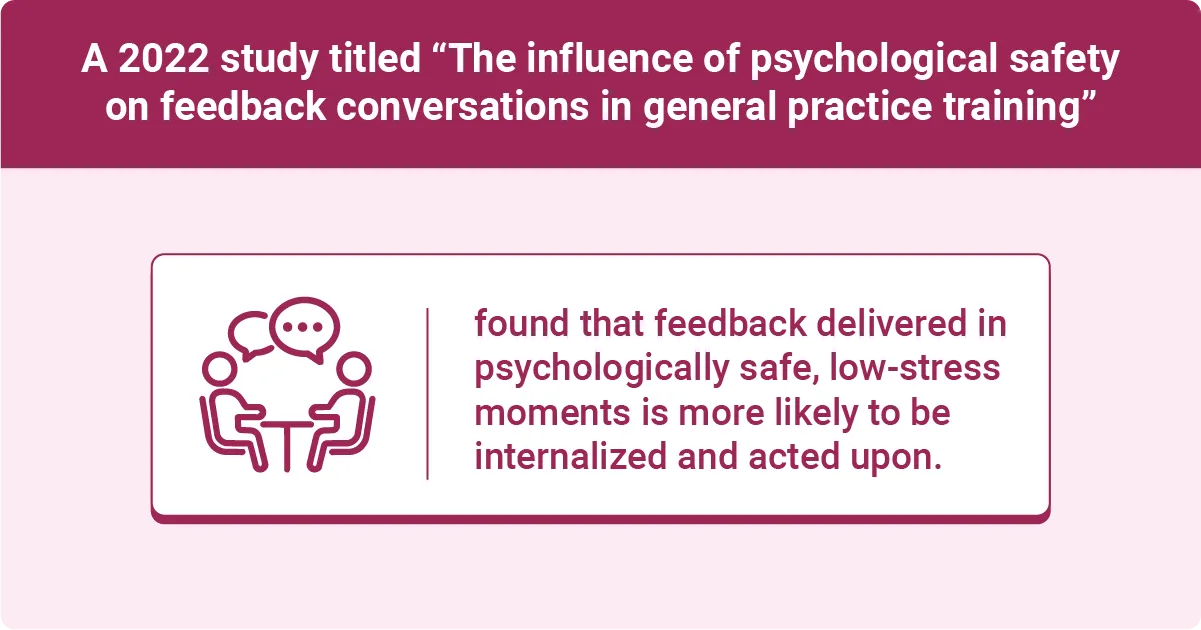
- During performance feedback. Formal reviews create a structured, expected space for two-way dialogue. Use this opportunity to share feedback examples with your manager that are specific and tied to real situations.
- During one-on-one meetings. Regular one-on-ones are among the best settings for ongoing feedback, according to doctoral research from the University of North Carolina, “A New Approach to Promote Employee Engagement: One-on-One Meetings Between Managers and Direct Reports”, says. They’re private, low-pressure, and designed for honest conversation.
- When your manager signals openness. Pay attention to moments when your manager is actively seeking feedback or asking how things are going. These signals indicate genuine receptiveness, making it an ideal time to speak candidly.
When to refrain from giving feedback to a manager?
Just as important as knowing when to speak up is knowing when to hold back. Some situations are simply not conducive to productive feedback.
- During high-stress moments. If your manager is dealing with a crisis or a pressing deadline, feedback is unlikely to be heard well. Instead, wait until the pressure subsides before initiating the conversation.
- Immediately after a conflict. Emotions run high after a disagreement. Feedback delivered in this window can easily be misread as an attack rather than a genuine attempt to improve the working relationship.
- When your manager is visibly distracted. A feedback conversation requires presence from both sides. If your manager is clearly preoccupied, reschedule for a time when they can fully engage.
Remember that choosing the right moment is an act of respect. It also dramatically increases the chances that your feedback will lead to meaningful change.
How can leaders encourage employee feedback for managers?
Creating a positive workplace culture where employees feel comfortable sharing honest feedback doesn’t happen by accident. It requires deliberate effort from leaders at every level.
The good news is that small, consistent actions can shift the entire feedback culture of an organization over time.
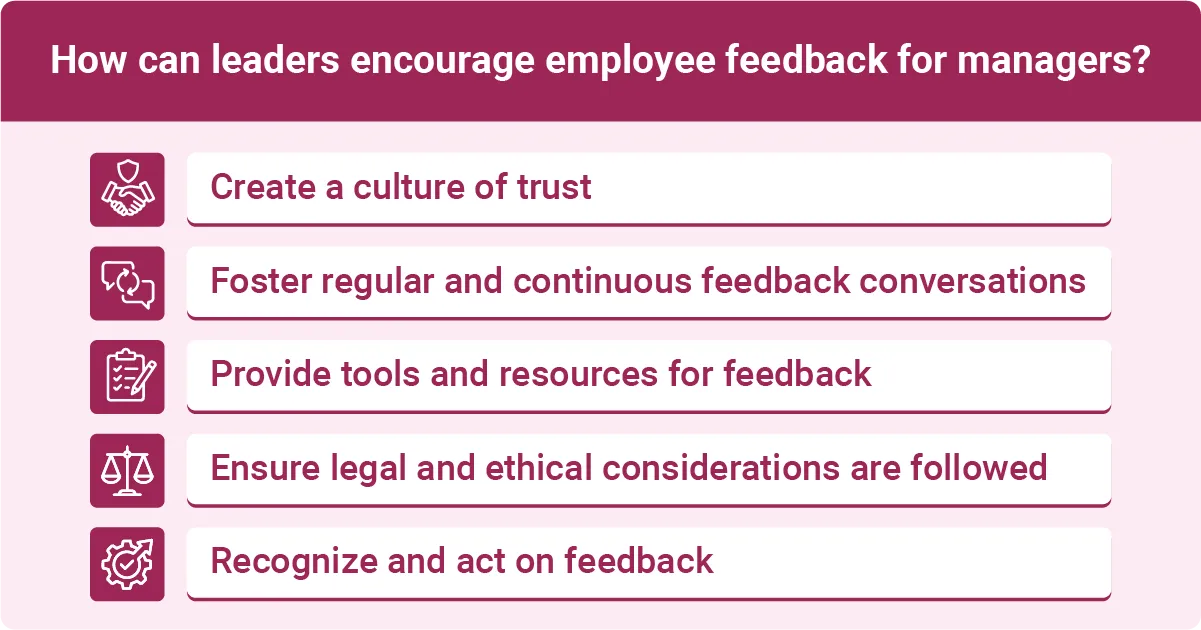
Create a culture of trust
Trust is the foundation of any feedback culture. Without it, employees will default to silence rather than risk vulnerability.
Leaders can build that trust by modeling the behavior they want to see. Building a genuine culture of feedback starts when managers openly invite input, respond without defensiveness, and visibly act on what they hear.
According to one study, “Impact of Managerial Trustworthy Behavior on Employee Engagement: Mediating Role of Perceived Insider Status”, employees who trust their manager are significantly more likely to be engaged and to contribute ideas openly.
Foster regular and continuous feedback conversations
Annual reviews alone are no longer enough. Workhuman’s research, “Staying Connected” on building a culture of continuous feedback, shows that feedback works best when it’s fast, frequent, and tied to recent events rather than distant memories.
Practical ways to make this happen include dedicating time in weekly team meetings for open reflection, building feedback prompts into one-on-one agendas, and encouraging peer coaching across the team.
Such a consistent rhythm also makes feedback feel less like a formal event and more like a natural part of how your team communicates.
Provide tools and resources for feedback
Even employees who want to give feedback may hesitate without the right channels to do so. Leaders can help remove that barrier by equipping their teams with accessible, easy-to-use feedback tools.
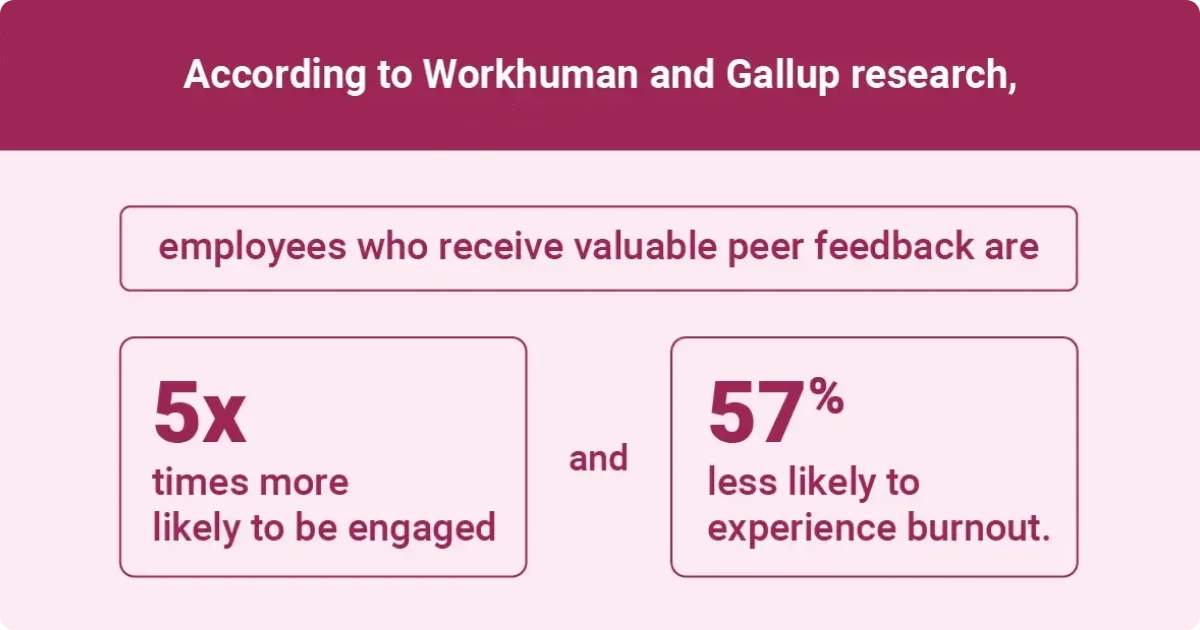
The impact is measurable. According to Workhuman and Gallup research, “Staying Connected”, employees who receive valuable peer feedback are five times more likely to be engaged and 57% less likely to experience burnout.
More importantly, data from Workhuman® Analytics & Research Institute (WARI) published in “10 Unexpected Benefits of Continuous Performance Management” shows that employees are 2.5x more likely to give feedback when they’re also giving or receiving recognition. Consider these numbers a direct argument for integrating recognition and feedback within the same platform.
Legal and ethical considerations
Feedback must always be grounded in fairness, professionalism, and respect. It means keeping feedback fact-based, focused on observable behaviors, and free from any form of discrimination.
Leaders should also ensure that feedback processes comply with relevant employment laws and organizational policies, observes the article “Organizational Policies and Practices for the Inclusion of Vulnerable Workers: A Scoping Review of the Employer’s Perspective” from the Journal of Occupational Rehabilitation. Confidentiality must be protected, particularly in anonymous survey formats, to ensure employees feel genuinely safe participating.
Beware that a feedback culture that lacks ethical guardrails can quickly erode the trust it was designed to build. Getting it right isn’t optional.
Recognize and act on feedback
Collecting feedback without acting on it is one of the fastest ways to lose employee trust, says “Exploring the Relationship Between Employee Trust and Silence in Performance FeedbackOpens in a new tab”. When employees see that their input leads to real change, they’re far more likely to keep contributing honestly.
Leaders can even reinforce this loop by regularly updating the team on how their feedback has influenced decisions or shaped new initiatives. Even small acknowledgments go a long way in signaling that feedback is valued and taken seriously.
Workhuman’s Social Recognition® platform supports this by connecting recognition moments to the feedback loop. Doing so helps leaders visibly celebrate contributions and close the gap between feedback given and action taken.
Conclusion: Build a culture of trust and feedback in your organization
Building a feedback culture doesn’t happen overnight. It takes consistent effort, the right tools, and a genuine commitment from both employees and leaders.
Throughout this guide, you have explored practical feedback for manager examples across positive, constructive, and negative scenarios. You have also seen how timing, empathy, and the right environment all play a role in making feedback land effectively.
The organizations that get this right don’t just have better managers. They have more engaged teams, stronger communication, and healthier workplace cultures overall.
Fortunately for you, Workhuman Conversations® makes it easier to embed feedback into everyday workflows rather than saving it for once-a-year reviews. When feedback becomes a habit, personal and professional growth follow naturally.
Remember this: Start small. Pick one practice from this guide and apply it in your next one-on-one. Over time, those small moments of honest dialogue add up to something much bigger.
FAQ
What is upward feedback?
Upward feedback is the process of employees sharing feedback directly with their managers or senior leaders.
Unlike traditional top-down feedback, upward feedback gives employees a structured opportunity to voice observations, concerns, and suggestions about their manager’s performance and leadership skills.
When done consistently, it contributes to a stronger culture of feedback across the entire organization, where team communication flows freely in every direction rather than just downward.
How do I write a performance review for my boss?
When writing a performance review for your manager, focus on specific behaviors and their impact on the team rather than general impressions.
Structure your review around key areas, such as communication, decision-making, leadership, and support for employee development.
Plus, use concrete examples wherever possible, keep your tone professional and constructive, and balance areas of strength with areas for improvement.
The manager feedback examples throughout this guide can serve as a practical starting point.
How to use 360-degree feedback samples?
360-degree feedback samples work best as a reference point rather than a script. Use them to understand the tone, structure, and specificity that effective feedback requires, then adapt them to reflect your own genuine experience with your manager.
More importantly, focus on observable behaviors. Tie each point to its impact on the team and ensure your feedback is balanced across strengths and professional development areas.
Why should you give your manager 360-degree feedback?
360-degree feedback gives managers a fuller picture of their own performance than top-down evaluations alone can provide. It surfaces blind spots, validates strengths, and helps managers understand how their behavior affects the team from multiple perspectives.
For organizations, it supports more accurate performance development and stronger leadership at every level.

Ryan Stoltz
Ryan is a search marketing manager and content strategist at Workhuman where he writes on the next evolution of the workplace. Outside of the workplace, he's a diehard 49ers fan, comedy junkie, and has trouble avoiding sweets on a nightly basis.
Recommended for you