
Best 360 Feedback Software for 2026: Top 20 Tools Reviewed
by Ryan Stoltz
Last updated
24 min read
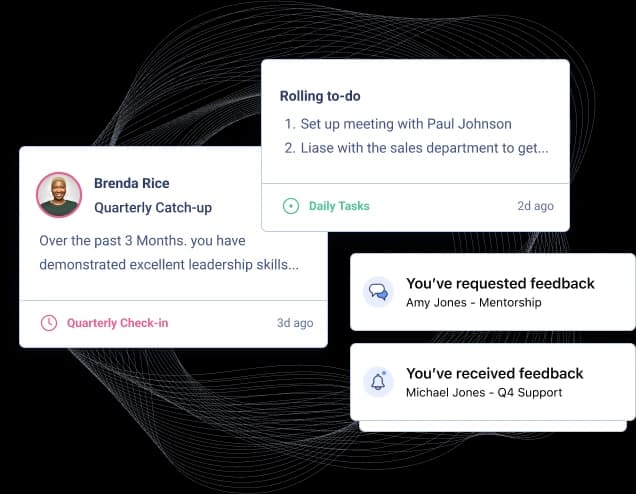
Table of contents
- What is 360-degree feedback, and why does it matter in 2026
- Our methodology: How we evaluated these platforms
- Top 20 360-degree feedback tools for 2026
- 360-degree360-degree feedback software insights from Reddit and user communities
- Head-to-head comparisons: Leading 360-degree feedback platforms
- 360 feedback software pricing: What to expect in 2026
- 360-degreeBest 360-degree feedback software by company size and industry
- Quick-start guide: Choosing your first 360 feedback tool in 3 steps
- Key features and capabilities to evaluate
- Benefits and ROI of 360-degree feedback software
- Common challenges with 360 feedback software — and how the right platforms address them
- FAQs
- The right platform is the one your organization will really use
Share this article
Collecting employee feedback is the easy part. Turning that input into better employee performance, stronger leadership development, and real behavior change is where most programs break down.
The best 360-degree feedback tools go beyond survey administration to support a more effective feedback process — one that helps managers, peers, and direct reports deliver constructive feedback that employees can actually use.
This guide covers 20 leading platforms and evaluates how well each one supports comprehensive feedback, continuous feedback, and broader performance management goals.
We looked at feature depth, user experience, reporting, integrations, and how effectively each performance management platform helps organizations conduct performance reviews, strengthen career development, and close talent gaps over time.
What is 360-degree feedback, and why does it matter in 2026
A 360-degree feedback tool collects input on an employee’s behaviors, impact, and leadership competencies from multiple perspectives across the organization, including managers, peers, direct reports, and self-assessments.
Unlike a traditional performance review, which usually reflects a single manager’s point of view, 360-degree feedback gives employees more comprehensive feedback on how their work shows up across teams.
That makes it especially valuable for talent development, career development, and leadership development. A manager may see one side of employee performance, while peers and direct reports often surface different strengths, blind spots, and critical competencies.
Core components of 360-degree feedback systems
A 360-degree feedback program is only as useful as the trust employees place in it. If raters doubt that responses are truly anonymous or participants receive feedback with no clear path forward, then the data collected has little value.
Well-designed systems address this with workflows built around psychological safety and follow-through:
- Multi-rater survey design
- Anonymity and confidentiality controls
- Automated reminders and participation tracking
- Insight-focused reporting and visualization
- Action planning and development workflows
How 360-degree feedback differs from traditional performance reviews
It's important to know what a 360 program is not before you implement it in your organization. First, it is not a replacement for performance reviews, and organizations that conflate the two end up undermining both. Tying 360-degree feedback to compensation or promotion decisions can corrupt the honesty of survey respondents. The two serve very different purposes:
| 360 feedback | Traditional review | |
| Purpose | Development and coaching | Evaluation and rating |
| Perspective | Multi-rater input | Single-manager assessment |
| Cadence | On-demand or periodic | Annual |
| Outcome | Behavior change and skill growth | Documentation |
Leading organizations are moving away from isolated annual 360 cycles toward more frequent, lighter-weight feedback moments that complement ongoing performance conversations. Workhuman Conversations® reflects this directly, combining structured check-ins, real-time crowdsourced feedback, and recognition data into a single continuous development workflow rather than a once-a-year exercise.
How AI is reshaping 360-degree feedback software
The hard part of 360 feedback is helping people make sense of sometimes dozens of responses at once. With modern systems, AI now does much of that work automatically.
The common capabilities of current leading 360-degree feedback platforms include:
- Natural language processing to summarize open-text comments and detect sentiment
- Pattern recognition to identify recurring themes across raters and cycles
- Bias detection to flag potentially skewed language or rating anomalies
- Coaching recommendations that suggest focus areas based on feedback patterns
- Insight prioritization that highlights what matters most
The practical result is that managers spend less time reading reports and more time acting on them. This gives everyone more time to spend on professional development rather than interpreting survey results.
Our methodology: How we evaluated these platforms
In addition to feature depth and pricing, we evaluated platforms on how effectively they support participation, insight clarity, and post-feedback action. Here is how we approached it:
- Feature evaluation: Assessed each platform against a rubric that covers survey design, anonymity controls, reporting and analytics, integrations, user experience, and mobile access
- Secondary research: Reviewed G2, Capterra, and Gartner Peer Insights with particular attention to the most recent feedback
- Hands-on exploration: Where possible, used trials or demo environments to configure 360 cycles and experience both the admin and participant sides of the workflow
- Vendor input: Drew on publicly available documentation and vendor conversations to clarify pricing, implementation approach, and product roadmaps
- Customer perspectives: Referenced published case studies, independent reviews, and direct conversations with HR leaders actively using these tools
Top 20 360-degree feedback tools for 2026
No two organizations run 360-degree feedback software the same way, so there's no single right answer to which system is best. The platforms here were chosen to reflect a range of use cases and team sizes, giving you a starting point that matches where your organization is today.
1. Workhuman
G2 Rating: 4.7/5, based on more than 2,000 reviews
Best for: Enterprise
Pricing: Custom
Integrations: Deep human resources information system (HRIS) integrations with Microsoft Teams, Outlook, Slack, Workday, SAP SuccessFactors, Oracle, ADP, and 50+ systems
Key features:
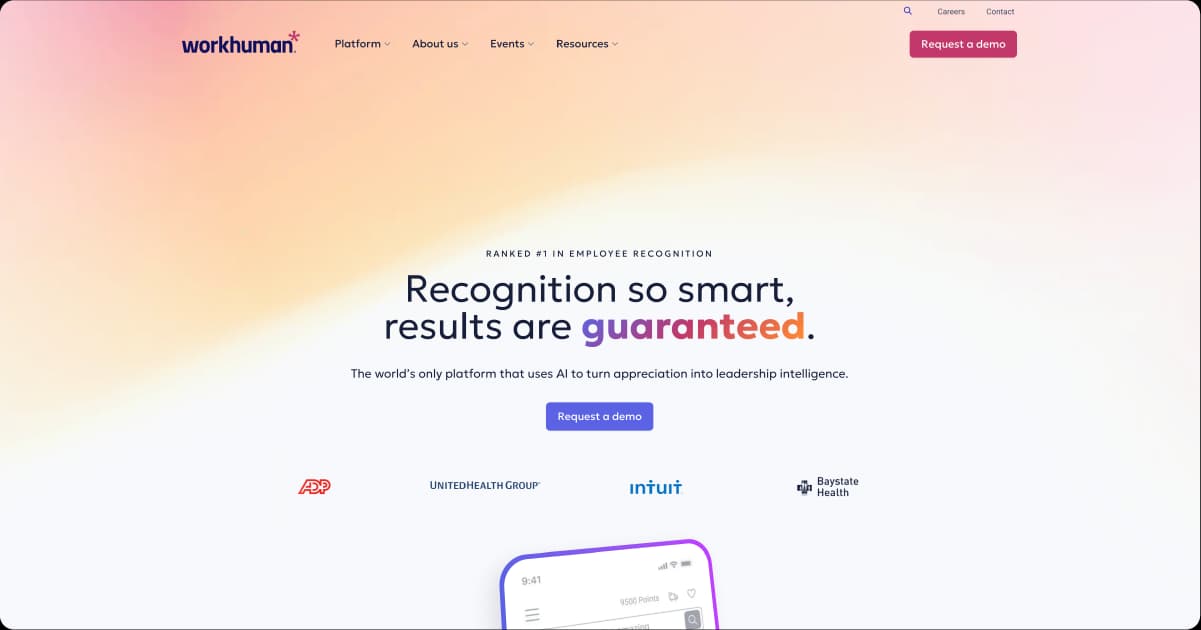
Workhuman stands apart from many 360-degree feedback vendors because it connects the feedback process to a broader performance management strategy.
Rather than relying only on survey cycles, it helps organizations support career development, leadership development, and recognition-driven growth through a more continuous, human-centered experience.
For companies looking for a performance management tool that goes beyond a traditional performance review, Workhuman offers a stronger link between employee feedback, culture, and business outcomes.
Pros:
- Supports continuous feedback, not just annual review cycles
- Makes it easier to conduct performance reviews with richer context through Reflections
- Connects 360-degree feedback with recognition, helping reinforce values and strengthen employee satisfaction
- Surfaces insights on leadership competencies, critical competencies, and critical skills through Human Intelligence™
- Strong option for organizations that want performance management, talent development, and employee engagement in one platform
- Integrates with existing performance management systems and collaboration tools
Cons:
- Organizations looking for only a lightweight online tool for basic annual reviews may not need the full breadth of capabilities
- Teams may need a thoughtful rollout plan to get the most value from continuous performance management features beyond the traditional performance review process
2. Culture Amp
G2 Rating: 4.5/5
Best for: People analytics
Pricing: Starts at $5/month per user
Integrations: Workday, SAP SuccessFactors, Microsoft Teams, Slack
Key features:
- 360-degree feedback and customizable performance review cycles
- AI-powered comment analysis and engagement survey heatmaps
- AI Coach for personalized development guidance tied to feedback data
Culture Amp serves more than 25 million employees from more than 6,500 companies. Its standout strength is its analytics depth. HR teams can segment survey results by role and function to identify the biggest areas of opportunity, making it easy to incorporate data into decision-making.
Pros:
- Industry benchmarking that adds credibility with leadership
- Intuitive survey setup with strong HRIS automation
Cons:
- Customizing reports is time-consuming.
3. Lattice
G2 Rating: 4.7/5
Best for: Integrated performance management
Pricing: Starts at $11/month per user
Integrations: Workday, BambooHR, Slack
Key features:
- 360-degree feedback tied to performance review cycles
- Objectives and Key Results (OKR) tracking with manager and peer visibility
- AI-powered coaching
Pros:
- Easy to navigate and implement
- Slack integration for teammates to share kudos without leaving the app
Cons:
- Managers can't do group check-ins, only one-on-one meetings.
- Closed surveys can't be reopened.
4. 15Five
G2 Rating: 4.6/5
Best for: Continuous feedback
Pricing: Starts at $4/month per user
Integrations: BambooHR, Slack, Microsoft 365
Key features:
- Weekly check-ins and guided 1-on-1s
- 360-degree reviews with OKR tracking
- AI-powered engagement surveys
15Five turns manager-employee communication into a regular habit. Weekly check-ins feed directly into performance reviews, so nothing gets lost between cycles. The platform works especially well for managers who want ongoing visibility into how their team is doing week to week.
Pros:
- Quick setup
- Check-in data rolls up into annual reviews automatically
Cons:
- Limited engagement survey customization
- Check-in prompts get repetitive if not manually edited
5. Qualtrics EmployeeXM
G2 Rating: 4.4/5
Best for: Survey sophistication
Pricing: Custom
Integrations: Slack, SAP, Salesforce, ServiceNow
Key features:
- Science-backed engagement surveys with AI analytics
- 360-degree development tools with competency frameworks
- Lifecycle listening from onboarding through exit
Qualtrics EmployeeXM is the go-to choice for enterprise HR teams that need more than a basic engagement survey. Its AI-driven analytics look at open-ended responses at scale, turning thousands of comments into clear themes that executives can act on.
Pros:
- Industry benchmarks make it easy to contextualize results for leadership
- Strong professional services team to help with implementation
Cons:
- Steep learning curve for new users
- High cost makes it inaccessible to smaller organizations
6. Leapsome
G2 Rating: 4.8/5
Best for: Small & mid-market European companies
Pricing: Starts at $6,000/year
Integrations: Workday, Microsoft Teams, Slack
Key features:
- 360-degree reviews with customizable competency frameworks
- Engagement surveys with AI-generated questions and benchmarking
- Built-in HRIS connecting employee records to performance
Leapsome replaces several HR tools at once without the enterprise price tag. It's compliant with the General Data Protection Regulation (GDPR) and available in 17 languages, perfect for companies managing employees in multiple countries. The platform's design also lets teams start with what they need and expand over time.
Pros:
- Highly customizable review templates and workflows
- AI included in all plans at no extra cost
Cons:
- Backend setup quite complex for HR admins
- No dedicated mobile app
7. PerformYard
G2 Rating: 4.7/5
Best for: Customization
Pricing: Starts at $5/month per user
Integrations: ADP, BambooHR, Workday, Slack
Key features:
- Fully customizable review cycles, including 360s and continuous feedback
- AI-assisted review writing and automated summaries
- Engagement surveys with sentiment analysis and eNPS tracking
Most performance platforms make you adapt to their structure. With PerformYard, your HR teams can configure review forms and feedback cycles to match how your organization works. Every customer also gets a dedicated success manager, which users consistently call out as a differentiator.
8. Effy AI
G2 Rating: 4.8/5
Best for: AI-assisted feedback
Pricing: Starts at $3/month per user
Integrations: Slack
Key features:
- AI-generated review forms and bias detection are built into every cycle
- Spider charts and company-wide heatmaps for visual performance analysis
- Anonymous 360-degree feedback with customizable viewing permissions
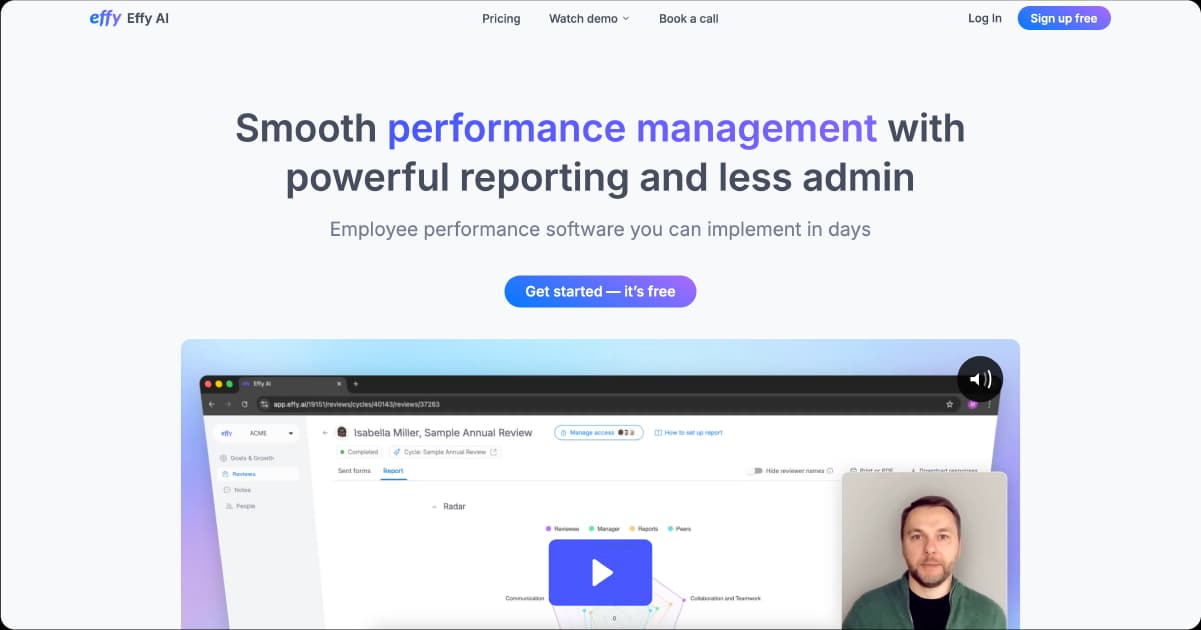
Effy AI is built for teams that want to run structured 360 reviews without the admin overhead. You can launch a full review cycle in under an hour, and the AI handles drafting and refining feedback so managers don't have to do the grunt work. This platform works best for smaller organizations getting their first formal review process off the ground.
Pros:
- AI drafts and summarizes reviews automatically to cut down on admin time
- Fast to set up with no extensive training required
Cons:
- Only integrates with Slack
- Full data exports across all reviewers are not currently available
9. Betterworks
G2 Rating: 4.4/5
Best for: Goal alignment
Pricing: Custom
Integrations: Microsoft Teams, Slack, Workday, Google Workspace
Key features:
- OKR and goal-setting tools that connect individual objectives to company strategy
- AI-assisted goal writing with automated nudges to keep updates consistent
- Continuous feedback and performance reviews in one system
Betterworks connects individual goals to company objectives in one continuous system. AI-assisted goal writing and intelligent nudges keep employees and managers aligned between review cycles. It's built for large organizations that need performance visibility without relying on IT or analysis support.
Pros:
- Goal transparency lets every employee see how their work connects to team and company priorities
- HR admins can configure workflows without involving IT
Cons:
- Reporting functionality is limited for data-heavy teams.
- Some features may confuse employees without extra guidance.
10. Cornerstone Performance
G2 Rating: 4.0/5
Best for: Learning integration
Pricing: Custom
Integrations: Workday, Google Workspace, Microsoft Teams, Slack
Key features:
- Skills matrix to identify competency gaps and evaluate employee capabilities
- Performance reviews linked directly to personalized learning and development plans
- Observation checklists for recording and assessing skills on the job
This is the go-to for organizations that want performance and learning in one system. Combined with Cornerstone Learning, the platform serves machine learning-powered training recommendations based on review outcomes, so employees don't have to chase down their next step.
Pros:
- Strong goal visibility with targets and thresholds that managers can track in real time
- Served 140 million users across 186 countries with support in 50 languages
Cons:
- Admin configuration is complicated and usually requires a dedicated system admin.
- The user interface feels dated, as some areas haven't been meaningfully updated in years.
11. Reflektive
G2 Rating: 4.2/5
Best for: Real-time feedback
Pricing: Starting at $7,500 per month
Integrations: Microsoft Teams, Gmail, Slack
Key features:
- Recognition Wall for peer-to-peer appreciation visible across the organization
- Continuous check-ins and goal tracking with company-level dashboards
- Engagement surveys with analytics to surface team-level insights
Pros:
- Clean, uncluttered interface that employees can use without much training
- Solid reporting tools to show usage and help HR identify top adopters
Cons:
- Users claim the Gmail integration is unreliable.
- Goal visibility across departments is limited.
12. Primalogik
G2 Rating: 4.7/5
Best for: Small businesses
Pricing: Starts at $6/month per user
Integrations: BambooHR, Okta, Google Workspace
Key features:
- 360-degree feedback with customizable review cycles and multi-reviewer support
- Continuous feedback and engagement surveys in one platform
- Goal tracking with progress dashboards for managers and HR teams
With this no-frills option, small teams can have 360 reviews up and running fast. Administrators can get comfortable with the platform in under an hour, and regular users need no training at all. Customer support is consistently called out as a differentiator, with a responsive team that engages directly regardless of account size.
Pros:
- Quick to implement, with an interface that works for non-technical HR teams
- Customizable templates across review types without complex configuration processes
Cons:
- Users say the interface design feels unpolished and could use some refinement.
- There is limited control over automated email frequency and content sent to reviewers during active cycles.
13. ClearCompany
G2 Rating: 4.6/5
Best for: Talent management suite
Pricing: Custom
Integrations: ADP Workforce Now, UKG Pro, LinkedIn Recruiter
Key features:
- Full talent lifecycle, including applicant tracking, onboarding, performance, engagement, learning management, and compensation
- AI-powered sourcing and job descriptions
- Unified analytics that connect performance and engagement data without business intelligence support
A single platform for HR teams that don't want to stitch together five separate tools, ClearCompany connects recruiting through to performance and compensation. Data moves easily across the employee lifecycle without manual exports. The platform is especially well-suited for distributed and deskless workforces in healthcare and hospitality.
Pros:
- Covers more of the talent lifecycle than most performance-focused platforms
- A dedicated customer success manager is included for every account at no extra cost
Cons:
- Navigation between modules can feel clunky, as users claim basic tasks require more clicks than expected.
- Some promised features aren't yet available publicly.
14. Synergita (Best for Asia-Pacific Market)
G2 Rating: 4.6/5
Best for: Asia-Pacific market
Pricing: Starts at $3/month per user
Integrations: Jira, Microsoft Teams
Key features:
- OKR management with both top-down cascading and bottom-up alignment
- 360-degree feedback with voice-to-text input for continuous on-the-go feedback
- AI-powered sentiment analysis to identify employee emotions and team dynamics
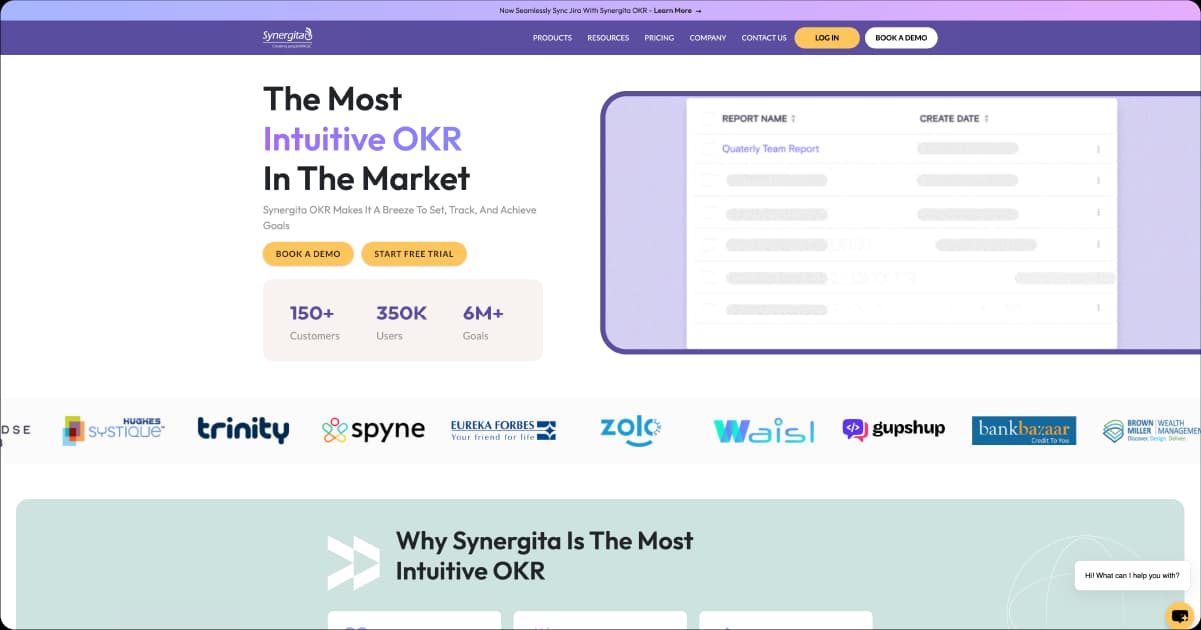
Synergita was purpose-built in India for companies operating across multiple geographies and time zones. HR teams can configure department-level review templates and appraisal workflows independently, ideal for organizations that run different review processes across regions without forcing a single global standard.
15. Trakstar
G2 Rating: 4.2/5
Best for: Performance appraisals
Pricing: Custom
Integrations: ADP Workforce Now, BambooHR, Slack, UKG Pro
Key features:
- Customizable appraisal cycles with more than 100 competency options and automated review workflows
- 360-degree feedback with peer notes and recommended performance improvement statements
- Goal cascading from leadership down to individual employees, with progress tracking
One of the more established names in appraisal software, Trakstar now operates under the Mitratech umbrella following a 2023 acquisition. HR teams that run structured, repeatable review cycles will find it matched to their workflow. Completion rates and on-time delivery are consistently called out as strengths by long-term users.
Pros:
- Strong appraisal history tracking lets managers reference past reviews during current cycles
- Responsive customer support team with fast turnaround on issues
Cons:
- Bulk edits across multiple review processes aren't supported, so you'll have to make changes one at a time.
- A rigid goal structure needs manual workarounds to accommodate stretch targets or non-standard scoring scales.
16. Spidergap
G2 Rating: 4.2/5
Best for: Visual, user-friendly surveys
Pricing: Pay-as-you-go
Integrations: Microsoft Excel
Key features:
- Visual spider diagram reports designed with HR directors and employees to make feedback immediately actionable
- Fully customizable questionnaires with best-practice templates as a starting point
- Impact surveys to measure return on investment after each feedback cycle
Purpose-built for 360-degree feedback with no extras bolted on, Spidergap is especially popular with independent coaches and consultants who run feedback programs with multiple clients. Reports are designed to be understood without training, driving consistently higher employee engagement with the results.
Pros:
- Scales from 10 to 10,000-plus participants without significant admin overhead
- Customer support consistently rated among the best in the 360-degree feedback category.
Cons:
- Few online reviews make validating the platform difficult.
- Customization has limits, and some survey configurations can't be fully replicated without workarounds.
17. Engagedly
G2 Rating: 4.3/5
Best for: Affordability for small to medium-sized businesses (SMB)
Pricing: Custom
Integrations: BambooHR, ADP, Salesforce
Key features:
- An agentic AI assistant that routes tasks across goal, feedback, learning, and recognition modules
- Gamified recognition system with badges and points
- OKR management with cascading goals and continuous check-ins
With the Engagedly platform, teams can get a full talent suite at a price point that doesn't require an enterprise budget. The social feed and recognition keep remote teams connected day to day, not just during review cycles. HR admins can impersonate accounts directly to troubleshoot issues without asking employees to walk them through what they're seeing.
Pros:
- Covers performance, learning, engagement, and recognition in one platform without the enterprise price tag
- Fast development turnaround on customer feature requests
Cons:
- The platform can load slowly, especially for larger teams.
- Reporting is difficult to filter, requiring lots of manual cross-referencing to pull specific employee data.
18. Small Improvements
G2 Rating: 4.3/5
Best for: Continuous conversations
Pricing: Starts at $3/month per user
Integrations: Slack, BambooHR, Workday, Google Workspace
Key features:
- Structured 1:1 meeting tool with agenda preparation and follow-up tracking built in
- AI-assisted feedback that helps employees translate peer input into concrete objectives
- Praise feature that posts recognition directly into Slack without leaving the workflow
Pros:
- Quick to implement, with a clean interface that requires little to no training for managers or employees
- Good customer support is consistently called out in reviews
Cons:
- Reporting capabilities are limited for both admins and managers.
- Pulse survey scheduling is unintuitive and requires extra steps to configure correctly.
19. Motivosity
G2 Rating: 4.7/5
Best for: Recognition-first culture
Pricing: Custom
Integrations: Slack, Microsoft Teams, Workday, BambooHR
Key features:
- Peer-to-peer recognition tied directly to company values
- Social feed that promotes milestone celebrations and team highlights
- Rewards marketplace that covers 140+ countries with Amazon, PayPal, Venmo, and other digital gift cards
Motivosity is built primarily around recognition and culture more than performance reviews, so organizations looking for a full feedback and goal management suite will need a separate platform. Users consistently describe it as something they'd actually enjoy opening rather than a compliance tool, which explains its reported 95%+ user engagement rate.
Pros:
- Recognition tied to company values gives peer appreciation strategic weight
- 95%+ reported user engagement rate, unusually high for HR software in this category
Cons:
- Reward catalog options are noticeably limited for users outside North America.
- The social feed can feel noisy and unfocused for employees at large organizations with little context for colleagues they've never met.
20. AssessTEAM
G2 Rating: 4.2/5
Best for: Project-based feedback
Pricing: Starts at $2/month per user
Integrations: Google Workspace, Microsoft 365
Key features:
- Project-based performance tracking that ties individual evaluations to specific assignments rather than annual cycles
- AI-powered SMART KPI recommendations to help managers define measurable job expectations without starting from scratch
- Library of prebuilt KPI and evaluation templates covering a wide range of roles and industries
At $2 per user per month with no contracts required, AssessTEAM is one of the most affordable options on this list. That makes it perfect for businesses that need structured evaluations without a heavy implementation investment. The breadth of features can feel overwhelming during initial setup, and the mobile experience is lacking.
Pros:
- Extremely low price point with no contract commitment
- Customer support is consistently praised by name in reviews
Cons:
- Mobile app noticeably underperforms relative to the desktop experience.
- Evaluation templates cannot be modified after they've been sent out.
Best free and freemium 360-degree feedback tools
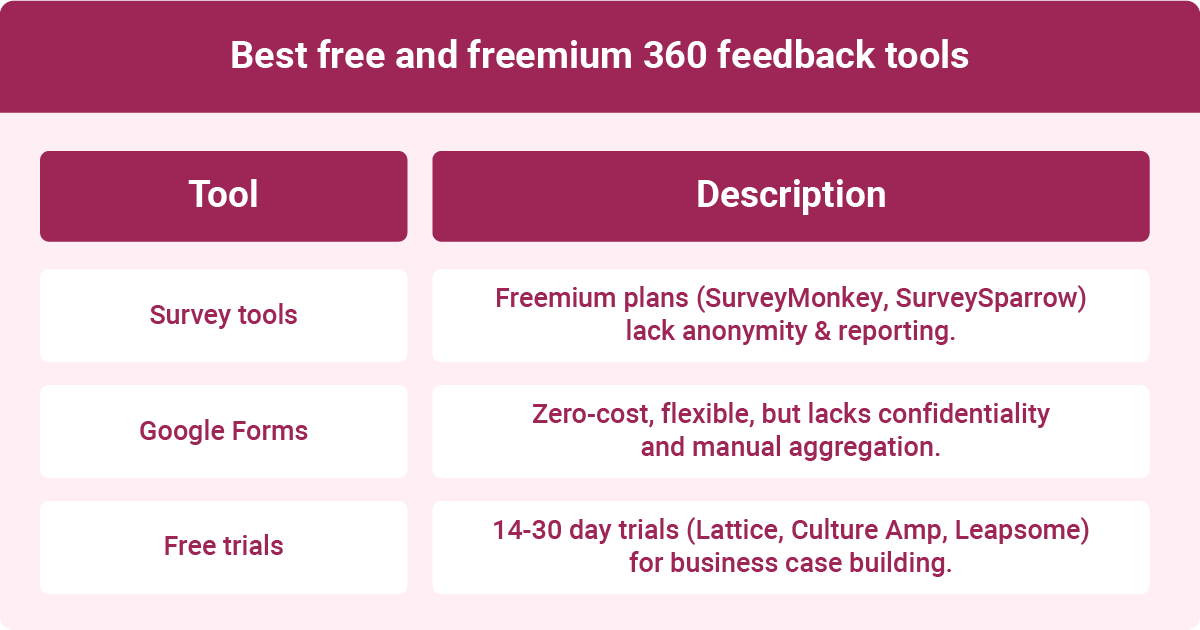
Not every team needs a paid platform to begin implementing a 360-degree feedback plan. These are a few free 360-degree feedback tools that are great options for small teams or for those looking to get started before investing in software:
- Survey tools: Tools like SurveyMonkey and SurveySparrow have freemium plans that can mimic 360 surveys. However, they usually lack anonymity control and meaningful reporting capabilities, so they really only work for small teams.
- Google Forms: This option is zero-cost and flexible, but requires manual aggregation and comes with no confidentiality safeguards.
- Free trials: Lattice, Culture Amp, and Leapsome run 14- to 30-day full-feature trials, which are useful for building an internal business case before getting budget approval.
Free tools make the most sense for one-time leadership assessments, small team pilots, nonprofits, and academic use cases where simplicity is more important than sophistication. Once you exceed 100 participants or need compliance features, however, the manual workarounds required by free platforms tend to create more administrative burden than the cost savings justify.
Honorable mentions and integrated HR suites
A few platforms did not make the main list but are worth considering, depending on your priorities:
360-degree360-degree feedback software insights from Reddit and user communities
The recurring advice on forums like r/humanresourcesOpens in a new tab is to start with the problem you're trying to solve before evaluating any tool. As one commenter put itOpens in a new tab, identify if you're addressing a specific issue or just reacting to industry buzz. Another warned against investingOpens in a new tab in any platform without first fitting it into a larger engagement strategy.
When it comes to specific problems, the complaints that come up most consistently have little to do with features. Real users flag steep admin learning curves and mobile experiences that lag behind desktop versions as the most pressing issues. On the customization front, users of Culture Amp and Lattice note that rating scales and review question formats can be more rigid than the sales process implies.
The most common advice from experienced practitioners is to run a pilot before committing to a full rollout. Then, hold off on advanced analytics features until after the first year and train managers on how to have a conversation about the feedback once it arrives. For programs focused on executive development, reviewing leadership feedback examples can be a great way to calibrate question design before launch.
Head-to-head comparisons: Leading 360-degree feedback platforms
Choosing between platforms often comes down to less obvious factors than feature checklists. The comparisons here focus on pricing, organizational fit, how much work managers have to do to interpret results, and how naturally the platform moves from feedback to action.
Workhuman vs Culture Amp: Enterprise choice
Both of these platforms are enterprise-tier and require custom pricing conversations, but they're built around different philosophies. Workhuman centers recognition data as the connective tissue between feedback and performance. Culture Amp leads with survey science and a benchmarking database that gives people analytics teams external context for internal results.
This is how Workhuman and Culture Amp compare for 360-degree feedback purposes:
| Workhuman | Culture Amp | |
| Best for | Unified employee experience | People analytics and benchmarking |
| Key advantage | Recognition, analytics, wellbeing, and continuous development in one platform | Research-backed frameworks and deep benchmark data |
| Manager burden | Lower, because AI synthesizes insights automatically | Moderate, requiring analytical interpretation |
| Feedback to action | Embedded through continuous recognition workflows | Structured but requires dedicated follow-through |
| Pricing | Custom | Custom |
Lattice vs 15Five: Mid-market decision
These two options dominate the mid-market conversation for good reason. They're priced similarly and cover comparable ground, while focusing on different priorities. Lattice invests heavily in interface polish and employee self-service. 15Five concentrates on manager coaching and weekly touchpoints.
Here are the biggest differences between Lattice and 15Five for mid-market organizations:
| Lattice | 15Five | |
| Best for | Tech companies prioritizing UX | Organizations focused on manager development |
| Key advantage | Polished interface and broad performance features | Stronger coaching tools and continuous check-ins |
| Manager burden | Low for employees, but steeper admin learning curve | Lower overall with guided manager workflows |
| Feedback to action | Strong, with goal tracking and review integration | Strong, built around weekly follow-through habits |
| Pricing | $8-15 per user per month | Starts at $4 per user per month |
PerformYard vs Leapsome: Customization focus
These two platforms occupy a customization-forward position in the mid-tier market, but they serve different geographies and compliance needs. PerformYard is built for US organizations with non-standard performance processes, while Leapsome is the stronger choice for European companies dealing with GDPR compliance and multi-country rollouts.
This is how PerformYard and Leapsome compare:
| PerformYard | Leapsome | |
| Best for | US organizations with unique performance workflows | European companies with multi-country needs |
| Key advantage | Deep workflow customization and white-label options | Strong localization and modular platform design |
| Manager burden | Moderate, because flexibility requires more setup | Low thanks to modules that can be adopted incrementally |
| Feedback to action | High customizability to adopt feedback quickly | Structured pathways built into the platform |
| Pricing | Starts at $5/month per user | Starts at $6,000/year |
360 feedback software pricing: What to expect in 2026
Pricing for 360 feedback software covers a much wider range than you may expect, from $2 per user per month for no-frills evaluation tools to six-figure annual contracts for enterprise platforms with deep analytics. That range is indicative of the vastly different capabilities of these platforms and how far they go in turning feedback data into something managers can use.
Pricing and contract considerations
Pricing models vary tremendously, but you shouldn't choose your 360 platform based on costs alone. Evaluate pricing in the context of adoption, participation rates, customization, and the internal effort required to run each cycle.
The biggest pricing considerations to keep in mind are:
- Per-user vs. per-cycle pricing and how it grows with your headcount over time
- Whether implementation and training are included or priced separately as add-ons
- Contract flexibility that allows for a pilot or trial before committing to a full rollout
- The cost trade-off between a standalone 360 tool and a platform that bundles feedback with performance management or recognition
Pricing model comparison
Each pricing structure suits a different kind of buyer and program design:
| Pricing model | How it works | Usual range | Best for |
| Per-user subscription | Monthly or annual fee per employee | $5-$20 per user per month | Ongoing programs with a consistent headcount |
| Per-cycle pricing | Fee per 360 feedback round | $15-$50 per participant per round | Annual programs with variable participation rates |
| Flat-rate annual | Fixed fee regardless of users | $10k-$50k for small and medium businesses or $100k+ for enterprises | Organizations that want predictable budgeting |
| Tiered packages | Base features at a lower price with analytics and integrations for an extra fee | Varies | Teams starting lean with room to expand |
Total cost of ownership breakdown
The subscription line item is only one part of what a 360 program will end up costing. Always evaluate the full three-year picture when evaluating platforms:
| Cost component | Share of three-year total | Notes |
| Software subscription | 60-70% | Primary recurring cost |
| Implementation and setup | 10-20% | One-time or spread across the first year |
| Training and change management | 5-10% | Almost always underestimated |
| Ongoing support and success | 5-10% | Sometimes bundled into the subscription costs |
| Integration and custom development | 5-15% | Highly variable based on technical complexity |
Cost optimization strategies
The platforms that can get you the best ROI are rarely the cheapest or the most expensive. They're the ones that get used consistently and create lasting change in your organization. Try these tips to stretch your budget without compromising on outcomes:
- Negotiate multi-year contracts: Most vendors will offer 10-20% in annual savings for a two- or three-year commitment, and it's almost always worth asking before signing anything.
- Start with a pilot: Running your first 360 cycle with 100 to 200 users before a full rollout lets you identify any configuration issues and build internal buy-in before you're locked into a larger spend.
- Lean on existing integrations: If your HRIS or collaboration tools already integrate with a platform you're considering, that compatibility can significantly reduce implementation costs and time investments.
- Use vendor templates: Most platforms ship with pre-built survey frameworks and report templates. Using them in Year 1 keeps customization costs low as you learn what your organization needs.
- Think in bundles, not point solutions: A platform that combines 360-degree feedback with performance management or engagement surveying usually costs less over three years than three separate tools that require separate implementations and integrations.
360-degreeBest 360-degree feedback software by company size and industry
The right platform for a 50-person startup and the right platform for a 20,000-person global enterprise are almost never the same product. You need to consider your organization's size and specific requirements when evaluating the best 360-degree feedback tools.
Enterprise vs. SMB needs
Larger organizations often need performance management systems that can support global scale, complex workflows, and deep analytics. Smaller and mid-market organizations usually need a performance management tool that is easier to launch, easier to manage, and flexible enough to support current needs without adding unnecessary complexity.
For enterprise buyers, the priorities often include:
- Advanced reporting and performance metrics
- Sophisticated anonymity and permissions controls
- Global support and integrations
- Scalable workflows for employee feedback and performance management
This is where flexibility matters. Some organizations may want a lighter approach centered on review cycles, while others want a broader performance management strategy that includes recognition, coaching, and ongoing employee feedback.
Small business (25-500 employees)
For smaller teams, setup and pricing transparency are more important than feature depth. Steer clear of platforms that require dedicated admin resources or advanced customization that you don't need at this stage. The top picks are Primalogik, Small Improvements, and Engagedly:
| Primalogik | Small Improvements | Engagedly | |
| Pricing | $6/user/month | $3/user/month | Custom |
| Implementation | $100-500 | $100-500 | $100-500 |
| Top features | Pre-built templates and self-service administration | Continuous feedback and 1:1 meetings | Full talent suite and recognition wall |
Mid-market (500-5,000 employees)
Mid-market buyers need a balance of usability and depth, with room to grow. Where possible, favor platforms that take a modular approach so you can add capabilities as the organization matures. That way, you won't have to replatform in two years. The top choices are:
| Lattice | 15Five | Leapsome | PerformYard | |
| Pricing | Custom | Custom | Custom | $5/user/month |
| Implementation | $5,000-25,000 | $5,000-25,000 | $5,000-25,000 | $5,000-25,000 |
| Top features | Easy UX and self-service options | Manager coaching and routine check-ins | European localization and modular platform design | Deep workflow customization |
Enterprise (5,000+ employees)
At enterprise scale, analytics depth and security features are the top considerations. System and Organization Controls (SOC 2) compliance, a 99.9% service level agreement, 24/7 support, and a dedicated customer success team should be baseline requirements. Consider these enterprise 360 assessment tools:
| Workhuman | Culture Amp | Qualtrics | Cornerstone | |
| Pricing | Custom | Custom | Custom | Custom |
| Implementation | $25,000-150,000+ | $25,000-150,000+ | $25,000-150,000+ | $25,000-150,000+ |
| Top features | Native AI that converts peer feedback into performance and skills insights | Research-backed survey science and deep external benchmarking data | Advanced analytics and experience management at global scale | Learning recommendations tied directly to performance and skills gaps |
Unified HRIS and all-in-one HR suites
Not every organization needs a standalone 360-degree feedback tool. For teams that prioritize a single system of record, these platforms bundle feedback capabilities into a broader HR stack:
| ClearCompany | Rippling | BambooHR | HiBob | |
| Pricing | Custom | Custom | Custom | Custom |
| Top features | Full talent lifecycle from recruiting through performance | Unified workforce management with automated workflows | Simple, intuitive HR suite built for small and mid-size teams | People-first platform with strong engagement and analytics tools |
| Best for | Remote and deskless teams | Fast-growing companies that need HR and IT in one place | Small businesses looking for straightforward HR software | Mid-market companies prioritizing culture and employee experience |
Industry-specific considerations
Compliance requirements can vastly differ by industry. You need to look for tools that solve your specific compliance considerations:
Remote and hybrid work optimization
Remote teams need feedback tools that work where they already spend most of their time. Platforms with native Teams and Slack integrations, like Workhuman, let employees give recognition and receive feedback nudges without switching applications. Also, look for platforms with asynchronous feedback collection that accommodate multiple time zones and virtual coaching tools.
Quick-start guide: Choosing your first 360 feedback tool in 3 steps
Picking a 360-degree feedback platform doesn't have to take months. If you're starting from scratch, these basic steps will get you from blank slate to signed contract without unnecessary detours:
- Define your must-haves: Identify your company size tier and budget range, then lock in your single top priority among ease of use, analytics depth, integrations, and cost. Every platform has trade-offs, so knowing your priority upfront keeps your evaluation honest.
- Shortlist three vendors and run parallel trials: Small business teams should look at Primalogik, Engagedly, and Small Improvements. Mid-market buyers should look at Workhuman, Lattice, 15Five, and Leapsome. Enterprise clients should start with Workhuman, Culture Amp, and Qualtrics. Request demos for each platform, and invite 10 to 20 internal users to complete a mock cycle. Then, score each platform on ease of setup, report usefulness, participant experience, and cost fit on a one-to-five scale.
- Plan your timeline: Mid-market procurement usually takes four to eight weeks from shortlist to signed contract. Enterprise adds another eight to 12 weeks for security reviews and legal. Build that time into your project plan before you start reaching out to potential providers.
Over-customizing in Year 1, skipping manager training, and choosing based on price alone are the three decisions most likely to undermine an otherwise solid platform choice. Get those right, and most other problems are recoverable.
Key features and capabilities to evaluate
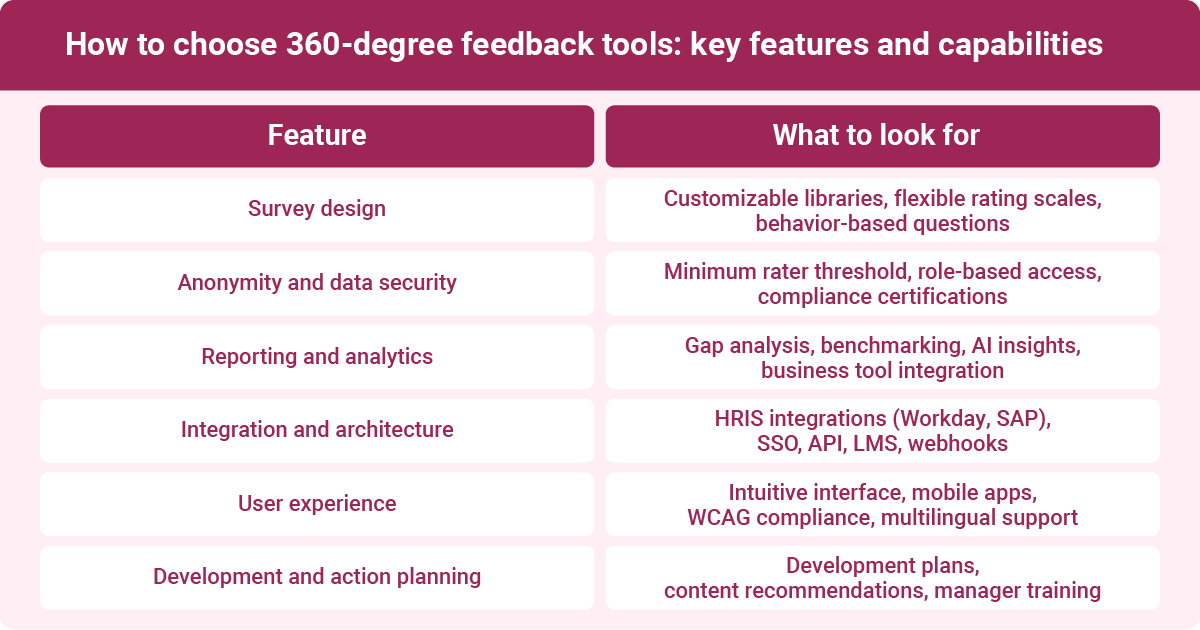
Not all 360-degree feedback platforms are built the same way, and the differences that matter most aren't always obvious from a feature list. Here's what to look at closely before signing anything.
Survey design and administration
The best survey tools stay out of the way. Look for pre-built competency libraries with the option to customize, flexible rating scales, multi-language deployment, and rater workflows that don't create unnecessary steps for managers. Survey question design should align with the principles of effective feedback so responses focus on observable behavior, not personality judgments.
Anonymity and data security
Trust is the most important part of 360 feedback. If employees doubt that responses are truly anonymous, then response quality will drop immediately. Always verify:
- Minimum rater threshold for anonymity, which is usually three to five responses
- Role-based access controls and audit trails
- Compliance certifications covering SOC 2, GDPR, HIPAA, and more when applicable
- Geographic data residency options for global organizations
Reporting and analytics
Individual feedback reports and executive analytics serve different audiences and should be evaluated separately. At the individual level, look for gap analysis and strengths identification capabilities. At the organizational level, look for benchmarking across departments and tenure bands, trend analysis across multiple feedback cycles, heatmaps for pattern recognition, development-level benchmarking, and direct export into your business intelligence tools.
Integration and technical architecture
A feedback platform that doesn't connect to your existing HR stack creates more work than it eliminates. Prioritize native HRIS integrations with:
- Workday
- SAP SuccessFactors
- BambooHR
- ADP
- Slack
- Microsoft Teams
Beyond HRIS integrations, pay attention to whether the platform supports single sign-on (SSO) and security assertion markup language (SAML) authentication, API access for custom builds, learning management system (LMS) connectivity for development recommendations, and webhook support for custom workflow triggers.
User experience and adoption
Participation rates live and die by how easy the platform is to use. Look for intuitive interfaces, native mobile apps, Web Content Accessibility Guidelines (WCAG) accessibility compliance, and multilingual support for global teams. Tools that offer in-platform guidance and contextual help reduce the reliance on HR to answer basic questions during every cycle.
Development and action planning
Feedback that doesn't connect to a development plan rarely changes behavior. Evaluate whether the platform lets you create individual development plans and if it provides learning content recommendations tied to competency gaps.
Beyond the platform itself, managers need training on how to give effective feedback once reports arrive. Even perfectly configured 360 surveys fail when managers don't know how to apply the feedback.
Benefits and ROI of 360-degree feedback software
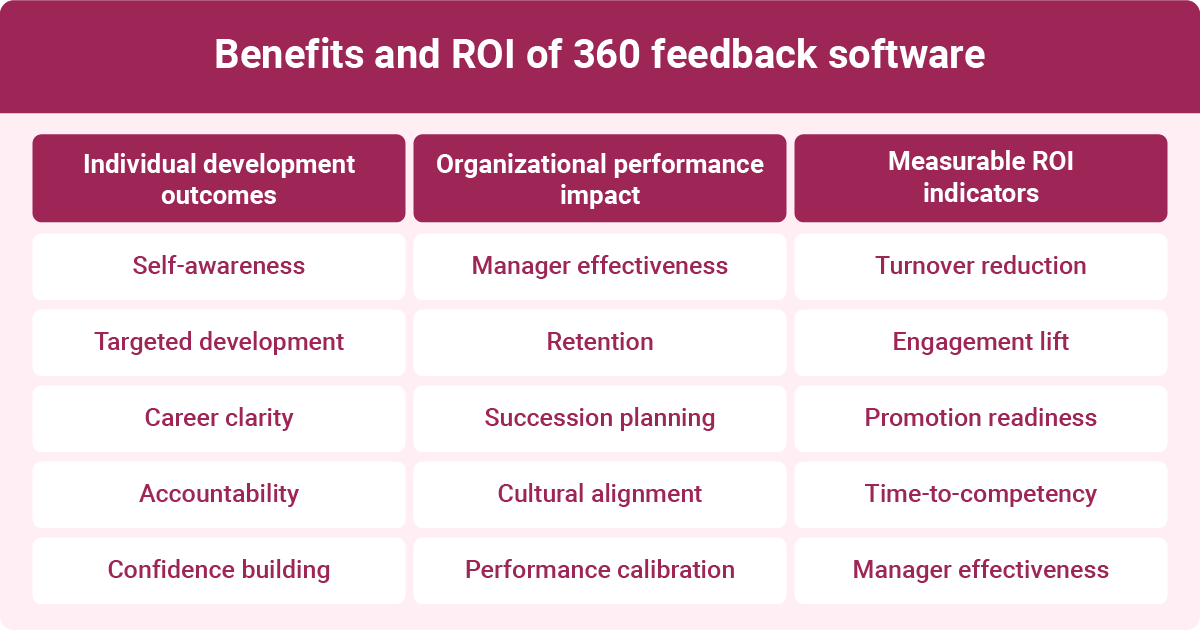
The main benefits of 360-degree feedback go beyond employee development. Well-designed programs that run consistently can lead to jumps in retention numbers and manager effectiveness scores.
Individual development outcomes
One of the biggest reasons why 360-degree feedback works at the individual level is tha360-degree it replaces assumptions with evidence. Employees learn how their behaviors land across the people they work with most closely, which helps them identify a more honest starting point for development. The impact is even bigger when organizations use growth mindset feedback approaches to position competency gaps as opportunities:
- Self-awareness: Blind spots identified by multiple people give employees a fuller picture than self-assessment alone.
- Targeted development: Feedback highlights specific behaviors to strengthen or change rather than leaving employees to guess where to focus.
- Career clarity: Competency profiles inform promotion readiness and lateral moves with more objectivity than manager opinion alone.
- Accountability: Documented feedback creates a shared commitment to improvement.
- Confidence building: Recognizing strengths reinforces positive behavior.
Organizational performance impact
The organizational benefits compound over time, especially when 360 feedback is embedded into broader talent processes:
- Manager effectiveness: Leadership competency feedback gives coaching conversations a specific, behavior-based focus.
- Retention: Employees who receive regular, meaningful feedback feel more invested in and are less likely to quietly disengage.
- Succession planning: Multi-rater assessments identify high-potential talent with more objectivity than manager nominations alone.
- Cultural alignment: Feedback tied to organizational values reinforces the behaviors that leadership wants to see.
- Performance calibration: 360 data complements manager ratings and reduces the risk of biased or incomplete evaluations.
Measurable ROI indicators
Organizations that run 360 programs consistently and connect feedback to actual development plans tend to see results that show up in the data:
Common challenges with 360 feedback software — and how the right platforms address them
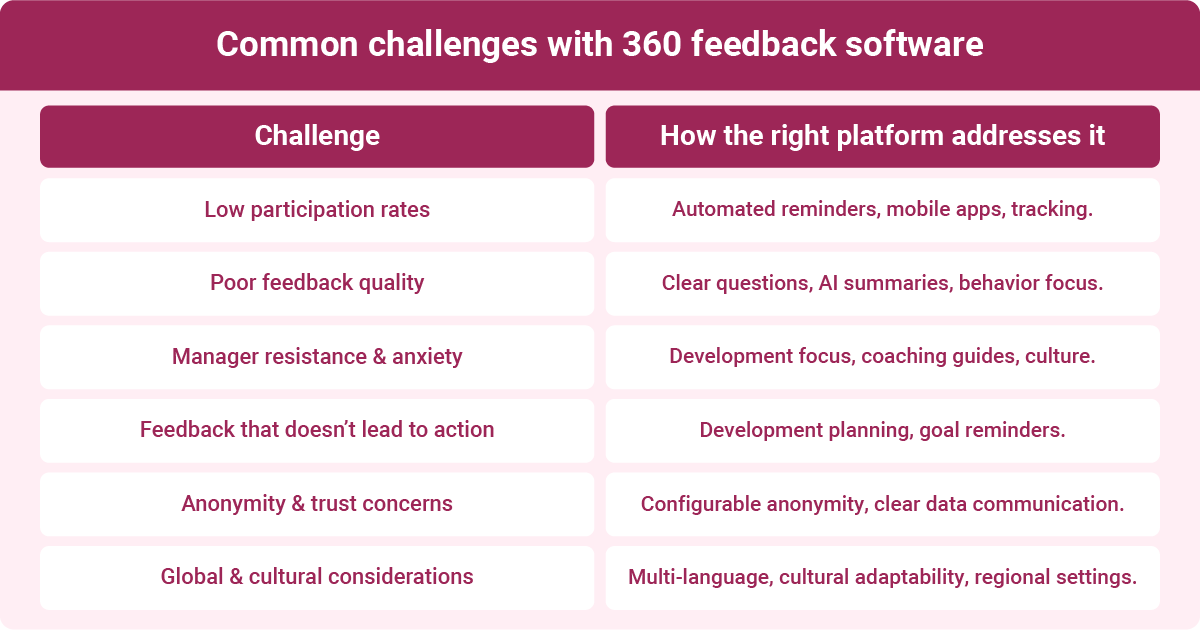
Even well-intentioned 360 programs can fail. The root cause is almost always that feedback was difficult to collect or hard to implement. These are the most common challenges with 360-degree feedback software and what to look for in a platform to mitigate them:
- Low participation rates: Survey fatigue and poor mobile experiences are the usual culprits. Look for platforms with automated reminders, native mobile apps, manager-level completion tracking, and feedback prompts embedded directly into existing workflows. An 80% participation threshold is generally the minimum needed for statistically reliable results.
- Poor feedback quality: Vague comments and recency bias are signs that the platform isn't doing enough to guide raters. Behavioral question design with clear anchors and AI-assisted summarization to highlight themes helps produce input that's truly useful.
- Manager resistance and anxiety: Fear of negative feedback and uncertainty about how to respond are common, especially for first-time participants. Platforms that clearly position 360 as a development tool and include built-in coaching guides see higher adoption rates. In the organization itself, building a strong feedback culture goes hand in hand with implementing 360-degree360-degree feedback software.
- Feedback that doesn’t lead to action: Reports filed away without follow-through are the single most common reason organizations abandon 360 programs after Year 1. Development planning built directly into the platform and reminders tied to development goals make it easier for employees to stick to their goals.
- Anonymity and trust concerns: If participants don't trust that responses are confidential, they're more likely to self-censor or opt out entirely. Look for configurable anonymity thresholds and clear pre-survey communication about how data is handled. The best platforms balance psychological safety with enough specificity to make feedback actionable.
- Global and cultural considerations: Direct feedback norms in the US aren't always the norm in other countries. Multi-language support, culturally adaptable questions, flexible anonymity settings by region, and training resources that explain feedback intent across cultures all reduce the risk of misinterpretation in global rollouts.
FAQs
What are the best enterprise 360 feedback platforms with advanced analytics?
Workhuman, Culture Amp, and Qualtrics lead the list of 360 feedback software at the enterprise level for analytics depth. Workhuman's Human Intelligence layer stands out for converting recognition and feedback data into real-time skills mapping and engagement insights across large organizations.
Can 360 feedback be used for performance appraisals and compensation decisions?
Though 360 feedback technically can be used to appraise performance or compensation, most practitioners advise against it. Tying these programs to pay or promotion decisions tends to corrupt rater honesty and undermine the psychological safety that these programs depend on. 360 feedback works best when kept strictly in the employee development lane.
What are the main challenges with 360 feedback programs?
Low participation, vague or overly positive feedback, manager resistance, and lack of follow-through after reports are delivered are the biggest challenges of 360 feedback programs. Most of these are platform problems as much as people problems, which is why survey design and built-in development planning are so important.
What is the ROI of implementing 360 feedback software?
Organizations with mature 360 feedback programs report 10-15% reductions in regretted attrition, 5-10 point engagement score increases, and 25-30% improvements in manager effectiveness ratings. ROI results vary significantly based on how consistently the program runs and whether feedback connects to real development plans.
The right platform is the one your organization will really use
The 360-degree feedback software market has never been more capable or more crowded. The platforms on this list cover a wide range of budgets, team sizes, locations, and organizational priorities, but the best choice for you may not be the one with the longest feature list.
Look for a platform that fits how your organization works and earns the trust of 360-degree employees for them to participate honestly. Your solution shouldn't drastically increase your administrative burden and should connect feedback to development in a way managers can sustain beyond their first cycle.
Start with a pilot and involve the managers early. Remember to treat the platform decision as the beginning of the work, not the end of it. The technology is only as good as the culture it runs in.
Want to learn more? Request a demo today.

Ryan Stoltz
Ryan is a search marketing manager and content strategist at Workhuman where he writes on the next evolution of the workplace. Outside of the workplace, he's a diehard 49ers fan, comedy junkie, and has trouble avoiding sweets on a nightly basis.
Recommended for you