Talent Review: How to Assess Performance, Potential, and Readiness
by Ryan Stoltz
Last updated
11 min read
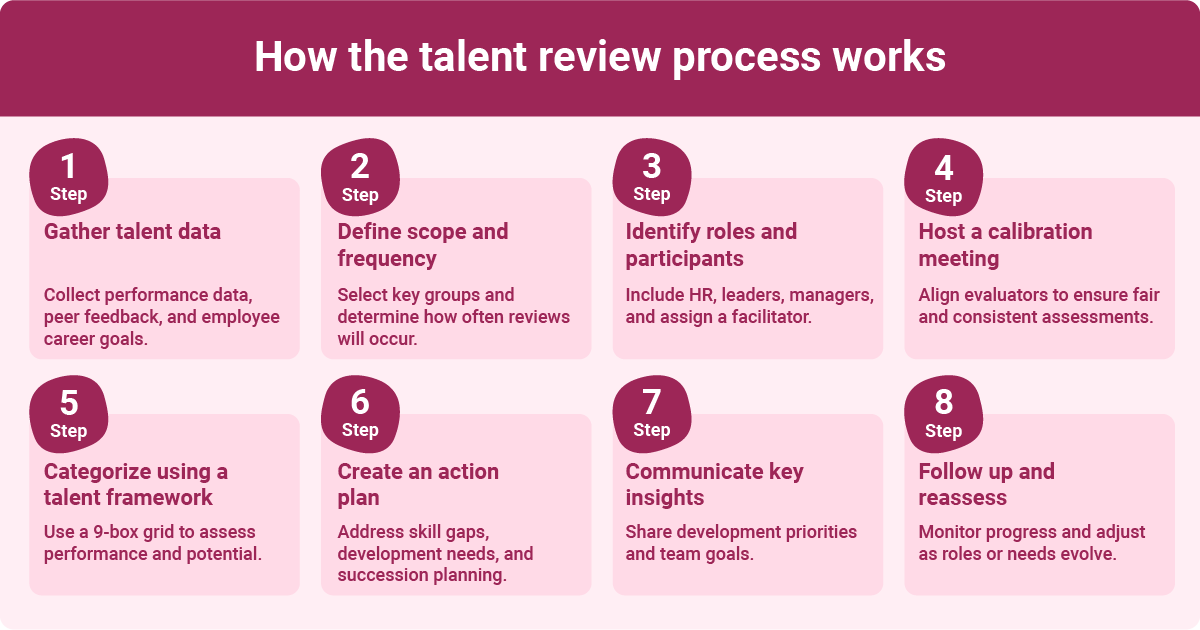
Table of contents
- What is a talent review? Definition and core purpose
- Talent review vs. performance review: Key differences
- How the talent review process works: Step-by-step
- The 9-box grid: The most common talent assessment framework
- Alternative talent review frameworks beyond the 9-box
- Why talent reviews matter
- Common mistakes to avoid in talent reviews
- Key questions to ask during talent review calibration
- Talent review software: Tools to streamline the process
- Key metrics for measuring talent review effectiveness
- FAQs
- Conclusion
Share this article
Most leadership teams review talent once a year, spend two hours debating names on a grid, then file the results away until next year. Meanwhile, critical positions sit empty for months, and your competitors keep nabbing your top talent. Oh, and that brilliant succession plan only exists on a half-forgotten sticky note.
The challenge is that many talent reviews rely on episodic, manager-generated data – performance ratings, annual feedback, and subjective potential scores – which can miss how work is actually getting done day to day.
How can you take back control? Start with a talent review. This simple, structured process can help Human Resources and business leaders evaluate talent across past performance, future performance, and readiness, so you can make confident calls about promotions, retention, and future leaders.
Of course, it’s only valuable if it drives real decisions about talent development. When done well, talent reviews surface talent gaps, clarify where employees fall on your framework, and show what will make all the difference in building a stronger leadership pipeline.
This guide walks you through the talent review process and how to put these reviews into action - from talent review questions and calibration to performance metrics, succession coverage, and creating development plans that support long-term future success.
What is a talent review? Definition and core purpose
Talent reviews help you identify high-potential employees who can grow into bigger roles, including future leaders who can step into critical positions as part of your organization’s succession plan.
For example, a junior software developer with strong leadership skills could become a product manager with the right mentorship. The process also helps leaders make more consistent decisions about where to invest time and opportunity, especially for top performers.
Unlike traditional performance reviews, a talent review zooms out to consider how each employee’s aspirations, capabilities, and readiness align with team and organizational needs. Participants typically include senior leaders, HR business partners, and people managers, not the employees themselves.
Another key purpose is aligning talent and business strategy. If your organization is investing more in automation, you might scale back hiring for certain roles and prioritize hiring or developing skills in areas such as machine learning.
Talent reviews also help future-proof the organization by:
- Anticipating succession risks
- Building resilient leadership pipelines that do not depend on a handful of people
- Identifying flight risks, such as high performers who do not feel challenged in their current roles
- Preparing for rapid growth or market shifts
- Spotting current and future skills gaps
- Strengthening learning and development, and other core talent management activities
Many organizations conduct talent reviews annually or twice a year. However, you may review more frequently for critical roles or fast-growing areas, such as emerging technologies. Talent reviews complement performance reviews, but they are typically separate conversations.
Talent review vs. performance review: Key differences
Talent and performance reviews often go hand in hand for workforce planning, but they have different goals and audiences. As the AIHR notes in the article “How To Perform a Talent Review in 2026”, talent reviews "...are forward-looking and help identify high-potential individuals for development and strategic placement, whereas performance reviews primarily assess past job performance and goal attainment."
Here's a quick comparison:
| Talent reviews | Performance reviews | |
| Focus | Strategic planning for the organization's future | Evaluating an individual's past work |
| Format | Group calibration session with multiple leaders and HR | One-on-one conversations between an employee and their manager |
| Goals | Improve succession planningReveal gaps in the leadership pipeline Inform big-picture talent decisions, such as restructuring a department or investing in an upskilling program. | Create an individual development plan for each employeeGive performance ratings Inform compensation decisions |
| Audience | Internal leadership team and HR | Employees |
How the talent review process works: Step-by-step
The talent review process typically takes around six to eight weeks, though larger organizations may spend more time on it. Follow these steps to plan your next review:
- Gather data: For the most objective and in-depth assessment, you need the right talent data. Ask managers to collect performance data, peer feedback, and recognition patterns that reflect how employees contribute across teams. These real-time signals, combined with performance ratings and manager assessments of potential, create a more complete and less visibility-biased picture.
- Clarify the scope and frequency: Don't overwhelm yourself by trying to evaluate your entire workforce at once. Pick a handful of key groups, such as senior leaders or critical departments. You should also determine how often you plan to conduct talent reviews, such as twice a year for the most high-impact areas.
- Define roles and participants: Identify key players who should attend talent review meetings. This may include business unit leaders, HR, direct managers, and other stakeholders. Keep these sessions consistent and organized by appointing a facilitator to guide the discussion.
- Host a calibration meeting: Make sure all your evaluators are on the same page by bringing them together to discuss each employee's performance and compare evidence across managers. For instance, you may assess campaign results when reviewing the marketing team and leads for sales. By coming to a consensus on the performance and potential ratings, the evaluators can assess employees fairly and consistently.
- Sort employees with a talent framework: Use a 9-box grid or another framework to categorize employees based on their performance and potential. Clearly define what each category means beforehand to avoid confusion.
- Create an action plan: As you analyze your employees, you'll likely notice skill gaps and development opportunities. Use these findings to plan reskilling or upskilling initiatives and targeted experiences, such as a leadership program for high-potential employees. This is also the time to look for succession candidates and retention risks.
- Communicate what you learned: Managers should explain what they learned to their departments, such as skill gaps they aim to repair. However, they don't necessarily need to share comparative rankings, especially if it would hurt morale.
- Follow-up on the plan: A talent review is only useful if you actually put it to work. Keep close tabs on employees as they progress through development plans and prepare for new internal roles. You should also revisit talent placements periodically as employees grow or your organization's needs change. An employee who thought they wanted a leadership role, for instance, may realize that they're better suited for a customer-facing position.
Manager preparation checklist
Managers often know their teams better than anyone else in the organization. Ask them to prepare for talent reviews by:
Sample talent review meeting agenda
Talent reviews may take only a few hours or stretch out across several days, depending on the scope. For maximum efficiency, plan a realistic agenda, such as:
- Talk about performance review basics and spell out ground rules and rating definitions (10 minutes)
- Go over evidence for each employee and rate their performance and potential (5 to 10 minutes per individual)
- Calibrate ratings and talk through any major discrepancies (20 to 60 minutes, depending on the ratings)
- Identify notable employees, such as high-potential talent and retention risks (15 minutes)
- Go over action items, such as following up with succession candidates and planning development programs (20 minutes)
Communicating talent review outcomes to employees
Talent reviews can lead to more effective performance conversations, but leadership should decide how much they'll share upfront. Many organizations discuss strengths and growth areas without sharing how individual employees ranked.
For example, you might observe that your sales team can improve client relations without singling out Jessica's lack of communication skills. Or you could offer mentoring to Steve, but don't mention that you're considering him for a management position. Discretion protects confidentiality and lets you focus on concrete steps instead of judging people on their potential or shortcomings.
For the best results, time these discussions around routine career conversations or performance reviews. That way, employees won't feel constantly scrutinized or overwhelmed by too many processes.
The 9-box grid: The most common talent assessment framework
The 9-box grid is one of the most popular talent review frameworks. It divides employees into nine categories along two axes: performance (x-axis) and potential (y-axis). Here's a quick visualization:
| Develop | Develop / Stretch | Stretch | |
| Potential | Dilemma | Core | Stretch / Develop |
| Underperformers | Effective performers | Trust | |
| Performance |
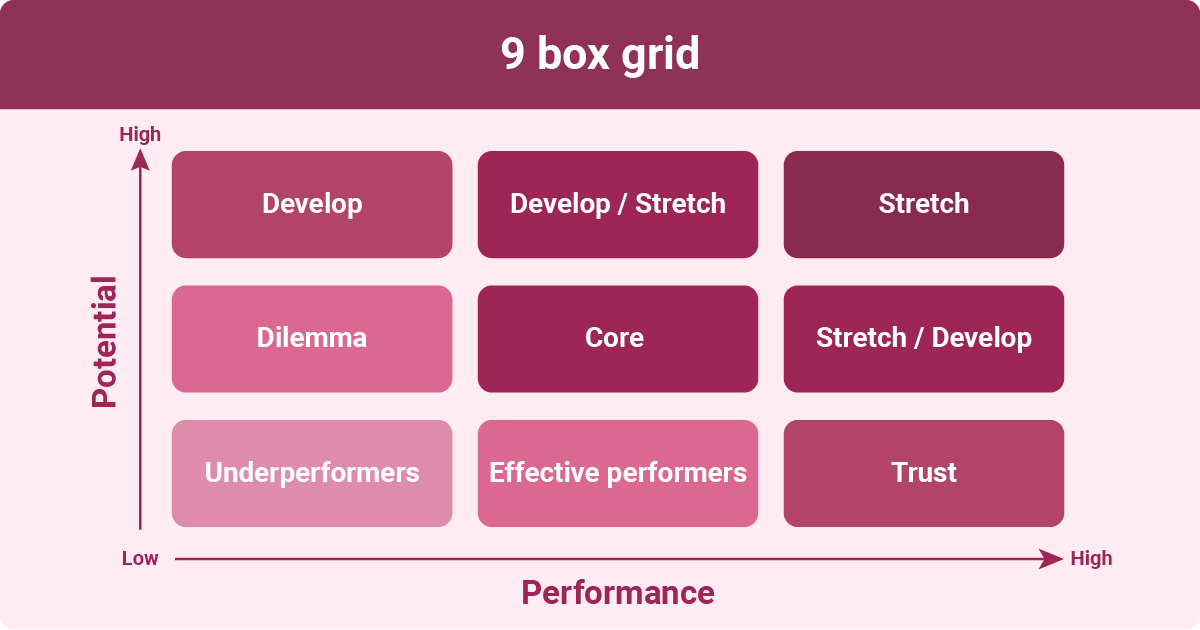
Someone who falls in the Dilemma category may sometimes excel at tasks, but their performance isn't consistent. Meanwhile, a trusted professional always meets their goals, but they may not aspire to a higher position. Stretch employees score high for both performance and potential, which means they're likely ready to take on more advanced responsibilities.
Adapt these labels as necessary to fit your organization's culture. If your business values development, you might call the Develop category "hidden talent" to emphasize its value. You could also change the axes to rate employees based on other criteria, such as risk of loss vs. impact of loss.
Reduce the risk of bias by setting clear criteria for each category and having multiple leaders debate placement. If Manager A ranks an employee as a core player but Manager B puts them in the stretch category, use evidence to come to a consensus.
A 9-box grid may seem simplistic at first, but it has many practical applications in modern performance management, including:
- Finding the best candidates for stretch assignments
- Making retention decisions
- Succession planning
However, it’s important to note here that the effectiveness of any grid depends entirely on the quality and diversity of the data used to place employees within it. This is an ideal place to be sure you’re triangulating and using sources of human signals like recognition.
How to define "potential" vs. "performance"
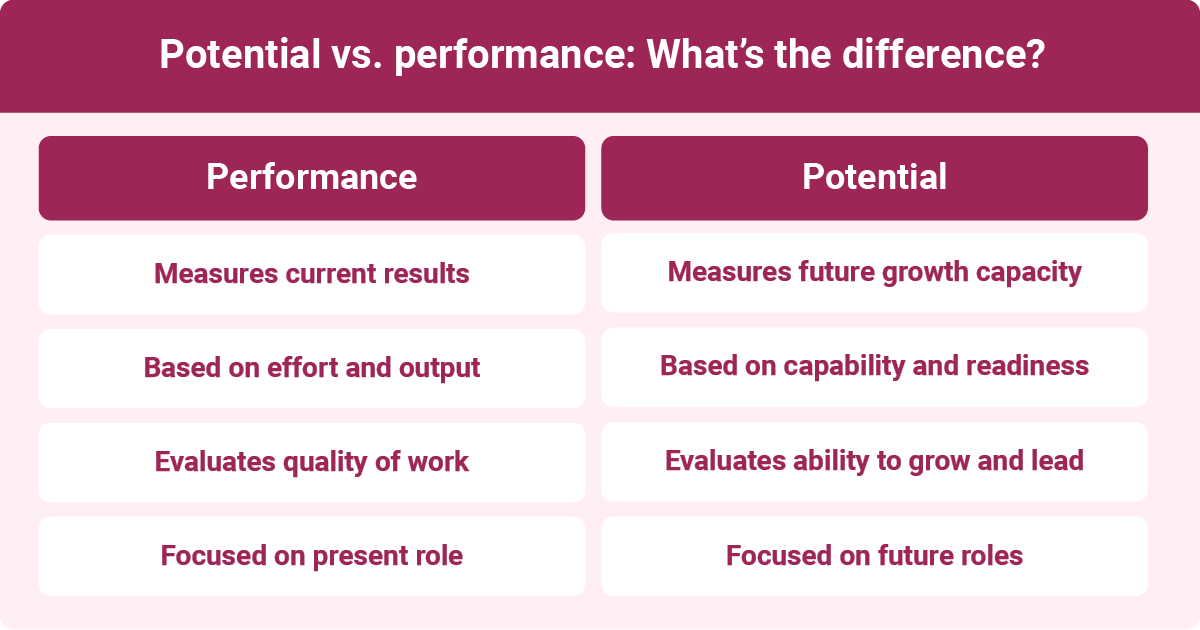
Understanding the difference between potential and performance is key to accurately rating employees. In a nutshell, performance measures current effort based on measurable results and quality of work.
By contrast, potential is all about capacity for growth. That may seem ambiguous, but it still focuses on observable traits and skills, such as:
Avoiding 9-box pitfalls
Like any assessment tool, the 9-box comes with a few potential drawbacks. The halo effect is one of the biggest challenges. Just because someone performs well in one area doesn't necessarily mean that they have high potential for every future role.
You must also resist the temptation to rely on your gut. Use hard data and behavioral evidence to evaluate potential and encourage the calibration team to challenge assumptions. A quiet employee may have overlooked leadership potential, or someone who underperformed last year could make huge strides forward.
Arguments against the 9-box and when to supplement or replace it
While the 9-box remains a staple of talent reviews, many HR professionals have critiqued it as overly simplistic and outdated.
In the SHRM article titled “Outside the 9-Box: A Holistic Approach to Talent Evaluation”, John Hazan, the global leader of Bain & Company's Talent solution, notes, "The 9-box matrix may have been effective in a more stable era when companies operated in a linear manner. However, the complexities, fluidity, and integrated nature of business today introduce new dimensions to decision-making that the 9-box cannot capture."
For instance, an organization may struggle to assess traits like digital fluency and AI literacy with the traditional grid.
Labeling employees can also create self-fulfilling prophecies. If workers are rated as low potential, they may get fewer opportunities for development and mentorship, limiting their growth. Potential is subjective, too, which could cause some employees to get unfair ratings based on unconscious bias or their most recent performance.
If your organization is relatively hierarchical, consider supplementing the 9-box with skills inventories, engagement data, and project-based assessments. These tools can give you a more well-rounded view of your team's abilities while maintaining consistent ratings.
Focused more on agility? Consider a skills-first or project-based talent model to evaluate your team's capabilities instead of relying on static ratings.
Alternative talent review frameworks beyond the 9-box
The 9-box system remains popular for companies prioritizing performance and succession. However, it's certainly not the only tool for assessing talent.
Many organizations use a skills-based framework to measure everything people can do rather than focusing on their current job titles. Workhuman® iQ™ uses AI analytics to identify and track employee skills through recognition data. It helps you spot hidden skills and potential that may otherwise go unnoticed, so you can make smarter talent decisions. A business analyst, for instance, may have the creativity and interpersonal skills needed to thrive as a senior manager.
Workhuman’s new AI AssistantOpens in a new tab can help automate and streamline much of this analysis by tracking skills profiles and giving managers a quick overview of their team members as needed.
AI Assistant can also make smart suggestions based on these skills profiles when it comes time to consider someone for a promotion or find someone for a particular project. You can ask things like, “Who on my team is qualified for X?” or “Who has the best interpersonal skills?”
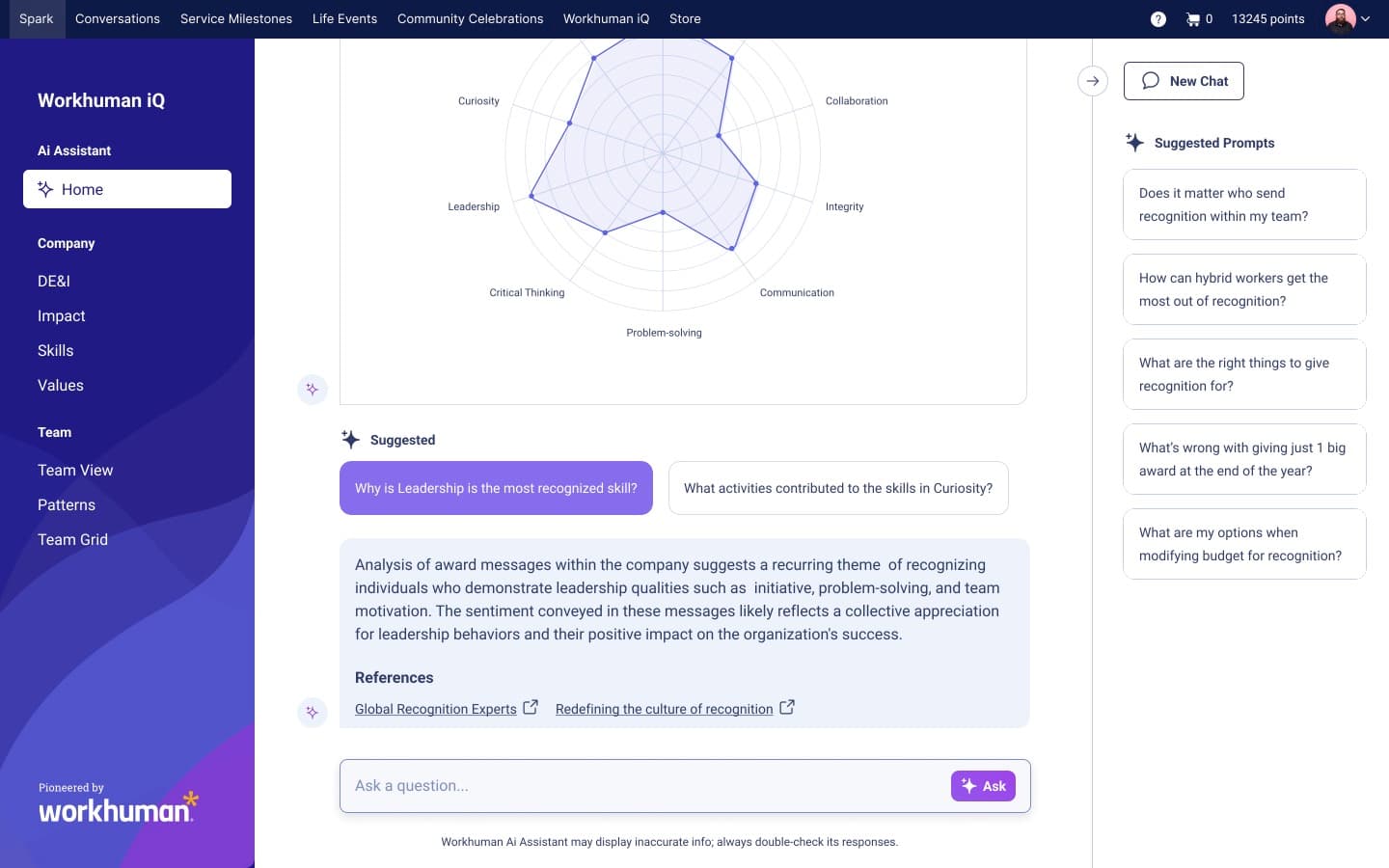
By using your organization’s data, AI Assistant makes intelligent, bias-free suggestions to help you fill open positions and prevent skills gaps.
From “Skills frameworks fuel skills-based organizations”, we can see that Deloitte's hub and spoke model focuses on mapping adjacent skills and career pathways across an entire organization. A data scientist's spokes, for instance, may include Python and statistics. This approach increases agility by making it easier to reskill and redeploy employees instead of hiring externally.
Why talent reviews matter
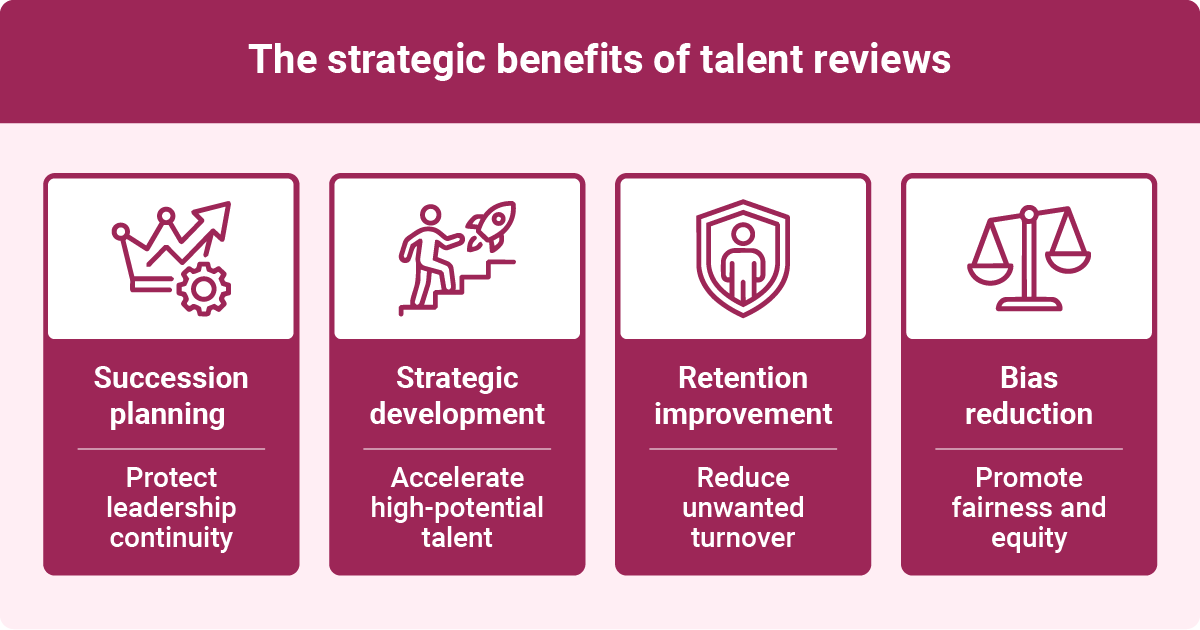
Talent reviews aren't just another formality or a more complicated performance review. They offer many benefits:
Common mistakes to avoid in talent reviews
Talent reviews have several built-in safeguards, such as group calibration and the emphasis on evidence. However, even the savviest HR and leadership teams can run into obstacles when performing these assessments.
Overloading the agenda is one of the most common pitfalls. Resist the urge to cram as many employees as possible into one sitting. If you overwhelm your reviewers, they may feel fatigued and make less thoughtful decisions.
Confusing performance with potential is another error. Sure, that star employee may have aced their last three tasks, but that doesn't mean you should catapult them to the boardroom. Avoid relying too heavily on a handful of current go-getters for future roles, and look out for hidden talent.
Rater bias and data quality: The hidden accuracy killers
Performance management systems are only as good as your data and the people who interpret it. When potential is evaluated primarily through manager perception rather than behavioral evidence (such as cross-functional collaboration, peer recognition, and demonstrated influence), bias can unintentionally shape outcomes. If your organization uses incomplete or outdated information, your talent review will be less reliable.
Raters may unintentionally make biased decisions, too. This may involve recency bias, such as favoring an employee who just completed a major project over one who had a similar win last quarter. Raters may also gravitate toward people who are similar to them or treat certain employees more leniently.
Workhuman's Inclusion Advisor decreases bias by using AI to flag potentially biased language in real time and offer immediate coaching. If someone praises a female colleague as "surprisingly confident," for instance, the Advisor can recommend more inclusive phrasing. During a pilot, this tool helped users revise 75% of the language flagged as biased.
Key questions to ask during talent review calibration
Even the most thorough data doesn't always reveal immediate insights, especially if reviewers aren't familiar with a specific role or skill. Asking the right questions can help participants see the full picture and overcome disagreements.
20 calibration questions organized by stage
Consider creating a handout with questions that the facilitator and participants can refer to throughout the calibration session. During performance validation, focus on unpacking the evidence for each employee with questions like these:
- How does this employee's performance stack up to colleagues in similar roles?
- What were their biggest achievements?
- How has their performance changed over time?
- Are there any outside factors that may have affected them, such as maternity leave?
- Are there any places where this employee has exceeded or failed to meet expectations?
Building on their current performance, use these questions to gauge potential:
- How does this employee interact with others?
- Do they have any special influence, even if they're not in a formal leadership role?
- Can they learn from their mistakes?
- Does this team member take initiative?
- What are their career aspirations, and what steps have they taken to get there?
Of course, even the most promising employees may not be ready to climb the next rung on the ladder. These questions will help you measure their readiness:
- How consistent is the employee's performance at their current level?
- What skill gaps do they need to close before promotion?
- Do they have a development plan?
- Are they currently receiving mentorship or coaching?
- How do they handle feedback?
Finally, zoom out to consider the diversity and fairness of the entire calibration process. Use these questions to probe for potential biases:
Talent review software: Tools to streamline the process
Gathering and analyzing performance data can be incredibly time-consuming, especially if you're reviewing dozens or hundreds of employees at once. Talent software makes continuous performance management faster and more accurate by automating many of these tasks.
Workhuman Cloud Integrations connect with popular workforce tools, such as Microsoft Teams, Slack, and Workday. Use it to centralize talent review data your team already uses daily. For instance, peer feedback and skill indicators can reveal standout performers.
Lattice also lightens HR to-do lists by using AI to create performance summaries and recommend development opportunities. Its people analytics and custom dashboards allow you to track your employees' accomplishments and skills across the entire organization.
Key metrics for measuring talent review effectiveness
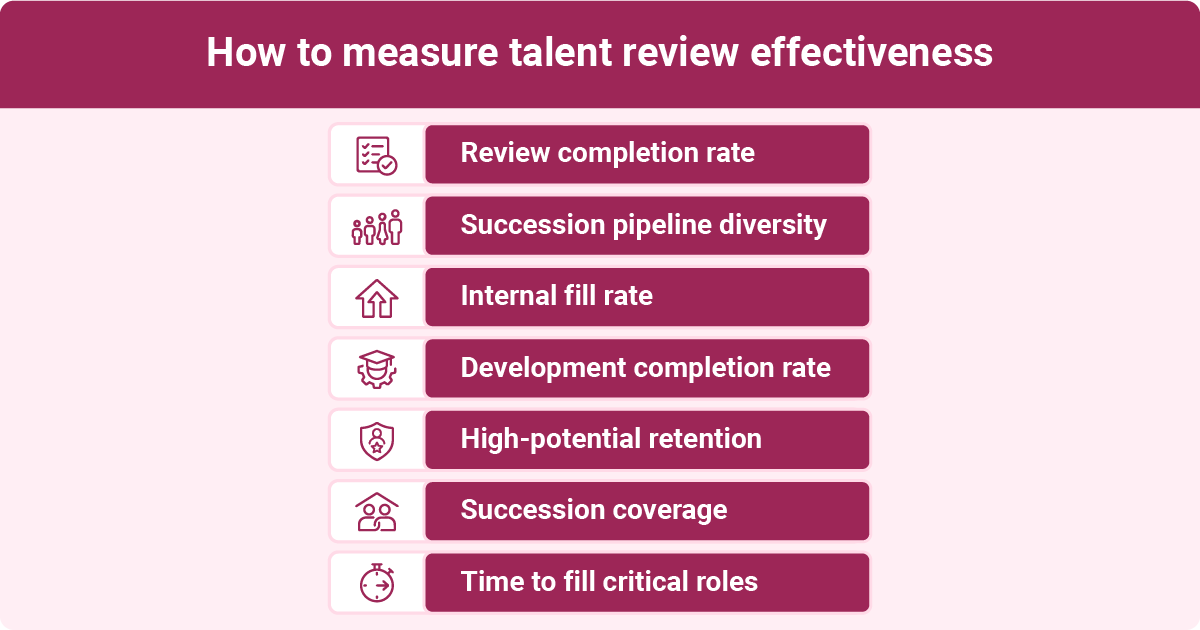
Talent reviews are a long game, especially if you use them for succession planning. Results often start gradually and add up over time, which can make it challenging to see your impact. Use these metrics to make sure you're moving in the right direction:
- Completion rates for talent reviews
- Diversity of the succession pipeline and leadership roles
- Internal fill rate
- Percentage of employees who complete their development plans
- Retention for high-potential employees
- Succession coverage, or the percentage of critical roles with at least two capable or almost-ready successors
- Time-to-fill
FAQs
What is the difference between a talent review and a performance review?
A talent review evaluates employees' potential and skills across the organization. Meanwhile, a performance review provides individual feedback about an employee's achievements and areas of improvement.
How often should we conduct talent reviews?
Most organizations conduct talent reviews every six to 12 months. Consider more frequent reviews if your company is transforming quickly or hiring for critical roles.
What are common mistakes to avoid in talent reviews?
A lack of adequate performance data is one of the biggest mistakes in talent reviews. Participants should also be on high alert for potential bias, such as viewing recent accomplishments or certain groups more favorably.
How do talent reviews support succession planning?
Talent reviews help you find and nurture high-potential people within your own organization. That way, you have a pool of capable employees ready to step into more advanced roles.
Conclusion
A talent review is really about making sure you aren't leaving your best people stuck in neutral. It enables leadership teams to uncover the high-potential employees who might be flying under the radar. But the key to building a reliable succession plan is to differentiate between performance and potential.
When you base these decisions on regular recognition signals, peer feedback, and continuous, human-centered data (not just annual ratings), you reduce bias and gain a clearer view of how influence, leadership, and impact actually show up across the organization. Use real-time recognition and AI-driven insights to show you exactly who is moving the needle, so you can develop a data-backed roadmap for growth.
The real magic happens when you move past the labels and use your findings to create concrete development plans, mentorships, and stretch assignments that give your top performers a reason to stay.

Ryan Stoltz
Ryan is a search marketing manager and content strategist at Workhuman where he writes on the next evolution of the workplace. Outside of the workplace, he's a diehard 49ers fan, comedy junkie, and has trouble avoiding sweets on a nightly basis.