
Strategic Initiatives: How to Define, Execute, and Measure What Truly Matters
by Ryan Stoltz
Last updated
13 min read
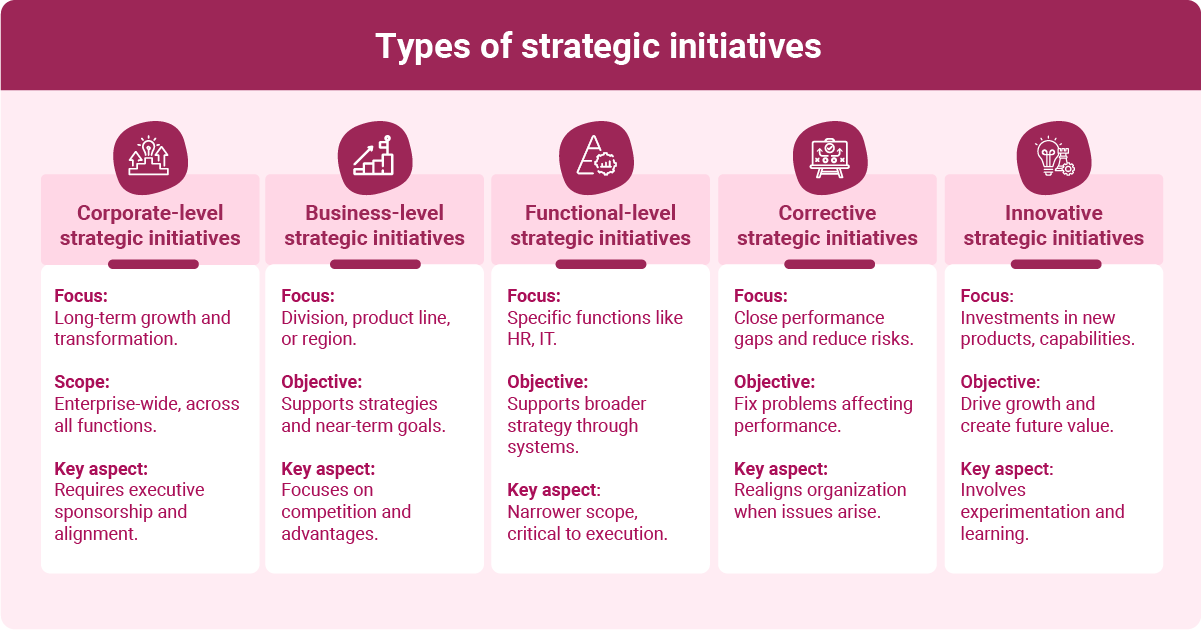
Table of contents
- What are strategic initiatives?
- Why strategic initiatives matter: Business purpose and value
- Strategic initiatives vs. projects vs. goals: Key differences
- Types of strategic initiatives
- Common strategic initiative categories (with examples)
- Strategic initiatives department and organizational structure
- How to develop strategic initiatives: planning and design process
- Implementing strategic initiatives: Best practices
- Turning strategic initiatives into shared direction
- Measuring success: KPIs and performance tracking for strategic initiatives
- Common pitfalls and how to avoid them
- FAQs
- Conclusion
Share this article
Your team just spent six months on a major initiative that leadership now calls a "project." Meanwhile, three other efforts labeled "strategic" are really just business-as-usual with bigger budgets. How can you sort out the real strategic initiatives from the noise and get people aligned to them?
Strategic initiatives are time-bound programs designed to execute specific elements of your business strategy and drive measurable organizational change. For HR leaders, they represent the bridge between people strategy and business outcomes, whether you're building leadership pipelines, transforming employee experience, or enabling digital transformation.
This guide clarifies what a strategic initiative actually is, shows how they differ from projects and goals, and provides a practical framework for planning, executing, and measuring initiatives that create lasting impact. You'll learn how to identify genuine strategic work, build executive support, get employees rowing in the same direction, avoid common pitfalls, and demonstrate ROI.
Whether you're launching your first enterprise-wide initiative or refining your approach to portfolio management, our HR strategy objectives will help you execute with confidence and credibility.
What are strategic initiatives?
These efforts require dedicated resources, the backing of senior leadership, a governance structure, and clear start and end points to distinguish them from ongoing operations. More than just business as usual, they are larger in scope, impact, and cross-functional nature.
Data from McKinsey’s study “How Strategy Champions winOpens in a new tab” shows that a well-planned strategy reduces uncertainty, which increases a company's chances of meeting the Ten Tests of Strategy, which test the quality of strategic initiatives. In yet another survey titled “Improving strategic planning”, McKinsey estimates that only 56% of organizations track their execution and success.
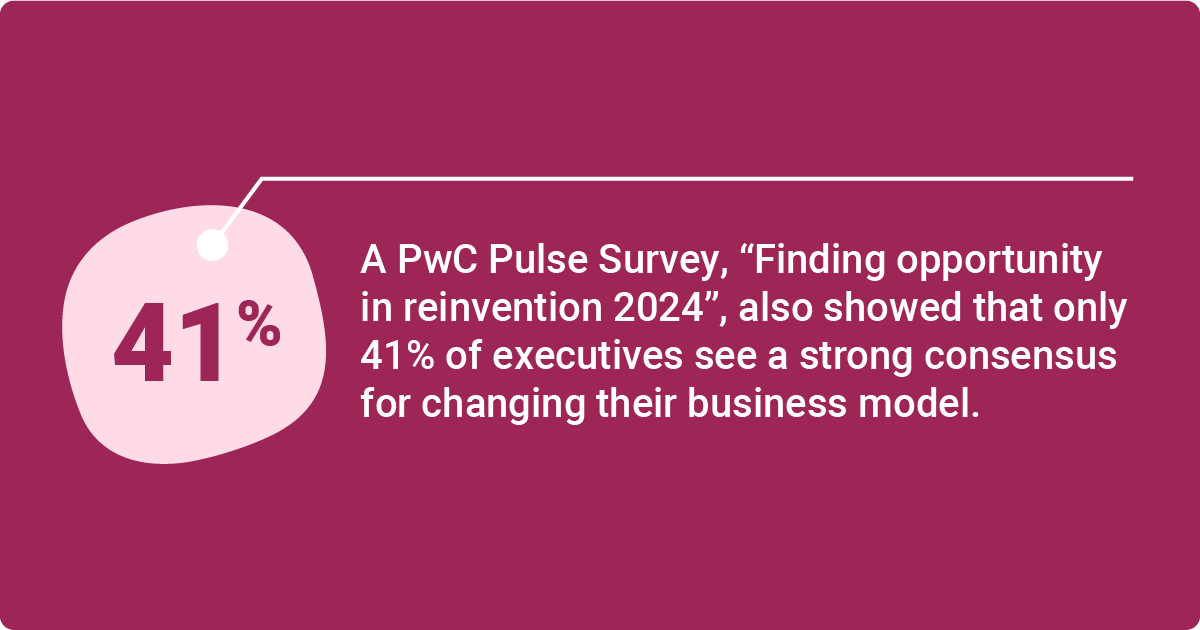
A PwC Pulse Survey, “Finding opportunity in reinvention 2024”, also showed that only 41% of executives see a strong consensus for changing their business model. Many companies lack the framework, understanding, and motivation to follow initiatives through from beginning to end.
Core components and key characteristics of a strategic initiative
A good strategic initiative must have:
- A clear connection to the company strategy and strategic goals
- A clearly defined scope that measures success criteria, including KPIs, timelines, and assigned owners
- A committed cross-functional team with designated leadership and accountability
- Sufficient resource allocation, including budget, time, and personnel
- A strong understanding of who makes decisions and can escalate paths
What makes an initiative "strategic"
An initiative is strategic if it addresses a significant business challenge or opportunity. It requires organizational change or capability building and has multi-departmental or enterprise-wide impact, with a three- to five-year planning horizon. It must also create operational improvement or a sustainable competitive advantage.
Common terminology and synonyms
You may hear these initiatives called corporate initiatives, transformation programs, enterprise initiatives, or strategic programs.
There may also be industry-specific terms like workstreams (consulting firms) or big rocks (tech), but the core concept remains the same: focused, time-bound efforts to align strategy. When you join a new organization, it’s important to discuss what terminology and definitions they use.
Why strategic initiatives matter: Business purpose and value
Workforce planning initiatives are more than “feel-good” projects. They provide alignment, focus, execution, and adaptability to your company.
In a Journal of Open Innovation article, “Business Strategies and Competitive Advantage”, researchers reported that innovation in the form of a well-designed strategic initiative provides competitive advantages.
But again, data published by ClearPoint Strategy in “The Strategic Imperative: Your Complete Guide to Strategy Planning Software” shows that more than half of strategic initiatives fail due to poor execution. Simply put, such failure isn’t about lacking ambition or intelligence, but rather a lack of focus, accountability, and systems.
Execution gaps are often cultural gaps. In fact, our research shows that employees who are recognized for work tied to strategic priorities are significantly more likely to understand and align with those initiatives.
Strategic value for HR and people functions
In the people aspect of business, strategic initiatives elevate HR from provider to partner. By highlighting the direct link between people and outcome, these initiatives justify investment in culture, talent, and organizational development initiatives. They provide a framework for staying competitive in the HR world, while creating visibility and credibility with executive leadership.
Benefits of strategic initiatives for project and portfolio management
When it comes to managing portfolios and projects, strategic initiatives once again set a framework for priorities. Measurable criteria help teams identify dependencies and conflicts. Management success increases with standardized best practices and governance, the simplified combination of groups operating under the same umbrella, identification of top priorities, and learning what works across different strategy types.
Strategic initiatives vs. projects vs. goals: Key differences
The Strategy Engine estimates that miscommunication and confusion quickly tank many initiatives, so it’s important to separate these three concepts:
Strategic initiatives vs. projects
Initiatives differ from projects in scope, duration, complexity, governance, and alignment:
- Projects: Narrowly scoped, short-term, focused on specific deliverables, governed by a project management body consisting of a manager or team lead, and more operational in nature
- Initiatives: Span multiple teams, spaced out over several months or years, require interdependence and multiple workstreams, rely on senior sponsors or steering committees, and are tied to strategic priorities
Strategic initiatives vs. strategic goals
Strategic goals are outcomes, clearly defined by what you want to achieve. Initiatives are the programs used to achieve those goals. There may be several strategic initiatives to support a single strategic goal, which are measured by key performance indicators (KPIs).
For example, a goal may be to become a preferred employer, while an initiative to achieve that goal could be the implementation of a comprehensive DEI program.
Strategic initiatives vs. strategy: Understanding the relationship
Think of strategy as the overarching umbrella of direction and plan. Initiatives are the programs that fit under that umbrella to execute the strategy.
Strategy tells you where to go and why, and initiatives are how to get there. Strategy is constantly evolving, while initiatives are time-bound. For example, if your strategy is to create a digital-first customer experience, the initiatives may include digital skills training, CRM implementations, and mobile app development.
Types of strategic initiatives
Strategic initiatives can take many different forms. Take the Harvard Business School's case study of Best Buy’s “Renew Blue” strategic turnaround. A complete reimagination of its business model allowed the store chain to compete with online giants, leading to five years of consecutive sales growth.
Another example is Lego's rebrand, as reported in The Transformation Advisor’s article, “Business Transformation and 5 Case Studies of Real-World Success Stories”. Facing bankruptcy in the early 2000s, the famous toy company committed to a comprehensive restructuring with a focus on innovation and products.
This achieved operational streamlining, improved supply chain efficiency, media leverage, and brand engagement through projects like "The Lego Movie."
Understanding the types of strategic initiatives helps leaders choose the right scope, sponsorship, and measures of success, especially when multiple business units are involved.
Corporate-level strategic initiatives
Enterprise-wide priorities tied to the company’s vision and strategic vision – often focused on long-term growth, transformation, or protecting market position. These initiatives typically span functions and require strong executive sponsorship and alignment with the organization’s strategic objectives.
Business-level strategic initiatives
Initiatives within a division, product line, or region that strengthen business-level strategies and directly support near-term performance. These efforts translate the organization’s strategy into decisions about where to compete, how to win, and how to build or defend existing competitive advantages.
Functional-level strategic initiatives
Function-owned programs – HR, IT, finance, operations, marketing – that enable the broader strategy. While they may be narrower in scope, they’re critical to execution because they support the processes, systems, and capabilities needed to meet business goals.
Corrective strategic initiatives
These are targeted efforts designed to close performance gaps, reduce risk, or address problems that are limiting results. These initiatives aim to stabilize execution and get the organization back on track when indicators show the current approach isn’t meeting expectations.
Innovative initiatives
Investments in new capabilities, products, or ways of working – often designed to create future value, unlock growth, or raise brand awareness. Innovative initiatives tend to include experimentation and learning as part of the plan, with success measures evolving as insights emerge.
No matter the category, such initiatives should be anchored to a clear strategic plan, owned by named leaders, and measured against outcomes – not just activity.
Common strategic initiative categories (with examples)
While industry and organizational needs shape priorities, most initiatives fall into a few common categories:
General and HR-specific strategic initiative examples
From capability building to transformation, HR-led work is often where strategy becomes real. Examples include workforce planning, employee experience transformation, succession planning and leadership development, DEI programs with measurable targets, performance management redesign, total rewards strategy updates, and remote/hybrid work policies.
Tool note: When initiatives depend on sustained behavior change, platforms like Workhuman® Cloud can help reinforce desired behaviors through Social Recognition™, milestones, and manager-employee touchpoints – supporting adoption alongside project delivery.
Digital transformation as a strategic initiative (callout)
Digital transformation often functions as a strategic initiative because it requires coordinated change across people, processes, and technology. Common measures include adoption rates, productivity gains, and employee sentiment.
Strategic initiatives department and organizational structure
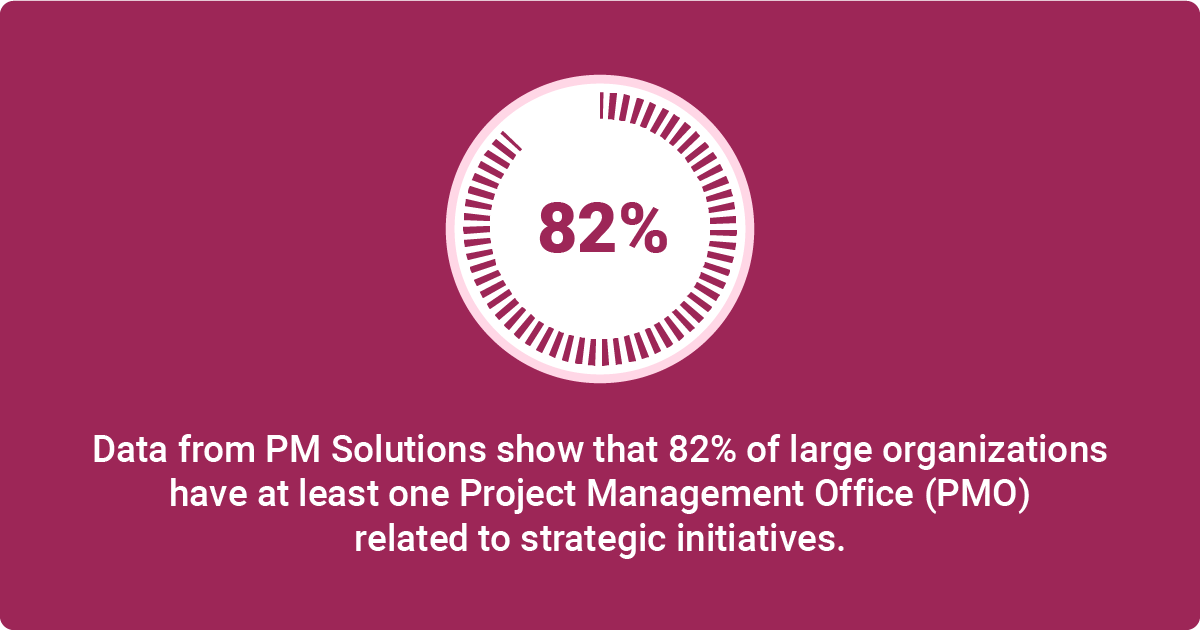
Data from PM Solutions show that 82% of large organizations have at least one Project Management Office (PMO)Opens in a new tab related to strategic initiatives. These positions require strategic thinking abilities, data-driven decision-making, problem-solving skills, a collaborative mindset, adaptability, and attention to detail.
Strategic initiatives, roles, and career paths
A number of roles may oversee initiatives:
- Strategic Initiative Director or Manager: Leads large, complex strategic initiatives with more than 7-10 years of experience
- Strategic Initiative Analyst: Supports planning, tracking, and analysis; often an entry-level role suitable for those with project coordination or analytical experience
- Program Manager: Aligns cross-functional activities, monitors milestones, and coordinates workstreams within initiatives
- Change Management Specialist: Drives adoption, stakeholder engagement, and communication to embed initiative outcomes into day-to-day operations
Salaries vary by industry and company size, but the strategic initiatives career path often follows this route:
- Analyst
- Manager
- Senior Manager
- Director
- VP Strategy Execution
Strategic initiative jobs are great for those who are comfortable with authority and want to work with leadership, think outside the box, invest in departments across the company, and provide measurable results in areas that aren’t always at the forefront of the business model.
How to develop strategic initiatives: planning and design process
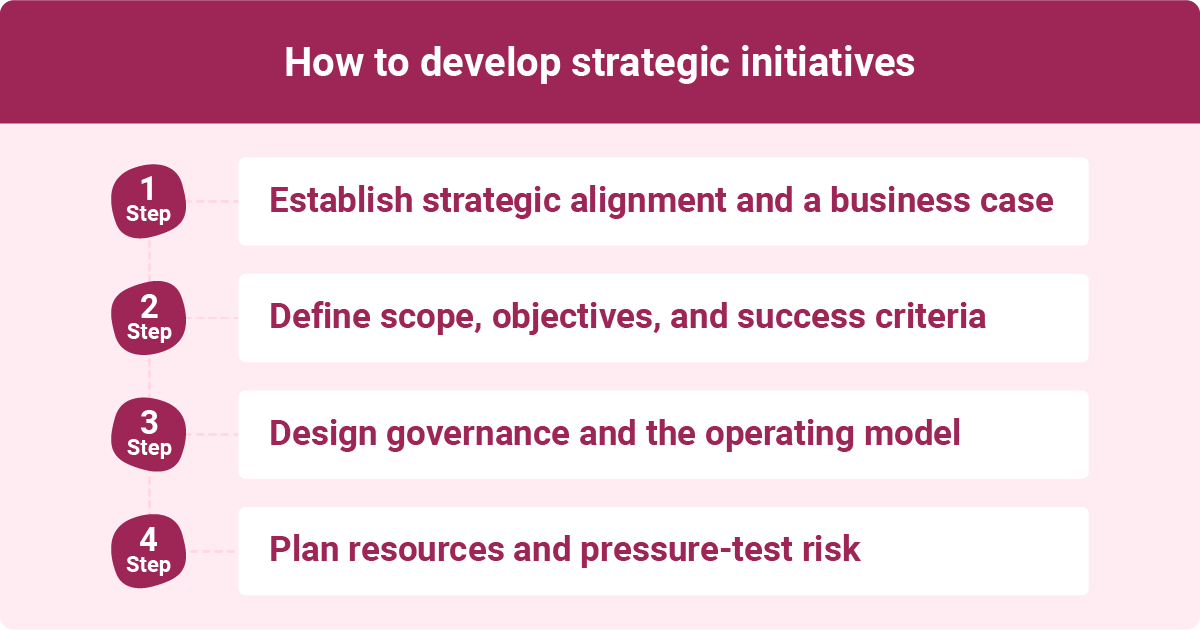
Once you’ve identified a priority that truly merits “strategic” attention, the goal is to turn a big idea into a plan leaders can fund, teams can execute, and the organization can actually adopt.
A strong development process makes tradeoffs explicit before you launch – scope, resources, governance, and success measures – so you don’t discover misalignment halfway through delivery.
Step 1: Establish strategic alignment and a business case
Start by naming the business problem (or opportunity) in plain language, then tie it to a specific strategic goal.
Quantify the expected impact – revenue, cost, risk reduction, or capability building – and confirm the work fits your portfolio capacity (what you will pause or stop to make room). Secure an executive sponsor with the authority to unblock decisions and protect priority when competing work shows up.
HR example: For a leadership development initiative, connect internal mobility and succession coverage to reduced talent risk and stronger business performance.
Step 2: Define scope, objectives, and success criteria
Write a short initiative charter that clarifies purpose, what’s in scope, what’s explicitly out of scope, and who’s accountable. Translate the strategy into 3–5 measurable objectives with targets and timelines, then define success metrics that link back to business outcomes.
Identify stakeholders and map dependencies on other initiatives, systems, or org changes so you can plan sequencing instead of reacting later.
HR example: For a DEI program, set time-bound objectives (for example, representation targets and inclusion survey movement) and document them in the charter.
Step 3: Design governance and the operating model
HR example: For an employee experience transformation, create a cross-functional steering committee (HR, IT, operations) to remove blockers and align decisions quickly.
Step 4: Plan resources and pressure-test risk
Estimate budget, staffing, skills, and timeline with contingency. Identify skill gaps and how you’ll close them (hire, contract, or develop). Run a risk assessment that includes execution risk, adoption risk, and external factors, then assign owners and mitigation actions for the highest-priority items. Finish with a phased plan that names milestones, deliverables, and checkpoints where you can pivot if assumptions change.
HR example: For workforce planning, assess critical-role skill gaps, identify shortage risk, and build contingency options into the roadmap before implementation begins.
Implementing strategic initiatives: Best practices
A strong plan only matters if it survives day-to-day execution. The best implementations create clarity early – who decides, how progress is measured, and how the work stays aligned when priorities shift.
1) Launch with a clear kickoff and decision log
Treat the kickoff as a working session, not a presentation. Confirm scope boundaries, success metrics, and the top dependencies and risks. Then establish a simple decision log (what was decided, by whom, and why) so the team doesn’t relitigate the same questions as new stakeholders join.
2) Build a governance cadence that matches the complexity
Set a rhythm that keeps work moving without creating meeting overload:
- Weekly workstream check-ins to manage tasks, dependencies, and near-term risks
- Biweekly sponsor reviews to unblock decisions and manage tradeoffs
- Monthly steering committee meetings to assess progress against outcomes and approve pivots
This cadence ensures issues surface early, before they become delays or budget surprises.
3) Make progress visible with a small set of outcome metrics
Track 3–5 KPIs that reflect business impact, not just activity. Pair them with operational indicators (timeline, budget, adoption) so leaders can see whether you’re on track and whether the change is sticking. Assign an owner and an update frequency for each metric to keep reporting consistent.
For people and culture initiatives, visibility often improves when you can measure reinforcement in real time – how often desired behaviors are recognized, whether participation is broad-based, and where momentum is uneven.
Recognition data can act as a live indicator of alignment. When recognition is tied to strategic initiatives, understanding and personal investment rise dramatically. Instead of waiting for annual surveys, leaders can see – week by week – which priorities are being reinforced and where momentum is uneven.
For example, teams using Workhuman Cloud® can reinforce new behaviors through Social Recognition®, Conversations®, and milestone moments, while Workhuman® iQ helps surface patterns and trends (and reduce manual analysis) so leaders can course-correct earlier – adjusting communications, manager enablement, or reinforcement before adoption slips.
Workhuman’s Topics feature helps companies better understand, in real time, how people are supporting strategic initiatives and who is driving them forward, based on peer observations about where work is happening.
4) Design for adoption from day one
Strategic initiatives often fail at the “last mile”: behavior change. Build change management into implementation by identifying impacted audiences, what’s changing for them, and what support they need.
Reinforce the “why” in plain language, provide training and enablement where it matters, and measure adoption so you can intervene early, not after rollout. And note: adoption accelerates when people feel safe to engage, experiment, and speak up.
Workhuman research shows that employees who have been recognized in the past month report 21% higher psychological safety. And employees in high-psychological-safety environments are significantly more likely to understand and align with company values and strategic initiatives.
5) Deliver early momentum with a 60–90 day plan
6) Stay flexible without losing the strategy
Use checkpoints to evaluate whether assumptions still hold. If conditions change, agree on what triggers a pivot (for example, a dependency slip, adoption below target, or budget constraints).
Adjust the plan, but keep the initiative anchored to its original strategic goal so a flexible schedule doesn’t become scope creep.

Turning strategic initiatives into shared direction
You can have the clearest strategy in the world, but if employees can’t see themselves in it, it stalls. That’s where most strategic initiatives fail. Not at the strategy table. Not in the business case. But in the translation from executive intent to daily behavior.
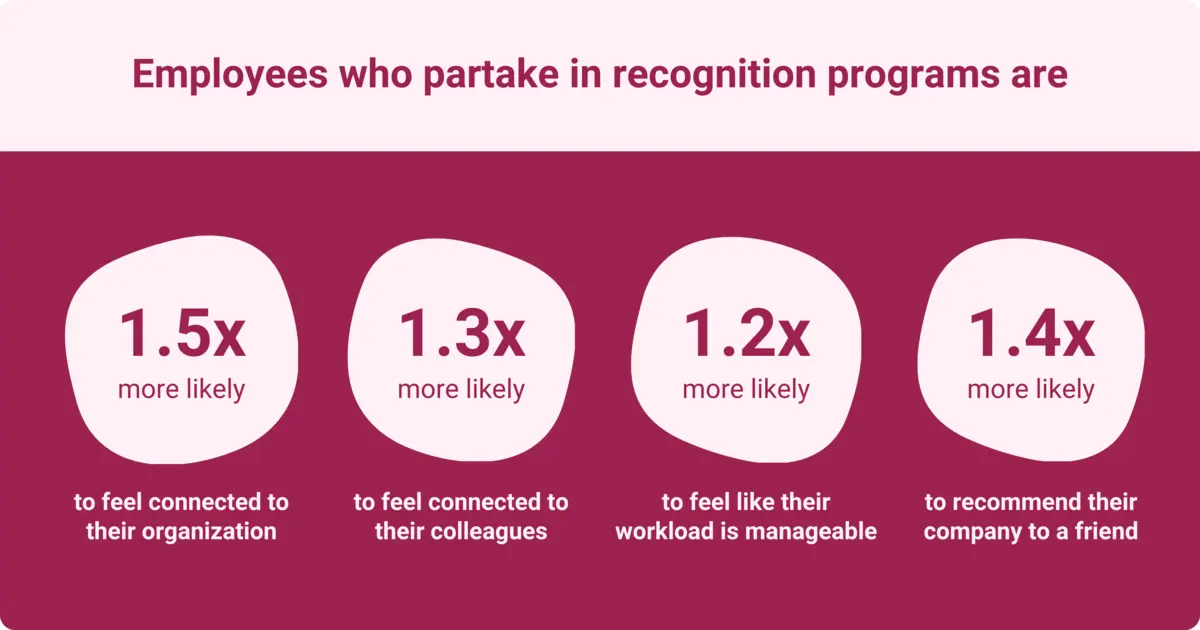
Workhuman’s 2025 Global Research Study: Recognition as an Engine for Strategy found that recognition is one of the strongest drivers of that translation.
Here’s what our data showed:
- Employees in organizations with recognition programs are 23% more likely to feel aligned with organizational goals.
- When recognition is explicitly tied to strategic initiatives, employees are 129% more likely to understand how their work contributes to those priorities.
- And when recognition is always or often connected to company initiatives, 93% say they fully understand those initiatives – compared to just 62% when it isn’t.
- Perhaps most striking: employees are 5x more likely to feel “very personally invested” in company priorities when recognition is linked to strategic initiatives.
The reality is: strategic initiatives live or die on behavior change. Recognition makes priorities visible in real time by answering three unspoken employee questions:
- What actually matters here?
- What does “good” look like?
- Does my contribution count?
When managers consistently recognize work that advances a strategic priority, they’re rewarding effort, but they’re also reinforcing direction.
In practical terms, this means:
- Tagging recognition to strategic pillars or company values.
- Coaching managers to call out impact in relation to stated goals.
- Tracking recognition patterns to see whether initiatives are gaining traction across teams.
Recognition becomes a behavioral flywheel for execution. It turns strategy from something communicated quarterly into something reinforced daily.
How to see and measure alignment to strategic objectives
Most organizations measure strategic initiative progress through lagging indicators: revenue impact, cost savings, survey results, and milestone completion.
But by the time those metrics move, behavior has already formed and may already need encouragement or triage.
Recognition data offers something different: a live stream of how strategy is being reinforced across the organization. And with natural language processing tools like Workhuman’s Topics, leaders can see how work already maps to strategic priorities.
Topics uses NLP to analyze the language inside recognition moments and surfaces patterns:
- Which strategic initiatives are gaining traction?
- Which values are being reinforced most often, and which are underrepresented?
- Where are behaviors aligned with the stated direction?
- Where are they not?
Instead of waiting for an annual engagement survey, leaders can see how initiatives are actually showing up in how people recognize one another. That turns recognition from a cultural gesture into a diagnostic system.
Measuring success: KPIs and performance tracking for strategic initiatives
You are more likely to get what you measure and monitor done. Tracking success is one of the most important and rewarding parts of strategic initiatives.
Types of metrics for strategic initiatives
Use these KPIs to measure:
Building a measurement framework
Define a few key metrics that connect to your objectives. Establish a baseline before you launch the initiatives. Include a specific target for each metric, and create a regular reporting mechanism.
Common KPIs by initiative type (HR context)
Here are useful KPIs in different HR initiatives:
- Talent development: Skills proficiency gains, internal mobility rate, bench strength
- Employee experience: Engagement scores, employee net promoter score (eNPS), retention rates
- DEI programs: Representation metrics, pay equity, inclusion index
- Performance management: Goal completion rate, calibration consistency, feedback frequency
- Digital HR: System adoption rate, process cycle time, employee self-service usage
Using data to drive decisions
Identify trends through regular metric reviews, compare progress against your plan, and interpret quantitative data with qualitative feedback. If the initiative is off-track, adjust your tactics.
Workhuman iQ™ combines with AI algorithms to analyze platform data and provide personalized recommendations for improving performance. Advanced analytics can track cultural health indicators, program effectiveness, and initiative ROI.
Sample KPI set for a DEI strategic initiative
Representation metrics measure demographic data for underrepresented groups at different organizational levels. Pay equity is also important across comparable demographics and roles. When creating KPIs for a DEI initiative, try employee surveys to track perceived belonging, respect over time, and fairness.
Common pitfalls and how to avoid them
Strategic initiatives usually fail for predictable reasons. The good news: most issues show up early, if you know what to watch for.
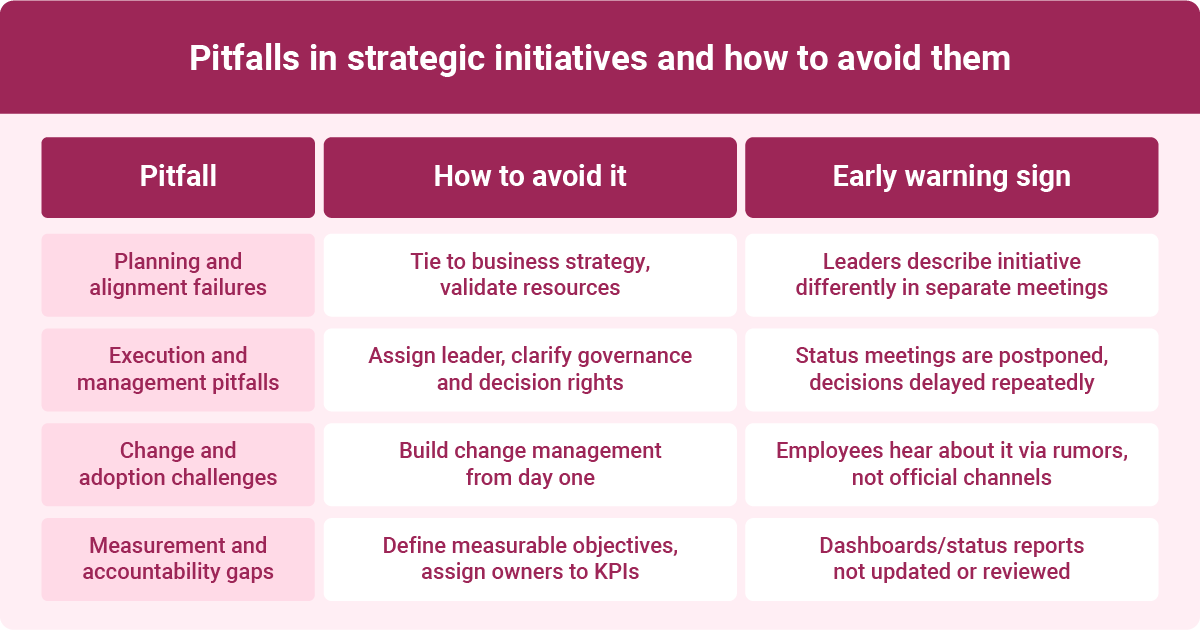
Planning and alignment failures
Pitfall: Launching without a clear tie to business strategy, shared success criteria, or a realistic scope and timeline.
How to avoid it: Invest in alignment before kickoff: confirm strategic linkage, document scope boundaries, validate resources, and secure true executive sponsorship.
Early warning sign: Senior leaders describe the initiative’s purpose or success metrics differently in separate meetings.
Execution and management pitfalls
Pitfall: The initiative leader lacks authority/time, governance is weak, decisions stall, and communication becomes inconsistent – leading to drift or burnout.
How to avoid it: Assign a dedicated leader, establish decision rights and escalation paths, and run a steady governance cadence focused on risks, dependencies, and decisions.
Early warning sign: Status meetings are repeatedly postponed, or key decisions are escalated multiple times without resolution.
Change and adoption challenges
Pitfall: Underestimating resistance to change, skipping stakeholder engagement, or failing to equip managers and employees with the training and support they need.
How to avoid it: Build change management into the plan from day one – audience mapping, communications, enablement, champions, and adoption metrics.
Early warning sign: Employees say they first heard about the initiative through rumors or informal channels rather than official communications.
Measurement and accountability gaps
Pitfall: Success criteria are vague, progress isn’t monitored often, and accountability for outcomes is unclear – so problems compound and “wins” get declared too early.
How to avoid it: Define measurable objectives up front, assign owners to KPIs, review metrics in governance forums, and keep accountability tied to outcomes.
Early warning sign: Dashboards or status reports are rarely updated or reviewed in governance forums.
FAQs
What is a strategic initiative?
A strategic initiative is a comprehensive plan that an organization uses to achieve long-term improvement and strategic goals.
Who should lead a strategic initiative?
Strategic initiative leaders should have authority, credibility, and the ability to execute with clear ownership.
What makes a strategic initiative successful?
Strategic initiatives succeed when ownership, intent, and execution stay aligned over time.
How long should a strategic initiative typically last?
Near-term strategic initiatives should last 3-6 months, medium-term 6-18 months, and long-term about 18-36 months.
Conclusion
Strategic initiatives succeed when they’re built for execution: clear strategic objectives, named owners, realistic resourcing, and a tight set of outcome metrics tied to business goals.
Align key stakeholders early, track progress consistently, and course-correct fast when assumptions change.
The difference between a strategic initiative that lives on a slide and one that reshapes performance is alignment. And alignment isn’t built through communication alone – it’s built through reinforcement. When values, goals, and recognition are visible in one connected system, alignment stops being a quarterly conversation and becomes an everyday reality.
For people and culture initiatives, reinforcing new behaviors matters as much as the plan – platforms like Workhuman® can help support adoption by making progress visible and measurable, and sustaining momentum over time.

Ryan Stoltz
Ryan is a search marketing manager and content strategist at Workhuman where he writes on the next evolution of the workplace. Outside of the workplace, he's a diehard 49ers fan, comedy junkie, and has trouble avoiding sweets on a nightly basis.
Recommended for you