
Organizational Development in 2026: Definition, Process, and Implementation Guide for HR Leaders
by Ryan Stoltz
Last updated
15 min read
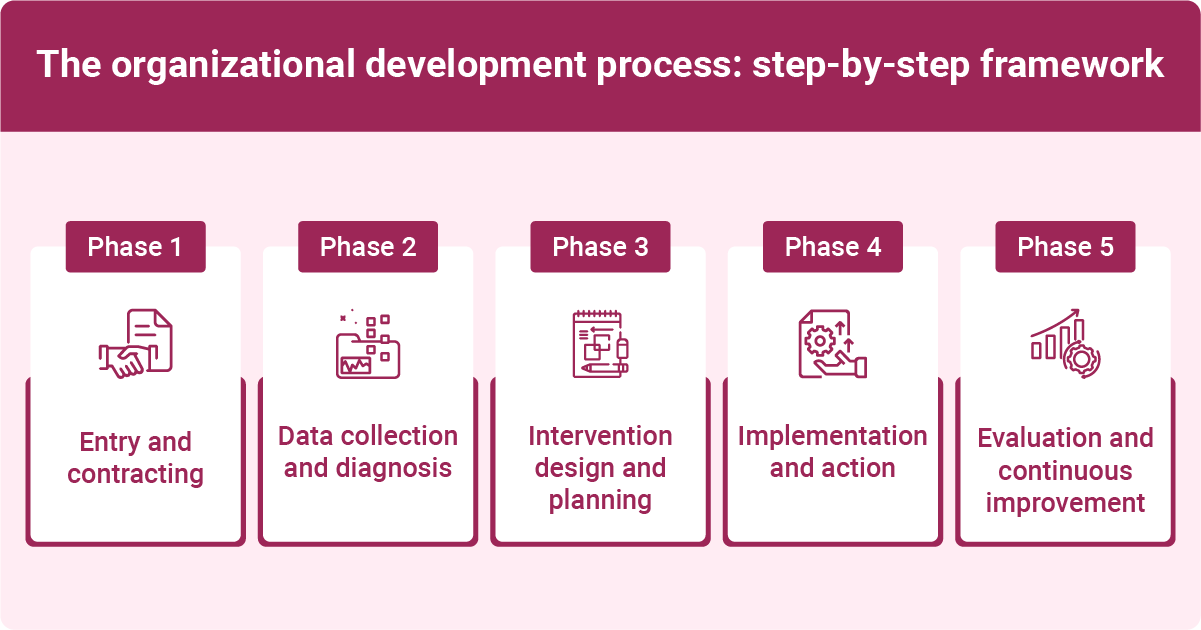
Table of contents
- What is organizational development? Core definition and scope
- Why organizational development matters: business impact and value
- Organizational development theory and historical foundations
- The organizational development process: step-by-step framework
- Common OD models and frameworks
- Practical steps for HR leaders to launch an OD initiative
- Types of organizational development interventions
- Key OD focus areas
- Real-world OD intervention examples
- Organizational development vs. related disciplines: key distinctions
- The role of the OD consultant or practitioner
- Measuring organizational development success: metrics and KPIs
- Challenges in OD implementation
- FAQs
- Conclusion
Share this article
Your leadership team says the company culture needs work. Engagement scores are dropping. Turnover is climbing. But when you ask what needs to change, you get vague answers about communication or morale. Organizational development (OD) gives you the structure, process, and diagnostic tools to move from gut feelings to evidence-based interventions.
This guide explains what organizational development is, why it matters for business performance, and how to implement organizational development strategies that drive measurable results.
Along with the meaning of organizational development, you will learn the core OD process, explore proven intervention types, understand how OD differs from HR and change management, and discover how to measure success.
Whether you're building internal OD capability or evaluating external support, this is your practical roadmap for leading organizational transformation in 2026.
What is organizational development? Core definition and scope
The Institute of Organization Development defines it as a "whole systems approach to improving organizational effectiveness and health through planned change initiatives."
Key characteristics of organizational development
OD is a form of change management that looks at the organization as an interconnected system. It focuses on the organization as a whole, acknowledging how changes in one area affect other aspects of the business. As a result, it only works when it involves collaborative engagement with stakeholders at every level.
In addition, OD is proactive rather than reactive. Companies look for potential problems before they cause a crisis and implement solutions, known as initiatives, to prevent them from worsening.
Primary goals of organizational development initiatives
The goal of OD is long-term transformation, which requires companies to continuously monitor changes and make ongoing improvements. It encompasses many different business areas that contribute to organizational effectiveness and performance.
For example, initiatives often focus on cultural changes, which can strengthen employee engagement and well-being. Others aim to strengthen internal processes, so the company is more prepared for and adaptable to changes in the market or industry.
You'll select and design initiatives depending on which parts of your business are causing dissatisfaction or affecting organizational performance.
Why organizational development matters: business impact and value
Well-implemented OD initiatives can have positive effects throughout your organization, ranging from turnover to productivity to financial performance. By aligning strategy, structure, and processes, you can address changes head-on and become more flexible in the face of shifting markets, technologies, and pressure from competitors.
Measurable benefits for organizations
The structured, data-informed interventions that OD practitioners create and perform can improve an organization's productivity and operational efficiency. This allows businesses to reduce costs and react more effectively to disruptions.
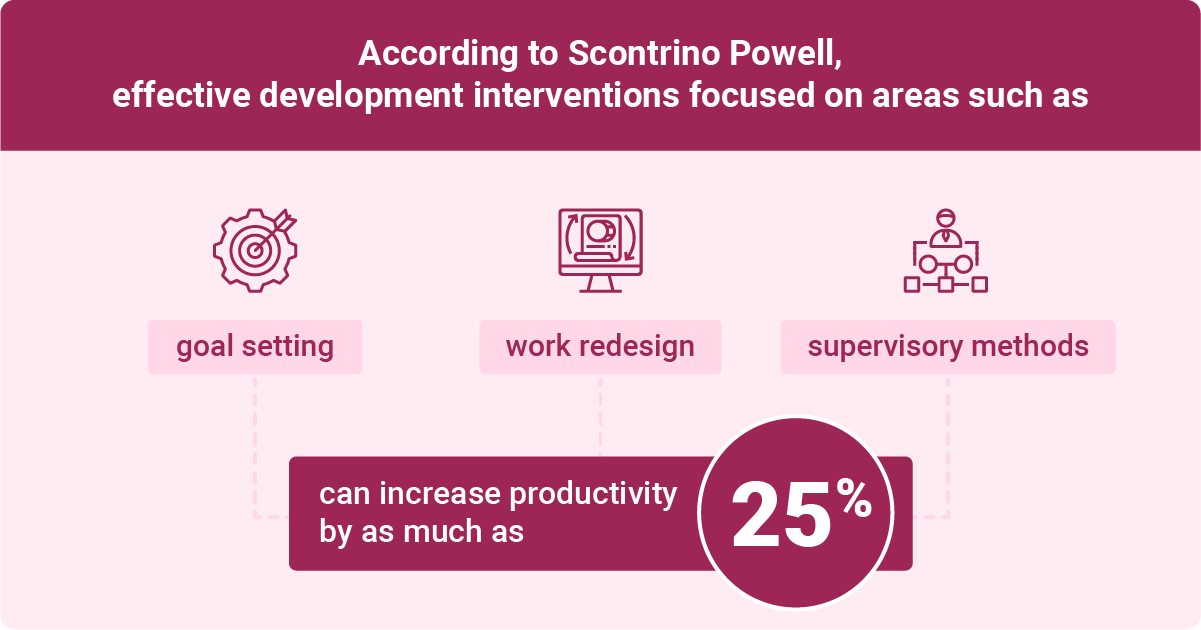
According to Scontrino Powell, effective development interventions focused on areas such as goal setting, work redesign, and supervisory methods can increase productivity by as much as 25%.
Culture-focused OD efforts often result in stronger employee engagement and better financial performance. A survey by BetterManager, “The business impact of leadership developmentOpens in a new tab”, reveals that leadership development, a common initiative, has an average return on investment (ROI) of $7 for every $1 spent, and 87% of companies report higher employee satisfaction rates.
Strong initiatives can address the root causes of resignations, such as disengagement and dissatisfaction. As SHRM explains in the article “Career Development Gaps Frequently Drive Employee Turnover”, improving employee engagement, career development, and job satisfaction supports better retention, which, in turn, results in reduced hiring and onboarding costs.
Effective organizational development can also increase succession readiness for key roles, which gives existing employees more paths of advancement and allows organizations to maintain institutional knowledge.
OD benefits for small vs. large organizations
The size of your company determines the type and scope of impact you see from OD. Small businesses can leverage OD to establish scalable systems and processes early and prevent culture drift during rapid growth. For large organizations, OD can break down functional silos, improve cross-unit coordination, and simplify processes.
In both cases, OD uses a proactive approach to culture and capability building. It makes unexpected emergencies, breakdowns, and failures less likely, minimizing the need for abrupt, expensive interventions. Tailoring your OD interventions based on the size, maturity, and resource constraints of your organization will help maximize their impact.
OD's strategic role in HR functions
Organizational development in HR works as a strategic, diagnostic arm. It complements the core infrastructure services of the HR department by providing opportunities for improvement.
HR tasks often focus on administrative support. OD can elevate standard administrative tasks to make them more intentional and impactful.
Organizational development theory and historical foundations
As a discipline, OD combines humanistic values with evidence-based behavioral science. It acknowledges how an organization's health depends not only on its systems, but also on how those internal processes influence worker behavior and the people involved.
The origins of organizational development
The organization development field emerged more than 70 years ago based on the research of psychologist and social scientist Kurt Lewin.
Consultants at the National Training Labs coined the term during experiential learning and sensitivity training workshops, which the National Training Labs Institute labels as T-groups. Other key researchers in organizational development include Edgar Schein, Warner Burke, and Chris Argyris.
Over time, OD broadened to larger systems and became applied behavioral science, incorporating elements such as action research and strategic change. Today's approach to the field brings together positive psychology, neuroscience, and systems theory.
Humanistic values and respect
At its heart, organizational development is about people and the belief in their ability to grow. Under this framework, organizations treat people as whole individuals rather than resources or assets. That means creating an environment where they feel safe giving and receiving honest feedback.
Organizational development requires a careful balance between organizational needs and employee well-being. OD associations have developed ethics codes to reflect this focus on humanistic values.
For example, the International Society for Organization Development and Change has a Code of Ethics emphasizing values such as quality of life, freedom and responsibility, dignity, and justice.
Systems thinking and holistic perspective
From an OD standpoint, organizations are interconnected systems, not silos. Changes in one area have ripple effects across departmental boundaries, ultimately impacting the entire business. This means adjustments can't occur in isolation. Instead, organizations have to align them across multiple levels and investigate more deeply to find the source of the problem.
Failing to acknowledge that interconnectedness and looking only at the symptoms rather than the causes creates problems instead of solving them.
Participation and collaboration
OD strategies also rest heavily on participation and collaboration, particularly from stakeholders and leadership. Involving stakeholders increases buy-in and commitment, which helps make your interventions more successful.
With an OD approach, you co-create solutions, leveraging intelligence from multiple sources within your organization to gain a deeper understanding of the structure and processes you need to improve. Shared ownership also drives sustained implementation, as everyone is equally invested in the success of your efforts.
Data-driven and evidence-based
Evidence-based practice and behavioral science research are the final pillars of OD. When planning and implementing interventions, OD specialists ground every decision in organizational data. Throughout the process, they prioritize ethical data collection and analysis practices, including informed consent and transparency.
They use validated assessment tools and methods to continuously measure performance, learn from successes and failures, and make adjustments to improve outcomes.
The organizational development process: step-by-step framework
OD is a cyclical, iterative process with steps your organization can repeat as needed to make adjustments based on documented effects. While every organization will have unique interventions based on its needs, the steps of the process are typically the same.
Phase 1: Entry and contracting
The first step in organizational development establishes the foundation for all your interventions. Either a consultant or your internal OD specialist will ask stakeholders, company leaders, and employees questions to clarify underlying concerns. They will also define the scope and objectives of the process, as well as determine stakeholder roles.
Phase 2: Data collection and diagnosis
The data collection and diagnosis phase involves extensive qualitative and quantitative research. Organizational development professionals will conduct a needs analysis to determine what types of interventions are most important, drawing information from sources such as:
- Interviews
- Focus groups
- Observations
- Surveys
- Performance metrics
- HR analytics
Reviewing data provides insights into lived experiences, patterns, and trends within the organization, allowing the OD specialist to analyze your company's culture, structure, workflows, and people systems and look for opportunities to better align them with your strategy.
They can also get a deeper view of any problems, looking beyond surface-level systems and connecting ideas across different areas of your business.
Workhuman® iQ™ is a valuable tool during this process because it combines artificial intelligence (AI) with proprietary algorithms to analyze platform data. It can distill information into actionable insights on cultural health, surfacing trends across departments or regions through on-demand reports and the AI Assistant.
After performing this analysis, the next step is sharing the findings with stakeholders, with the goal of confirming and fine-tuning the conclusions. Following those conversations, the OD professional will synthesize all the information into a set of themes, which will guide the intervention design.
Phase 3: Intervention design and planning
The information your OD professional gathers during the data collection phase informs their next step: selecting interventions aligned with your issues and organizational readiness. Remember, these interventions aren't based on trends or exciting new tools. They're directly related to your priorities and current weaknesses.
To choose specific interventions, the OD specialist will collaborate with your leaders, stakeholders, and subject-matter experts, developing an action plan with specific interventions, goals, timelines, and desired outcomes.
Along with an intervention roadmap, they'll put together communication and change management plans for different stakeholder groups. This phase also requires careful consideration of any potential risks of each intervention, with the hope of avoiding any negative unintended consequences that could impact business operations and productivity levels.
Finally, the OD practitioner will identify any required resources, training, and support for each intervention.
Phase 4: Implementation and action
At this point, the OD consultant will execute the planned interventions, taking a measured approach and consistently monitoring and adjusting as needed. Interventions are planned actions or events that intentionally disrupt the usual way of doing things.
While they have positive outcomes, interventions can also create temporary confusion. As a result, the consultant will support managers and teams throughout the transition, providing coaching, resources, and feedback channels for open communication.
An article from Frontiers in Psychology, “The Psychology of Resistance to ChangeOpens in a new tab”, explains that some employees are resistant to changes and interventions. OD experts should react with empathy to smooth the transition and increase employees' willingness to participate. When necessary, they can modify their approach to address concerns from stakeholders.
To maintain momentum and encourage enthusiasm, the practitioner should communicate progress and share information about early wins. As the implementation continues, they'll take time to document the lessons your organization has learned and the best practices you've discovered along the way.
Phase 5: Evaluation and continuous improvement
The OD process requires close monitoring at every stage. Measuring outcomes against baseline data and predefined objectives is the only way to know whether your interventions are working as designed.
Consultants can get this knowledge from a mix of sources, including participant and stakeholder feedback. They'll look closely at how well your team received the intervention, ask what they learned from it, and examine what kinds of behavioral changes occurred, giving the opportunity to offer unfiltered insights into what worked, what didn't, and why.
You can transition successful practices into policies and processes, embedding them in your institution and its culture. You can also begin planning the next OD cycle, taking into account everything you've learned, any emerging challenges you expect to encounter, and new strategic priorities based on your organization's current health.
Common OD models and frameworks
Although OD almost always involves the same basic phases, it can differ depending on the specific model or framework you choose.
These are some of the most popular approaches, as described by the Institute of Organization Development and the International Risk Management Institute in their blogs “What is Organization Development (OD) and How Does it Differ from Other Change Management Models” and “Appreciative Inquiry—A Transformational Change Management Tool”, respectively:
- Lewin's Change Model: This model has three stages: unfreeze, change, refreeze. The company prepares for a change, implements it, and then finds ways to sustain it.
- Action Research Model (ARM): The ARM framework has iterative cycles of diagnosis, planning, action, and evaluation. It's a collaborative, problem-solving approach to OD.
- Appreciative Inquiry: This framework involves identifying strengths rather than weaknesses. You focus on what works well in your business to drive further change.
- Prosci's ADKAR Model: This model stands for Awareness, Desire, Knowledge, Ability, and Reinforcement. It offers a framework for individual change.
Keep in mind that organizations don't have to limit themselves to a single framework or model. For example, your company might employ Appreciative Inquiry to select interventions and use Lewin's Change Model to implement and maintain them.
Practical steps for HR leaders to launch an OD initiative
Some businesses don't have internal OD specialists or the capacity to bring in an outside consultant. Fortunately, other HR employees can create and start initiatives by following a few basic steps:
- Clarify your business's problem or opportunity, such as high turnover, rapid growth, or cultural misalignment, and decide how OD could help address it.
- Find an executive sponsor willing to support the initiative, and work together to decide on a focused pilot area, allowing you to test the intervention without immediately attempting an organization-wide change.
- Do a small-scale needs analysis based on existing data, including engagement surveys, turnover rates, and performance metrics, as well as a few stakeholder interviews.
- Put together a cross-functional design team that can help you interpret data, create solutions, and advocate for changes.
- Choose one or two targeted interventions, such as team effectiveness workshops, leadership development, or process redesign, which align with the problems you've diagnosed.
- Establish a short list of success measures and a review timeline, such as three to six months, to evaluate the impact of your initiatives and plan your next steps.
These lower-stakes initiatives may not make the sweeping organizational changes of a larger OD strategy, but they can have significant impacts over time.
Types of organizational development interventions
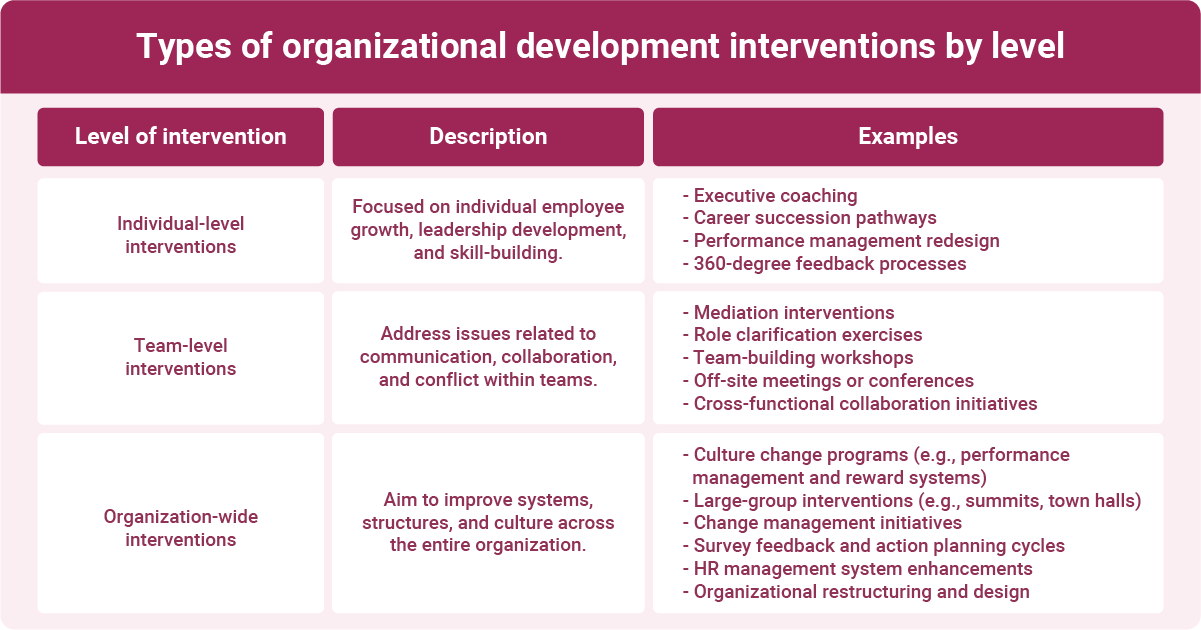
Depending on the nature of the issues in your organization, OD interventions can target several levels of your company, including individuals, teams, and systems. Recognizing which kinds of interventions you need allows you to choose the most appropriate tools for implementation and, in some cases, layer mutually reinforcing initiatives.
Individual-level interventions
Team-level interventions
Team interventions address issues with communication, collaboration, and conflict. For example, you might launch a mediation intervention to address team-level tensions or use role clarification exercises to reduce ambiguity and frustration.
Team-building workshops and off-site meetings or conferences can help shore up trust, and cross-functional collaboration initiatives improve coordination across departments.
Organization-wide interventions
To address issues at a broader scale, you can implement changes across all areas of your business. These are some possible organization-level interventions:
- Programs to change company culture, often by updating performance management and reward systems
- Large-group interventions, such as summits and town halls, to engage with large numbers of employees
- Change management initiatives to shift the approach to major systems or strategies
- Survey feedback and action planning cycles to translate data into concrete improvements
- Enhancements to HR management systems to reinforce desired behaviors
- Organizational restructuring and design to better align structure with strategy
Workhuman's Social Recognition solution can help you achieve many of these goals. It serves as a culture intervention tool through peer-to-peer awards, which reinforce company values. It includes the Recognition Advisor for alignment coaching and the Culture Hub for showcasing cultural behaviors at scale across more than 180 countries.
Key OD focus areas
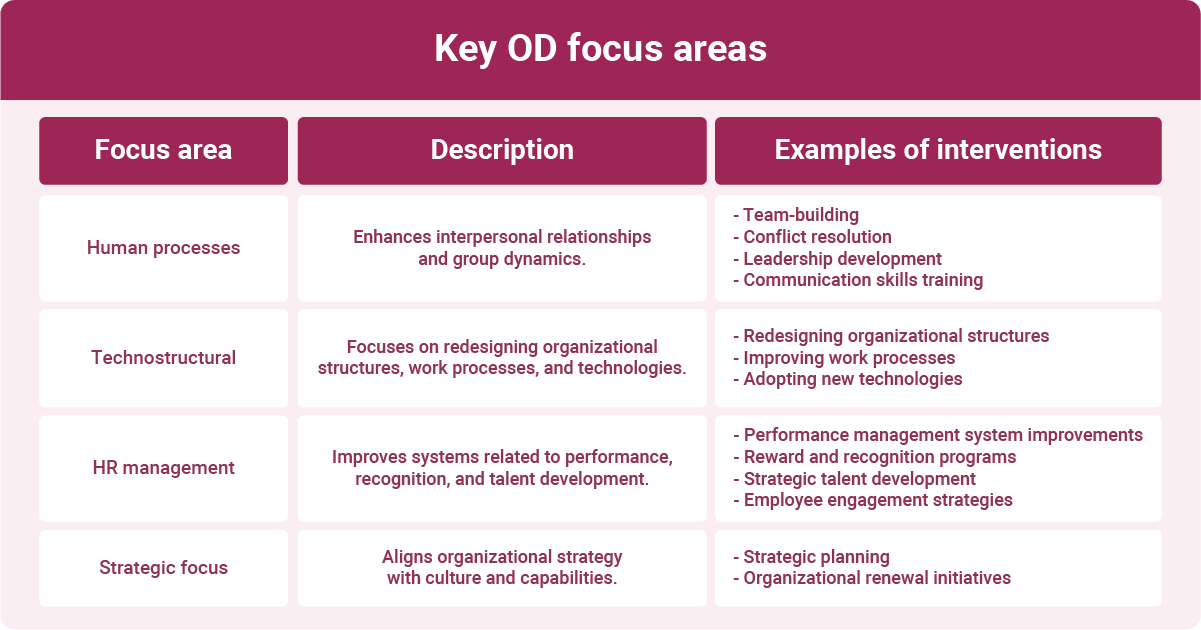
You can construct OD interventions for virtually any aspect of your organization, but many businesses focus on these problem areas:
- Human processes: Interventions that enhance interpersonal relationships and group dynamics include team-building, conflict resolution, leadership development, and communication skills training.
- Technostructural: Initiatives such as redesigning organizational structures, work processes, and technologies fall under the technostructural category.
- HR management: HR interventions improve performance management, reward and recognition systems, strategic talent development, and employee engagement strategies.
- Strategic focus: Interventions for improving strategic focus aim to align your organizational strategy with your culture and capabilities through strategic planning and organizational renewal initiatives.
The specific strategies you use will depend on the focus. If you want to improve company culture through OD, you can design initiatives and use storytelling, role modeling, and recognition to reinforce the behaviors necessary to make your desired culture a reality. However, many OD initiatives span multiple focus areas.
For instance, a single initiative could address culture change, HR system changes, and process redesign. This overlapping approach often helps make changes more sustainable.
Real-world OD intervention examples
Some of the world's most successful businesses have accelerated their growth and shifted their cultures through OD. Their cases underscore how interventions can redefine a company's health and future success.
One of the best organizational development examples is Southwest Airlines. The company often receives praise for creating a learning culture and supporting employee growth through systematic training interventions and leadership development. As Gallup explains through the article, “Leadership With LUV: Lessons From Southwest Airlines' CEOOpens in a new tab”, one of this business's greatest strengths is the willingness of leaders to be authentic and service-oriented, even when problems arise.
Another OD success story is Microsoft. An interview from SHRM explains how CEO Satya Nadella led a cultural transformation at the company, which had struggled for several years before. When Nadella stepped in, he boldly heralded a shift from a purely competitive mindset to a collaborative culture with a focus on employee development.
Organizational development vs. related disciplines: key distinctions
Organizational development overlaps with several other aspects of business operations, including HR and change management. However, they have distinct areas of focus and purposes, and understanding what sets them apart helps you coordinate efforts across disciplines and ensure task assignments are appropriate.
OD vs. Human Resources
OD consultants, on the other hand, design and implement interventions to change the organization's culture and performance.
OD can sometimes fall under the umbrella of HR, in which case, the two fields must collaborate. For example, they may work together on issues such as talent development, employee engagement, performance management, and culture initiatives.
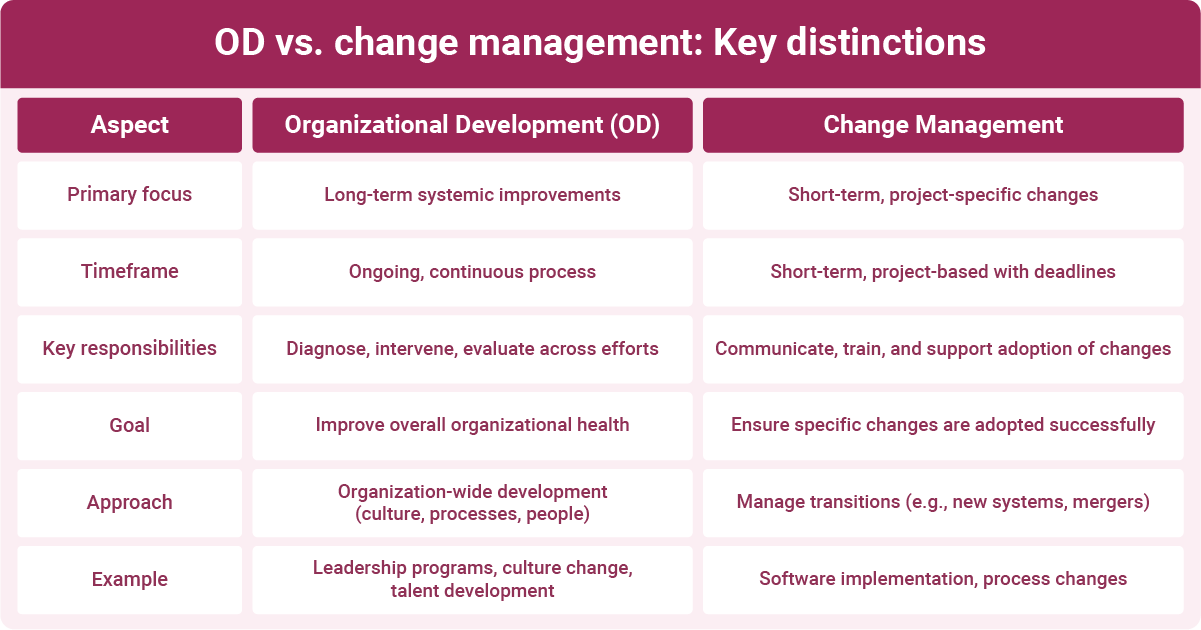
OD vs. change management
The most important difference between OD and change management is the timeframe. OD is a wide-ranging, continuous process with objectives related to a business's health, learning, and adaptability. In contrast, change management describes short, project-based initiatives with firm deadlines and clear success criteria. A single system implementation, for example, qualifies as change management.
During OD, a consultant performs diagnosis, interventions, and evaluation across multiple change efforts, while change management emphasizes stakeholder communication, training, and adoption for specific changes.
Organizations sometimes use change management models, such as Kotter and ADKAR, as tools within their OD strategies, and both processes can benefit from cooperation and integration.
For instance, the OD consultant sets the long-term direction, and change management professionals execute the specific initiatives under that plan.
The role of the OD consultant or practitioner
OD practitioners have a thorough understanding of the process and strategies organizational development involves, but they're not directors. They serve as facilitators, guiding employees through changes rather than giving orders, which is a role requiring a special skill set and a close connection with your company.
Core responsibilities and key skills
OD practitioners take on a variety of duties in their day-to-day work, including:
- Diagnosing organizational issues through data collection and analysis
- Designing and facilitating interventions
- Building capacity for change and continuous improvement
- Coaching leaders and teams through transitions
- Evaluating impact and refining approaches based on outcomes
These responsibilities require expertise in behavioral science, systems thinking, and facilitating change, as well as strong interpersonal and facilitation skills. A strong OD practitioner can clearly see patterns and knows how to gather insights from data and research. They're also emotionally intelligent and culturally sensitive, recognizing the needs of a diverse group of staff.
Most importantly, an OD professional knows how to build trust with stakeholders, leaders, and frontline employees.
Internal vs. external OD consultants
OD practitioners can be an integral part of a company, often within an HR team, or work as third-party consultants. Each option comes with advantages and drawbacks, so examining your organization's budget, staffing, and needs is crucial when deciding who should take charge of your OD efforts.
Internal employees typically have deeper organizational knowledge, giving them a leg up when it comes to analyzing processes and systems. They also have ongoing relationships with other employees, and they come at a lower cost because they're already on staff.
However, if your current employees don't have the necessary level of OD training, they may need to complete a course or certificate program to get up to speed before you begin your interventions.
External consultants, on the other hand, bring a fresh perspective to the table. You can also easily change third-party consultants if you discover they don't have the specialized knowledge you need. Despite those upsides, consultants are usually the more expensive option, and they require at least some degree of onboarding and knowledge transfer before they can jump into the OD process.
If you want to take advantage of the positive aspects of both internal and external OD practitioners, consider taking a hybrid approach. You can combine the strengths of both, bringing together the specialized knowledge of a consultant and the organizational expertise of your current staff.
Measuring organizational development success: metrics and KPIs
Long-term tracking of key performance indicators (KPIs) is vital in OD because it allows you to distinguish between failed interventions, temporary improvements, and sustained organizational change. Using both qualitative and quantitative data is the best way to get a full perspective of the outcomes.
Leading and lagging indicators of OD success
Other important metrics include participation rates in OD-related interventions, such as workshops or development programs, and the quality and frequency of stakeholder feedback.
Lagging indicators, such as turnover and financial results, allow you to confirm the impact of your interventions. Look closely at data points such as customer satisfaction scores, productivity measures, revenue growth, and time-to-fill for open positions. These numbers will tell you whether your interventions are making a real difference in your organizational culture and health.
Workhuman's Human Intelligence is an asset when it comes to KPIs and data collection. It mines recognition data to provide measurable insights into skills gaps, performance patterns, and diversity, equity, and inclusion (DEI) metrics. This information enables your organization to track your OD program ROI and document the impact of your interventions.
Evaluation methods and approaches
When measuring your performance, start by establishing a baseline. Pinpointing where you began enables you to accurately assess how much progress you've made through your interventions.
You can use a variety of techniques to collect information, such as:
- Pre/post surveys, which measure changes in attitudes, behaviors, and perceptions over time
- Control or comparison groups, which isolate the effects of specific interventions
- Qualitative feedback from interviews, focus groups, and open-ended survey questions
- ROI analysis comparing program costs and benefits, including reduced turnover and productivity
As you analyze your data, account for any limitations and be careful not to make assumptions about the correlation between an initiative and a shift in your KPIs. Try to link specific metrics to particular interventions, so you know what is driving each outcome.
Challenges in OD implementation
OD can be a high-impact, transformative process, but it isn't always an easy one. Recognizing the potential pitfalls in leadership commitment, persistence, communication, and sustainability helps you avoid them.
Common obstacles and solutions
While your OD interventions can go off without a hitch, these are some of the most likely issues you could encounter:
- Resistance: Middle management or frontline employees who feel threatened or excluded might resist interventions. This reaction is natural, and reacting to it with understanding and openness is best.
- Lack of leadership commitment: Leaders may waver in their commitment, damaging the effectiveness of the intervention. Keep them involved with visible accountability, clear roles, and specific ongoing engagement.
- Insufficient resources: Interventions need proper support to succeed. Work with stakeholders to secure the time, budget, and internal expertise you need.
- Premature declarations of success: Quick wins feel good, but celebrating them too early could cause your interventions to falter down the line. Highlight achievements as they happen, but also stay focused on long-term culture and system work.
- Inconsistent communication: Trust can quickly erode if you don't keep everyone in the OD process informed. Make sure communication is frequent, transparent, and two-way.
If you hit a roadblock in your OD strategy, remind yourself and others in your organization of its iterative nature. Failed initiatives will teach you what you need to know for greater success in the future.
Applying OD in remote and hybrid environments
One common question for modern businesses is whether OD is possible in non-traditional workplaces, namely those with hybrid or remote models. Although the process may look different than in an in-person office, OD can be just as effective.
In addition, make sure everyone on your team, whether remote or on-site, has equal access to OD activities so you don't inadvertently create a two-tier culture where one group feels less valued than another.
FAQs
What is the difference between organizational development and organizational design?
Organizational design focuses on establishing structural elements of a company, such as roles, processes, and systems, and generally doesn't include more abstract issues. Organizational development, on the other hand, encompasses culture, behaviors, and relationships, as well as systems and processes.
Do we need an external consultant, or can we do OD internally?
You can task internal employees with OD, bring in an outside consultant, or take a hybrid approach, depending on your budget and staff expertise. Partnering with an outside consultant is often more expensive but allows for more specialized knowledge, while existing staff have a more thorough understanding of your organizational history, structure, and culture.
How do we know if our organization is ready for an OD intervention?
Before implementing an OD intervention, make sure you have clear data, a diagnosis, and leadership buy-in. If your organization is in danger of failing, you have documented evidence of a problem in the culture or processes, or employee and stakeholder feedback indicates a pattern of concerns, planning an intervention is a logical step.
What are the biggest mistakes organizations make with OD?
Allocating insufficient resources, looking only at short-term outcomes, and failing to get support from organizational leadership are common errors in OD. The process is cyclical and requires lasting commitment from employees and stakeholders.
Conclusion
Organizational development gives HR leaders a way to turn broad concerns about culture, performance, or change readiness into structured action.
When you ground your efforts in data, involve the right stakeholders, and treat OD as an ongoing process rather than a one-time fix, you create stronger systems, healthier teams, and a more adaptable organization.
For HR leaders navigating growth, disruption, or persistent performance issues, OD is not just a support function. It is a strategic discipline for building long-term business resilience.

Ryan Stoltz
Ryan is a search marketing manager and content strategist at Workhuman where he writes on the next evolution of the workplace. Outside of the workplace, he's a diehard 49ers fan, comedy junkie, and has trouble avoiding sweets on a nightly basis.
Recommended for you