
Flexible Work Policies: The Future of Work Culture
Last updated
6 min read

Flexible work policies have seen quite a shift since they took the world by storm in 2020. Some organizations have returned to the office, while others have decided to stay remote forever. Others are testing out hybrid working arrangements, and many are still undecided about what their “forever policy” will be.
Whatever your stance, you cannot deny the relevance of flexible working. According to the Pew Research CenterOpens in a new tab, "About a third of U.S. workers who can work from home now do so all the time," around 22 million employed adults (aged 18 and over) in the U.S. work from home all the time, and just over one-third of U.S. workers who can work remotely do so full-time.
A study by Upwork estimates that 22% of the American workforceOpens in a new tab will be remote by 2025.
This isn’t that surprising, given that the majority of white-collar workers would prefer to work from home at least three days per week, according to the article 'Remote Work Statistics and Trends in 2024Opens in a new tab' published on US Today.
That said, there is still a lot of confusion and uncertainty surrounding flexible working. Is it really just as productive as being in the office? How can an organization adjust its working arrangements without too much disruption? How do you know which setup is right for your company?
Let’s talk about flexible work arrangements, how they work, and their benefits and challenges.
Understanding flexible work policies
There are a lot of different flexible working arrangements out there – one size does not fit all! Here are some common types of flexible work policies:
Some companies are fully remote, while others offer hybrid work policies, offering a few remote days per week while expecting employees to come into the offices on other days. Telecommuting can help your employees have more time to spend on their lives outside of work and feel more energized while helping your business save on overhead costs.
Four-day workweek: Compressed workweeks work great for some companies, where employees work 10-hour days four days a week and have either Monday or Friday off. There are other ways to arrange it, but this working arrangement gives employees more time for their personal lives and can even result in higher productivity.
Flextime: Give employees the option of choosing when they work by offering a few different schedules from which to choose. Some may prefer to work earlier, from 7 a.m. to 3 p.m., for example, while others might prefer a later schedule starting at 10 a.m.
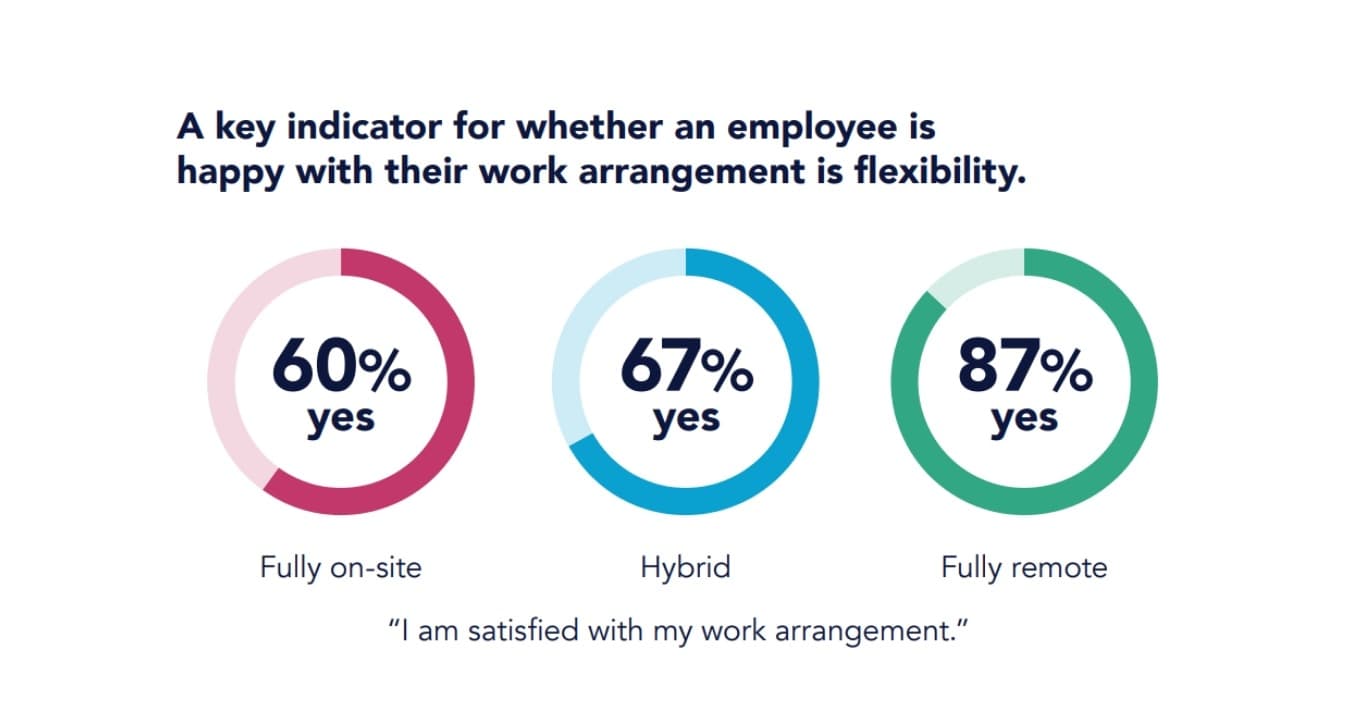
These flexible work hours enable employees to work whenever works best for their personal schedules. If your office operates in-person, it can be helpful to establish hours when everyone is expected to be in office so that there is sufficient overlap for collaboration and meetings.
Job sharing: This flexible work arrangement enables two or more employees to share a workload that would normally fall upon one full-time employee. This means each employee has reduced pay, hours, and benefits and can help reduce your overall payroll.
What are the benefits of flexible work arrangements?
Nowadays, workers expect some sort of flexibility from their employers. The COVID-19 pandemic showed us how many different ways we can work while still being productive, and the impact of that is difficult to forget. Many workers never want to go back to “the old ways,” and they have plenty of good reasons to feel that way.
Workers feel strongly about having remote work as an option. According to a survey by USA Today, only 16% of white-collar workers would consider a role that doesn’t offer any days of remote work. What’s more, 42% of office workers would take a 10% pay cut to have the flexibility to work remotely.
By honoring employees’ preferences, companies can enjoy reduced overhead and greater talent attraction and retention. The benefits of hybrid work culture are evident, as flexible work policies are an opportunity to differentiate your culture and really put your values into practice.. This is where you show how much you care about your employees’ overall well-being and work-life balance.
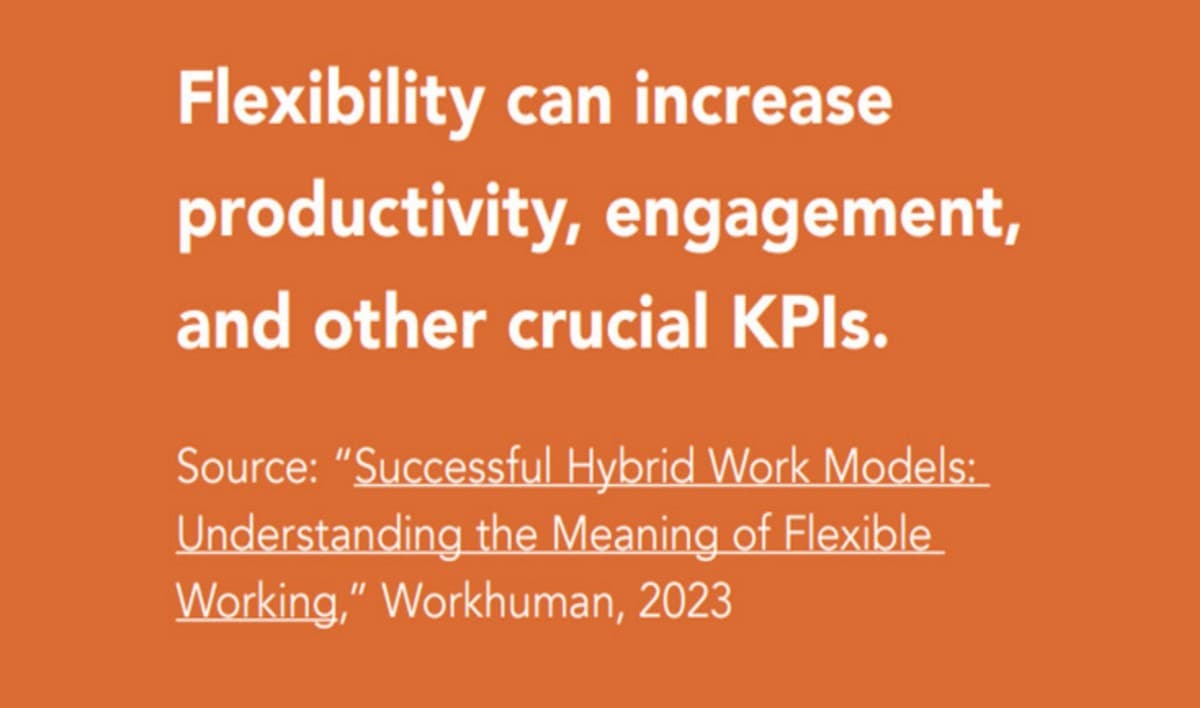
Flexible work arrangements can have a positive impact on business outcomes too. Hybrid employees had the highest level of engagement according to the "Remote Work Statistics" Quantum workplace studyOpens in a new tab, followed by remote employees, then on-site employees. Another Upwork study, "The Future of Remote Work,"Opens in a new tab shows that 32.2% of hiring managers found that productivity increased after going remote.
Flexible working arrangements are also correlated with lower stress levels, which tends to help employee engagement and productivity as well.
Implementing flexible work policies
Putting flexible work into practice isn’t as simple as simply telling your team they now work remotely. There will be many steps to take before the new policies are set into motion.
Best practices for managing remote teams
Hold regular check-ins and virtual team meetings. Facetime is priceless, and with flexible arrangements, it is even more important. Regular meetings ensure your teams, managers, and employees are connecting on a consistent basis, enabling employees to share their current work as well as their successes and struggles.
Speaking of success – track it! Invest in tools that enable performance tracking and feedback, like Workhuman’s Social Recognition® and Conversations®. These tools promote ongoing feedback and appreciation, which can easily get lost in the shuffle of busy days, particularly in an alternative work arrangement where managers might not see their employees every day.
These tools will also enable you to monitor the impact of your new flexible work policy on productivity and overall connection.
Set expectations with your employees of when you expect team members to be online and available. Do certain teams need to be present in the office on certain days of the week for meetings? Are there set hours for meetings? Setting these guidelines will help ensure alignment and prevent confusion among employees as they adjust to the new arrangements, particularly for a compressed workweek or staggered work schedules.
Offer facetime. Finding opportunities to meet face-to-face shouldn’t be challenging. Spending time together in person is one of the challenges of managing remote and hybrid organizations. If a team member feels they need some Facetime, it shouldn’t be a headache to organize. Make yourself available and ensure that your organization readily facilitates in-person meetings.
Emphasize trust and collaboration. Fostering positive relationships among employees is crucial for a harmonious workplace. In fact, having a close friend at work is shown to boost overall satisfaction. Receiving recognition for a job well done shows employees that their work is valued and that their efforts are being seen and appreciated.
Giving recognition fosters this culture of appreciation and encourages teammates to celebrate one another.
Invest in the right tools. Flexible work arrangements can’t succeed without mechanisms to support communication, collaboration, and feedback, regardless of location. Here are some tools to consider:
- Chat software
- Video calling
- Project management system
- Recognition software
- Screen sharing and collaboration software
- HR software
Challenges and solutions
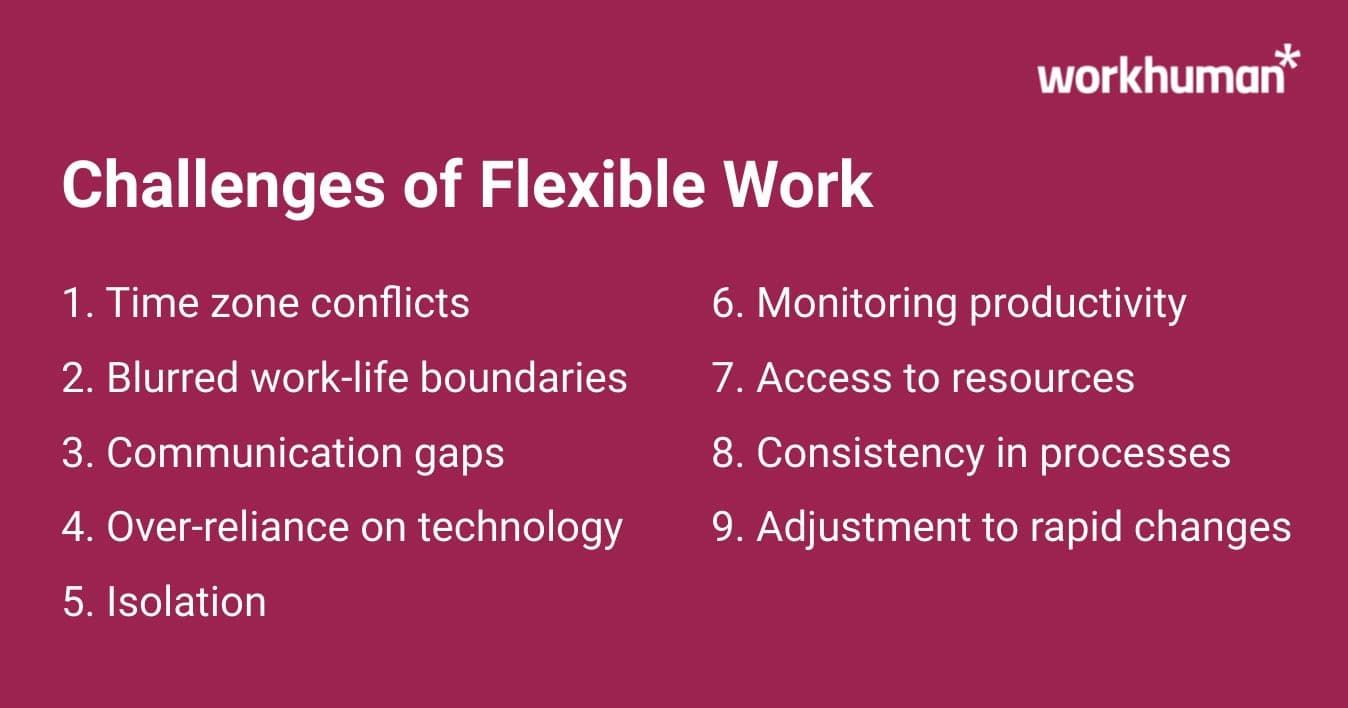
Of course, remote work isn’t without its challenges. Physical separation among teams can be difficult for both the employee and the company. Eligible employees may find the change difficult to manage. For staggered work times, it can be hard to find the right working hours that suit everyone’s needs.
In implementing new flexible work arrangements, it’s important for team leaders to work with their team members to set the new policies. While leaders should create the framework, data from GallupOpens in a new tab shows that team-organized policies are more effective than direct mandates. This structure gives employees a sense of ownership and naturally encourages them to uphold promises made to one another.
Some workers can find it difficult to unplug from work while working from home due to the lack of physical separation of home and work. Lack of work-life balance can contribute to burnout and low feelings.
Peer-to-peer recognition can make a world of difference to foster connection amongst remote employees. It encourages managers to pay attention and recognize every milestone and accomplishment, particularly those that might go overlooked in an asynchronous organization.
Other things that can help organizational connections are mentor programs to connect more senior employees with more junior ones, employee resource groups to support employee development and other cultural cornerstones. Of course, it’s also important to have plenty of opportunities to meet in person.
Gallup data shows that managers need to have one meaningful conversation per week with each of their direct reports. For hybrid teams, ensure each team has at least a monthly get-together to align on projects and goals. For fully remote organizations, having team off-sites and summits a few times a year can help team unity and connection.
Case studies
Flexible work arrangements have been a hot topic since 2020. Experiments in different ways of working have been underway for years, sometimes even happening on a national level.
For example, Germany just launched a four-day workweek trialOpens in a new tab with 45 companies joining the six-month trial. Employees in participating companies will get one day off per week while remaining on full-time pay. The study aims to determine whether this change boosts productivity while making staff happier and healthier.
The study is piloted by the non-profit organization 4 Day Week Global, which estimates that output should remain consistent or even increase while absences due to illness, stress, and burnout should decrease.
These estimates are based on similar experiments in the US and Canada, where participating workers reported improved physical and mental health and less burnout. None of the participating companies planned to return to a five-day workweek.
On an organizational level, Cengage Group is an education technology company that has adopted a flexible hybrid work model. As shared with ForbesOpens in a new tab, they operate on the motto: “Digital first doesn’t mean never together.”
This means they rely heavily on tech tools to keep them connected but know that no tool can replace the power of in-person connection. Teams are encouraged to gather at a rhythm that makes the most sense for their needs. Some of their key takeaways from the adoption include:
- Establish clear expectations, particularly when it comes to performance management. To do this, Cengage uses “Team Norms,” where teams establish their availability, meet expectations, and more. These agreements are fluid and open to changes as needed.
- Rely on trust. Cengage emphasizes that trust is the bedrock of flexible work success and that reframing productivity in terms of output and success rather than time spent in the office is crucial.
The future of flexible work policies
Flexible work arrangements are bound to become increasingly custom as the world of work continues to adapt to this new working style. Flexible work policies will be embedded in company culture, just like recognition and ERGs.
Continued technological advancements will continue to develop alongside flexible working, especially as workplace sustainability initiatives become more integrated into these advancements, with it becoming an industry itself.
Tools to facilitate remote work will continue to emerge, enabling both part-time and full-time employees to work flexibly regardless of their situation.
Conclusion
Flexible working arrangements will continue to dominate in the coming years. While flexible working isn’t for everyone, it is worth your time to explore how it might work for your organization, given how in-demand it is, particularly among white-collar workers. Businesses must adapt to the times, and this is just another shift in the world of work.

Maeve Ginsberg
A wellness enthusiast and the mid-day walk’s #1 fan, Maeve champions work-life balance.
Having gone from a corporate job to self employment, Maeve has lived through countless working styles. This evolution forced confrontation of her own limiting beliefs, eventually breeding a completely individualized approach to work and productivity.
As a Senior Copywriter, Maeve often writes on workplace wellbeing and strives to advocate for all workers and leaders to find small yet significant ways to make their work lives healthier and more fulfilling.
Offline, Maeve enjoys testing new cuisines and hanging upside down off walls (also known as bouldering).
Recommended for you