
SBI Feedback Model: How to Use It Effectively at Work
by Ryan Stoltz
Last updated
10 min read
Like most managers and HR leaders, you understand the need to give effective feedback. But without a framework such as the SBI feedback model, it’s easy to default to vague, evaluative language that triggers defensiveness or evaporates without driving the changes you desire.
The Situation-Behavior-Impact model gives you a structure to help you create a successful feedback culture that inspires healthy communication. It offers the specificity and objectivity to focus on observable behavior, which eliminates ambiguity and makes it easier for the recipient to understand and act on feedback.
To help you provide effective SBI feedback, here’s a breakdown of its framework and how to apply it, along with its strengths and weaknesses and the most common mistakes to avoid.
What is the SBI feedback model?
The SBI feedback model is a structured framework for providing constructive feedback to employees or team members. It organizes feedback into three components:
- Situation: Anchors your feedback to a concrete moment
- Behavior: Describes what the person did, in observable, factual terms
- Impact: Explains what effect the behavior had on you or your team
For example, when you offer vague praise such as “great job on that presentation,” you don’t tell the recipient what things to do again next time. Similarly, if you give vague criticism like “you need to be more professional,” you don’t tell the recipient what to change. The SBI framework connects a behavior to its effect in language that the recipient can act on.
Breaking down situation, behavior, and impact
The Situation-Behavior-Impact framework for providing feedback to your team is simple and direct. You just have to clarify the Situation, describe the specific Behavior you observed, and explain the Impact that behavior had on you or your team.
Situation
Begin by providing context. Clearly describe to the recipient when and where the behavior occurred so there’s no ambiguity about what feedback you’re giving.
For example, instead of saying “During meetings,” you can offer a stronger situation statement by saying “In this morning’s 10 AM project update meeting.” The clarity gives a timestamp that the recipient can verify.
Behavior
After pinning down the situation, identify the specific behavior you observed without making judgments. It's important for you to focus on factual actions without any interpretative layer, rather than labels or individual character assumptions.
Instead of using judgment words such as “rude” or “careless,” simply say what you saw, for instance, “You interrupted Maria three times while she was sharing her budget data.”
Impact
Explain the impact of the behavior on the work or the team's ability to hit its goals, helping the recipient understand the consequences of their actions. For example, you can say, “I felt frustrated because we lost track of her data,” or “I’m concerned the team may feel their contributions aren’t being heard.”
First-person language helps you express your perspective without sounding accusatory, which is especially important when conversations become difficult.
Why the SBI model works
The SBI feedback model is effective because it:
- Reduces defensiveness by focusing on facts instead of the recipient's character. When you tell someone, “You’re arrogant,” the natural response is to defend their identity. But when they hear “You interrupted Maria three times during her budget walkthrough,” there’s less space for pushback because the behavior happened.
- Makes feedback specific enough to act on. By breaking down feedback into specific elements, you eliminate ambiguity to make it easier for the recipient to understand and act on it.
- Works across hierarchies, including manager-to-employee, peer-to-peer, and upward-to-leadership feedback. The SBI model remains effective regardless of power dynamics because it stays grounded in observable facts. The deliberate use of “I” statements in the Impact step also helps frame feedback as a personal perspective rather than an accusation.
Pros and cons of the SBI feedback model
As with any framework, SBI has its advantages and limitations. Understanding both helps you apply it where it works best and recognize where a different approach is warranted.
How to use the SBI feedback model: A step-by-step approach
Like any well-run process, your organization’s feedback culture needs a strategy. Follow these steps to provide fact-based feedback messages that are easy for the recipients to act on.
Step 1: Anchor the situation
Establish the specific context before you say anything evaluative. Capture the situation with a concrete date, time, place, context, or project milestone. If there are several events, reference one at a time so you don’t muddy the message and make the recipient feel like you’re indicting rather than coaching them.
Avoid generalizations such as “always” or “never” because they might be inaccurate and shift the conversation from a specific behavior to character judgment, which SBI tries to avoid.
Step 2: Describe the behavior objectively
Stick only to what you observed, including:
- Words said
- Actions taken
- Decisions made
- Non-verbal cues
When you’re unsure whether your description of the behavior is judgmental, ask yourself, "Could a camera have captured the action?” If yes, the description of the behavior can be objective.
Avoid subjective adjectives such as “rude” or “lazy” as they are an interpretation of what you saw, which doesn’t belong in this step. Also, separate behavior from intent, as the goal is to describe what the person did, not why they did it. If you assume intent this early on, you risk escalating the conversation before it really starts.
Step 3: Share the impact
Connect the behavior to its effect on you, the team, project, or organization. Use "I" statements deliberately to frame the impact from your own perspective. For example, “I noticed the team went quiet afterward” or “I was concerned we would lose the thread of the data” reduces the accusatory tone of the feedback. It also gives the recipient something to respond to instead of getting defensive.
After delivering the impact, pause and invite the recipient’s response to create a space for intent vs. impact discussion. Your recipient's intention might be different from the impact you experienced, so the conversation should make space for the expression of both perspectives.
When and where to deliver SBI feedback
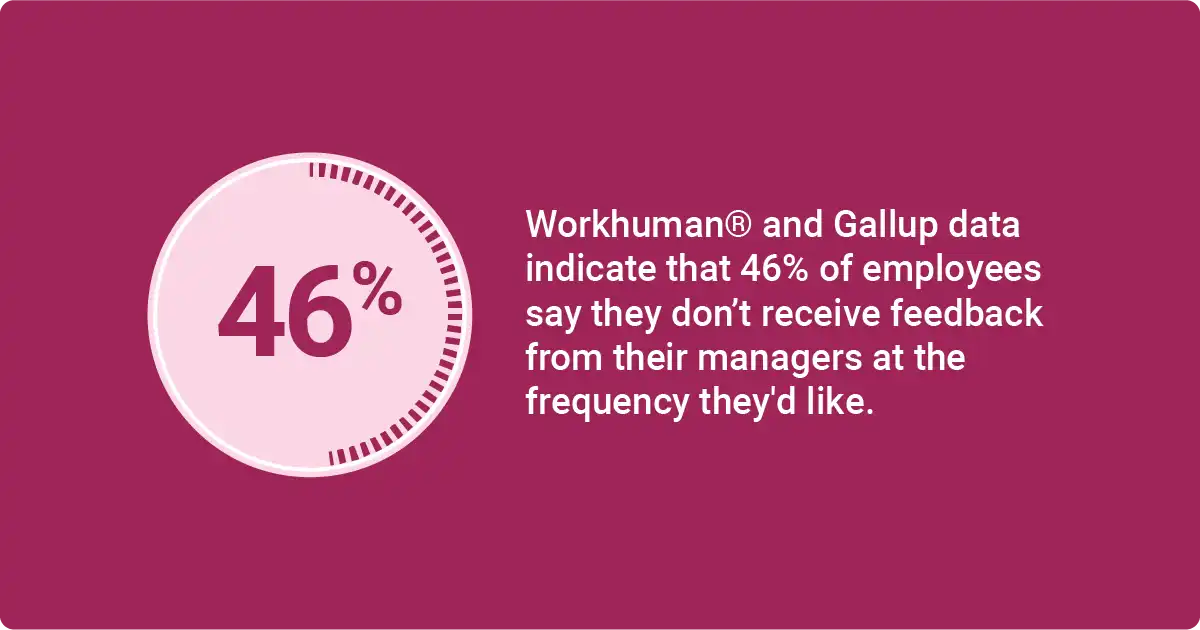
Feedback you deliver close to the behavior is more useful for the employee and easier for them to receive than feedback that comes weeks later. Moreover, Workhuman® and Gallup data indicate that 46% of employees say they don’t receive feedback from their managers at the frequency they'd like.
SBI feedback examples for real workplace scenarios
Understanding how SBI works in the workplace can help you build a strong feedback culture that creates an engaged, high-performing team. Consider scenarios where you can apply this model effectively.
Example 1: Recognizing strong performance — positive feedback scenario
When a team member performs well, vague feedback would be something such as “Great job on the Henderson pitch.” While this compliment may be well-intentioned, it omits concrete details that the employee can apply to future work. A 2023 Textio report titled “Language Bias in Performance Feedback” shows that employees who receive low-quality, inactionable feedback are 63% more likely to leave their organization within a year.
SBI feedback for the same scenario would be more specific: “In Tuesday’s client pitch for the Henderson account [Situation], you anticipated their concern about the implementation timeline and addressed it before they raised it. You walked them through the phased rollout unprompted [Behavior]. The client came back within 24 hours to move forward, and the account lead told me it was the proactive approach that sealed it [Impact].”
These SBI leadership feedback examples tell the recipient exactly what to repeat in future pitches, while specifying what action made the difference. When people understand what excellent performance looks like in their specific context, they are more likely to repeat those behaviors and apply them in future situations.
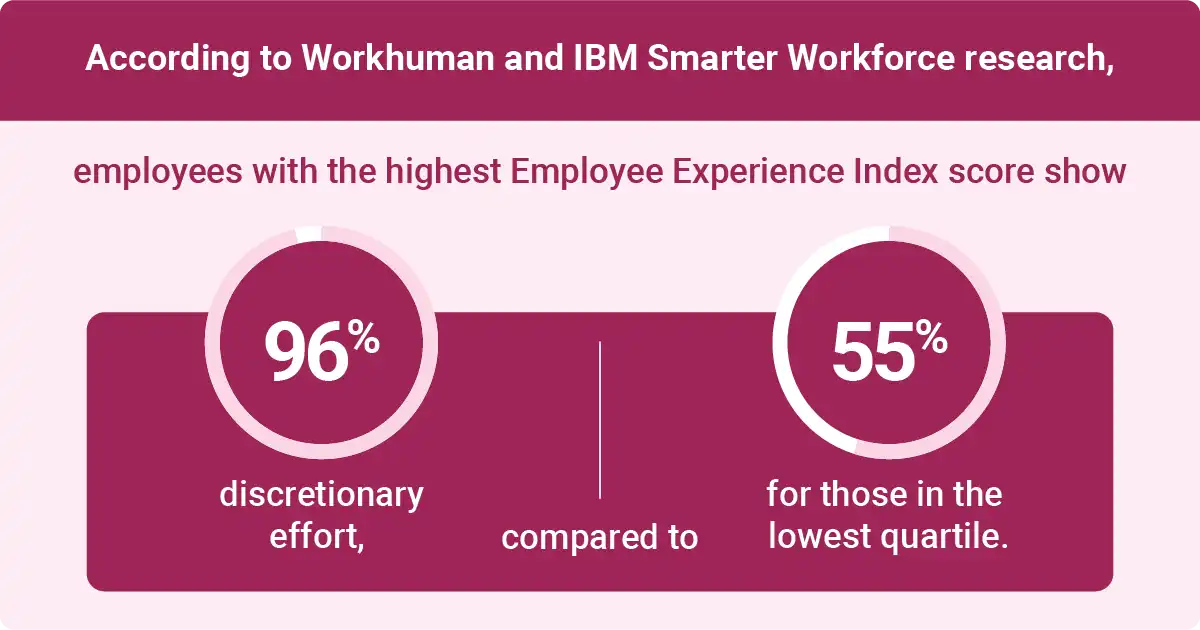
According to Workhuman and IBM Smarter Workforce research, employees with the highest Employee Experience Index score show 96% discretionary effort, compared to 55% for those in the lowest quartile. Frequent peer feedback and check-ins surface high performers more accurately than annual reviews can. SBI recognition is a practical framework to make an ongoing stream of feedback specific enough to be meaningful.
Workhuman’s Social Recognition® platform extends SBI with peer-to-peer recognition where team members can structure award messages around Situation, Behavior, and Impact. Integration with Microsoft Teams, Slack, Outlook, and Workday means recognition reaches people wherever they’re working, close to the moment the behavior occurred.
Example 2: Addressing a performance issue — constructive criticism
Vague feedback to address a performance issue might be along the lines of “You’ve been careless with client communication lately.”
With SBI, you can give more specific and actionable feedback: “In the follow-up email to Morales & Associates on Thursday [Situation], you referenced the January agreement instead of the March amendment [Behavior]. The client asked for clarification, and we had to spend extra time correcting the record before the call, putting the renewal at risk [Impact]. Can you walk me through what happened on your end?”
The SBI approach reduces defensiveness and opens the floor for the recipient’s perspective before you can draw conclusions. The invitation to respond will help you find out whether the behavior reflected a skill gap, information gap, or something else.
Example 3: Providing upward feedback to a manager
Giving feedback upward is uncomfortable for most people. According to “The Strengths, Weaknesses and Blind Spots of ManagersOpens in a new tab”, a 2024 report from Gallup, less than half of U.S. employees (42%) reported having the opportunity to formally provide feedback to their manager, and only 24% provided it.
You can use SBI to make upward feedback easier and keep the message factual and forward-looking. Instead of raising a complaint, you’ll describe a specific moment and its effect, which is harder to dismiss.
For example: “In our team standup on Wednesday [Situation], you shared the updated Q3 targets for the first time while three team members were out [Behavior]. Several of us felt caught off guard and weren’t sure how to prepare for client conversations that afternoon [Impact]. Would it be possible to share major target updates by email a day ahead of meetings when we know the attendance will be limited?”
Example 4: Offering peer-to-peer feedback
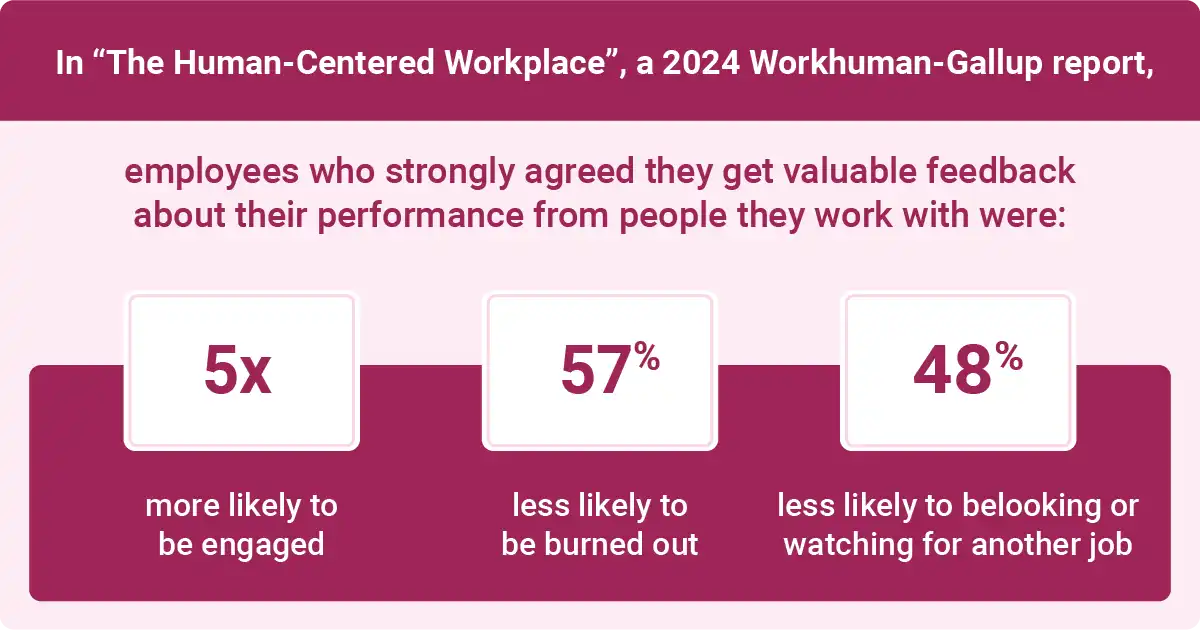
Peer feedback is often the most overlooked direction in a feedback culture, yet it carries significant weight when done well. In “The Human-Centered Workplace”, a 2024 Workhuman-Gallup report, employees who strongly agreed they get valuable feedback about their performance from people they work with were:
- 5x more likely to be engaged
- 57% less likely to be burned out
- 48% less likely to be looking or watching for another job
SBI gives peer feedback the specificity it needs to be valuable: “During yesterday’s design review [Situation], you flagged the accessibility gap in the mobile navigation before anyone else caught it [Behavior]. That saved us from a significant rework cycle, and shifted the room’s attention to a problem we’d been circling around [Impact]. That kind of an analytical eye is exactly what makes these reviews useful.”
How to receive SBI feedback
While offering SBI feedback is a skill that takes practice, receiving it well can be as challenging. If someone is offering you structured feedback, the best approach is to:
- Listen to the full message before reacting or becoming defensive.
- Ask clarifying questions about the situation or behavior the feedback provider is describing.
- Separate the impact of the statement from your own intent. You should recognize that your intentions do not erase the experience another person had.
- Treat the SBI feedback conversation as a collaborative discussion about intent versus impact, where both perspectives can be valid.
- Respond constructively and with emotional intelligence by acknowledging the feedback and reflecting on it so you can objectively discuss possible next steps.
- Explain your perspective calmly if you disagree with the impact the feedback giver describes while still recognizing the other person’s experience.
Common mistakes to avoid with the SBI feedback model
Although offering feedback based on the SBI framework is generally straightforward, certain missteps may limit its effectiveness. If you’re looking to improve your organization’s feedback culture, watch out for these common SBI mistakes.
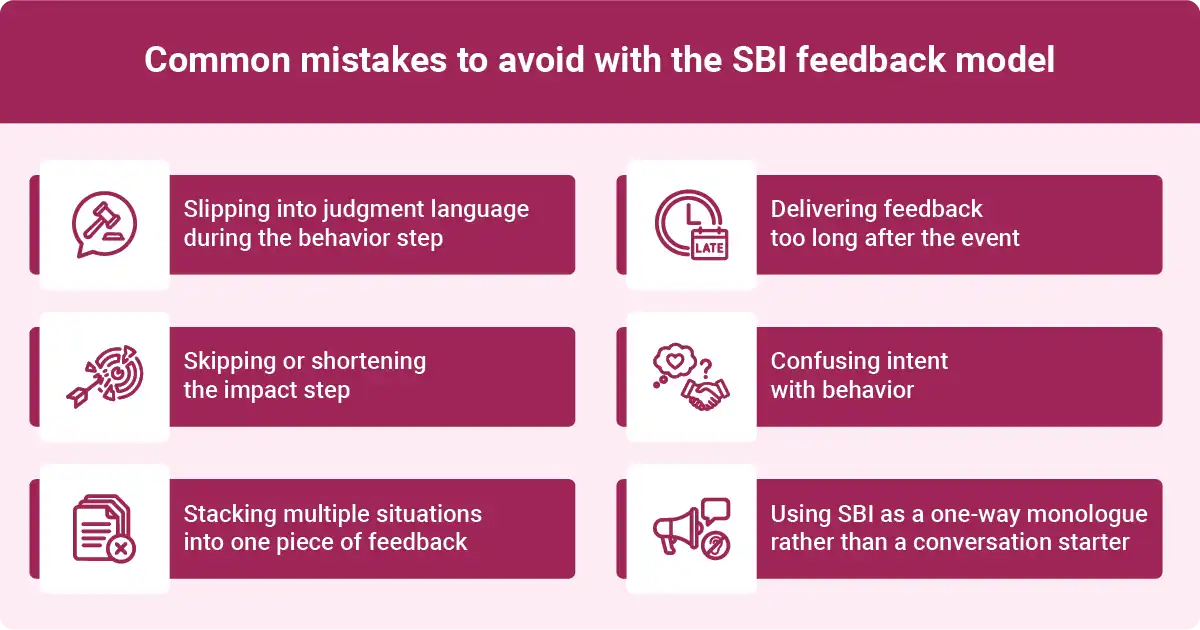
Slipping into judgment language during the behavior step
It’s easy to contaminate the entire SBI feedback in the Behavior step using words such as “rude,” “unprofessional,” “careless,” or “difficult,” which feel like descriptions but are actually interpretations. A useful test is to ask yourself whether a camera could have recorded the behavior you’re describing.
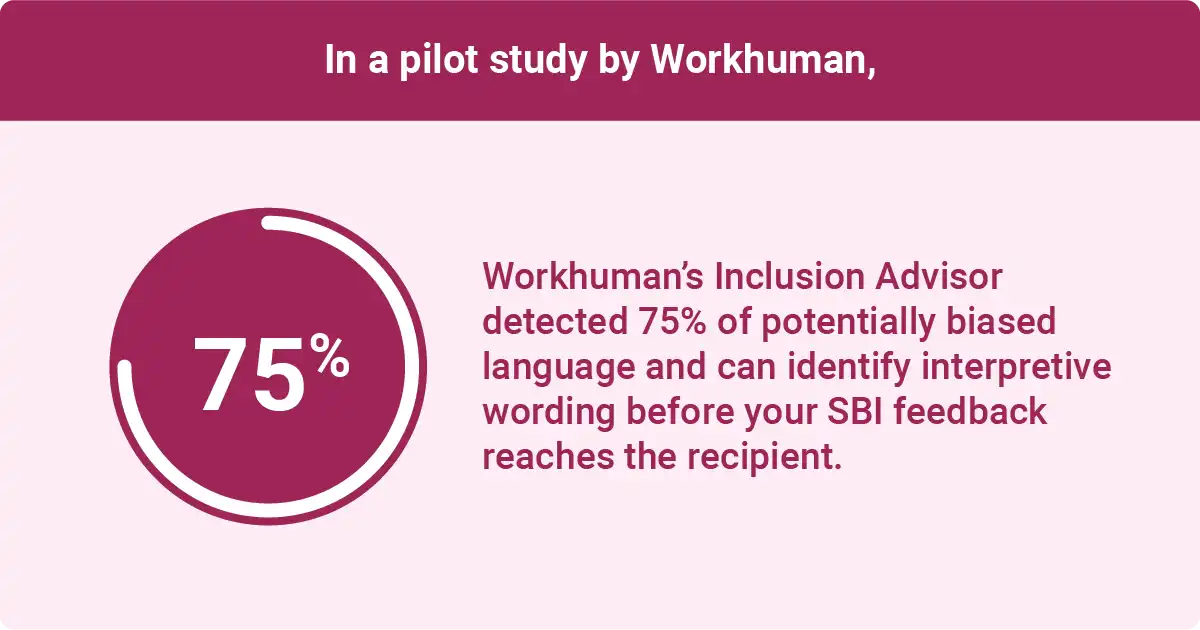
Workhuman’s Inclusion Advisor can help identify words or phrases in your feedback that may be perceived as biased and provide real-time coaching to revise written feedback. In a pilot study by Workhuman, the tool detected 75% of potentially biased language and can catch interpretive wording before your SBI feedback reaches the recipient.
Skipping or shortening the impact step
Without describing the Impact, your feedback will feel like a report instead of a conversation. The Impact step gives the recipient a reason to care because it connects the behavior to an actual consequence.
Stacking multiple situations into one piece of feedback
Trying to address several incidents at once can overwhelm the recipient and dilute your message. Instead of helping a team member improve, the feedback could feel like a list of accumulated grievances and trigger defensiveness.
Delivering feedback too long after the event
SBI feedback works best when the situation is still fresh in everyone’s mind. When you wait too long, the details become less accurate and reduce the relevance of the conversation. You’ll make it harder for the recipient to connect the behavior to its impact or apply changes in future situations.
Confusing intent with behavior
It’s common to assume intent instead of focusing on the observable actions. Statements like “You were trying to undermine the meeting” shift the conversation into speculation and defensiveness. Your SBI feedback will work best if you ground it in what actually happened instead of assumptions about the employee's intent.
Using SBI as a one-way monologue rather than a conversation starter
If you deliver SBI feedback without inviting reflection or response, the conversation will feel rigid. After sharing Situation, Behavior, and Impact, create a space for the recipient to explain their perspective and ask questions, so you can discuss the next possible steps.
SBI vs. STAR and other feedback models
Feedback should feel like two adults talking about work. SBI, STAR, and other models provide a structure for constructive feedback conversations. Here's how different feedback frameworks compare.
SBI vs. STAR at a glance
The STAR framework (Situation, Task, Action, Result) is a feedback model that describes past performance, most commonly used in interviews and behavioral assessments. It includes the Task element (what the recipient was trying to accomplish) and evaluates the result from an outcome perspective, which makes it suitable for retrospective storytelling.
SBI, on the other hand, is built for delivering feedback in the flow of work. Its impact element is explicitly relational and connects the behavior to its effect on team members. This comparison table can help you decide which one best suits your needs or particular situation:
Beyond SBI and STAR frameworks, there are other models you can use to build your organization's feedback culture:
- DESC (Describe, Express, Specify, Consequences)Opens in a new tab: This more prescriptive model includes a step for stating what you want to happen differently. It’s useful when the feedback conversation needs to close with a behavioral ask.
- COIN (Context, Observation, Impact, Next steps): It adds a forward-looking step that SBI omits, making it useful for conversations where the feedback needs to end with a concrete action plan.
When to extend SBI to SBI-I
The biggest gap in the original SBI model is intent. Employees generally intend to do the right thing, but sometimes their actions produce unintended negative impacts. SBI describes the impact but doesn’t create space to surface intent.
SBI-I adds a fourth element, Intent. After explaining the impact, you can explicitly invite the recipient to share what they were trying to accomplish. “What were you hoping to achieve in that moment?” or “I’m curious what was driving your approach there” opens the door without sounding accusatory.
A standard SBI conversation might end with, “and I noticed the team went quiet for the rest of the meeting.” An SBI-I continues, “I want to understand what you were going for. Can you walk me through your thinking?” The question will signal that you aren’t assuming the recipient had bad intent, encouraging them to share their perspective.
FAQs
What does SBI stand for in the feedback model?
SBI stands for:
- Situation: You establish the specific context in which the behavior occurred.
- Behavior: Then you describe the observable action in factual terms.
- Impact: Finally, you explain the effect that behavior had on you, your team, project, or organization.
What is the SBI feedback model used for?
The SBI framework is used to structure feedback conversations in a way that’s specific and objective to help the recipient easily act on your feedback. It works for positive reinforcement and constructive criticism, so you can use it for peer feedback, upward feedback, real-time coaching, or situations where behavior-based feedback would be more effective.
Can the SBI feedback model be used for constructive criticism?
Yes, you can use the SBI model of feedback for constructive criticism. Because the Behavior step requires you to use observable language instead of judgmental words, this model keeps constructive feedback conversations grounded in fact rather than character assessments. With this approach, you can reduce defensiveness and make it easier for your recipient to understand what specifically needs to change.
What is the difference between intent and impact in the SBI model?
Intent is what the feedback recipient was trying to accomplish, while impact is the effect of their behavior on others. The two can diverge because a person can mean well but still cause harm or confusion. The standard SBI model focuses on impact but not intent. SBI-I extends the model to invite discussion on intent as well as impact, creating space for a more complete and honest exchange.
What are the main benefits of the Situation-Behavior-Impact model?
The primary benefits of SBI are specificity, objectivity, and reduced defensiveness. With SBI, you give the recipient a clear picture of what happened and why it mattered, which makes your feedback actionable rather than abstract, and drives continuous improvement.
The framework is also simple to apply across hierarchical directions. It’s equally effective for recognizing strong performance and addressing problem behaviors.

Ryan Stoltz
Ryan is a search marketing manager and content strategist at Workhuman where he writes on the next evolution of the workplace. Outside of the workplace, he's a diehard 49ers fan, comedy junkie, and has trouble avoiding sweets on a nightly basis.
Recommended for you