
Effective Employee Performance Coaching: Frameworks, Manager Tactics, and Evidence for HR Leaders
by Ryan Stoltz
Last updated
10 min read
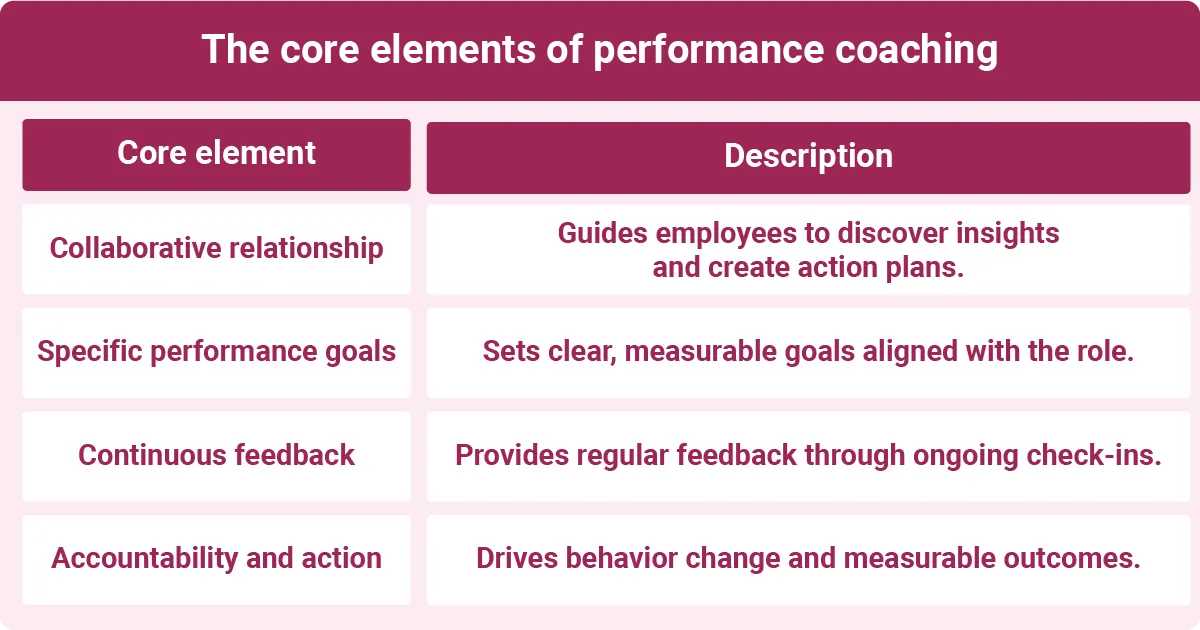
Table of contents
- What is performance coaching?
- Performance coaching vs traditional coaching process
- Core performance coaching frameworks managers should know
- How managers implement performance coaching in team meetings and one-on-ones
- The evidence: How does coaching improve performance and productivity?
- Trends shaping performance coaching in 2026
- FAQs
Share this article
Performance coaching is a standard expectation for managers. Yet only 20% of organizations say their managers are effective coaches, according to a WTW press release: “Organizations can achieve greater productivity and employee engagement with improved performance management, new research finds.Opens in a new tab”
Most managers were promoted for technical expertise, not because they knew how to coach. So they aren't avoiding coaching; they're improvising it. A lack of a structured approach runs the risk of preventing daily performance improvements and measurable outcomes.
As well, rather than meeting employees where they are, many managers still rely on annual performance reviews, which can be far too slow to change behavior in real time.
To help managers coach effectively and get measurable results, this article:
What is performance coaching?
Performance coaching is a structured process that focuses on improving role-specific skills, behaviors, and outcomes on the job. Like a sports coach, the performance coach observes the coachee’s work, identifies opportunities for improvement, and helps them draw out actionable insights from situations.
At its best, high-performance coaching helps employees connect day-to-day behaviors with measurable role outcomes.
Executives and senior managers are the typical recipients of performance coaching. However, any manager can apply the same coaching principles in one-on-one interactions to maximize employees’ contributions to the organization.
External coaches were once common in the workplace, but the manager-as-coach model is increasingly supplementing or replacing them. According to Gallup’s “Don't Overcomplicate the Best Management Practice: Coaching,” organizations spend billions each year to upskill their managers into coaches.
The core elements of performance coaching
A successful performance coaching program has four key components:
- Collaborative relationship: The performance coach asks guiding questions to help the coachee generate their own insights during one-on-one meetings. They also co-create performance goals and action plans.
- Specific, measurable, and role-specific performance goals: Performance coaching goals clearly define what the coachee wants to achieve in their current job position and how progress will be measured.
- Continuous feedback loops instead of one-off sessions: An employee receives feedback throughout the year during regular check-ins, often weekly or monthly.
- Accountability for behavior change and outcome: The manager helps the employee commit to an action plan that’ll change behavior and produce particular results.
How performance coaching differs from consulting, mentoring, training, and therapy
This table distinguishes business performance coaching from consulting, mentoring, training, and therapy.
Why performance coaching matters for modern organizations
Performance coaching can benefit employees and the organization in multiple ways:
- Closes the gap between annual reviews and the pace of real work. Traditional performance evaluations happen once a year, too infrequent to guide day-to-day performance. With coaching, you can move from yearly employee reviews to more regular conversations that improve daily work. Lisa Stedel Smith, manager of leadership and organization development at CAE, describes this as a shift from performance management to performance development to improve employees’ work performance.
- Builds manager capability: Coaching helps managers change focus from fixing problems for employees to empowering them to solve issues independently. Because managers account for up to 70% of employee engagement, according to Gallup’s report “Manager Development: What It Is, Why It Matters and How It Works,” improving their coaching capability can increase engagement in your workplace.
- Turns strategy into measurable behavior change: Coaching helps employees break down big goals into specific daily actions or habits that are easy to implement and track.
- Supports employee retention: According to a McKinsey article, “Reimagining people development to overcome talent challenges,” organizations that prioritize learning and employee development are competitive in attracting and retaining talent. Coaching is one of the best ways to invest in employee development.
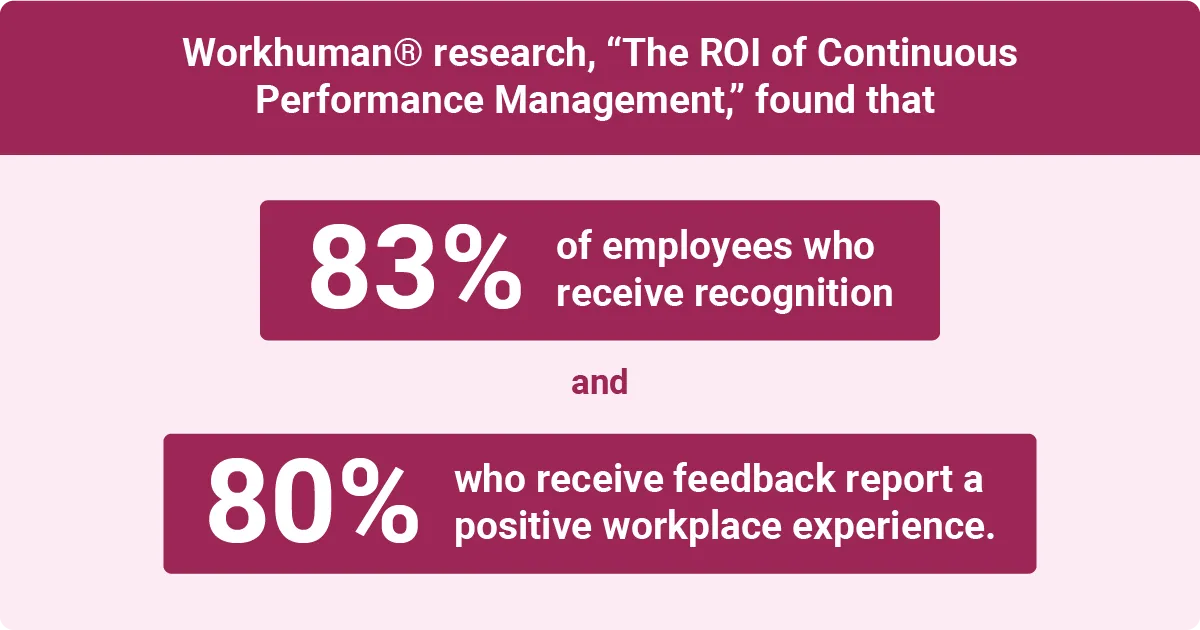
- Creates the feedback infrastructure that hybrid and distributed teams need: Regular one-on-one coaching conversations create a consistent feedback loop that makes employees feel supported and connected, whether they’re working remotely or in the office. Workhuman® research found that 83% of employees who receive recognition and 80% who receive feedback report a positive workplace experience.
Performance coaching vs traditional coaching process
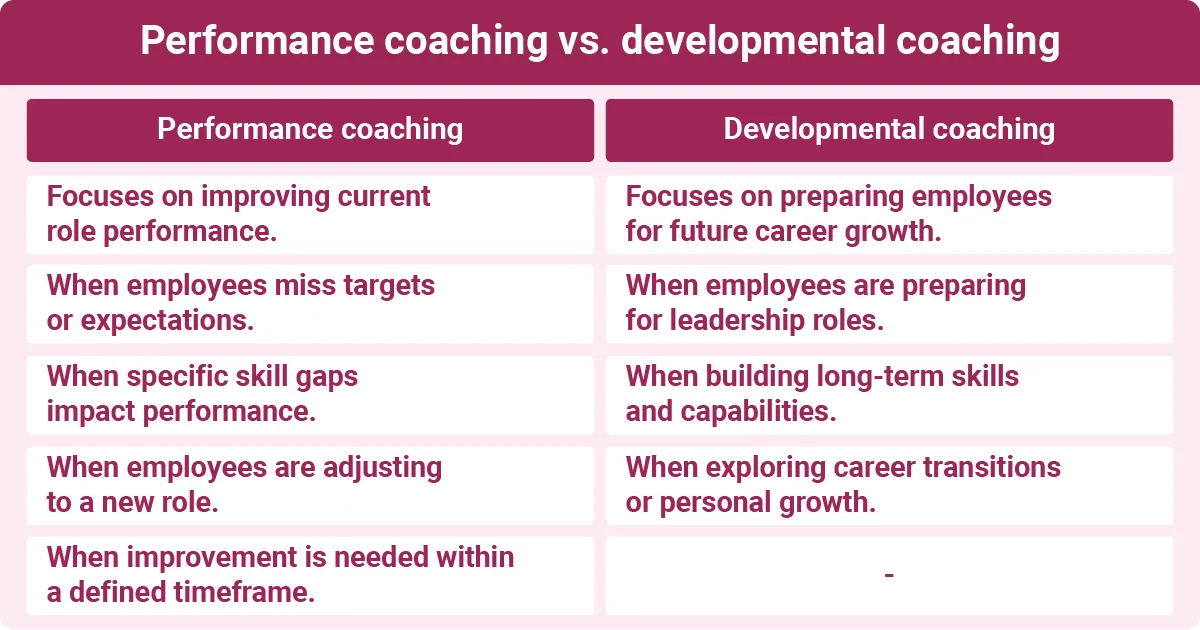
When to use performance coaching vs. developmental coaching
Use performance coaching when:
- An employee is missing targets or expectations.
- A specific skill gap is affecting results.
- Someone is settling into a new role.
- Performance needs to improve within a defined timeframe.
Use developmental coaching when:
- An employee is preparing for leadership responsibilities.
- The goal is to build long-term capabilities.
- The coachee wants to transform their personal identity or transition into a new career path.
Managers can implement both approaches consecutively if needed. Use performance coaching to help employees succeed in their current roles, then transition to developmental coaching to prepare them for future career growth.
Core performance coaching frameworks managers should know
When holding performance conversations, coaching frameworks show you what to focus on from the beginning to the end. Training your managers on how to use them drives business results. Brandon Hall Group research, “Four Essentials of Effective Performance Development,” found that formal coaching training for managers can increase:
- Employee engagement by 47%
- Talent retention by 28%
- Quality hires by 42%
Here are common coaching frameworks for managers.
The GROW model
Developed in the 1980s by Sir John Whitmore, the GROW model is a four-step framework still popular today:
- Goal: Set clear targets. What exactly does the coachee want to achieve and by when? How will they know they’ve reached their goals?
- Reality: Ask about the coachee’s current performance status. The manager can also inquire about the obstacles or limitations the employee is facing.
- Options: Guide employees in identifying potential ways to overcome challenges. Help them brainstorm ideas without prescribing solutions.
- Will: Help the coachee commit to specific next steps and accountability checkpoints. Ask what solutions the employee will choose, when they’ll complete implementing them, and how they’ll track progress.
As cross-functional and distributed teams become more common, performance development is expanding from individual contributions to team outcomes, according to the Brandon Hall Group study. The GROW model works for both individuals and teams.
The FUEL model for manager coaching
A favored model for manager-led coaching, the FUEL framework stands for Frame, Understand, Explore, and Layout:
- Frame the conversation by establishing the purpose of the meeting. What are you going to discuss? To make the coachee an active participant rather than a passive listener, ask what areas they’d like to focus on.
- Understand the employee's current state by asking open-ended questions. This might include inquiring about the challenges they face, the methods they use, and the strategies that are already producing positive results.
- Explore the desired state by helping the employee clarify their performance goals. What does success look like for them, and when would they like to achieve it? Once there is a clear picture of the desired outcome, the business performance coach guides the employee in exploring potential ways to achieve it.
- Lay out a success plan by turning ideas into actions. Ask the coachee to select the most suitable solutions, then help them break down each option into specific actions with clear implementation deadlines and measurable outcomes. Together, establish check-in timelines to maintain accountability and track progress.
Besides FUEL and GROW, other coaching models include CLEAR (Contract, Listen, Explore, Action, and Review), OSKAR (Outcome, Scale, Know-how, Affirm & Action, and Review), and CIGAR (Current reality, Ideal, Gaps, Action, and Review).Opens in a new tab.
Note: Coaching frameworks should guide the structure of a conversation, not act as rigid step-by-step scripts. Tailor them to what employees share in one-on-one meetings.
Key steps in a performance coaching cycle
Here are the core phases of performance coaching:
Modern performance management systems can connect these steps into a continuous cycle. For example, Conversations® by Workhuman connects regular check-ins, goal-setting sessions, feedback meetings, and recognition moments in daily workflows. This promotes a continuous performance management process.
How managers implement performance coaching in team meetings and one-on-ones
During coaching conversations, managers focus on five core behaviors:
- Identifying performance issues and areas for improvement
- Collaborating with employees in setting clear, measurable, realistic performance goals aligned with their daily responsibilities
- Helping employees commit to specific actions, deadlines, and outcomes to promote accountability
- Optimizing employee capabilities by guiding workers to unlock their full potential and access resources that can improve their performance
- Improving efficiency and effectiveness by removing obstacles that limit employee performance
In addition, effective managers establish a regular coaching schedule. For example, they can hold short weekly check-ins, more in-depth monthly one-on-ones, and quarterly goal reviews.
According to Workhuman research, employees who check in daily with their managers are twice as likely to respect them and nearly three times as likely to trust them. During coaching check-ins, follow best practices that make constructive feedback more useful and promote better performance conversations:
- Use open-ended questions to promote a two-way dialogue and evoke comprehensive answers, rather than simple “yes” or “no.”
- Move routine progress updates to email or shared work tools to free up more time for one-on-one coaching.
- Hold career development and goal-setting conversations separately so that each topic receives the attention it deserves rather than being overshadowed by the other.
Examples of coaching questions for managers
After scheduling one-on-ones, prepare a list of questions to guide the meeting. Here are examples of coaching questions for leaders:
- Starting the conversation: What’s the most important thing for us to talk about today?
- Understanding the nature of a situation: What have you tried so far? What did you learn?
- Exploring the situation: What would you do if there were no constraints?
- Closing the meeting with action plans: What will you do by when, and how will we know it worked?
Structuring a coaching-oriented team meeting
Performance coaching isn’t exclusive to one-on-one conversations. Managers can use it during team meetings to create opportunities for reflection, peer feedback, and recognition.
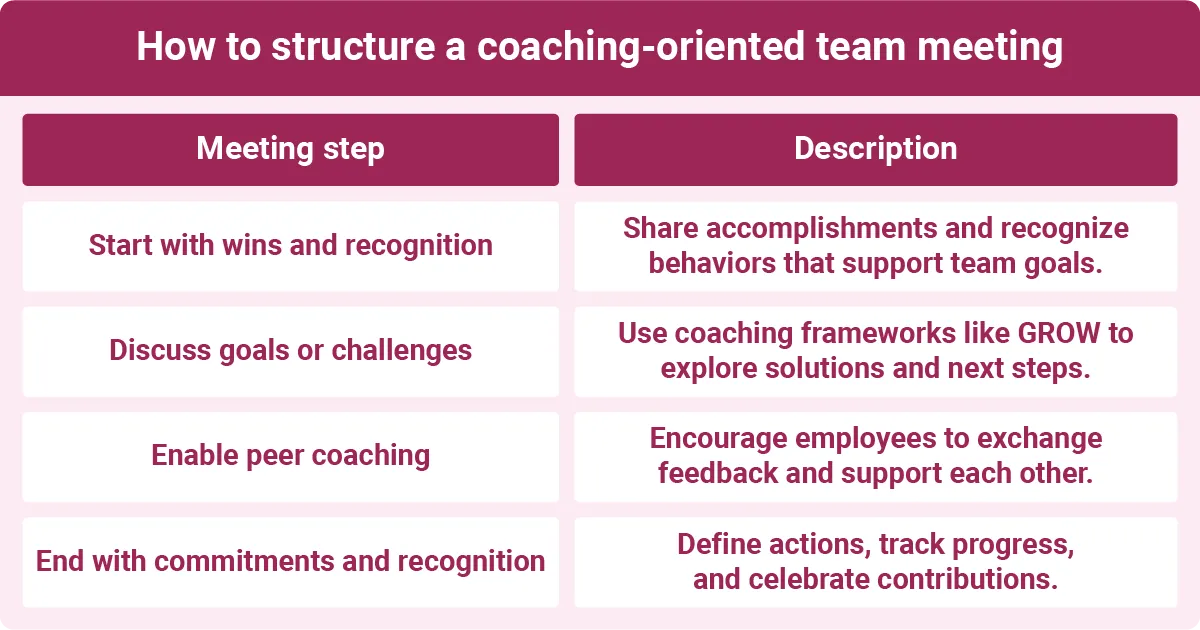
A simple coaching-oriented team meeting might follow this structure:
- Start with five minutes of wins and recognition: Invite team members to share recent accomplishments and recognize colleagues who demonstrated behaviors that contributed to team goals.
- Facilitate a working session around a shared goal or obstacle: Use a framework such as GROW to help the team brainstorm shared challenges, explore solutions, and identify next steps.
- Create peer coaching opportunities: Pair employees for two-to three-minute discussions where they ask questions, share feedback, and help each other work through challenges. Research by Gallup and Workhuman, “The Human-Centered Workplace: Building Organizational Cultures That Thrive,” found that employees who receive valuable feedback from their peers are five times more likely to be engaged. To promote this practice among colleagues, tools such as Workhuman’s Recognition Advisor help with writing specific, in-the-moment recognition messages.
- End with commitments and specific recognition: Have each participant identify actions they will take before the next meeting. Close the conversation by publicly recognizing a team member or group for a specific behavior that supported progress.
When to move a conversation out of the team meeting
Use team meetings for group coaching moments, not for sensitive individual feedback. Reserve corrective or personal coaching for private one-on-ones where individuals feel psychologically safe to admit mistakes and receive feedback.
Move coaching from team meetings to a one-on-one when you want to:
Performance coaching examples: 3 common scenarios
Scenario 1: Coaching a sales rep missing quota using the GROW model
- Opening question: How are you feeling about your current pipeline and progress toward your quota?
- Diagnostic question in Reality stage: You’ve missed quota for the last two months. Where in the sales process are you seeing the most drop-off?
- Next-action question (Options for the way forward): What specific changes can you make this week to improve conversion rates?
Scenario 2: Coaching a newly promoted manager struggling with delegation using the FUEL model
- Opening question: What does effective delegation look like in your new role, and where do you feel stuck?
- Diagnostic question to understand the current state: What’s making delegation difficult for you?
- Next-action question (Layout): What responsibilities can you delegate this week, and how will you define success?
Scenario 3: Coaching a high performer who has plateaued (using stretch goals and recognition)
- Opening question: What part of your role feels too routine or no longer challenging?
- Diagnostic question: What do you think is limiting your growth or motivation right now?
- Next-action question: What stretch opportunity would help you re-engage, and what support would you need to succeed?
The evidence: How does coaching improve performance and productivity?
Evidence from multiple studies shows that coaching boosts productivity. A study in the journal Public Personnel Management titled “Executive Coaching as a Transfer of Training Tool: Effects on Productivity in a Public AgencyOpens in a new tab” found that training alone could increase managers' performance by 22%. But if they combined training with coaching, productivity increased by 88%.
Another study by the International Coaching Federation found that around 80% of people who receive coaching report increased self-confidence, while 70% report improved work performance. While self-reported data should be interpreted carefully, the consistency of findings across meta-analyses is notable.
What the meta-analyses show
Meta-analyses – research that combines results from multiple studies to produce more reliable findings – show positive effects of coaching on individual and organizational outcomes:
- A 2013 meta-analysis, “Does coaching work? A meta-analysis on the effects of coaching on individual level outcomes in an organizational context,” found that coaching improves employees’ wellbeing, coping ability, work attitudes, and goal-focused behavior. Collectively, these factors can boost productivity by improving how effectively employees execute their work.
- A 2014 study, “The influence of coaching on employee performance: Results from two international quantitative studies,” examining performance differences among sales employees (controlling for tenure and experience), found that coaching explained 2.9% to 6.2% of the performance variance. While relatively small, such measurable productivity gains become significant when scaled across large teams.
- A 2015 meta-analysis, “The effectiveness of workplace coaching: A meta-analysis of learning and performance outcomes from coaching,” found that coaching has a moderate positive impact on organizational outcomes, with even stronger effects at the individual performance level, showing direct improvements in employee output and effectiveness.
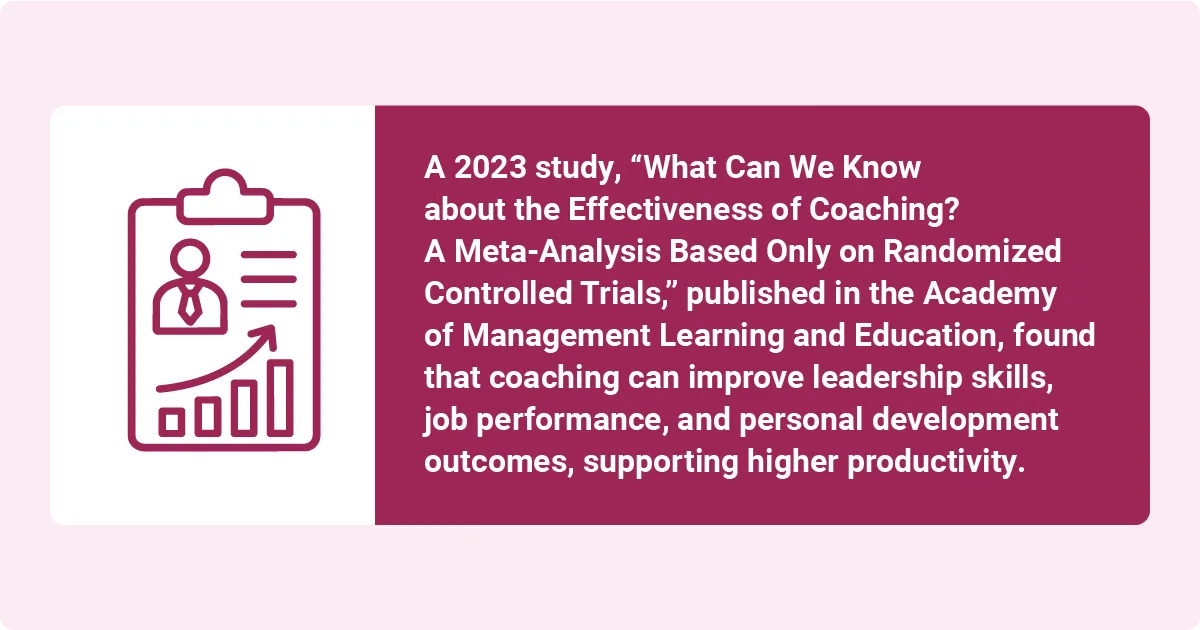
- A 2023 study, “What Can We Know about the Effectiveness of Coaching? A Meta-Analysis Based Only on Randomized Controlled Trials,” showed that coaching can enhance leadership skills, job performance, and personal development outcomes, all of which can improve productivity.
Where the evidence is thinner
Despite strong overall findings, there are still gaps in the research:
Trends shaping performance coaching in 2026
Performance coaching is no longer limited to senior leaders. Companies are extending it across all levels, including mid-level managers, frontline employees, and high-potential individual contributors. As coaching targets more employees, organizations are increasingly relying on managers to serve as performance coaches.
A successful coaching program also gives managers the structure, data, and support they need to coach consistently across teams.
Managers are also expanding performance coaching to cover wellness factors, such as workload and resilience, when necessary. That’s because employee wellness is closely linked to performance, according to Wellbeing at Work’s article “The Link Between Wellbeing and Performance Is Getting Harder to Ignore”.
Additionally, continuous feedback and micro-coaching – brief, frequent coaching sessions and check-ins – are replacing annual employee reviews as the primary means of improving performance. Rather than saving feedback for an annual evaluation, which is too infrequent, managers address behaviors and challenges when they occur. This approach makes coaching timely and effective.
Coaching is also becoming more growth-oriented and appreciation-driven to meet employee expectations and prevent micromanagement. Workhuman’s survey shows that employees want more appreciation (31%) and independence (15%). They also want managers to focus more on career growth (19%), learning and development (14%), and frequent one-on-ones (8%).
AI-augmented coaching
AI tools are helping managers to prepare for coaching sessions and summarize conversations.
For example, AI-powered Workhuman iQ and Human Intelligence™ can analyze recognition data to reveal top skills, hidden performers, and engagement patterns that managers can use to prioritize coaching. These AI tools can also identify patterns across coaching conversations and personalize recommendations. Plus, managers can generate reports on demand.
However, AI should serve as a supportive tool in performance coaching, not a replacement for human judgment. AI can make mistakes and doesn’t always have human-level contextual awareness.
Recognition as a coaching mechanism
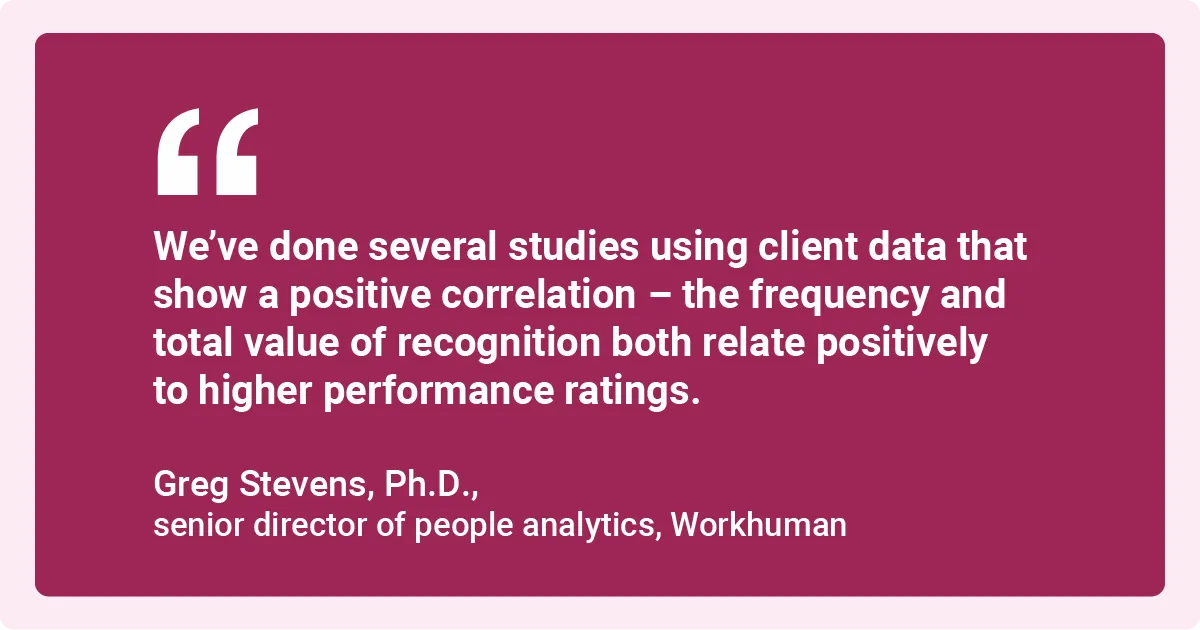
Recognition, at its core, is a coaching tool because it reinforces the specific behaviors managers want to promote. It also highlights employee strengths that managers can help people build over time.
Recognition tends to be most effective when it’s frequent – every one or two months – rather than a yearly practice. Experts agree:
Jesse Harriot, the executive director of the Workhuman iQ team, says that spreading awards over the whole year has more impact than recognizing employees only during annual performance evaluations.
Frequent recognition improves engagement and belonging. It also makes it easy for employees to see how their work contributes to the organization’s overall performance.
Interested in using recognition as a strategic coaching tool? Request a demo to see how Workhuman can help.
FAQs
What is performance coaching?
Performance coaching is a structured process that helps employees improve role-specific skills, behaviors, and outcomes.
What is a performance coach?
In the workplace, a performance coach helps employees develop skills and achieve specific work goals through structured conversations, feedback, and accountability.
How is performance coaching different from traditional coaching?
Performance coaching focuses on improving role-specific outcomes, while traditional or developmental coaching focuses on personal growth and career advancement.
What is the GROW model in performance coaching?
The GROW model guides performance coaching conversations through four stages: Goal, Reality, Options, and Will. Managers use this framework to help employees assess performance issues and develop actionable solutions.
Does performance coaching actually improve productivity?
Yes, by helping employees sharpen role-specific skills, overcome obstacles, commit to an improvement plan, and get performance feedback, performance coaching can optimize their output and improve productivity.
How can managers do performance coaching inside regular team meetings?
To performance coach in regular team meetings, managers can open the conversation with peer recognition, then pair team members to identify common obstacles and actionable solutions. Finally, ask each member to identify actions they’ll take to implement the solutions before the next meeting.

Ryan Stoltz
Ryan is a search marketing manager and content strategist at Workhuman where he writes on the next evolution of the workplace. Outside of the workplace, he's a diehard 49ers fan, comedy junkie, and has trouble avoiding sweets on a nightly basis.
Recommended for you