
Employee Performance Metrics: How to Measure What Matters in 2026
by Ryan Stoltz
Last updated
14 min read
Table of contents
- What employee performance metrics are and why they matter
- 10 categories of employee performance metrics (with examples)
- Frameworks that structure performance metrics: OKRs, KPIs, SMART, MBO, and 360-Degree Feedback
- How to create effective employee performance metrics
- The future of performance metrics: 2026 trends reshaping measurement
- FAQs
Share this article
Telling someone how they're doing at work can feel subjective, especially if you're relying on your own observations. Employee performance metrics might seem like an obvious way to make feedback fairer and less personal. After all, numbers can seem like cold, hard data.
But not all data is equally helpful. Many HR leaders and executives track dozens of metrics that don't actually tell them much about performance. For example, an employee may look impressive if they finish projects faster than their colleagues. However, they might be focusing on easy, low-value tasks that don't contribute much to the organization.
Real value is about clarity, not the quantity of data. This guide offers practical advice for choosing performance management metrics that provide meaningful insight into performance and support development. You'll also learn which frameworks matter, how to design measures that encourage the right behaviors, and which approaches are shaping performance management today.
What employee performance metrics are and why they matter
Employee performance metrics are measurable indicators used to evaluate an employee's productivity, efficiency, and quality of work. They can also reveal how much each team member contributes to the organization's overall goals.
Meaningful employee performance metrics go beyond tracking what people do all day. They cover behavior, output, outcomes, and growth. These factors let you see the big picture of each employee's contributions, not just how many emails someone sends in a day.
The most effective measurement approaches combine quantitative metrics with qualitative data related to company goals. Numbers help leaders evaluate how much work an employee completes and whether they meet specific targets. Qualitative data assesses behavior and more subjective areas of performance, such as collaboration.
These metrics help leaders evaluate their employees fairly and support their professional development. For example, if you notice that a salesperson makes hundreds of cold calls but rarely closes deals, the data can signal a need for a closer look. That kind of insight can help leaders identify opportunities for additional training, coaching, or other resources.
HR leaders can also use performance metrics to connect individual goals to organizational strategy. If your business wants to improve the customer experience, for example, you might track satisfaction rates for your support team.
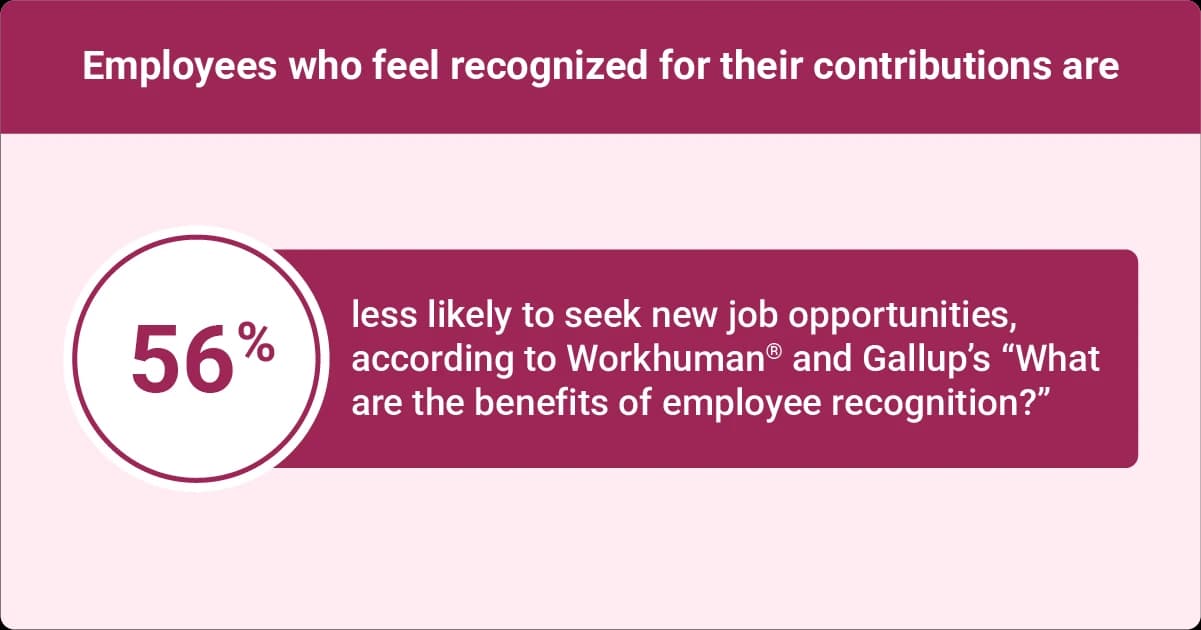
The same performance metrics can also give leaders greater visibility into employees' contributions, creating opportunities to recognize strong performance. When employees feel recognized for their contributions, they're 56% less likely to look for other job opportunities, according to “What Are the Benefits of Employee Recognition?” from Workhuman® and Gallup.
How performance metrics connect to organizational goals
Employees don't perform in isolation. Their individual progress should contribute to the organization's broader goals.
A cascading approach to measuring employee performance starts by defining the company strategy, then linking it to team goals and individual metrics. This creates a clear line of sight, so employees can see how their day-to-day work helps the organization achieve larger priorities.
Suppose a fashion company wants to become a leader in sustainability within three years. The organizational performance metrics might aim to reduce waste by making its supply chains more efficient. At the department level, its product development team could create eco-friendly packaging. Leaders could also track how effectively individual designers use sustainable materials in new products.
Of course, balance is key. Use counterbalancing metrics to make sure employees don't fixate on a single metric at the expense of others. For instance, if you only track response times for customer calls, employees might rush conversations or even hang up on people. If you also monitor customer satisfaction, employees will prioritize both efficiency and quality.
Leading vs. lagging indicators
As you choose which performance metrics to track, include both lagging and leading indicators.
To understand how employees performed in the past, track lagging indicators, such as:
- Amount of revenue earned by sales representatives
- Number of tickets resolved
- Number of products shipped
By contrast, leading indicators focus on predicting future performance or outcomes. For instance, a new hire who completes training during the first three months may be more likely to meet their sales goals in year one. Other examples of leading indicators include pipeline activity and recognition given.
A balanced set of metrics includes both types of indicators. That way, you can recognize employees for their recent accomplishments while looking ahead to where they may develop or need support.
Benefits of tracking employee performance metrics
Here are a few reasons why organizations track employee metrics:
- Identify performance issues earlier: Sometimes, employees need extra support to achieve their goals. By tracking your team's performance, you can spot problems early and provide additional training or resources.
- Improve productivity and accountability: When employees understand how they're being assessed, they can channel their energy into the areas that actually matter.
- Reveal training and development needs: Most HR leaders don't have unlimited resources. With performance metrics, you can look for skills gaps and spend your budget on the areas where employees need the most help. You may also spot promising employees who might move into leadership roles with the right training.
- Increase retention: Even the most attentive leaders can accidentally overlook a team member's contributions. Tracking performance helps you recognize everyone's accomplishments fairly.
- Help prevent burnout: Setting balanced, realistic goals gives employees something to work toward without pushing themselves too hard.
- Build a culture of appreciation: It's much easier to recognize employees when you can see exactly what they've achieved. For example, if your organization prioritizes quality, you might give a shout-out to someone who decreased errors by 20% this quarter.
10 categories of employee performance metrics (with examples)
There's no single recommended set of metrics to track employee performance. The best set for your purposes depends on the roles, your organization's goals, and the behaviors you want to encourage.
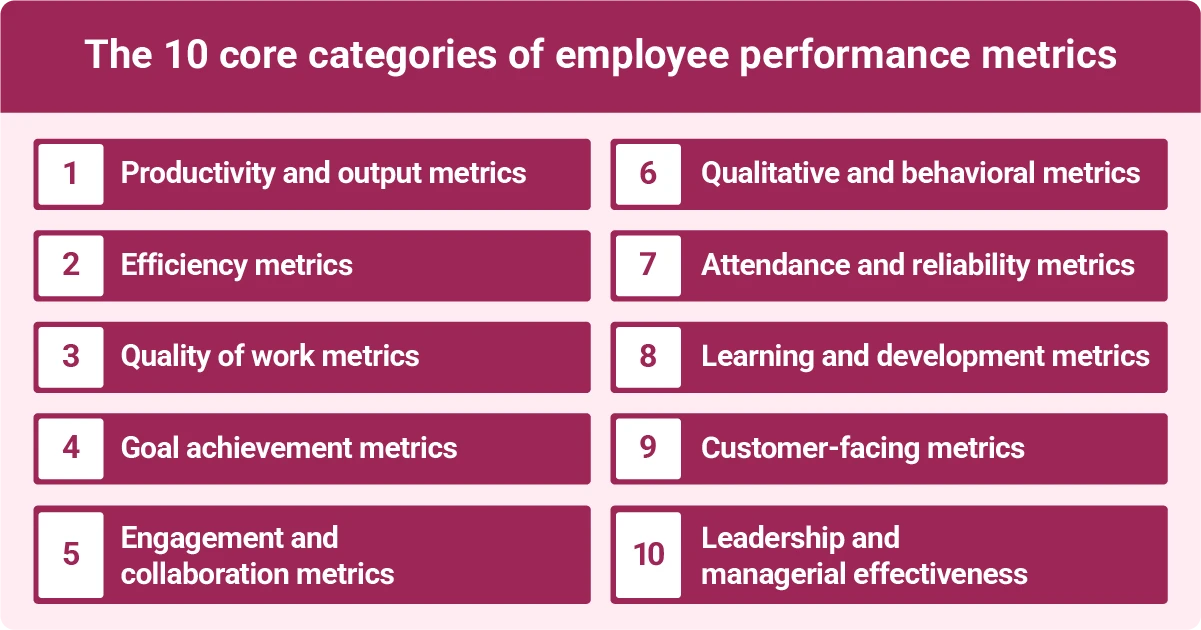
Here are 10 categories of employee performance metrics, with examples of how they can offer useful insights.
1. Productivity and output metrics
These indicators help you understand what each employee produces. For instance, you might track how many tasks they complete each month or how much revenue they generate. If they work with products directly, you could monitor the number of units they produce.
Workplace software often has built-in tools for tracking productivity data. Use project management tools like Asana or Jira to track task completion. Likewise, human resources information systems (HRIS) or enterprise resource planning (ERP) systems can help you calculate revenue per employee.
2. Efficiency metrics
Efficient performers make the best of their time and resources. To monitor how effectively each employee gets work done, track these key efficiency metrics:
- Cost per output
- Resource utilization
- Time-to-completion
- Turnaround time
This data can also help you spot waste, such as a confusing approval process that slows down turnaround time.
Monitor these metrics with time-tracking software like Toggl or a project management platform.
3. Quality of work metrics
Speed isn't everything. Quality metrics can help you evaluate how accurately employees complete their work. Common examples include:
- Accuracy
- Defect rate
- Error rate
- Rework rate
Quality assurance systems may automatically gather this data. You can also use code review tools and defect tracking in Jira.
4. Goal achievement metrics
Progress isn't always visible, especially when an employee first starts working toward a new goal. Make sure they're on the right track by monitoring OKR attainment and KPI hit rate. You could also look at management by objectives (MBO) completion, which assesses progress toward goals an employee sets with their manager.
5. Engagement and collaboration metrics
Engagement indicators can help you understand how connected and involved employees feel at work.
Workhuman's Social Recognition® software can track how often people give and receive peer-to-peer feedback. This gives you a tangible way to measure recognition activity across your organization, a signal of engagement.
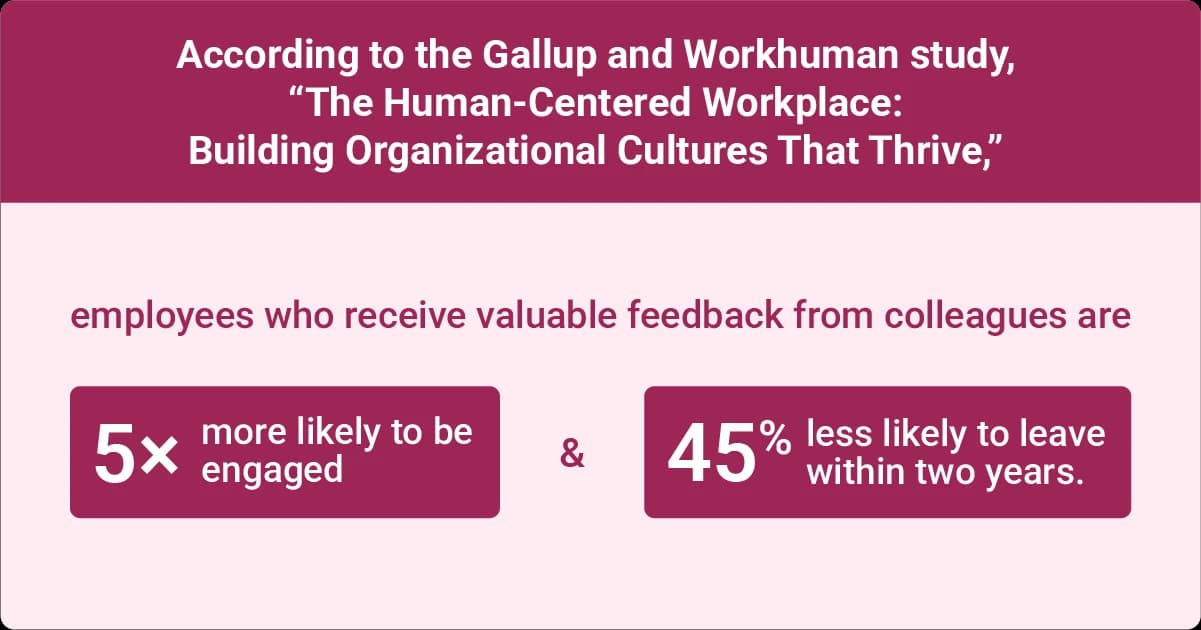
Even small gestures of appreciation can have a meaningful impact on workplace culture. According to a Gallup and Workhuman study titled “The Human-Centered Workplace: Building Organizational Cultures That ThriveOpens in a new tab,” employees who agree that they get valuable feedback from their colleagues are five times more likely to be engaged and 45% less likely to leave within two years.
Engagement survey tools are another simple way to gather data. Use them to track the employee net promoter score (eNPS) and ask staff to rate their engagement. This data can help you spot changes in morale early.
6. Qualitative and behavioral metrics
While quantitative metrics can measure tangible outputs like speed and productivity, they can't capture soft skills and behavior. To assess areas like collaboration and leadership, you'll need to gather qualitative data.
Many companies use 360-degree feedback tools to collect anonymous input on each employee's behaviors and impact. These platforms allow managers, peers, direct reports, and the employees themselves to provide feedback.
Other useful tools include manager evaluations and peer reviews. For example, you could ask managers to evaluate their team's initiative and teamwork. You may not be able to quantify how much an employee supports their peers, but a manager can observe and evaluate it.
7. Attendance and reliability metrics
How often employees show up can affect their productivity and engagement. Use an HRIS system or time clock software to track attendance, punctuality, and schedule adherence.
Watch for patterns that may suggest that someone needs extra support. If a normally punctual employee starts clocking in 45 minutes late, schedule a one-to-one meeting to check in. On the other hand, a sudden increase in absenteeism across a department could signal a larger cultural issue.
8. Learning and development metrics
Employees often keep adding new skills to their toolkits throughout their careers. Track their progress with these metrics:
- Certifications earned
- Internal mobility readiness
- Skills growth
- Training completion rates
Learning management systems (LMS) often track skills growth and training progress. Many HRIS also include skills tracking tools.
9. Customer-facing metrics
You can't watch over your employees' shoulders every time they interact with customers, but the right employee performance metrics help you keep an eye on their performance.
Customer satisfaction score (CSAT) reveals how people feel about the service they receive. To calculate it, divide the number of positive ratings by the total number of responses. If a support representative has a high CSAT, that's a green flag that they're helping customers effectively.
Net promoter score (NPS) is another critical metric for assessing customer-facing performance. Ask customers to rate how likely they are to recommend your company after interacting with your employees. Then subtract the percentage of detractors from the percentage of promoters.
Other meaningful metrics include resolution time and retention. For example, if an employee has a slow resolution time, extra training may help them work more efficiently.
10. Leadership and managerial effectiveness
The impact of leaders and managers tends to ripple across organizations. To see the full picture of their performance, consider metrics from several categories, such as:
- Coaching cadence
- Engagement among direct reports
- Recognition frequency
- Team retention
Quantitative vs. qualitative metrics
Resist the urge to track dozens of metrics at a time. That may seem productive, but too much data often leads to information overload. Instead, pick a handful of metrics connected to your goals.
Use hard numbers when you want to measure clear outcomes. Metrics like sales revenue and the number of tickets resolved are easy to track with software.
On the other hand, behavioral or qualitative assessments work best for less tangible aspects of performance. For instance, you can't necessarily count how effectively someone communicates or leads a project, but that doesn't mean you can't evaluate these areas consistently. Use 360-degree feedback to get a fuller picture of your team's performance. That way, you're not relying on a single person's judgment.
You should also avoid over-quantifying knowledge work. Employees will feel more confident exercising their creativity and experimenting if they know they're not being judged only by the numbers. Plus, it's often difficult to determine the value of work like problem-solving strictly numerically.
Role-specific metric examples
A software developer and an accountant have very different responsibilities, so you shouldn't try to measure their performance the same way. Instead, adapt metrics to each role.
Here's what that looks like in action:
Using the wrong metric can give you a false picture of an employee's performance. For example, code quality is an essential metric for a software engineer. On the other hand, if you focus on customer retention rate, you might assume that they're performing poorly, even if your support team has a bigger influence on this metric.
How to structure performance evaluation: Assessment models
Ideally, you'll take regular snapshots of your team's performance throughout the year instead of relying only on annual reviews. Using simple assessment models will make it easier to evaluate performance data consistently over time.
A 9-box grid plots performance versus potential. Use this employee performance matrix to make decisions about development and succession.
For example, a worker who ranks high on potential but low on performance may benefit from more mentorship. Meanwhile, a strong performer with moderate potential may benefit from targeted development opportunities to prepare for a future leadership role.
Another assessment model is forced ranking, which comes with some limitations. It compares and ranks employees against their peers, often using a bell-curve distribution. Employees are then placed into predetermined performance categories based on their relative ranking, with, for example, the highest-ranked group categorized as top performers and the lowest-ranked group considered underachievers.
Sometimes, it's helpful to go straight to the source: the employees themselves. Send out periodic surveys asking your team to assess their own performance against specific criteria, such as time management and quality of work. These assessments are distinct from 360-degree feedback and can help managers understand their employees' perspectives before a review.
Of course, you don't need to limit yourself to a single model. Organizations often blend several qualitative assessments with quantitative data. That might involve asking managers and employees to complete evaluations and comparing the results with hard numbers. Combining a few data sources makes the performance review process more complete and balanced.
Common shorthand groupings: The 4 metrics, 5 KPIs, and 5 Cs of performance
There are a few ways to group performance metrics, depending on your priorities and your team's responsibilities.
One simple approach is to focus on four core areas: quality, quantity, efficiency, and effectiveness. These dimensions overlap with some of the 10 categories listed above:
Another option is to track KPIs across five common areas:
- Attendance and reliability
- Engagement
- Goal achievement
- Quality of work
- Productivity
KPIs in these areas are relatively easy to quantify with accessible tools, such as clock-in-and-clock-out apps and engagement surveys.
When you're ready to branch out into qualitative data, one framework you could use is the five C’s of performance:
- Character: Peer feedback and manager evaluations
- Collaboration: Recognition data about how employees collaborate and support others
- Commitment: Goal completion and demonstrated initiative
- Communication: 360-degree feedback can provide insight into communication skills
- Competence: Skills assessments and quality of work
Want to begin tracking performance tomorrow? Start by looking at the data your organization already collects and identify the metrics that align with your goals and employees' roles. Depending on what you want to understand, examples at the individual, team, or organizational level might include:
- CSAT
- eNPS
- Error rate
- Goal attainment rate
- Revenue per employee
You may already have access to much of this data through your CRM or HRIS system.
Frameworks that structure performance metrics: OKRs, KPIs, SMART, MBO, and 360-Degree Feedback
Creating a patchwork of metrics can make employee assessments feel arbitrary. Instead, consider using an established framework to help you decide what to measure and manage performance more consistently.
Many businesses use KPIs to measure employee contributions to the organization's larger goals. A good KPI is easy to measure and actionable, so workers can see how to improve. Choose KPIs related to the most critical parts of each employee's role, such as customer retention for an account manager.
OKRs involve setting ambitious goals for an entire organization or team and tracking the results. OKR examples in HR might involve improving retention or increasing employee satisfaction. Review progress toward OKRs regularly and adjust them if they're too simple or unrealistic.
You should also encourage employees to set individual SMART goals, which are:
- Specific
- Measurable
- Achievable
- Relevant
- Time-bound
A software developer, for instance, may aim to reduce their error rate by 20% this quarter.
Another option is 360-degree feedback, which gathers comments from everyone in an employee's work circle. That could include supervisors, direct reports, peers, and even clients. It measures qualitative aspects of performance, such as communication and teamwork. However, feedback can be subjective or biased, and low response rates to surveys can limit its usefulness.
If you want a simple indicator of employee engagement, sentiment, and advocacy, consider using eNPS as a standalone instrument.
Combining several frameworks can help you evaluate performance from different perspectives. For quick feedback sessions, pick the framework that fits your goals most closely.
SMART goal examples for performance metrics
Here are a few examples of SMART goals for work:
- A sales representative aims to close 50 deals this year.
- A customer support representative sets a goal to reduce their response time by 10% in October.
- An engineer aims to complete two certifications this quarter.
Avoid setting SMART goals that aren't achievable within your timeline or that are difficult to measure clearly.
Choosing between OKRs, KPIs, and MBOs
Use KPIs to track your business's ongoing operational health against important targets. OKRs come in handy when you want to set a stretch goal and get specific results over a defined period. For traditional goal alignment between managers and employees, consider MBOs.
Businesses may blend all three, using MBOs and KPIs for individual goals and OKRs and KPIs for broader organizational objectives.
How to create effective employee performance metrics
Reviewing all the possible metrics you can track may feel intimidating, but you don't need to cover everything. Follow these steps:
- Start by defining your business strategy and team objectives. These might not line up with your available data, so don't get hung up on the current sources.
- Define what "good" performance looks like for each role and pick corresponding metrics.
- Use SMART criteria when setting performance goals and targets, making sure they're specific, measurable, achievable, relevant, and time-bound.
- Balance leading and lagging indicators, such as pipeline activity and closed sales.
- Include a mixture of quantitative metrics and qualitative data. For instance, you might pair productivity metrics with qualitative input from recognition and feedback provided by managers and peers. According to the Workhuman research “The ROI of Continuous Performance Management,” 83% of employees who receive recognition and 80% who receive feedback reported a positive employee experience.
- Limit the number of metrics per role to avoid information overload.
- Build in counterbalancing metrics to discourage unintended employee behaviors, such as taking shortcuts. For instance, pair speed with quality for support teams.
- Make sure employees can meaningfully influence the outcomes they're measured against.
- Set targets using historical data, benchmarks, and a bit of a stretch.
- Explain how the metrics will be used, including how they will inform feedback, development, training opportunities, and performance conversations. Get employee buy-in before rollout.
Communicating new metrics and building buy-in
Always involve managers and employees when choosing metrics instead of surprising them with new criteria at rollout. You should also explain the business rationale and individual benefit for each metric.
Before you roll out your new metrics to the entire company, consider running a pilot with a single department. Use this trial to gather feedback and make adjustments. Then train managers to calibrate feedback and apply metrics fairly.
Any rollout can also include self-assessment. Give employees ownership by asking them to evaluate their own performance before a manager review.
Use this launch to kickstart ongoing conversations about the continuous performance management process.
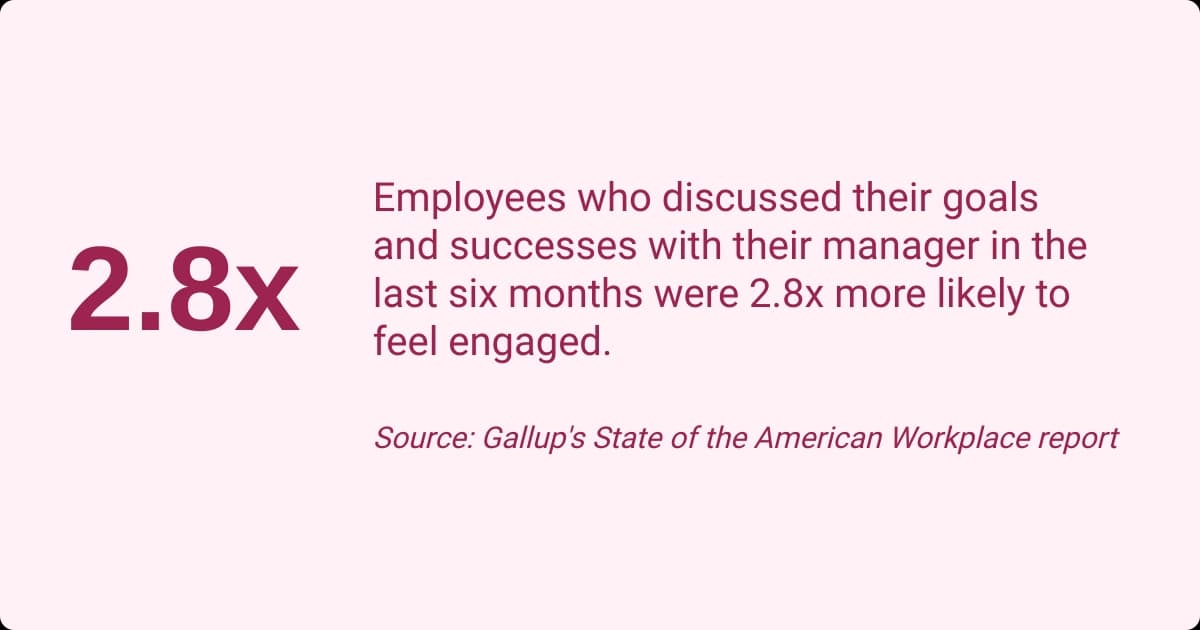
According to Gallup research, employees who discuss goals and successes with managers in the last six months are 2.8x more likely to be engaged. Likewise, people who receive daily feedback are 3x more likely to be engaged, and regular-feedback companies see 14.9% lower turnover.
For instance, Molly Lehrsch, former Director of Corporate Communications at First Tech Federal Credit Union, explained, “We decided to roll out recognition and ConversationsTM together as that human application suite because we believed in the full spectrum of feedback.”
Reviewing and updating metrics over time
Consider quarterly check-ins to assess the relevance of your metrics and a broader strategy review each year. If a metric stops encouraging the right behavior, sunset it. You should also watch for unintended consequences, such as gaming or drift.
Conversations can help you touch base with employees and gather ongoing feedback. It also lets you pull recognition, feedback, and check-in data into reflections, which can make it easier to recalibrate metrics every quarter or year.
Tools for measuring employee performance
Here are a few types of tools to help track performance metrics:
- Project management tools (Asana, Jira) for output and efficiency metrics
- CRM platforms (Salesforce) for sales and customer-facing metrics
- Support platforms (Zendesk) for customer support metrics
- HRIS systems (Workday) for attendance and other people data
- Clock-in/clock-out tools for attendance and schedule adherence
- 360-degree feedback tools for qualitative and behavioral assessments
- LMS platforms for learning and development metrics
- Performance management platforms for consolidated dashboards, goal tracking, and metric visualization across categories
Tracking and visualizing metrics: Dashboards and performance matrices
A simple spreadsheet can help monitor one or two metrics. However, a dedicated performance management platform is often easier to manage, especially for large teams.
Set up employee performance dashboards to track a manageable set of relevant metrics for each role. Use it to monitor trends and track progress against relevant goals or benchmarks. Make sure managers have access, and update the dashboard as frequently as the underlying metrics require.
A performance matrix is another useful tool that can help plot performance vs. potential. Consult this visualization when making development decisions.
Avoid common mistakes, such as:
- Tracking vanity metrics, like the number of emails sent
- Not providing enough context
- Not setting targets
The future of performance metrics: 2026 trends reshaping measurement
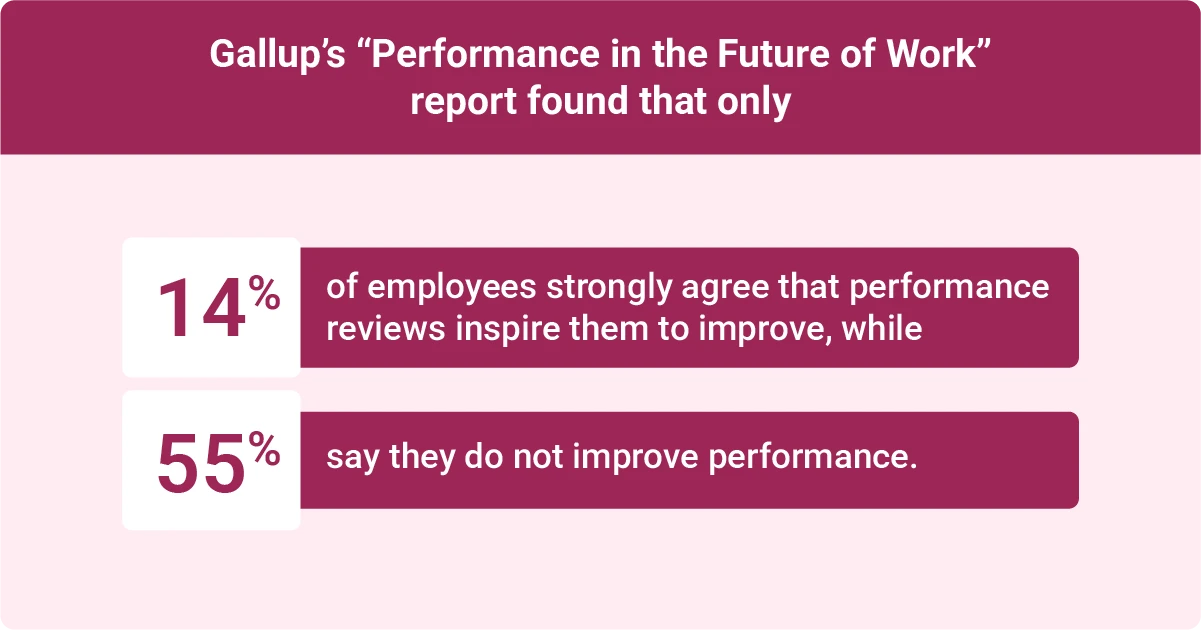
Other trends include:
- Using AI and people analytics to help assess performance
- Using skills-based performance metrics instead of purely role-based ones
- Prioritizing business outcomes over activity for hybrid and remote workers
- Focusing on trust, fairness, and bias reduction
- Using recognition data to gain insight into engagement and retention
- Tracking internal mobility and readiness
AI's role in performance measurement
AI can help draft reviews, identify potential bias in feedback, analyze sentiment in recognition data, predict flight risks, and more. For example, Workhuman iQ and Human Intelligence™ can map skills for internal mobility and detect bias via an Inclusion Advisor.
A Gallup survey found that 93% of Fortune 500 Chief Human Resources Officers have started using AI, but only 33% of employees are aware of it. Always be transparent with employees about how AI is being used and how it may affect them. AI should support rather than replace human judgment in high-stakes decisions, such as promotions and raises.
Skills-based and outcome-based measurement
As AI continues to reshape roles, many job descriptions look different than they did five years ago. Focus on measuring how employees acquire and apply new skills, rather than relying on job titles alone. Outcome metrics can also help you understand how remote and hybrid teams perform without relying on activity or visibility as stand-ins for performance.
FAQs
What are the most common employee performance metrics?
Common employee performance metrics include productivity metrics, such as tasks completed and revenue per employee, and efficiency metrics like time-to-completion and cost per output. Many organizations also use customer-facing metrics, such as CSAT and resolution time. Always adapt metrics to specific roles.
What do employee performance metrics actually measure?
Employee performance metrics measure how effectively someone performs in their specific role and how much they achieve. They can help you determine whether an individual is meeting expectations and their own goals. They also give you a better understanding of each employee's contributions and where they might improve.
What are examples of KPIs for employees?
Examples of KPIs for employees include attendance rate, goal attainment rate, error rate, sales revenue, and customer satisfaction scores. The right KPIs depend on the employee's role and should connect their contributions to relevant team or organizational goals.
How do you write a SMART goal for employee performance?
A SMART goal for employee performance should be specific, measurable, achievable, relevant, and time-bound. Start by identifying an ambitious yet feasible outcome that the employee wants to achieve. Then determine which metrics you'll use to measure progress and set a realistic deadline.
Why are employee performance metrics important to organizational success?
Employee performance metrics help leaders understand how effectively individual workers contribute to the business's goals and identify areas for improvement or where support and training may be needed. They also allow organizations to allocate resources more efficiently and recognize the accomplishments of high performers.

Ryan Stoltz
Ryan is a search marketing manager and content strategist at Workhuman where he writes on the next evolution of the workplace. Outside of the workplace, he's a diehard 49ers fan, comedy junkie, and has trouble avoiding sweets on a nightly basis.
Recommended for you