
Goal Alignment at Work: A Complete Guide for HR Leaders and Managers
by Anna Picagli
Last updated
8 min read

Table of contents
- What is goal alignment?
- How goal alignment drives business impact
- The role of HR in goal alignment
- Top-down vs. bottom-up alignment approaches
- Choosing the right goal alignment framework
- How goal alignment shows up in daily work
- How to implement aligned goals across the organization
- Measuring the success of goal alignment
- Conclusion
Share this article
When goal alignment breaks down, the symptoms are familiar: teams pull in different directions, employees struggle to prioritize, and strategy feels disconnected from day-to-day work. Most organizations do not fail because they lack goals, they fail because employees cannot see how their work connects to company priorities, or because the behaviors that drive success are not consistently reinforced.
Goal alignment is not just a strategy or planning exercise. It lives or dies in daily employee behavior. That makes HR uniquely responsible for shaping it.
This guide explores how HR leaders can move beyond goal-setting frameworks to build true alignment at scale by combining clarity, connection to purpose, and behavioral reinforcement. You will learn how to align employees with company goals using the right frameworks, systems, and signals, and how Workhuman’s human-centered platform helps organizations turn strategy into consistent action.
What is goal alignment?
Goal alignment is the practice of connecting organizational priorities to team objectives and individual contributions so that effort across the enterprise moves in the same direction. True alignment exists when employees understand not only what their goals are, but why those goals matter and how success is measured.
Many organizations equate goal alignment with goal setting. In reality, goal setting is only the starting point. Alignment requires line-of-sight: employees must be able to trace their daily decisions and behaviors to company outcomes.
When alignment is strong:
- Employees can explain company priorities in their own words
- Teams make faster, more confident decisions
- Managers coach toward outcomes, not just activity
Frameworks like SMART goals can help define expectations, but without reinforcement and visibility into behavior, even well-written goals lose impact. Alignment is sustained through how work is experienced, recognized, and discussed every day.
How goal alignment drives business impact
Goal alignment delivers measurable value when it is embedded into how work happens, not when it lives in static planning documents. When priorities are clearly connected from the enterprise level down to individual roles, employees spend less time guessing what matters and more time executing against what drives results. Alignment sharpens focus, reduces duplicative effort, and enables faster decision-making across teams.
More importantly, aligned goals create consistency between strategy, behavior, and outcomes. Teams are better equipped to make trade-offs, managers can coach with greater clarity, and leaders gain visibility into whether strategic intent is translating into real progress. Over time, this consistency compounds, driving stronger performance, higher engagement, and a culture where people understand not just what they are working on, but why it matters.
Faster execution and better prioritization
Aligned organizations move faster because employees do not need constant clarification. When priorities are clear, teams can resolve tradeoffs locally and focus effort where it creates the most value.
Higher engagement through purpose clarity
Employees are more engaged when they understand how their work contributes to something bigger. Goal alignment connects effort to impact, reinforcing meaning and motivation, especially during periods of change.
Stronger team alignment and cross-functional collaboration
Team alignment improves when goals are visible and mutually reinforcing. Shared priorities reduce duplication of effort and make collaboration more effective across functions and geographies.
More effective performance management
When goals are aligned to strategy, performance conversations become clearer and fairer. Managers evaluate outcomes against shared expectations, rather than subjective interpretations.
Workhuman supports this shift through performance enablement capabilities that connect goals, feedback, and recognition, helping organizations reinforce what success looks like in real time, not just at review cycles.
Hear from our partners
Learn how Qlik partnered with Workhuman to realign its people processes to the pace of business after transforming its performance management approach.

The role of HR in goal alignment
HR plays a central role in making goal alignment durable, not by owning strategy, but by ensuring it is understood, reinforced, and operationalized across the employee lifecycle. As the connective tissue between leadership intent and employee experience, HR helps translate high-level priorities into systems, processes, and behaviors that scale across the organization.
Through goal-setting frameworks, manager enablement, performance management, and recognition, HR ensures alignment shows up consistently in how people are hired, developed, evaluated, and rewarded. When alignment is embedded into these core moments, it becomes part of how work gets done, not a one-time initiative, allowing strategy to remain visible, relevant, and actionable at every level of the organization.
Translating strategy into employee understanding
Strategy often loses clarity as it moves down the organization. HR helps translate high-level priorities into language that resonates at every level by:
- Simplifying strategic narratives
- Ensuring consistency across leaders and regions
- Equipping managers with shared messaging and coaching tools
When employees hear conflicting interpretations of priorities, alignment erodes quickly. HR ensures clarity scales.
Embedding alignment into people processes
Alignment must be built into the systems employees interact with every day:
- Onboarding that connects roles to company goals
- Performance management that emphasizes outcomes and behaviors
- Communication rhythms that reinforce priorities consistently
Because HR has a cross-functional view, it can detect misalignment early, before it shows up in missed results or disengagement.
Common goal alignment challenges
Even organizations with strong intent struggle to sustain alignment at scale. The most common challenges are structural, not cultural.
Lack of strategic clarity
When strategy is unclear or overly complex, employees cannot articulate what matters most. HR can help leaders distill priorities into simple, actionable themes that guide decisions.
Inconsistent communication
One-time announcements and top-down messaging are not enough. Alignment requires repetition, dialogue, and reinforcement through multiple channels, including manager conversations and recognition moments.
Silos and misalignment across teams
Without shared visibility, teams optimize locally instead of collectively. Conflicting priorities lead to duplication of work and missed opportunities for collaboration.
Limited visibility into day-to-day behavior
Traditional metrics show outcomes after the fact, but they do not reveal whether employees are behaving in ways that support strategy. Behavioral data is essential for understanding whether alignment is actually happening.
Workhuman’s recognition platform provides this visibility by capturing real-time signals about what behaviors are being encouraged, repeated, and celebrated across the organization.
Hear from our partners
At Workhuman Live, Eaton leaders shared how recognition data provided visibility into daily behaviors across a workforce of 95,000 employees in 160 countries, offering insights few traditional listening tools can match.
Top-down vs. bottom-up alignment approaches
Most organizations need a balance of both approaches.
Top-down alignment
Top-down alignment provides clarity and consistency by cascading priorities from leadership. It works well in highly regulated or operationally complex environments, but risks disengagement if employees feel disconnected from decision-making.
Bottom-up alignment
Bottom-up alignment increases ownership and engagement by allowing teams to shape goals locally. Without guardrails, however, it can lead to fragmentation.
The hybrid model
High-performing organizations combine both. Leadership defines strategic guardrails, while teams determine how best to execute within them. Frameworks like OKRs are particularly effective in supporting this balance.
Choosing the right goal alignment framework
No single framework works for every organization. The right choice depends on business context, maturity, and pace of change.
OKRs
Best suited for agile environments where priorities evolve quickly. OKRs promote focus and transparency, but require discipline to avoid overload.They work best when outcomes are clearly defined and progress is reviewed frequently.
SMART goals
Ideal for role clarity, operational consistency, and coaching conversations. SMART goals are especially effective when paired with ongoing feedback. They help translate broad expectations into concrete, measurable actions for individuals.
Cascading goals
Cascading goals ensure structural alignment across levels and functions, particularly in large enterprises. They must be reviewed regularly to remain flexible. Without periodic recalibration, they risk reinforcing outdated priorities.
Team goals
Team goals improve team alignment and accountability, especially in cross-functional work. They encourage shared ownership of outcomes rather than isolated individual effort.
Performance goals
Performance goals connect individual execution to strategic outcomes, reinforcing accountability and fairness. They are most effective when supported by clear criteria and consistent evaluation practices.
How goal alignment shows up in daily work
Alignment becomes real through behavior, not documentation.
Behavior as the true signal of alignment
What gets rewarded gets repeated. If employees see that certain behaviors consistently lead to recognition, advancement, or visibility, those behaviors become the de facto strategy.
Recognition as behavioral reinforcement
Recognition is one of the most powerful and underutilized tools for reinforcing alignment at scale. When aligned to strategic priorities, recognition:
- Reinforces desired behaviors in real time
- Helps employees internalize what success looks like
- Provides HR with insight into cultural and behavioral trends
- Connects strategy to everyday actions through visible reinforcement
Workhuman’s Social Recognition® platform enables organizations to tie recognition moments directly to company values and strategic themes, transforming recognition into a continuous listening and alignment mechanism.
How recognition reinforces safety behaviors
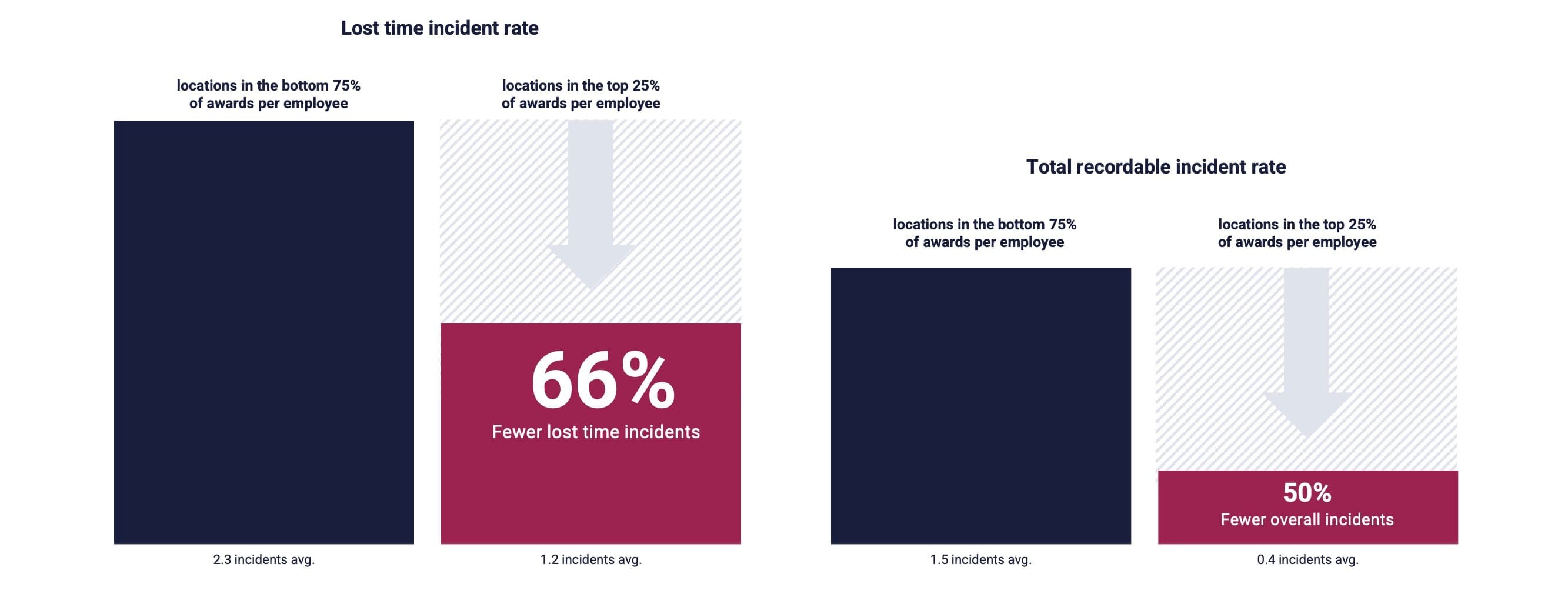
Safety priorities often succeed or fail based on everyday choices. When safety-conscious actions such as speaking up about risks, following protocols under pressure, or intervening to protect a colleague are consistently recognized, they become normalized across the organization.
Recognition reinforces safety by signaling that safe behavior is valued as much as productivity or speed. It encourages proactive risk identification, reduces hesitation to raise concerns, and helps shift safety from a compliance requirement to a shared responsibility. Over time, visible recognition of safety behaviors strengthens trust, accountability, and a culture where employees feel empowered to protect themselves and others while still delivering results.
How to implement aligned goals across the organization
Step 1: Clarify and communicate strategic priorities
Translate strategy into simple language employees can remember, repeat, and apply. Reinforce these priorities frequently through multiple channels so they remain top of mind beyond annual planning cycles.
Step 2: Equip managers to drive alignment
Managers are the linchpin of alignment. Provide conversation guides, coaching frameworks, and tools that support consistent messaging. When managers understand both the “why” and the “how,” they are better positioned to translate strategy into meaningful day-to-day work.
Step 3: Connect individual and team goals
Ensure every employee can see how their goals ladder up to broader priorities. This creates true line-of-sight. Clear goal linkage increases accountability and helps employees prioritize work that delivers the greatest impact. Learn more about how to measure employee performance.
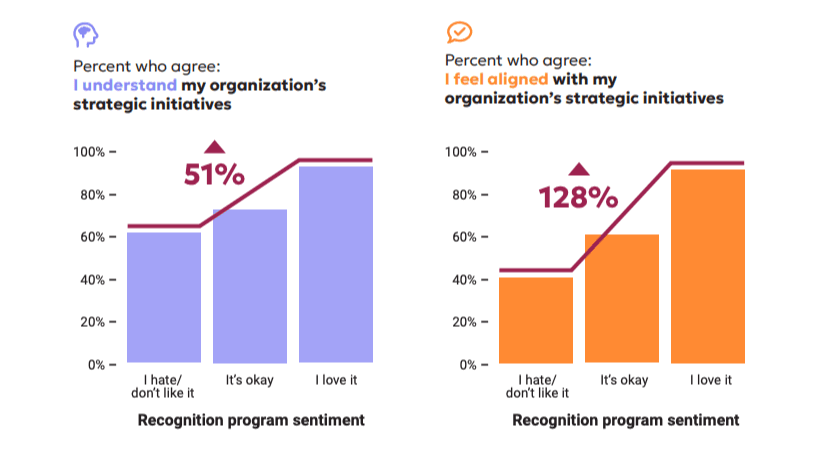
Tip: Personal investment grows more than 5X when recognition can be connected directly to strategic initiatives (source: Recognition as an Engine for Strategy)
Step 4: Reinforce with recognition
Tie recognition to strategic behaviors and priorities to make alignment visible and repeatable. Publicly acknowledging aligned behaviors signals what success looks like and accelerates cultural adoption.
Workhuman found when recognition is tied to strategic initiatives, 96% of employees say they "know exactly how my work ties in" vs. 42% when it's rarely or never tied to strategic initiatives – a difference of 129%!
Hear from our partners
Learn how PepsiCo uses Workhuman to connect everyday behaviors to measurable business impact.
Step 5: Monitor and realign continuously
Use performance data, recognition insights, and cross-team reviews to adapt as priorities evolve. Ongoing recalibration ensures goals remain relevant as business conditions and organizational needs change.
Measuring the success of goal alignment
Effective goal alignment can be measured through a combination of quantitative data and qualitative signals. Together, these indicators reveal whether alignment is truly shaping behavior or simply documented in planning materials.
Quantitative indicators of goal alignment
Progress against goals and initiatives
Track how consistently teams and individuals are meeting objectives that are directly tied to strategic priorities. Sustained progress across functions suggests alignment is driving execution, not just intent.
Cross-team collaboration patterns
Examine how frequently teams collaborate across functions on shared priorities. Increased cross-functional work is often a leading indicator that goals are aligned beyond silos.
Recognition trends linked to strategic behaviors
Analyze recognition data to identify whether employees are being acknowledged for behaviors that support stated priorities. Strong alignment shows up when recognition reinforces the same strategic themes repeatedly.
Qualitative indicators of goal alignment
Employees clearly articulate priorities
Employees at all levels should be able to explain how their work connects to organizational goals without relying on formal documentation. Clarity in everyday language signals genuine understanding.
Managers demonstrate alignment in decisions and coaching
Look for consistency between strategic priorities and how managers set expectations, allocate resources, and provide feedback. Alignment is strongest when it shows up in day-to-day decisions, not just goal-setting conversations.
Together, these signals show whether alignment is embedded in how work gets done or if it’s empty rhetoric.
Common pitfalls to avoid
Too many competing goals
When priorities are not clearly ranked, teams spread effort across initiatives that dilute impact. Focus and trade-offs are essential for meaningful alignment.
Assuming communication equals understanding
Sharing strategy does not guarantee comprehension or adoption. Alignment requires dialogue, repetition, and reinforcement over time.
Over-engineering frameworks
Complex goal structures can create administrative burden and confusion. Simplicity increases adoption and makes alignment easier to sustain.
Failing to reinforce behavior
If aligned behaviors are not recognized or rewarded, employees will default to what is easiest or most familiar. Reinforcement is what turns intent into habit.
Treating alignment as an annual event instead of a continuous practice
Alignment erodes when it is revisited only during planning cycles. Ongoing check-ins and adjustments are necessary as priorities and conditions evolve.
Conclusion
The future of goal-alignment is human-centered. The organizations that succeed will be those that translate strategy into everyday behavior. Goal alignment is not sustained through frameworks alone: it requires clarity, connection to purpose, and consistent reinforcement.
HR plays a critical role in ensuring employees understand how their work contributes to company goals and in shaping the behaviors that bring strategy to life. With the right systems for accountability and reinforcement, such as a quality recognition program, alignment becomes visible, measurable, and scalable.
That is how organizations move from goal setting to true goal alignment.

Anna Picagli
As an RYT500 yoga instructor and a Reiki Master Teacher, Anna is an advocate for holistic wellness, especially within the workplace. She’s extremely passionate about the brain-body connection and exploring how mental and physical wellness intersect.
Anna has experienced firsthand how chronic stress, overworking, poor management, and other organizational issues can lead to extreme burnout. Knowing the impact that a toxic work environment can have on a person’s body, psyche, and general sense of well-being, she now works to direct others away from facing the same fate.
As Workhuman’s Senior Content Specialist, Anna is a regular contributor to Workhuman iQ reports and aims to create resources that company leaders can reference to help improve their culture and empower their employees, creating healthier workplaces for everyone.
In her free time, she’s an avid solo traveler, a voracious reader, and a seasoned home chef. You can learn more about Anna’s work on LinkedIn or through the Yoga Alliance.
Recommended for you