Employee Motivation Strategies That Actually Work: How Recognition and Rewards Drive Lasting Employee Engagement
Last updated
7 min read

Keeping up employee motivation at work has never been harder. Between shifting work models, economic uncertainty, and the constant pressure to “do more with less,” even the most passionate teams are running low on fuel.
If you’ve noticed more quiet quitting, disengagement, or that subtle sense of “just getting by” across your workforce – you’re not alone. According to GallupOpens in a new tab, only 31% of employees in the U.S. were engaged in 2024 – the lowest in a decade. That means the majority are simply showing up, not firing up.
And it’s not just a “feel–good” issue. Low motivation hits the bottom line. Productivity drops. Turnover climbs. Culture starts to feel...flat.
When people stop feeling seen, valued, or connected to purpose, they naturally pull back. And when that happens at scale, even the best HR initiatives can lose their spark.
Workhuman’s research shows a simple truth: meaningful recognition and rewards keep employees motivated. In our latest report, 2025 Reward Study: The Impact of Tangible Rewards, we found that employees who loved their recognition program and reward experience were almost universally engaged – 94% say they’re motivated to do their best work every day. Motivation declines steadily as enthusiasm drops:
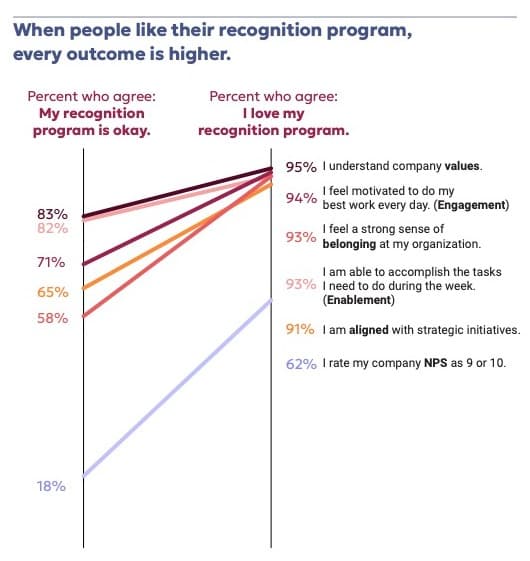
When recognition programs are designed thoughtfully and paired with meaningful rewards, motivation lasts. People give their best work not because they’re pushed, but because their contributions are noticed and valued.
The psychology behind a motivated workforce
So why do some people thrive at work while others tune out?
The answer lies in understanding what truly drives us – and how simple acts of recognition can unlock something powerful inside every person.
Maslow’s Hierarchy of Needs, reimagined for work
You’ve probably seen Maslow’s pyramidOpens in a new tab before – the one that starts with basic needs like food and safety, and climbs toward belonging, esteem, and self–actualization. At work, that wellbeing pyramid looks a little different:
- Basic needs: A fair salary, job security, clear expectations, and a healthy work–life balance.
- Belonging: Feeling connected to team members and valued by peers.
- Esteem: Being recognized for contributions and achievements.
- Self–actualization: Doing meaningful work that aligns with personal purpose.
If the lower layers are shaky (think pay inequity, lack of psychological safety), motivation is fragile. When people feel secure, appreciated, and purposeful, effort and creativity soar.
Herzberg’s Two–Factor Theory: The why behind the “thank you”
Psychologist Frederick HerzbergOpens in a new tab broke motivation into two categories:
- Hygiene factors – things that prevent dissatisfaction but don’t inspire passion (salary, working conditions, policies).
- Motivators – the experiences that spark energy, pride, and loyalty (recognition, growth, achievement).
Recognition is a core motivator. When employees receive meaningful, timely feedback, it reinforces their sense of competence and purpose – far beyond the momentary lift of random shout–outs or blanket rewards.
That’s why Workhuman focuses on the quality and context of recognition. And when you do that well, something remarkable happens – motivation becomes self–sustaining.
How to motivate employees
Effective employee engagement strategies tap into two flavors of motivation: intrinsic and extrinsic.
Intrinsic motivation: The “I love what I do” energy
Intrinsic motivation is that inner drive to do something because it feels meaningful, fulfilling, or simply “right.” This kind of motivation is powered by three human needs:
- Purpose – “I know why my work matters.”
- Mastery – “I’m growing and getting better at what I do.”
- Autonomy – “I have the freedom to make an impact.”
How to tap into it: Career growth programs, flexible scheduling option, mentorship, and team–building experiences give employees space to manage their work and career paths, learn new skills, and build meaningful connections.
Recognition and rewards amplify that impact. By reinforcing progress and celebrating effort, they create a positive loop where employee feedback, acknowledgment, and guidance strengthen commitment over time. In other words, when recognition is tied to growth and effort, it provides positive feedback that deepens employees’ sense of purpose and competence.
Extrinsic motivation: The rewards and reinforcements
Extrinsic motivation comes from outside factors like bonuses, promotions, or public praise. These signal to employees: “We see your effort, and it matters.”
How to tap into it: The key is how rewards are designed. Random, one–size–fits–all, or purely transactional incentives lose impact quickly. Meaningful, fair, and personalized rewards become powerful reinforcers that shape culture.
Monetary vs. non–monetary incentives: Striking the balance
Here’s the key: monetary and non–monetary incentives work best together. Cash or bonus rewards can spark short–term action, while recognition, flexibility, and belonging sustain motivation over time. A heartfelt “thank you” or acknowledgment of effort resonates long after a bonus is spent.
Tip for HR leaders: Combine tangible rewards (like points, gifts, or experiences) with genuine recognition that connects the dots back to purpose. This approach creates motivation that is both emotional and measurable, turning everyday effort into lasting employee satisfaction.
So, how do you actually design systems that make that happen every day, across teams and time zones?

The strategic recognition & meaningful rewards cycle
One–off incentives or pep talks can spark energy for a moment – but that energy fades. Motivation sticks when recognition and rewards form a continuous, self–reinforcing cycle.
Here’s how it works:
- Recognize strategically: Celebrate effort, growth, or problem–solving as it happens.
- Reward meaningfully: Connect tangible rewards to behaviors and outcomes.
- Track and learn constantly: Use recognition data to see which behaviors align with company values and drive results.
Purposeful recognition makes employees feel valued. Relevant rewards make them feel valued. Visible recognition builds belonging. Measured recognition scales impact. Repeat this loop, and it drives sustained motivation, shapes culture, and delivers measurable business outcomes.
From motivation to business outcomes: The ROI of R&R
When we started studying how recognition and rewards influence employee motivation, we wanted to answer a simple question: Can recognition actually move the needle on business outcomes?
The short answer? Yes – dramatically.
The performance & productivity ripple effect
When employees see peers celebrated for actions aligned with company goals, they emulate those behaviors. Psychologists call this behavioral reinforcement – what gets rewarded gets repeated.
Workhuman–Gallup research found improving both the frequency and quality of recognition can deliver a 9% productivity gain per 10,000 employees, translating to tens of millions in value.
And a great rewards experience is a force multiplier. When people have a positive reward experience, they are more than 2× more likely to feel motivated (Workhuman’s 2025 Reward Study).
The belonging & engagement link
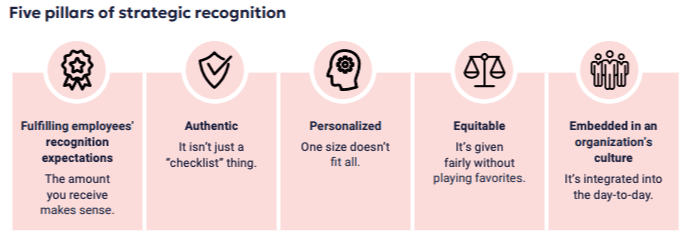
Authentic, equitable recognition fosters a sense of belonging. Joint research from Workhuman and Gallup found employees whose recognition meets four or more of the five pillars of strategic recognition are:
- 12.2× more likely to feel deeply connected to the culture
- 9× more likely to be engaged at work
Tangible rewards matter, too. When rewards carry real monetary value, feelings of belonging rise by 28%, and engagement (motivation) rise by 21% (Workhuman’s 2025 Reward Study).
How frequently people redeem and what they redeem for were also factors in increasing belonging and engagement. Download the full study for the big picture impact of everyday recognition and rewards.
The retention & advocacy amplifier
High–quality recognition reduces turnover and boosts advocacy. Workhuman–Gallup data shows that employees who receive high–quality recognition are:
- 45% less likely to leave within three years
- 65% less likely to be actively seeking new roles
- 3.8× more likely to feel connected to their company’s purpose and values
And when coupled with a positive reward experience, recognized employees are 19× more likely to recommend their company as a great place to work (Workhuman’s 2025 Reward Study).
By fostering a culture of meaningful recognition, organizations not only retain top talent but also strengthen engagement, turning satisfied employees into brand ambassadors.
The takeaway
When thoughtfully designed, a Recognition and Rewards program is a system of energy that powers employee performance. It transforms motivation from something fleeting into something measurable and scalable.
Start small, but intentionally. Recognize meaningfully. Reinforce the behaviors that define your culture. Over time, those moments compound into belonging, belief, and business growth.
How to improve employee motivation
1. Get the timing right
Recognition is most powerful when it’s timely. If an employee finishes a complex project or lives out one of your company values in action, don’t wait until the next all–hands to call it out. Recognize it now, while it’s still fresh.
That immediacy strengthens the connection between effort and reward – a classic concept in behavioral reinforcement theory.
Tip: Use digital tools like Workhuman's to make real–time recognition easy with key platform integrations like Slack, Outlook and a mobile platform. A quick, authentic message today is worth more than a formal “thank you” next quarter.
2. Make it specific (and sincere)
“Great job!” feels nice. But specific recognition – e.g., “Great job leading that tricky client conversation. Your calm tone and preparation really turned the meeting around” – tells employees exactly what they did well and why it mattered.
It’s a small shift that makes a big psychological difference – it reinforces competence and purpose, two core intrinsic motivators. It also helps capture more meaningful data that can be transformed into workforce signals with Human Intelligence. See how→
Tip: Train managers and employees to pair every recognition with context. Workhuman has developed Recognition Advisor and Inclusion Advisor, two in-the-moment coaching tools that help employees create more impactful, more inclusive messages.

3. Personalize rewards to match motivation
Not everyone is motivated the same way. Offer choice: experiences, products, gift cards, charitable donations, or public praise. Autonomy taps intrinsic motivation and strengthens engagement.
Nearly 1 in 4 employees say they value options that align with their lifestyle or hobbies, and 1 in 5 look for rewards that align with their personal values.
Workhuman's 2025 Rewards Study
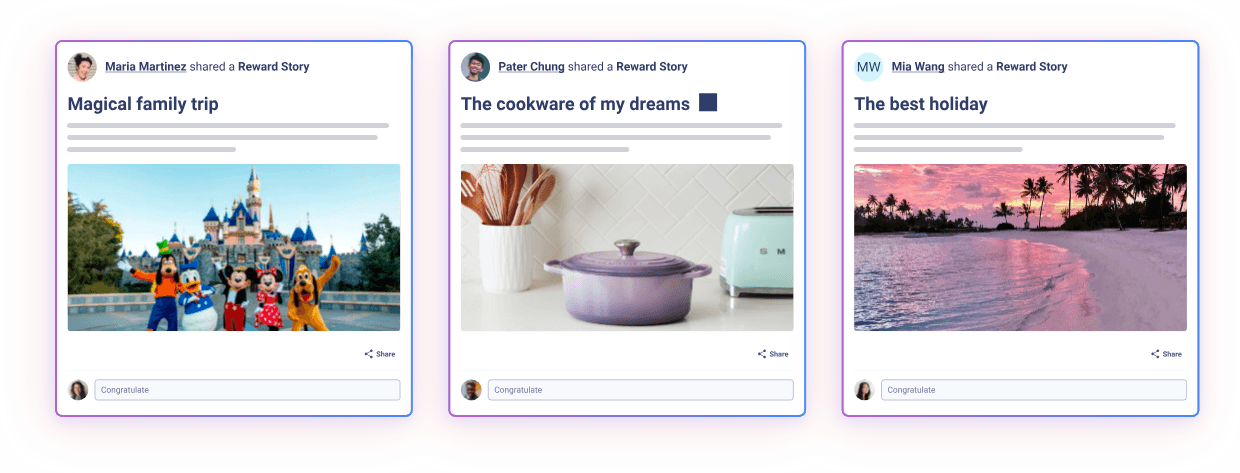
Tip: When employees post photos, mention their purchases in team chats, or share stories about their rewards (such as the Reward Stories in Workhuman’s Culture Hub), they travel through teams, strengthening connections and extending the cultural impact of recognition. Promote redemptions that create shareable moments of joy to amplify cultural impact.
4. Embed recognition into the flow of work
If recognition only happens during performance reviews, it’s already too late. Make it part of the daily rhythm – integrated into the tools and touch–points your teams already use.
For remote and global teams, celebrate wins publicly and tailor rewards to diverse locations and lifestyles. Highlight value–driven wins in team meetings, and – for those who appreciate public recognition – encourage peer–to–peer shoutouts during stand–ups.
Tip: Build recognition prompts, insights and peer–to–peer options directly into daily workflows to make giving recognition easy, visible, and habitual.
5. Empower leaders (and hold them accountable)
Leadership shapes motivation. Employees take cues from the top: when leaders model authentic recognition, the behavior spreads across teams. When they don’t – even the best programs can stall.
Common leadership mistakes:
- Only rewarding outcomes, not effort or learning
- Offering generic praise that feels insincere
- Overlooking quiet performers who make steady contributions
Leaders who consistently recognize their teams not only drive engagement but also benefit personally: giving recognition strengthens their relationships, visibility, and influence, while reinforcing their direct reports’ motivation and performance.
Tip: Recognition is a leadership skill – one that can be taught, practiced, and measured. Platforms like Workhuman’s manager enablement tools help leaders give effective, consistent recognition and track how it impacts team motivation over time.
6. Monitor motivation like a metric
You can’t improve what you don’t measure. Even in the strongest cultures, motivation can dip.
Early signs to watch for:
- Declining productivity or missed deadlines
- Reduced collaboration or social withdrawal
- Increased absenteeism or disengaged survey responses
Tracking recognition and engagement metrics shows where motivation is thriving – and where intervention is needed. Modern recognition platforms (like Workhuman's) make these insights real–time, turning what used to be “soft” culture signals into actionable intelligence.
Tip: Use recognition data to spot motivation trends:
- Who’s being recognized most often – and for what?
- Which teams have the strongest recognition networks?
- How does recognition frequency link to engagement scores, NPS or turnover?
7. Build a habit, not a campaign
The real goal is consistency. When recognition becomes a cultural habit – something people just do – motivation stops being an HR initiative and starts being a shared value.
That’s when you see the real payoff: lower turnover, stronger trust, and teams that stay energized long after the novelty of a new program fades.
Tip: Encourage everyone to recognize one person per week. Small, regular acts compound into a positive work environment that sustains motivation.
Conclusion: Make motivation your superpower
Motivation is a system. It’s a mix of psychology, leadership, culture, and strategy – all working together to help employees feel seen, valued, and inspired to do their best work.
Recognition and rewards are measurable levers within that system that:
- Strengthen engagement and retention
- Reinforce behaviors that drive business success
- Create a positive cycle of peer–to–peer motivation
- Build a culture where employees want to stay, contribute, and grow
As an HR leader or head of people, the power is in your hands. By acting with intention – recognizing consistently, personalizing rewards, and empowering leaders – you can turn motivation into a sustainable advantage for your organization and elevate the overall employee experience.

Alison Enzinna
A content strategist and innately curious person, Ali Enzinna has started exploring the working world, looking for opportunities to make big changes through small actions.
Recommended for you