
Psychological Safety at Work: Fostering Engagement & Wellbeing
by Mike Lovett
Last updated
6 min read

Table of contents
- What is psychological safety at work?
- The importance of psychological safety at work
- The connection between psychological safety and employee well-being
- The 4 stages of psychological safety
- How to create psychological safety at work
- Lack of psychological safety in the workplace
- CONCLUSION:
Share this article
To uncover what drives team success, Google’s People Operations studied more than 180 teams to determine what made them perform better, make better decisions, try new ideas, and learn from failures. One factor stood clearly above the rest: psychological safety.
Psychological safety at work is what separates good workplace cultures from toxic ones. When employees have the confidence to be themselves, speak up, voice concerns, and ask questions, they’re more connected, engaged, productive, and happier.
If you’re wondering if your organization is currently a psychologically safe environment, here’s a tip. There will always be ideas, concerns, and questions swirling in the minds of employees. All of the time. So if you’re not hearing them, that’s a red flag.
What follows is a look at the elements, benefits, importance, and strategies you can implement to foster psychological safety.
What is psychological safety at work?
She goes on, “Every time we withhold our thoughts, we rob ourselves and our colleagues of small moments of learning. This stifles innovation in our teams and companies. By modeling curiosity and asking lots of questions, leaders can begin to elicit ideas that can spark innovation.”
At work, psychological safety manifests itself in active team meetings, candid check-ins between managers and direct reports, and in raising serious concerns about the workplace. It creates a healthier work culture employees want to be a part of.
The importance of psychological safety at work
Psychological safety is the most critical factor in determining team success. Such an environment encourages colleagues to be open, honest, and respectful, which leads them to be more engaged, inclusive, and collaborative.
Psychological safety improves problem-solving, decision-making, and overall well-being. It brings forth more diverse perspectives and attracts top talent.
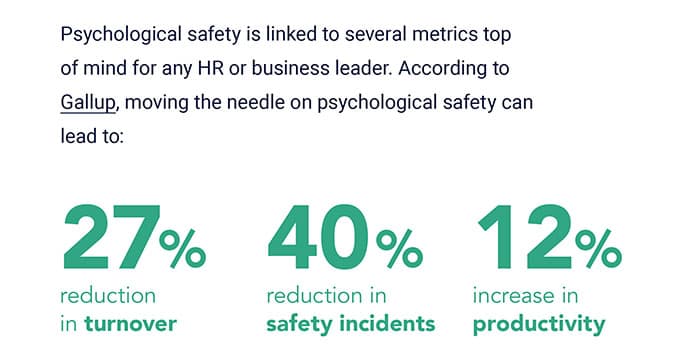
And for the data-inclined, while so much of it is invisible, you can measure psychological safety. According to Gallup, moving the needle on psychological safety can lead to a 27% reduction in turnover, a 40% reduction in safety incidents, and a 12% increase in productivity.
Psychological safety bridges an organization’s engagement strategy and its diversity, equity, and inclusion efforts. It creates a sense of belonging where anyone, regardless of gender, race, age, sexual orientation, or any other human differences, can feel empowered to contribute, grow, and speak up.
The connection between psychological safety and employee well-being
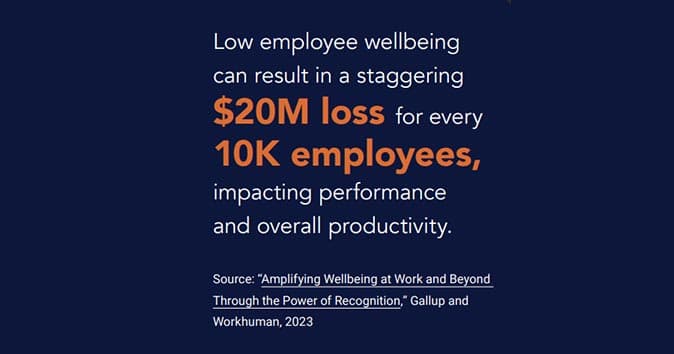
A psychologically safe workplace promotes numerous positive outcomes at work, but none are more important than employee well-being.
Open and honest communication boosts creativity and reduces stress. It creates stronger connections between co-workers which helps build community and trust within teams and throughout the organization. And combined, all of those factors provide a boost to one’s mental health.
Psychological safety and employee well-being are so intricately tied you can’t have one without the other.
The 4 stages of psychological safety
In his book The 4 Stages of Psychological Safety, Timothy R. Clark presents four stages that organizations through which organizations can progress on their path to building psychological safety. He notes that it’s important everyone in the organization do this together, and leaders need to model each stage to see progress.
Stage 1 — Inclusion safety
The first stage is inclusion safety which focuses on making sure that all employees feel included and valued. This stage might require inclusion and DEI training, and it can continually benefit from micro-coaching tools like Inclusion Advisor®.
An add-on to Social Recognition®, Inclusion Advisor uses AI to pick up on subtleties in your words, underlining those that may be perceived as biased. At Merck, employees with language flagged in their messages changed it 74% of the time.
Those moments of learning add up to positive everyday communications and interactions, improved team performance, and, ultimately, a more inclusive and psychologically safe workplace.
Stage 2 — Learner safety
If a company is to innovate and grow, its employees need to innovate and grow. When you give them the time, space, and confidence to hone their skills and learn new ones, you’ll soon find challenges are met with more creative solutions, and team members develop deeper connections to their work.
Stage 3 — Contributor safety
The contributor stage of psychological safety is about empowering employees. At this point, employees feel safe to use their skills and abilities to present and follow through on new ideas. This is where they begin to see the impact they’re capable of and how their role ties back to the goals of the organization.
For employers and managers, just as critical as practicing active listening in this stage is recognizing the contributions of employees. Reward the behavior and actions you want to see more of.
Stage 4 — Challenger safety
The final stage of fostering psychological safety at work is challenger safety. This is where employees feel safe to question the status quo, raise serious issues, and work through healthy conflict.
This stage is difficult in part because the subject matter could be difficult. There needs to be high psychological safety for employees to feel confident challenging superiors or common notions within the organization.
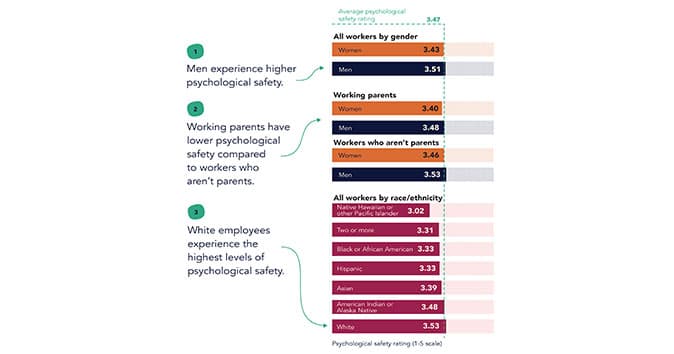
This can be especially intimidating for women and employees of color who score lower on psychological safety scores than white men. At this stage, what might be called for is psychological bravery by team members with more tenure or hierarchy to initiate challenges to pave the way for others to follow suit.
Further reading: 10 Ways to Create an Environment of Appreciation to Boost Employee Happiness
How to create psychological safety at work
In our research on psychologically safe work environments, two actions stood out as psychological safety boosters: expressing appreciation and checking in.
Expressing appreciation for the contributions and ideas employees are bringing to work helps them feel valued. And when you allow them to express appreciation to colleagues through a program like Social Recognition, you help strengthen connection and collaboration.
Employees thanked in the last month had the highest psychological safety and the lowest stress. The more infrequent, the lower the psychological safety and the higher the stress.
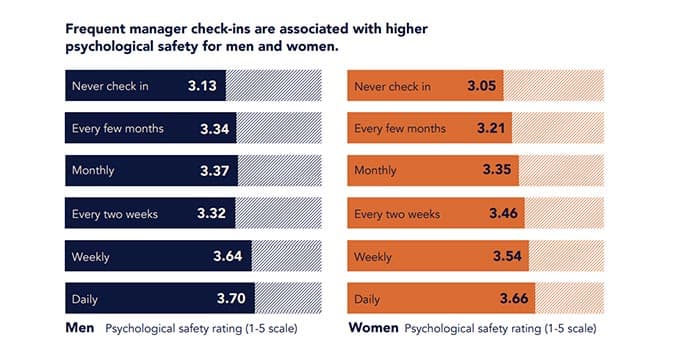
The research unveiled a similar phenomenon for check-ins between managers and employees. Both men and women experience higher psychological safety the more they check in with their managers.
Beyond the broad strokes of recognition and check-ins are the everyday actions and behaviors that will help employees feel psychologically safe at work.
Demonstrating your engagement
As a leader or manager, showing interest and attention in meetings and conversations will help employees feel seen and heard. Practice active listening, be curious, and ask relevant questions.
Conveying understanding to your team
When team members are facing a challenge at work or even in their personal lives, lead with empathy. Find ways to help them to not exacerbate any feelings of stress. This signals to other team members that it’s safe to raise concerns and ask difficult questions.
Building trust by avoiding blame
In a psychologically safe workplace, instead of assigning blame, you seek solutions and work together as a team to right the ship.
Fostering self-awareness and team transparency
Self-awareness is a key component of emotional intelligence. Understanding your thoughts and behaviors and how they affect other people will help you lead and work with people more effectively.
When the entire team has self-awareness, it operates with transparency and develops a deeper sense of trust.
Tackling negativity head-on
Negativity can seep into any work environment. What differs is how it is dealt with. In a psychologically safe work climate, negativity is addressed head-on. Again, lead with empathy in the moment and in check-ins to try to identify the root cause of the negativity and determine how best to remedy it.
Including your team in decision-making
An easy way for employees to feel like what they do and think matters is to include them in decision-making. Asking for their input through feedback or surveys can unearth new approaches and fresh perspectives. And when you highlight those contributions, you encourage more of it.
Embracing a culture of open feedback
A psychologically safe work environment does not shy away from feedback of any kind. Constructive criticism is part of the working experience, but frame it as a learning opportunity, not a way to attribute blame.
Fostering a culture of curiosity
Foster a culture of curiosity by seeking feedback from employees, expressing interest in their ideas, and asking questions. Show them you care about the work they are doing and offer up help whenever it may be needed.
Further reading: Learn more about employee wellbeing initiatives in How to Define and Implement an Employee Wellbeing Strategy
Lack of psychological safety in the workplace
If your organization lacks psychological safety, you won’t just miss out on all of the benefits organizations with high psychological safety see; your culture could start to deteriorate.
Identifying signs of psychological unsafety
There are a few clear indicators of a psychologically unsafe workplace, all of which can be measured in some way.
Fear of speaking up
If team meetings are dominated by one or two voices, if team members are hesitant to raise their hands and speak up, that is a glaring sign that they do not feel comfortable or confident to do so without repercussions.
Such an environment can decimate open communication and trust within a team. Creating a safe and inclusive environment can encourage employees to overcome their apprehension and freely express their thoughts and ideas.
High employee turnover
Another sign of a psychologically unsafe workplace is high turnover. This can destabilize teams, decrease employee morale, and result in high, sudden costs for organizations. Not all turnover is bad, but turnover due to a lack of psychological safety is an unforced error on behalf of an organization.
Decreased innovation and creativity
Without the confidence to posit new ideas and challenge the status quo, you hamper innovation and creativity. When an employee suppresses a suggestion, that is a missed opportunity for growth and progress.
Consequences of a non-inclusive environment
See also: Bring Your Whole Self to Work – Whatever That Means to You
Impact on mental health
In our research with BLK Men in Tech, survey respondents described the experience of feeling excluded. It led to higher stress and depression. A few respondents mentioned they sought therapy for the first time as a result of feeling othered.
Negative effects on employee well-being
In addition to the mental challenges, stress and burnout create physical and emotional challenges too. They can lead to poor sleep quality, higher heart rates, and blood pressure and erode trust and communication.
Stifled employee engagement
When employees are stressed, when they feel excluded or tired, and when they’re in a negative headspace, they are far less likely to engage with their work and connect with their colleagues. Such an environment is not one people want to stay in, and it will not attract prospective employees.
CONCLUSION:
Psychological safety at work is one of the most critical elements of a healthy workplace culture. It elevates employee well-being and employee voice and empowers everyone in the organization to take chances, swing big, and operate without fear of failure.
Even if you progress through all of the stages mentioned above, you must maintain psychological safety to continue seeing the benefits of employee retention, engagement, and connection that it can lead to.

Mike Lovett
Mike is a senior content marketing specialist at Workhuman where he writes about the next era of the workplace. Outside the workplace, he’s an avid gardener, a frequent biker, a steadily improving chef, and a fantasy sports fanatic.
Recommended for you