
Best Peer-to-Peer Recognition Software 2026: Top 9 Platforms Compared
by Ryan Stoltz
Last updated
12 min read

Picking the best peer-to-peer recognition software platform means sifting through a crowd of vendors that look nearly identical at a glance. Each tool claims a full feature list, broad integrations, and AI capabilities to streamline HR workflows.
But most comparison guides don’t mention the tools’ trade-offs that often derail rollout. It’s difficult to know whether the peer recognition software would work well with your organization’s headcount, human resources information system (HRIS), and culture goals that leadership is asking you to justify with data.
Providing the structured information you need to identify which platform best fits your organization’s size, stack, and culture goals, this guide compares nine of the best peer recognition software platforms.
We assessed the top peer-to-peer recognition tools across recognition depth, rewards flexibility, analytics, integrations, global reach, and pricing to explain where each platform fits best in 2026.
Top peer-to-peer recognition software tools
Methodology: How we evaluated the best peer recognition platforms in 2026
- Recognition breadth: We examined how easily employees can recognize one another, including peer-to-peer, manager-led recognition, customizable recognition types, and options for celebrating different contributions and milestones. Platforms that support multiple recognition modes scored higher.
- Reward flexibility: Recognition is more meaningful when you offer rewards that fit employees’ preferences. Yet, according to “The Power of Recognition Done Right,” by Workhuman, only 11% of employees say someone at their organization has ever asked them how they would like to be recognized. We looked for platforms that offer meaningful choice in how employees redeem their rewards and support different reward structures.
- Analytics: We prioritized the depth of reporting and analysis available to HR and leadership. Platforms that track metrics such as participation rate, recognition activity, reward spending, engagement trends, and insights to measure program impact came out ahead.
- Integration depth: Your peer recognition software should integrate with your HRIS platform and communication tools, such as Slack and Microsoft Teams. We considered native integration and API flexibility.
- Global reach: We considered a peer recognition tool's ability to support distributed and multinational teams. The best options support broad country coverage, multiple currencies and languages, international rewards, and cross-regional program operations.
- AI-assisted recognition: Generative AI praise suggestions are a key differentiating factor in [current_year]. Workhuman’s AI Assistant and Bonusly’s AI (Bizy) stood out with live generative features that help you draft and improve recognition messages.
We reviewed each vendor’s feature set and supported integrations on official product pages. Then we referenced review platforms such as G2 and Capterra to assess category leadership and user ratings. The ranking reflects the strongest fit across the six criteria above, with extra weight given to platforms such as Workhuman and O.C. Tanner that publish recognition ROI or engagement research to substantiate their claims.
The nine platforms we included range from enterprise-grade social recognition programs built for global rollouts to lightweight tools that live entirely inside Slack or Microsoft Teams. Everest Group’s 2025 Rewards and Recognition PEAK Matrix independently evaluated several of these vendors, including Bonusly, Nectar, Vantage Circle, Workhuman, and WorkTango, across market impact, vision, and capability.
Workhuman is positioned as a leader in Everest and G2. But before you dig into the individual profiles, you should weigh your organization’s headcount, budget, HRIS ecosystem, and whether recognition ties to your broader performance or engagement workflows.
1. Workhuman
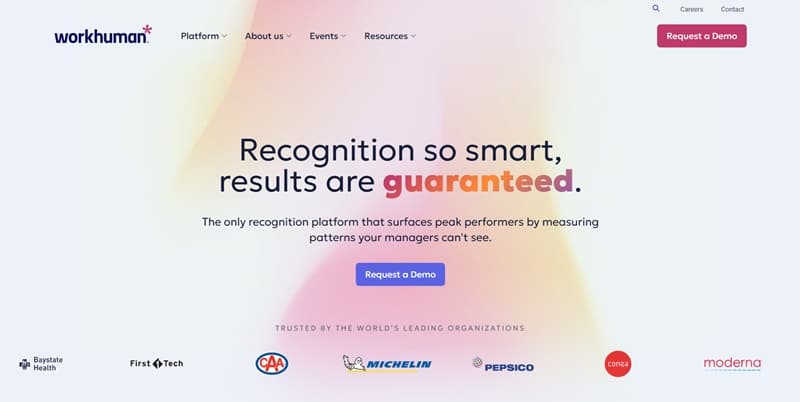
Many peer recognition software programs start with employee recognition as a standalone activity and expect culture to follow. Workhuman Employee Recognition™ is different because it combines peer-to-peer recognition, milestone automation, behavioral analytics, and a global rewards store. Your company can tie recognition to values, inclusion, culture, and measurable business outcomes.
But the integration of recognition into broader workforce intelligence is far from Workhuman’s only standout feature. The platform features Workhuman iQ, staffed by a team of data scientists and I-O psychologists who tie recognition patterns to metrics such as retention and productivity, delivering recognition insights you can act on.
You also get an AI-powered Inclusion Advisor that flags potentially biased language in award messages before they’re sent, drawing on a database built from more than 70 million recognition moments. Workhuman calls this pairing of AI and recognition data Human Intelligence™.
These features are concrete differentiators that set Workhuman apart from generic peer recognition platforms.
- Key features: Social peer-to-peer recognition tied to company values, automated service and career milestone celebrations, Workhuman iQ people analytics and sentiment insights, inclusion and equity guidance across recognition activity, global rewards store with localized fulfillment, Conversations and continuous performance check-ins.
- Rewards available: Gift cards, merchandise, travel and experiences, charitable donations, and localized reward options across 100+ countries.
- Workhuman integrations: Workday, SAP SuccessFactors, Microsoft Teams, Slack, Oracle HCM, ADP.
- Pricing: Custom pricing, quoted based on headcount and program scope.
- G2 rating: 4.7/5Opens in a new tab
- Capterra rating: 4.8/5Opens in a new tab
- Choose Workhuman if your recognition needs to scale globally, support inclusive participation, and produce measurable human data that leaders can use to improve culture, alignment, and retention.
2. Bonusly
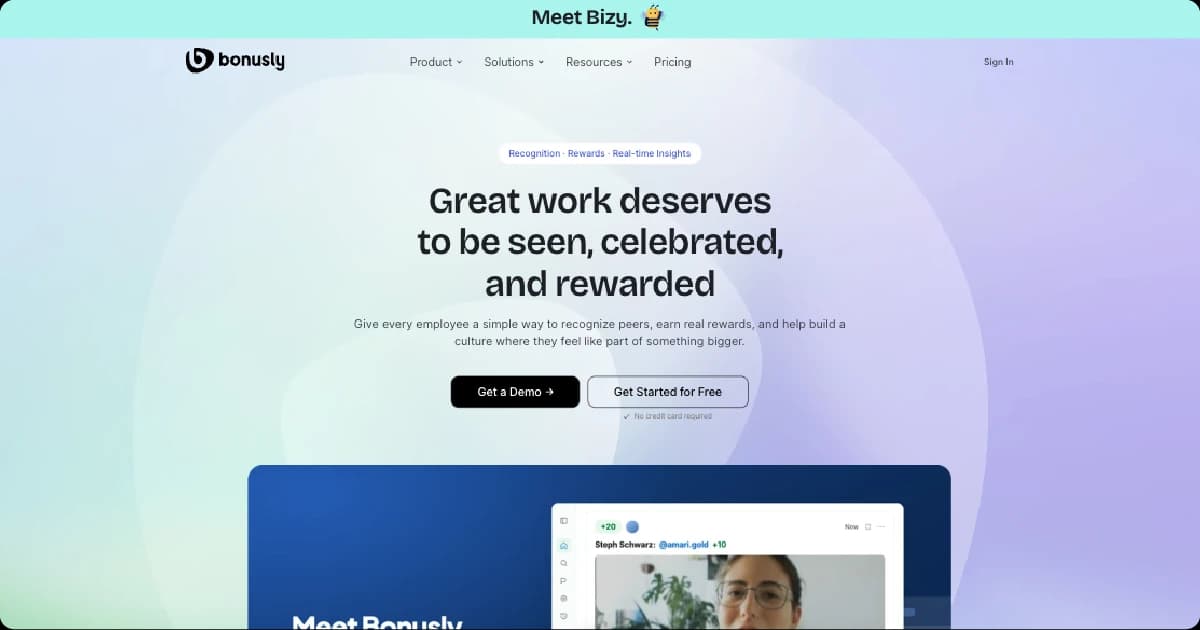
Best for: Small and mid-sized companies wanting simple, high-frequency peer bonuses that are easy to launch.
Bonusly keeps things lightweightOpens in a new tab with its points-based peer bonuses, a public feed, and redemption that doesn’t require admin-driven manual processing. This simplicity makes Bonusly suitable if you are looking for peer recognition software that can be up and running in Slack or Teams within days and doesn’t need behavioral analytics or a global rewards catalog.
- Key features: Points-based peer-to-peer bonuses, public recognition feed, automated rewards redemption, recognition analytics and reporting, Slack and Teams native recognition.
- Rewards available: Gift cards, charitable donations, custom company rewards, and merchandise.
- Bonusly integrations: Slack, Microsoft Teams, BambooHR, Workday, Gusto.
- Pricing: Free tier available, with paid per-user subscription plans starting at $5/user/month.
- G2 rating: 4.7/5Opens in a new tab
- Capterra rating: 4.8/5Opens in a new tab
- Choose Bonusly if you are an SMB that wants fast deployment, Slack/Teams-native recognition, and a simple points-based model without enterprise configuration overhead.
3. Nectar
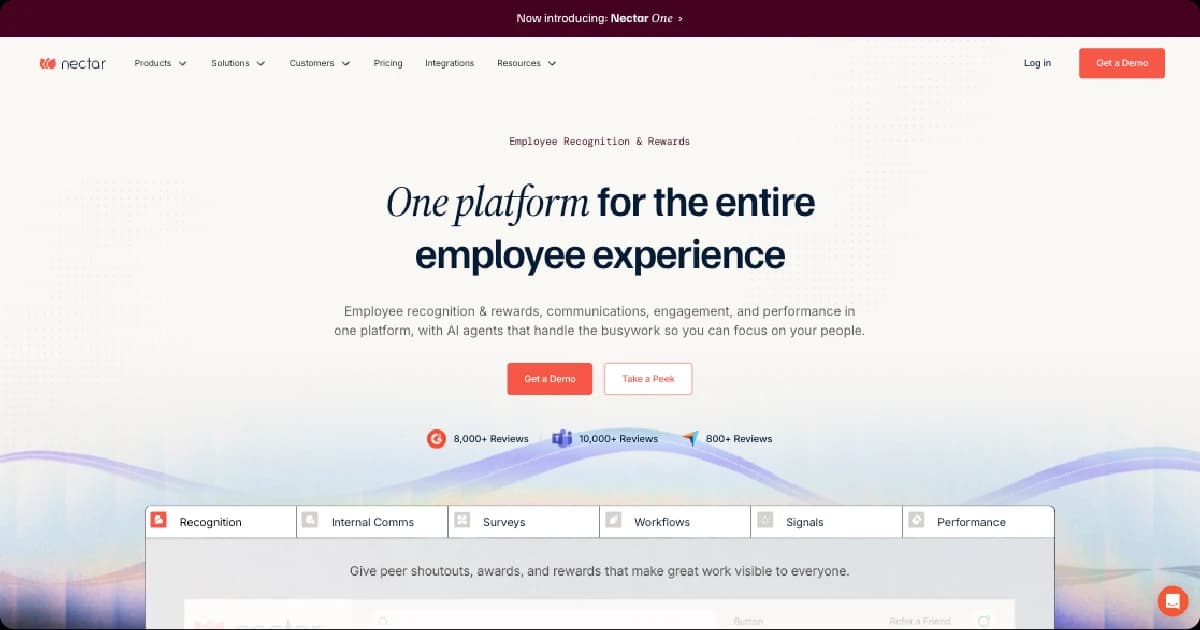
Best for: Small and mid-sized businesses seeking affordable peer recognition with a built-in rewards catalog and Amazon integration.
Like Bonusly, Nectar is a points-based, values-tied peer-to-peer recognition tool. Its differentiator is a broad reward catalog that taps into Amazon Business to give employees a much wider redemption pool. Pricing tends to undercut enterprise tools, making Nectar a common pick by teams looking for affordable recognition software.
- Key features: Points-based peer recognition tied to core values, Amazon Business rewards integration, automated milestone and birthday recognition, company swag store, Slack and Teams integrations.
- Rewards available: Gift cards, Amazon products, company swag, and charitable donations.
- Nectar integrationsOpens in a new tab: Slack, Microsoft Teams, BambooHR, ADP, Amazon Business.
- Pricing: Per-user subscription; pricing requires you to contact sales.
- G2 rating: 4.7/5Opens in a new tab
- Capterra rating: 4.8/5Opens in a new tab
- Choose Nectar if you need affordable per-user pricing, values-aligned peer recognition, and a broad rewards catalog including Amazon products for an SMB or mid-market team.
4. Awardco
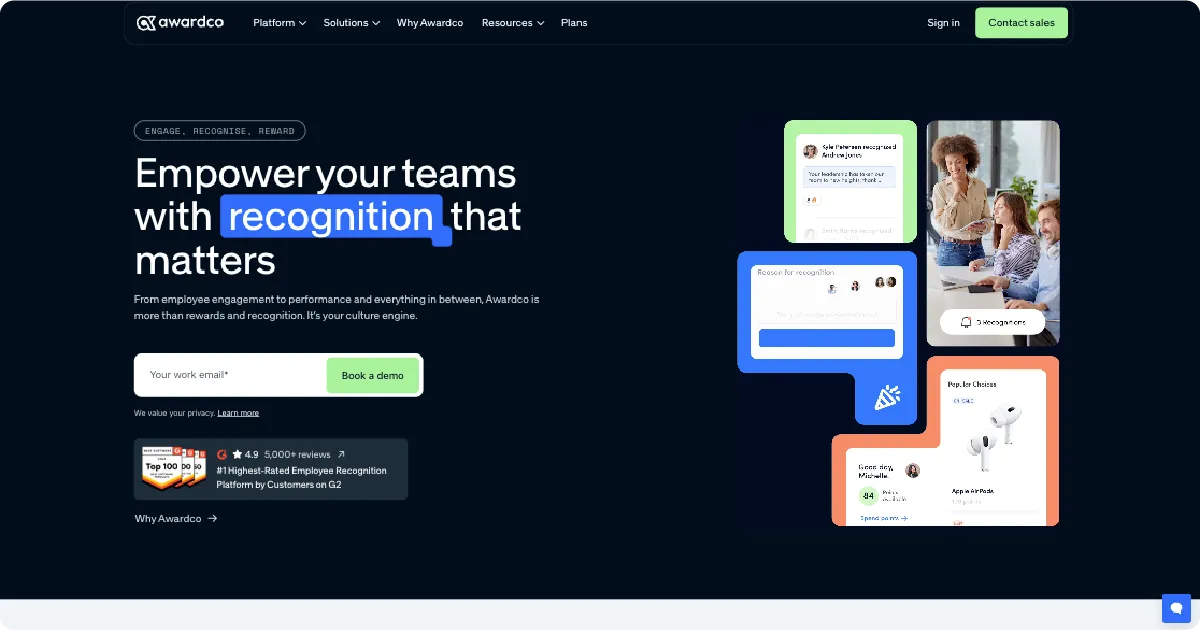
If you want a broad selection of rewards that gives employees more choice, you’ll appreciate Awardco’s extensive catalogOpens in a new tab. Its Amazon Business integration offers employees extensive product options, which means they won't get stuck with rewards they don’t want. Awardco also has recognition and milestone programs, making it a good fit if you’re looking to combine employee recognition with flexible incentives.
- Key features: Peer-to-peer recognition with points, Amazon Business-powered rewards network, service milestone and anniversary automation, incentive and spot-bonus programs, reporting and budget controls.
- Rewards available: Amazon catalog, gift cards, travel, events, swag, and charitable donations.
- Awardco integrations: Workday, ADP, Slack, Microsoft Teams, Amazon Business.
- Pricing: Custom pricing, quoted based on headcount and program scope.
- G2 rating: 4.9/5Opens in a new tab
- Capterra rating: 4.9/5Opens in a new tab
- Choose Awardco if rewards breadth is a top priority, and you want the Amazon catalog available to employees alongside peer recognition and milestone programs.
5. Kudos
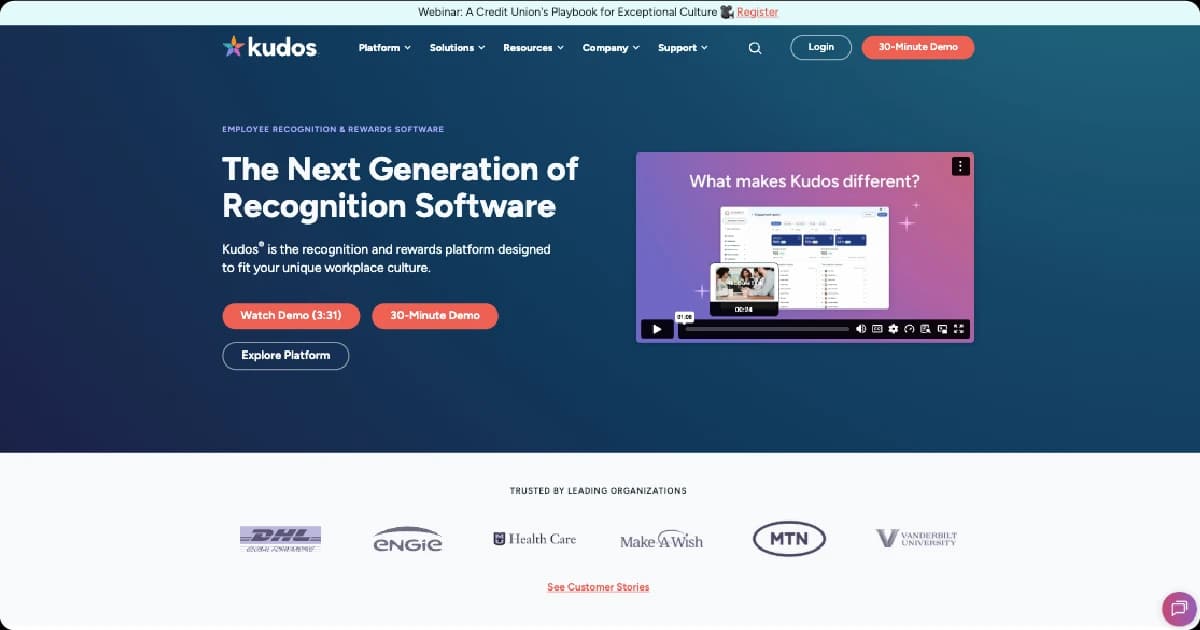
Best for: Culture-focused teams that want values-based peer recognition with or without monetary rewards.
Kudos is built around the recognition messages employees send to one another, not points. Employees tag recognition to specific company values and qualities, which the platform then uses to track culture and sentiment trends over time.
Rewards are optional, and you can toggle them based on how you structure your recognition program, which makes Kudos a reasonable fit if you want to launch a values-based recognition program.
- Key features: Values-based peer recognition messages, recognition levels and qualities, culture and sentiment analytics, optional points and rewards, anniversary and milestone recognition.
- Rewards available: Gift cards, merchandise, and custom rewards when the rewards module is enabled.
- Kudos integrationsOpens in a new tab: Slack, Microsoft Teams, Workday, ADP, BambooHR.
- Pricing: Custom pricing, quoted based on headcount and program scope, and the optional rewards module may be priced separately.
- G2 rating: 4.8/5Opens in a new tab
- Capterra rating: 4.8/5Opens in a new tab
- Choose Kudos if your program prioritizes values alignment and culture-building over point volume, and you want the option to run recognition with or without a monetary rewards layer.
6. Guusto
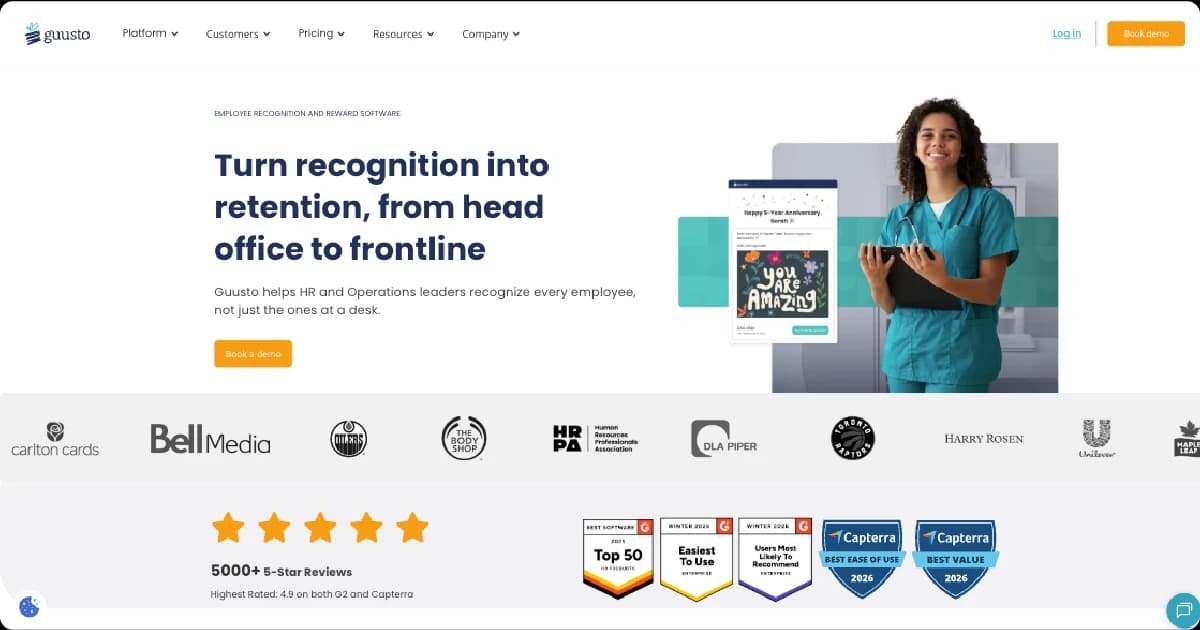
Best for: Companies with frontline and deskless workforces that need recognition and rewards accessible without corporate email.
Most peer-to-peer recognition software assumes every employee has a desk, an inbox, and a Slack account. Guusto doesn’t, so it offers kiosk-friendly access and a mobile option to let employees give and receive recognition without a corporate email address.
Its sender-seat pricing can also lower costs for large frontline workforces because you only pay for employees who send recognition, not for everyone receiving it.
- Key features: Peer and manager recognition, gift-based rewards redeemable at many merchants, deskless and kiosk-friendly access, milestone and nomination programs, budget and approval controls.
- Rewards available: Gift cards redeemable across thousands of merchants and charitable donations.
- Guusto integrationsOpens in a new tab: Slack, Microsoft Teams, ADP, BambooHR.
- Pricing: Sender-seat pricing model; only senders require a paid seat, not every recipient. Free tier available with paid plans starting around $150/month per sender seat.
- G2 rating: 4.9/5Opens in a new tab
- Capterra rating: 4.9/5 Opens in a new tab
- Choose Guusto if you have a large frontline or deskless workforce where per-user seat pricing would be cost-prohibitive, and employees lack corporate email or regular desktop access.
7. Motivosity
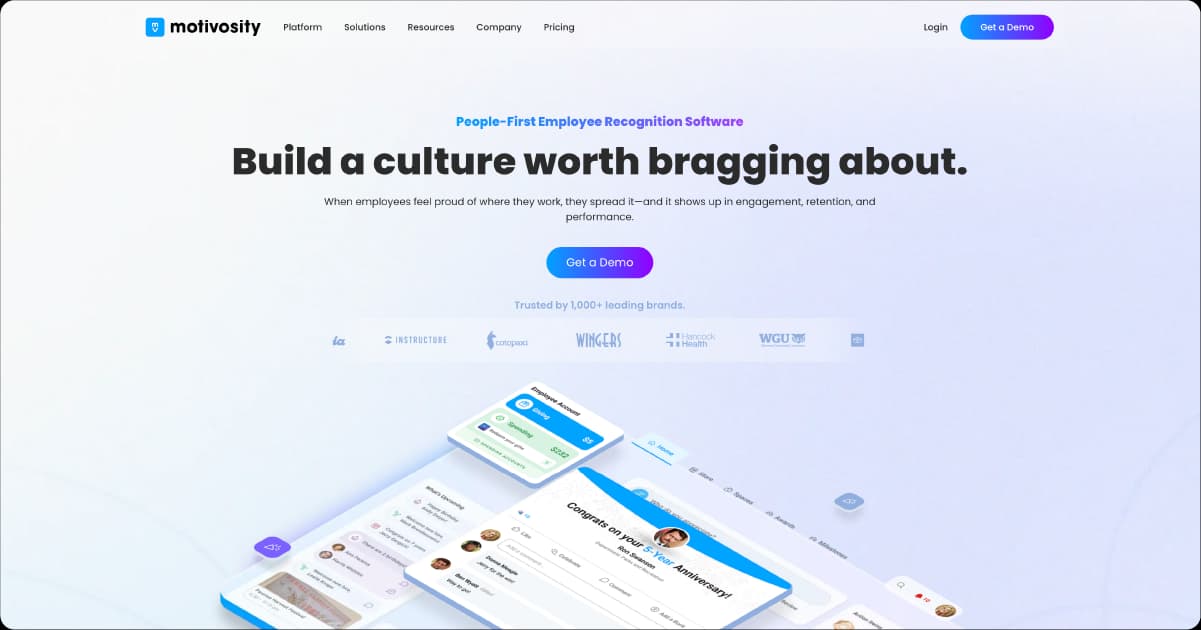
Motivosity pairs a recognition feed with a monetary peer-recognition component that awards employees points or dollars for rewarding their peers. This platform adds modules for manager coaching and engagement surveys, making it a good fit if your company treats recognition as part of a broader people-development strategy.
- Key features: Social peer recognition feed, small monetary peer-recognition component, manager development module, engagement and eNPS surveys, milestone celebrations.
- Rewards available: Gift cards, company-store items, and cash-out options.
- Motivosity integrationsOpens in a new tab: Slack, Microsoft Teams, ADP, BambooHR, Workday.
- Pricing: Custom pricing, quoted based on headcount and program scope.
- G2 rating: 4.7/5Opens in a new tab
- Capterra rating: 4.8/5Opens in a new tab
- Choose Motivosity if you want social peer recognition bundled with manager development and engagement survey capabilities in a modular, mid-market priced platform.
8. O.C. Tanner
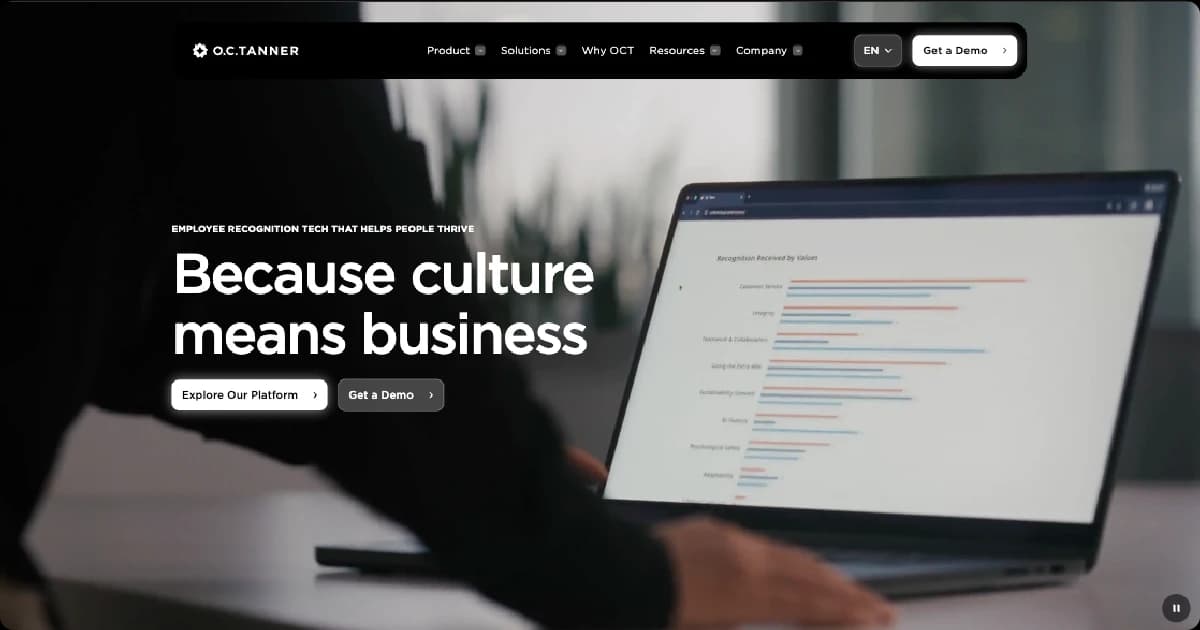
Best for: Large enterprises seeking a research-backed recognition program with strong service-award and milestone capabilities.
O.C. Tanner has been in the recognition and service-awards business since 1945, according to Funding Universe’s History of O.C. Tanner. This history shows in the depth of its milestones and fulfillment infrastructure.
For instance, O.C. Tanner offers Culture Cloud, which adds analytics to peer and career recognition. It also supports global reward fulfillment at a scale that suits large, established enterprises.
- Key features: Peer-to-peer and above-and-beyond recognition, service and career milestone awards, Culture Cloud analytics, yearbook and celebration features, global rewards fulfillment.
- Rewards available: Symbolic awards, merchandise, gift cards, travel, and experiences.
- O.C. Tanner integrationsOpens in a new tab: Workday, SAP SuccessFactors, Microsoft Teams, ADP.
- Pricing: Custom pricing, quoted based on headcount and program scope.
- G2 rating: 4.8/5Opens in a new tab
- Capterra rating: 4.8/5Opens in a new tab
- Choose O.C. Tanner if your enterprise needs a research-backed recognition program with deep service-award fulfillment and Culture Cloud analytics at a global scale.
9. Terryberry
Best for: Organizations that want recognition, service awards, and wellness under one long-established provider.
For more than a century, Terryberry has built its business around employee recognition and rewards. The vendor brings peer recognition, service awards, and wellness programs into a single platform, making it a good fit if you want to manage multiple employee engagement programs through a single provider.
- Key features: Peer-to-peer social recognition, service and milestone awards, wellness challenge programs, points-based rewards, reporting and program administration.
- Rewards available: Gift cards, merchandise, symbolic awards, and custom catalogs.
- Terryberry integrationsOpens in a new tab: Workday, ADP, Microsoft Teams, Slack.
- Pricing: Custom pricing, quoted based on headcount and program scope.
- G2 rating: 4.6/5Opens in a new tab
- Capterra rating: 4.3/5Opens in a new tab
- Choose Terryberry if you want peer recognition, service awards, and wellness challenges consolidated under a single long-established provider to reduce vendor complexity.
Comparison table
What is peer-to-peer recognition software?
According to G2, peer-to-peer recognition software allows any employee, not just managers, to recognize a colleague for their contributions.
Depending on the program design, the recognition may also include an award that the recipient can redeem through the platform's rewards catalog, be tied to company values, and be displayed in a social feed across the organization. Some software offers analytics to track participation and culture trends.
Unlike traditional top-down recognition, peer-to-peer recognition enables employees to acknowledge colleagues across teams and reporting lines, helping surface contributions as they occur.
Peer recognition also differs from standalone rewards and engagement surveys because it records the recognition moment itself and can connect it to reward and recognition analytics. Core components of peer-to-peer recognition include:
- Recognition moments
- Value tagging
- Reward redemption
- Recognition analytics
The recognition stays visible in the platform’s social feed for the whole team to see while the software logs the interaction for participation and engagement analysis.
Key features of the best peer-to-peer recognition software
To narrow down your employee recognition software options, it’s important to identify the features most important to your organization. Here are some of the functions to look for:
- Slack- and Teams-native recognition so praise happens where employees already work
- Points-based peer bonuses with a public social feed to drive frequency and visibility
- Values tagging that connects recognition moments to company culture
- Flexible, localized rewards catalogs and inclusive access for deskless workers
- Recognition analytics that surface participation, sentiment, and culture trends
These features make recognition easier than manual processes. Aberdeen Group’s research, “The Art of Appreciation: Top-Tier Employee Recognition,” found that the best-in-class companies are 1.94 times as likely as others to use technology-enabled online social recognition tools.
Manual recognition can make peer recognition harder to sustain, limiting its potential to support retention. And replacing an employee can run about 20% of their annual salary, making sustained recognition a retention investment.
How to choose the best peer-to-peer recognition software
Once you’ve identified the features you want, compare platforms against your company’s needs and recognition goals. The best peer-to-peer recognition software should fit naturally into how your employees work and how you plan to manage recognition.
Key evaluation criteria
Use these criteria to compare platforms and identify the one that best fits your organization:
Integration fit
Check compatibility with your HRIS and collaboration tools, such as Slack or Teams. Poor integration can create friction that limits adoption.
Recognition depth
Look for a tool that supports diverse recognition needs on a single platform. It should cover peer and manager recognition, milestone celebration, and values tagging to address your different recognition priorities without requiring separate tools.
Rewards flexibility
Choose a platform that gives employees meaningful reward options to match different preferences and recognition occasions. If you have a global team, look for localized fulfillment so employees can redeem rewards that are relevant and available in their area.
Analytics and reporting
Consider reporting that reveals participation, engagement, retention risks, and harder-to-measure insights such as relationship-building and soft skills. Workhuman applies data science and natural language processing to recognition insights.
Its data shows that employees who received recognition in the last month are nearly twice as likely to be highly engaged, nearly three times as likely to find meaning in their work, and four times as likely to be happy at work.
Frontline and deskless worker access
If you’re looking for frontline workers recognition software, prioritize platforms that offer QR code or kiosk login options and a mobile-first design. If your workforce is deskless, these access options make it easier for employees to participate in recognition without relying on a desktop or work email.
Global and distributed access
Look for features that make recognition accessible across locations and work arrangements so distributed teams can participate on equal footing. Cisco’s global peer-to-peer recognition program reported 85% employee participation in year one across nearly 400 locations and 7,000 employees, using globally redeemable, culturally relevant rewards.
If you are looking for a global recognition software program, check that your vendor is built for multi-country rollouts.
Budget and pricing considerations
Your subscription is only part of the total cost. When you’re comparing peer recognition software, consider the following.
- Software vs. reward costs: Separate the platform subscription fee from the budget you allocated for employee rewards.
- Pricing model: Per-user pricing can suit SMBs, while sender-seat pricing may be more practical for large frontline teams. Global rollouts may require custom enterprise pricing.
- Implementation and administration: Factor in setup costs, ongoing admin work, and support tiers when comparing vendors.
- Budget controls: Look for admin controls that allow you to set fixed monthly point allowances, limit spending, and prevent point inflation from exceeding budget limits.
- Security standards: Since a peer-to-peer recognition platform handles employee data, confirm that the vendor has an SOC 2 certification.
How to implement peer-to-peer recognition software
Even the best peer-to-peer recognition tool will fail to make a positive impact if you don’t roll it out properly. Here are six best practices for employee recognition programs for successful implementation.
Step 1: Define program objectives
Set clear goals and tie recognition to specific company values before launch. This alignment helps employees understand which behaviors deserve recognition and how those actions reinforce the culture you’re trying to build.
Step 2: Secure leadership buy-in
Get leaders involved early in your peer recognition by securing a budget and agreeing upfront on how often employees should be recognized. Meaningful, company-wide recognition requires deliberate investment to fuel widespread participation and long-term impact.
Step 3: Configure integrations
Connect your peer-to-peer recognition platform to the tools your organization already uses, such as Slack, Microsoft Teams, and your HRIS, so recognition fits naturally into existing workflows. Then configure your company’s values, recognition tags, and reward tiers to reflect how you want employees to recognize and reward one another.
Step 4: Launch recognition inside existing chat tools
Introduce recognition through Slack or Microsoft Teams before asking employees to adopt the standalone peer recognition software. This integration-first sequence reduces the time needed to learn a new platform at the outset and lowers the risk of low adoption. You can introduce additional features and channels as participation grows.
Step 5: Communicate and train stakeholders
Explain how the peer recognition software works and what behaviors employees should recognize. Train managers and employees on the platform and recognition guidelines, then seed early recognition to show what good participation looks like.
Step 6: Track adoption from day one
Monitor participation and recognition activity to track adoption and identify where engagement is lagging. Once your program is live, use recognition data to identify performance and retention signals, then apply the insights to refine your program and inform future recognition budgets.
For instance, Human Intelligence™ from Workhuman uses AI to uncover hidden insights that help you identify leaders, predict performance, and understand risk in recognition data.
FAQs
What is the best peer recognition software for Slack or Microsoft Teams?
Bonusly and Nectar run natively in Slack and Teams, making them a good fit if you want recognition to happen where employees already work. Workhuman and Motivosity also integrate with both tools, but add more analytics and program depth for large organizations.
How much does peer-to-peer recognition software cost per employee?
Per-user pricing for lighter tools like Bonusly or Nectar usually starts at $3–5 per employee per month, excluding reward funding. Guusto only charges for employees who give recognition, while Workhuman, Awardco, and O.C. Tanner use custom, quote-based pricing.
What is the difference between peer-to-peer recognition and manager-led recognition?
Peer-to-peer recognition lets any employee recognize a colleague, while manager-led recognition flows from a manager down to a direct report.
Can peer-to-peer recognition software integrate with Slack, Microsoft Teams, and our HRIS?
Yes, most peer recognition platforms integrate with Slack and Microsoft Teams and support major HRIS systems, but confirm that a platform supports your specific HRIS before committing.
Does peer-to-peer recognition improve employee retention and engagement?
Yes. According to Workhuman, employees recognized in the last month vs. never recognized are nearly twice as likely to be highly engaged and more than four times as likely to be happy at work. Longitudinal research from Gallup and Workhuman, titled “Recognition and Retention: New Evidence of Recognition’s Long‑Term Impact,” similarly found that well-recognized employees are 45% less likely to leave within two years.

Ryan Stoltz
Ryan is a search marketing manager and content strategist at Workhuman where he writes on the next evolution of the workplace. Outside of the workplace, he's a diehard 49ers fan, comedy junkie, and has trouble avoiding sweets on a nightly basis.
Recommended for you