
The Best Employee Recognition & Engagement Software for Frontline and Deskless Workers
by Ryan Stoltz
Last updated
10 min read
Table of contents
- Why frontline workers are underserved by most recognition platforms
- The business case: What's at stake when frontline workers go unrecognized
- What to look for in employee recognition software for frontline workers
- Industry-specific considerations
- How Workhuman supports frontline and deskless employee recognition programs
- Questions to ask vendors (buyer's checklist)
- FAQs
- Recognition equity starts with access
Share this article
Though employers are increasingly aware of how recognition affects employee engagement and longevity, that understanding doesn't always translate to effective recognition programs. Most platforms are best-suited to people sitting at desks and using company email addresses, but the vast majority of the global workforce, roughly 80%, doesn't work under those conditions.
Employee recognition software for frontline workers allows organizations to reach workers who don't spend most of their time in an office, whether they're nurses, drivers, plant operators, or retail associates.
Turnover costs for frontline workers are high, and recognition is one of the best tools to improve retention without making drastic compensation changes. This guide will introduce you to the most important features to look for in recognition software for a deskless or mixed workforce.
Why frontline workers are underserved by most recognition platforms
Many employee recognition programs operate on the assumption that employees have regular access to software via a desktop. They also assume workers rely on a single device to interact digitally with their managers throughout the day.
However, that's not the reality for the frontline employees who make up more than 80% of the global workforce. Whether they work in manufacturing, healthcare, retail, hospitality, education, service industries or others, these workers are not as well served through a typical recognition and rewards platform. Most solutions don’t meet the needs of frontline staff because of:
- Technology dependency: Many deskless employees can't access an on-site network during their shifts, and some have no way to check their emails. This means they miss out on digital recognition through standard platforms, which leaves them feeling unrecognized or like an afterthought.
- Manager adoption gaps: Many frontline managers don't spend much time at a desk, either. If a manager finds it difficult to use a platform on the floor or in the field, they may fail to offer much timely recognition to their team.
- Mobile limitations: Frontline workers often have limited or no internet connectivity, even if they have access to mobile devices. This makes it more difficult to offer on-the-go recognition and ensure they receive it during their shifts.
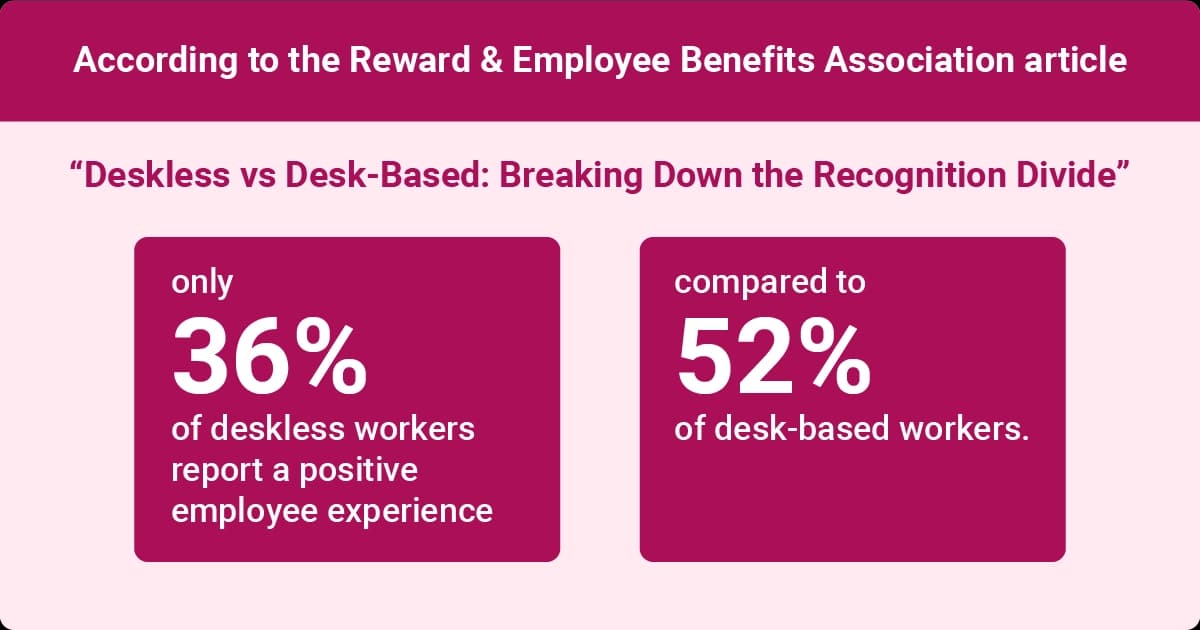
These issues with recognition contribute to a larger problem with frontline engagement and job satisfaction. According to an article from the Reward and Employee Benefits Association, titled “Deskless vs desk-based: breaking down the recognition divide”, only 36% of deskless workers report a positive employee experience, while 52% of desk-based workers feel good about their experience at work.
On top of that, only 30% of deskless workers state they feel valued compared to 69% of corporate workers.
The business case: What's at stake when frontline workers go unrecognized
When a deskless workforce doesn't receive the recognition they need or deserve, the effects can be severe. As engagement and enthusiasm drop, employees are more likely to leave their jobs and seek new ones.
Retention and financial consequences
Lowering turnover is critical to preventing operational disruptions and productivity losses. In addition, problems with retention can cause serious financial damage. According to a survey by PWC, “Manufacturing talent strategy and frontline employee experience”, 36% of manufacturers experienced frontline employee attrition rates above 10%
.
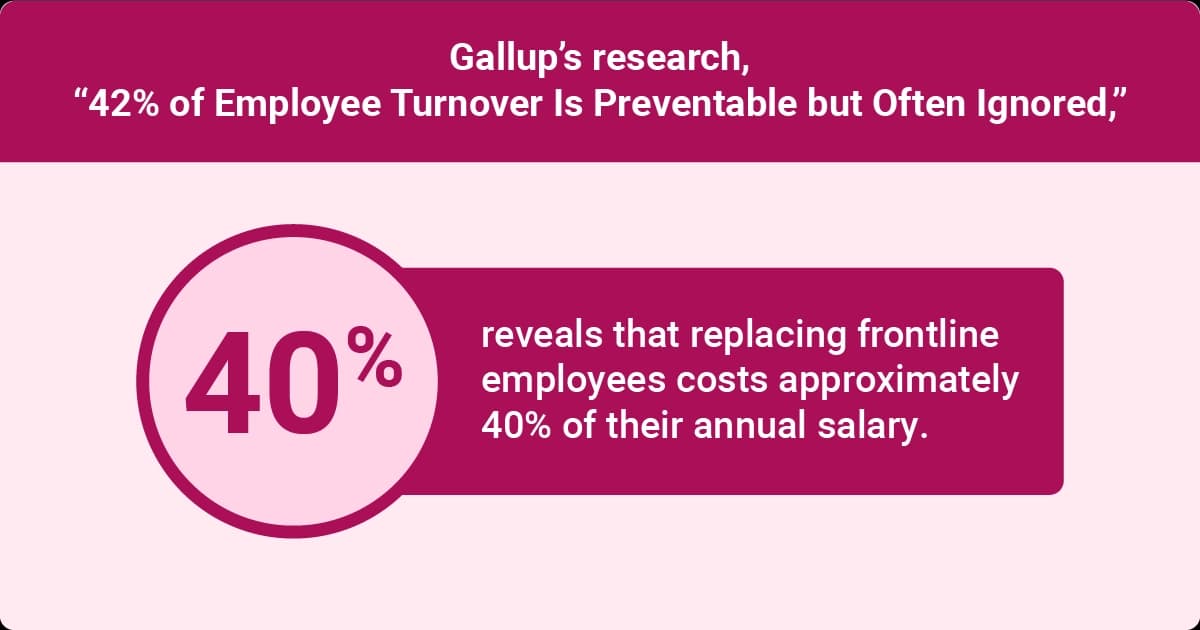
The Gallup research, “42% of Employee Turnover Is Preventable but Often IgnoredOpens in a new tab”, reveals that replacing frontline employees costs around 40% of their annual salary, so replacing this number of workers each year can rapidly drain a company's resources.
Impact on performance
A lack of recognition widens the existing engagement gap between desk and non-desk workers. The Staffbase Employee Communication Impact Study, revealed that only 9% of deskless workers are very satisfied with their workplace's internal communications, a core component of employee recognition and engagement.
In contrast, 47% of desk-based employees are happy with the level of internal communication in their workplace. When frontline employees receive lacking or inconsistent recognition, their satisfaction with the company culture and communication processes worsens further.
The level of engagement and satisfaction has a direct impact on employee performance. When poor recognition leads to lower engagement, performance consequently suffers. On the other hand, high employee engagement in healthcare can translate to better patient care, while strong employee engagement in manufacturing may result in fewer mistakes on the floor.
Cultural concerns
An improperly managed recognition program can also negatively affect the diversity, equity, and inclusion (DEI) in the workplace. When recognition is inequitable, it may contribute to an unhealthy work environment.
For instance, some companies implement digital-focused recognition platforms that prioritize desk workers and are less accessible to hourly or shift employees. This creates a two-tier culture that leaves some employees feeling unappreciated. If unaddressed, it can create or worsen resentment between employees and make collaboration more challenging.
What to look for in employee recognition software for frontline workers
Developing a solid peer-to-peer recognition program begins with choosing the right software, but you have to consider more than price and basic features when dealing with a frontline or deskless workforce.
The most important quality of any deskless recognition solution is that it meets YOUR employees where they are. How you get there is likely to be different for any employee population, so you’ll want to find a solution with a flexible approach that can be calibrated to fit your workforce. You’ll also want to find a vendor with an experienced, full-service consulting group that can help you to meet those needs.
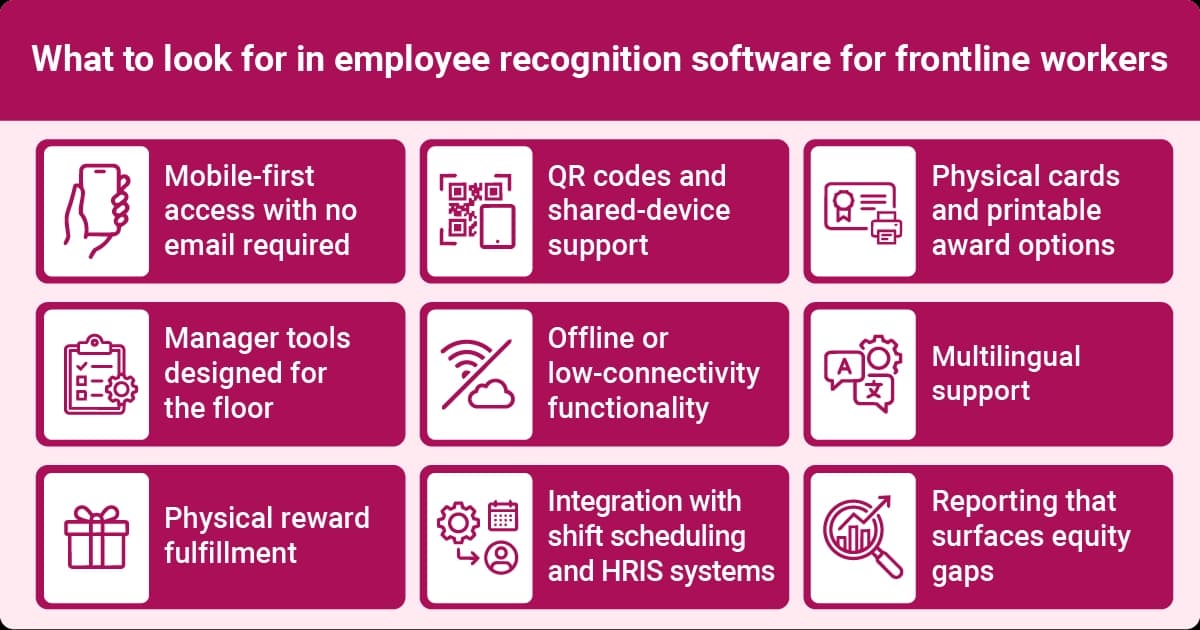
Here are some examples of recognition options a recognition vendor can deploy to help meet your employees' needs:
- Mobile-first access with no email required: Any program you choose should have a native iOS or Android app or allow for an SMS or phone-number-based login. Eliminating dependency on company email makes it easier for frontline workers to access the system even if they don't have an official company account.
- QR codes and shared-device support: Many workers in industries such as healthcare and manufacturing are prohibited from carrying personal mobile devices on the floor. It’s possible to address that issue by making recognition accessible from a shared device, such as a tablet or break room kiosk, or by posting a printed QR code onsite.
- Physical cards and printable award options: These in-the-moment tools are distinct from traditional reward catalog fulfillment, allowing supervisors to hand an employee a physical recognition card or print an award certificate as instant praise. This is critical in environments where digital access is limited or nonexistent. Ask providers whether their program includes this as a standalone capability instead of a limited part of their rewards redemption flow.
- Manager tools designed for the floor: Look for a platform that allows for quick recognition on mobile devices rather than limiting it to a multistep workflow completed by a desk-based manager. This includes the ability to issue recognition in under 60 seconds from a phone without having to log into a full platform or use a browser.
- Offline or low-connectivity functionality: Companies that need to offer recognition to employees in places with limited signal, who work on plant floors, or who spend a lot of time at remote sites, should look for a solution with offline recognition capabilities. Workers can enter recognition information at any time, and the system will automatically submit it as soon as it's online again.
- Multilingual support: Frontline workers are often linguistically diverse, and providing recognition in their native language fosters a more positive, welcoming environment. Choose an employee recognition platform that supports multiple languages so employees from all backgrounds feel respected and can get the full benefit of the program.
- Physical reward fulfillment: While many platforms center around digital rewards, the best solutions should accommodate employees with limited internet access. Gift cards and merchandise, which you can share through physical delivery rather than over email or through an app, are especially important when employees don't have reliable online access to redeem their recognition rewards.
- Integration with shift scheduling and HRIS systems: A recognition platform capable of integrating with your Human Resources Information System (HRIS) allows you to automate rewards for employee milestones. Choose a system that can tie to scheduling data from platforms such as UKG or Workday.
- Reporting that surfaces equity gaps: A high-quality recognition platform allows leaders in your organization to see how recognition rates break down by shift and location, as well as employment type. If that level of analysis isn't possible, you won't get a clear picture of which employees aren't receiving fair recognition.
In addition to asking providers about their software capabilities, request a demo or free trial so you can see firsthand whether they meet these criteria.
Industry-specific considerations
Manufacturing and logistics
Many manufacturing and logistics companies prohibit employees on the floor from carrying mobile devices, including smartphones and tablets. While those rules are critical to maintaining a safe workplace, they also make it more difficult for managers to use a platform to offer frequent recognition.
Recognition equity can also fall short based on when and where employees work. For instance, day-shift workers tend to receive more regular recognition than those working evenings and nights because managers may not be on site during later shifts.
The right employee recognition ideas for manufacturing allow you to adjust your approach and address these and other issues without completely restructuring your recognition program. Here are some features that can help.
- On-the-spot rewards: Manufacturing companies and logistics organizations often tie frontline recognition to safety milestones and production goals, but fail to take into account individual employee contributions and accomplishments. Along with celebrating milestones, supervisors can offer spot rewards to employees who are upholding safety rules or demonstrating great performance by handing out tangible rewards such as company swag or giving peer-to-peer shoutouts. It’s an incredible way to underscore those big initiatives.
- Union involvement: Many manufacturing companies have unions, and they may respond negatively to recognition programs because of potential favoritism. If your employees are unionized, consider involving union representatives in the development and implementation of your recognition platform so they can help ensure it's fair and equitable to all employees.
- Centrally managed platforms: Employees working in different regions or countries may not have access to the same types of physical rewards as their colleagues, and financial incentives may not be equivalent based on local currencies. Select a multilingual platform that allows you to choose reward items based on regions, and, if possible, partners with local suppliers for the delivery of physical rewards.
A strong recognition platform like Workhuman can help you achieve these goals.
Healthcare
Healthcare employees often work rotating or irregular hours, and in a facility requiring 24/7 coverage, managers may find it difficult to provide consistent recognition across all shifts. Organizations in this industry also have special regulatory concerns at play, which can make issuing cash rewards more complicated.
Third-party platforms without the proper security measures could result in data breaches, putting confidential employee information at risk and potentially violating regulations such as the Health Insurance Portability and Accountability Act (HIPAA). Select a program with appropriate security, including encryption, to maintain compliance with regulations.
The areas of recognition in healthcare tend to differ from other industries. For example, employees may receive acknowledgment for their emotional labor as well as their productivity and output.
Tailoring workplace recognition to specific functions instead of issuing generic employee rewards can better support healthcare workers. For instance, you might offer time-based rewards such as priority shift selection for clinical staff, while giving administrative staff a team lunch to celebrate their accomplishments.
Retail and hospitality
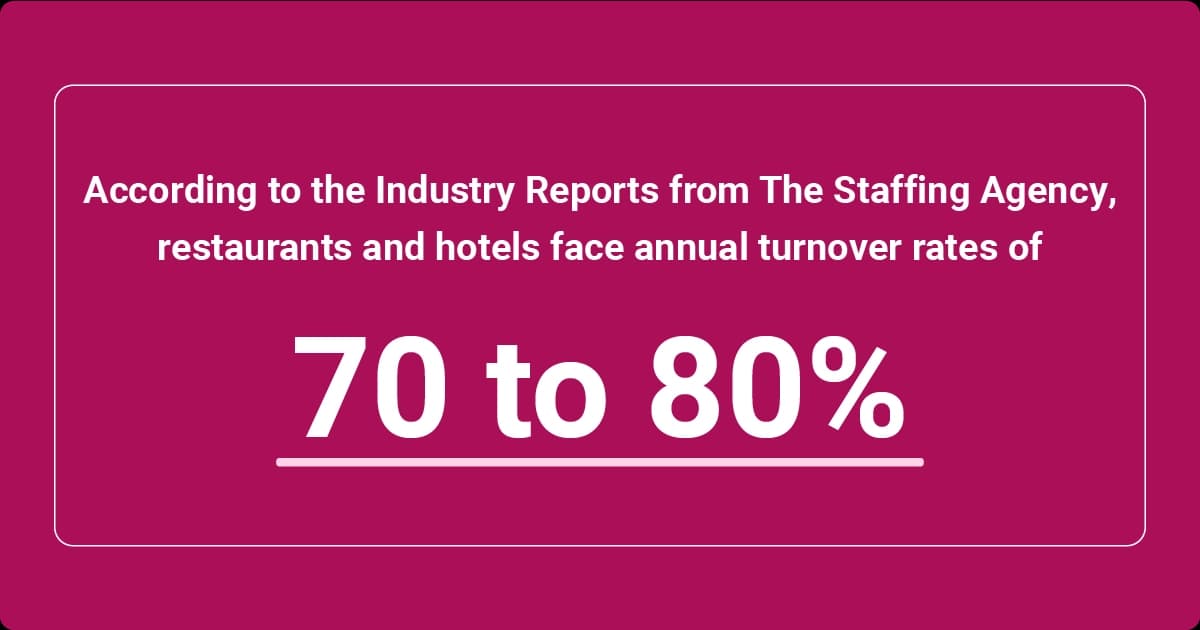
Companies in the retail and hospitality industries often have problems with turnover and frequently bring in temporary employees for seasonal work. According to the Industry Reports from The Staffing AgencyOpens in a new tab, restaurants and hotels face annual turnover rates of 70 to 80%.
High turnover makes it hard to maintain consistent recognition programs, while low recognition contributes to higher turnover. This vicious cycle can have serious financial repercussions.
Because retail and hospitality companies tend to have multiple locations, achieving consistency is also key. Using a centralized platform gives employees at all sites access to the same rewards and recognition while maintaining your branding across the frontline workforce.
How Workhuman supports frontline and deskless employee recognition programs
Workhuman wants to see every employee succeed and receive recognition, whether they spend eight hours a day at a desk or are on their feet all shift. The platform's design allows you to issue meaningful rewards and connect with your workforce no matter where or when they work.
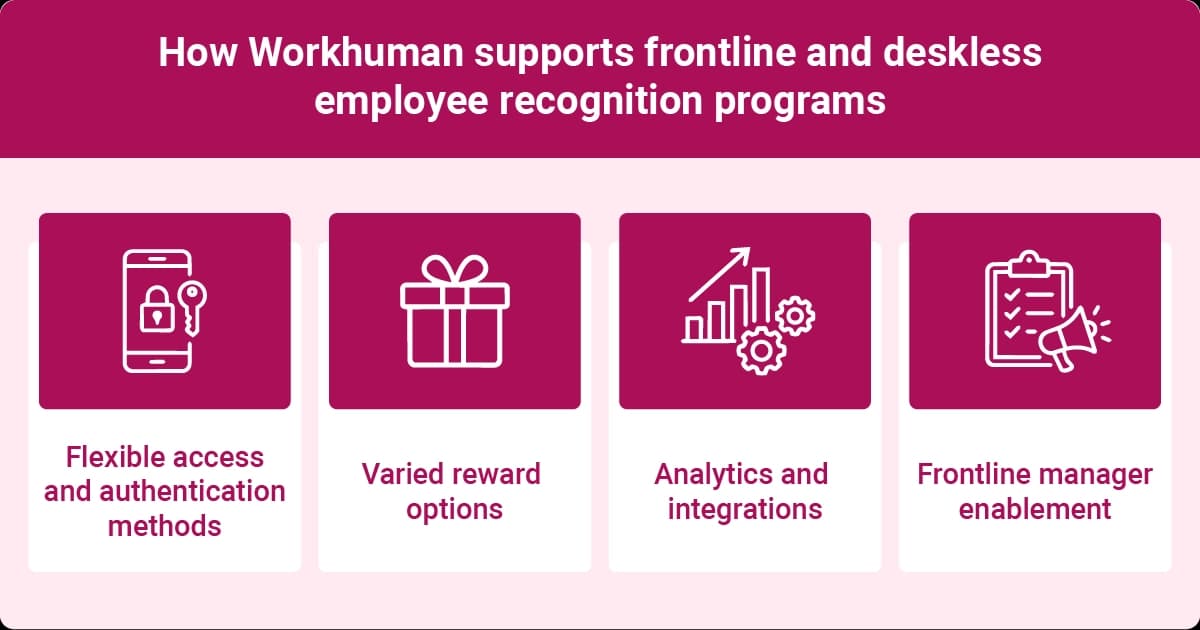
Flexible access and authentication methods
Making recognition software accessible is crucial, so Workhuman offers a mobile app with no email dependence required for employee participation. This means workers without company email addresses can fully participate at the same level as workers who work at their desks. Workhuman also has QR-enabled, low-friction flows and kiosk access options to meet the needs of frontline employees who can't use dedicated devices.
Workhuman prioritizes security and protects employee privacy. Claiming and identity verification processes ensure the right employee receives the rewards they've earned. On top of that, the platform's compliance and governance align with existing nomination flows to keep employee information safe.
Varied reward options
Finding the best types of rewards is central to the success of your recognition program, and each organization's needs are unique. Workhuman offers a global rewards catalog alongside a wide range of options for frontline workers, including physical cards and printable awards for in-the-moment, floor-level recognition, ideal for engaging offline workers.
Automated rewards simplify the recognition process and make it more consistent. Workhuman has automation for service milestones for onboarding and work anniversaries, as well as life-cycle events. These automations are available not only for office employees but also for those who never log into a desktop system.
Analytics and integrations
With Human Intelligence™, you can get a deeper understanding of recognition equity by location, shift, or employee segment. As a result, you can more quickly address inequities so employees receive fair recognition.
Workhuman also offers HRIS integrations with systems such as UKG, Workday, SAP SuccessFactors, Slack and Microsoft Teams. Connecting these systems enables automated milestone recognition without manager action, taking tasks off your busy managers' plates.
Frontline manager enablement
Workhuman's platform covers every aspect of frontline employee recognition, but technology is only half the equation. No matter how well the software works, your team still has to get on board.
Some companies assume employee engagement is the biggest obstacle. However, frontline manager adoption can be the most common bottleneck when rolling out a meaningful recognition program.
To support frontline manager onboarding and behavior change, Workhuman offers training and communication resources to organizations implementing the platform, including those rolling out the software to a mixed workforce. Walking managers through the software shows them how fast and simple it is to offer recognition.
At the same time, the platform is designed to make recognition easy enough that a floor supervisor can use it during their shift without taking their time or attention away from other important work.
Questions to ask vendors (buyer's checklist)
Research is an important step when choosing an employee recognition platform, especially if frontline access is a requirement. Before you commit to a solution, ask potential providers to address these key points:
The answers to these questions will guide your decision and help you find the most effective software for your company. The right platform supports your recognition program to ensure all your employees, whether in the office or out on the floor or in the field, feel valued and appreciated.
FAQs
Can employee recognition software work without company email addresses?
Yes, some employee recognition platforms offer email-free authentication options, such as QR codes and phone numbers. These modern platforms can handle mixed workforces where a significant number of employees lack access to a company email address. For example, Workhuman includes a mobile app and supports recognition access through break room kiosks, shared devices, and paper nomination forms.
How do you recognize employees who work in areas with no internet connectivity?
You can recognize employees without internet access by using a recognition platform with limited connectivity functionality. Offline apps allow employees to enter recognition information at any time, with automatic delivery as soon as they're back online. Managers can also give out physical cards and printable awards to workers, offering support and recognition without requiring device access. Seek a platform that allows for instant digital recognition but also offers alternative methods without assuming everyone is constantly online or at a desk.
What types of rewards work best for frontline and hourly employees?
Physical rewards are an ideal solution for frontline and hourly employees because digital-only reward systems may fall short for them or be difficult to access on the job. Rewards you can deliver directly to employees, such as gift cards and merchandise with local fulfillment, are popular options. Non-cash recognition is also a valuable tool, so look for a recognition platform featuring milestone certificates and peer shoutouts.
How do you get frontline managers to actually use a recognition platform?
Convincing floor managers to adopt an employee recognition platform is easier when the software has a mobile-first design. This makes the recognition process fast enough to fit into a shift handoff or floor walkthrough. Workhuman emphasizes the importance of clear communication with managers about why recognition is necessary for the company's success and provides thorough training so they feel comfortable using the platform.
How can HR leaders tell if recognition is reaching their frontline workforce equitably?
Analytics are vital to understanding whether all your employees are benefiting equally from your recognition program. Look at metrics such as recognition rates by shift, location, employment type, and tenure, and identify gaps where workers aren't receiving the recognition they deserve. Workhuman's Human Intelligence analytics allow you to analyze these and other metrics so you know how well the system is working.
Recognition equity starts with access
Employee recognition software for deskless workers represents more than a fun technological advancement for your company. It's a simple but powerful way to address structural equity issues within your organization, including problems you didn't know existed. In addition to offering a variety of recognition features, a good platform will make them accessible to every employee across the company, no matter their role or shift.
Workhuman is built for a world where deskless and frontline workers receive the same recognition as their in-office peers. Schedule your demo today to learn more about our Frontline Recognition platform.

Ryan Stoltz
Ryan is a search marketing manager and content strategist at Workhuman where he writes on the next evolution of the workplace. Outside of the workplace, he's a diehard 49ers fan, comedy junkie, and has trouble avoiding sweets on a nightly basis.
Recommended for you