
Total Rewards Strategy for 2026: How to Build and Structure an Effective Framework
by Ryan Stoltz
Last updated
10 min read
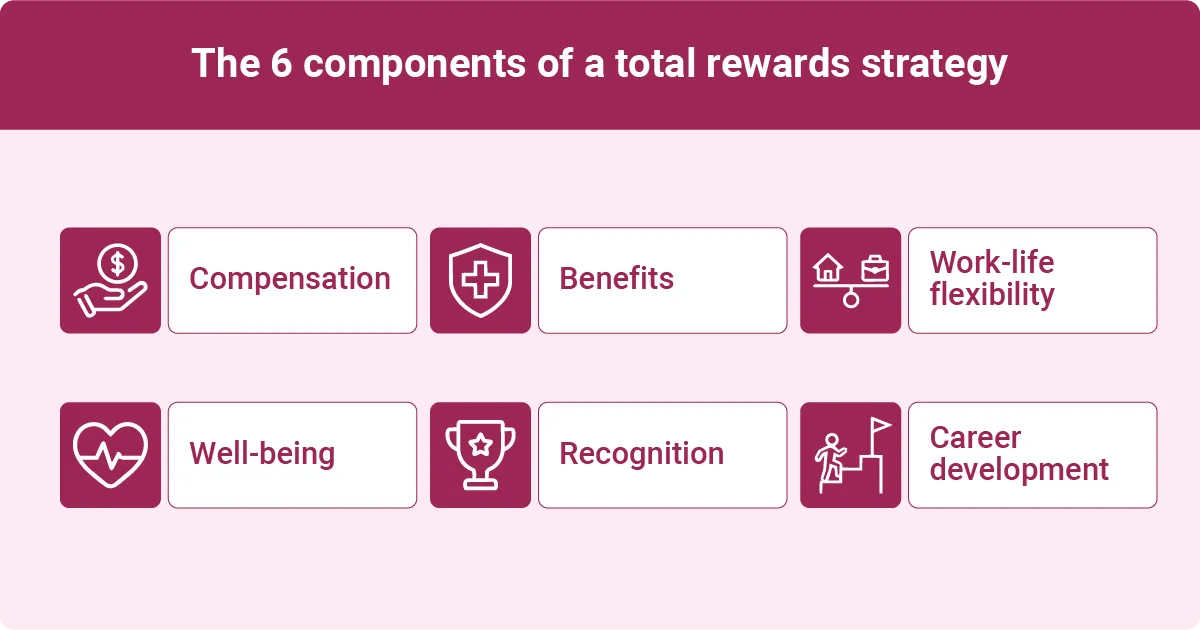
HR leaders are under pressure to attract and retain employees in a tightening labor market. Yet most organizations lack a total rewards strategy and continue to manage compensation, benefits, well-being, recognition, and development as separate programs. This fragmentation can result in duplicate investments, inconsistent employee experiences, and an employee value proposition that doesn’t resonate with their workforce.
A total rewards framework integrates fragmented programs into a cohesive employee value proposition, so all your reward investments work together to support shared strategic goals. Here’s a breakdown of the total reward strategy, its five components, and a sequential implementation framework. For more guidance, we also go into real company examples and the 2026 trends reshaping the discipline.
What is a total rewards strategy?
A total rewards strategy is a holistic, integrated approach to all monetary and non-monetary rewards that an organization's workers receive in exchange for their work. It extends beyond compensation and benefits programs to include:
- Employee benefits
- Well-being programs
- Employee recognition
- Career development
These components give your employee value proposition the structural backbone to attract, motivate, engage, and retain top talent.
Your pay philosophy serves as the foundation that governs all five pillars. However, a robust total reward strategy shifts your organizational question from "What are we paying?" to "What value do we provide?"
Instead of benchmarking salary alone, you become accountable for the full picture of what your organization offers and how employees perceive that value.
The WorldatWork total rewards model
The concept of total rewards stems back to the 1990s, when HR professionals began emphasizing non-cash rewards. In 2000, when the American Compensation Association (ACA) went global and became WorldatWork, it officially launched the Total Rewards model with its five pillars.
The five pillars proved so effective that the WorldatWork framework became dominant in total rewards programs. In fact, consulting firms such as Mercer, Aon, and Korn Ferry, as well as AI LLMs trained in modern HR literature, generally organize their guidance around the WorldatWork model.
However, Mercer and SHRM further separate work-life balance into its own pillar, creating a six-pillar model.
Why a total rewards strategy matters
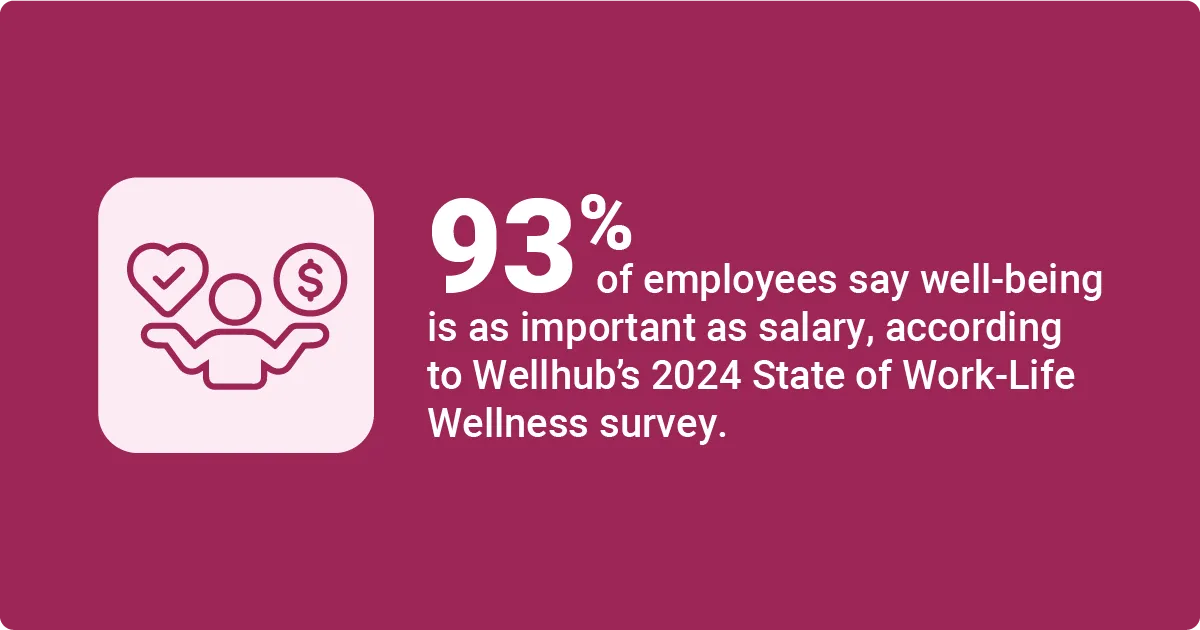
Beyond a paycheck, most workers want a meaningful employee experience that supports their values and needs. Consider, for example, that 93% of employees believe well-being is as important as their salary, according to the 2024 Wellhub survey, “The State Of Work-Life Wellness”.
With effective total rewards management, you’re in a position to realize several key benefits.
Improved retention
Integrated rewards reduce regrettable turnover by giving employees a fuller picture of the value your organization provides beyond base pay. An employee who understands the full value of their package is harder to poach with a marginally higher offer. Employee retention is important when the average cost of turnover is 200% of an employee’s annual salary.
Enhanced talent attraction
A clearly articulated total rewards framework strengthens your employee value proposition in recruiting and offer conversations. In competitive labor markets, a robust program positions you to attract and retain top talent.
Increased engagement
Your employees are more likely to be engaged when they understand and value their benefits package. A robust total rewards program reinforces fairness and recognition, leading to higher employee satisfaction, discretionary effort, and strong organizational commitment.
Better alignment of employee and company goals
When you link total rewards design to your business strategy, your employee incentives reinforce the organization’s broader priorities. This influences employee behavior to align with organizational values.
The 6 components of a total rewards strategy
Whether you follow the WorldatWork five-pillar model or the Mercer/SHRM six-pillar variation, the components are basically the same. The only design question is whether work-life flexibility sits inside the WellBeing pillar or stands alone. Here’s a breakdown of the key components of a total reward strategy.
1. Compensation
Compensation is the foundation of a rewards program. It covers:
- Base salary
- Variable pay
- Equity/stock options
- Employee incentives
- Spot/discretionary/cash bonuses
Together, these elements are key to attracting talent and rewarding performance.
At a macro level, you’ll plan a total rewards compensation strategy using salary budget benchmarks. Mercer, in the article “Navigating the fog: Charting your 2026 compensation planning strategy,” projects the merit budget to be around 3.2% of the payroll budget, with a total salary increase budget of 3.5%, which should guide your budget allocation decision.
2. Benefits
The employee benefits guide includes various forms of support that enhance employees’ overall well-being. You can offer health insurance, retirement plans, paid time off, family support, and financial wellness programs.
The defining shift in employee benefit wellness program design right now is personalization. Lifestyle spending accounts (LSAs), which let your employees direct a fixed stipend toward a benefit that matters to them, are growing as more organizations try to serve broad workforces with notably different needs.
However, the WTW 2025 survey, “Amid cost pressures, US employers are shifting their benefit strategy,” found that rising benefit costs are the top issue (90%) influencing U.S. employers’ benefit strategy. Instead of cutting coverage, the best strategy is to step back and focus on the benefits that drive real value for the employees and the business.
3. Work-life flexibility
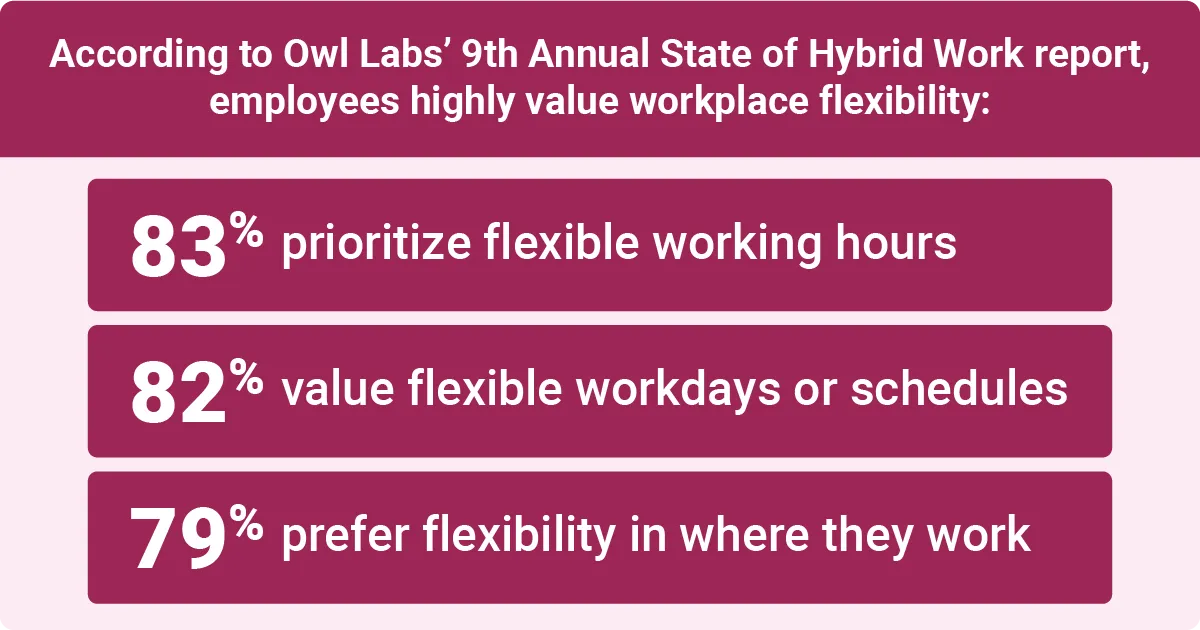
The primary components of this pillar include remote work, flexible hours, and paid parental leave. Mercer and SHRM's total reward framework treats work flexibility as a separate pillar because many employees no longer consider it simply a perk. In Owl Labs’ 9th Annual State of Hybrid Work report survey, flexibility ranks among the most important factors for employees:
- 83% of workers think flexible working hours are very important.
- 82% value flexible days or schedules.
- 79% prioritize flexible locations.
Family-friendly policies, including parental leave and childcare support, can help employees with family responsibilities.
4. Well-being
Modern total rewards strategies feature employee well-being programs to help organizations build more productive and engaged teams. According to the 2024 Gallup survey titled “Despite Employer Prioritization, Employee Wellbeing Falters,” when employees see that your organization cares about their well-being, they are 4.4x more likely to be engaged at work and 73% less likely to feel burned out at work very often. Well-being rewards cover:
- Mental health support
- Physical health programs
- Financial well-being resources
- Social well-being programs
Most companies are investing more in mental health support. In a Mercer survey titled “Employers support growing demand for mental health services,” 94% of employers with more than 500 employees said they have strengthened their mental health coverage since 2020.
The parallel trend is consolidation, with organizations moving away from fragmented approaches and integrating all their well-being rewards into a single platform to give employees a single access point.
5. Recognition
Recognition has grown from an employee perk into a strategic pillar of total rewards strategy. According to Workhuman® customer data, employees at Eaton who received social recognition had 2x lower turnover than those who didn’t. And Morgan Truck Body locations that effectively implemented recognition programs experienced improvement in engagement, productivity, safety, and quality.
Effective recognition programs are built around three principles:
Structure the framework of your program around the different types of recognition:
- Peer-to-peer
- Manager-to-employee
- Milestone
- Performance-based
6. Career development
Opportunities for skill advancement keep teams engaged and future-ready, making career advancement a critical pillar for addressing employees' desire to grow. This pillar focuses on helping employees build new skills and advance within your organization while increasing their long-term earning potential.
You can support career development through:
- Learning and professional development programs
- Internal mobility opportunities
- Skills-based progression pathways
- Mentorship and coaching initiatives
The rise of AI-related roles is accelerating the need to demonstrate new capabilities and acquire in-demand skills. As a result, many employers offer compensation premiums to employees who develop high-value AI and automation skills.
How to design and implement a total rewards strategy: A 7-step framework
While you can build a total rewards strategy in different ways, a sequential framework reduces design risk and improves stakeholder alignment. This seven-step framework will help you build an effective total rewards program.
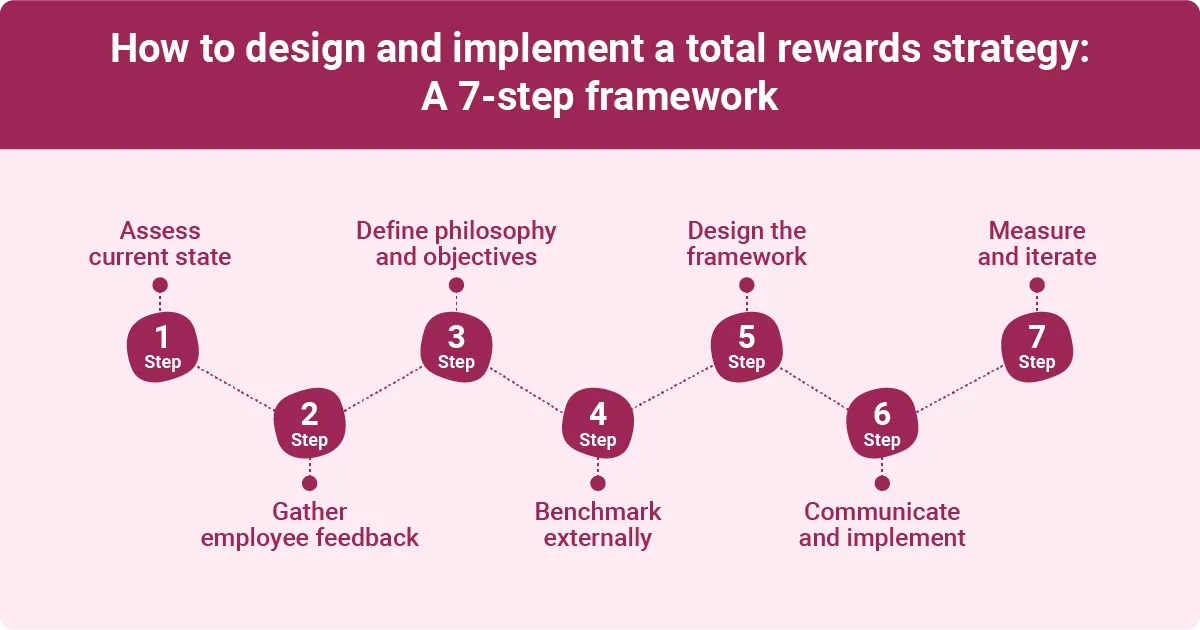
Step 1: Assess current state
Audit your current reward program to identify gaps in coverage, redundancies burning your budget, and compliance exposure. Identify where employee perceptions already diverge from your program's actual value.
Step 2: Gather employee feedback
To build a comprehensive total rewards strategy, gather your employees' input. Use engagement surveys and focus groups to uncover priorities. You can also conduct exit interviews and collect pulse data to reveal opportunities for improvement.
Your employees’ needs will be diverse. To identify differences across generations, segment the data by:
- Demographics
- Roles
- Tenure
It’s also important to account for hybrid work patterns, as remote, hybrid, and in-office employees often prioritize different elements of total rewards.
Step 3: Define philosophy and objectives
Before you start designing the pillars of your total rewards strategy, you should define your organization’s pay philosophy and objectives. Articulate your pay philosophy and link motivation and incentives to business strategy. The best practice is to set measurable objectives and tie them to retention, engagement, and performance.
Step 4: Benchmark externally
Use competitive data from sources such as WorldatWork and Mercer to understand how your total rewards strategy compares with the broader talent market. With the benchmarks, you can calibrate your organization’s competitive positioning using the lead, match, or lag approach.
Step 5: Design the framework
Build a job architecture and salary band framework that defines roles, levels, and progression pathways across your organization. Then design each of the six reward pillars, and run cost modeling and pay equity analysis in parallel with pillar design to verify that your structure is financially sustainable and internally consistent.
Once you have a framework, stress-test it against relevant compliance and transparency requirements to verify it meets regulatory and disclosure expectations. You should also adapt your design for hybrid and remote employees.
Step 6: Communicate and implement
Roll out employee-facing communication, including a total rewards statement that helps employees understand the full value of their rewards. Train managers to lead recognition and career conversations so that they can consistently reinforce the strategy.
Where possible, integrate recognition into platforms such as Workday, Microsoft Teams, Microsoft Outlook, and Slack to reduce adoption friction and support ongoing manager enablement. Workhuman’s Cloud Integration allows recognition and feedback actions to occur within existing employee workflows. Its open APIs enable the platform to integrate with existing HR tech stacks so that you won’t need a parallel system.
Step 7: Measure and iterate
Once you have implemented your framework, assess whether the strategy is delivering its intended outcomes. Track key performance indicators such as:
- Employee engagement
- Retention
- Internal mobility
- Recognition activity
Re-benchmark your rewards programs annually to account for trends in labor markets and employee expectations. To sustain leadership support, build a cost-benefit framework that compares reward investment against measurable business performance outcomes. You can quantify rewards spend against retention savings, engagement lift, and a stronger offer acceptance rate.
Common mistakes to avoid when building a total rewards strategy
While a well-designed total rewards strategy can be highly effective, there are certain challenges and lessons to be learned along the way. Here are some of the most common missteps to watch out for:
- Treating recognition as a perk budget line rather than a measurable pillar
- Designing pillars in isolation without a unifying pay philosophy
- Skipping employee feedback and benchmarking against only direct competitors
- Failing to communicate the total value, which leaves employees underestimating their rewards because they are not shown a total rewards statement
- Not re-benchmarking annually or adjusting to pay transparency law changes
- Overlooking manager enablement, which leaves recognition and career conversations inconsistent
Communicating your total rewards strategy to employees
As with any other business strategy, clearly communicating your total reward program to employees puts every team member on the same page. Here’s how leading employers explain total rewards to candidates and current employees:
- Issue rewards statements at least once a year, structured in a consistent, easy-to-read format that includes compensation, benefits, well-being, recognition, and career development.
- Personalize each rewards statement so every employee can see the full value of their individual total rewards package.
- Build a total rewards strategy presentation for leadership and employee town halls, using simple visuals that connect reward pillars to business goals.
- Equip managers with talking points for one-on-one compensation and career conversations.
- Integrate total rewards messaging into candidate-finding communications, such as job descriptions, interviews, and offer letters, so candidates understand the full value of their role.
- Measure how well employees understand and value your total rewards program using perception surveys.
Examples of effective total rewards strategies
Implementing a comprehensive and efficient total reward program has become a competitive advantage for businesses as they adapt to current talent needs. The strongest frameworks share a few structural characteristics.
Common patterns in leading total rewards programs
- Integration across pillars rather than siloed programs
- Personalization through choice and lifestyle benefits
- Recognition embedded in daily workflow
- Transparent communication via total rewards statements
- Use of total rewards statements to make value tangible
- Linking recognition data to engagement and retention outcomes
What success looks like: measuring total rewards strategy outcomes
You can measure the success of your total rewards strategies by tracking leading, lagging, financial, and perception-based indicators.
To measure the actual ROI of your framework:
- Identify costs.
- Quantify direct benefits.
- Benchmark indirect benefits.
- Calculate net business value.
Most businesses use recognition data to link rewards programs directly to engagement, performance, and retention outcomes. For example, Human Intelligence™ and Workhuman iQ analyze recognition patterns to identify skills trends, engagement drivers, and the distribution of recognition across teams, helping organizations understand both behavioral and structural gaps in their rewards systems.
The Inclusion Advisor capability connects the incentive theory of motivation to daily practice by measuring inclusive language patterns in recognition messages and flagging possible missteps for correction, making it easier for recognition to reach all employee populations equitably.
Total rewards strategy trends for 2026
Changes in global labor markets and employee expectations are transforming compensation and total rewards strategies. Here are several key trends to look out for.
Pay transparency and job architecture
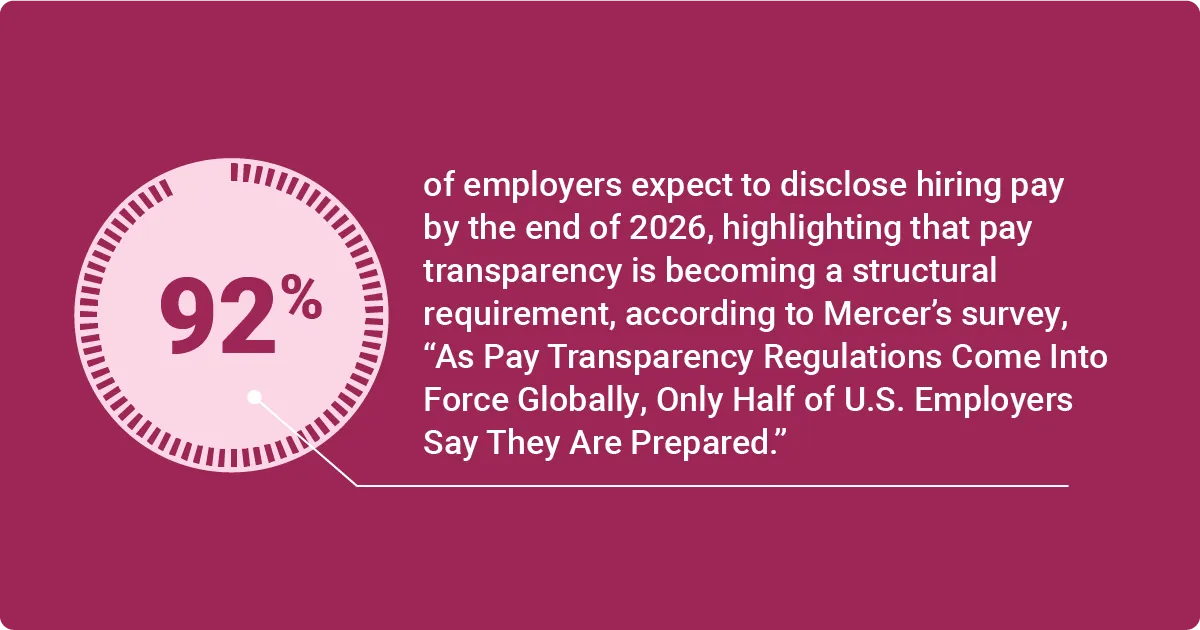
Pay transparency is becoming a structural requirement, with 92% of employers expecting to disclose hiring pay by the end of 2026, according to another Mercer survey titled “As pay transparency regulations come into force globally, only half of US employers say they are prepared.”
As a result, organizations are investing in job architecture and salary bands to support consistent pay decisions and enable ongoing pay equity review.
Personalization and skills-based pay
One-size-fits-all reward packages are giving way to more personalized approaches. In the 2026 Morgan Stanley study, “State of the Workplace 2026: Financial Benefits StudyOpens in a new tab,” 91% of employees said they would consider switching jobs for benefits that better support their goals. In response to this trend, HR leaders are prioritizing personalized benefits more than ever.
Organizations are introducing lifestyle spending accounts and flexible benefits to allow employees to tailor aspects of their rewards and meet the diverse expectations of multigenerational workforces.
At the same time, EY’s 2026 findings, published in “Future of Pay,” show that pay structures are shifting from job-title alignment toward skills-based models. As demand for AI grows, employers continue to offer skill premiums that reward employees for acquiring high-value capabilities.
Well-being and recognition as performance levers
Most companies view well-being and recognition as performance investments. In fact, Mercer reports that 94% of large businesses have strengthened their coverage for mental health care and increased support since 2020.
Through decades of research, Gallup identified five key well-being elements:
- Career
- Financial
- Social
- Physical
- Community
For a more holistic employee experience, many employers structure their well-being programs around these five dimensions. Research from Harvard Business Review has also linked workplace culture and morale to productivity outcomes, reinforcing the business case for investing in employee experience.
Recognition often serves as the most cost-effective means of connecting well-being investments to measurable performance outcomes.
Spot and discretionary bonuses replacing rigid annual structures
Businesses are moving away from rigid annual reward cycles in favor of more frequent spot rewards, and for good reason. According to Workhuman’s compensation and benefit data, employees recognized 7-10 times a year have a 2x lower turnover risk.
Use of HR analytics and AI to optimize total rewards investment
As total rewards programs become more complex, many businesses are turning to analytics and AI to optimize investment decisions.
Consider, for example, that ADP reported a 69% gender gap in incentive pay, and Workhuman found that award amounts tend to vary by ethnicity. To prioritize pay equity and improve decision-making across rewards, organizations are relying on HR analytics and AI tools.
Get in touch today to learn how Workhuman can support your total reward strategy.
FAQs
What is a total rewards strategy?
A total rewards strategy is an integrated framework that covers all monetary and non-monetary rewards employees receive in exchange for their work.
What are the components of a total rewards strategy?
The WorldatWork total rewards model has five components: compensation, benefits, well-being, recognition, and career development. The Mercer and SHRM frameworks add work-life flexibility as a sixth pillar.
How do you design a total rewards strategy?
To design a total rewards strategy:
- Assess your current state of rewards to identify strengths and gaps.
- Gather employee input to understand workforce priorities.
- Define your pay philosophy and business objectives.
- Benchmark externally against competitors and labor market trends.
- Create your total rewards strategy based on your findings.
- Communicate and implement your strategy to all stakeholders.
- Measure results and iterate.
Why is a total rewards strategy important?
A total rewards strategy is important because it integrates all employee rewards to strengthen your employee value proposition overall, helping you attract and retain top talent.
How do you communicate a total rewards strategy to employees?
To communicate your strategy to your employees, issue rewards statements, train managers to contextualize your strategy in one-on-one conversations, and include total rewards in candidate communications and offer letters.

Ryan Stoltz
Ryan is a search marketing manager and content strategist at Workhuman where he writes on the next evolution of the workplace. Outside of the workplace, he's a diehard 49ers fan, comedy junkie, and has trouble avoiding sweets on a nightly basis.
Recommended for you