
Crafting Compelling Performance Review Phrases: A Comprehensive Guide with Examples
Last updated
7 min read

Performance reviews represent a critical moment in the employee lifecycle. This is the time when managers and employees get together to review the past quarter or year, depending on frequency, to discuss the employee's delivery, accomplishments, and areas of improvement.
Using the right performance review phrases is critical for a successful appraisal. These phrases set the tone and guide the performance review conversations. However, it can be difficult to know exactly what to say to strike the right balance between positive and constructive feedback.
If you're looking for examples of performance management, use this guide with compelling performance review phrases to craft your feedback session.
How to craft effective performance review feedback
Good feedback isn't just about praise or criticism – it should include guidance and insights to empower the employee to take their career growth into their own hands.
Your employee probably had specific goals they worked on since their last performance review or since they started their role. Connect your review to those goals. Which of them did they achieve and how? Which weren't met? Ask how they accomplished what they did and why they didn't meet certain targets.
You should also connect your feedback to your organization's goals. How did your employee support the organization's growth goals? This not only makes the feedback more specific but also helps the employees understand what role they play in the broader company structure. Check out these examples of effective feedback for some inspiration.
You can also tie your performance review phrases in with certain traits. Are they positive, helpful, willing to try new things, good collaborators, team players, interpersonally skilled, and good leaders? Identify their strengths and weaknesses, tying them into specific examples, so they know what traits are valuable and which need some work.
Ultimately, after a performance review, there should be no confusion. The employee should walk away with a clear understanding of where they stand. This helps them both professionally and personally by giving them a clear picture of where they stand in the organization and gives them a specific roadmap to continue honing their skills and adding value to the company.
It can also help them further develop skills and traits that will support their growth, like time management or a certification.
Goal setting should also be baked into the performance review process. The goals should align with both the employee's individual growth objectives as well as the company's goals. These goals should be specific, challenging yet realistic, and relevant.
Of course, performance reviews also usually play into promotions. If an employee is receiving a promotion or pay raise as a result, be sure to convey that during the review and be specific about why. If they have more work to do in order to earn a promotion, again, be specific about why and what they can do to achieve it.
Examples of performance review phrases
It's important to go into employee performance appraisals prepared with key points and examples to back them up. Here are some key phrases you can use in performance reviews to give both constructive and positive feedback.
Performance review phrases for quality of work
Positive
- Consistently shows attention to detail
- Can handle a high volume of work without forgoing quality
- Demonstrates thoughtfulness and attentiveness
- Gets creative with challenging projects
- Integrates feedback well to produce a better result
To improve
- Delivers inconsistent work quality
- Needs greater attention to detail to avoid errors and typos
- Needs more focus or time management
- Must follow established project management process to check and complete work
Leadership
Positive
- Collaborates well
- Asks thoughtful questions of all peers
- Helps fellow employees
- Keeps team members motivated
To improve
Attendance
Positive
- Shows up on time for meetings
- Clocks in promptly
- Values others' time with punctuality and not running off schedule
To improve
- Fails to show up on time
- Regularly arrives late to meetings
- Doesn't follow the company attendance policy
- Doesn't inform the company of days off
Communication and interpersonal skills
Positive
- Shares ideas thoughtfully and efficiently
- Asks questions to ensure clarity
- Participates in conversations, even if the topic is difficult
- Isn't afraid to bring in new ideas or challenge old ones
To improve
- Is unwilling to listen to others or take feedback
- Does not meaningfully participate in meetings
- Fails to communicate clearly or concisely
- Uses harmful language
Teamwork and collaboration
Positive
- Can work well with different personalities and positions
- Facilitates and maintains positive relationships with coworkers
- Motivates the team through affirmation and encouragement
- Demonstrates respect for others
To improve
- Does not work well with others
- Fails to meaningfully participate in team meetings or collaborative work
- Doesn't share ideas or feedback with others
Efficiency and time management
Positive
- Shows efficient time management and task management
- Consistently meets deadlines and delivers quality work
- Has strong organizational skills, managing multiple projects and responsibilities
- Adapts flexibly to changing conditions
To improve
- Fails to deliver quality work on time
- Prone to procrastination, compromising delivery time and quality
- Misses deadlines or rushed work
- Has poor attendance
- Doesn't delegate, which could aid in better quality work
Flexibility
Positive
- Shows adaptability in evolving priorities and projects
- Has a positive attitude in the face of change
- Shows willingness to make changes and feedback in stride
- Adapts to new responsibilities
To improve
- Doesn't embrace change
- Isn't willing to adapt new points of view or approaches
- Needs to improve flexibility
Dependability
Positive
- Shows they can be counted on
- Commits to their work and collaborating with others
- Doesn't shy away from hard work and putting in extra effort
To improve
- Seems to struggle to keep up with deadlines
- Fails to deliver expected work on time
- Doesn't show an interest in learning new skills or developing their career
Problem-solving
Positive
- Proactively suggests new solutions to problems
- Effectively addresses stakeholder/customer concerns
- Uses constructive feedback to improve output
- Skilled at anticipating challenges
To improve
- Doesn't take initiative during brainstorming sessions
- Rarely experiments or tries new things
- Gets stuck without finding creative solutions
Initiative
Positive
- Proactively takes on new projects
- Explores opportunities beyond standard role responsibilities
- Shows motivation to deliver exceptional value
- Consistently takes ownership of new projects and assignments
To improve
- Doesn't show interest in new projects
- Requires supervision and oversight
- Doesn't meet bare minimum requirements
- Has poor attendance and dependability
Integrity
Positive
- Shows dedication to high-quality work
- Contributes to a culture of discipline, ethics, and honesty
- Follows company values
To improve
- Doesn't follow company values
- Is prone to gossip and badmouthing
- Tries to skirt responsibility and blame others for oversight
Achievements
Positive
- Increased sales 20% YOY
- Increased productivity by 15%
- Increased organic traffic by 20%
- Supported 93% customer retention
- Met all of their annual goals
To improve
Tips for conducting a great performance review
It's important to get performance reviews right. They are widely viewed as time-consuming, demotivating, unfair, and biased. To combat this, you should go into performance reviews prepared to give specific and actionable feedback to your employees so that they leave the meeting feeling empowered with the knowledge of what they need to do to succeed at your organization.
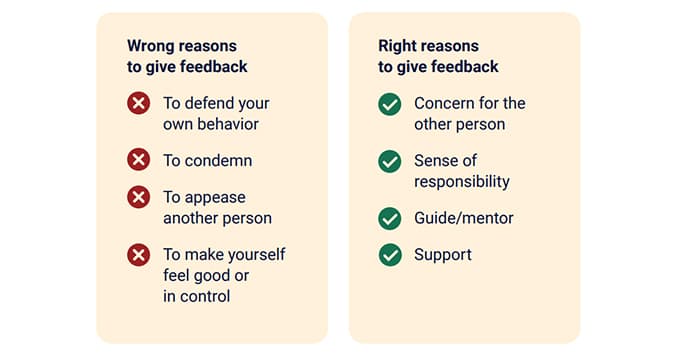
Here are some tips to run a constructive performance review:
Prepare well for the meeting
As mentioned, effective performance reviews require preparation. As a manager assessing your team members, you should measure employee performance against organizational goals and values. Analyze both their performance and their behavior to see what has worked well and what might need support.
If the employee has any performance issues, are they due to a lack of motivation, capabilities, or support? Can they be coached or trained up? Are there different responsibilities that might suit them better? Where are their skills best utilized? And finally, be sure you have adequate time for the meeting.
Quick reviews don't feel good and make employees feel undervalued. Also, be sure to tailor each meeting to the specific employee.
Set the tone
If you want the employee to feel encouraged, be sure to lead with that and keep it consistent throughout the review. Positive feedback feels good! If they have a lot of work to do, don't shy away from that fact – be direct but fair.
Try not to go too far in any one direction, which could end up misleading or confusing. Balance your feedback but remain forthcoming about the employee's performance.
Be specific
Every piece of feedback should be backed up by a concrete example. Share the impact of this action, good or bad. Whatever they've done well, name it, like: "You had great communication skills with X project" or "You demonstrated great teamwork when X happened."
Whatever your team member needs to work on, be clear and constructive, saying: "You're showing a lot of promise with data analysis, but you need to work on your presentation skills" or "Your quality of work is good, but you need to focus on delivering your projects on time."
Make it a conversation
Use performance reviews as a two-way conversation. Ask the employee to respond and make it a discourse rather than a one-sided delivery of feedback. How does the employee feel about this accomplishment? How do they feel they performed on X project? Here are some examples of check-in questions that can help guide your employee performance reviews.
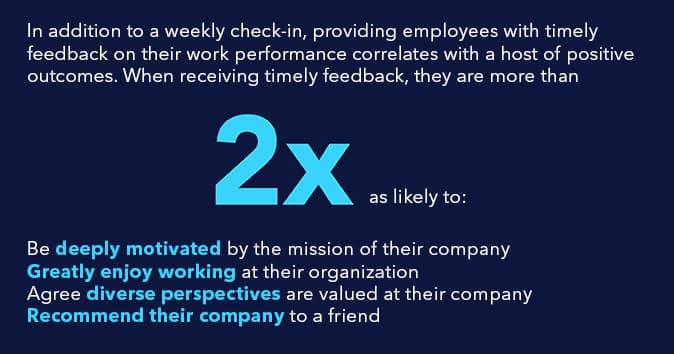
Ask for feedback
Ensure the time was valuable for everyone. What did your team member find valuable in the meeting? What do they still have questions about? How could things be more constructive next time? Do they have any questions for you as a manager?
Follow up regularly
What not to say in a performance review
There are many ways an employee performance review can go wrong. If a manager is too vague, shies away from constructive feedback, or is too harsh, the team member could walk away discouraged or unclear on their standing within the team and the company at large.
Here are some tips of what to avoid in a performance review so that you can inspire and motivate your employees rather than discourage and demean them.
Don't give generic feedback
Saying "You did a great job" or "You haven't been on the ball" is unspecific, which is unhelpful to employees who want to understand what they're doing well and what they need to improve.
You help employees by not being vague and giving particular examples that illustrate your feedback. What particular work stood out? What project didn't meet expectations?
Don't compare employees
Comparison breeds competition, which can make for a cutthroat, negative work environment. You're evaluating your team member's best performance, not which team member was the best.
You don't want to give employees a reason to resent each other. Focus on the person in front of you and give specific feedback that encourages individual growth.
Don't degrade your employees
Even if your team member has significant improvements to make, you shouldn't humiliate them. Your performance review phrases should revolve around constructive feedback and give an objective assessment. Remember that the feedback is not personal – it is not about who they are as a person, their personality, or their interests.
Avoid extremes
Excessive positive feedback can be almost as damaging as feedback that's too negative. You should stay away from phrases like "always" or "never," as they are rarely accurate and tend to paint a false picture.
Conclusion
Knowing quality examples of performance review phrases can make a world of difference in your appraisal meetings. They can help show an employee where they excel and where they need to boost performance. They can help recognize interpersonal, problem-solving, technical, and creative skills. These reviews are a crucial part of performance management, so it's important to be prepared with high-quality feedback.

Workhuman Editorial Team
More by Workhuman Editorial TeamRecommended for you