
People and Culture: What It Means, How It Works, and Why It Matters
by Ryan Stoltz
Last updated
10 min read

Like any business area, HR is constantly evolving in response to trends and shifting requirements. Today, top companies are adapting their HR function toward People and Culture – a modern, holistic evolution of Human Resources that treats employees not as resources to be managed but as people who are central to organizational success.
Traditional HR is often ill-equipped to address the increasing responsibilities placed on the department. HR teams aren’t just responsible for administering policy and process – they also must actively shape how people work, connect, and stay.
People and Culture can be the solution, both a business function and an organizational philosophy designed to set workforces up for success. Discover how People and Culture differs from the traditional HR approach you may currently be using, what it requires structurally, and what you can do to strengthen this approach inside your own organization.
What People and Culture mean in a modern company
Top companies like Microsoft — which recently overhauled its HR functions amid the AI-powered transformationOpens in a new tab — Apple and Google have shifted toward People and Culture over traditional HR. The exact approach will naturally vary from business to business, but they’re emphasizing the same modern HR philosophy: considering employees people who are the lifeblood of the company as opposed to simply resources that need managing.
So what is People and Culture, exactly?
As a business function, People and Culture is responsible for everything from talent acquisition and onboarding to organizational culture and engagement. Other duties of a People and Culture manager may include:
- Employee development
- Compensation and benefits
- Diversity, Equity, and Inclusion (DEI)
- Employee wellbeing
- Employer branding
- Workforce analytics
Even where People and Culture tasks overlap with traditional HR responsibilities, many companies are not simply adding them into their existing systems. Instead, they’re renaming and redesigning their HR departments to better reflect their growing emphasis on the employee experience. It’s about treating employees not just like resources to be managed, but rather as invaluable contributors to the success of the organization.
An organization’s people (in this case, employees) and its culture (such as its shared values, norms, and behaviors) have always been tied together. Company leadership can try to mandate a culture from above, but it only takes root with employee buy-in. Adopting a People and Culture approach recognizes this, framing employees as contributors to a strong company culture rather than mere assets.
The core components of organizational culture
Make sure you address these key elements of organizational culture:
- Shared values and beliefs: Actionable, observable values that are reflected in every level of your organization, from meetings to team-building exercises, and even informal meet-ups
- Norms, rituals, and everyday behaviors: The little things in a company that have a big impact, like how you speak to one another and how you start the day
- Symbols, language, and physical or digital artifacts: How you describe your company’s values visually and verbally
- Leadership behaviors that signal what is rewarded: What you praise, how you handle conflict, who gets promoted and why
Start by defining your organization’s values. These core values are the DNA of your company culture – your highest priorities and the promises you’re making to employees, customers, and even your community.
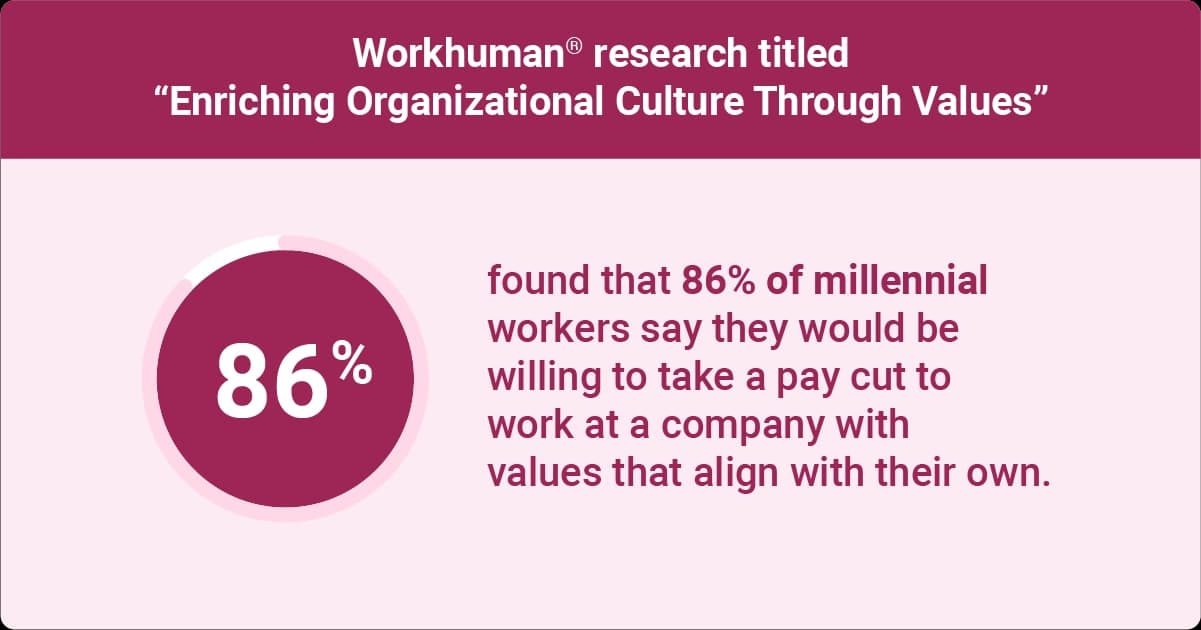
Younger generations of customers and employees pay particular attention to a company’s values. Workhuman® research titled “Enriching Organizational Culture Through Values” found that 86% of millennial workers say they would be willing to take a pay cut to work at a company with values that align with their own.
Craft a stronger organizational culture with these four key steps:
- Discover what really matters in your organization – not just at the top, but to your employees as a whole.
- Stand out with unique yet honest values that reflect your brand’s style.
- Dig deeper into the specifics to clarify your meaning.
- Assign actions to each value so employees have a clear path to enacting them.
The details are crucial here. Be as specific as possible with examples so there's no confusion for any employees about the culture. Of course, modeling behaviors remains the best way to teach them, so make sure your company leadership behaves in ways that reflect your values.
How people shape culture (and vice versa)
Employees are both products and producers of culture. Your company culture isn’t something you can simply decide on and mandate to your workforce. If you want the culture to change, you need to bring employees into that process.
Start with hiring and onboarding. At every step of the hiring and onboarding process, stress the central components of your company culture and seek out candidates who will fit in. Be mindful of how employees exiting the organization can significantly affect your company culture for better or worse, especially in smaller workforces.
People and Culture influences the employee journey – and therefore shape company culture – from the first interview to the exit interview. Even before you clearly state your company culture, your employees will feel it. They’re creating it, after all.
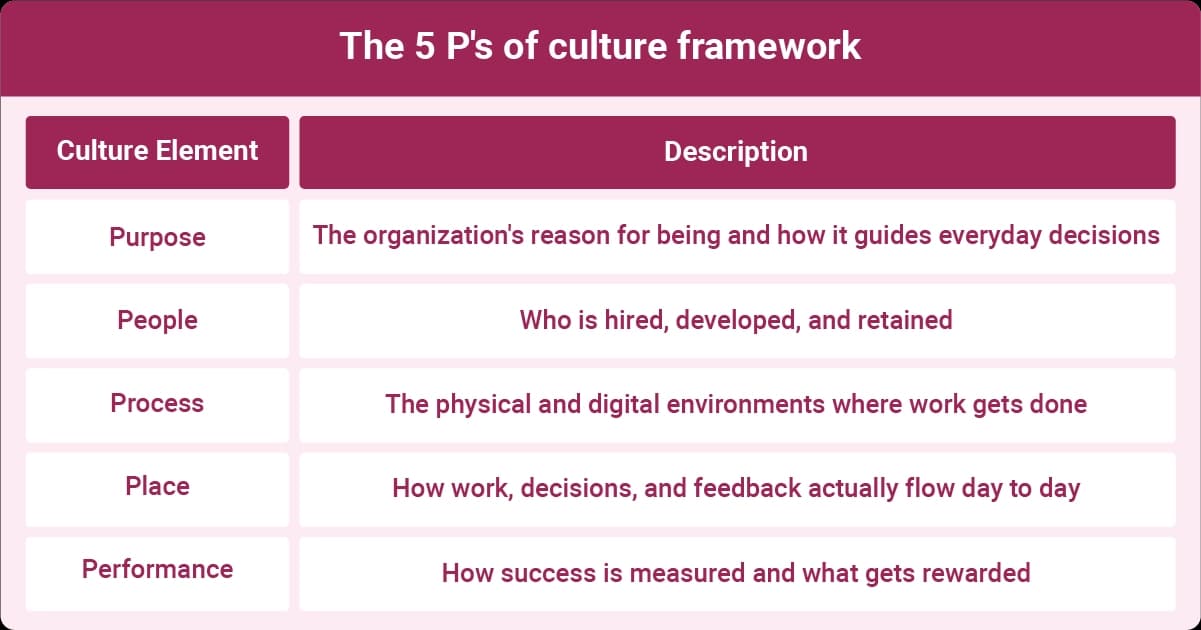
The 5 P's of culture framework
If you’re struggling to define how to improve company culture in the workplace, keep the five P’s of culture in mind.
People & Culture vs. Human Resources: Key differences
For organizations currently operating with a traditional HR department, going to a People and Culture framework requires a mindset shift. You stop thinking about HR as primarily focused on compliance and administration and move to a focus on the employee experience and culture building.
The People and Culture department also has a wider scope. Beyond transactional HR tasks, the People and Culture team will work on strategic culture initiatives, employee engagement, and efforts to make employees feel like they belong.
As responsibilities change, metrics to measure success change, too. You’re not just looking at cost-per-hire and turnover rates anymore, though they are still important metrics. You also need to emphasize employee engagement metrics, employee Net Promoter Score (how likely employees are to recommend working for your organization on a scale of 1–10), belonging, and retention drivers like satisfaction rates.
Not everything changes, however. The new approach does not replace operational HR – it reframes what the function prioritizes. The People and Culture team will still handle payroll, benefits, and compliance.
Compared to traditional HR, the main difference is the bottom-up instead of top-down approach to company culture. People and Culture often report directly to the CEO or COO and may have a seat at the leadership table to make sure company values and business strategy stay closely aligned.
You can also often tell HR and P&C apart by tone. HR is typically reactive and protective, while People and Culture tends to be proactive and collaborative.
At-a-glance comparison table
When the rebrand is real vs. cosmetic
While many companies are evolving with the times and fundamentally reshaping their HR into People and Culture, this change is not yet universal. And under pressure from employees, customers, and other stakeholders, some business leaders may rebrand HR to People and Culture without actually implementing the key philosophy behind it.
These are signs that the change may just be a name swap:
- Strong messaging without structural changes to support those values
- Only performative perks for employees, like free snacks or mandatory parties – not the changes or support the employees are asking for
- No changes in responses to employee feedback
- Minimal or nonexistent employee development opportunities
- Contradictory values not reflected in company management
Before renaming your HR function, ask yourself questions like:
- What is the central goal of the department?
- Has the department shifted to a more strategic approach that’s aligned with business objectives?
- What are employees saying about any changes implemented? Have you taken their feedback into account?
- What metrics are you tracking to determine the success of the department?
Core responsibilities of a People and Culture function
People and Culture is already at work before new employees start their roles at the organization. The department is responsible for talent acquisition but goes beyond the traditional HR tasks of completing background checks and onboarding. People and Culture talent acquisition happens through the lens of which candidates will fit in and even add to the company culture.
From there, the P&C team also designs the onboarding process to provide as much support to the new employee as possible and kickstart a positive employee experience from day one.
They continue to play a key role in the employee’s life at the company through learning, development, and career pathing. Unlike the traditional HR approach of mandatory compliance training, P&C focuses on long-term development, mentorship, and helping employees find purpose in their work.
People and Culture also provides feedback and performance enablement to drive continuous improvement and help employees succeed in their roles and future growth. When paired with an emphasis on recognition, rewards, and total wellbeing, employees can feel truly appreciated.
Not sure how to build an employee recognition program? Workhuman teaches your managers how to provide more impactful recognition using Workhuman iQ and Human Intelligence™ that analyzes real human data.
The People and Culture team acts as cultural stewards for the company, sending out internal communications and taking efforts toward building diversity, equity, inclusion, and a sense of belonging. The department is also responsible for leadership development, including tracking and improving manager effectiveness.
The leadership mandate
In far too many companies, you see culture delegated completely to HR. The official company culture becomes little more than positive phrases in emails and brochures. Meanwhile, the actual organizational culture develops among the employees without clear direction.
If you want to shape a positive culture, you need to integrate it into every department, from the top down. It’s not just about what executives and other leaders say, either. What the company leadership actually does is far more impactful on company culture than written values.
Daily rituals that reinforce culture
If the thought of building a positive workplace culture feels overwhelming, don’t worry. You don’t need to overhaul everything all at once in a single huge undertaking. Once you assess your organizational culture and decide what values are most important in your company, your goal should be to reinforce them a little every day with small actions, such as:
- Recognition moments tied to company values: For example, if honesty is one of your key values, commend an employee who speaks up and is honest about a mistake.
- Feedback cadences and check-ins: Regularly check in with employees and offer feedback, including what they’re doing well through the lens of company culture, and where they might want to adjust.
- Decision-making norms and meeting practices: Make sure leaders make decisions big and small in line with company values and apply them in meetings.
Staying on top of all the feedback an employee receives and consolidating it into meaningful suggestions for professional development can be tricky. You don’t have to do it manually, though.
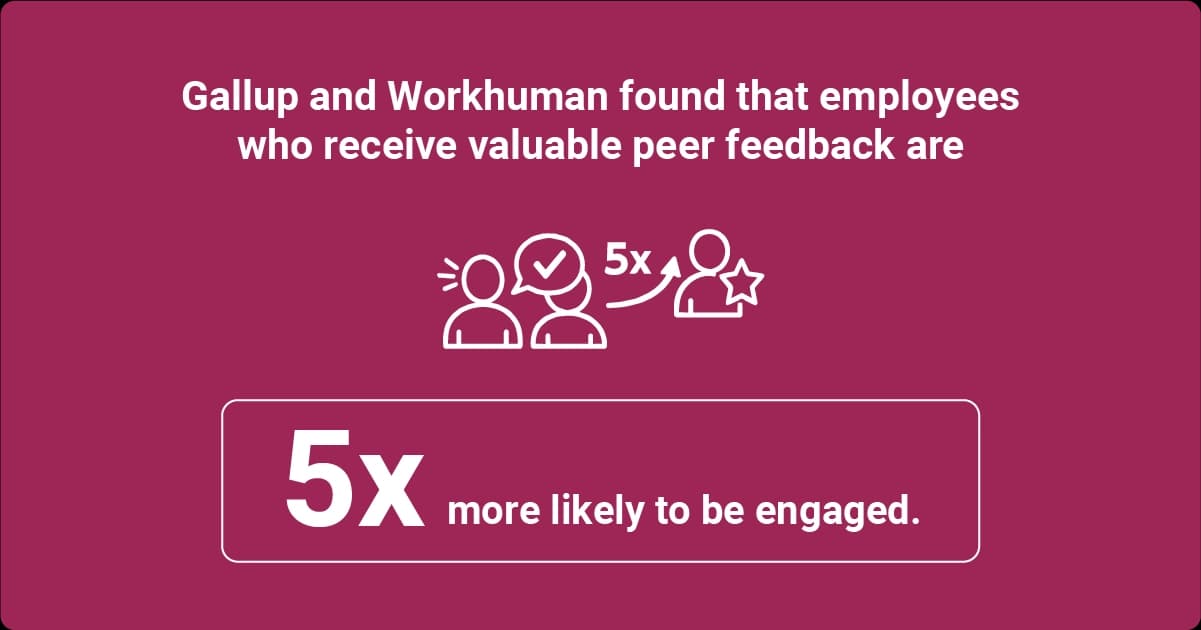
Conversations® by Workhuman makes frequent, meaningful check-ins easier than ever while incorporating real-time crowdsourced feedback for each employee. Gallup and Workhuman found that employees who receive valuable peer feedback are 5x more likely to be engaged. Having convenient, integrated access to that feedback in Conversations can support your company culture.
As Mara Notarfonzo, VP of Total Rewards at CAA, explains, “Our values are reinforced through our recognition program. … If you ask individuals, ‘What are you recognized on?’ they can name the four values that drive our organization.” A company’s recognition data reveals which values employees actually relate to, so your rituals and check-ins can act as a feedback loop for refining your company’s cultural priorities.
How the People and Culture team is structured
The typical roles in a People and Culture team include:
- Head/Chief People Officer
- People Partners
- Talent Acquisition
- Learning and Development (L&D)
- Diversity, Equity, and Inclusion (DEI)
- People Operations
A startup might only have a few People and Culture generalists, given the smaller workforce size, while enterprises may have over 100 people on the team.
A People and Culture manager or director typically reports to either the CEO or COO, providing direct integration with the executive leadership team and company strategy. Traditional HR, by contrast, is often isolated from strategic decision-making, and the HR team may not be considered integral to the company’s ongoing success the way it should be. Reframing employees at the bedrock of a company’s operations, and thus, success, turns this on its head.
Employees are more than resources – they’re what make your company run. People and Culture recognizes this and centers them.
Why a strong People and Culture strategy matters
Shifting to People and Culture from traditional HR isn’t merely about branding or cosmetic changes. A People and Culture approach offers tangible business benefits:
- Better employee engagement and retention, leading to reduced turnover costs
- Higher employee productivity and discretionary effort gains
- Stronger employer brand and talent attraction
- More innovation and psychological safety
- Resilience during organizational change, including remote and hybrid shifts
- Better customer outcomes that follow from employee experience
Traditional HR metrics emphasize low turnover rates and high compliance rates as indications of success. Those are still positive metrics, but for People and Culture, a higher employee NPS score is the defining success metric. When your eNPS score is high, you know your employees are engaged and satisfied, creating a strong foundation for company success.
How remote and hybrid work reshape culture
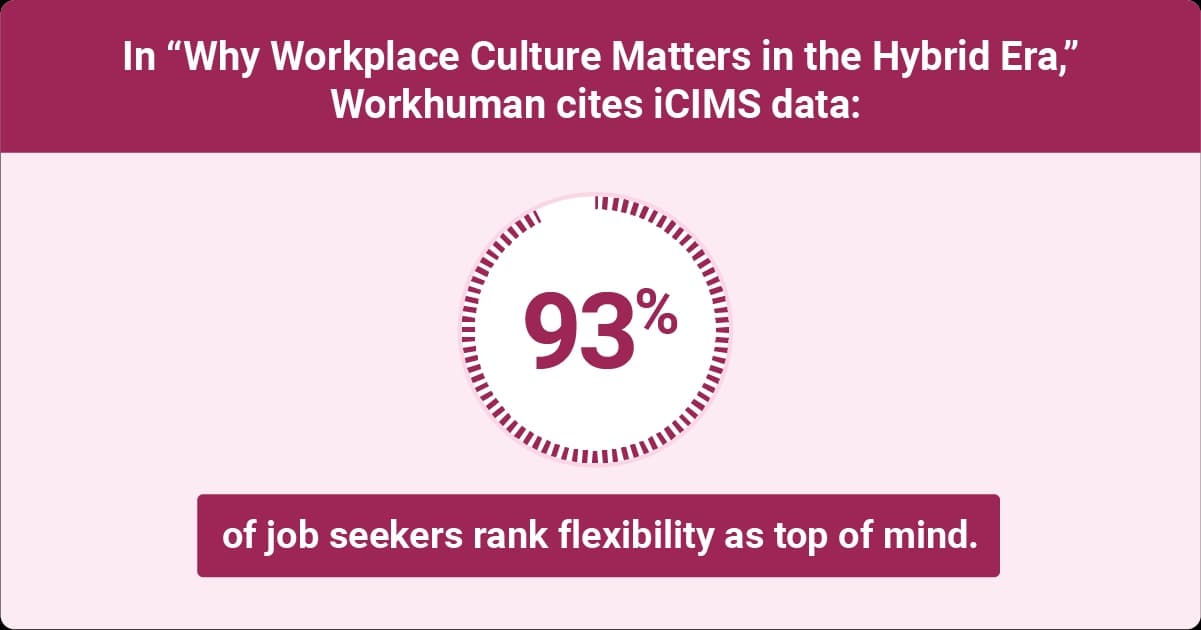
In “Why Workplace Culture Matters in the Hybrid Era”, Workhuman cites iCIMS data: 93% of job seekers rank flexibility as top of mind. It also states that many companies are responding accordingly.
Shifting to remote or even hybrid work will inevitably reshape company culture somewhat, but that doesn't have to be a bad thing. You may lose many incidental connections, but try to think of ways to replace them, like scheduled meet-ups for employees.
Implement intentional rituals for your distributed teams. In hybrid settings, manager skills are even more important, so invest in training.
Don’t forget the importance of recognition for remote or hybrid employees, either. Workhuman data shows that recognizing life events and work milestones makes employees 3x as likely to feel connected to their company culture.
How to strengthen people and culture in your organization
Any company can make the transition to People and Culture by following the right steps:
- Start by auditing your current culture with surveys, listening sessions, and exit data.
- Align your core values with your business strategies. Your business goals must mesh with the company's mission before recognition or survey initiatives will have any impact.
- Define and operationalize your desired company values into observable behaviors.
- Equip managers as the front line of culture with the necessary training, tools, and support.
- Build continuous recognition and feedback into daily work.
- Measure what matters: engagement, belonging, retention, eNPS
- Iterate based on data and employee feedback.
How can you stay on top of all this information, though? Workhuman iQ and Human Intelligence™ is an example of how recognition data can be analyzed to surface insights on cultural health, skills gaps, DEI distribution, and retention drivers. And try Inclusion Advisor as an in-the-moment coaching mechanism for operationalizing inclusive language in everyday recognition.
Steps for smaller organizations
Reshaping your HR approach can feel especially daunting in a smaller organization, but it’s still possible.
Start with clarity on values and behaviors. You have to go beyond simply stating your values out loud and posting them online, though. Emphasize and reinforce them through recognition.
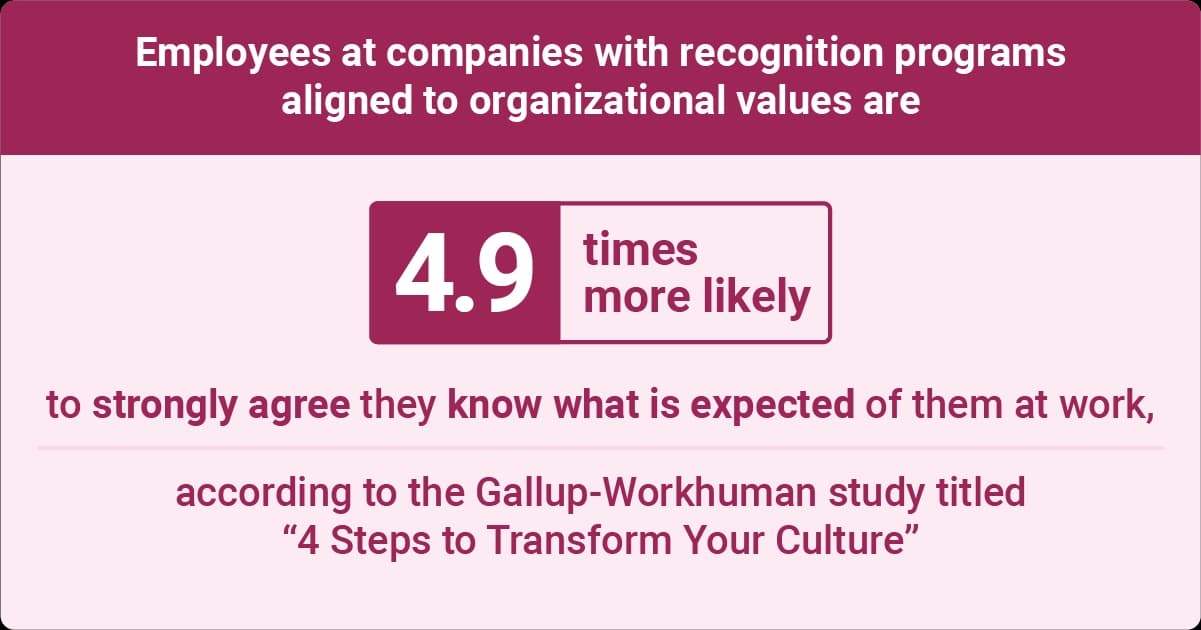
Employees at companies with recognition programs aligned with organizational values are 4.9x more likely to strongly agree they know what's expected of them at work, as per a Gallup-Workhuman study titled “4 Steps to Transform Your Culture”. For a smaller organization, this means there’s a concrete reason to tie recognition directly to your cultural values.
Use lightweight pulse surveys before investing in platforms. Employees are untapped wells of information about what you can do or change to make your company more likely to succeed. Send surveys and analyze the results.
Make recognition an ongoing manager habit, not simply an annual event. A platform like Workhuman makes regular, one-on-one check-ins more manageable. Also, implement the modeling principle. Publicly recognizing wanted behaviors spreads them throughout the organization, a low-cost, high-impact tactic well-suited to smaller teams.
If you want to boost company culture, it’s all about the small daily actions you can take. Make recognition a habit, make sure company leadership’s actions reflect your values, and listen to your employees’ feedback.
Examples of companies known for strong People and Culture
- Patagonia emphasizes values-driven decision-making.
- HubSpot published its Culture Code as a living document.
- Atlassian uses team rituals and transparent feedback norms to shape its workplace culture.
FAQs
What does People and Culture mean in a company?
People and Culture is both a philosophy and a business function. As a philosophy, it’s about recognizing the integral role employees play in an organization’s success and creating a positive employee experience. As a business function, People and Culture is responsible for tasks such as recruiting top talent, fostering an inclusive workplace, and supporting employee development and wellbeing.
Is People and Culture just a rebrand of HR, or is it something different?
People and Culture does handle traditional HR tasks like enforcing company policies and administering benefits, but there is more to it. Companies that implement People and Culture are taking a proactive, strategic approach to workforce management. It’s about supporting business success by emphasizing employee engagement and satisfaction.
How is People and Culture different from Human Resources?
Unlike traditional Human Resources, People and Culture goes beyond administrative and operational tasks. It’s a fundamental shift in an organization’s philosophy around workforce management. The emphasis is on nurturing employee wellbeing and growth to support them, and in turn, fuel the success of the organization.
What are the main responsibilities of a People and Culture department?
A People and Culture department takes ownership of talent acquisition, employee development, DEI efforts, and employer branding, among other tasks related to improving employee satisfaction. Beyond the specific business team, a People and Culture approach means the entire organization, from the top on down, puts more emphasis on fostering a positive workplace environment for employees.
What are the main components of organizational culture?
Every business leader wants to build a strong organizational culture, but it can be tricky to pin down what that means in practice. Focus on the key components, such as efficient leadership, core values, open and transparent communication, and accountability. Proper recognition matters, too – consistently recognizing your employees’ efforts and results is one of the best ways to boost employee engagement and retention.

Ryan Stoltz
Ryan is a search marketing manager and content strategist at Workhuman where he writes on the next evolution of the workplace. Outside of the workplace, he's a diehard 49ers fan, comedy junkie, and has trouble avoiding sweets on a nightly basis.
Recommended for you