
Leadership Pipeline: What It Is and How to Build One That Works
by Ryan Stoltz
Last updated
8 min read
One of the biggest leadership development challenges that keeps CHROs up at night: A critical leadership role has opened, and there is no internal candidate ready to step in as a new leader. A strong leadership pipeline can help prevent this problem.
A leadership pipeline is a continuous system for identifying, developing, and moving employees into leadership roles at every level of your organization. Without one, organizations may find themselves scrambling to fill critical positions through external searches.
External searches can be costly and time-consuming, with no guarantee that a new hire will succeed. Yet many organizations don’t invest enough in developing internal leadership talent. Instead, they promote their strongest performers and assume leadership skills come with the title. That's where pipelines begin to break down.
What is a leadership pipeline?
A leadership pipeline is a continuous framework for identifying, developing, and transitioning employees into leadership roles at every level of an organization, from first-line managers to enterprise leaders. Rather than reacting to vacancies, it maintains a ready supply of internal talent equipped for the demands of each new leadership level.
Most companies still treat leadership planning as reactive. A role opens, and HR scrambles for an external hire. “From insight to impact: Building a leadership factory,” by McKinsey, describes the better approach as building a leadership factory: a system that continuously produces ready leaders, instead of waiting for a vacancy to force the issue.
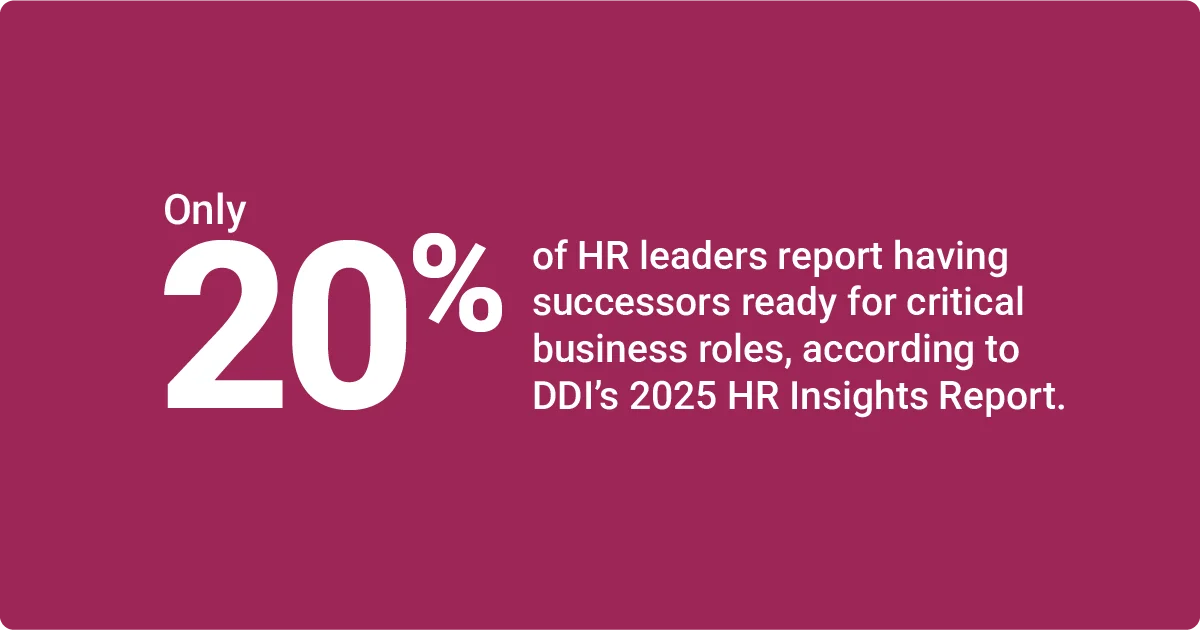
Further, companies promote their strongest performers into leadership without preparing them for a fundamentally different job. According to DDI’s “2025 HR Insights Report,” only 20% of organizations report having leaders ready for critical roles.
“Leading in a boundaryless worldOpens in a new tab,” by Deloitte research, also shows that 94% of workers say leadership capability is essential to business success, but only 23% believe their leaders are ready to lead.
Leadership pipeline vs. succession planning: What is the difference?
A leadership pipeline and succession planning aren’t the same thing, even though the terms get used interchangeably.
A pipeline is the continuous development flow across every leadership level, from individual contributors stepping into their first management role to senior executives preparing for enterprise leadership.
Succession planning names candidates for specific critical roles, drawing from the talent the pipeline has already developed. The two work together: a strong succession plan is only as good as the pipeline feeding it.
What is the leadership pipeline model?
The leadership pipeline model is a framework popularized by Ram Charan, Stephen Drotter, and James Noel in their 2001 book “The Leadership Pipeline”. It describes leadership development as a series of transitions, or ‘passages,’ each requiring a fundamentally different job rather than more of the same work at a bigger scale.
With over 300,000 copies sold and a 2024 revised edition, it remains one of the most influential leadership development frameworks of the past two decades.
The model’s core insight is simple: each passage into a new leadership role demands new skills, a new use of time, and new work values. Leaders who skip this recalibration keep doing the work that got them promoted, and that’s exactly where pipelines break down.
The six leadership passages:
- Managing self to managing others — shifting from personal output to delivering results through a team.
- Managing others to managing managers — selecting and developing first-line managers, not just individual contributors.
- Managing managers to functional managers — running an entire function and thinking with strategic perspective instead of tactical execution.
- Functional manager to business manager — balancing short-term results with long-term strategy for a business unit with full P&L responsibility.
- Business manager to group manager — allocating capital and strategy across multiple business units.
- Group manager to enterprise manager — leading at the CEO level, shaping culture, vision, and external relationships.
What changes at each passage:
- Skills — the new capabilities the next leadership role demands.
- Time application — how leaders then plan and spend their time.
- Work values — what leaders believe matters, and what they choose to reward in others.
How do you build a leadership pipeline?
Building a leadership pipeline follows a repeatable four-step process. It starts with defining the leadership roles and competencies your business strategy requires, followed by objectively identifying high-potential employees. Afterward, you help develop them through real experience and manage their transitions with a regular review cadence.
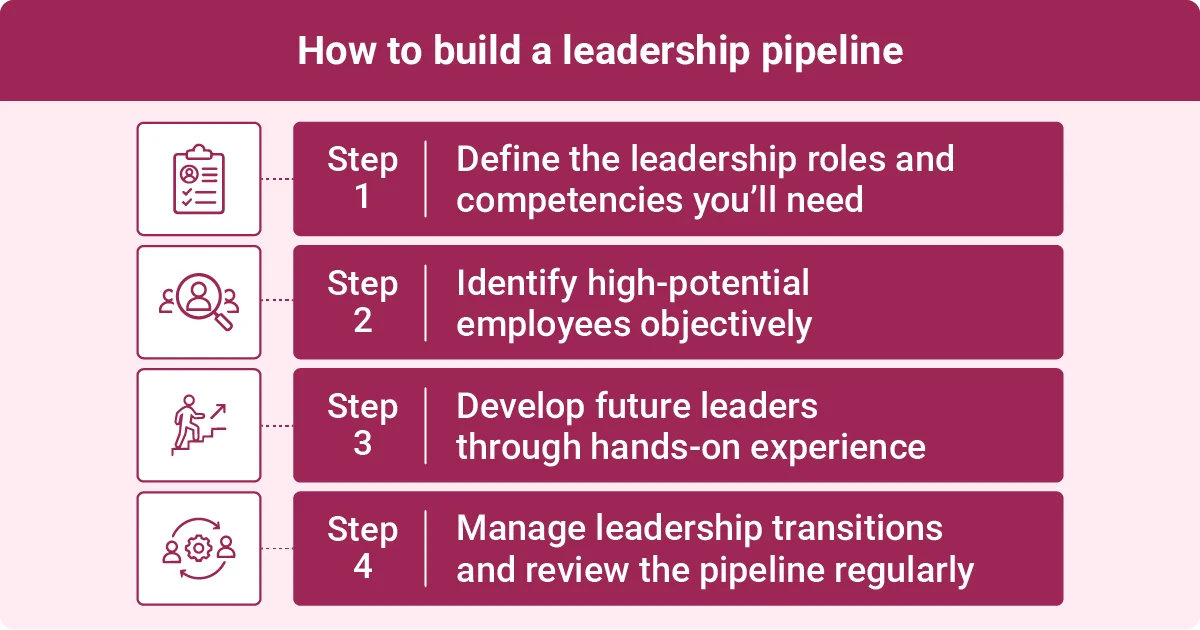
Step 1: Define the leadership roles and competencies you will need
Start by mapping the critical roles where a vacancy would hurt the most, from first-line managers up through senior executives and business leaders.
Define observable competencies for each leadership level instead of relying on one generic leader profile that ignores how a business manager’s job differs from an enterprise manager’s. More importantly, anchor these definitions to your current business strategy.
Most organizations skip this step, and that’s a mistake. They jump straight to identifying candidates without a clear picture of the leadership role they’re developing them to fill.
Step 2: Identify high-potential employees objectively
Identifying potential is one of the most consequential leadership development steps.
Most organizations rely on manager nomination, and Gallup’s research, “Why Great Managers Are So Rare,” shows that most organizations choose the wrong managers when they do. Tools, like 9-box performance-vs-potential reviews, 360-degree feedback, and validated assessments that separate leadership potential from past performance, can help organizations evaluate leadership potential beyond past performance.
Further, look for specific potential signals. Those include learning agility, influence without authority, and coaching instinct in how someone already treats other managers and peers. Guard against similar-to-me bias and visibility bias, which excludes people who look and sound like current leadership.
Consider recognition data too. When employees receive peer and manager recognition in the flow of work, that language can be mined with AI to surface and validate the skills they’re demonstrating, what Workhuman® calls Human Intelligence®.
The latter is a way to spot high-potential employees without relying on self-reported skills or manager-only validation. This matters given that DDI research, “Succession Planning Best Practices: How to Close the Leadership Readiness Gap,” shows internal candidates can currently fill only about 49% of leadership roles immediately when they open.
Step 3: Develop future leaders through real experience
Leadership development often benefits more from hands-on experience than classroom training alone. Stretch assignments, interim leadership roles, and cross-functional rotations build judgment that a workshop can’t replicate. Additionally, pair emerging leaders with mentors and active sponsors willing to advocate for them.
Don’t default to generic leadership content either. Instead, match each development opportunity to the demands of the next passage. A talent development strategy built around real experience is what separates organizations with a genuine bench from those with a training budget and few successful transitions to senior roles.
Step 4: Manage transitions and review the pipeline on a cadence
The transition into a new leadership role is a critical test of a leadership pipeline, particularly during the first year. New leaders need active support through the passage itself, not just a new job description and a “good luck.”
Fortunately, the original model prescribes specific ways to monitor these leadership transitions. Typically, it includes direct observations, 360-degree feedback sampling, and gap analysis between how a new leader sees their own performance and how others actually observe it.
More importantly, run talent reviews every 6 to 12 months and refresh readiness ratings each time. A solid talent review process tracks who’s ready now, ready soon, and/or ready later for every critical role.
That’s how the pipeline stays a living system instead of a static list you build once and forget about.
Why do leadership pipelines fail?
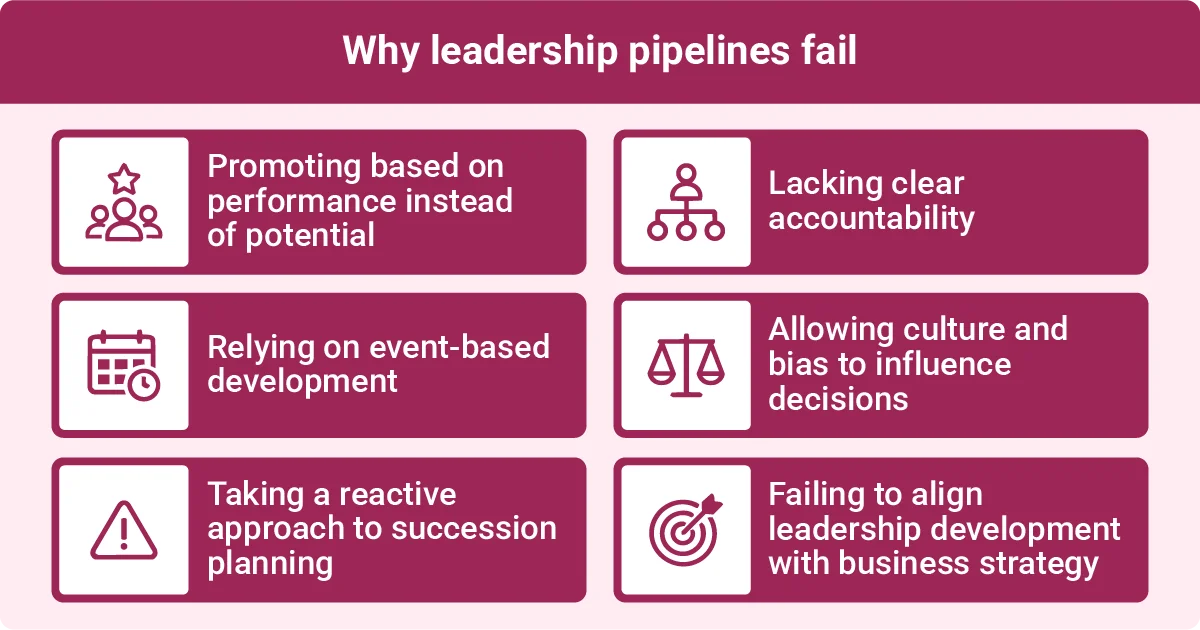
But what they lack is a system that identifies, develops, and promotes them correctly. According to “Leadership Pipeline Gaps StatisticsOpens in a new tab,” by Careertrainer, 60% of organizations say their leadership pipeline isn’t strong enough, and these six failure patterns explain why.
- Promoting on performance instead of potential. Companies reward strong individual contributors with management roles, assuming technical skills predict leadership ability. However, Gallup’s research, “Why Great Managers Are So Rare,” confirms that this backfires. Many organizations choose the wrong managers in this manner, since past performance rarely signals readiness for a different kind of work.
- Event-based employee development. A single workshop doesn’t build a leader. Rather, real capability comes from sustained coaching conversations and stretch assignments.
- Reactive succession planning. Many organizations only think about pipeline health once a critical role opens. By then, it’s too late to develop someone internally, so a hiring decision is rushed and leads to an external hire.
- No accountability. Talent reviews happen on the calendar, but nobody owns bench strength. As a result, readiness ratings go stale, and successor plans stay theoretical.
- Culture and bias. Talent hoarding keeps high-potential leaders locked in one function, while similar-to-me bias narrows who even gets considered. This environment eventually pushes the strongest leaders to opt out or leave.
- Disconnect from business strategy. Any talent blueprint has to evolve with your business goals. Otherwise, it leaves a surplus of skills that nobody needs and a shortage of the ones that matter now.
Note: Retention ties every failure together. Losing a high-potential employee isn't just a retention concern. It can also undermine years of investment in developing the organization's next generation of leaders. Why? Because that person often represents years of planned development.
How do you measure leadership pipeline health?
Leadership pipeline health is measured by combining leading indicators, like leadership readiness and bench depth, with lagging indicators, like fill and failure rates. A pipeline you never measure is only a list and not a system. Each metric tells you something different about where the gaps are.
Readiness metrics form the core leading indicator. Segment talent as ready now, ready soon, or ready later for each critical role. This distribution shows you where the bench is thin before a vacancy forces the issue.
DDI’s research, “Build Your Leadership Pipeline with Succession Planning,” backs the investment here. It found that organizations with strong leadership benches consistently achieve better financial performance than those without one.
Core leadership pipeline metrics
Recognition program analytics can help organizations measure and monitor signals related to leadership pipeline health. Frameworks that track business impact metrics, including manager effectiveness, attrition reduction, and retention, alongside employee metrics (i.e., engagement and skills), give bench strength and fill-rate KPIs a richer, more current data source than an annual talent review alone.
What a healthy leadership pipeline looks like
According to SkillPanel’s analysis of mature succession programs, “Succession coverage rate: The metric that reveals if your leadership pipeline is real or just a spreadsheet,” strong benchmarks include succession coverage of at least 80% for critical roles, internal fill rates of 70% or higher, and a bench strength of two to three qualified successors per critical position.
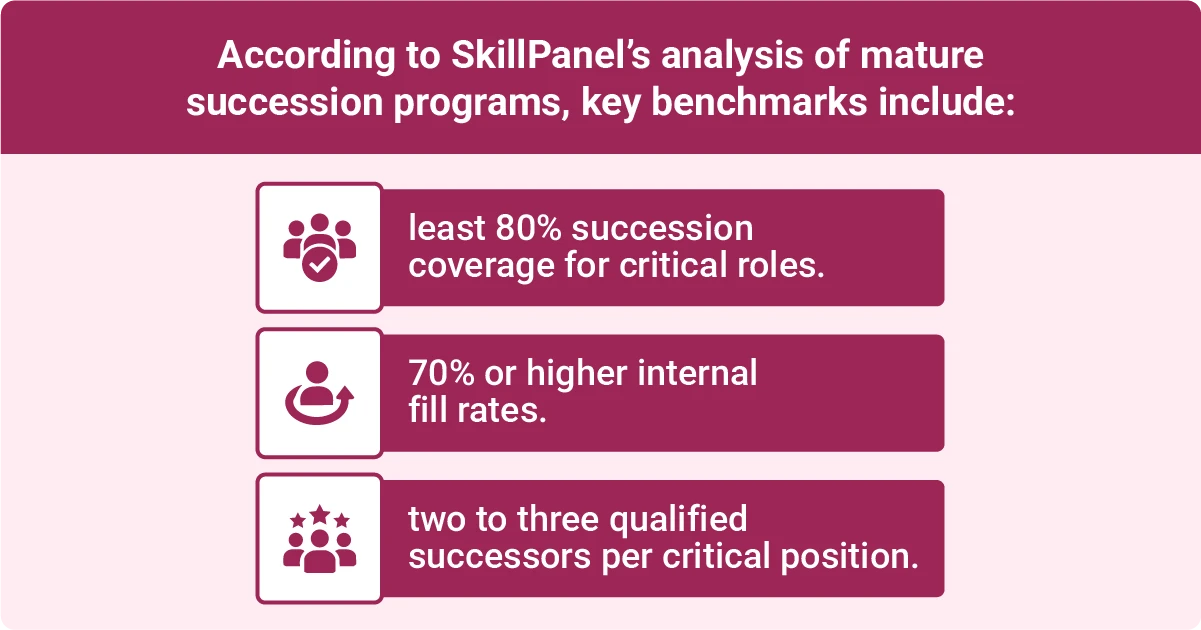
In the end, a healthy pipeline balances ready-now depth with longer-horizon development, rather than resting on a shortlist of a few standout stars.
How is leadership pipeline development changing?
Leadership pipeline development is shifting from identifying a single backup for each role to building capacity across the entire organization. Instead of one hand-picked successor, companies now track bench strength across multiple time horizons.
So, don’t just name backups. Bench strength now means leadership readiness across near-term, mid-term, and long-term horizons.
Keep in mind AI’s impact. Senior leaders need AI fluency to lead effectively, yet “Rethinking early-career talent in the agentic organization,” by McKinsey, warns that AI is simultaneously automating the early-career tasks that historically built leadership judgment. As a result, organizations may need to rethink entry-level roles to preserve the experiences that help employees develop the judgment required for future leadership positions.
Further, skills-based systems widen the pool. Internal talent marketplaces are pulling leadership potential from beyond the usual hand-picked group. Deloitte’s “A new age of talent agility” supports this shift toward internal mobility over static, function-locked career paths.
Also remember: sponsorship alongside mentorship. Senior leaders are increasingly spending real capital to advocate for rising talent in rooms those employees aren’t in yet. Emotional intelligence, psychological safety, and coaching ability now carry more weight than they used to, particularly for leading hybrid teams.
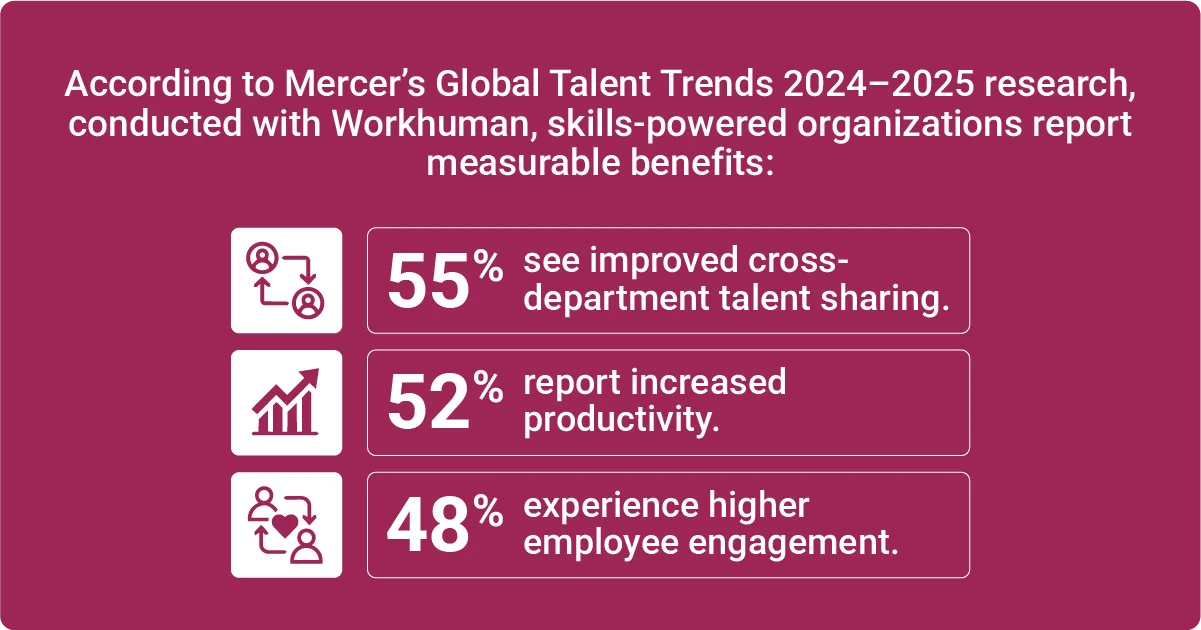
Above all, Mercer’s Global Talent Trends 2024-2025 research, “Unlock the Skills-Powered Organization,” conducted with Workhuman, backs this research with hard numbers: 55% of skills-powered organizations report improved talent sharing across departments, 52% report a productivity boost, and 48% report higher employee engagement.
The Harvard Business Impact “2025 Global Leadership Development Study” also sums up where all this is heading with three suggestions: leadership development needs to be fast, fluid, and future-focused.
FAQs
How do you identify high-potential employees for leadership roles?
Use objective tools rather than manager instinct. Those include 9-box performance-vs-potential reviews, 360-degree feedback, and validated assessments. Look for learning agility and influence without authority. Recognition data also surfaces skills through peer and manager feedback. Good leaders possess a combination of technical and soft skills.
What are talent readiness metrics?
Talent readiness metrics segment employees as ready now, ready soon, or ready later for a given leadership role. This distribution reveals bench depth before a vacancy forces the issue. It’s also the leading indicator every pipeline review should track first.
How is a leadership pipeline different from a leadership development program?
A leadership pipeline is the full system: identifying talent, developing it, and managing transitions across every leadership level. A development program is one component within that system, typically training or coaching delivered to a specific cohort of future leaders.
How often should you review your leadership pipeline?
Run talent reviews every 6 to 12 months. Each cycle should refresh readiness ratings, reassess succession depth per critical role, and check whether development plans still match the business strategy driving your leadership needs.
What is L1, L2, and L3 leadership?
L1, L2, and L3 typically refer to sequential leadership levels: first-line managers (L1), managers of managers (L2), and functional or senior leaders (L3). Exact definitions vary by organization, but each level maps to a passage in the pipeline model.

Ryan Stoltz
Ryan is a search marketing manager and content strategist at Workhuman where he writes on the next evolution of the workplace. Outside of the workplace, he's a diehard 49ers fan, comedy junkie, and has trouble avoiding sweets on a nightly basis.
Recommended for you