
Leadership Assessment Tools 2026: Types, Validity, and How to Choose the Right One
by Ryan Stoltz
Last updated
14 min read
Table of contents
- What are leadership assessment tools?
- What do leadership assessments actually measure?
- What are the main types of leadership assessment tools?
- How to choose a leadership assessment tool for your goal
- How do you evaluate validity, reliability, and fairness?
- How do you assess leadership potential and readiness?
- How do you act on leadership assessment results?
- FAQs
Share this article
You have to make a high-stakes leadership call, but all you have to go on is a resume and the personal perceptions of a manager. Leadership assessment tools can provide additional, valuable insights to help you make a more informed decision.
Effective leadership isn't always as easy to measure, especially when you're trying to predict management potential and how someone will respond to future challenges. An employee may seem like they have a knack for leading, but you can't know how they'll perform running a team until they're actually in the position.
Leadership assessment tools take some of the guesswork out of HR decisions by using standardized methods to evaluate a person's current performance or leadership potential. From skills inventories to simulations, these tools use different methods to provide additional evidence when considering someone for career advancement.
Understanding what these tools measure and the strengths and weaknesses of each resource can help you choose the right assessment tools for your workforce. The right choice depends on what you need to measure, how reliable the assessment is, and how you plan to use the results in leadership decisions.
What are leadership assessment tools?
Leadership assessment tools are structured, standardized methods for evaluating how a person leads or is likely to behave in a leadership position. They come in many forms, including questionnaires, psychometric inventories, multi-rater surveys, situational scenarios, simulations, and structured interviews.
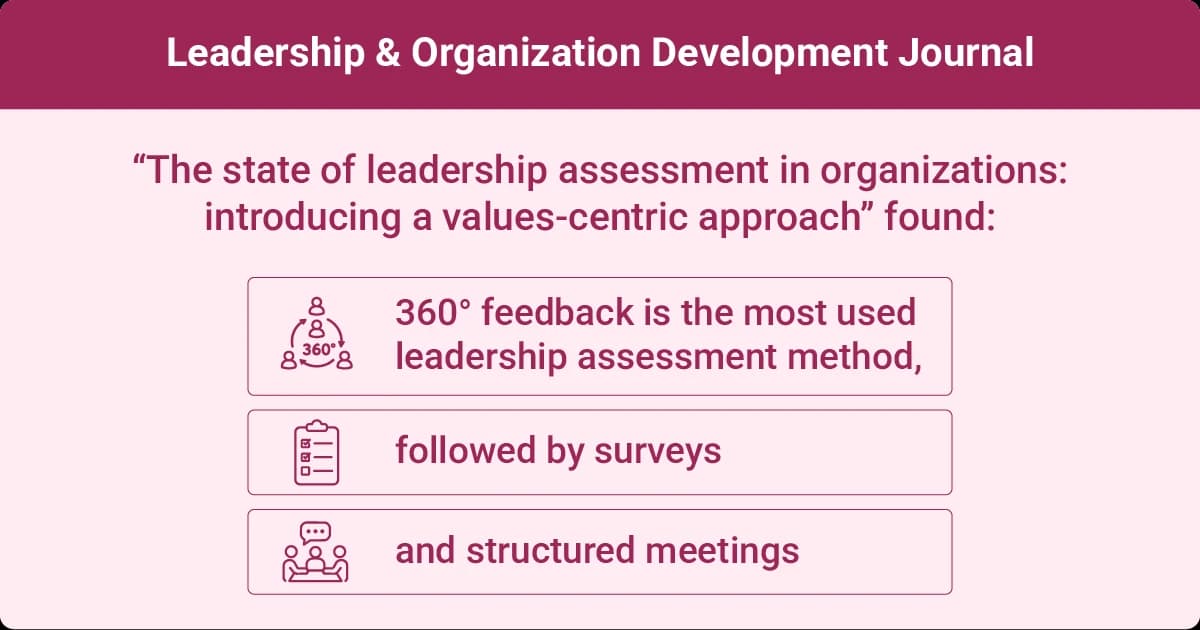
According to researchers in the Leadership & Organization Development Journal, “The state of leadership assessment in organizations: introducing a values-centric approachOpens in a new tab,” 360-degree feedback is the most frequently used assessment, followed by surveys and structured meetings.
There's no single standard leadership assessment for every situation. Every tool reveals different insights about a person's leadership. If you want to evaluate how someone will respond to a PR crisis, you might run a simulation. For a balanced view of their strengths and weaknesses, you might collect 360-degree feedback.
Organizations often use these tools as part of a broader talent assessment process. They give HR leaders additional information to support high-stakes decisions without relying only on intuition. They can also provide a more consistent framework for evaluating candidates using an organization’s defined leadership criteria.
These tools offer a shared vocabulary for leadership behavior as well. They can also reveal leadership development needs and areas for improvement.
How a leadership assessment differs from a personality test
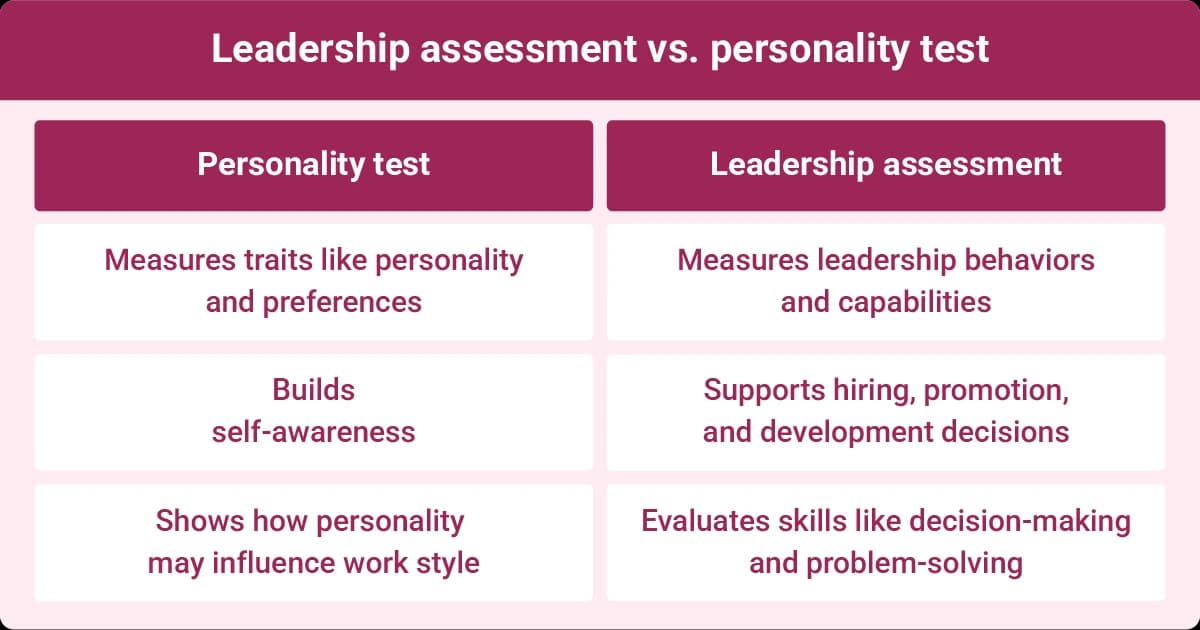
You may already use a personality test to measure common psychological traits, such as extroversion and agreeableness. These tests can also increase self-awareness by helping employees understand how their unique personality may affect their work. On their own, though, they generally shouldn't be the sole basis for hiring or promotion decisions.
Leadership assessments, on the other hand, focus on specific behaviors and traits associated with effective leadership. For instance, a cognitive test can give insight into an employee's ability to reason through and solve a logistics or budget problem.
Who uses leadership assessments, and what they get out of them
Here are a few roles that often use leadership skills assessments:
- Talent acquisition may use these structured tools alongside interviews when making external leadership hires.
- Learning and development and coaching teams can consult them for development planning.
- HR and executive teams use leadership assessments to plan succession and evaluate bench strength beyond relying on manager opinions.
What do leadership assessments actually measure?
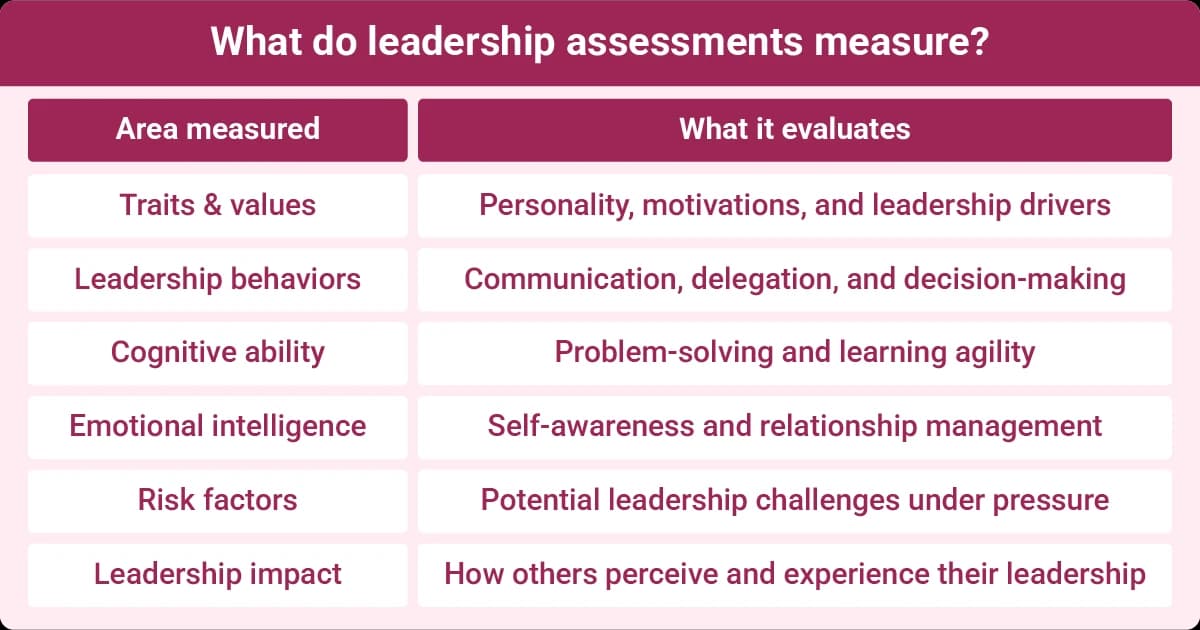
Assessment tools for leadership effectiveness measure behaviors, traits, and values that can influence how people perform in leadership roles. Each type of tool can reveal strengths and weaknesses in different areas, such as emotional intelligence or decision-making. Try to match the type of assessment with the capabilities you're trying to evaluate.
Here are a few capabilities that leadership assessments measure:
- Traits and dispositions: Personality characteristics that tend to remain relatively consistent over time, such as openness and risk tolerance.
- Motives, values, and drivers: The goals and principles that motivate and sustain a leader.
- Competencies and observable behaviors: Skills such as change leadership, communication, decision-making, and delegation.
- Cognitive capability and learning agility: A person's ability to reason, solve problems, and learn from new experiences.
- Emotional intelligence: The ability to understand and regulate one's own emotions and those of the people around them
- Derailers and risk factors: Negative behaviors such as defensiveness and micromanagement that may surface during stressful situations.
- Reputation and impact: How colleagues perceive and interact with the leader.
Traits, motives, and competencies: 3 different questions
Traits tell you who the leader is, while motives help you understand what drives them. Meanwhile, competencies are observable behaviors and skills. Each category answers a different question, so a single assessment usually doesn't cover all three.
Instead, it's best to mix and match tools for different types of decisions. Suppose you're planning succession for a client-facing leadership role. You might evaluate your team's traits and motives to identify ambitious employees who are motivated to build relationships. For promotions, competencies could help you find people who already know how to delegate and manage conflicts.
Derailers: What assessments catch that interviews miss
A relaxed interview doesn't always tell the full story about how someone behaves under pressure. An employee may describe themselves as laid-back and empathetic. However, if their team misses a deadline, they might become angry or controlling.
Assessments can identify potential stress-related behaviors that might otherwise go unnoticed until a crisis. Of course, just because someone gets flagged for a possible risk doesn't mean they'd actually behave that way in a real-life situation.
These tools give predictions, not promises. Use them to offer coaching and development opportunities instead of writing off everyone who doesn't score highly in all areas.
What leadership assessments cannot tell you?
Even the best leadership assessment tools can't fully assess someone's character or integrity or predict future success across different contexts. For instance, someone who excels at managing a small in-person team may not perform with the same competency if promoted to lead a global, hybrid department.
Culture matters. The population used to develop and validate an assessment matters, too. If that population differs significantly from the people you're assessing, the results may not provide an accurate picture of their leadership abilities.
Given these variables, it's best to treat a score as a guide, not a verdict.
What are the main types of leadership assessment tools?
The most common types of leadership assessments include 360-degree feedback, personality and behavioral inventories, cognitive ability tests, simulations, competency and potential assessments, and interview-based formats. Each kind of instrument offers different insights into a potential or current leader's behaviors and strengths.
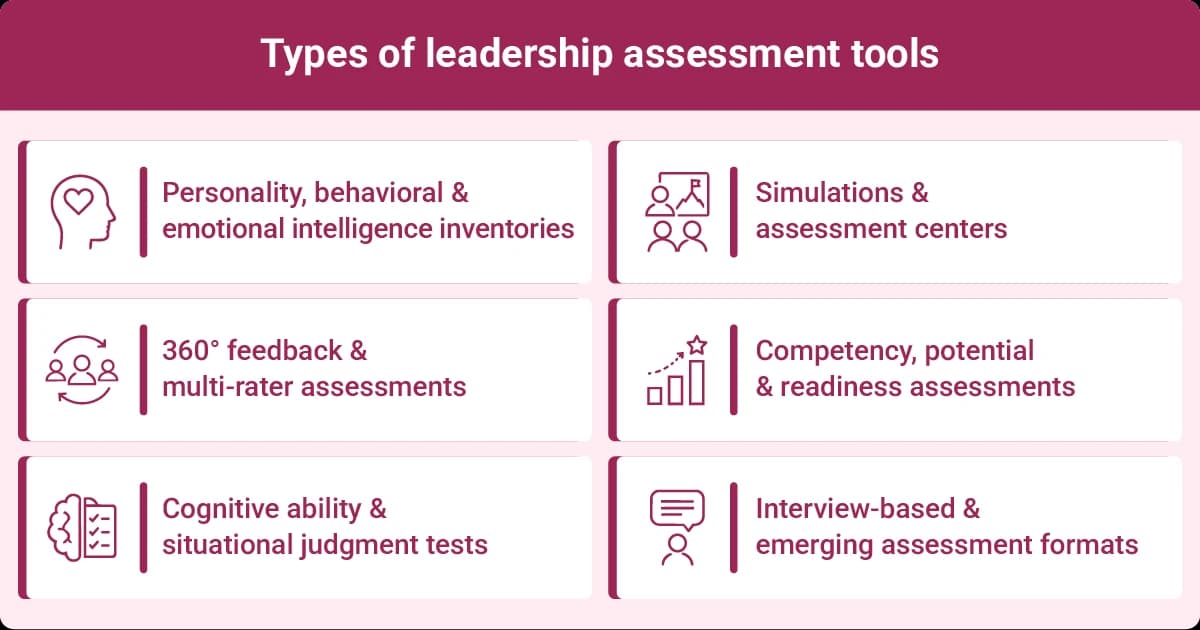
Personality, behavioral, and emotional intelligence inventories
These inventories use self-reported data to assess behavioral and leadership styles and personality characteristics that tend to remain relatively consistent over time. Common examples include:
- Emotional intelligence instruments, which measure empathy and self-regulation
- Motives and drivers inventories, which assess what inspires a person
Best for:
Coaching, raising self-awareness, and building teams
Limitations:
Focus on tendencies instead of proven performance, and people may only report positives to try to make themselves look good
Examples of instruments:
CliftonStrengths, Hogan Personality Inventory, and the Emotional and Social Competency Inventory (ESCI)
360-degree feedback and multi-rater assessments
When you picture a leadership readiness assessment, 360 feedback is probably the first tool that comes to mind. It gathers input from multiple raters, including direct reports, peers, managers, and even the leaders themselves.
Best for:
Identifying blind spots, supporting professional development, and comparing reputation versus identity
Limitations:
May be influenced by rater bias, workplace politics, and how well you administer the assessment
Examples of instruments:
CCL Benchmarks® 360, Korn Ferry 360, the Leadership Circle Profile®, and Skillscope®
Cognitive ability and situational judgment tests
Cognitive tests assess critical thinking and problem-solving abilities. These evaluations can give insight into how leaders may perform when faced with complex issues without clear solutions.
Likewise, situational judgment tests present realistic scenarios with different response options. They can help you understand how a person might make decisions in specific circumstances. For instance, you might ask potential hires how they would respond if a natural disaster derailed a major project.
Organizations often use both types of assessments to measure different kinds of problem-solving. While they may require fewer resources than full-fledged simulations, they don't provide the same kind of observed behavioral evidence.
Best for:
Complex, ambiguous, and high-volume roles
Limitations:
Strong reasoning doesn't always translate into the ability to lead people
Examples of instruments:
Hogan Business Reasoning Inventory, Saville Assessment's Situational Judgment Tests, and Talent Q
Simulations and assessment centers
You don't need to put someone into a real leadership role to be able to see their behavior in action. Role play and case analysis allow potential leaders to demonstrate their leadership skills under the supervision of trained observers.
Observed behavior can provide different and potentially more direct evidence than self-reported answers. However, it may not tell the full story if the exercise isn't realistic. You'll also need to train assessors to provide objective observations.
Best for:
High-stakes hiring and succession decisions
Limitations:
Expensive and time-consuming
Examples of instruments:
DDI leadership simulations and the Heidrick Immersive Assessment
Competency, potential, and readiness assessments
A competency assessment rates a person against an internal leadership model. It compares their behaviors and skills to the ones your organization values. For instance, if cross-cultural communication is a core competency, the assessment could evaluate how effectively someone works with people from different backgrounds.
For a more forward-looking view, consider a leadership potential or leadership readiness assessment. These instruments estimate whether someone can grow into more senior roles and when they'll be ready to step up. They typically measure cognitive ability, motivation, learning agility, and personality.
These leadership development assessment tools can be useful for identifying internal candidates for succession planning. They also support promotion and development decisions, such as which employees to mentor.
Best for:
Succession planning and development
Limitations:
Only as good as the underlying competency model and raters
Examples of instruments:
Leadership Practices Inventory® and the Korn Ferry Four Dimensions of Leadership and Talent
Interview-based and emerging assessment formats
In many organizations, unstructured interviews are still the norm when making leadership decisions. These conversations may feel informative, but they can be difficult to apply consistently. You may ask each candidate different questions, making it difficult to compare their responses. It's also not always clear what a "good" answer is.
Structured interviews address these issues by using standardized questions and a scoring rubric for each candidate. That way, you're evaluating everyone against the same criteria.
While these emerging instruments may add useful evidence, take the time to make sure they're valid and don't have any negative impacts on employees.
Best for:
Comparing candidates for hiring and promotion decisions
Limitations:
The quality of the questions will affect candidate responses, while emerging tools need to be checked carefully for fairness and reliability
Examples of instruments:
Karat and RightMatchAI
How to choose a leadership assessment tool for your goal
Before you start shopping for leadership assessment instruments, take the time to identify your goal and define the competencies that matter. Then look for tools that measure those skills and behaviors, as well as a solution that fits your organizational culture, budget, and timeline.
Matching the assessment type to the decision
| Goal | Recommended methods | What to weigh most | Primary risk |
| External hire and internal promotions | Cognitive testsSimulations Structured interviews | Predictive validity and defensibility | Using scores as a verdict instead of as one piece of evidence |
| Development and coaching | 360-degree feedback Behavioral and emotional intelligence inventories | Actionable output and debrief quality | Not connecting findings to a thoughtful development plan |
| Succession and potential identification | Psychometric tests focused on potential Simulations and assessment centersCareer historyContinuous talent signals | Forward-looking evidence from multiple sources | Overlooking high-potential employees because they're not visible or don't have a manager advocating for them |
Define your leadership success profile first
The last thing you want to do is invest in an instrument before you know what you need to measure. After all, you probably wouldn't look for the same qualities when you're hiring a Chief Technology Officer (CTO) versus a Director of Finance.
Start by analyzing the role itself. List essential skills and behaviors that a leader needs to succeed. A CTO, for instance, should know how to delegate effectively and have extensive technical knowledge.
You can't comprehensively evaluate every competency on your list, so focus on a few key areas. Then look for leadership assessments that help you evaluate candidates on those specific capabilities. For instance, you might use 360-degree feedback to see how CTO candidates interact with their direct reports.
Practical filters: Cost, time, reporting, and certification
Cost is one of the biggest factors when shopping for leadership assessment instruments. Look for tools that fit your budget and scale with your hiring needs.
You should also weigh how long the assessment takes versus how much insight it gives. A simulation might take several hours but give you a strong sense of how candidates would respond to specific challenges.
Meanwhile, when answering “Common Questions About HoganOpens in a new tab,” Hogan Assessments notes that simple instruments like its personality test and development survey only take around 15 to 20 minutes. However, short assessments may give you less evidence about how candidates will actually perform.
Reporting quality is another major consideration. Some tools offer in-depth behavioral indicators or detailed feedback from observers. Others only provide bare scores or labels. The more work your team has to put into interpreting the results, the less likely they are to use the instrument.
Check for certification requirements, too. Your internal HR staff may need special training to administer some assessments or debrief the results. That may slow decision-making while you wait for them to get certified.
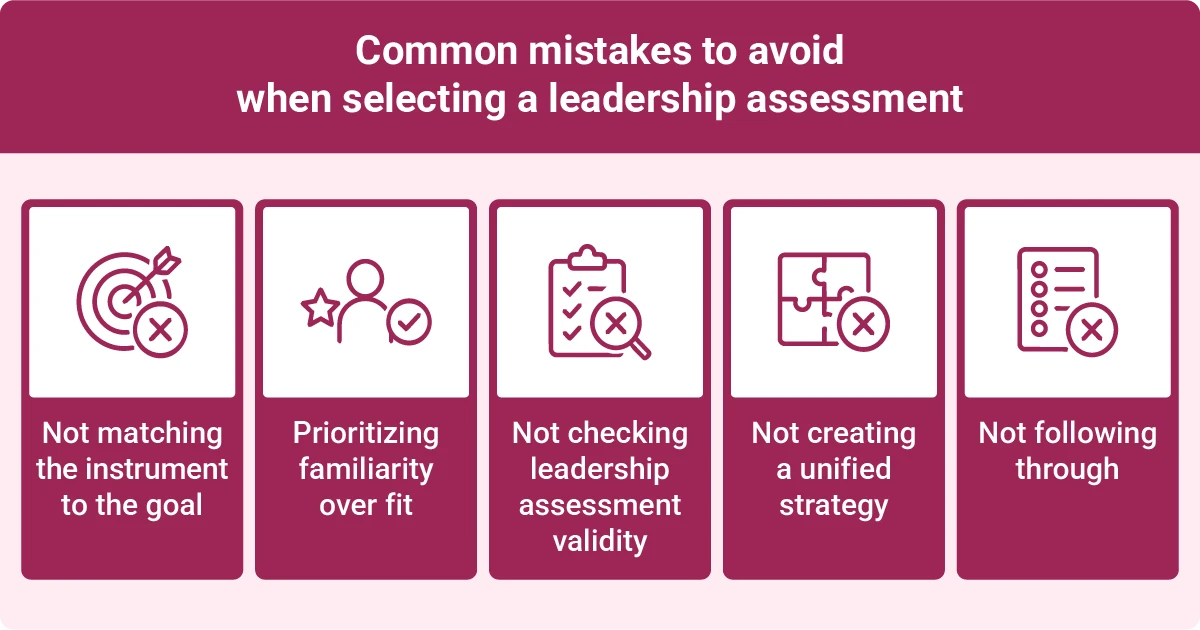
Common mistakes when selecting a leadership assessment
As you compare tools, avoid these common pitfalls:
- Not matching the instrument to the goal: If the tool doesn't fit your purpose, you may end up with incomplete or irrelevant data.
- Prioritizing familiarity over fit: You may be tempted to default to the traditional 360-degree feedback, but that doesn't always measure the right competencies.
- Not checking leadership assessment validity: If a tool doesn't measure what it claims to assess, you could end up choosing candidates based on flawed data.
- Not creating a unified strategy: If your organization isn't on the same page about leadership expectations, different teams might apply criteria and data unevenly.
- Not following through: Assessment data is only helpful if you use it to make concrete plans for development, hiring, or succession.
Combining assessments: Winning combinations by use case
According to “Recognition as a Strategic Lever: Driving Data-Driven Decisions and True Business Impact,” by Everest Group and Workhuman®, if your organization has a recognition program, it may already contain behavioral signals that provide additional insight into your leadership team.
Workhuman iQ can surface patterns that help you understand leadership behaviors and team dynamics. Tracking these trends also makes it easier to figure out which qualities and capabilities you want to measure with leadership assessments.
As you choose assessment methods, consider pairing a self-report method with an observed or multi-rater assessment. Here are a few potential combinations for different goals:
- External leadership hire: Use a cognitive test, a personality inventory, and a structured interview, with a simulation for senior roles.
- Internal promotion: Ask employees to complete a situational judgment test and a structured interview.
- Individual development and coaching: Get a sense of your employees' strengths and weaknesses with 360-degree feedback, plus a personality or derailer inventory.
- Succession and high-potential identification: Combine an assessment center or simulation with psychometrics and a career history review.
Just don't overdo it. The more leadership assessments you add, the more likely candidates are to get fatigued or drop out. More data also takes longer to sift through, slowing decision-making.
Stop when you have all the assessments you need to answer your core questions.
How do you evaluate validity, reliability, and fairness?
An assessment has validity when there is evidence that it measures what it is designed to measure, while reliability refers to the consistency of its results. You can evaluate these criteria by reviewing evidence from the assessment's development and validation and asking vendors specific questions about how they evaluate their assessments.
The 3 types of validity that matter
Look for a leadership assessment that can provide evidence of validity across three areas:
- Construct validity: The assessment measures what it says it does.
- Criterion and predictive validity: Scores are related to real leadership outcomes.
- Content validity: The items reflect the role's leadership demands.
Reliability: Test-retest, internal consistency, and inter-rater
Reliability means the tool produces consistent results in three areas:
- Test-retest: If the same person takes the assessment twice, they'll get reasonably consistent results.
- Internal consistency: All the items in the same subscale measure the same thing.
- Inter-rater reliability: Different raters give similar scores for the same behavior.
Unreliable results limit a tool's validity because you can't confidently interpret what the scores mean. This is a common issue for 360 programs when raters aren't properly trained or perceive the same behavior differently from person to person.
According to “An Aberrant Abundance of Cronbach’s Alpha Values at .70Opens in a new tab,” an article in Advances in Methods and Practices in Psychological Science, a Cronbach's alpha of .70 is frequently used as a benchmark for internal consistency. However, the authors caution against treating .70 as a universal threshold because alpha can vary based on factors such as how a test is constructed and evaluated.
Here's what to ask a vendor:
- What's the Cronbach's alpha for this tool?
- Do you have evidence of inter-rater reliability?
- Have you performed test-retest studies?
Fairness, adverse impact, and legal defensibility
Fairness means evaluating whether an assessment provides an equitable opportunity for people to demonstrate the capabilities being measured and whether its results disadvantage particular groups.
Ask your vendor:
- Have you conducted an adverse impact analysis for different demographic groups?
- What is the composition of your norming sample?
- How do you accommodate people with different abilities and backgrounds?
- Does this assessment meet the Uniform Guidelines on Employee Selection Procedures?
Extra scrutiny for AI-scored assessments
In a press release titled “U.S. EEOC and U.S. Department of Justice Warn against Disability DiscriminationOpens in a new tab,” the U.S. Equal Employment Opportunity Commission warns that employers' use of AI and other software tools in employment decisions can create risks of discrimination against people with disabilities.
When evaluating AI-based assessments, look for vendors that follow established professional guidance, such as the Society for Industrial and Organizational Psychology's “Considerations and Recommendations for the Validation and Use of AI-Based Assessments for Employee SelectionOpens in a new tab.”
Other questions to ask include:
- What type of training data do you use?
- Can you explain how the AI scores employees?
- Is there any human review?
How do you assess leadership potential and readiness?
Leadership potential is the ability to grow into larger and more complex roles over time, while readiness is how prepared a person is to succeed in a specific role. Assessments for leadership potential often focus on qualities associated with future growth, such as adaptability and learning agility, while readiness assessments look for evidence tied to the requirements of a specific role.
Potential versus readiness: 2 different questions
Potential is an individual's capacity for growth, while readiness is their preparedness for a specific role now. High performance doesn't necessarily demonstrate either, because someone who excels in their current job won't necessarily be a great leader. People may be promoted based on success in previous roles only to reach a role for which they're less well suited.
What current potential models measure
Leadership potential models include the Korn Ferry Four Dimensions and the Russell Reynolds Leadership Portrait. These models evaluate:
- Learning agility and adaptability in ambiguous situations
- Drive, resilience, and social intelligence
- Systems thinking and self-insight
Where the 9-box grid falls short on its own
While the 9-box grid can be useful for calibration conversations, it shouldn't be the only source of evidence used to assess leadership potential. Manager assessments may not capture the full range of an employee's skills, interests, and potential.
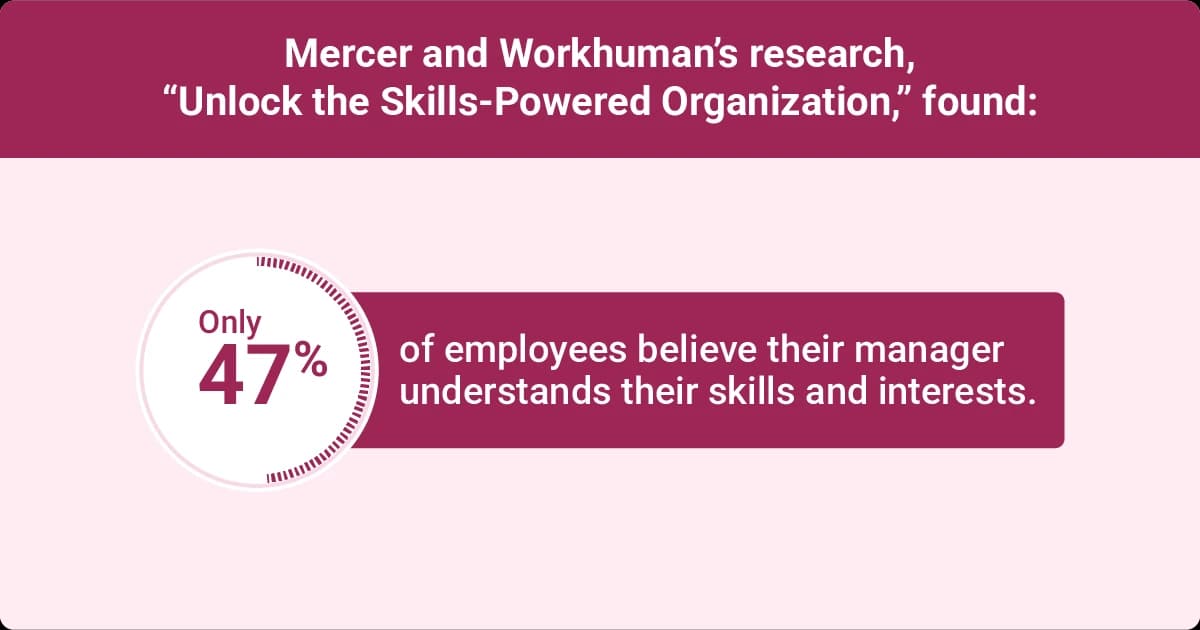
According to Mercer and Workhuman research, “Unlock the Skills-Powered Organization,” only 47% of employees believe their manager understands their skills and interests. Consider complementing manager judgment and tools such as the 9-box grid with evidence from validated assessments and continuous behavioral signals.
How AI and continuous signals can uncover overlooked leadership potential
Formal assessments can tell you a lot about an employee, but they don't tell you who to assess or develop in the first place. Relying primarily on manager nominations and tenure may also limit who gets considered.
Continuous workforce data can help you spot evidence of leadership behavior and core skills beyond formal talent reviews. For example, Workhuman Future Leaders™ uses AI and workforce signals to help organizations identify emerging leadership potential early and support their development. These signals can provide additional insight when building a succession plan.
Of course, this tool doesn't replace validated leadership assessments. Instead, use it to identify talent you want to evaluate more and invest in.
Assessing readiness for a specific role and context
A readiness profile should include:
- Skills and behaviors tied to the role's strategic mandate
- A reassessment date to re-check readiness ratings
- Emerging capabilities relevant to the role, such as AI and digital fluency, and the ability to exercise sound judgment under pressure
How do you act on leadership assessment results?
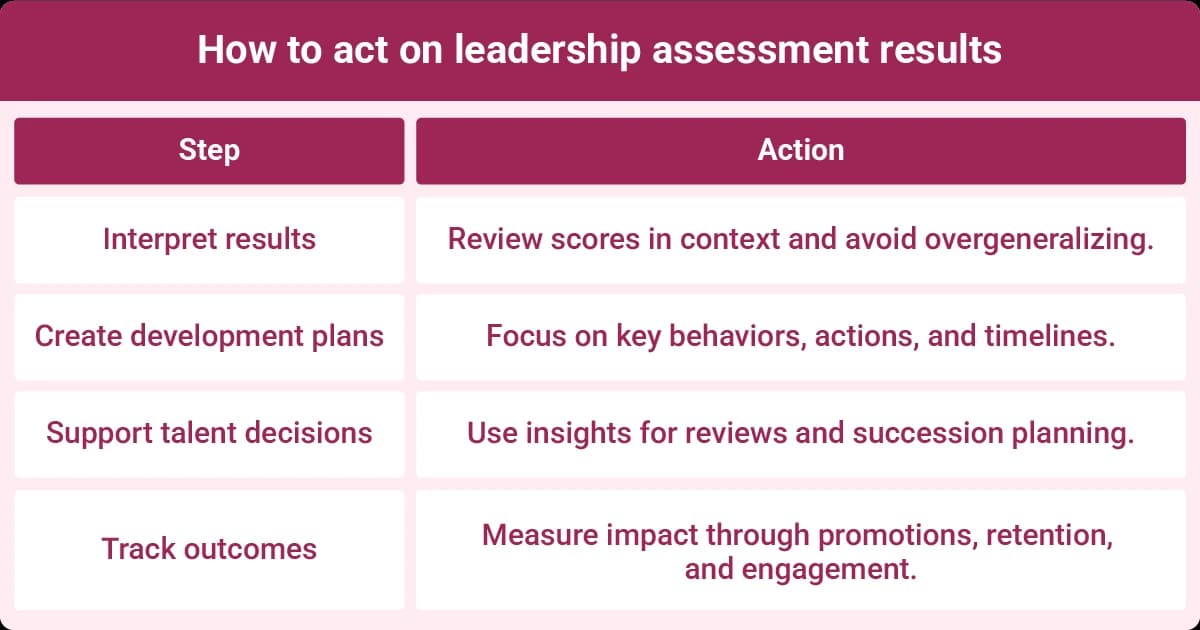
After you interpret the results of your leadership assessments, use them to create development plans and support your talent review process. You should also use metrics to monitor outcomes and evaluate whether your assessment program is supporting its intended goals.
Interpreting results without over-reading them
Put the results in context by considering the norm group, role demands, and situation. Look at the score band it falls within, and debrief with the candidate to help you understand the results better.
Turning findings into a development plan
Choose two or three observable behaviors from your leadership development assessment to focus on. Pair each with a stretch experience that gives employees an opportunity to put their new training into action. You should also name who's responsible and set a timeline for re-measurement.
Connecting assessment data to talent reviews and succession
Assessment results shouldn't stay in a vacuum. Use them to calibrate talent reviews and plan succession.
“How Work Gets Done (Now),” a Workhuman study, recommends combining this data with skills mapping and career readiness signals to see who's ready to move into leadership roles. Evaluating these signals continuously instead of only once a year can provide a more current view of employees' skills and career readiness.
Measuring whether the assessment program worked
To evaluate program effectiveness, consider reassessing employees at appropriate intervals and monitoring metrics such as:
- Internal fill rate
- Promotion success
- Retention
- Team engagement
FAQs
What is the difference between leadership potential and leadership readiness?
Leadership potential is a person's capacity to grow into leadership roles over time. By contrast, leadership readiness describes how prepared someone is for a specific role now. Potential is forward-focused, while readiness focuses on the requirements of a particular role.
Are leadership assessment tools accurate predictors of job performance?
Validated leadership assessment tools can provide evidence about behaviors, capabilities, and traits associated with job performance, but their predictive value varies by assessment and how it's used. No assessment can guarantee how someone will perform once they're actually in a leadership role.
Can you use the same leadership assessment for hiring and for development?
Yes, you can use the same leadership assessment for different HR purposes, but you should use the results in different ways. For hiring, focus on whether the evidence indicates that a candidate has the necessary competencies. For development, look for areas of improvement.
Are free leadership assessment tools worth using?
Free leadership assessment tools can be helpful for low-stakes decisions and self-awareness. For instance, you might use a free personality inventory to help employees explore their core traits. However, you shouldn't rely on assessment tools for hiring and other critical decisions unless they're validated.
How long does a leadership assessment take to complete?
It depends on the type of leadership assessment. Simple tools, such as behavioral and emotional intelligence inventories, may only take 15 to 20 minutes to complete. On the other hand, complex cognitive tests and in-depth simulations might last several hours.

Ryan Stoltz
Ryan is a search marketing manager and content strategist at Workhuman where he writes on the next evolution of the workplace. Outside of the workplace, he's a diehard 49ers fan, comedy junkie, and has trouble avoiding sweets on a nightly basis.
Recommended for you