
Intrinsic Rewards: How to Define, Compare, and Cultivate Them at Work
by Ryan Stoltz
Last updated
13 min read
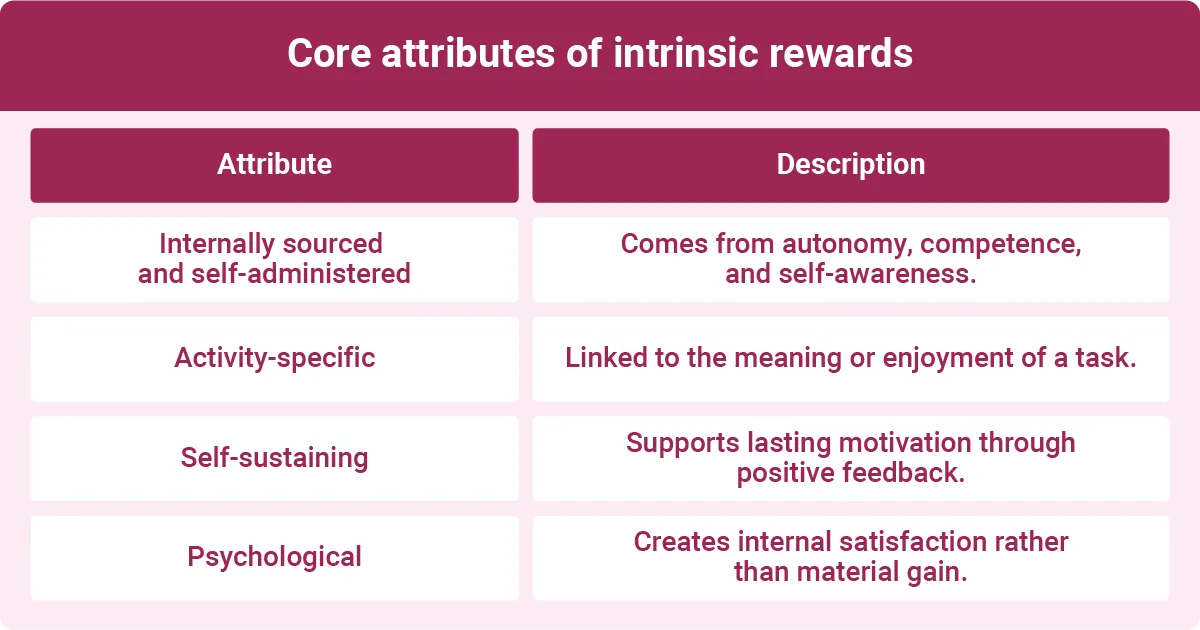
Table of contents
- What are intrinsic rewards?
- Intrinsic vs. extrinsic rewards: The key differences
- The psychology behind intrinsic rewards: SDT, flow, and Pink's Drive
- Examples of intrinsic rewards in the workplace
- Why intrinsic rewards matter: Benefits for employees and organizations
- How managers can cultivate intrinsic rewards
- The evidence: What recent research says about intrinsic rewards
- FAQs
Share this article
Human resources (HR) leaders and executives are investing in compensation, benefits, and perks. However, they're seeing disengagement, attrition, and low discretionary effort, even with rewards and recognition systems in place. This gap is often caused by an overreliance on extrinsic rewards without enough focus on intrinsic rewards. Extrinsic rewards alone cannot produce sustained motivation, yet most reward systems are built almost entirely around them.
Leaders know pay matters, but they also sense that something beyond pay drives their best performers, and they lack a precise framework for what that something is or how to design for it. Intrinsic rewards are the construct that explains why some employees stay engaged without constant external incentives.
This article will:
- Define intrinsic rewards grounded in psychology.
- Directly compare extrinsic and intrinsic rewards, including the contexts where each reward works best.
- Explore concrete workplace examples organized by the psychological needs they satisfy.
- Delve into specific management practices for cultivating intrinsic rewards.
What are intrinsic rewards?
Intrinsic rewards are internal, psychological, self-administered rewards generated by performing the activity itself. They are intangible and non-monetary, which means there's no way to directly give these rewards to employees. Instead, these rewards are derived intrinsically through healthy environments, company cultures, good work-life balance, and empowering workflows.
Intrinsic rewards can show up in various ways, including feelings of competence, meaning, autonomy, growth, and enjoyment. In the workplace, intrinsic rewards show up as pride in craft, absorption or flow, and feelings of progress, purpose, and belonging. Even if you can't see them, intrinsic rewards are often more durable and lasting than tangible benefits or financial employee incentives.
Think of the sense of relief, pride, and accomplishment a tax accountant feels after they've completed the last tax return document of the fiscal year, after having a desk full of papers the week before. Imagine the intense joy and fulfillment a doctor feels after saving a patient's life and seeing them reunite with their family.
According to a paper published in the Journal of Informatics Education and Research titled “Role of Intrinsic and Extrinsic Rewards in Motivating EmployeesOpens in a new tab,” intrinsic rewards play a crucial role in sustaining long-term engagement and job satisfaction. Meanwhile, extrinsic rewards are more ideal for short-term employee performance and goals.
The core attributes of an intrinsic reward
Intrinsic rewards are often defined by the following attributes:
- Internally sourced and self-administered: Intrinsic rewards are felt by the individual rather than delivered by another party. This self-administration hinges on employees' feelings of autonomy, personal competence, and self-awareness.
- Activity-specific: Most intrinsic rewards are tied to the activity itself rather than a separable outcome. Organizations rarely find employees motivated intrinsically to complete tasks simply because they're part of the job, but rather because of what the specific task means to them.
- Self-sustaining: Intrinsic rewards can create positive feedback loops that push durable, long-term employee motivation, especially when HR teams foster healthy work environments.
- Psychological: Rather than being based on material rewards, intrinsic rewards are natural effects that occur based on human psychology, such as a dopamine boost that arises after a strenuous task.
How intrinsic rewards show up at work
Examples of intrinsic rewards in the workplace can take many forms, such as:
- Sense of accomplishment: Employees feel both satisfied and confident in their skills after solving hard problems and completing challenging tasks. For instance, an IT technician may feel a sense of accomplishment after permanently fixing ongoing internet issues, especially knowing the issue won't arise again.
- Purpose and meaning: Employees understand and recognize why their work matters beyond the task itself, whether they're supporting specific individuals, their team, their organization, or their community. For example, a social worker may get a sense of purpose from supporting a family, while construction teams may gain a sense of purpose from maintaining safety standards.
- Pride in mastering a new skill: Employees may feel a sense of personal growth, job satisfaction, and competence after learning new skills or overcoming new challenges. For instance, an employee in one department may feel healthy levels of pride after cross-training in another department, even if it's not a department they're interested in transferring to.
- Absorption and flow during deep work: Healthy, immersive workflows with minimal distractions can help employees enter a "flow state," giving them a deeper, often more fulfilling connection to their work. For example, when writing code, a software developer may enter a flow state that heightens their focus on important details, minimizes their feelings of doubt, and makes time fly by.
Intrinsic vs. extrinsic rewards: The key differences
Extrinsic rewards are external, tangible, and delivered by someone else beyond the individual employee. They're usually provided to employees for completing specific tasks, reaching clear and measurable goals, or being recognized by peers. While many extrinsic rewards are financial, others focus more on recognition, career advancement, job perks, and employee benefits and wellness program design.
Examples of extrinsic rewards include:
- Base pay increases
- Cash bonuses
- Paid time off
- Flexible scheduling
- Promotions and title changes
- Mentorship and job shadowing opportunities
- Public shout-outs
- Peer-to-peer awards
Whereas extrinsic rewards drive short-term compliance, intrinsic rewards drive sustained engagement and persistence long after the first instance. Organizations that rely too heavily on external rewards risk running into the overjustification effect, which can erode the intrinsic motivation of already enjoyable work.
That said, these two types of rewards aren't opposites or zero-sum forces. Well-designed extrinsic rewards can support, rather than undermine, intrinsic motivation – as long as HR leaders understand how to introduce them effectively and how incentives shape behavior.
Comparison table: Intrinsic vs. extrinsic rewards
Explore the key differences between intrinsic and extrinsic rewards for employees:
The overjustification effect explained
The overjustification effect occurs when external or financial rewards overshadow pre-existing intrinsic motivations. If employees already connect to their tasks, you don't need to overjustify their reasoning or motivations to complete their work.
Short-term extrinsic rewards can temporarily boost engagement and productivity, but they can take away from the intrinsic interest employees already have in their responsibilities. Even long-term extrinsic rewards can diminish employees' feelings of accomplishment and satisfaction as their motivations solely turn to meeting measurable goals.
The foundational research for this effect was conducted in the study, “Undermining Children's Intrinsic Interest With Extrinsic RewardOpens in a new tab” by Mark R. Lepper, David Greene, and Richard E. Nisbett. The psychologists used a nursery school experiment that gauged students' interest in drawing with markers before and after some were introduced to extrinsic rewards – "Good Player Awards" with golden stars.
Some kids received no awards, some received them as a surprise after drawing, and some knew they were drawing to receive the award. The kids who expected an award going into the experiment lost motivation after the awards were removed, while the other two groups saw no motivational change.
In this scenario, the awards may have had a briefly beneficial effect on the students who knew about them beforehand, but their effects were otherwise inconsequential or even harmful.
While workplace environments are more complex than classroom experiments, the findings influenced decades of research on how rewards can affect existing motivation.
This doesn't mean that organizations should never use extrinsic rewards. However, they should be aware of their best use cases and be careful when introducing contingent cash rewards for inherently meaningful work.
Of course, this doesn't mean that organizations should never use extrinsic rewards. However, they should be aware of their best use cases and be careful when introducing contingent cash rewards for inherently meaningful work.
How to balance intrinsic and extrinsic rewards
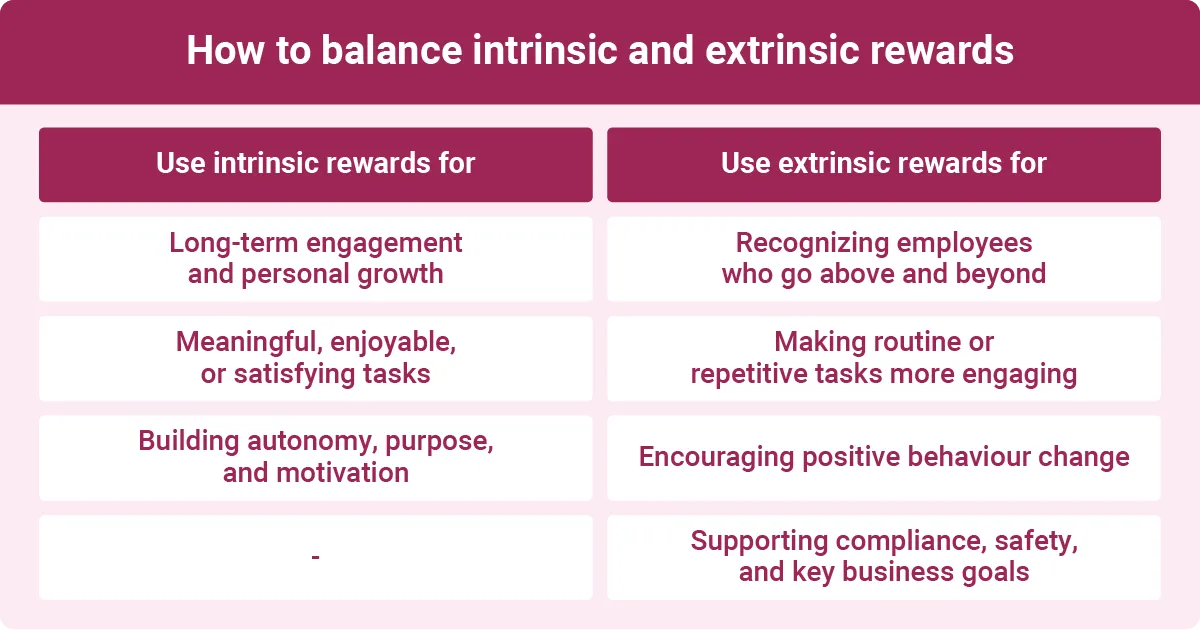
Balancing intrinsic and extrinsic rewards requires you to understand each strategy's strengths and best use cases. Intrinsic rewards are ideal for fueling long-term engagement and growth for tasks that are inherently satisfying, motivating, or enjoyable.
Other excellent use cases for extrinsic rewards include:
- Making routine, repetitive, or mundane tasks more enjoyable
- Encouraging behavioral change by laying the groundwork for positive feedback loops
- Increasing employees' focus on compliance, safety, and other essential goals
Extrinsic rewards should also be positioned around clear and measurable goals to maintain fairness and accuracy. Otherwise, you could further hinder employees' intrinsic connections to their work and cause them to lose sight of what really matters.
For instance, employee of the month recognition should be inspired by performance, productivity, and attendance metrics rather than by whichever employee the manager happened to notice last month.
The psychology behind intrinsic rewards: SDT, flow, and Pink's Drive
Intrinsic rewards' meaning and effectiveness are supported by many psychological theories and studies:
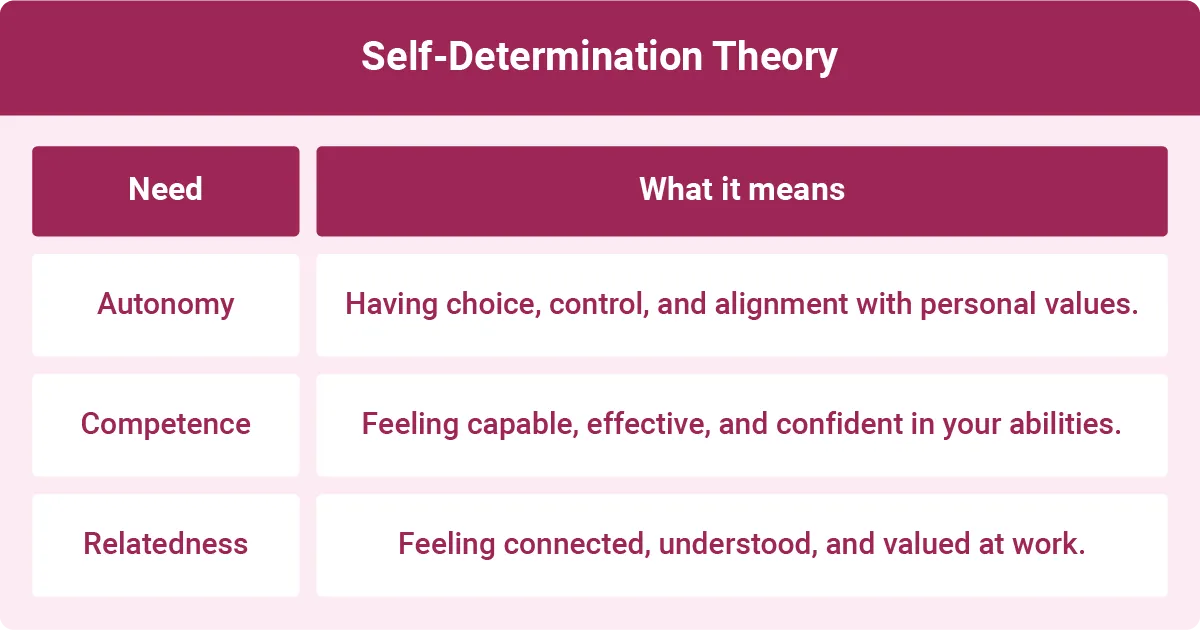
- Self-Determination Theory (SDT)Opens in a new tab: Developed by Edward Deci and Richard Ryan, Self-Determination Theory distinguishes controlled forms of motivation from autonomous forms. The theory claims that intrinsic motivation hinges on autonomy, competence, and relatedness.
- Cognitive Evaluation Theory: This sub-theory of Self-Determination Theory claims that rewards can be informational or controlling. Controlling rewards can impair intrinsic motivation, whereas informational rewards and recognition can empower employees and raise their intrinsic feelings of competence.
- Flow theory: This theory by Mihály Csíkszentmihályi claims that employees may experience intrinsic rewards if they already have optimal experience and skills when facing challenges. The IT technician who fixed the internet and the doctor who saved a patient may both feel like Superman, saving a day in ways no one else could.
- Drive: The Surprising Truth About What Motivates Us: The book “Drive” by Daniel Pink combats the traditional "carrot-and-stick" reward systems that organizations have overrelied on. It identifies the three elements of intrinsic motivation as autonomy, mastery, and purpose, offering a practical workplace translation of the Self-Determination Theory.
- Metamotivation: This emerging concept focuses on how people recognize and regulate which motivations to draw on. It can hypothetically help employees and HR leaders foster positive, intrinsic motivation tailored to specific roles and tasks.
- Incentive Theory of Motivation: This theory believes that employees are driven by internal and external motivators, such as wanting money, praise, or avoiding getting in trouble.
Self-Determination Theory: Autonomy, competence, relatedness
According to Self-Determination Theory, intrinsic motivation and rewards are driven by three innate psychological needs:
- Autonomy: Acting with volition and choice, maintaining a sense of control over your work, and connecting your work to your personal values
- Competence: Feeling effective at meaningful work and reassured in your own strengths and capabilities
- Relatedness: Feeling connected to, understood, and valued by others in your work environment
HR leaders can't just pick and choose between these psychological needs. All three must be satisfied to reduce friction and allow intrinsic motivation to flourish. After all, a competent worker may not be motivated to apply their skills if their values don't align with what they're doing.
Likewise, a skilled employee who relates to and cares about their team may not step up as much if they aren't confident in their own abilities.
Flow: when the work itself becomes the reward
Intrinsic flow relies on a few workplace conditions:
- Clear, direct goals
- Immediate, real-time feedback
- Challenge-skill balance
- Intrinsically rewarding experiences and outcomes
Flow and absorption often serve as leading indicators of engagement and motivation. Managers can enable this by maintaining high-quality communication and designing roles around outcomes rather than fixed, restricted tasks. This can help employees better connect to their work while continuously reaffirming their competence and building upon their strengths.
Pink's autonomy, mastery, and purpose
Self-Determination Theory was originally structured around educational settings. Daniel Pink's Drive: The Surprising Truth About What Motivates Us reframes SDT for the workplace setting and redefines the three elements of intrinsic motivation:
- Autonomy: Employees deserve to feel like they have control over their own careers and lives. This doesn't mean they have no oversight, but giving employees the space to complete their work in their own way often yields greater intrinsic results.
- Mastery: Mastery is more than talent – it's the drive to continuously learn and relearn skills to be the best professional you can be. Managers can support this by offering frequent opportunities for training, job shadowing, or even higher education.
- Purpose: Employees want to feel like they're part of something greater than themselves. This isn't about a mission statement but about the pride and satisfaction employees take away from their work, both at the end of the day and after ten years.
Examples of intrinsic rewards in the workplace
Intrinsic motivations and rewards can show up in many ways throughout an employee's workday and across different tasks. Key intrinsic reward examples include:
- A sense of accomplishment from completing meaningful work
- A sense of purpose and meaning, knowing the work matters beyond the immediate task
- Autonomy and ownership over how, when, and where tasks get done
- Personal and professional growth through learning and new challenges
- Feelings of competence and mastery from building and demonstrating skill over time
- Pride in craft and work quality
- Alignment with values, with employees choosing to work on tasks that resonate with their personal passions and beliefs
- A sense of belonging
- Quality relationships with teammates
- Sincere, specific recognition that affirms competence
- Creative freedom and ownership over ideas
- Flow, absorption, and deep engagement that make time fly by
These examples of intrinsic rewards can vary in many ways. HR leaders aiming to satisfy specific intrinsic needs should consider examples and strategies related to each unique goal.
Examples that satisfy autonomy
The following intrinsic reward examples can give employees a greater sense of control and autonomy over their work:
- A sense of ownership over their accomplishments and outcomes
- A sense of control over their workflows and choices
- Alignment with values, passions, and beliefs
- The freedom to experiment and grow
Leaders can foster workplace autonomy by prioritizing choice over methods and schedule and allowing employees to work on tasks that resonate with their personal values.
Examples that satisfy competence
These intrinsic rewards can raise employees' feelings of competence and confidence in their own abilities:
- A sense of mastery and effectiveness
- Personal and professional growth
- Visible progress and feedback
- Feelings of accomplishment from completing meaningful challenges
Examples that satisfy relatedness
These examples of intrinsic rewards can satisfy feelings of relatedness among teams:
- A sense of purpose and meaning, knowing the work contributes to something larger than themselves
- Feelings of belonging within a team
- Sincere peer-to-peer recognition
- Meaningful mentorship
Recognition as an intrinsic reward amplifier
Recognition is technically an extrinsic reward because it comes from another person, but when delivered effectively, it reinforces intrinsic drivers such as competence, belonging, and purpose.
Specific, sincere, and informational recognition reinforces competence more than generic or controlling feedback by referencing how and why employees did a good job. It reassures employees about their own strengths and supports relatedness across distributed teams.
According to Gallup and Workhuman®, employees who receive valuable peer feedback are 5x more likely to be engaged in their work and 57% less likely to experience burnout. This demonstrates how organizations can use recognition to satisfy employees' psychological need for relatedness. Workhuman's Social Recognition® ties peer-to-peer recognition programs to company values to do just that.
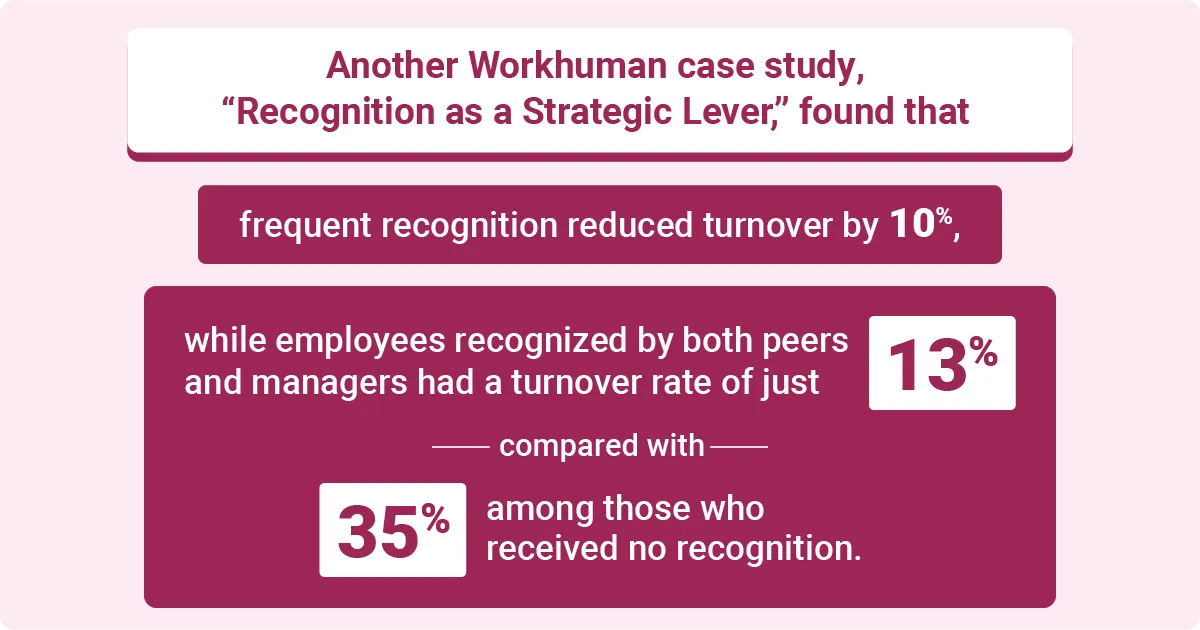
Another Workhuman case study, “Recognition as a Strategic Lever,” found that frequent recognition cut turnover by 10%. Additionally, employees recognized by both peers and managers had a turnover rate of just 13%, compared to 35% for those receiving no recognition.
The study also found that authentic, specific recognition tied to individual contributions creates emotional connections that make employees feel seen. These findings showcase how recognition amplifies the intrinsic reward of feeling valued rather than exclusively extrinsic perks.
Why intrinsic rewards matter: Benefits for employees and organizations
Several core advantages make intrinsic rewards important for employees, including:
- Higher employee engagement: Intrinsically motivated employees show stronger and more durable engagement than those driven by extrinsic rewards alone.
- Long-term motivation: Intrinsic rewards sustain effort over time rather than requiring repeated external reinforcement.
- Better performance: Intrinsic rewards often contribute to greater performance and productivity, especially in complex, creative, or non-routine work where autonomy and mastery are central.
- Higher job satisfaction: Intrinsically motivated employees report greater fulfillment and well-being at work.
- Greater employee retention: Case studies indicate that intrinsic rewards yield higher sustained engagement and lower turnover compared to purely extrinsic reward systems.
- Career growth: Intrinsic rewards support improved learning, skill development, and adaptability over time.
- Connection to work: Employees may experience greater well-being, job satisfaction, and resilience, even when under stress.
- Cost-efficiency: Intrinsic rewards scale without the proportional budget increases of extrinsic and monetary rewards.
- Cultural compounding: Intrinsically motivated teams reinforce norms of mastery, ownership, and purpose.
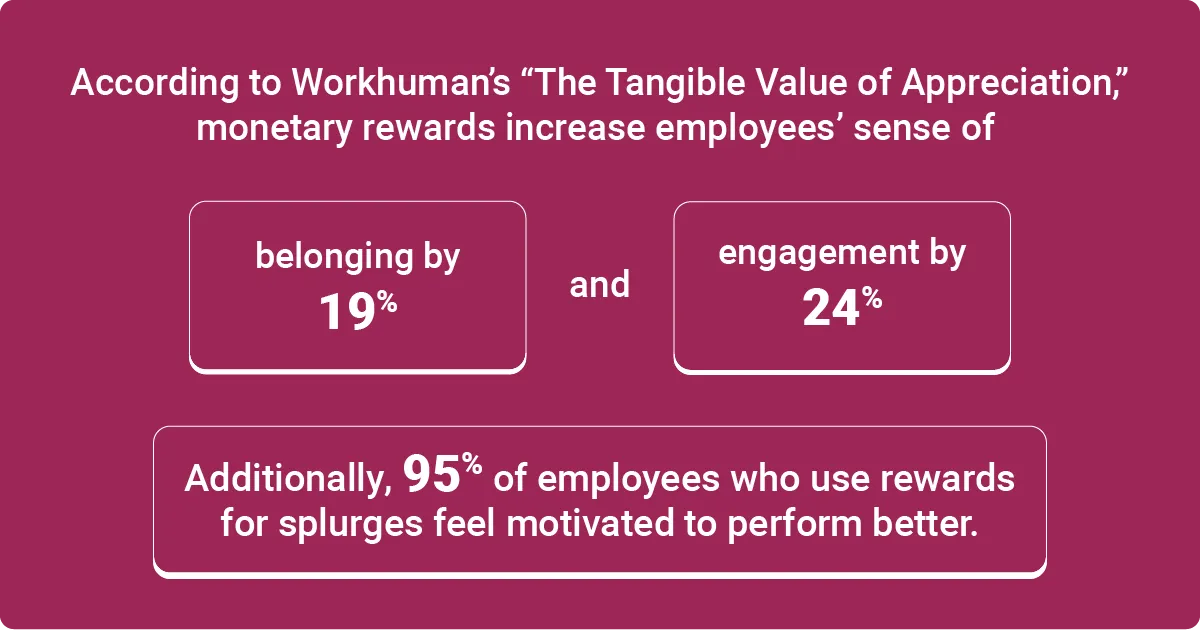
Still, intrinsic rewards aren't the only solution. Meaningful reward experiences that employees can share, such as shout-out boards or team bonus goals, can further reinforce and amplify the benefits of intrinsic rewards. In “The Tangible Value of Appreciation,” Workhuman found that feelings of belonging rise by 19% and engagement rises by 24% when rewards carry monetary value. Additionally, 95% of employees who use rewards for splurges feel motivated to perform better.
Limitations and trade-offs of relying on intrinsic rewards
HR leaders must also be aware of the potential disadvantages and trade-offs of depending on intrinsic reward systems:
- Intrinsic rewards can't substitute for fair, competitive base pay. Extrinsic fairness is a prerequisite for feelings of autonomy, competence, and relatedness.
- Intrinsic rewards vary by individual. What's intrinsically motivating to one employee may not motivate another.
- These rewards are harder to measure and report than extrinsic compensation, which can complicate HR accountability.
- Rewards take longer to take effect, since intrinsic motivation is cultivated rather than switched on.
- Intrinsic rewards risk manager misuse. A "meaningful work" framing can potentially mask under-resourcing or burnout.
- Intrinsic rewards, such as recognition, still need formal structure and funding to deliver results.
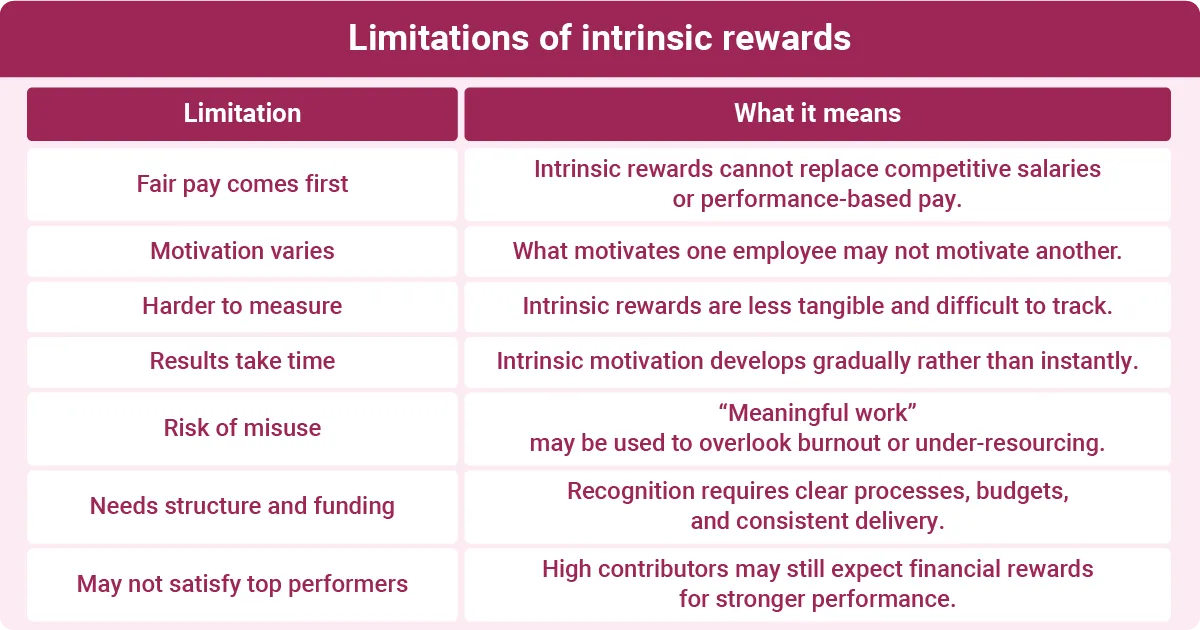
Without some extrinsic pay-for-performance component, top contributors may feel their effort isn't acknowledged.
How managers can cultivate intrinsic rewards
Leaders can foster intrinsic motivation using various strategies:
- Designing for autonomy: Delegate outcomes, not tasks, and offer real choices.
- Building for mastery: Create opportunities for stretch assignments, feedback loops, and learning budgets.
- Connecting to purpose: Create a line of sight from employees' daily work to customer impact and organizational missions.
- Cultivating relatedness: Encourage sincere, specific, frequent recognition from both leadership and peers.
- Avoid the overjustification trap: Don't attach contingent cash to inherently meaningful work.
- Recognize what makes employees unique: Intrinsic motivation varies by person. Use 1:1s to surface what personally motivates each employee.
The Manager's Field Guide to Gratitude helps leaders emphasize the accomplishment rather than the reward to preserve intrinsic motivation when recognizing employees. Managers can also analyze recognition patterns to identify where intrinsic drivers, such as growth or risk-taking, need coaching support.
Cultivate autonomy
Managers can cultivate autonomy by:
- Delegating outcomes, not steps
- Being flexible on how and when tasks are completed
- Inviting dissent and real input on decisions
Cultivate mastery
Managers can cultivate mastery by:
- Matching assignments to the sweet spot between challenge and skill
- Providing specific, frequent, informational feedback
- Investing visibly in growth, such as through learning time or mentoring
Around 46% of employees don't get feedback from managers at the rate they want, illustrating a clear need for more recognition and career-centered input. Workhuman's Conversations® gives teams a continuous feedback workflow that supports employees' feelings of competence. These workflows include check-ins, crowdsourced real-time feedback, and goal-setting.
Cultivate purpose and relatedness through recognition
Managers can cultivate feelings of relatedness and purpose by:
- Connecting every recognition moment to impact and outcomes
- Making recognition specific, sincere, and timely
- Building peer-to-peer recognition into the rhythm of work
Workhuman's Inclusion Advisor is an AI-powered micro-coaching feature that flags potentially biased language in recognition messages and provides real-time guidance. A pilot finding discovered that employees changed 75% of the biased language the feature identified, which helped managers deliver recognition that reinforced belonging and relatedness.
According to “Building a Culture of Recognition,” Effective moments of recognition must also meet five criteria: being timely, specific, meaningful, appropriate, and consistent. These criteria offer a concrete framework when delivering recognition that reinforces purpose and relatedness.
Be aware that poorly delivered recognition can backfire into bitterness and resentment, underscoring the importance of authenticity. Managers can borrow sample scripts, such as thanking someone for volunteering as a notetaker, as practical examples to adapt.
The evidence: What recent research says about intrinsic rewards
Recent research offers new insights and findings about what intrinsic rewards are and how to foster intrinsically motivating environments. “A systematic review and meta-analysis of self-determination-theory-based interventions in the education context,” by Wang et al. (2024), tested 36 SDT-based interventions, showcasing strong effects for autonomy (g=1.14), intrinsic motivation (g=0.58), and competence (g=0.48).
Emerging research on metamotivation provides new insights into how people regulate which motivations they draw on, though this concept is still emerging. Workplace surveys, such as those done by Workhuman, indicate that intrinsically motivated employees show higher performance, engagement, and job satisfaction.
“A brief Report on the Validation of the Functional Meaning of Cash Rewards ScaleOpens in a new tab,” a study on informational vs. controlling rewards, reinforces the Self-Determination Theory's concept that reward timing and design matter as much as reward type.
What the latest meta-analyses show
According to the latest meta-analyses on intrinsic rewards, SDT-based interventions often yield small-to-medium effects, stressing a need for further research and customization around organizations' unique needs.
Competence moves the needle more than autonomy or relatedness, though all three psychological needs are still essential. Generalizability is highly context-dependent across education and workplace settings, though Pink's Drive helps bridge this gap.
Beyond the intrinsic/extrinsic dichotomy
Bardach's study suggested an integrated view combining both intrinsic and extrinsic rewards. An integrated and balanced reward system design can help organizations foster both short-term and long-term motivation tailored to their goals and employees' needs.
Stepping beyond the dichotomy and binary of these labels can help leaders identify what actually works for their unique teams, especially when guided by an understanding of metamotivation and self-regulation of motives.
FAQs
What are intrinsic rewards in simple terms?
Intrinsic rewards are non-monetary and intangible feelings and internal motivations that employees receive from their work. This could be a sense of accomplishment after completing a challenging task, knowing the larger impact their work will have.
What is the difference between intrinsic and extrinsic rewards?
Intrinsic rewards are lasting motivators internally sourced within employees, arising from the nature of their work. Extrinsic rewards are provided by leadership, often using monetary or otherwise significant value to drive short-term goals.
What are some examples of intrinsic rewards at work?
Intrinsic rewards can appear as feelings of accomplishment, satisfaction, purpose, meaning, competence, autonomy, and relatedness. An employee can feel pride in their mastery of skills or confidence from the control they have over their workflows.
How can managers create more intrinsic rewards for their teams?
Managers can support intrinsic rewards by designing roles that prioritize employee autonomy and connect to employees' sense of purpose. They must also put in continuous effort to meet employees' psychological needs, such as feelings of autonomy, mastery, purpose, and belonging.
Does Self-Determination Theory really work in the workplace?
Self-Determination Theory offers significant benefits in many workplaces, but it's still just a theory and not a universal rule. New research and practices reinforce the conclusion: intrinsic rewards and strategies must be unique to each team and organizational goal.

Ryan Stoltz
Ryan is a search marketing manager and content strategist at Workhuman where he writes on the next evolution of the workplace. Outside of the workplace, he's a diehard 49ers fan, comedy junkie, and has trouble avoiding sweets on a nightly basis.
Recommended for you