
Extrinsic Rewards: How to Use Them Effectively With Examples and Research
by Ryan Stoltz
Last updated
10 min read
Human resources (HR) leaders and executives are increasingly using extrinsic rewards to drive goals and productivity, only to keep running into the same issues.
Even though extrinsic rewards are already in use in every organization, many reward systems are still designed around convention rather than evidence. This often leads to two unwanted outcomes:
- Overreliance on monetary incentives that erode engagement over time
- Underinvestment in recognition to reinforce the behaviors that matter
For HR leaders, the real decision is not whether to reward employees – it's how to design and deploy rewards so they drive performance without displacing the motivation that sustains it.
Explore the meaning of extrinsic rewards and how they differ from intrinsic rewards. We'll get into what the research actually shows, including when these rewards work and when they backfire. We'll then translate that evidence into design principles that you can apply to your own reward systems.
What are extrinsic rewards? Definition and examples
Extrinsic rewards are tangible, external employee incentives provided by an organization to recognize performance and encourage desired behaviors. These types of rewards motivate employees to achieve organizational goals and maintain high productivity by acknowledging and reinforcing favorable outcomes.
Extrinsic rewards are separable from the task itself – the reward is given for completing the work rather than derived from doing it. This differs from intrinsic rewards that arise from the work itself, such as mastery, meaning, autonomy, enjoyment, or a sense of purpose.
In psychology, extrinsic motivation sits on a continuum. On one end, you have purely controlled motivation driven by external regulation, such as a telemarketer aiming for a specific sales goal to earn a bonus. On the other end, you have more internalized forms of motivation driven by identified regulation and personal goals, such as an employee taking the time to learn new software after seeing its benefits.
Leaders and managers must leverage both extrinsic and intrinsic rewards to effectively motivate teams and foster long-term change.
These are key characteristics of extrinsic rewards:
- Tangible and external: Exist outside the individual and are separate from the work itself
- Given by leadership or the organization: Not self-generated but provided by supervisors, leaders, or the broader organization
- Focused on short-term and behavioral goals: Effective for short-term performance and behavioral reinforcement
See also: Best employee rewards software reviewed
Monetary vs. non-monetary extrinsic rewards
Non-monetary rewards, such as recognition, promotions, flexible work, paid time off (PTO), and awards, focus more on the employee experience and help cultivate a positive workplace culture.
These extrinsic rewards can outperform direct monetary rewards in many contexts because they bridge the gap between extrinsic and intrinsic motivation.
Functional examples of extrinsic rewards include:
- Financial incentives: Base pay increases, performance bonuses, referral or retention bonuses, commissions, spot cash awards, profit sharing, and equity or stock options
- Career advancement: Promotions, title changes, expanded responsibilities, mentorship or cross-training opportunities, sponsored courses or certifications, conference sponsorships, and learning stipends
- Recognition: Public acknowledgment, shout-outs, peer-to-peer awards, manager praise, personalized notes, and employee of the month programs
- Perks and benefits: Flexible schedules, additional PTO, meeting-free days, hybrid or remote work options, and appealing employee benefits program designs
Whereas financial incentives are monetary rewards, career advancement, recognition, and employee benefits are often categorized as non-monetary. Workhuman found that employees perceive three times more value from a tangible gift or experience than from an equivalent cash-value reward.
This supports the idea that non-monetary extrinsic rewards outperform straight cash, though your best strategy will still depend on your unique team and organizational goals.
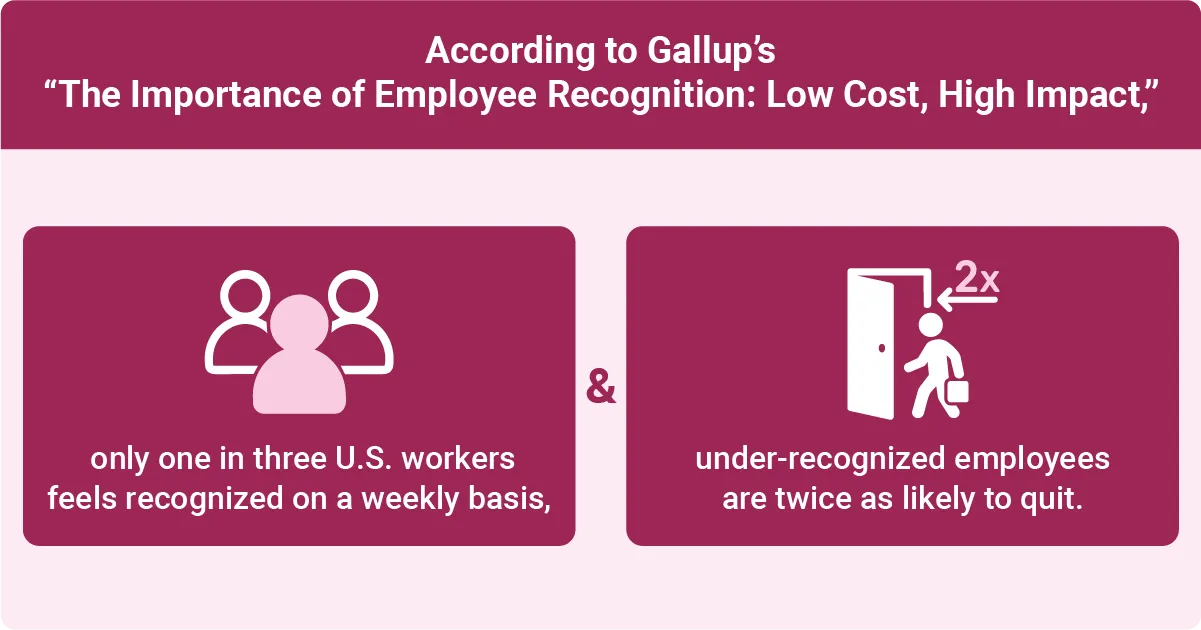
According to Gallup’s “The Importance of Employee Recognition: Low Cost, High ImpactOpens in a new tab,” only one in three U.S. workers feels recognized weekly, and under-recognized employees are two times more likely to quit. Distinguishing between monetary and non-monetary rewards is important for setting goals and identifying programs that align with them to ensure your efforts are as effective as possible.
Monetary rewards tend to act as controlled motivators, while non-monetary recognition is often more supportive of worker autonomy.
Extrinsic rewards in psychology
Psychologically speaking, extrinsic rewards are directly rooted in operant conditioning and reinforcement theory. According to this theory, behaviors and actions are defined by their outcomes and consequences – and behavior followed by a reward is more likely to recur. Operant conditioning learning styles shape behavior by reinforcing positive behaviors and punishing or otherwise addressing negative behaviors.
Controlled motivation is often short-term, with employees only completing a task or going above and beyond because of the reward. As soon as the reward is gone, the behavior disappears. Instead, SDT challenges HR leaders to build upon employees' independent motivation by supporting their autonomy, competence, and relatedness.
Understanding the psychology of workplace extrinsic rewards can also help HR leaders prioritize identified regulation over other types of extrinsic motivation. Identified regulation occurs when an employee genuinely values the outcome a reward represents, whether that's career development or a public shout-out. As a result, extrinsic motivation becomes more self-endorsed, enabling long-term change.
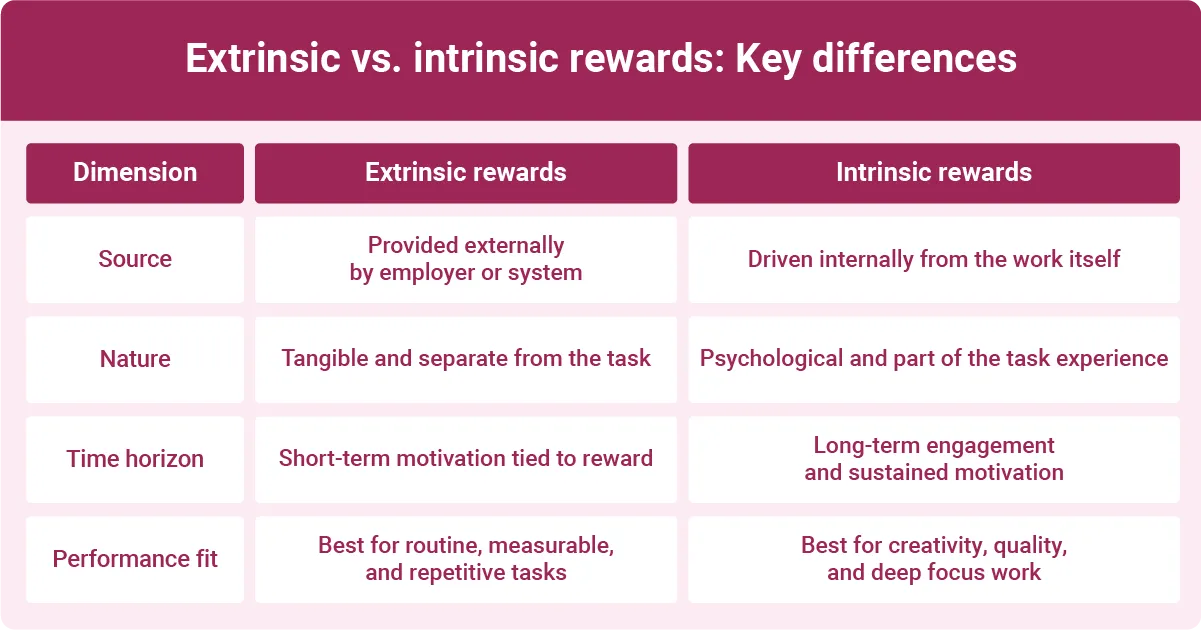
Extrinsic vs. intrinsic rewards: Key differences
Extrinsic and intrinsic employee rewards differ in several key aspects:
- Source: Extrinsic rewards are provided externally by the employer or system, such as extra PTO offered by a supervisor or from the corporate level. Intrinsic rewards are derived internally by each employee from the work itself, such as a sense of pride and satisfaction after completing a large project.
- Nature: Extrinsic rewards are tangible and separate from the task, creating opportunities for greater motivation beyond the job's typical nature. Intrinsic rewards are psychological and inherent to the task, usually requiring employees to derive at least some feeling of internal satisfaction or accomplishment from their work.
- Time horizon: Extrinsic rewards often drive short-term behavior that ends as soon as the reward is earned or taken away. Intrinsic rewards sustain long-term engagement by fostering genuine behavioral change.
- Performance fit: Extrinsic rewards excel for routine, measurable, quantity-based tasks, especially responsibilities that may otherwise be unappealing. Intrinsic rewards drive quality, creativity, and persistence by connecting employees' motivations to the work they're completing.
Intrinsic and extrinsic rewards aren't mutually exclusive. The best systems layer both types of rewards based on what works best for each employee, task, and behavioral goal.
For instance, an organization may foster intrinsic rewards for the main part of employees' work. They could then introduce extrinsic rewards for mundane tasks, such as office chores, or for adopting new practices or technologies.
Balancing intrinsic and extrinsic rewards is especially crucial for avoiding the overjustification effect. This occurs when organizations overapply extrinsic rewards to already intrinsically motivated work. It can potentially impair the personal enjoyment and satisfaction employees take from their work by shifting their focus to short-term incentives.
When extrinsic rewards work best
Extrinsic rewards are well-suited for certain types of goals and tasks:
- Routine and repetitive tasks: Transactional or repetitive tasks often lead to work that employees don't find inherently rewarding, even if they understand why it's important. Routine extrinsic rewards can operate like allowances for kids' chore charts, motivating employees to step up when accomplishing otherwise mundane tasks, such as data entry or documentation.
- Measurable and output-based tasks: Tasks where effort directly produces a countable result make it easier to fairly track effort and outcomes. Examples include sales or deadline-based responsibilities.
- Short-term goals: Extrinsic rewards encourage teams to put extra focus on specific, time-sensitive goals. Short-term goal examples include time-bound campaigns, new skill requirements, onboarding, training, implementation of new systems, and behaviors that need reinforcement to become habits.
- Compliance goals: Direct, extrinsic rewards can reinforce necessary behaviors related to compliance, safety, and other mandatory protocols. Examples of compliance-related goals could include timely safety training, regular maintenance of hazardous equipment, adherence to operating procedures, and no audit non-conformities.
When extrinsic rewards backfire: The overjustification effect
When tangible rewards are offered for activities that people already enjoy, intrinsic interest can decline. This is the overjustification effect – a phenomenon that all HR leaders should be aware of to avoid overdoing extrinsic reward programs. The effect is at its strongest when expected, contingent, tangible rewards are applied to interesting work tasks, in essence, taking the fun out of the job.
According to the findings of the research “ Negative Effects of Extrinsic Rewards on Intrinsic Motivation: More Smoke Than Fire” by the University of Southern California, the effects of the overjustification effect depend heavily on the reward program, task, and other unique variables.
For a practical example of the overjustification effect, consider a team of software designers that's already intrinsically motivated to learn new programming languages and skills. Offering non-monetary opportunities for skill development and training can reinforce identified regulation.
On the other hand, introducing financial rewards, such as a cash bonus for every completed course, can immediately boost training and skills. But it may take away from the intrinsic value employees get from honing their skills. Rather than taking new courses based on what's relevant to their roles or career goals, they're now basing them on purely monetary gains.
They may also not give courses their full attention if they are now only there for the immediate reward for course completion, rather than the intrinsic rewards of learning.
Advantages and disadvantages of extrinsic rewards
Balancing extrinsic and intrinsic rewards requires HR leaders to understand the benefits of each approach.
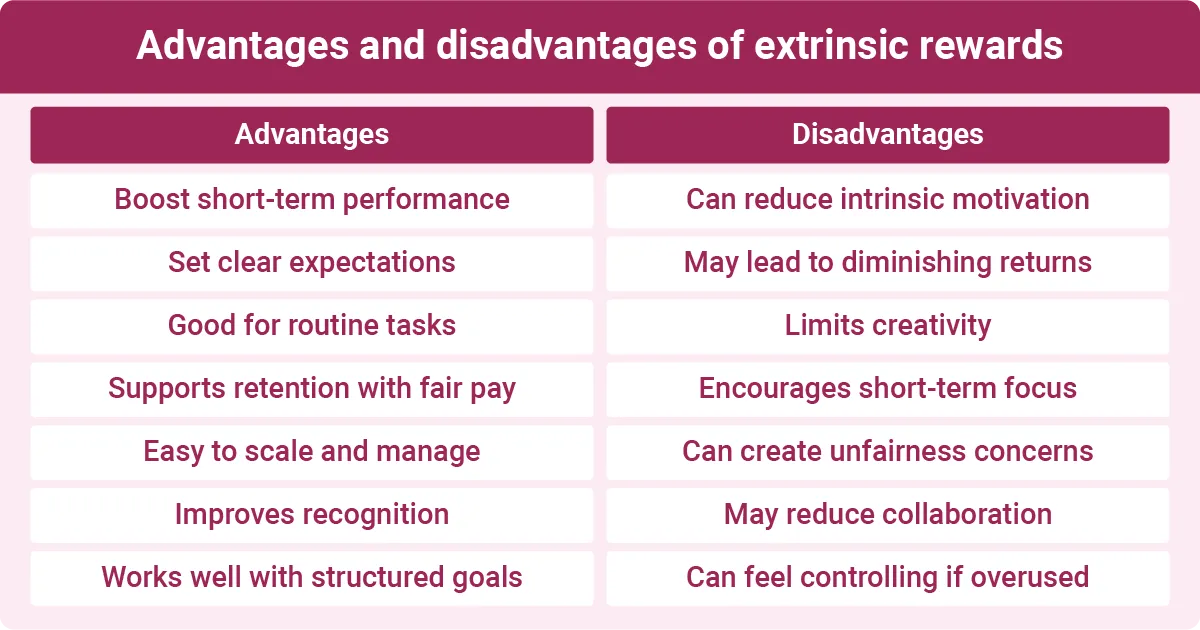
Advantages of using extrinsic rewards over intrinsic rewards include:
- Driving measurable short-term performance
- Clarifying expectations
- Supporting routine and output-based work
- Supporting retention when paired with fair compensation
- Administering and scaling rewards with ease
- Consistently boosting engagement without undermining intrinsic motivation, especially when based on recognition
Disadvantages of using extrinsic rewards over intrinsic rewards include:
- Risking the overjustification effect on intrinsically motivating work
- Diminishing returns when stacked
- Narrowing focus to short-term goals
- Reducing creativity and creative collaboration
- Damaging collaboration with zero-sum designs
- Reducing motivational value with a perceived unfairness, especially if goals aren't accurately measurable
- Eroding autonomous motivation if rewards are over-relied on or framed as controlling
The psychology and research behind extrinsic rewards
Self-Determination Theory is the dominant framework defining what an extrinsic reward is and how they work. According to the theory, the quality of motivation matters more than the quantity of motivation.
This places extrinsic motivation on a continuum from external regulation or pure compliance to identified and integrated regulation that's self-endorsed. In addition, three psychological needs – autonomy, competence, relatedness – determine whether an extrinsic reward energizes or undermines motivation.
Cognitive Evaluation Theory, a sub-theory of SDT, predicts that rewards experienced as controlling reduce intrinsic motivation, while rewards experienced as informational support motivation. The Incentive theory of motivation, reinforcement theory, Vroom's expectancy theory, Herzberg's Two-Factor Theory, and motivation theory research offer complementary lenses.
Many of these studies and findings have contributed to the belief that intrinsic and extrinsic motivation in zero-sum reward systems, where one employee's success comes at another's expense, that can't coexist. However, this isn't necessarily true.
A meta-analysis in the Psychological Bulletin, “Intrinsic motivation and extrinsic incentives jointly predict performanceOpens in a new tab,” indicates that intrinsic and extrinsic motivation jointly predict performance. When designing incentive programs for employees, the relationship between intrinsic and extrinsic motivation is additive, with both types of rewards building upon each other.
Self-Determination Theory and the motivation continuum
Autonomy-supportive reward design moves employees across the Self-Determination Theory's motivation continuum. Types of regulation within this continuum include:
- External regulation: This behavior is driven purely by reward or punishment and, while effective, is often the least durable.
- Introjected regulation: This behavior is driven by guilt, ego, or social pressure.
- Identified regulation: This behavior exists when employees value the outcomes the reward represents. It's the most performance-predictive form of extrinsic motivation.
What recent research shows
Recent research into extrinsic rewards reflects diminishing returns. Layering new incentives on top of already-strong baseline rewards produces only small, marginal effects, stressing the need for intentionality when creating rewards programs. In line with this, the newer framing in Self-Determination Theory workplace research is now optimized for motivation quality, not just quantity.
Creative and innovative work shows trade-offs between extrinsic and intrinsic motivators that don't appear in routine responsibilities. Additionally, recognition now functions as a relatively non-controlling extrinsic reward and shows consistently positive effects across studies.
Analyzing aggregated recognition data – as done through Workhuman iQ and Human Intelligence™ – can surface insights on skills, engagement, and retention impact. This illustrates how modern research on extrinsic recognition extends beyond academic meta-analyses into large-scale workforce data.
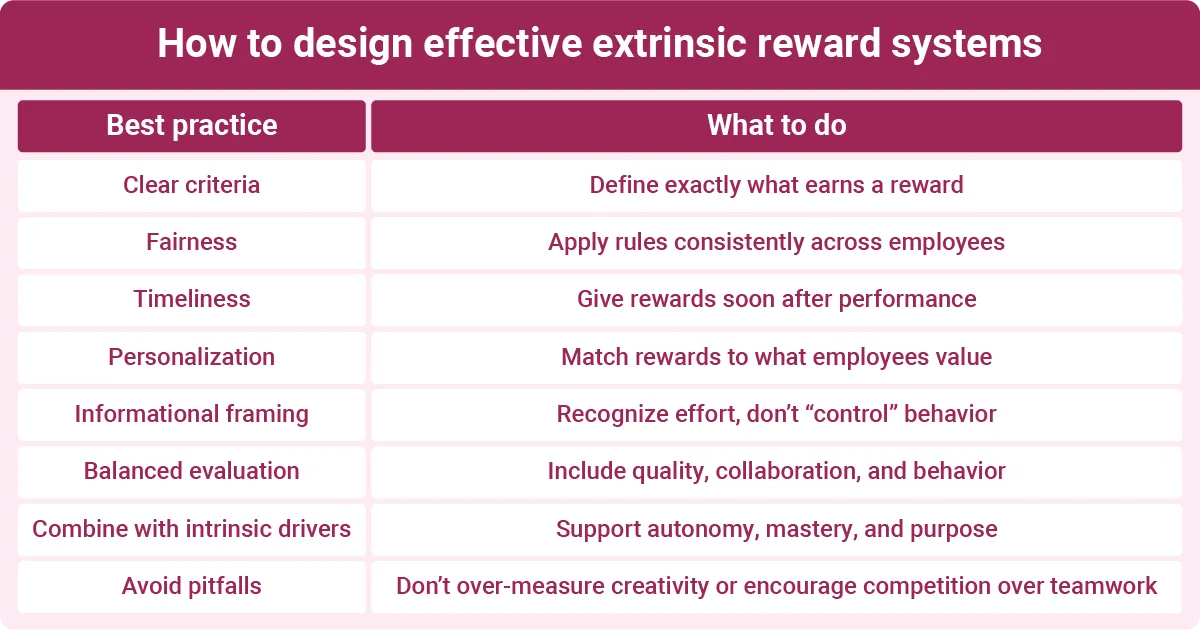
How to design effective extrinsic reward systems
Consider the following strategies and best practices when designing your extrinsic reward system:
- Make criteria clear and measurable: Employees should know exactly what triggers a reward.
- Ensure fairness and consistency: Perceived inequity destroys the motivational value of any reward.
- Deliver rewards in a timely manner: The closer the reward is to the behavior, the stronger the reinforcement.
- Personalize where possible: A reward only motivates if the recipient values it.
- Frame rewards as informational, not controlling: Recognize the achievement, but don't dangle the carrot.
- Use a balanced scorecard: Consider reward quality, collaboration, and behaviors, not just output metrics.
- Combine extrinsic rewards with intrinsic motivators: Focusing on autonomy, mastery, and meaning can help bridge the gap between intrinsic and extrinsic motivation.
- Avoid common pitfalls: Avoid over-quantified creative work, public ranking that pits employees against each other, and rewards that crowd out existing intrinsic interest.
8 principles for high-impact extrinsic reward design
High-impact extrinsic reward systems follow eight basic principles:
- Clarity of criteria
- Fairness and procedural transparency
- Timeliness of delivery
- Personalization to recipient preferences
- Informational framing that hinges on recognizing rather than controlling
- Balanced metrics that combine quality, quantity, and behavioral data
- Pairing with intrinsic motivators
- Visibility and social reinforcement through peer recognition
Peer-to-peer recognition workflows operationalize timeliness and personalization by following fixed steps: nominating employees, customizing messages, attaching point values, and approving the rewards. In Social Recognition®, the Recognition Advisor coaches and guides users as they write specific, values-aligned messages, further supporting informational framing.
As per “Increasing Employee Retention,” Cicero Group found that peer-to-peer recognition drives engagement, performance, and innovation more effectively than an additional 5% salary bonus. This directly ties to the principle of paying for performance with recognition rather than relying on routine bonuses.
Moreover, in a Payscale survey, high performers defined fair pay as being rewarded differently (rather than paid differently) from underperformers. Accordingly, shifting even 1% of salary into pay-for-performance can outperform burying it in base pay.
Common pitfalls to avoid
As you develop your program, be careful of falling into the common mistakes of extrinsic reward programs:
- Over-incentivizing creative or judgment-heavy work in scenarios where rewards narrow employee focus
- Stacking incentives, leading to diminishing returns
- Relying on zero-sum ranking systems that damage collaboration and relatedness
- Treating compensation as a substitute for meaning, autonomy, or personal growth
- Giving one-size-fits-all rewards that ignore generational and individual preferences
With the right tools and systems, HR leaders can dodge many of these pitfalls. For instance, Admin Hub's misuse detection surfaces potentially fraudulent workflows. Leaders can also leverage award nomination review and approval workflows, along with advanced reporting. These solutions help maintain fairness, consistency, and transparency when implementing extrinsic reward programs at scale.
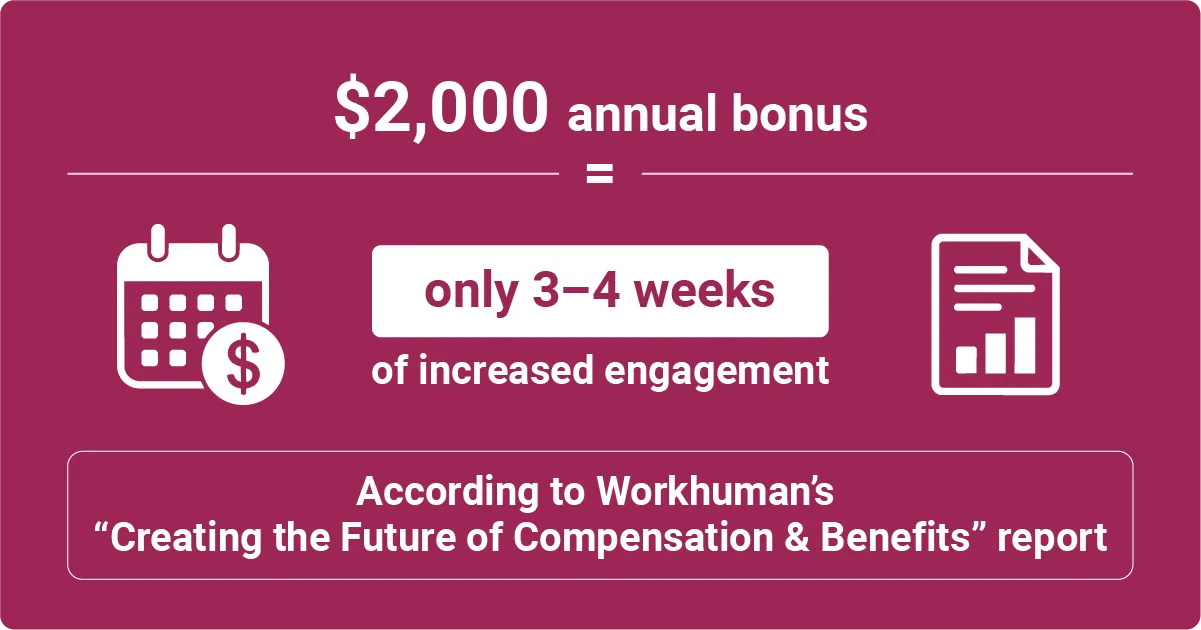
According to findings published in “Creating the Future of Compensation & Benefits” by Workhuman, a one-time $2,000 annual bonus lifts engagement for only three to four weeks. This illustrates the pitfall of relying on large, infrequent rewards instead of frequent recognition.
These issues reflect the pitfalls of baking bias into reward structures. Follow a checklist of design principles to avoid such traps:
- Equal opportunity for all participants
- Spontaneity and surprise
- Frequency and consistency of positive reinforcement
- Meaning and relevance to work
- Multiple points of view, including peer-to-peer perspectives rather than only top-down
When extrinsic rewards are most useful to businesses
Extrinsic rewards can be highly beneficial across various business scenarios and purposes:
- Supporting high-volume, output-driven roles, such as sales, operations, and customer support, where contribution is countable
- Driving adoption of new behaviors or short-term campaigns, such as for safety milestones and product launches
- Supporting retention and maneuvering competitive talent markets where total rewards parity is table stakes
- Reinforcing strategic priorities by tying rewards to specific organizational objectives
Conversely, extrinsic rewards are less effective for:
- Deeply creative work
- Roles and projects where quality is hard to measure
- Teams that are already highly intrinsically motivated
FAQs
What is the definition of extrinsic rewards?
Extrinsic rewards are tangible, external incentives provided to employees to recognize their performance, contributions, and specific achievements. When used effectively, these rewards can reinforce positive behaviors and boost motivation for measurable, routine, short-term goals.
What are examples of extrinsic rewards in the workplace?
Examples of monetary extrinsic rewards in the workplace include performance bonuses, cash awards, equity options, and base pay increases. Examples of non-monetary extrinsic rewards include promotions, learning opportunities, team recognition, and PTO.
What is the difference between extrinsic and intrinsic rewards?
Extrinsic rewards are tangible incentives provided by the organization, ideal for immediate or mundane, routine tasks. Intrinsic rewards are intangible and innate to the work, derived internally based on employees' personal goals and job satisfaction.
Do extrinsic rewards reduce intrinsic motivation?
Extrinsic rewards can impair intrinsic motivation when misused or not properly implemented. The best rewards systems combine both extrinsic and intrinsic rewards by recognizing each type's unique benefits and best use cases.
What does recent research say about extrinsic rewards and employee performance?
According to recent research, extrinsic rewards may have diminishing returns with regards to employee performance. However, they still can be effective if carefully implemented to be non-controlling and optimized for motivation quality, such as in employee recognition programs.

Ryan Stoltz
Ryan is a search marketing manager and content strategist at Workhuman where he writes on the next evolution of the workplace. Outside of the workplace, he's a diehard 49ers fan, comedy junkie, and has trouble avoiding sweets on a nightly basis.
Recommended for you