Employee Engagement Training: How to Build Programs That Actually Improve Engagement
Table of contents
- What is employee engagement training?
- Why employee engagement training matters: Business benefits and ROI
- Leadership skills that improve employee engagement
- How to develop an employee engagement training program
- Key topics, skills, and activities
- Employee engagement training for specific contexts
- How to measure employee engagement and training impact
- Free and paid employee engagement training resources and certifications
- Common challenges in employee engagement training and how to overcome them
- Employee engagement training for managers
- Employee engagement training case studies
- FAQs
- Conclusion
Employee engagement training is meant to equip managers with the skills to build an engaged workforce. Unfortunately, many programs fall short because they treat engagement as a single workshop instead of a long-term employee engagement strategy tied to daily behaviors.
When managers know how to give meaningful recognition, deliver effective feedback, and connect work to purpose, organizations can boost employee engagement, strengthen retention, and build engaged teams that perform better. The challenge is designing training that leads to real behavior change, not just completed modules.
This guide covers what employee engagement training is, why employee engagement is important for business outcomes, and how to build programs that improve engagement over time, from design to measurement.
What is employee engagement training?
Employee engagement training is a structured learning program that builds the skills and habits managers and leaders need to strengthen day-to-day employee engagement efforts.
Instead of relying on one-off initiatives, it teaches practical engagement strategies that help employees feel connected to their work, their team, and the organization.
Core components
This type of program has a narrower focus than general leadership training because it incorporates specific engagement-related behaviors and metrics. Participants learn through workshops, e-learning modules, coaching, and facilitated sessions.
Strong programs also use employee engagement surveys and pulse feedback to identify which engagement drivers to prioritize and to track progress after training.
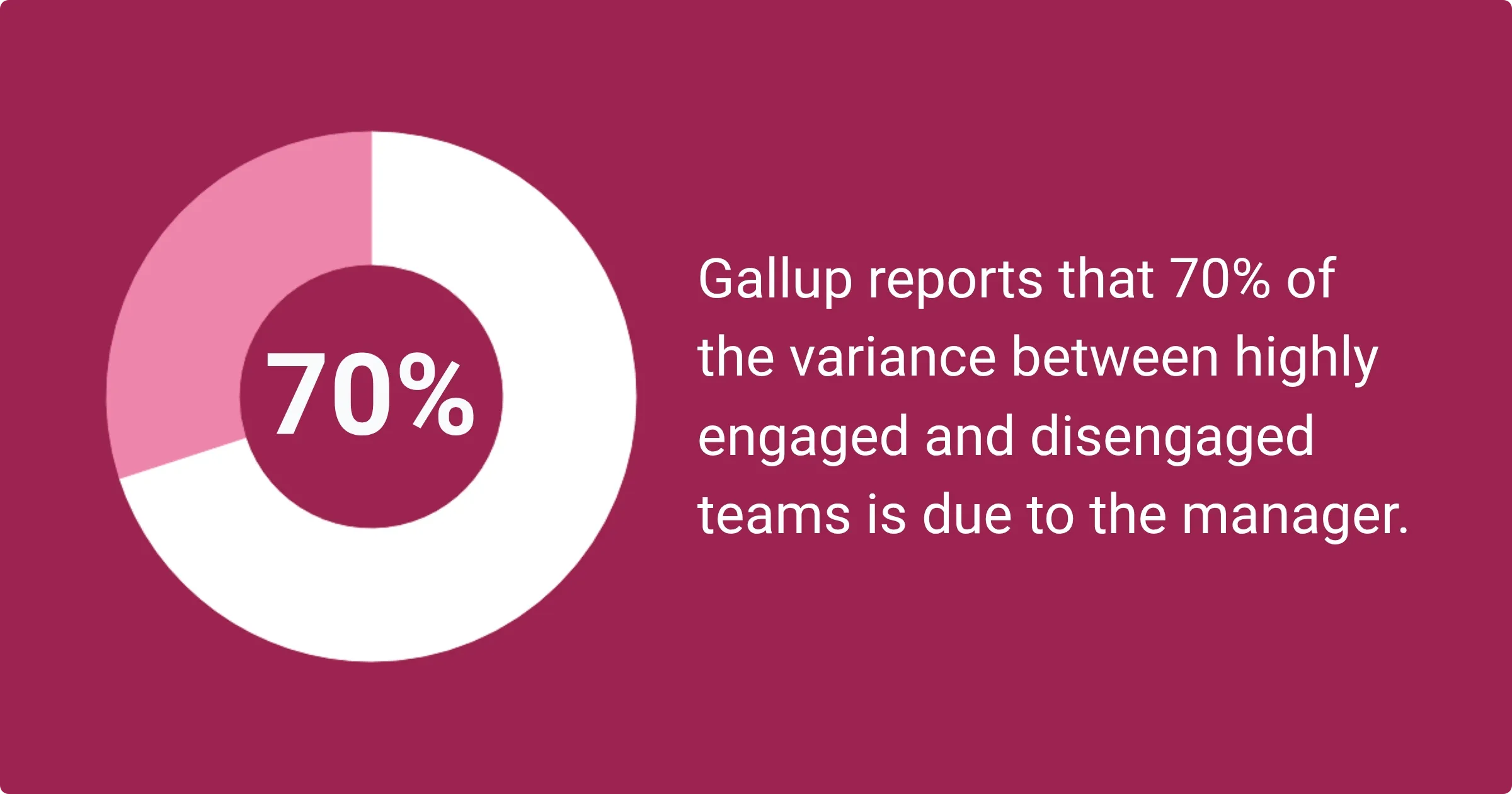
In “Gallup Finds a Silver Bullet: Coach Me Once Per WeekOpens in a new tab”, Gallup reports that 70% of the variance between highly engaged and disengaged teams is due to the manager. As a result, employee engagement training focuses on developing leadership skills, including recognition and appreciation techniques, goal setting, effective feedback delivery, and fostering a culture of psychological safety.
Who needs engagement training?
Engagement training is valuable for managers, senior leaders, frontline supervisors, and HR partners because their daily behaviors shape engaged teams and a positive workplace culture. Done well, it helps leaders empower employees through clearer expectations, better coaching conversations, and more meaningful recognition.
Engagement training is equally useful for first-time managers transitioning from their previous roles, mid-level leaders developing a more positive team culture, and HR business partners facilitating organizational change.
Why employee engagement training matters: Business benefits and ROI
Engagement-focused training ultimately leads to higher team engagement scores, which have ripple effects throughout your organization. A well-developed program improves a company's bottom line as well as the employee experience.
Quantifiable outcomes
Implementing an engagement training program can reduce voluntary turnover rates, improve performance review ratings, and increase engagement survey scores. According to the Gallup study titled “The 'Great Resignation' Is Really the 'Great Discontent'”, turnover rates are between 18% and 43% higher when teams have low engagement levels.
Another Gallup report, “The Benefits of Employee Engagement”, shows an 81% lower rate of absenteeism and a 10% difference in customer loyalty when engagement is high, which translates to better output, quality, profitability, and safety.
Qualitative benefits
Employee engagement training also fosters stronger manager-employee relationships, increased trust, and psychological safety. In this environment, team members feel comfortable speaking openly about their challenges and concerns and exploring their creativity.
The study, “Employee Engagement and Innovative Work Behavior Among Chinese Millennials”, published in Frontiers in Psychology, reveals that engaged employees have more innovative work behaviors and better work-life balance.
Leadership skills that improve employee engagement
To boost engagement, managers need a set of core competencies that support leadership excellence. That skill development takes time, so engagement training should function as ongoing management training, not a one-time event.
Emotional intelligence
Daniel Goleman, in the “EI Overview”, breaks emotional intelligence down into four domains: self-awareness, self-management, social awareness, and relationship management. Organizations with high employee engagement have leaders who excel in all these areas by practicing active listening, communicating openly, and modeling resilience.
These behaviors matter because highly engaged employees are more likely to bring energy and commitment to their work, and highly engaged employees achieve stronger outcomes when they have leaders who build trust and clarity.
Managers can identify their weaknesses using self-assessment tools, such as EQ-i 2.0 or the Emotional Intelligence Appraisal. With those results in mind, they can improve with perspective-taking exercises, conflict de-escalation techniques, and emotional regulation strategies.
A coaching mindset
Another critical step for managers is understanding the difference between coaching and directing. Leaders boost engagement when they encourage employee ownership of solutions, balancing support with accountability. The GROW model (goal, reality, options, will) is an excellent coaching framework for one-on-one meetings, performance reviews, and goal-setting sessions.
Recognition training
If there’s one engagement behavior for leaders you can train quickly and see results from fast, it’s recognition. Not the occasional “great job,” but consistent, specific recognition that reinforces what good looks like and helps people feel seen for real contributions.
Recognition training works because it’s practical and repeatable. Managers don’t need a new philosophy – they need a few simple standards and reps:
- Make it specific: name the behavior and the impact (what happened because of it).
- Tie it to values: connect the moment to what your organization says it stands for.
- Get the timing right: closer to the moment beats “end-of-quarter catch-up.”
- Balance visibility: make sure recognition isn’t reserved for the loudest voices or most public work.
- Encourage peer recognition: culture scales faster when appreciation isn’t bottlenecked at the manager level.
A strong recognition module is less about theory and more about practice. Give managers examples of high-quality recognition, run short write-and-revise exercises, and build recognition into existing team rhythms (weekly wins, meeting close-outs, project retros). Over time, these habits create a clearer, more continuous signal of how work is getting done across the team.
How to develop an employee engagement training program
Increasing employee engagement through training and development is a worthwhile goal for any organization, but setting up a new program is a daunting task. These steps will help you navigate the process.
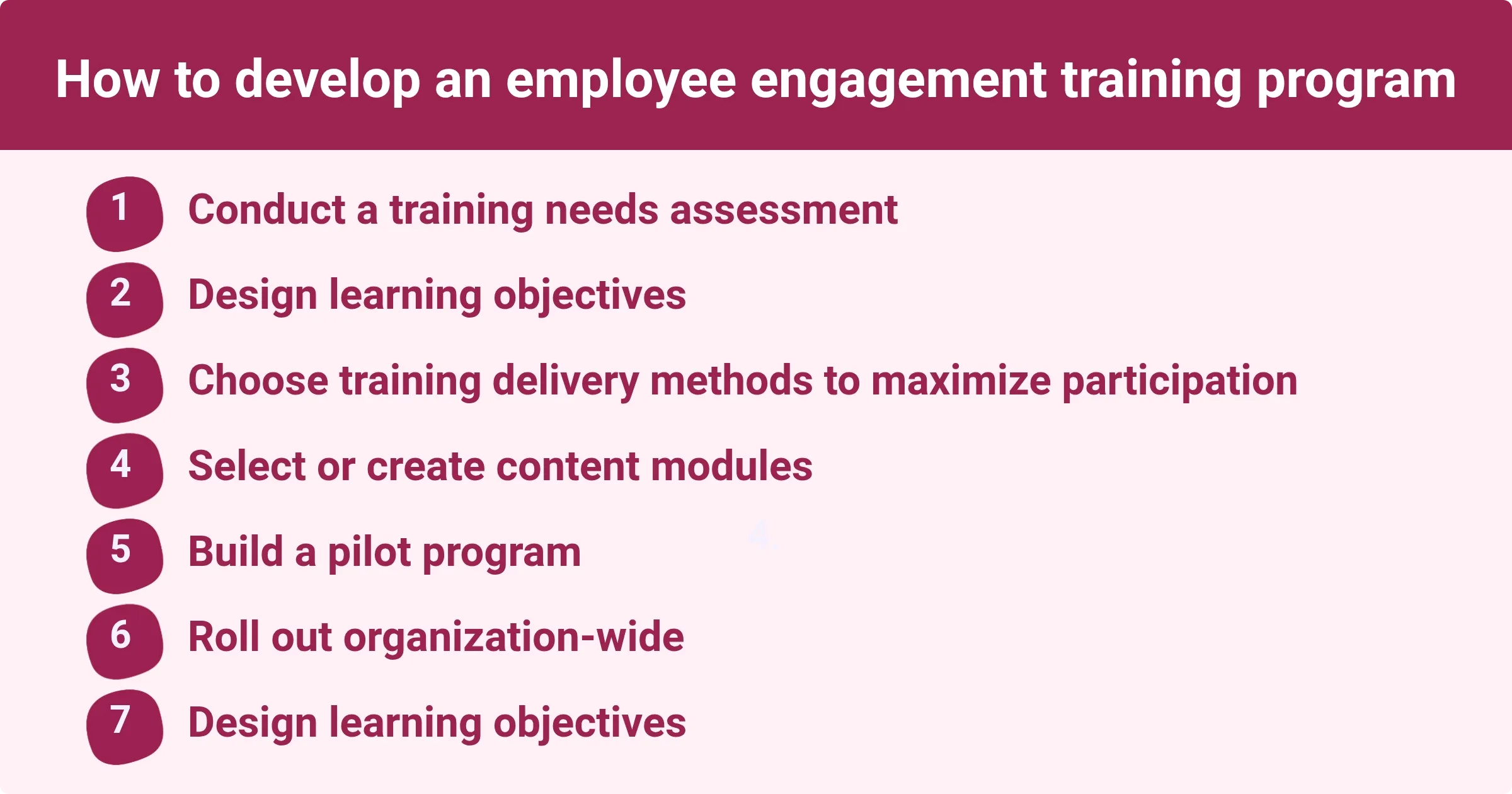
1. Conduct a training needs assessment
Start by assessing your current engagement levels and analyzing engagement survey data to identify skills gaps. Speak directly to managers to uncover pain points, and examine exit interviews for recurring concerns about management quality. In addition, benchmark your organization's engagement against industry standards.
2. Design learning objectives
Create learning objectives aligned with your organizational engagement goals and business outcomes. Use SMART (specific, measurable, achievable, relevant, and time-bound) criteria to ensure your objectives are clear and achievable. Look beyond knowledge transfer to behavior change, prioritizing high-impact skills such as recognition and feedback.
3. Choose training delivery methods to maximize participation
You can implement training programs in one of these formats, each with advantages and drawbacks:
- In-person training: In-person sessions are highly interactive, making them ideal for intensive workshops, new manager cohorts, and co-located teams. However, they generally have a higher cost and are more logistically complicated.
- Online training: Virtual programs are scalable, flexible, accessible, and less costly, making them a great option for distributed or remote teams, busy managers, and supplemental learning. But in some cases, workplace engagement rates are lower, and participants may find it harder to practice soft skills.
- Hybrid training: Hybrid training models combine live sessions with self-paced modules and virtual coaching. Blending in-person sessions with on-demand content allows you to balance flexibility and structure, but it can be more difficult to implement.
When deciding what type of training program to use, consider your company's size, budget, and workplace model.
4. Select or create content modules
As you choose and develop modules, treat engagement training as employee training that supports both business outcomes and employee experience, including professional development and personal growth where appropriate.
- Use real-world scenarios relevant to participants' roles.
- Personalize content using pre-work assessments, role-based tracks, and choose-your-own-path modules.
- Gamify your training with leaderboards, badges, and team competitions.
- Create micro-learning modules of 5 to 10 minutes and use spaced repetition.
- Embed training into everyday tools, including collaboration platforms, mobile apps, and kiosks.
These strategies will help boost overall course engagement so that the participants get the most value.
5. Build a pilot program
Testing your training program allows you to fine-tune it before sharing it with all your employees. Select a representative group of managers to evaluate the effectiveness of the content, pacing, and engagement. Ask for feedback and look at pre- and post-training assessment data to see whether the program has the expected outcomes.
6. Roll out organization-wide
After making adjustments, implement your training program on a larger scale. Provide managers with guidance on how to use it, who should participate, and expectations for completion. Workhuman® cloud integrations allow you to provide training-related recognition, check-ins, and feedback within the tools employees already use, including Teams, Slack, and Workday.
You can also use mobile apps and kiosks for offline or deskless workers, reducing barriers and meeting employees where they work.
7. Measure impact
Your training program should continue to evolve. Evaluate its effectiveness by continuously measuring employee engagement. Based on the findings, update the content and design of the modules. In addition, send resources to managers regularly to reinforce the material they've learned.
Key topics, skills, and activities
The training your company offers will depend on your current level of engagement, organizational structure, and general approach to learning. However, most programs include similar essential subjects and activities.
Employee engagement training topics
Your employee engagement training and development program should cover:
- Recognition and appreciation, with both peer-to-peer and manager-led practices
- Coaching and career development
- Diversity, equity, and inclusion
- Resilience and well-being
- Goal-setting and performance management
- Team collaboration and cross-functional partnerships
- Autonomy and empowerment
If addressing all these areas at once seems overwhelming, prioritize them based on the weak points you've identified from employee and manager feedback.
7 Practical training exercises
These and other employee engagement training activities help you create a well-rounded, varied program capable of appealing to many different kinds of employees:
- Recognition round-robin: Participants give specific, timely, and inclusive recognition to a colleague in the session.
- Difficult feedback role-play: Paired participants deliver constructive feedback using SBI or Radical Candor frameworks.
- Engagement barrier brainstorm: Small groups identify the top three obstacles to engagement in their teams and suggest ways to overcome them.
- One-on-one meeting simulation: Managers practice coaching conversations with direct reports.
- Psychological safety self-assessment: Managers rate their teams on safety indicators and discuss strategies for improvement.
- Purpose storytelling exercise: Organizational leaders show how their work relates to the company's mission through stories they can share with their teams.
- Commitment action planning: Participants write a specific engagement behavior they'll practice each week and choose a partner to keep them accountable.
Incorporating AI-powered coaching tools like the Inclusion Advisor into your workshops can help managers and employees practice inclusive communication in real time. Inclusion Advisor is a practical training aid for DEI and psychological safety exercises because it uses a proprietary database analyzing 70 million recognition moments to flag bias and provide instant feedback.
Create a diverse, equitable, and inclusive culture in your organization
See for yourself how Workhuman’s Social Recognition solution — with its Inclusion Advisor feature — can help you infuse DEI training and awareness into your organization’s lifeblood, and help it achieve DEI maturity.
Post-training reinforcement tools
Enhance the effects of your training with manager tool kits containing one-pagers, templates, and conversation guides. Consider sending micro-learning nudges, such as pertinent weekly tips via email or Slack. At every step, monitor participant progress with manager dashboards, which can track engagement metrics at the team level.
Employee engagement training for specific contexts
Employees have different needs based on their roles, work models, and levels of authority. Tailoring elements of your program to particular groups will better support their learning.
Remote teams
Engaging remote employees can be challenging, but an effective training program helps you bridge the divide. During training, encourage managers to implement virtual recognition programs with tools such as Slack Kudos, digital appreciation boards, and Workhuman's Social Recognition platform. These tools are effective for fully remote teams and frontline and deskless workers, who can also benefit from mobile-first training and shift-based delivery.
Small businesses
Organizations with more limited budgets can create strong employee engagement training by choosing options on free or affordable platforms, such as YouTube or LinkedIn Learning, or using internal peer training. Focus on high-impact, low-cost practices such as weekly recognition and structured check-ins.
New employees
Embed your engagement expectations, recognition practices, and communication norms into new-hire content so the program is clear from the earliest days of employment. Train managers to run structured check-ins every 30 days for the first three months, emphasizing belonging, feedback, and support.
How to measure employee engagement and training impact
Even the best employee engagement training programs require some refinement. Continuously gathering information about your program is key to finding areas that need improvement.
Survey and feedback mechanisms
Conduct a baseline engagement survey before training launch, followed by pulse surveys at 30, 60, and 90 days post-training. The results of these surveys will tell you whether your organization is seeing engagement gains. When distributing surveys, include manager-specific questions related to recognition frequency, feedback quality, and trust.
Key performance indicators (KPIs) for engagement training programs
As you evaluate your program, look at both leading and lagging indicators, including training completion rates, skill practice logs, engagement scores, and turnover. Along with key employee engagement metrics, track these data points:
- Performance outcomes, including productivity and customer satisfaction scores
- Training completion and attendance rates
- Pre- and post-engagement survey score changes
- Time-to-proficiency for new employees
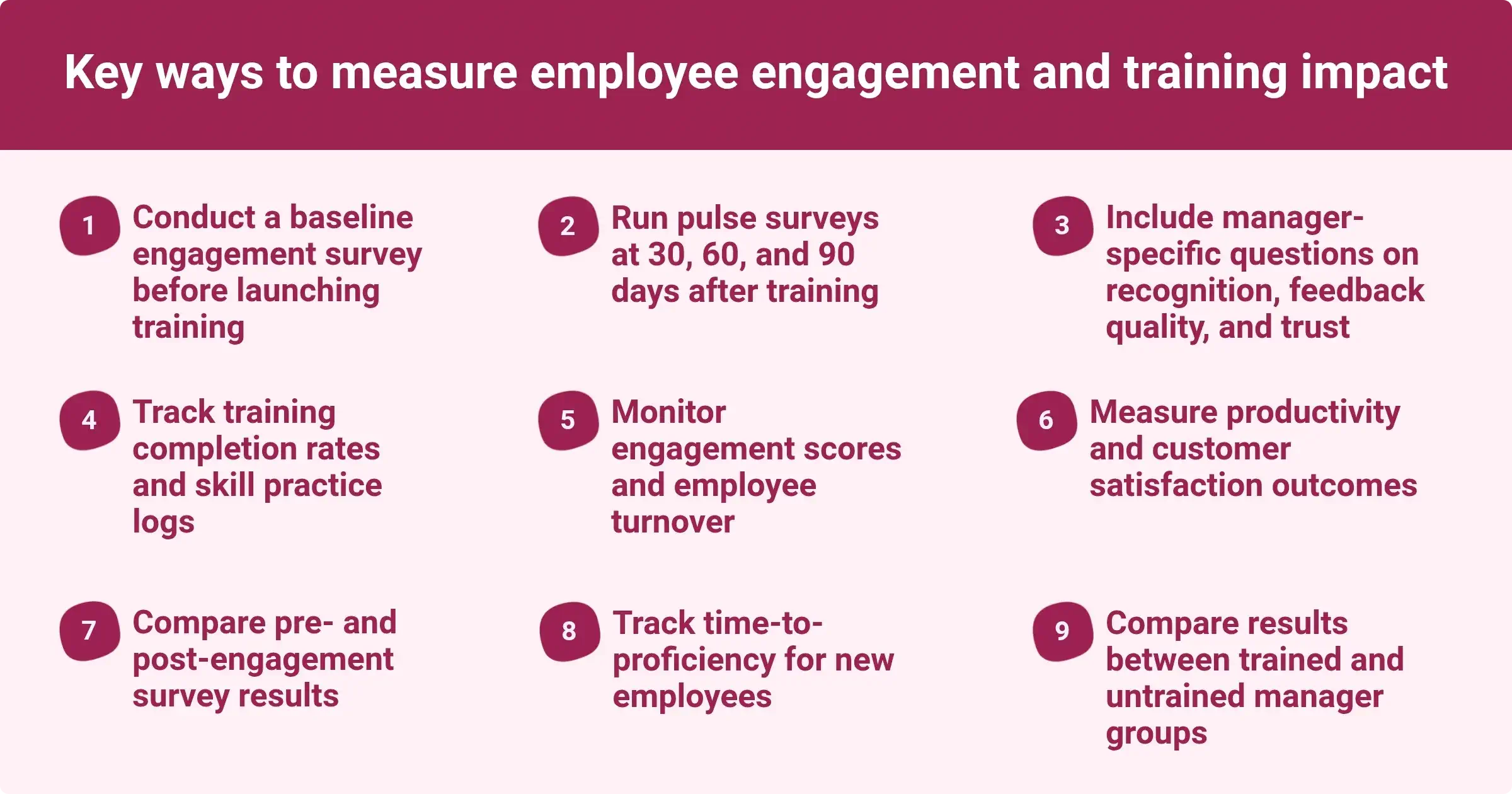
For the best results, compare the results between trained and untrained manager cohorts. Workhuman IQ™ can mine recognition and feedback data to track manager behaviors, team-level engagement trends, and skill development over time. It offers insights, on-demand reporting, and personalized recommendations so HR leaders can measure training ROI and correlate manager actions with engagement outcomes.
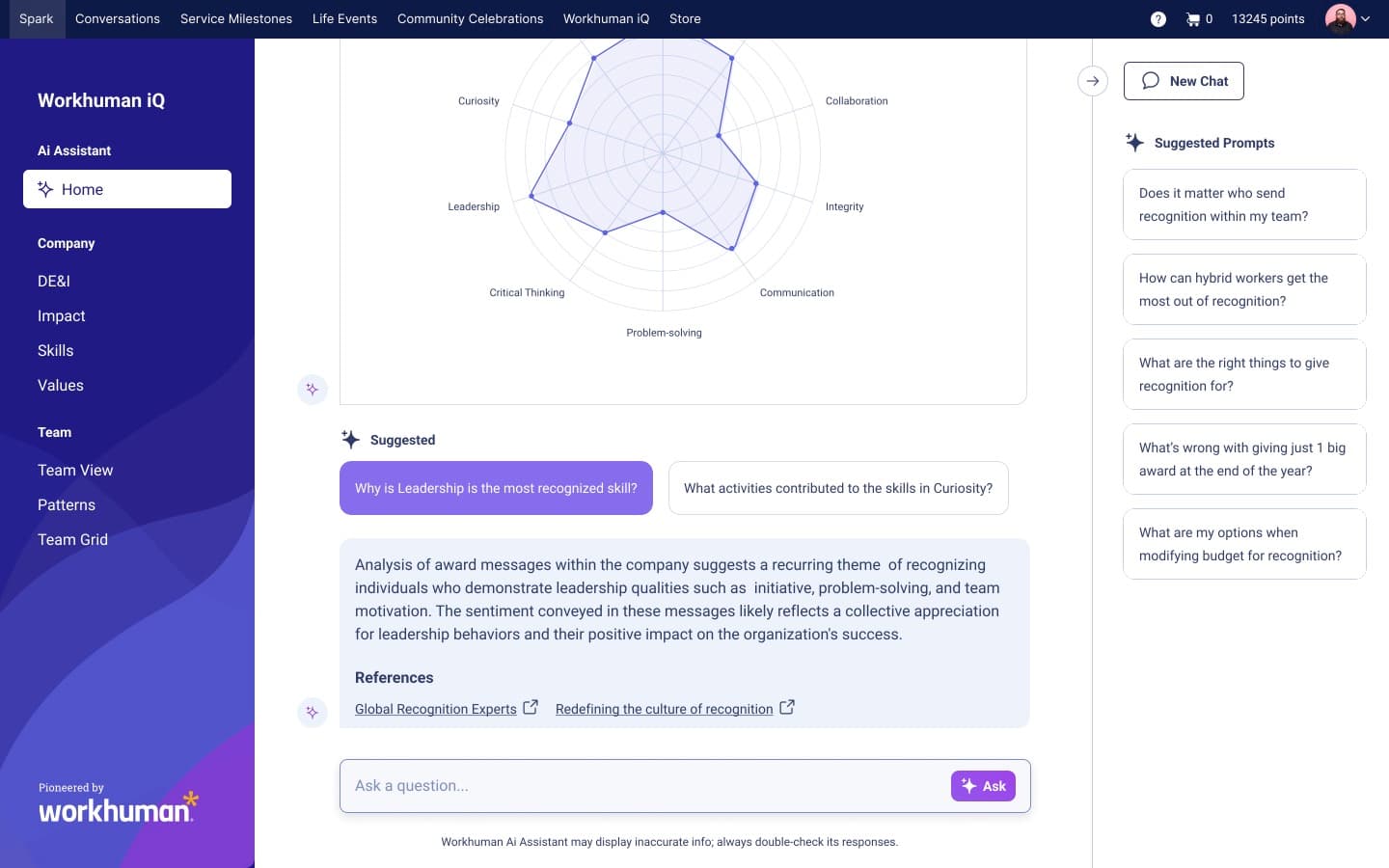
The Workhuman iQ team of data scientists and linguists developed a recognition-specific language model so you can see skills employees recognize in each other.
Map skills and shape development across your company with insight and guidance from Workhuman's new AI AssistantOpens in a new tab.
Free and paid employee engagement training resources and certifications
Finding high-quality engagement training resources is time-consuming if you don't know where to look. These free and paid providers are a good place to begin.
Free options
You can find ample information on YouTube, particularly from the Society for Human Resource Management (SHRM), Gallup, and TED. To take free online courses, try Coursera, LinkedIn Learning, or OpenLearn. Finally, SHRM, Workhuman, and Culture Amp have resource libraries with HR blogs and podcasts.
Professional certifications and credentials
Certifications are especially valuable if you're seeking HR career advancement, consulting credibility, and organizational buy-in. The Certified Employee Engagement Professional (CEEP) program focuses on workplace morale and retention. Other popular options include the Gallup Certified Strengths Coach, Cornell's eCornell Strategic HR Leadership, and SHRM's specialty credentials in talent acquisition, people analytics, and employee relations.
Premium training providers and programs
If you have money to invest in additional resources, try BetterUp, a coaching provider with programs supporting manager effectiveness and employee engagement, or FranklinCovey, which offers leadership courses. You can also create custom programs and task internal employees with facilitating them.
Evaluating training vendors and resources
When developing a training program, you'll need to decide whether to build your own or buy a pre-made one. Building gives you more control, so you can align the program with your company's culture, but deployment is usually faster with a purchased program. You can also opt for a hybrid solution, using internal facilitators and licensed vendor content.
If you decide to purchase a program or tool, look for one with a good balance of affordability, scalability, and customization options. In addition, consider the content quality, availability of post-training support, and whether the format is self-paced or instructor-led.
Common challenges in employee engagement training and how to overcome them
Implementing an effective employee engagement training program is a complex process. Understanding the potential obstacles upfront can help you avoid them.
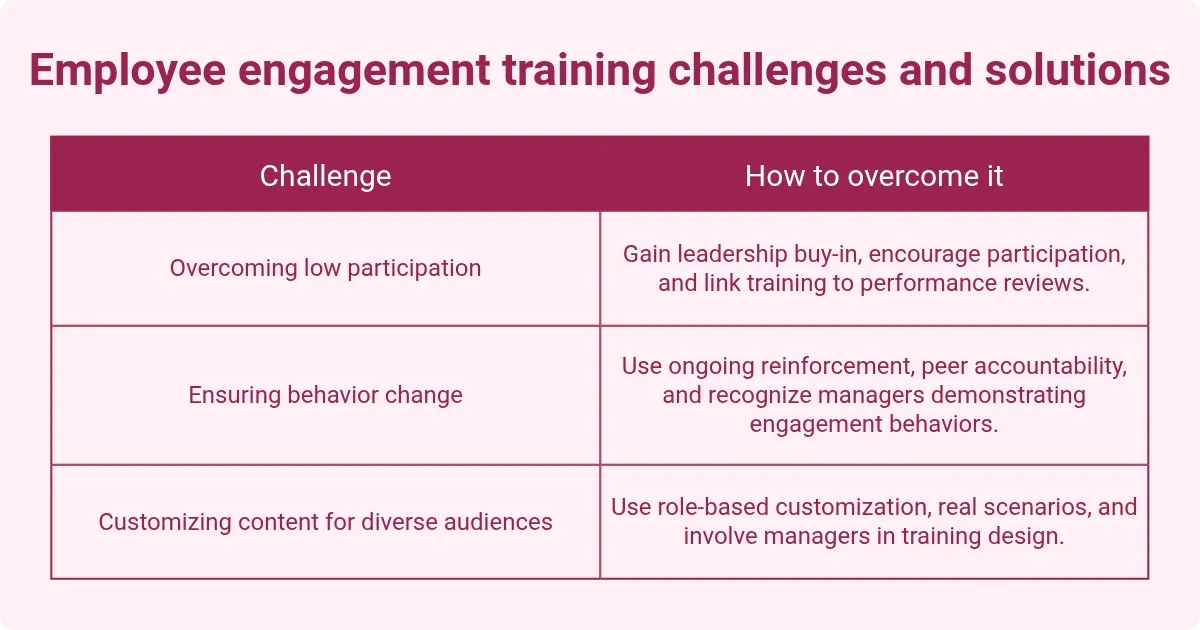
Overcoming low participation
Managers and employees may be resistant to a new training program, feeling it's a waste of time and an HR initiative. When the leadership team fully buys in and participates, it encourages adoption throughout the company. You can also tie training to performance reviews.
Ensuring behavior change
Although managers may complete the program, that may not always translate to real-life changes in engagement and recognition strategies. Use ongoing reinforcement and peer accountability to keep them top of mind. Most importantly, recognize managers who demonstrate the engagement behaviors they've learned.
Customizing content for diverse audiences
Generic content won't resonate with many of your employees, so focus on using role-based customization and real team scenarios. Give managers input in the design, potentially asking them to co-create modules, review drafts, or test the program. If possible, create role-specific racks for groups such as new managers, remote or hybrid employees, and experienced leaders.
Employee engagement training for managers
When managers complete employee engagement training, they should walk away with practical skills they can immediately implement in their interactions with their teams. Some of the most popular modules for manager training include:
- Recognition and appreciation basics, such as what meaningful recognition looks like and how often it should occur
- Building inclusive teams using everyday behaviors to promote belonging and reduce bias
- Leading through change and stress by supporting engagement during workload spikes or organizational shifts
Before managers complete their modules, set expectations for post-training behavior changes, such as higher-quality recognition, better conflict resolution, and check-ins on workload and well-being. Moving forward, consider using peer learning circles or cohorts, where managers share challenges and engagement wins.
Employee engagement training case studies
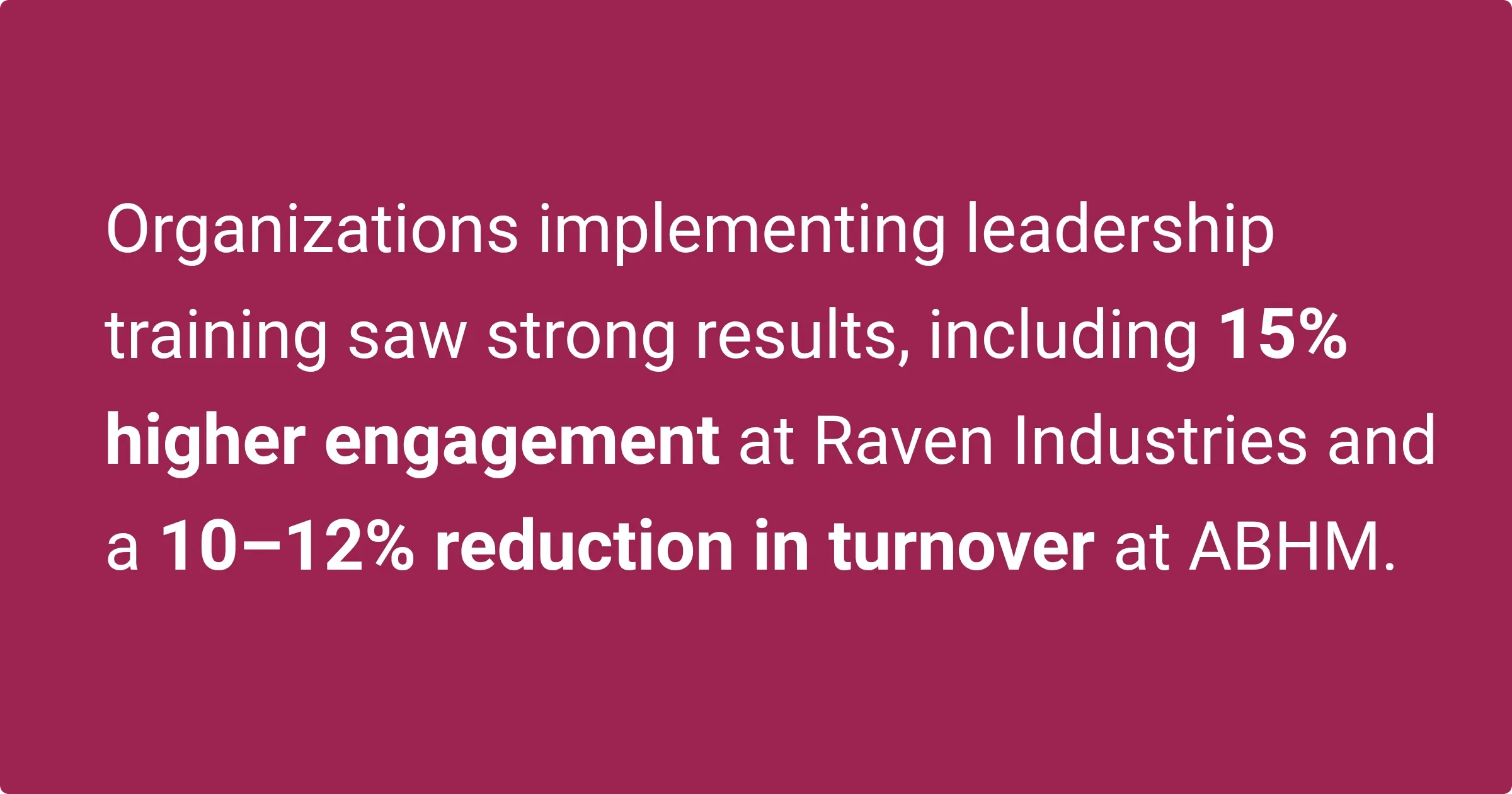
Looking at real-world examples of successful employee engagement training makes clear the possible gains. Business Training ExpertsOpens in a new tab describes how Raven Industries, an agriculture tech company, achieved a 15% improvement in employee engagement after implementing a leadership training program.
Managers practiced better communication, team building, and motivation.
Another case study from Business Training Experts, “A Focus on Leadership Development at ABHM Reduces Turnover 10%, Boosts Employee Satisfaction, and Improves Patient Care”, explains how American Baptist Homes of the Midwest, a healthcare provider for seniors, significantly reduced turnover and costs through manager training. More specifically, turnover decreased between 10% and 12%, and employee satisfaction rates grew each year.
FAQs
What is the difference between employee engagement training and leadership development?
Employee engagement training is a more focused program centered around engagement-specific behaviors and strategies. It emphasizes areas such as communicating during one-on-one meetings, offering regular recognition, and giving constructive feedback.
What are the most important skills to teach managers in engagement training?
Some of the most important skills managers should learn are active listening, goal setting, and practicing empathy. Training programs should also cover inclusivity and psychological safety.
Should we build or buy employee engagement training content?
The decision to build or buy depends on your organization's needs. You can implement a purchased program more quickly, but building allows you to tailor it to your culture and objectives.
What are the biggest mistakes companies make with engagement training?
Common mistakes include creating generic content without differentiating by role, failing to get leadership buy-in, and neglecting to follow up on behavior change.
Conclusion
Employee engagement training works best when it’s treated as a long-term capability builder, not a one-and-done event. With the right engagement strategy, you can equip leaders with practical strategies that empower employees, strengthen trust, and create a positive workplace culture where engaged teams thrive.
Pairing ongoing management training and reinforcement with insights from surveys helps you focus your efforts where they’ll have the biggest impact. Over time, those habits add up to a more engaged workforce, and when highly engaged employees feel seen, supported, and developed, they achieve more and stay longer.
Ready to turn training into lasting engagement? Start by identifying the behaviors your managers need most, build learning moments into the flow of work, and reinforce progress with frequent feedback and meaningful recognition.
About the author
Ryan Stoltz
Ryan is a search marketing manager and content strategist at Workhuman where he writes on the next evolution of the workplace. Outside of the workplace, he's a diehard 49ers fan, comedy junkie, and has trouble avoiding sweets on a nightly basis.