
Workhuman vs. Bonusly: 2026 Comparison Guide
by Ryan Stoltz
8 min read

Table of contents
- Workhuman vs. Bonusly Platform Overview
- Feature Comparison: Workhuman vs. Bonusly
- Recognition & Culture Building
- Integrations & Tech Ecosystem Fit
- Pricing & Cost-Effectiveness
- Impact on Engagement, Retention, and Morale
- AI and Product Innovation
- Global Reach and Capabilities
- Customer Support
- Ease of Use & Implementation
- Workhuman vs. Bonusly: Strengths & Weaknesses
- Workhuman vs. Bonusly: What Customers Say
- Workhuman vs. Bonusly: Final Verdict
Share this article
Employee recognition software has outgrown its “nice-to-have” reputation. Today, it’s a core lever for engagement, retention, and performance — especially as leaner teams, hybrid work, and constant change put more pressure on culture to carry the load.
That shift has raised the bar. Recognition platforms can’t just make it easy to say “thanks” or hand out points. They need to support recognition done right — helping people give meaningful, values-connected recognition at scale, and giving leaders the visibility to understand what’s working, what’s not, and where to intervene.
That’s why Workhuman and Bonusly are often compared. Both enable peer-to-peer recognition, both aim to increase participation, and both help make appreciation more visible across teams.
But the similarities don’t tell the whole story. The two platforms differ in how recognition is designed, how well it reinforces company values and culture, and how much insight organizations can gain from recognition activity over time.
If you’re evaluating these options, the real question isn’t just which platform generates more shoutouts — it’s which one turns recognition into a sustained cultural and business advantage.
This guide breaks down Workhuman vs. Bonusly so you can choose the approach that best fits your culture goals, scale requirements, and expectations for measurable impact.
Workhuman vs. Bonusly Platform Overview
Workhuman at a Glance
Bonusly at a Glance
- Founded in 2012, headquartered in Boulder, Colorado, and positioned as a recognition-and-rewards platform.
- Peer-to-peer “micro-bonuses” powered by points, where employees typically give recognition publicly and recipients redeem points for rewards.
- Values support via hashtags, designed to connect recognition moments to company values.
- Built for in-the-flow usage with integrations like Slack, enabling recognition and rewards actions without leaving collaboration tools.
- Analytics and reporting dashboards focused on participation trends, connections, and recognition frequency (with downloadable recognition analytics available).
At a basic level, both Bonusly and Workhuman let employees recognize one another and redeem rewards — but the difference isn’t in what they do, it’s in what that recognition is designed to achieve.
Feature Comparison: Workhuman vs. Bonusly


*Workhuman’s proprietary Standard of Living Index (SOLI) automatically adjusts award values based on each award recipient’s location, ensuring global equity.
Recognition & Culture Building
Workhuman
Bonusly
- Primarily peer-to-peer, points-based recognition designed for frequent, public shoutouts.
- High activity, but recognition can skew transactional, prioritizing points over meaning.
- Limited in-the-moment guidance to help people write specific, high-quality recognition.
- Over time, messages can become generic or repetitive due to the lightweight prompting.
- Culture-building tends to be driven by volume of recognition rather than deliberate, values-based reinforcement.
- Points-based reward structure can be confusing and offers limited customization, making it difficult to tailor recognition programs to an organization’s specific values, behaviors, and cultural priorities.
Integrations & Tech Ecosystem Fit
Workhuman
Bonusly
- Bonusly integrates with popular collaboration platforms such as Slack and Microsoft Teams, allowing users to give and receive recognition directly within these tools, enhancing workflow integration and user adoption.
- The platform supports integration with major HRIS systems like BambooHR, ADP, and Workday, enabling automated synchronization of employee data and streamlining recognition workflows.
- Bonusly offers an open API and embeddable widget, providing flexibility for organizations to create custom integrations and embed recognition features into their existing systems.
- Through its partnership with Zapier, Bonusly can connect to over 8,000 apps, allowing for extensive automation and integration possibilities across various business applications.
- The platform's integration capabilities are designed to fit seamlessly into existing tech ecosystems, making it a versatile choice for organizations looking to enhance their recognition programs without disrupting current workflows.
Pricing & Cost-Effectiveness
Workhuman
Bonusly
- Pricing Structure: Bonusly offers a tiered pricing model with a free tier for core recognition features, a Team plan at $3 per seat/month or $30 per seat/year, and a custom-priced Organization plan for enterprises. This structure can appear cost-effective for small to mid-sized teams but becomes less transparent for larger enterprises due to custom pricing and separate reward-billing options.
- Cost Complexity: While Bonusly's per-seat subscription model seems straightforward, the total cost of ownership (TCO) is influenced by separate reward funding options and associated convenience fees. This can complicate budgeting and financial planning for organizations.
- Operational Burden: The need for internal teams to manage reward funding and billing options, such as Pay-as-you-go, Flex, and Fixed plans, can increase administrative overhead. This may detract from the perceived cost-effectiveness of Bonusly's pricing model.
- Market Perception: Bonusly is perceived as cost-effective and transparent for small-to-mid teams due to its low per-seat Team price and free tier. However, for larger enterprises, the custom Organization pricing and separate reward-billing options add complexity, making it less predictable compared to Workhuman's premium and quote-based pricing model.
- Long-term Value: While Bonusly's initial costs may appear lower, the lack of bundled advanced features and enterprise services in the free and Team tiers could lead to higher long-term costs as organizations scale and require more comprehensive solutions.
Impact on Engagement, Retention, and Morale
Workhuman


“We’re really focused on outcomes. … And measuring who is getting recognized, the frequency of recognition, linking it to retention, linking it to turnover implications – all of that demonstrates the return on investment is significant.”
Bonusly
- Activity-Based Success Metrics: Bonusly often measures success through metrics like recognition frequency and adoption rates, using the volume of activity as a primary indicator of its impact on engagement and morale.
- Surface-Level Engagement Indicators: Metrics such as recognitions sent, logins, and rewards redeemed are commonly used to infer engagement and morale, providing a basic view of user interaction with the platform.
- Limited Deeper Outcome Connections: While Bonusly tracks recognition activity, there is limited connection to deeper outcomes like sustained engagement, retention, or performance improvement, which can make it challenging to assess long-term impact.
- Visibility Without Insight: Recognition data offers visibility into platform usage but provides little insight into the underlying reasons for changes in morale or which specific behaviors are driving results.
- Plateauing Impact: The impact on engagement and morale may plateau over time, as increased recognition activity does not necessarily lead to a stronger culture, sense of belonging, or long-term retention improvements.
AI and Product Innovation
Workhuman
Bonusly
- Product innovation is centered on enhancing user engagement through features like video recognition and AI-driven feedback generation, rather than deeply integrating recognition intelligence into strategic HR functions.
- The platform leverages technology to facilitate standard recognition workflows, including peer-to-peer recognition, milestone celebrations, and reward catalog management, ensuring ease of use and accessibility.
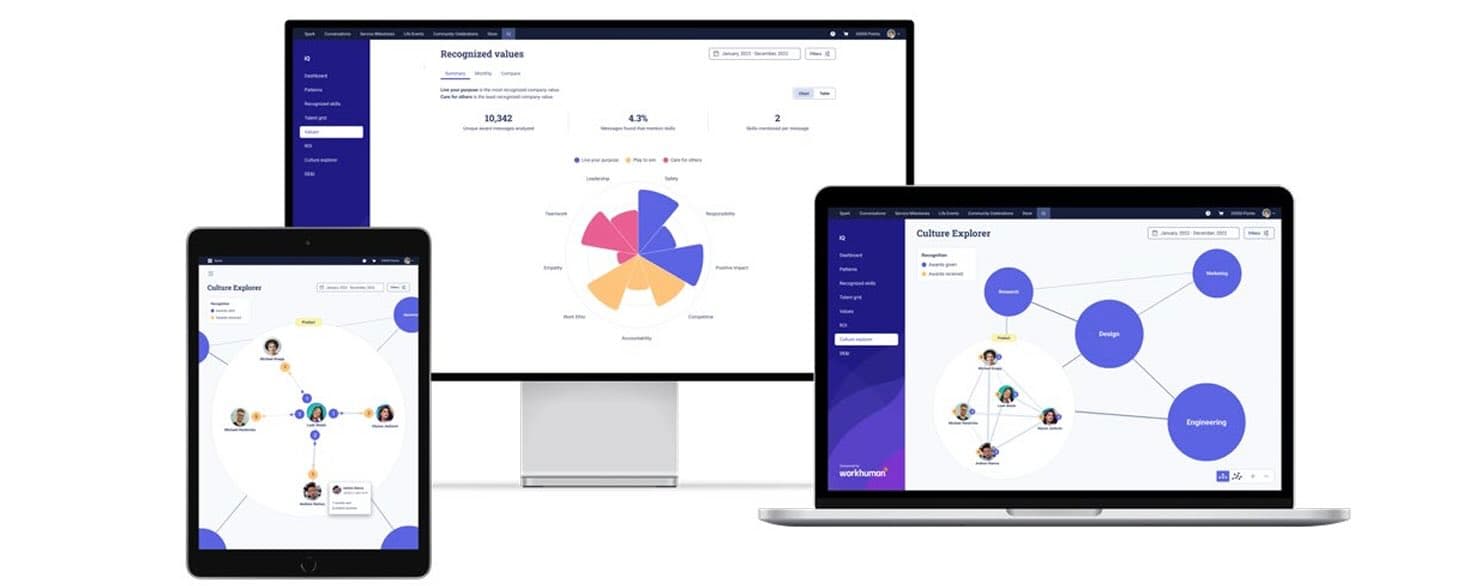
- Bonusly's analytics primarily focus on descriptive metrics such as recognition volume, program usage, and reward spend, providing basic insights into program performance.
- While Bonusly incorporates AI features like Recognition Quality Score and video-to-text recognition, the application of AI is limited in terms of improving recognition quality or translating data into comprehensive talent, culture, or business intelligence.
- Recognition data is not structured to support advanced skills intelligence, culture diagnostics, or strategic decision-making, which limits its potential as an intelligence layer for organizational leaders.
- The platform remains primarily an operational tool for recognition and rewards, rather than a strategic asset that provides deep insights into employee behavior and organizational culture.
Global Reach and Capabilities
Workhuman
Bonusly
- Global Reward Options: Offers a global reward catalog with options like digital gift cards and charitable donations, but the availability and relevance of rewards can vary by region, impacting the overall employee experience.
- Equity and Parity: While Bonusly provides a range of reward options, mechanisms to ensure purchasing parity and equity across different regions are not automatically integrated, often requiring manual adjustments or special configurations.
- Reliance on External Providers: The platform relies on external providers like Snappy and Tango Card for reward fulfillment, which can lead to inconsistencies in reward value perception and local relevance.
- Consistency Challenges: Bonusly lacks built-in systems to ensure fairness and consistency at scale, particularly as recognition programs expand globally, which may affect the uniformity of the employee experience.
- Functional Global Reach: While Bonusly has a functional global reach through its reward catalog, the platform does not inherently engineer global equity and experience consistency, potentially leading to varied employee experiences across different regions.
Customer Support
Workhuman
Bonusly
- Standard Support Model: Bonusly provides a standard customer support model that focuses primarily on platform usage assistance and issue resolution, ensuring users can effectively navigate and utilize the platform.
- Limited Strategic Consulting: The platform offers limited access to strategic consulting or data-driven guidance beyond the initial setup phase, which may require organizations to rely on internal resources for strategic program development.
- Reliance on External Partners: Bonusly's reliance on external partners for reward fulfillment can introduce handoffs and variability in the support experience, potentially affecting the consistency and quality of customer service.
- Internal Team Dependency: Ongoing success with Bonusly's platform is largely dependent on internal teams to optimize, evolve, and demonstrate the value of recognition programs over time, as the platform provides limited ongoing strategic support
Ease of Use & Implementation
Workhuman
Bonusly
- User-Friendly Interface: Bonusly is designed to be easy to navigate, particularly for basic recognition and reward actions, making it accessible for users at all levels.
- Lightweight Implementation: The initial implementation process is relatively straightforward, but it offers limited strategic guidance, requiring organizations to independently develop program design, rollout strategies, and optimization plans.
- Administrative Complexity: As program complexity increases, the administrative experience can become cumbersome due to limited segmentation capabilities by role, geography, or business unit, necessitating manual workarounds to manage multiple programs or regions.
- Operational Burden: Handling global tax, compliance, and localization can introduce significant operational burdens, often falling on internal HR, finance, and legal teams to manage without built-in support from the platform.
- Customization Constraints: Customization options for admin messaging, homepage content, and targeted communications are limited, which can reduce agility and relevance as programs evolve over time.
- Increased Manual Effort: What initially appears to be an easy-to-use platform may translate into more manual effort, greater internal dependency, and increased friction as programs scale and require more complex management.
Workhuman vs. Bonusly: Strengths & Weaknesses
Workhuman Strengths
Workhuman Weaknesses
- Best suited for organizations seeking strategic, culture-building recognition, not for those wanting a simple gift-card shop.
- The partnership model includes consultation and coaching, which some buyers may view as more robust than necessary.
Bonusly Strengths
- Bonusly's points-based peer-to-peer recognition system is intuitive and user-friendly, facilitating easy engagement and participation among employees.
- The platform offers a global reward catalog with diverse options, including digital gift cards and charitable donations, catering to a wide range of employee preferences.
- Bonusly's integration with popular collaboration tools like Slack and Microsoft Teams enhances its visibility and accessibility within daily workflows, promoting consistent recognition practices.
Bonusly Weaknesses
- Bonusly's pricing model can become complex for larger enterprises due to custom Organization pricing and separate reward-billing options, which may reduce transparency and predictability.
- The platform's analytics are primarily descriptive, focusing on basic metrics like recognition volume and program usage, with limited application of AI for deeper insights into talent and culture.
- Bonusly relies on external partners for reward fulfillment, which can introduce variability in the support experience and affect the consistency of reward value perception.
- Customization options for admin messaging and targeted communications are limited, potentially reducing the platform's agility and relevance as programs evolve.
Workhuman vs. Bonusly: What Customers Say
Customer Feedback & Quotes
Workhuman:
Bonusly:
- “Cool functionality, but limited rewards available - it's a nice concept and a positive way to incentivize people | - very limited rewards available (currenty, only 5 providers in RO + salary boost). Even those that normally work, are not always available, due to downtimes with voucher providers (certain rewards missing for a month).” - Verified User in Digital Marketing Operations (Enterprise customer G2 Review).
- "It's nice and easy to use. Some of the UI and interactions could be polished. Text formatting is a little glitchy sometimes. - Glitches when loading names or formatting text." - Verified User in Legal Services (Enterprise customer G2 Review).
- Confusing points system and limited customization: Multiple G2 reviewers note that Bonusly's points system is unclear for new users, with one reviewer stating the platform's hashtag requirements and point structures feel "cumbersome." Others cite restricted customization options for rewards, recognition categories, and survey scales, making it difficult to adapt the platform to their company's specific culture and language.
- Underdeveloped reporting and analytics: G2 reviewers, particularly those at larger organizations, frequently flag Bonusly's reporting capabilities as basic and unreliable. One verified G2 reviewer in Insurance noted they had to "pull multiple reports in order to see everything needed" and encountered "several bugs in reporting that make our teams not feel confident in the data being provided." Expert reviews corroborate that Bonusly's analytics features are "relatively underdeveloped" compared to competitors.
Workhuman vs. Bonusly: Final Verdict
Both Workhuman and Bonusly enable peer-to-peer recognition and rewards. The real decision comes down to what you need recognition to deliver over time — not just more moments of appreciation, but measurable cultural and business impact as your organization scales.
Choose Workhuman if:
Choose Bonusly if:
You want lightweight, day-to-day peer recognition with simple rewards.
Bonusly can be a good fit when the goal is frequent shoutouts and an easy points-to-rewards model.
Your primary success metric is participation.
If you mainly need to increase the volume of recognition moments and create visibility, Bonusly’s approach may meet the need.
You have simpler requirements and lower program complexity.
If you don’t need deep analytics, consulting support, or enterprise governance, a lighter platform may be sufficient.
Final Verdict
Both Workhuman and Bonusly can help employees recognize one another.
The difference shows up after launch.
Bonusly is often best suited to organizations that prioritize quick, lightweight peer recognition and rewards, and don’t require the same depth of outcome measurement, program intelligence, or strategic support over time.
Bottom line
- Workhuman delivers strategic recognition built for measurable impact and scale.
- Bonusly delivers simple, participation-forward recognition and rewards.
See also:

Ryan Stoltz
Ryan is a search marketing manager and content strategist at Workhuman where he writes on the next evolution of the workplace. Outside of the workplace, he's a diehard 49ers fan, comedy junkie, and has trouble avoiding sweets on a nightly basis.
Recommended for you