
Complete Guide to 360-Degree Feedback: Examples, Benefits, and Best Practices
by Ryan Stoltz
Last updated
12 min read
Table of contents
- What is 360-degree feedback?
- What are the benefits of 360-degree feedback?
- What are the disadvantages of 360-degree feedback?
- Best practices for 360-degree feedback
- How to implement 360-degree feedback in your organization
- Examples of 360-degree feedback
- Key questions to ask in 360-degree feedback
- Advanced 360-degree feedback tools and strategies
- Common challenges in implementing 360-degree feedback process
- Conclusion
Share this article
A single manager’s perspective can only tell you so much about how someone actually performs at work. 360-degree feedback fills in those gaps.
It collects input from peers, direct reports, managers, and the individual themselves to build a fuller, more honest picture of performance.
Research from the Journal of Organizational Behavior Management on Continuous Performance FeedbackOpens in a new tab also shows that employees who receive regular, multi-source feedback are significantly more likely to be engaged and improve over time.
Today’s guide covers everything you need to know: from the definition and benefits to real-world examples, implementation steps, and the tools that make it work.
What is 360-degree feedback?
Understanding 360-degree feedback
Most employee performance reviews flow in one direction—from manager to employee. But that only captures a fraction of how a person shows up at work.
360-degree feedback changes that. It’s a structured evaluation method that gathers input from everyone who works closely with an individual. That includes their manager, peers, direct reports, and the individual themselves through self-assessment.
How 360-degree feedback works
The process typically follows a clear sequence:
- Step 1: Select participants
The individual being reviewed and their manager identify a group of raters. This usually includes four to eight people across different working relationships.
- Step 2: Design the survey
Participants complete a structured questionnaire covering key competencies, such as communication, teamwork, and leadership. Questions are rated on a scale and often include open-ended responses.
- Step 3: Collect feedback
Responses are submitted anonymously through a feedback platform or survey tool, which protects honesty and reduces social pressure.
- Step 4: Analyze the results
Feedback is compiled into a report that highlights patterns, strengths, and development areas across all rater groups.
- Step 5: Share and act
The individual reviews their results, ideally with a manager or coach, and uses the insights to build a targeted talent development plan.
According to one study titled “Effects of repeated multi-source feedback on the influence behavior and effectiveness of managers”Opens in a new tab, multi-source feedback (MSF) leads to greater behavioral change than single-source feedback alone—particularly when follow-up and accountability structures are in place.
What are the benefits of 360-degree feedback?
360-degree feedback benefits everyone involved. Here’s a closer look at what the research and real-world experience show:
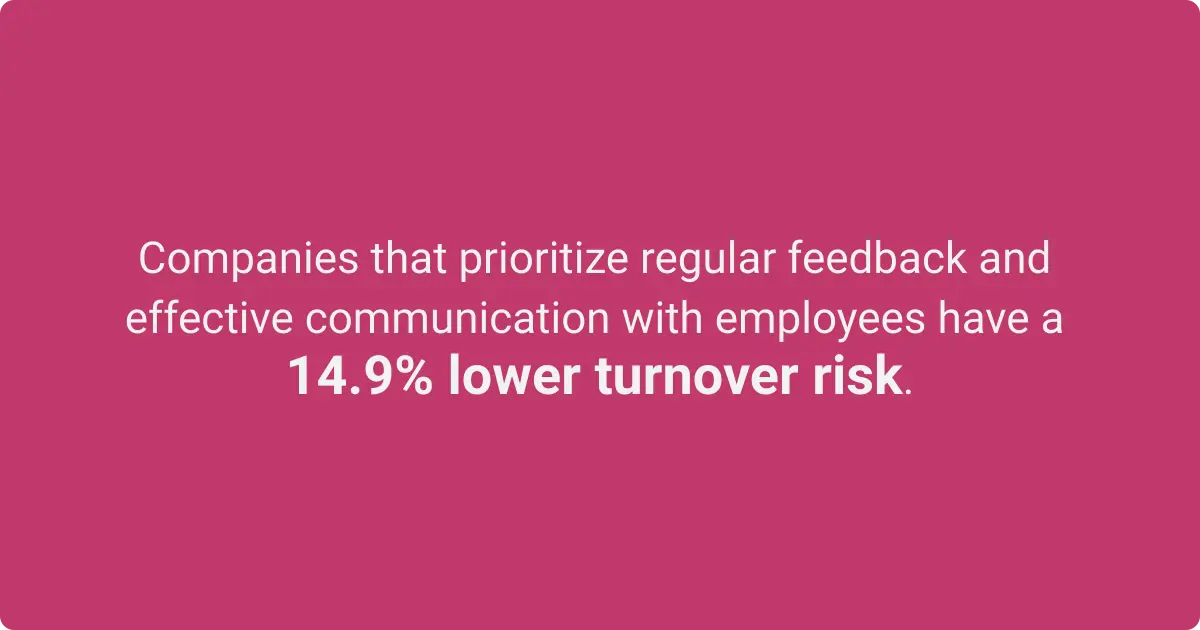
Boosts employee engagement
Have you ever wanted to anonymously tell your coworker or manager about their weak points? 360-degree feedback will let you do that.
An employee might respond better to negative feedback if they know it’s meant to motivate them. Receiving positive feedback can also increase their confidence.
That can have a great impact on the employee’s future performance as they work on their weaknesses.
Realistic and honest feedback
Gathering information from different people with different perspectives guarantees that the feedback is highly accurate.
That’s especially true since colleagues don’t realize the goal of the feedback; their input is simply recorded with complete anonymity.
360-degree feedback also ensures that there’s no ulterior motive behind a colleague’s review. It also helps build trust in the workplace, as employees can realize how others perceive their behavior.
For example, if there’s a pattern of behavior that multiple clients, suppliers, and co-workers agree on, that means it’s actually present. The employee will then need to work on that pattern.
Increases self-awareness and helps in self-evaluation
Most people have blind spots. The way we see ourselves at work rarely matches how others experience us, and that gap can quietly hold back both performance and growth.
Luckily, 360 reviews close that gap. When feedback comes from people across different working relationships, individuals get a much richer picture of their strengths and areas of development.
Research also backs this up:
A study by organizational psychologist Tasha Eurich titled "Are You a Self-aware Leader?"Opens in a new tab found that while 95% of people believe they are self-aware, only 10 to 15% actually are.
Improves work relationships and productivity
Just like providing feedback to peers, 360-degree feedback can boost employees’ self-esteem and increase their productivity.
When positive feedback comes from the people you work with every day, it boosts the positivity of the work environment and improves work relationships.
This, in turn, also helps improve communication and build more trust among the employees.
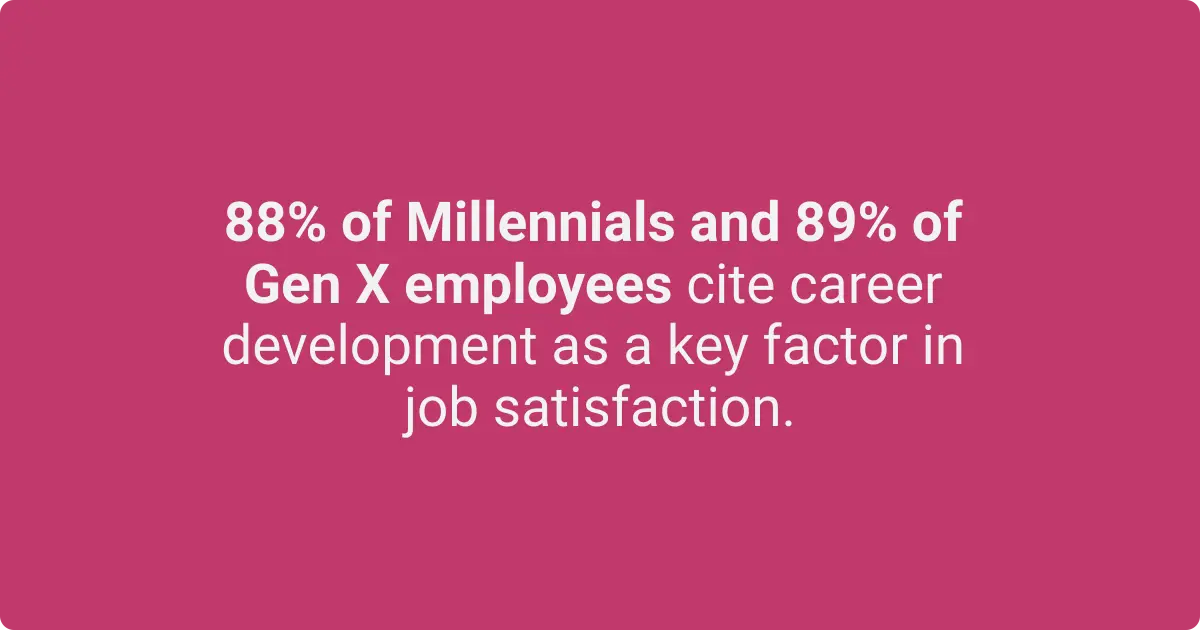
Employee development
Most development plans are built on guesswork. A manager identifies a few gaps, suggests some proper training, and hopes for the best.
360-degree feedback replaces that guesswork with more reliable, real input from the people who experience an employee’s work firsthand.
When feedback comes from multiple directions, employees can clearly see which strengths to lean into and which areas genuinely need attention. That clarity leads to development plans that are targeted and actionable rather than generic.
A research paper, “The Role of Organizational Culture in Driving Employee Engagement”Opens in a new tab showed that organizations with strong feedback cultures are more likely to report higher employee engagement and are better positioned to retain top talent long term.
Continuous feedback also plays a critical motivational role, as per another research published in the Journal of Organizational Behavior Management, “Continuous Performance Feedback”. Rather than waiting for an annual review to course-correct, employees get timely insights they can act on immediately.
That ongoing loop of feedback and growth keeps development moving and employees invested in their own progress.
Impact on leadership development
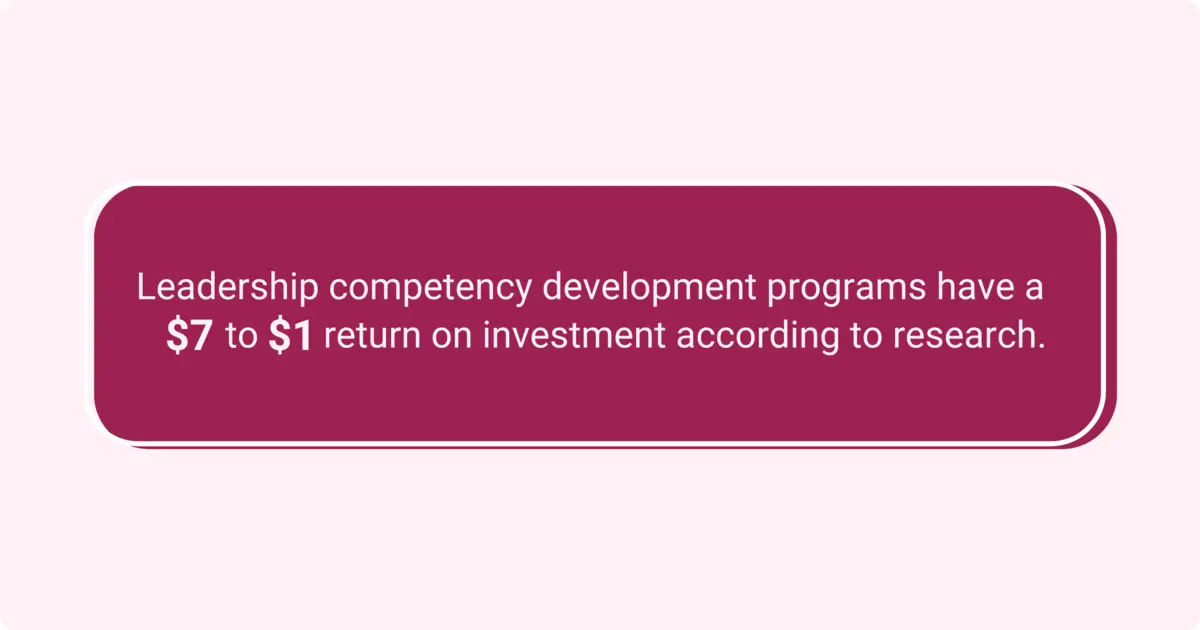
Leadership is one of the hardest things to evaluate from the inside. A leader might believe they communicate clearly, delegate effectively, and inspire their team, but their direct reports may experience something very different.
That’s exactly where 360 reviews for leaders prove their value. By collecting feedback from the people leaders work above, alongside, and below, organizations get an honest performance assessment of leadership behaviors that would otherwise go unexamined.
Consider, for instance, a senior manager who’s highly results-driven but consistently interrupts team members in meetings. Their own manager may never see this behavior. But peers and direct reports will.
360-degree feedback can help surface such an issue. It’ll give this hypothetical leader a concrete, specific area to work on.
Research supports this. One paper, “Leaders development program by 360 degree feedback”Opens in a new tab found that leaders who actively seek and respond to multi-source feedback show measurable improvements in effectiveness over time, particularly in areas such as emotional intelligence, communication, and team development.
For organizations investing in creating a feedback culture, starting at the leadership level sends a powerful message. When leaders model the willingness to receive and act on feedback, it normalizes the process for everyone else.
What are the disadvantages of 360-degree feedback?
Yes, 360-degree feedback is a powerful tool—but it’s not without its pitfalls.
Understanding the challenges upfront helps organizations design a process that actually works rather than one that creates more problems than it solves.
Conflicting ratings
One of the issues you can face with 360 reviews is conflicting ratings.
For example, you could receive highly positive feedback from a co-worker on a specific dimension, but a superior could give negative feedback on that same dimension.
In this case, some managers might simply discard the data as invalid.
Lowers self-esteem
Receiving negative feedback can lead to one of two situations: you either work on the negative points and improve yourself, or you let the negativity get into your head.
The latter scenario can lower one’s self-esteem and self-confidence, especially if the negative feedback is unexpected.
That’s why there should always be an action plan to improve. The negative feedback isn’t an act of blaming. It’s an attempt to identify one’s problems and work on them.
Implementation Challenges
Running a 360-degree feedback process isn’t a small undertaking. Designing surveys, selecting raters, collecting responses, analyzing data, and following up on development plans all take time and resources, especially in larger organizations.
Resistance from managers and employees is also common. Some see it as bureaucratic. Others worry about how feedback will be used.
Without clear communication about the purpose and process, participation drops, and results suffer.
In such a case, technology can make a real difference:
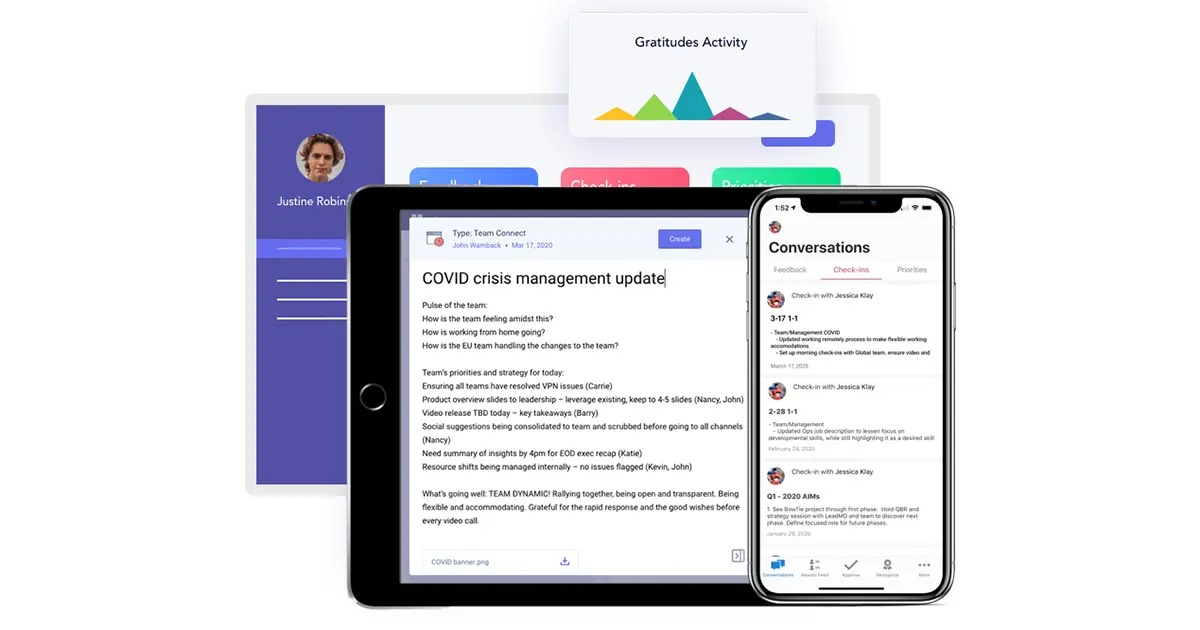
Workhuman’s® Conversations® tool is built specifically to take the friction out of continuous performance management. It facilitates structured check-ins, crowdsourced feedback, and real-time analytics.
As such, organizations can run meaningful feedback processes without the administrative burden.
Risk of biased feedback
Bias is one of the most serious threats to the integrity of 360-degree feedback. It can enter the process in ways that are difficult to detect, and even harder to correct after the fact.
Personal relationships can skew ratings in both directions. For example, a close friend might inflate scores. Conversely, someone with a long-standing conflict might deflate them.
Either way, unconscious biases related to gender, race, or communication style can also influence how raters perceive and evaluate the same behaviors differently.
Luckily, standardized rating scales, anonymous submissions, and rater training all help reduce this risk.
Additionally, Workhuman’s Inclusion Advisor® uses AI and natural language processing to flag potentially biased language in real time. The tool helps organizations catch bias before it shapes the outcome.
Best practices for 360-degree feedback
Knowing the benefits of 360-degree feedback is one thing. Getting it right in practice is another.
These best practices help organizations build a process that’s fair, effective, and actually drives change.
Ensuring anonymity and confidentiality
Honest feedback depends on psychological safety. If employees believe their responses can be traced back to them, they’ll soften their answers, and the value of the process disappears.
In short, anonymity is the foundation of a trustworthy feedback process.
Organizations should use secure digital platforms that aggregate responses and communicate clearly to all participants how data will be stored. They should also ensure that no individual response is ever shared in isolation.
Setting clear goals and expectations
Before launching any 360-degree feedback process, organizations need to answer a fundamental question: what is this feedback actually for?
Is it for personal development? Leadership evaluation? Informing promotion decisions?
The answer shapes everything—from how surveys are designed to how results are shared and followed up on.
When goals are unclear, feedback loses its direction. Employees don’t know how to use it. Managers don’t know how to support it either.
Alternatively, tying feedback goals to broader organizational priorities—whether that’s improving leadership effectiveness, building a stronger team culture, or accelerating development—gives the entire process a purpose.
Providing actionable feedback
Vague feedback helps no one. Telling someone they need to ‘communicate better’ or ‘be more of a team player’ gives them nothing concrete to work with.
Effective 360-degree feedback is specific, behavior-based, and forward-looking. Think about the difference between these two responses:
“Could improve communication” versus “During project updates, try summarizing key decisions in writing so the team stays aligned after meetings.”
The latter response is one a person can act on. Training raters to give this kind of feedback (and designing survey questions that prompt it) is one of the most important factors an organization can consider to make the 360 process worthwhile.
Continuous feedback and follow-up
One of the biggest mistakes organizations make is treating 360-degree feedback as a one-time event. That approach wastes everyone’s time.
Workhuman’s research on continuous performance management is detailed on this point. The most effective feedback addresses recent behavior while it’s still fresh.
Further, the research shows that continuous performance management demonstrably boosts engagement, reduces turnover, and increases productivity when it’s embedded into how an organization operates day to day.
Workhuman’s Conversations® tool can help with this, too. It makes follow-up less of a manual effort and more of an integrated part of how teams work.
How to implement 360-degree feedback in your organization
Getting 360-degree feedback right doesn’t happen by accident. It requires a structured approach, clear communication, and the right tools to support every stage of the process.
Creating a 360-degree feedback process
A well-designed 360-degree feedback process starts long before the first survey goes out. Here’s how to build one that holds up in practice:
- Define the purpose first. Are you focusing on leadership development, team performance, or individual growth? Your answer determines everything else about how the process is structured.
- Design your survey carefully. Focus on four to five core competencies most relevant to the role (i.e., communication, collaboration, and decision-making). Keep questions behavioral and specific.
- Avoid rating scales with too many levels. Research in “The Case for 5-Point Unipolar Scales”Opens in a new tab shows that five-point scales tend to produce the most reliable data.
- Select the right raters. Aim for four to eight raters per individual, drawn from different working relationships. Raters should have enough direct interaction with the person to give meaningful input.
- Use a 360 feedback tool to manage the process digitally. It ensures anonymity, streamlines data collection, and produces reports that are easy to interpret and act on.
- Debrief with support. Share results in a structured conversation, ideally with a manager or coach present. Give the individual time to process the feedback before jumping into action planning.
Integrating with performance management systems
360-degree feedback works best when it’s not sitting on a desk somewhere. Integrating it with your broader performance management system turns it from a periodic exercise into a continuous driver of growth.
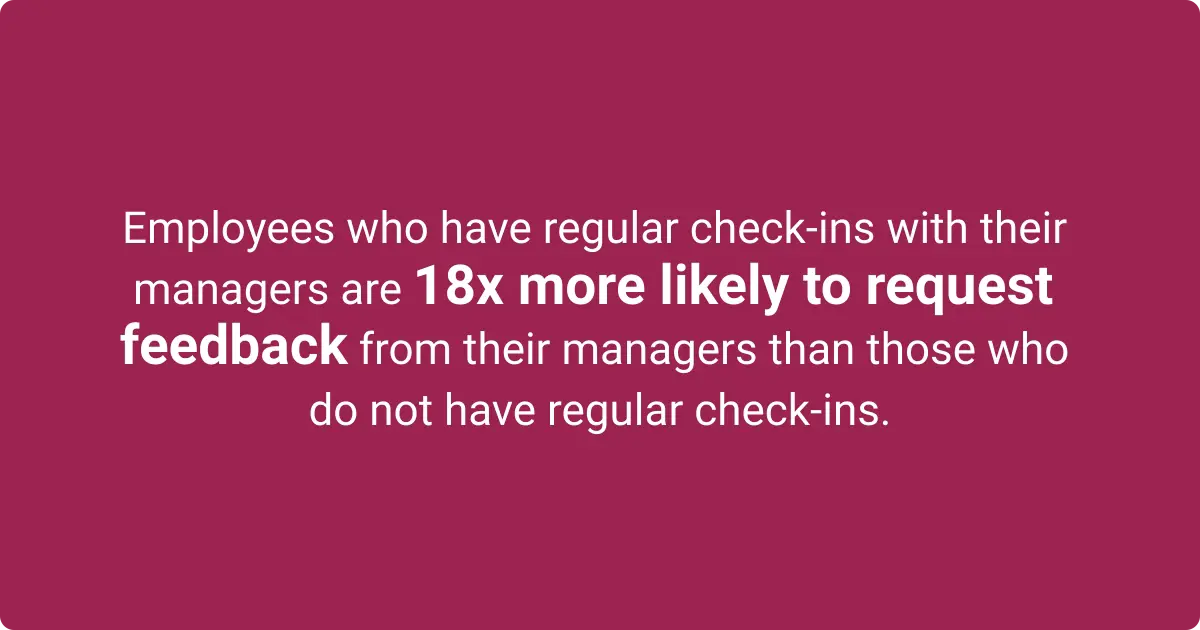
Regular check-ins are another key integration point. Rather than waiting for a formal review cycle, managers can use 360 insights to guide ongoing coaching conversations throughout the year.
Examples of 360-degree feedback
Understanding how the 360-degree feedback process works in theory is useful. Seeing how it plays out in real situations makes it actionable.
The examples below cover a range of common workplace scenarios, from peer feedback to 360 feedback for manager assessments, to show what good feedback actually looks like in practice.
Real-world 360-degree feedback examples
Example 1: Peer feedback on collaboration
“During our last product launch, you consistently shared project updates before team meetings, which helped everyone stay aligned. One area to develop would be inviting quieter team members into discussions more actively. Some great ideas aren’t making it into the room.”
This is effective peer feedback. It references a specific situation, acknowledges a strength they have, and offers a concrete, actionable suggestion for employee growth.
Example 2: Direct report feedback on communication
“I appreciate that you always explain the reasoning behind decisions. It helps me understand priorities better. I would find it easier to manage my workload if deadlines were communicated at the start of a project rather than as it progresses.”
This is a strong example of a 360-degree feedback strengths and weaknesses response. It balances appreciation with a specific, non-personal improvement suggestion.
Example 3: Manager feedback on ownership
“You have shown real initiative on the client accounts this quarter, and your attention to detail has noticeably improved. The next step would be bringing proposed solutions alongside problems when escalating issues. Doing so will accelerate your path toward a senior role.”
Each of these examples follows the same principle: specific context, acknowledged strength, forward-looking development point.
360-degree feedback examples for manager/leadership
360 reviews for leaders often reveal blind spots that no other performance evaluation method surfaces. Here are two scenarios specific to leadership assessment.
Platforms like Workhuman’s Social Recognition® can complement this process by creating a continuous record of peer-to-peer recognition that shows patterns of contribution that might otherwise go unnoticed in a structured survey.
Example 1: Feedback on leadership presence
“You do a great job setting a clear vision for the team. In high-pressure situations, though, decisions sometimes get made without consulting the people closest to the work. Bringing the team in earlier would strengthen both the decisions and team trust.”
Example 2: Feedback on developing others
“You give strong recognition when targets are hit, which motivates the team. A development area would be investing more time in one-on-one coaching conversations. Several team members have mentioned wanting more regular guidance on their career growth.”
Key questions to ask in 360-degree feedback
The quality of a 360-degree feedback process depends heavily on the questions asked. Poorly designed questions will produce vague, unusable responses.
Alternatively, the right questions surface specific, actionable insights that drive real development. Here’s a breakdown of what employees and employers should be asking:
Questions for employees to ask in 360-degree feedback
When employees approach their own 360 review thoughtfully, they get far more out of it. These 360-degree feedback questions for employees are designed to prompt honest, constructive responses from raters:
Open-ended questions such as these give raters space to share nuanced observations rather than just ticking a rating scale.
For guidance on gathering responses well, the Workhuman guide on how to give 360-degree feedback is a practical starting point.
Questions for employers to ask in 360-degree feedback
For leaders and managers, 360-degree feedback questions for employers should focus on behaviors that directly affect team culture, performance, and development:
- Do you feel supported in your professional development, and if not, how can I help?
- How well do I handle conflict within the team, and where can I improve?
- What can I do to create a more inclusive and collaborative work environment?
- How do you experience my communication style — is it clear, timely, and respectful?
- Do you feel your contributions are recognized and valued?
- How do you perceive my decision-making — do I involve the right people at the right time?
- What is one thing I could change that would make you feel more supported at work?
These questions signal to employees that leadership is genuinely open to growth. They can help strengthen trust and create a feedback culture across the organization.
Advanced 360-degree feedback tools and strategies
The right technology makes the insights from a 360-degree feedback process more accurate, more actionable, and easier to act on at scale.
Using AI for feedback analysis
Manually reviewing hundreds of open-ended survey responses is time-consuming and prone to human bias.
AI can change that. By analyzing patterns across large volumes of feedback data, AI tools can identify recurring themes and flag language that may reflect bias.
Workhuman iQ®, Workhuman’s Human Intelligence™ platform, goes a step further. Built on data from millions of recognition moments, it maps employee skills and contributions in real time.
Additionally, the platform gives HR leaders and managers a dynamic, evidence-based view of performance and development across their organization.
Feedback tools and software options
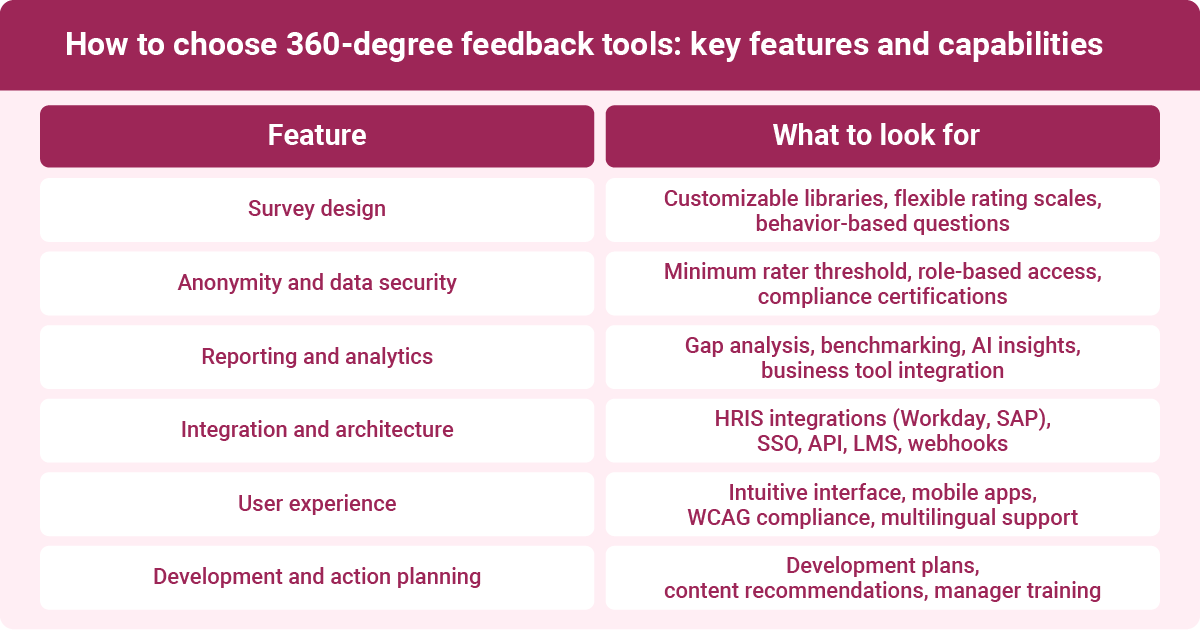
Choosing the right tools for feedback matters. The best 360-degree feedback software combines ease of use with robust analytics and seamless integration into existing workflows.
Workhuman’s Conversations® stands out here. Employees who receive valuable peer feedback through platforms like this are five times more likely to be engaged, according to Gallup and Workhuman research, “The Human-Centered Workplace: Building Organizational Cultures That Thrive”
And those who receive it consistently are 57% less likely to experience burnout.
Other platforms worth considering include Workday for enterprise-level performance management integration, and SurveyMonkey for organizations looking for a more lightweight, customizable survey solution.
Common challenges in implementing 360-degree feedback process
Even well-designed 360-degree feedback programs run into obstacles. Knowing what to expect and how to respond makes the difference between a process that drives growth and one that quietly loses momentum.
Addressing feedback bias and negativity
360-degree feedback bias is one of the most persistent challenges organizations face.
Fortunately, the Workhuman scientific guide to workplace bias identifies over 50 cognitive biases that can influence how people evaluate others. For example, that can include recency bias, where raters overweight recent events.
Managing resistance to feedback
Some employees resist giving feedback because they fear it’ll damage relationships. Others resist receiving it because it feels threatening.
Both forms of resistance are normal, and both can be addressed with the right culture and communication.
Time and resources needed for 360-degree feedback
For large organizations, the logistics of running a 360-degree feedback tool process across hundreds or thousands of employees can be significant. Survey design, rater selection, data collection, and follow-up conversations all take time.
Automation is the most effective way to manage this. As such, utilize platforms like Conversations® to handle the administrative heavy-lifting (i.e., scheduling, reminders, data aggregation, and reporting) so HR teams can focus on the conversations that matter.
Conclusion
360-degree feedback works best when it’s built on trust, supported by the right tools, and treated as an ongoing conversation rather than a one-time event.
Whether you’re an employee looking to grow or an organization building a stronger performance culture, the principles are the same:
Gather honest input from multiple perspectives, act on what you learn, and keep the feedback flowing. Remember to customize your approach to fit your team’s needs and revisit it regularly as those needs evolve.

Ryan Stoltz
Ryan is a search marketing manager and content strategist at Workhuman where he writes on the next evolution of the workplace. Outside of the workplace, he's a diehard 49ers fan, comedy junkie, and has trouble avoiding sweets on a nightly basis.
Recommended for you