Workhuman vs. Awardco: The 2026 Employee Recognition Comparison Guide
Table of contents
- Workhuman vs. Awardco Platform Overview
- Feature Comparison: Workhuman vs. Awardco
- Recognition & Culture Building
- Integrations & Tech Ecosystem Fit
- Pricing & Cost-Effectiveness
- Impact on Engagement, Retention, and Morale
- AI and Product Innovation
- Global Reach and Capabilities
- Customer Support
- Ease of Use & Implementation
- Workhuman vs. Awardco: Strengths & Weaknesses
- Workhuman vs. Awardco: What Customers Say
- Workhuman vs. Awardco: Final Verdict
Employee recognition software has evolved from a feel-good perk into a critical system for driving engagement, retention, and performance at scale.
As organizations are under increasing pressure to do more with fewer resources — and to clearly prove ROI on people investments — recognition platforms are expected to deliver far more than points and prizes. They need to integrate seamlessly into daily work, drive sustained participation, and generate insights leaders can actually use.
That’s why Workhuman and Awardco are so often compared. Both platforms enable peer-to-peer recognition and rewards, and both support broad participation across organizations.
But the similarities largely stop there. The two platforms differ meaningfully in how recognition is designed, how deeply it connects to company values and culture, and what kind of data and insight leaders gain from recognition activity over time.
For organizations evaluating these options, the real question isn’t just which platform recognizes more people, but which one turns recognition into a long-term cultural and business advantage.
This guide breaks down how Workhuman and Awardco compare — so leaders can choose the platform that best aligns with their culture goals, scale requirements, and expectations for measurable impact.
Workhuman vs. Awardco Platform Overview
Workhuman at a Glance
- World’s #1 employee recognition platform, pioneering the category more than 25 years ago and operating at 3× the scale of its nearest competitor
- Trusted by 7+ million users at the world’s most iconic brands to run recognition programs that deliver measurable business impact
- Only recognition provider with an ROI Guarantee, backed by documented customer proof showing increased retention, higher eNPS, and stronger engagement
- End-to-end recognition experience — never outsourced, from recognition through redemption and customer support
- AI-native platform powered by one of the world’s largest global rewards marketplaces, offering:
- Millions of reward options
- Locally curated catalogs in 150+ countries
- Native mobile apps
- 24/7 human support in dozens of languages
- Unrivaled in-house customer support, complemented by specialized consulting teams of former HR leaders, data scientists, and recognition experts
- Proprietary Workhuman iQ platform transforms rich recognition data into real-time insights on skills, culture, and performance, branded as Human Intelligence™
- Enterprise-grade security and seamless, certified integrations with Workday, Microsoft Teams, Slack, and Outlook
- Proven at scale for Fortune 500 and fast-growing mid-market organizations — and the only platform consistently shown to drive business outcomes that matter
Awardco at a Glance
- Founded in 2015, with a primary focus on reward distribution, not long-term culture transformation
- Recognition is largely points-driven and transactional, serving as a trigger to issue rewards rather than a mechanism to reinforce values or behaviors
- Emphasizes budget controls and administrative efficiency over strategic insight
- Limited ability to surface meaningful data about:
- How work gets done
- Which behaviors are being reinforced
- Where collaboration, leadership, or skills are emerging
- Limited support for global equity at scale, with rewards and value perception varying by country due to reliance on external marketplaces and currency-based models rather than a built-for-purpose global standard
At a basic level, both Awardco and Workhuman enable employees to send recognition and redeem rewards. But the similarity is largely functional, not foundational.
Feature Comparison: Workhuman vs. Awardco


Recognition & Culture Building
Workhuman
- Built on the science of recognition, with more than 25 years of research and real-world data informing how recognition drives behavior, belonging, and performance.
- Recognition is directly mapped to company values and success behaviors, helping employees clearly understand what matters and why it’s being recognized.
- Public, social recognition creates shared visibility, reinforcing cultural norms and a consistent understanding of “what good looks like” across the organization.
- AI Advisors improve recognition quality in the moment, helping messages be more specific, inclusive, and meaningful without adding effort for employees.
- Designed to deliver lasting cultural impact, with strong evidence linking recognition to higher engagement, stronger belonging, improved retention, and increased performance outcomes.
- AI embedded throughout the platform that hyper-personalizes the user experience, that produces the highest-impact recognition for givers and receivers, generates and mines unparalleled data to deliver break-through talent insights.
Awardco
- Recognition is primarily peer-to-peer and milestone-based, with an emphasis on participation and frequency.
- Recognition activity can be high, but messages often lack depth — focusing more on points and transactions than on values, behaviors, or cultural reinforcement.
- Limited mechanisms to guide or improve recognition quality in the moment, resulting in more generic recognition over time.
- Culture-building relies largely on volume rather than intentional reinforcement of what the organization wants more of.
- Better suited for driving recognition activity than for shaping culture in a deliberate, measurable way.
Integrations & Tech Ecosystem Fit
Workhuman
- Deep, enterprise-grade integrations, including Workday and SAP, designed to support clean data flow, high adoption, and long-term scalability.
- Strong Slack, Microsoft Teams, Viva, and Outlook integrations that embed recognition naturally into daily work — making it easy for employees to participate without changing behavior.
- Through integrations with LinkedIn and Viva Engage, employees can share recognition moments to extend reach beyond the platform, fueling greater emotional impact and increasing employer brand.
- Built for complex, global HR environments, where data accuracy, global equity, governance, compliance, and robust analytics matter.
- Integrations designed for outcomes, not just check-the-box connections — ensuring recognition data can actually be leveraged with other data sources for reporting, insight, and decision-making.
Awardco
- Offers surface-level integrations with tools like Slack, Teams, and HRIS platforms, primarily to support basic recognition actions.
- Integrations function largely as triggers and pass-throughs, with minimal depth beyond initiating or approving rewards.
- Recognition data flowing through integrations is thin and transactional, limiting its usefulness for reporting, analytics, or insight.
- Heavy reliance on standardized, one-size-fits-all integrations restricts flexibility as organizations mature or scale.
- As integration needs grow — especially around data, governance, and analytics — Awardco's ecosystem often becomes a constraint rather than an asset.
Pricing & Cost-Effectiveness
Workhuman
- Custom pricing designed for mid-market and enterprise organizations, reflecting program scale, global reach, and long-term impact rather than one-size-fits-all packaging.
- Shared success model that aligns Workhuman with the success of your program.
- All-inclusive pricing, includes:
- Unlimited access and use of the full Workhuman platform (no per user pricing)
- Dedicated Customer Success Manager
- Consultants with deep industry and recognition expertise
- In-house technical and Store support
- This approach helps organizations avoid missteps, launch effectively, and maximize value over time — eliminating hidden costs and rework.
- Reward value planning supported by experts, particularly for global programs, ensuring budgets are used efficiently and equitably rather than relying on guesswork.
- Cost effectiveness improves over time, as insights, adoption, and cultural impact compound without requiring additional tools or headcount.
Awardco
- Pricing is positioned as simple and transparent, primarily tied to reward spend and platform access — which masks the true cost of running an effective program.
- As program needs grow, costs increase linearly with usage — without any corresponding increase in intelligence, effectiveness, or ROI.
- Minimal built-in guidance shifts responsibility to internal teams to:
- Design and refine recognition programs
- Troubleshoot adoption issues
- Curate rewards catalogs
- Manage global inconsistencies and equity gaps
- Build reporting workarounds outside the platform
- What looks “cheaper” on paper often results in higher operational cost, more manual effort, and weaker long-term returns.
Impact on Engagement, Retention, and Morale
Workhuman
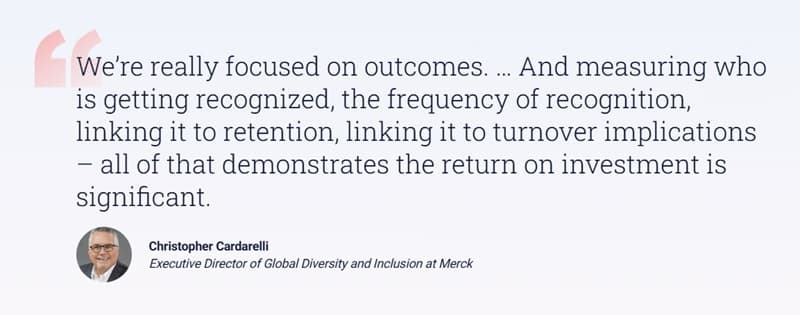
- Strong, research-based link between recognition and business outcomes, including higher engagement, stronger retention, improved employee performance, increased safety rates, and higher revenue production.
- Values-based recognition reinforces the behaviors leaders want repeated, helping culture show up consistently across teams, locations, and managers.
- Recognition is social and visible, increasing morale by making appreciation public, reinforcing a sense of belonging, and inspiring broad adoption of role-modeled behaviors.
- Recognition data goes beyond activity counts, fueling insight into what motivates employees, where engagement is strong, where and how the best work is happening, and where additional support is needed.
- Long-term impact compounds over time, as recognition patterns inform leadership decisions, talent development, and culture strategy — not just short-term participation.
Awardco
- Success is often framed around recognition frequency and adoption rates, positioning volume of activity as the primary indicator of impact.
- Engagement and morale are typically inferred from surface metrics such as:
- Recognitions sent
- Logins
- Rewards redeemed
- Limited connection between recognition activity and deeper outcomes like sustained engagement, retention, or performance improvement.
- Recognition data provides visibility into usage, but little insight into why morale is rising or falling, or which behaviors are driving results.
- Impact tends to plateau over time, as increased activity does not necessarily translate into stronger culture, belonging, or long-term retention.
AI and Product Innovation
Workhuman
- Market-leading AI innovation rooted in recognition science, backed by decades of research and one of the largest, richest recognition datasets in the world.
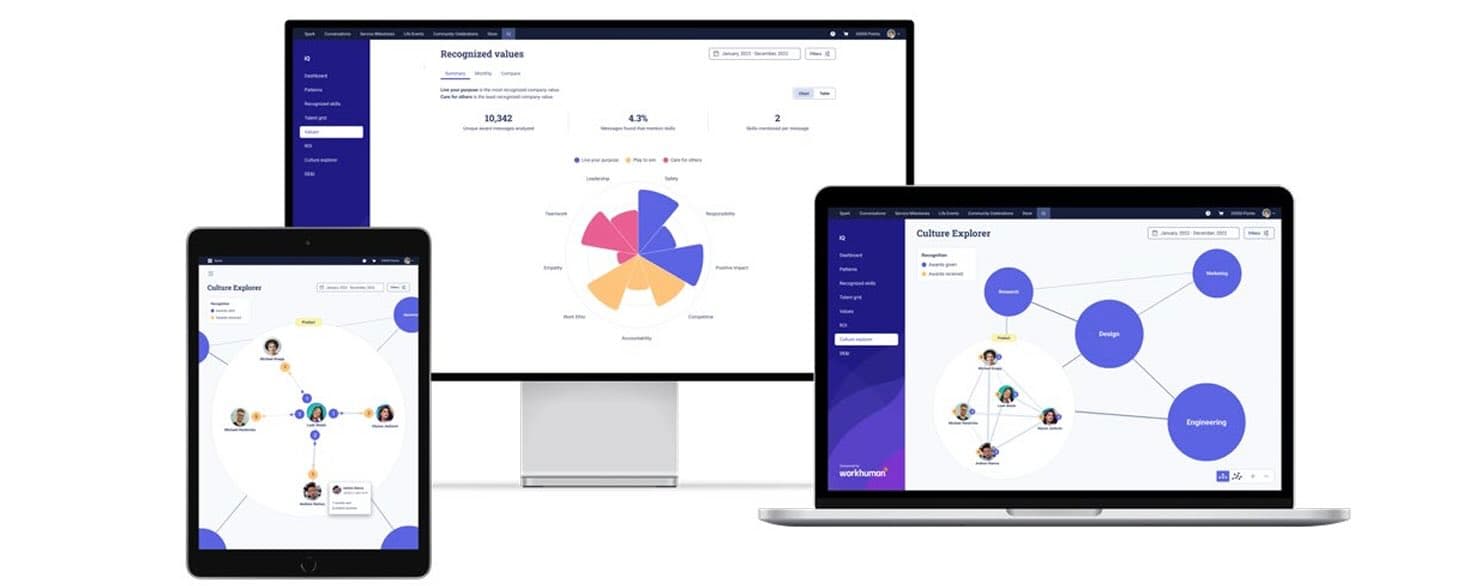
- Workhuman iQ (WHIQ) transforms everyday recognition into Human Intelligence™—the industry’s first recognition-based people analytics capability—turning recognition activity into insight leaders can actually use, supported by an AI assistant designed specifically to answer people and culture questions.
- AI improves recognition quality at scale, with market-leading built-in Advisors—including the first real-time bias detection for recognition—helping employees write more meaningful, specific, and inclusive recognition messages in the moment.
- Talent and skills intelligence surfaced automatically, using a recognition-specific language model to identify emerging skills, strengths, and capability trends across teams—without self-reporting or manual tagging.
- Culture and behavior insights built in, showing which values are truly being reinforced, where recognition is happening, and where gaps exist.
- Business impact and ROI visibility, connecting recognition patterns to outcomes like engagement, retention, and performance.
- Global intelligence embedded, including AI-supported SOLI™, ensuring rewards have equal value worldwide — without manual intervention.
- Designed to reduce admin effort, with AI working quietly in the background to surface insights without extra setup, analysis, or reporting work.
Awardco
- Product innovation is primarily focused on driving participation and simplifying reward delivery, rather than advancing recognition intelligence.
- Technology is used mainly to support standard workflows such as peer recognition, milestones, and reward fulfillment.
- Analytics are largely descriptive, centered on:
- Recognition volume
- Program usage
- Reward spend
- Limited application of AI to improve recognition quality, surface behavioral insight, or translate recognition data into talent, culture, or business intelligence.
- Recognition data is not structured or leveraged in a way that supports skills intelligence, culture diagnostics, or strategic decision-making.
- As a result, recognition remains an operational system, not an intelligence layer leaders can learn from.
Global Reach and Capabilities
Workhuman
- Curated global store with millions of globally sourced merchandise options, plus gift cards, swag, and experiences—designed to feel personal and meaningful everywhere employees work.
- The platform hosts one of the world's largest global rewards marketplaces, with higher satisfaction rates than Amazon.
- Key operational features include:
- 24/7 human support in dozens of languages.
- 95%+ redemption and satisfaction rate.
- Native mobile apps.
- Equitable, locally relevant rewards across 150+ countries.
- SOLI (Standard of Living Index, co-developed with Mercer) ensures rewards have equal value across countries, delivering fairness and consistency beyond simple currency conversion.
- Partnerships with Amazon and hundreds of other leading providers delivers unmatched choice and purchasing power while maintaining a high-quality, curated global experience.
Awardco
- Global rewards are available, but experiences vary significantly by country and region.
- Equity mechanisms such as purchasing parity are not automatic and often require manual configuration or special requests.
- Heavy reliance on external marketplaces creates inconsistency in:
- Reward value perception
- Local relevance
- Overall employee experience
- Limited built-in systems to ensure fairness and consistency at scale, especially as programs expand globally.
- Global reach exists functionally, but global equity and experience consistency are not engineered into the platform.
Customer Support
Workhuman
- Dedicated Customer Success Manager and consulting support, including a Workhuman IQ team of data scientists, researchers, industrial-organization psychologists, linguists, and researchers who measure the business impact of a client’s recognition program activity and investment.
- Shared success model focused on outcomes
- Unlimited support and service delivered at no additional charge
- Store and fulfillment support handled in-house rather than outsourced to third parties
Awardco
- Standard customer support model focused on platform usage and issue resolution.
- Limited access to strategic consulting or data-driven guidance beyond initial setup.
- Greater reliance on external partners for fulfillment, introducing handoffs and variability in the support experience.
- Ongoing success is largely dependent on internal teams to optimize, evolve, and prove value over time.
Ease of Use & Implementation
Workhuman
- Easy for employees and leaders to use from day one, with recognition embedded directly into everyday workflows like Slack, Teams, and Outlook.
- Straightforward to implement, even at enterprise scale, with proven rollout frameworks designed to get programs live quickly and correctly.
- Shared success model, meaning Workhuman partners with you throughout implementation and beyond — ensuring your program launches strong and continues to deliver value over time.
- Dedicated support team included, with a Customer Success Manager, experienced consultants, and in-house technical and Store support to guide setup, adoption, and ongoing optimization.
- Simple to manage, with minimal ongoing administration required and no need for constant reconfiguration.
Awardco
- Easy to navigate at a surface level, but simplicity is largely limited to basic recognition and reward actions.
- Implementation is relatively lightweight upfront — but offers limited strategic guidance, leaving organizations to figure out program design, rollout strategy, and optimization on their own.
- Administrative experience becomes increasingly cumbersome as complexity grows:
- Limited segmentation by role, geography, or business unit
- Manual workarounds required to manage multiple programs or regions
- Global tax handling, compliance, and localization introduce significant operational burden, often falling entirely on internal HR, finance, and legal teams.
- Customization options for admin messaging, homepage content, and targeted communications are constrained, reducing agility and relevance over time.
- What initially feels “easy” often translates into more manual effort, more internal dependency, and more friction as programs scale.
Workhuman vs. Awardco: Strengths & Weaknesses
Workhuman Strengths
- World’s #1 employee recognition platform with the only ROI Guarantee in the industry. Over 7 million users with 3x the scale of its nearest competitor.
- Real-time reporting + AI intelligence through Workhuman iQ, giving leaders immediate visibility into culture trends, collaboration patterns, skills, and performance signals.
- Highly customizable platform with flexible branding, UI layouts, workflows, and cultural content — no long request cycles required.
- One of the world’s largest global rewards marketplaces which provides a consumer grade user experience with millions of options and locally curated catalogues in over 150 countries. The marketplace features 24/7 human support in dozens of languages, native mobile apps, and boasts a 90%+ redemption and satisfaction rate
- Meaningful and inclusive recognition powered by the Advisor Suite (Inclusion Advisor, Recognition Advisor, Award Advisor), improving message quality and emotional impact.
- Global reward equity with SOLI™, ensuring employees worldwide receive rewards of equal value based on real purchasing power.
- Exceptional customer satisfaction, NPS, and renewal rates, reinforced by enterprise-scale implementations and long-term success.
- In-house customer support, complemented by specialized consulting teams of former HR leaders and data scientists
- Deep, purpose-built integrations focused on adoption, clean data, and strategic use of recognition insights.
Workhuman Weaknesses
- Best suited for organizations seeking strategic, culture-building recognition, not for those wanting a simple gift-card shop.
- The partnership model includes consultation and coaching, which some buyers may view as more robust than necessary.
Awardco Strengths
- Simple points-and-redemption structure that’s easy to use, but offers little beyond a standard ecommerce-style experience.
- Amazon partnership offers broad product availability, but largely replicates an off-the-shelf ecommerce experience rather than delivering a differentiated or meaningful recognition journey.
- Meets minimum requirements for organizations with very basic recognition expectations and no need for intelligence, customization, or scale.
Awardco Weaknesses
- High perceived pricing, with users reporting overpriced rewards and inflexible pricing structures.
- Confusing points system with limited transparency into value and redemption.
- Limited product search functionality, making it harder for employees to find what they want quickly.
- Manual or shallow integrations, especially with Slack and Workday, requiring IT teams to maintain basic connectivity.
- No global equity system like SOLI™, so international programs may feel inconsistent.
- Limited analytics and minimal insight beyond transactional reporting.
Workhuman vs. Awardco: What Customers Say
- Workhuman is the #1 ranked provider in G2’s Enterprise Grid® Report for Employee Recognition (Winter 2024), with the largest market presence and highest customer satisfaction in the category
- 97% of verified G2 reviewers rated Workhuman Social Recognition 4 or 5 stars; 96% believe it’s headed in the right direction
- Workhuman is ranked #10 in G2’s Best Software Products 2025, placing it in the top 1% of all vendors on G2
Customer Feedback & Quotes
Workhuman:
- “This program is honestly one of the best I have ever used. Our prior software at my job was clumsy, and [Workhuman] is just so much easier.” (G2 Enterprise Reviewer)
- “We are committed to creating a workplace where everyone can do their best work and feels valued and respected for their contributions. Workhuman’s platform and best practices fully support our needs in this objective!” (G2 Enterprise Reviewer)
- “One of my favorite things (about Workhuman) that I saw recently was kind of the overarching AI that suggests tone of messages that are being drafted by a peer or a leader.” - Workhuman user
- “Workhuman is probably leading the edge on the inclusive side of things... their unconscious bias tools were sort of, people have followed suit from them, introducing that.” - Workhuman customer
- “Workhuman’s data and analytics, along with its cost-effective pricing model, provide customers with the ability to evaluate program performance accurately and quickly. This ensures program success and aligns with their business growth.”- Workhuman buyer
Awardco:
- "Awardco lacks that 'extra' element that other programs capture really well. While you can recognize peers, you can't add those extra personalized touches with GIFs and emojis. The overall UI of Awardco is lackluster. Compared to others, the branding, company voice, and personality is missing." – Verified G2 User
- "We were promised hundreds of reward options but ended up with maybe 20-30 actually useful choices." – G2 Review
- "The system is down more often than it's up, which kills employee enthusiasm for the recognition program." – G2 Review
- Complex navigation: Multiple G2 reviews mention that the platform requires extensive training and has a steep learning curve that reduces organic adoption rates.
- Enterprise customers frequently mention 6-12 month implementation timelines with extensive change management requirements that strain internal resources.
Workhuman vs. Awardco: Final Verdict
Both Workhuman and Awardco support frequent recognition and broad participation. The real decision comes down to what you need recognition to deliver over time — not just at launch, but as your organization scales, globalizes, and expects proof of impact.
Choose Workhuman if:
You want recognition that’s easy for employees and leaders — without creating work for HR.
Workhuman is designed to live in the flow of work, driving high adoption while reducing manual effort for administrators.
You want fast, proven deployment with minimal long-term administration.
Workhuman deploys smoothly at enterprise scale and continues to run reliably without constant reconfiguration, manual reporting, or workaround-heavy management.
You want recognition to drive outcomes — not just activity.
Workhuman transforms everyday recognition into insight on culture, behaviors, skills, engagement, and performance, giving leaders data they can actually act on.
You want a trusted market leader that works at scale.
Workhuman is proven across global, regulated, and complex organizations — delivering consistency without sacrificing depth or flexibility.
You run on Workday or a modern HR stack and expect clean, usable data.
Workhuman’s integrations are built for adoption, governance, and downstream insight — not just surface-level connectivity.
You want to extend your team, not burden it.
With Workhuman, you don’t just get software — you get an embedded partnership:
- A dedicated Customer Success Manager
- Consultants with deep recognition and industry expertise
- In-house technical and Store support (not outsourced) — This model reduces risk, accelerates value, and avoids the need to add internal headcount just to keep the program running.
Choose Awardco if:
You primarily want a reward distribution system.
Awardco works best when recognition is treated as a trigger for points and redemption rather than a tool for shaping culture or behavior.
You prefer a simple, transactional model over strategic depth.
The platform is optimized for ease and familiarity, not for insight, intelligence, or long-term evolution.
You’re focused on short-term engagement signals.
Awardco emphasizes participation rates, reward usage, and spend visibility — which may be sufficient if usage is the primary success metric.
You have basic recognition needs and limited expectations for customization, analytics, or global equity.
Awardco can meet minimum requirements, but becomes more constrained as programs grow in complexity or scale.
Final Verdict
Both Workhuman and Awardco can support frequent recognition and be rolled out across organizations.
The difference shows up after launch.
Workhuman is easy to implement and easy to sustain — but it goes deeper. Recognition is intuitive for employees, embedded into daily work, and intentionally designed to generate insight, engagement, and long-term cultural impact. Leaders gain visibility into behaviors, skills, collaboration, and business outcomes — not just usage.
Awardco focuses on distributing rewards efficiently. But once programs are live, organizations often encounter limitations: recognition remains transactional, insight is limited to activity and spend, customization is constrained, and administrative effort increases as complexity grows. Over time, this can cap impact and make it harder to demonstrate real value beyond participation.
Bottom line
- Workhuman delivers efficiency plus insight and sustained impact.
- Awardco delivers rewards — with limited depth and diminishing strategic value over time.
See also:
Workhuman vs. Achievers: Which Employee Recognition Platform Is Better for Your Organization?
About the author
Ryan Stoltz
Ryan is a search marketing manager and content strategist at Workhuman where he writes on the next evolution of the workplace. Outside of the workplace, he's a diehard 49ers fan, comedy junkie, and has trouble avoiding sweets on a nightly basis.