
Workhuman vs. Achievers: Which Employee Recognition Platform Is Better for Your Organization in 2026?
by Ryan Stoltz
5 min read

Table of contents
- Workhuman vs. Achievers Platform Overview
- Feature Comparison: Workhuman vs. Achievers
- Recognition & Culture Building
- Integrations & Tech Ecosystem Fit
- Pricing & Cost-Effectiveness
- Impact on Engagement, Retention, and Morale
- AI and Product Innovation
- Global Reach and Capabilities
- Customer Support
- Ease of Use & Implementation
- Workhuman vs. Achievers: Strengths & Weaknesses
- Workhuman vs. Achievers: What Customers Say
- Workhuman vs. Achievers: Which Platform Is Better for Your Organization?
Share this article
Employee recognition software has moved from “nice to have” to a core part of how organizations drive engagement, retention, and performance. As leaders are asked to do more with less — and prove ROI on people investments — recognition platforms are expected to deliver more than feel-good moments. They need to scale, integrate cleanly, and produce insight leaders can act on.
That’s why Workhuman and Achievers are so often compared. Both platforms support global recognition and rewards. Both promise strong participation. But they differ in how recognition works, what data it produces, and what leaders can do with it over time.
Companies evaluating recognition platforms typically want to know whether Workhuman’s culture-focused, values-driven approach or Achievers’ more structured, reward-centric approach is the better fit. This guide breaks down the differences so organizations can decide with confidence.
Workhuman vs. Achievers Platform Overview
Workhuman at a Glance
Achievers at a Glance
- Founded in 2002, serving mid-market and enterprise organizations
- Recognition platform centered on points, e-thanks, and reward redemption
- Emphasizes consistency, participation rates, and standard recognition structures
At a high level, both platforms support frequent recognition and strong adoption.
The difference lies in what that recognition is designed to produce. Workhuman focuses on using employee recognition to catalyze culture, increase employee engagement and productivity, and generate people and business insights. Achievers focuses on driving user adoption of recognition.
Feature Comparison: Workhuman vs. Achievers

Recognition & Culture Building
Workhuman
Achievers
- Recognition is peer-to-peer and milestone-driven, with a strong emphasis on frequency and low-value “thank yous.”
- Recognition activity is often high, but messages tend to emphasize participation and points more than values, behaviors, or cultural reinforcement.
- Emphasizes non-monetary recognition to drive participation, despite research indicating it has minimal impact on sustained morale or business outcomes on its own.
Integrations & Tech Ecosystem Fit
Workhuman
Achievers
- Integrates with common workplace tools like Slack, Teams, and major HRIS platforms, supporting basic connectivity requirements.
- Frequently highlights its Workday Platinum Partner status, which reflects a commercial revenue-sharing relationship rather than deeper or more effective integration capabilities.
- Integrations are largely standardized, which can simplify setup but also limit flexibility in how data is used, extended, or analyzed over time.
- Supports core connectivity needs well, but can be more constrained as organizations require deeper integration, data usage, and scalability.
Pricing & Cost-Effectiveness
Workhuman
Achievers
- Pricing is structured around employees, awards, and activity, which can make costs easier to estimate upfront — but also requires upfront licensing for all employees, regardless of how much or little is actually used, limiting flexibility as programs evolve or scale.
- Often appears more budget-friendly at the start, particularly for organizations focused on simple reward distribution — but this comparison typically reflects software and reward costs only, not total cost of ownership, nor long-term effectiveness or outcomes.
- Lower upfront cost often shifts effort and responsibility internally, as teams take on more work related to reporting, customization workarounds, global complexity, and ongoing optimization — without the same level of built-in guidance or partnership. After-sale change management ends up to be a huge un-planned cost.
- Per user per month pricing does not incentivize usage, adoption or shared success.
Impact on Engagement, Retention, and Morale
Workhuman


“We’re really focused on outcomes. … And measuring who is getting recognized, the frequency of recognition, linking it to retention, linking it to turnover implications – all of that demonstrates the return on investment is significant.”
Achievers
- Frequently highlights high recognition frequency and adoption rates, positioning volume of recognition as a primary indicator of success, often driven by e-thanks only, low-value activity, limiting impact and insight.
- Impact is often measured through participation metrics, such as logins, recognitions sent, or rewards redeemed.
- Less emphasis on connecting recognition to deeper cultural or business outcomes, making it harder to assess long-term impact beyond usage levels.
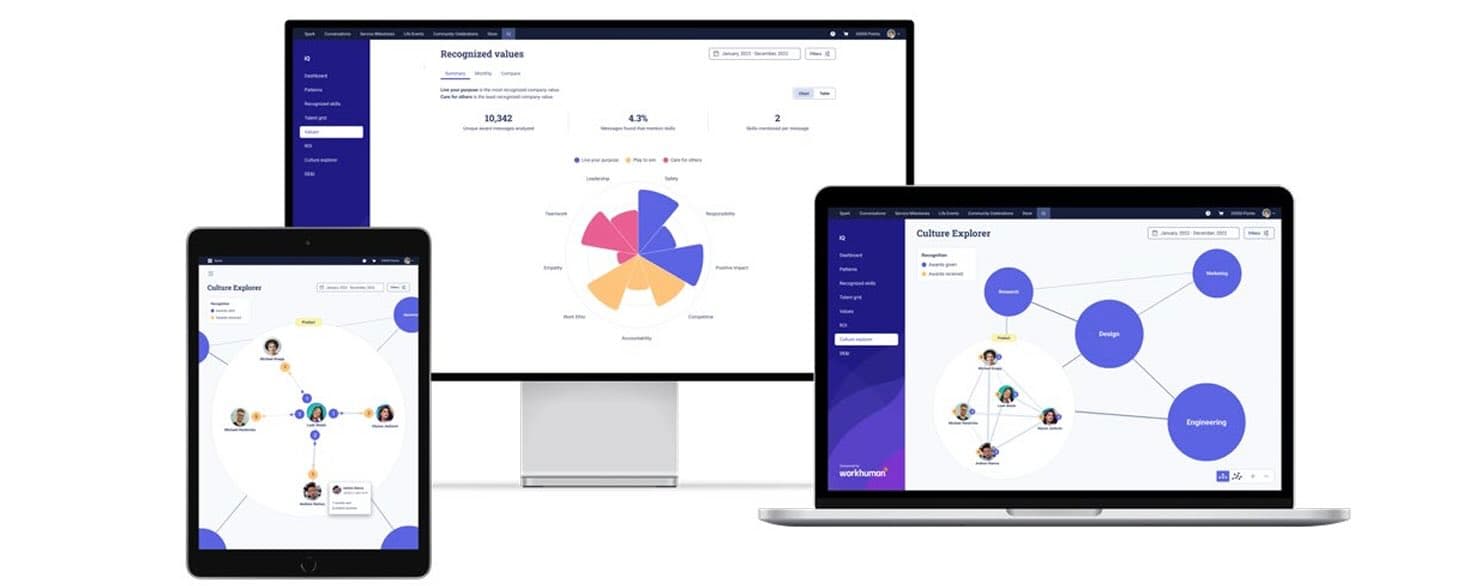
AI and Product Innovation
Workhuman
Achievers
- Product innovation focused on participation and consistency, with enhancements aimed at driving frequent recognition activity.
- Technology used primarily to support standard use cases, such as peer recognition, milestones, and non-monetary recognition.
- Limited use of recognition data for deeper insight, with analytics largely centered on participation, usage, and program activity.
- Less emphasis on translating recognition into talent, culture, or business intelligence, making it harder to use recognition data strategically.
Global Reach and Capabilities
Workhuman
Achievers
- Global rewards available but limited in many countries and regions
- Purchasing parity available by request, not automatic
- Less emphasis on built-in equity mechanisms
Customer Support
Workhuman
Achievers
- Standard customer support model
- Less emphasis on long-term consulting partnership
- Program changes and support delivered at additional cost
Ease of Use & Implementation
Workhuman
Achievers
- Generally easy to navigate, with a clean interface that helps admins understand where to go and how to complete basic tasks.
- Integrates with common workplace tools (e.g., Workday, Outlook, Teams), supporting standard enterprise environments without heavy customization.
- Admin views can feel overwhelming, with limited filtering by role, location, or function, requiring additional setup or workarounds to manage effectively.
- Global tax handling requires significant internal effort, particularly for organizations operating across multiple countries.
- Customization for admin messaging and homepage content is limited, reducing flexibility to communicate timely or targeted messages to employees.
- Spending controls are predictable, which can be helpful for finance teams, but this structure can limit flexibility in how recognition is used over time.
Workhuman vs. Achievers: Strengths & Weaknesses
Workhuman Strengths
Workhuman Weaknesses
- Best suited for organizations seeking strategic, culture-building recognition, not for those wanting a simple gift-card shop.
- The partnership model includes consultation and coaching, which some buyers may view as more robust than necessary.
Achievers Strengths
- Simple, intuitive user experience based on a familiar “earn points, redeem points” structure.
- Strong orientation toward reward redemption, which appeals to organizations focused on quick “check the box” initiatives.
- Sufficient core features for companies with basic recognition needs or smaller-scale programs.
- Workday “Platinum Partner” badge, which can appear attractive at first glance (explained neutrally below).
Achievers Weaknesses
- Reporting limitations, including delayed custom reporting, no real-time insights, and difficulty tracing recognition to business outcomes.
- Restricted customization, often requiring tickets for layout, graphic, or UI changes. Customers are able to do custom branding on their own (logo and color line under it)
- Recognition can feel transactional, with high point thresholds and a redemptions-first mindset.
- Lower customer satisfaction, with common feedback around reporting, customization, and the transactional feel.
- Workday Platinum badge is commercial—not technical (details below), and does not indicate integration depth or product quality.
- Hidden costs associated with program support, change management, and custom reporting.
Workhuman vs. Achievers: What Customers Say
Customer Feedback & Quotes
Workhuman:
Achievers:
- “Relying heavily on rewards can make recognition seem transactional. The rate of rewards doesn't match our currency, i.e. around 1200+ points make a Rs.1000.” (G2 Review)
- Users of Achievers consistently review the platform as highly transactional which lessens the impact of recognition.
- Achievers’ reporting and analytics capabilities are inferior to Workhuman’s abilities. The lack of data & analytics means that former Achievers customers could not highlight the lack of impact early on when it could be addressed.
Workhuman vs. Achievers: Which Platform Is Better for Your Organization?
Both Workhuman and Achievers support frequent recognition and broad participation. The right choice depends on what you need recognition to deliver — not just at launch, but as your organization grows and priorities shift.
Choose Workhuman if:
Choose Achievers if:
- You want a highly standardized recognition program with fixed award structures. Achievers is designed around consistent, predefined recognition patterns that reduce variation across teams.
- You prefer a rewards-led model where recognition is closely tied to points and redemption. This can work well when the primary goal is consistency and reward usage.
- You value a broader but lighter set of engagement tools over deeper insight from recognition itself. Achievers’ additional modules may appeal to teams looking for multiple use cases in one platform, with less emphasis on analytics depth or long-term evolution.
Final Verdict
Both Workhuman and Achievers are designed to support frequent recognition and can be rolled out at scale.
The difference is how well the platform performs once it’s live.
Achievers focuses primarily on administering recognition programs efficiently, but customers often cite friction once programs are in motion. Reviews frequently point to a dated, hard-to-navigate interface, limited reward variety, inconsistent point values, and weaker integrations with core HR systems. Reporting and insights tend to be basic, and administrative complexity can increase over time—contributing to lower adoption and engagement than intended.
Bottom line
For organizations evaluating employee engagement platforms, the choice comes down to outcomes:
Workhuman delivers efficiency plus insight and impact. Achievers delivers consistency, but with more friction and less depth over time.
See also:
Workhuman vs. Awardco: The 2026 Employee Recognition Comparison Guide
Workhuman vs. Bonusly Comparison
Nectar vs Workhuman software review

Ryan Stoltz
Ryan is a search marketing manager and content strategist at Workhuman where he writes on the next evolution of the workplace. Outside of the workplace, he's a diehard 49ers fan, comedy junkie, and has trouble avoiding sweets on a nightly basis.
Recommended for you