
Workforce Agility: 5 Steps Toward a More Agile Workplace
Last updated
5 min read

Table of contents
- What is workforce agility?
- Benefits of agile organizations
- How to build an agile workforce: 5 steps to make meaningful progress
- The bottom line
Share this article
“Be more agile” has become one of the most common directives for modern workers.
Leaders see workforce agility as essential for maintaining performance, engagement, and growth amid AI shifts, labor shortages, and volatility. In fact, Deloitte’s 2025 Global Human Capital TrendsOpens in a new tab report found 85% of executives say their organizations need to create more agile ways of working. On the flip-side, they found 75% of workers say they want stability – a tension that HR sits dead center in.
In practice, HR leaders are navigating change fatigue and career anxiety, incomplete or low‑quality skills and mobility data, and limited, hard‑to‑use agility metrics.
Let's get into what a more agile workforce looks like, and how you can foster agile transformations in your workplace – with a few surprising ways recognition can help.
What is workforce agility?
Workforce agility is your employees' ability to responding to changing business goals or needs – shifting roles, quickly redeploy skills, and reconfigure how work gets done without disruption to performance.
As a management concept, workforce agility has its roots in software and technology – a direct response to digital transformation. The agile methodology spread as executives saw product and technology teams delivering faster, responding better to customers, and innovating more.
In today's workforce, the conversation has shifted from time‑bound “agile initiatives” to agile skill sets, building agile teams, and developing agile workers.

Benefits of agile organizations
Organizations that embed agility across the enterprise consistently outperform their peersOpens in a new tab, including higher returns on invested capital and equity.
Performance, efficiency, and competitiveness
In agile organizations, people and work are organized around outcomes rather than job descriptions. Teams are skills- and capacity-informed, allowing employee resources to be reallocated quickly as needs evolve.
These flexible structures streamline workflows, reduce bottlenecks, and increase operational efficiency, minimizing downtime when priorities shift. At scale, increased productivity steams from agile performance management – regular check-ins and continuous feedback.
Innovation, resilience, and adaptability
Agile organizations foster psychological safety, enabling creativity, experimentation, and smart risk-taking – especially when addressing new challenges. Cross-team collaboration builds resilience and supports faster innovation and pivots in response to market shifts or technological disruption.
Agile leaders encourage idea-sharing and continuous skill development, particularly in critical “power skills” such as adaptability and resilience. By empowering employees with autonomy and decision-making authority at the appropriate level, organizations reduce unnecessary approval layers and enable faster, better-informed decisions by teams closest to the work.
Engagement, retention, and talent improvements
Flexible, skills-based roles make work more meaningful and engaging, improving employee satisfaction, retention, and the ability to attract top talent – especially during labor shortages.
Internal mobility, continuous learning, and cross-training aligned to emerging skill gaps and technologies help both employees and organizations stay competitive in dynamic job markets.
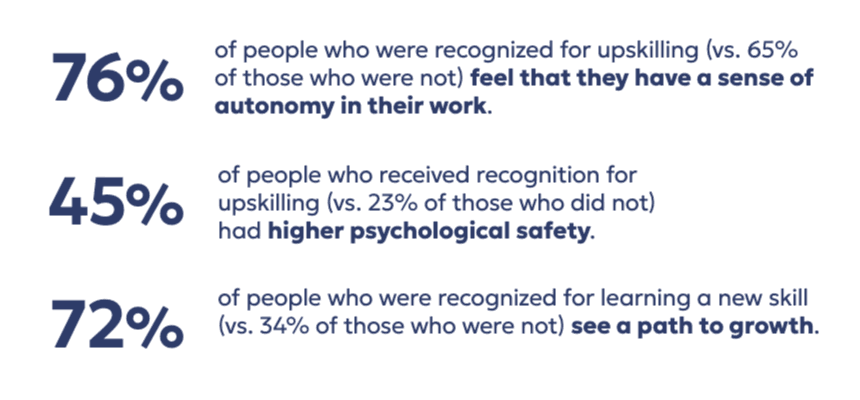
How to build an agile workforce: 5 steps to make meaningful progress
The organizations making real progress treat agility as a system, not an initiative. Strategy, skills, performance, recognition, and ways of working evolve together, in small, deliberate steps.
Here’s a realistic place to start.
1. Clarify the outcome
Decide what agility needs to improve for your business right now – Are you prioritizing faster redeployment? Internal mobility? Quicker reskilling?
Translate that into 3–5 measurable outcomes that guide decisions, align teams, and that HR can influence. Turn them into measurable goals, like:
- Upskilling for priority skills: Run 2-week sprints to close a critical gap (e.g., AI tools), tracking completion rates and application in projects.
- Internal mobility marketplace pilot: Launch a skills-based job board for one department, tracking fill rates and time-to-redeploy.
- Manager enablement cohorts: Run 4-week agile leadership training for 10 managers, measuring behavior change via check-ins and recognition of participants for leadership skills or behaviors.
Then define the behaviors that signal progress and make them observable in day-to-day work. Translate abstract goals into moments people can recognize in real time, such as:
- Sharing learnings from a pilot
- Supporting another team during a workload spike
- Documenting lessons from an experiment that didn’t fully succeed
2. Create faster feedback loops
Agility depends on fast, honest feedback – both operational and cultural. Workhuman has found time and again that the frequency of 1:1 meetings between managers and reports builds competency, trust, and psychological safety.
In fact, we found those who meet at least weekly are 1.5x more likely to be highly engaged and 2x more likely to get growth and development guidance. Meanwhile those who never have 1:1s are 2.5x more likely to feel drained or exhausted and 4.2x more likely to have not learned a skill recently (or ever!).
Move toward:
- Clear, consistent strategic priorities that are easy to reference in daily decisions and reinforced in recognition and performance practices.
- Shorter goal cycles, replacing annual objectives with quarterly or project-based goals so priorities can shift without confusion or wasted effort.
- Regular check-ins, where managers and teams discuss workload, focus, and what to deprioritize.
- Celebrating attempts, not just outcomes – name the learning, thank the courage, and reduce personal risk.
Reinforce leadership behaviors that build psychological safety, including:
- Treating unsuccessful initiatives as learning opportunities
- Acknowledging challenges openly while emphasizing paths forward
- Helping teams pause assumptions and examine patterns to identify root causes
When employees feel safe to raise concerns, experiment, and adapt without fear of blame, feedback loops become more honest and effective – accelerating agility while protecting engagement.
3. Use recognition to reinforce what “good” looks like
Recognition is a powerful reinforcement tool that energizes teams and keeps employee engaged. Peer-to-peer recognition, in particular, acts as a cultural amplifier when it reinforces performance and strategic priorities.
Tip: Workhuman specifically designed our Culture Hub to curate recognition activity to show the most culturally energizing moments, but also personalized to the employees work group, so they're seeing the most relevant examples for them.
Coach employees to send frequent, specific recognition that highlights the work, skills, and impact involved. Each message connects day-to-day actions back to shifting priorities – for the individual and for the organization.
Recency reinforces alignment to goals for both givers and recipients of recognition
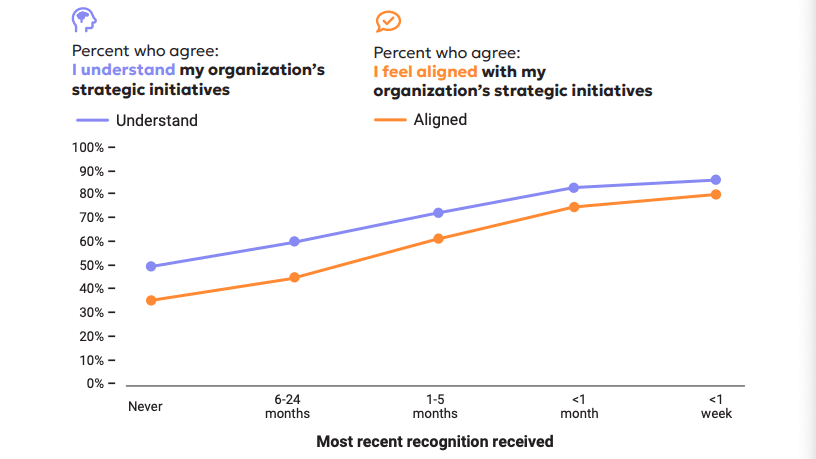
Over time, recognition creates a live feedback loop that reveals how work is actually happening:
- What are agile behaviors are getting recognized most?
- Who are the champions or amplifiers of agile mindsets?
- Which priorities are gaining traction or stalling?
Tip: With Workhuman's Topics you won't have to wonder if a change in strategy is landing. You can watch it unfold in a live stream of activity linked directly to specific goals, strategic initiatives, or organizational changes.
That kind of visibility changes how leaders lead and how confidently organizations pivot.
4. Build skills visibility incrementally
Start with a simple, shared skills taxonomy. Identify skills gaps and select 10–15 priorities directly tied to business goals and focus there first.
You don't need a comprehensive understanding to get started. Many organizations start with a focused pilot – one function or capability area – combining manager input, existing HR data, and signals from recognition and performance to validate what’s already in motion.
To uncover hidden skills across the organization, Workhuman’s platform uses natural language processing (NLP) to surface valuable insights and patterns from recognition messages. Leaders can explore skills at a high level or identify employees already demonstrating the capabilities needed for new or shifting work.
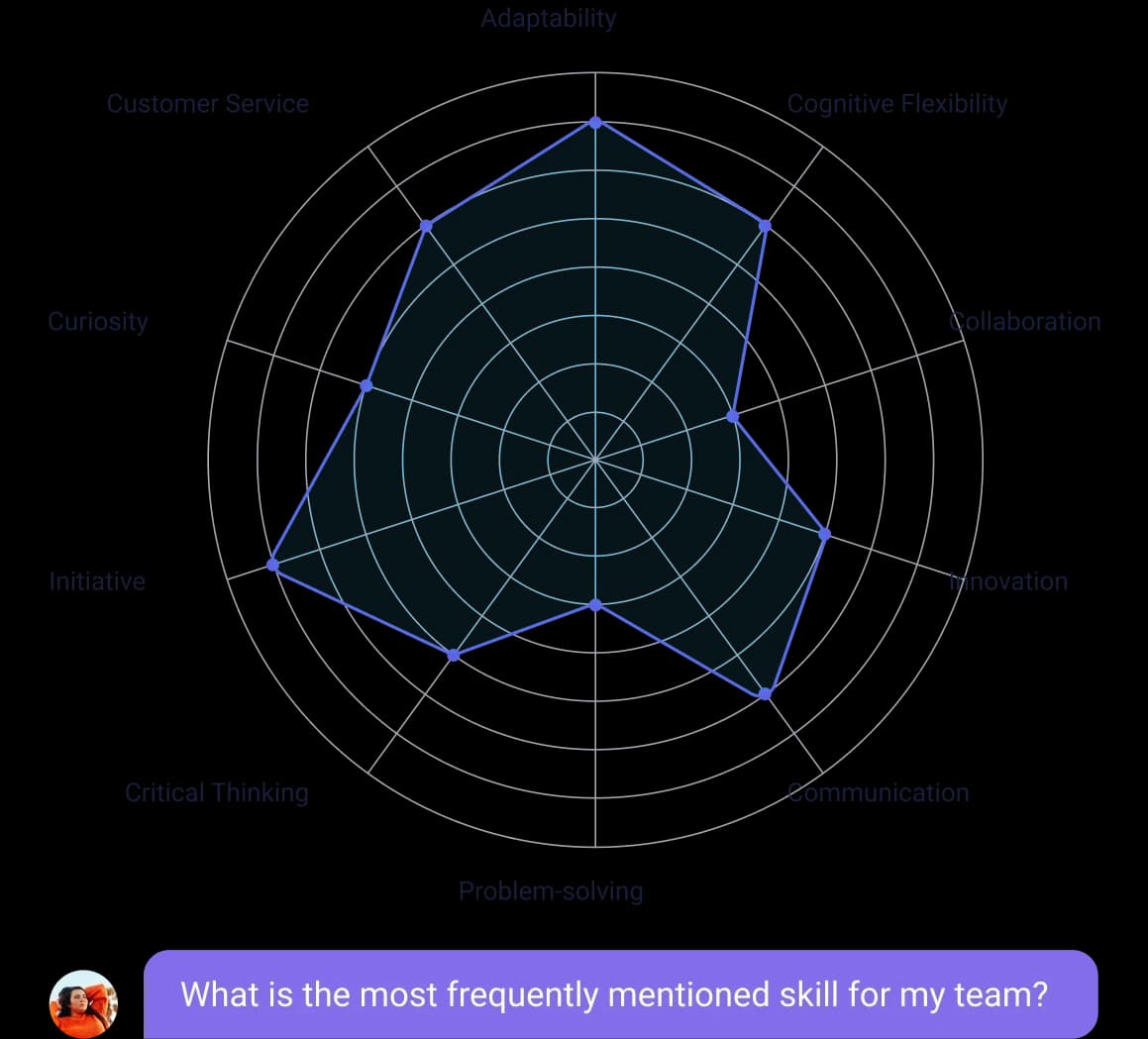
That incremental visibility supports better staffing, mobility, and development decisions without waiting for a full system overhaul.
5. Pilot, learn, and scale what works
Test changes in manageable ways, keep what delivers results, and expand only after it proves value. Rather than redesigning everything at once, test changes in small, contained ways:
- A new goal cadence in one team
- A skills-based staffing pilot for a critical project
- A recognition focus tied to a strategic priority or power skill
Measure what improves speed, quality, or employee experience and scale only what works. This keeps agility manageable and credible for the business.
The bottom line
Agility in the workplace isn't a competitive advantage any longer. The current unpredictable economic climate and accelerating pace of change will only continue to grow the need for agile work practices. But without the right people infrastructure, it often does the opposite – fueling burnout, job-hugging, and resistance to change.
Intentionally designed recognition and reward programs becomes the connective tissue between strategy and behavior. It reinforces experimentation, surfaces hidden capability, and creates the psychological safety required for real adaptation.
When people feel seen for trying, they stop clinging to the familiar – and start building what’s next.

Alison Enzinna
A content strategist and innately curious person, Ali Enzinna has started exploring the working world, looking for opportunities to make big changes through small actions.
Recommended for you