
Work Anniversary Program: How to Build, Run, and Measure One
by Ryan Stoltz
Last updated
11 min read

Table of contents
- What is a work anniversary program?
- Why formalize a work anniversary program instead of leaving it to managers?
- Which milestones should a work anniversary program cover, and how should each tier scale?
- How do you budget for a work anniversary program?
- Who does what in a work anniversary program: HR, managers, and peers
- How do you automate work anniversary tracking so no date is missed?
- How should a work anniversary program work for distributed and global teams?
- How do you measure a work anniversary program?
- FAQs
Share this article
Making sure employees get recognized for their tenure can be an important part of a company's approach to retention. But too often, this responsibility falls solely on individual managers rather than an organized work anniversary program. That makes it easy to miss milestones, especially for remote employees and people working under new managers.
One person might get a desk decoration and a cake for their five-year anniversary, while another doesn't even get a congratulatory email. Major milestones often encourage employees to consider whether they want to stay where they are or move on. A missed anniversary could make a valuable worker feel unrecognized and more likely to look elsewhere.
What is a work anniversary program?
A work anniversary program is a standing, documented system that recognizes every employee at defined tenure milestones on a repeatable schedule, instead of relying on individual managers to remember. Many organizations celebrate milestones in year one, year three, and year five, then every five years for the rest of the employee's tenure.
The 3 core components of a work anniversary program
An effective work anniversary program includes:
- A system of record with every employee's service date and automatic reminders
- A defined reward level for each milestone
- A human acknowledgment from the manager or a senior leader
For example, employees in every department could receive three days of PTO for their fifth anniversary, along with a handwritten card from their manager.
Work anniversary program vs. service awards program vs. everyday recognition
A work anniversary program and an employee service awards program are often used interchangeably to describe recognition initiatives that celebrate employees for reaching tenure milestones.
There are many ways to celebrate work anniversaries that go beyond traditional gift cards. Employees often appreciate monetary bonuses and more personal gifts, such as a custom T-shirt or potted plant.
Meanwhile, everyday recognition focuses on rewarding employees for their behavior and contributions. Recognition and anniversary programs work hand in hand to strengthen employee engagement and show appreciation for their efforts.
What a work anniversary program looks like in practice: 2 common program shapes
You don't need to commit to an elaborate staff anniversary program right away.
A lightweight starter program could include:
- Milestones at one, three, five, and 10 years
- One reward level per milestone for consistency
- Manager notes for each milestone
- Monthly reports from the human resources information system (HRIS) to track anniversaries and completion
Later, you might expand to a full-tiered program with:
- Milestones for every year
- Escalating award values, such as a $500 bonus at year five and a $1,000 bonus for year eight
- Recognition delivered by increasingly senior leaders, not just managers
- Recognition platform linked to the HRIS
- Ability for peers to give recognition
- Reporting tools that track coverage, on-time rate, and spend
Both work anniversary program examples have the same foundational components, but a full-fledged initiative requires more administrative work. If you're not sure if your organization can commit, a consistent starter program can still be effective and sincere.
Why formalize a work anniversary program instead of leaving it to managers?
Creating a formal work anniversary program can help boost employee retention. Every milestone is a natural reflection point, when many employees consider whether they want to stay or try something new.
If you rely on managers to mark these occasions, they might forget. When an employee is already thinking about leaving, a missed anniversary could reinforce that decision.
Formalizing the program also removes the mental load from managers. Instead of trying to remember 20 different anniversary dates for their team, they can simply write a celebratory message whenever the system tells them to.
The anniversary can be a retention decision point, not just a celebration
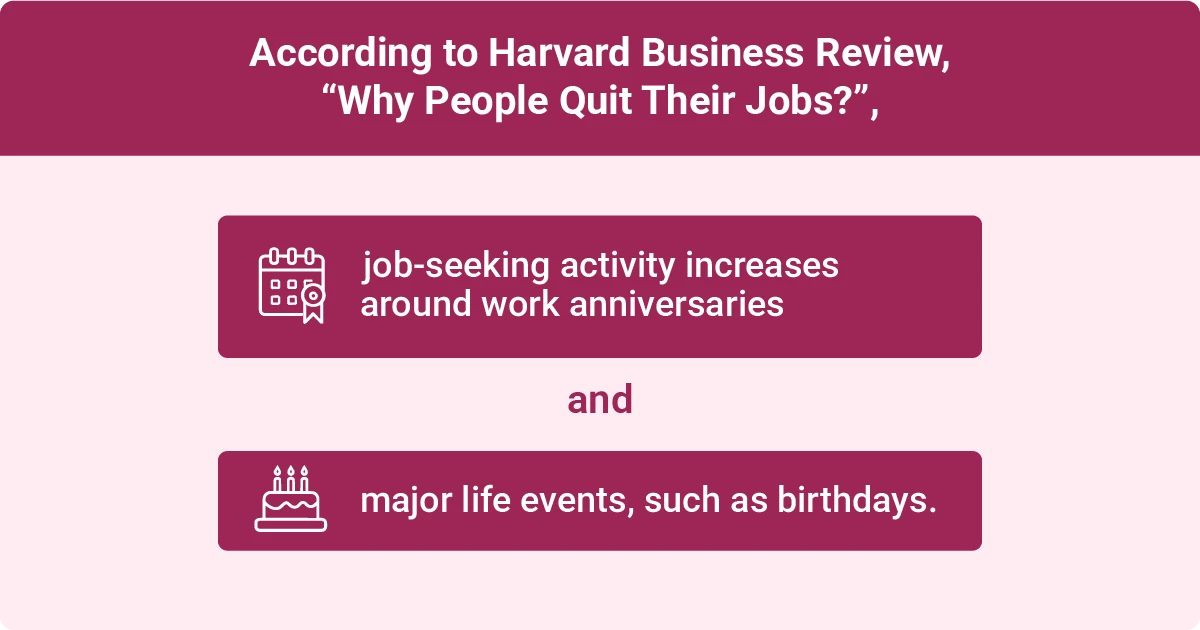
Major milestones are often reflection points for employees. Research highlighted by Harvard Business Review, “Why People Quit Their Jobs?Opens in a new tab” found that job-seeking activity increased around work anniversaries as well as major life events such as birthdays. By recognizing employees at tenure milestones, companies can show that they value their contributions and boost employee morale.
Of course, you also want to keep long-tenured employees. They often have years of institutional knowledge and experience that can be valuable to the organization. Celebrating their years of service can strengthen employee loyalty while helping you retain their knowledge and voices.
What goes wrong when recognition depends on who remembers
When recognition depends solely on managers' memories, employees often have drastically different experiences. An attentive manager might celebrate each milestone with public shout-outs and gifts, while a distracted one fails to acknowledge an employee hitting the 10-year mark.
That gap can create perceptions of unfairness or favoritism, even when the difference isn't intentional. After all, employees are paying close attention to who does and doesn't get recognized.
Without a system, certain employees are more likely to slip through the cracks than others. A manager might overlook a hardworking remote worker or someone who recently transferred to their team. Distributed teams can make it that much harder to keep track of dates.
Plus, it's difficult to monitor ad-hoc spending. One team might splurge on luxury anniversary gifts, while another only hands out $25 gift cards. If you're not tracking it, you can't tell who gets what. That can make differences in recognition feel even less consistent.
Which milestones should a work anniversary program cover, and how should each tier scale?
A work anniversary program can recognize every year of service, with more substantial rewards reserved for major milestones such as years one, three, five, and every five years thereafter. The value of the rewards and the seniority of the person delivering them typically increase at each level to recognize employees' growing tenure and long-term contributions.
Of course, anniversaries only come around one day a year. Recognition programs should also celebrate career milestones more broadly. For example, you might reward promotions and transfers as well.
An example milestone ladder
Why programs that start at five years start too late
Traditional employee work anniversary programs often waited until year five to start celebrating service milestones and only gave rewards in five-year increments. However, this model may be less effective when the median tenure for employees is only 3.5 years, according to the Bureau of Labor Statistics’s “Median years of tenure with current employer for wage and salary workers” dataset.
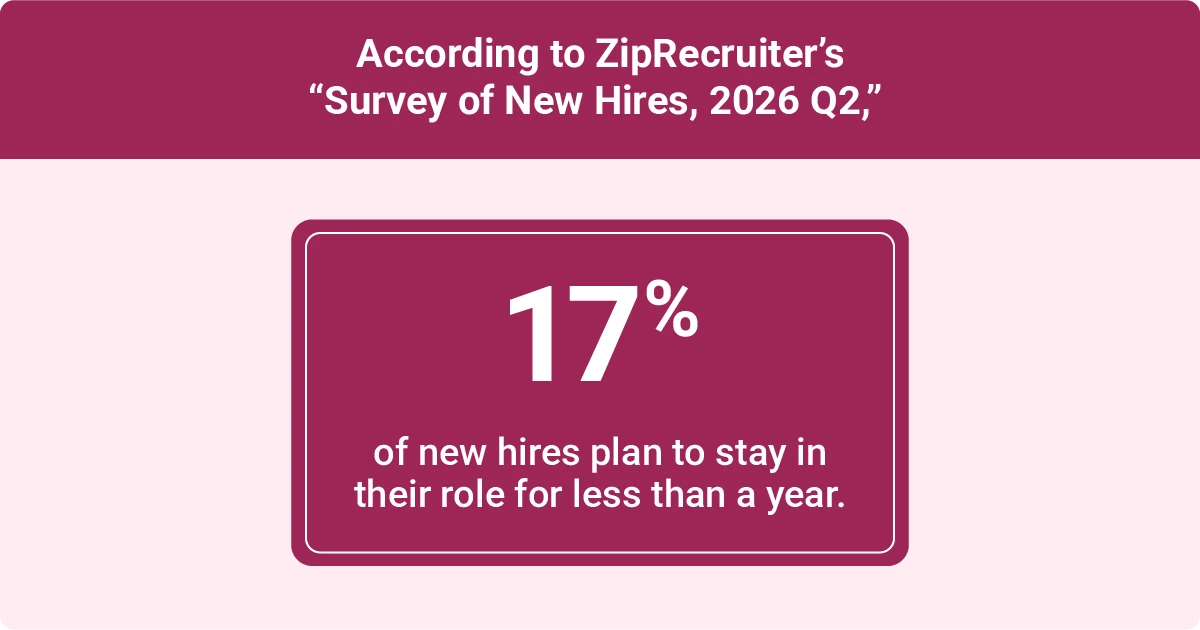
If you don't start recognizing tenure until year five, you'll miss the opportunity to recognize employees during the first year, when early attrition can be a concern. The “Survey of New Hires, 2026 Q2,” by ZipRecruiter, found that 17% of all new hires plan to stay in their role for less than a year. Celebrating people who make it to this milestone gives you the opportunity to celebrate their achievements and show that you appreciate their work.
What should change between tiers: Visibility, who delivers it, and reward value
While every work anniversary milestone matters, organizations can make major milestone tiers increasingly meaningful as tenure grows. This could include increasing the reward value or the seniority of the person delivering the recognition. Expanding the audience from the team to the entire organization (with consent from each employee) will also make later milestones feel more significant.
Clear and meaningful progression is key. Just don't make the top tier so elaborate that it's difficult to repeat.
It's also important to recognize the in-between years, without diluting the anniversaries. Save tangible rewards for major milestones, but don't make employees wait five years for recognition. A channel post or a small gift for every anniversary doesn't cost much and still marks progress. You should also consider celebrating early-tenure milestones with high turnover, such as at the end of onboarding or at the six-month mark.
What can sit inside a tier: Awards, extra time off, development budget, and public recognition
As you design your rewards ladder, include a mixture of categories across tiers, such as:
- Choice-based gifts
- Additional PTO
- Funds for development or a conference
- Formal public recognition
Reserve more special rewards, such as a thank-you from the CEO or a named contribution, for higher tiers, while using occasions such as Employee Appreciation Day to reinforce a broader culture of recognition.
At each level, give employees the flexibility to choose the specific gift or award. That way, they're more likely to receive a reward they genuinely value.
How do you budget for a work anniversary program?
To budget for your work anniversary program, you'll need to decide if you want to allocate money as a payroll percentage, per employee, or per milestone. Be sure to adjust this budget each year as employees move through the career ladder.
3 ways to size the budget: Payroll percentage, per employee, per milestone
Some organizations budget for a work anniversary program by setting aside a percentage of total payroll. For instance, you might plan to spend 1% of payroll on recognition.
Other companies allocate a set amount per employee each year to cover service awards and other recognition initiatives. Another option is to calculate the cost of each milestone tier and estimate how many employees will reach each level annually.
Modeling annual cost from your tenure distribution
Follow these steps to estimate the annual cost of your service awards:
- Check the HRIS to see how many employees are expected to reach each milestone next year based on their hire date.
- Multiply the number of employees at each milestone by the reward value for each tier.
- Sum up fulfillment and platform costs.
- Add a buffer for new hires, exceptions, and rounding.
Focus on coverage. It's better to have consistent but less expensive rewards than only recognizing a handful of people at random with big-ticket gifts.
Costs teams forget: Shipping, platform fees, taxes, and admin time
As you design your budget, don't forget to factor in the hidden expenses:
- Shipping and customs costs for physical gifts, which may vary wildly by country
- Platform fees
- Taxes for non-cash awards
- Administration time
Budgeting the launch year, including employees who already passed milestones
Unless your company just started up, you'll likely have long-tenured employees who have already passed some of the milestones in your new program.
Decide whether they'll receive a one-time catch-up award or get recognized at their next milestone. Be sure to communicate this decision before launch day, or senior employees might assume that you're ignoring their tenure.
Who does what in a work anniversary program: HR, managers, and peers
A work anniversary program works best when ownership is split between HR, managers, and (in some cases) peers. HR owns administrative tasks like budgeting, maintaining accurate data, and reporting, while managers and peers add warmth and acknowledgment through personal messages.
What HR owns: Policy, eligibility, data, budget, and reporting
HR is responsible for:
- Creating written policies covering the purpose of the program, eligibility, milestones, tiers, and how to handle exceptions
- Setting the budget
- Maintaining accurate records
- Reporting the results of the program
Workhuman® offers an Admin Hub™ where HR teams can delegate tasks, approve awards, detect misuse, and more.
What managers own: The specific, personal acknowledgment
Managers should own:
- A written acknowledgment that praises the employee's specific contributions
- A public or private moment of recognition, depending on the employee's stated preference
- Being present for any team celebration or recognition moment
Organizations need to enable managers so the personal part actually happens. Writing thoughtful messages takes time, so don't spring anniversaries on managers at the last minute. Prepare them during new-manager onboarding so they understand the expectations.
When an employee's anniversary approaches, notify their manager two to four weeks ahead. You should also help them decide what to write in the message by supplying prompts and examples instead of generic templates.
What peers add, and how to make contributing easy
While peers aren't a mandatory part of a work anniversary program, their comments can give details and personalization that the manager doesn't have. Keep contributions asynchronous so distributed colleagues can participate, and only ask for a short but sincere comment.
How do you automate work anniversary tracking so no date is missed?
Pairing your HRIS with a recognition platform can enable automated employee anniversary recognition, while also allowing you to track other milestones. Use the HRIS to enter important dates for your entire organization, while the recognition platform can send automatic reminders to managers and help ensure that rewards are delivered on schedule.
Making the HRIS the single source of truth for service dates
Use your HRIS to record service dates, and check them monthly for accuracy. You should also make sure that it syncs frequently with your recognition platform and alerts you to any failures, such as a missing date for a rehired employee.
Defining the service date: Rehires, leaves, and acquisitions
Tracking milestones isn't always straightforward. Decide whether the clock restarts or resumes for rehires and whether you'll pause tenure accrual if someone goes on extended leave.
Eligibility rules to settle before launch
As you build your program, take the time to answer these questions:
- Which types of workers are eligible? Will you only recognize full-time employees, or are part-time, fixed-term, or contract workers part of the program?
- How will you handle tenure for employees on leave or under notice?
- Who approves exceptions, and how will you log them?
The notification and completion workflow, end to end
Here's what the recognition workflow looks like in action:
- The recognition platform surfaces an upcoming milestone.
- The software automatically alerts the manager with a deadline.
- The manager gives the award to the employee.
- Leadership delivers acknowledgment.
- The manager or leader records completion in the recognition software.
Every step should have a named owner and a fallback owner in case someone isn't available. You should also escalate unactioned dates to HR or a senior leader. Otherwise, a milestone could get missed if a manager goes on vacation.
Personalization at scale: Automate the trigger, never the message
With a recognition tool like Service Milestones™, you don't have to manually track anniversary dates or chase down managers to send gifts. It automatically handles timing, budgeting, fulfillment, and tracking.
Of course, that doesn't mean you should remove the human element. Leaders should acknowledge what each employee has contributed in personal messages with specific examples. For another easy personal touch, let employees choose from a selection of awards at each tier.
How should a work anniversary program work for distributed and global teams?
Distributed employees' anniversaries can be easier to miss, so treat your remote teams as a test of whether your program is actually working. Make sure that employees can participate asynchronously and that the program provides equitable recognition and reward value across locations.
Async-first recognition and equal visibility for remote employees
Distributed teams are often spread across time zones, so don't try to coordinate live celebrations. Instead, use a tool like Service Milestones™ to create a shared channel where colleagues can contribute congratulatory messages, photos, and videos. This makes recognition more visible and lets peers participate on their own time.
Reward parity across countries: Value, availability, tax, and delivery
Gifts and monetary bonuses are an excellent way to show appreciation, but keep these caveats in mind:
- Money doesn't necessarily have the same value in different markets, so you may need to adjust award amounts.
- Catalog availability and local tax regulations vary by country.
- International shipping can take weeks, so build enough lead time into your trigger date.
Auditing recognition distribution by location and team
Tracking metrics can help you detect any disparities or gaps in your work anniversary program. Compare coverage and on-time rate by site, region, and for remote vs. in-office workers.
How do you measure a work anniversary program?
There are three types of criteria for measuring a recognition program: operational, experience, and outcome. Organizations should gather these key performance indicators continuously with an HRIS or recognition platform and review them regularly throughout the year to track their work anniversary program's performance.
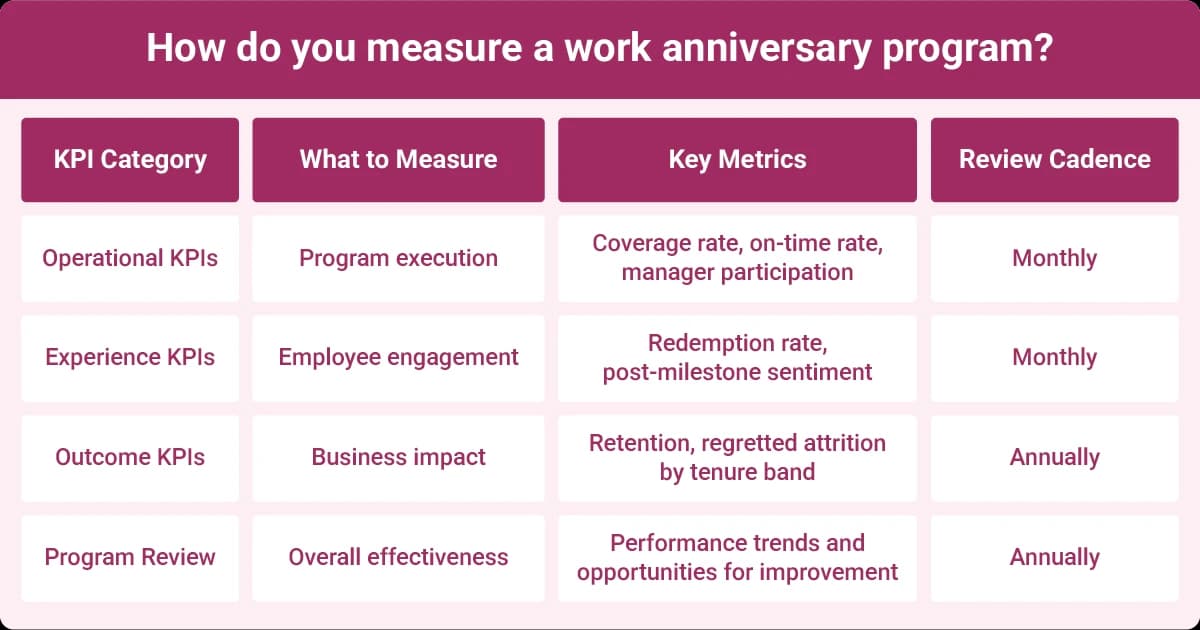
Operational KPIs: Coverage rate, on-time rate, manager participation
- Coverage rate: Number of recognized anniversaries / total number of eligible anniversaries
- On-time rate: Recognitions delivered on or before the anniversary date / total recognitions
- Manager participation rate: Recognitions with a manager contribution / eligible anniversaries
Experience KPIs: Redemption rate and post-milestone sentiment
- Redemption rate: Number of redeemed awards / total number of awards; a low redemption rate may signal a problem with your catalog
- Post-milestone sentiment: Send a two-question survey asking employees about the timeliness and personalization of their recognition
- Sentiment by tier: Differences can be concentrated in one milestone, so break down responses by tier
Outcome KPIs: Retention and regretted attrition by tenure band
- Retention: The percentage of employees still with your company at 12, 24, and 36 months
- Regretted attrition by tenure band: The percentage of high-performing employees who leave your company within each tenure band
One useful way to evaluate your anniversary program is to compare first-year regretted attrition for two groups: employees whose milestone was recognized on time, versus those whose date was missed or late.
However, this statistic is only directional unless everything else is the same between your two groups.
Setting a review cadence: Monthly operations, annual program review
You might assume that the HR team should own your recognition data, but that often leads to bottlenecks. Instead of keeping your program metrics in an HR-only report, give managers and leaders access.
For example, Workhuman Reporting™ lets you give colleagues access to recognition data with user-friendly reports and dashboards. That way, leaders can see trends and get up-to-date information to make decisions.
Establish a regular review schedule that checks your program's performance throughout the year. Here's how often to check each metric:
- Monthly: Coverage, on-time rate, exceptions, and data errors
- Quarterly: Redemption, sentiment, and budget consumption
- Annually: Tiers, budget, eligibility, and whether the program still serves its stated purpose
Avoid fixating on vanity metrics like number of awards sent. Sure, you may have sent 100 awards this year, but that doesn't matter if you only have 50% coverage.
FAQs
Should a work anniversary program recognize every year or only milestone years?
A work anniversary program should recognize every year of service, with more substantial rewards for major milestone years. For example, an organization might give employees a gift card for years two and four, while people who reach year five receive three extra days of PTO.
What is the difference between a work anniversary program and a service awards program?
A work anniversary program and a service awards program are often used interchangeably. Both refer to initiatives that celebrate employees for reaching tenure milestones, such as one and five years with the same company.
How far in advance should managers be notified of an upcoming work anniversary?
Managers should be notified two to four weeks in advance of an upcoming anniversary. That gives them enough time to write a thoughtful, personalized message of appreciation for the employee. Some managers may also prepare team lunches or other public celebrations for significant milestones.
How should a new work anniversary program handle employees who already passed major milestones?
Before you launch your program, decide whether employees who have already passed major milestones should receive a one-time catch-up reward or just get recognized at their next milestone. For example, you might offer a cash bonus or a special experience to recognize long-tenured employees.
Are work anniversary awards taxable?
According to “How Are an Employee's Fringe Benefits Taxed?Opens in a new tab” by Investopedia, tax regulations for work anniversary awards vary by region and the type of award. For example, employees may need to pay income tax on cash-based awards, such as a $500 bonus.
However, certain length-of-service awards may qualify for a tax exclusion if they meet IRS requirements, while cash, gift cards, and many other types of awards are generally taxable. Rules can vary by jurisdiction and circumstances, so consult a tax professional for guidance.

Ryan Stoltz
Ryan is a search marketing manager and content strategist at Workhuman where he writes on the next evolution of the workplace. Outside of the workplace, he's a diehard 49ers fan, comedy junkie, and has trouble avoiding sweets on a nightly basis.
Recommended for you