
Unique Employee Benefits in 2026: A Retention Strategy and Examples for HR Leaders
by Ryan Stoltz
Last updated
12 min read
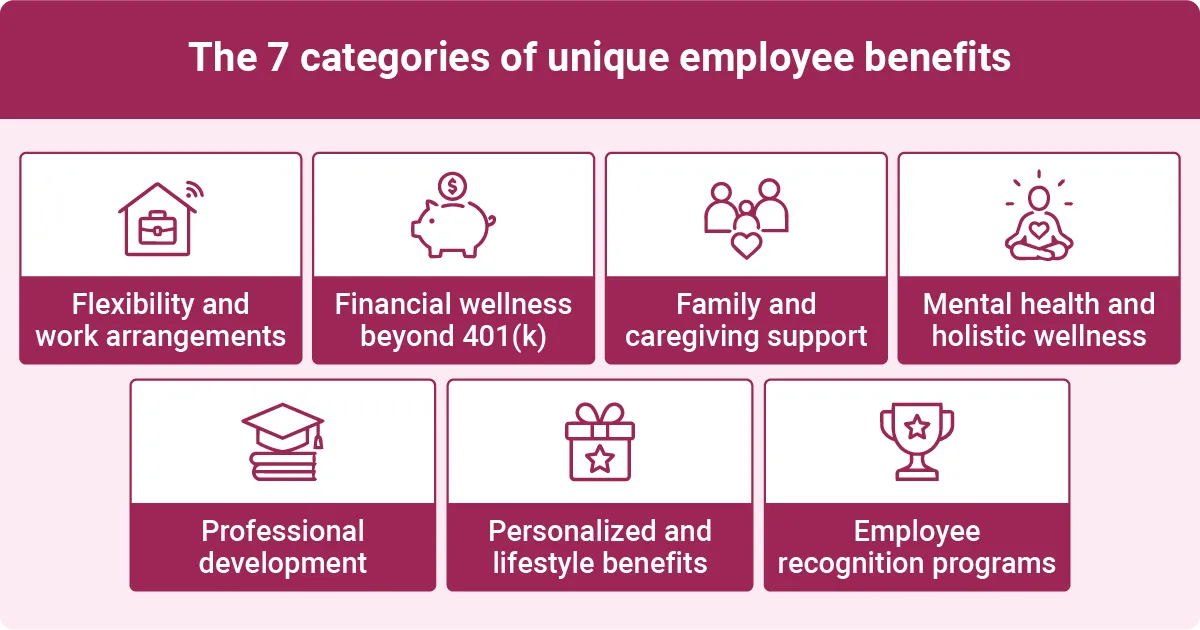
Table of contents
- What are unique employee benefits? Standard vs. unique defined
- The 7 categories of unique employee benefits (with company examples)
- How unique employee benefits drive retention
- Unique employee benefits for small businesses (affordable and low-cost options)
- How to choose and implement unique benefits
- FAQs
Share this article
Standard employee benefits packages such as health insurance, 401(k), and paid time off (PTO) are no longer enough to retain top talent. With these offerings now baseline expectations, forward-thinking HR leaders have started to curate unique employee benefits to reduce voluntary turnover.
The challenge is that many organizations must build a comprehensive benefits package while operating within budget constraints. This can involve thinking beyond physical office perks, such as free office snacks or after-hours social gatherings.
The pressure to offer more is especially high when working with distributed or hybrid teams, where fostering employee connections and demonstrating organizational investment can be more difficult than in a traditional office environment.
Fortunately, there are many creative benefits for employees that can work for both in-office and remote teams without breaking the bank. This guide provides a structured breakdown of seven categories of unique perks, with real-world examples.
What are unique employee benefits? Standard vs. unique defined
Unique benefits are non-traditional perks and employee incentives designed to enhance workers’ wellbeing and signal employer values. Standard benefits, on the other hand, are sometimes mandatory offerings to employees alongside their salaries that provide financial security, work-life balance, and health support.
While traditional employee benefits, such as PTO, were sufficient years ago, they’re not as effective at promoting retention today. Perks that might have once seemed unique, such as mental health support, have also become standard offerings as employees expect more from their employers.
The standard benefits baseline
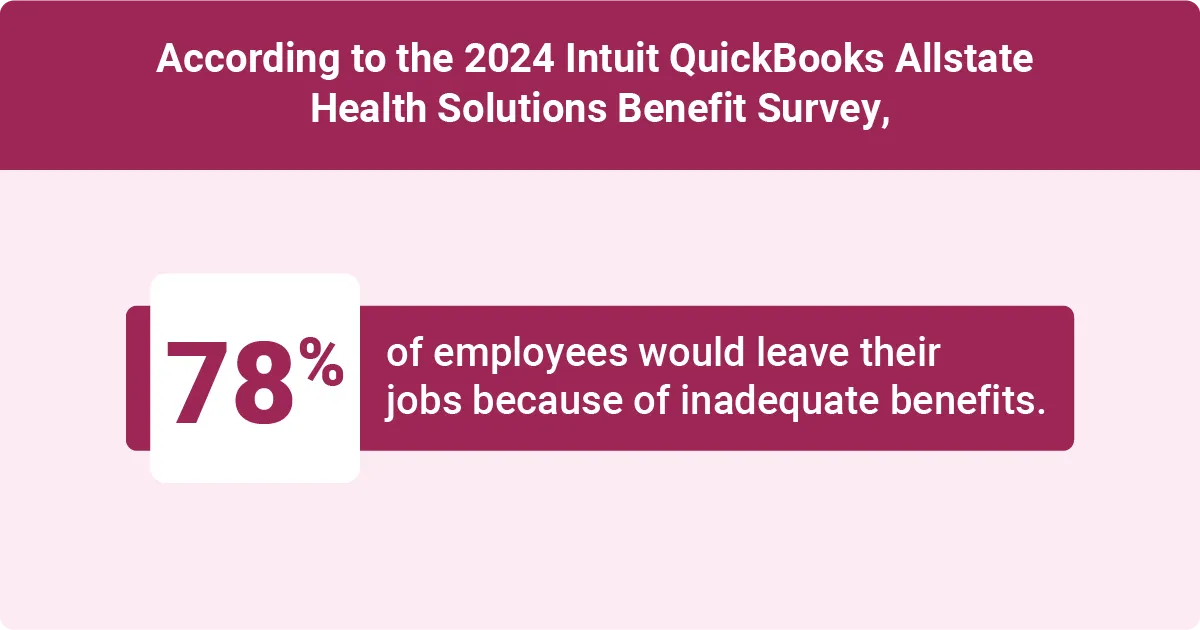
A 2024 Intuit QuickBooks Allstate Health Solutions Benefit Survey found that 78% of employees would leave their jobs if they deemed their benefits packages inadequate. Most employees find these standard offerings non-negotiable, and several are required under federal and state law:
- Health insurance: Employees expect coverage for their health insurance premiums, including medical, dental, and vision insurance. According to the IRS Employer shared responsibility provisionsOpens in a new tab, this coverage is also legally mandated as per the Affordable Care Act (ACA) shared responsibility provisions, often paired with health savings accounts.
- Retirement plans: Employees expect defined-contribution plans, such as 401(k)s, to support their retirement savings.
- PTO: It’s standard for employers to provide paid time off for nationally recognized holidays such as Memorial Day and Independence Day.
- Life and disability insurance: This coverage replaces a worker's income if they are injured, fall ill, or lose their life in the course of their employment.
- Legally mandated benefits: The Family and Medical Leave Act of the U.S. Department of Labor requires employers with 50 or more employees to provide up to 12 workweeks of leave for serious health conditions and for the birth or placement of a child.
What makes a benefit "unique"
Unique company perks go beyond compensation and standard benefits, such as retirement plans. They typically have the following traits:
- Non-mandatory: They’re not legally required or even expected by employees.
- Personalized: Unique benefits are tied to specific employers’ values or employees’ needs.
- Flexible: They’re adaptable to employees’ preferences.
- Holistic wellness: They aim to support all facets of employees’ lives to improve their overall wellbeing.
- Impactful: Being, essentially, unexpected add-ons, these benefits can have a significant impact on employee attraction, retention, engagement, and wellbeing.
The 7 categories of unique employee benefits (with company examples)
Unique company benefits fall into several broad categories, each designed to improve specific aspects of the employee experience. Some focus on employees’ work-life balance; others on their financial health or their mental wellness. These are popular, unique employee perks offered by a variety of companies across industries.
1. Flexibility and work arrangements
Flexibility-focused benefits give employees control over their work arrangements. With proper planning, these perks can reduce voluntary turnover without necessarily increasing your spending.
4-day workweek
Reducing the standard 40-hour workweek to 32 hours improves employees’ work-life balance, which can positively impact their work, engagement, and relationship with your company. A 4 Day Week Global interview with Kickstarter’s Chief Strategy Officer, Jon Leland, revealed that their transition to a 4-day workweek resulted in 50% higher employee engagement, increased productivity, and higher retention rates.
Unlimited or no-policy PTO
Unlimited PTO allows employees to take time off as needed, provided they complete their tasks. This benefit can remove the stress of tracking and managing their leave balances.
Paid sabbaticals
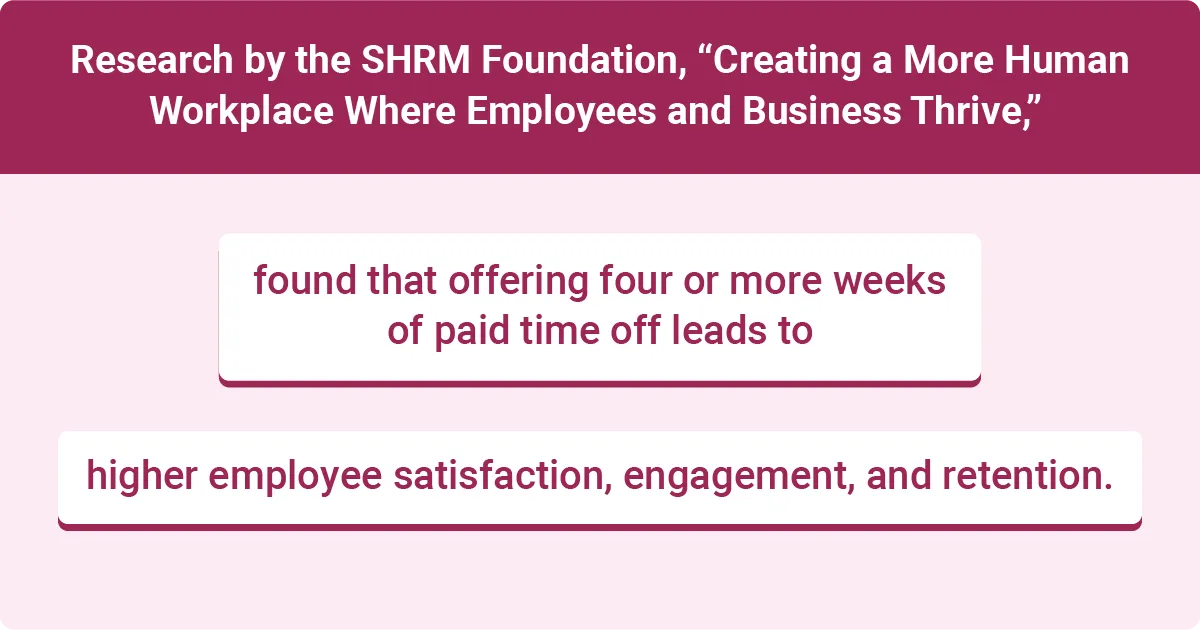
Giving employees extended time away after achieving tenure milestones lets them recharge and pursue personal development. Research by the SHRM Foundation, “Creating a More Human Workplace Where Employees and Business Thrive,” found that offering four or more weeks off results in higher rates of employee satisfaction, engagement, and retention.
Company-wide shutdown weeks
Pausing work across your entire organization allows people to take time off without pressure to stay connected. This benefit can improve employees’ physical and mental health.
Remote/hybrid flexibility and asynchronous schedules
Letting employees choose where and when they work can boost their satisfaction, potentially reducing turnover. This strategy has worked for Spotify, which, as reported by Fortune in “Spotify allowed its 6,500 employees to work from anywhere in the world. Its turnover rate dropped,” recorded a 15% drop in attrition rate after implementing its work-from-anywhere policy.
Internal gig and rotation programs
Giving employees the chance to work outside their primary roles can reduce burnout and help them build cross-functional skills. This perk also benefits employers by making it easier to cover gaps when workers take extended time off.
2. Financial wellness beyond 401(k)
While a 401(k) is an excellent employee benefit, it might not be sufficient for people with immediate financial concerns. With that in mind, some unique financial wellness benefits seek to address employees’ short-term needs.
Student loan repayment plans
Help employees reduce their debt by contributing toward their student loan repayments. This benefit can attract and retain professionals who have advanced their education.
Emergency savings accounts
Employer-sponsored emergency savings accounts can help employees cover unexpected expenses that might hinder their productivity or prompt them to look for other roles.
Earned wage access and financial coaching
Earned wage access (EWA) programs allow employees to access portions of their earnings before scheduled paydays. When offered alongside financial coaching, this benefit can help your teams meet emergency expenses without jeopardizing their overall financial health.
Tuition reimbursement
A tuition reimbursement benefit helps employees pursue additional education and certifications without stretching themselves too thin. The Starbucks College Achievement Plan is a working example. The program offers certain U.S. Starbucks employees 100% tuition coverage upfront for their first bachelor’s degree through Arizona State University (ASU).
3. Family and caregiving support
Employees with young children, aging parents and grandparents, or pets might need personalized packages to meet their caregiving responsibilities. Expanding your benefits to cover their needs could be the difference between them staying long-term and looking for other opportunities.
Fertility, IVF, and surrogacy support
Fertility support can alleviate the emotional and financial stress of trying to start a family. That can, in turn, strengthen employees’ connection to your company.
Extended parental and grandparent leave
Many employees need more than 12 weeks of leave after the arrival of a child to adjust to new family responsibilities. Older workers may also need time off to support their growing families and bond with new grandchildren. Offering extended parental or grandparent leave to these employees can reduce attrition during major life transitions.
Childcare and eldercare support
Childcare and eldercare can be persistent causes of stress and absenteeism. Offering support in the form of in-office childcare, external help subsidies, parenting coaching, or access to platforms such as Papa Pal can go a long way in easing employees’ burden.
Paternity leave
Benefits such as adoption leave or paid time off to care for sick animals can boost employees’ loyalty to your company. While this type of benefit might appear novel, in “BrewDog: Benefits for the Dogs,” Build It notes that BrewDog has had a “pawternity” policy for years. The policy allows employees to take up to one week off when they adopt new puppies or rescue them.
4. Mental health and holistic wellness
Therapy and employee assistance programs (EAPs)
Providing access to professional therapists and confidential, short-term counseling can help employees address personal and job-related challenges that may affect their performance and willingness to work.
Wellness stipends
Wellness stipends and other wellness benefits that support employees’ fitness, nutrition, and overall wellbeing promote happier workplaces. The happier your people are, the less likely they are to leave.
Burnout prevention programs
Proactive burnout management plans, such as mental health days, can reduce employee fatigue and, consequently, turnover. LinkedIn’s annual “company shutdown” weeks, for example, allow employees to recharge interruption-free, according to Damien Coullon, Vice President of Product, Growth + Premium.
Mental wellness subscription apps
Employer-covered subscriptions to wellness platforms such as Calm, Headspace, and Wellhub support employees’ nutrition, mindfulness, sleep, and emotional regulation. The more “balanced” employees are, the lower their chances of leaving unexpectedly.
On-site or virtual mental health professionals
Providing direct access to mental health professionals reduces friction in accessing mental health care. If on-site support isn’t feasible for your company, do what NerdWallet does. It provides support through Ginger, now part of Headspace, which gives employees access to virtual therapy sessions.
5. Professional Development
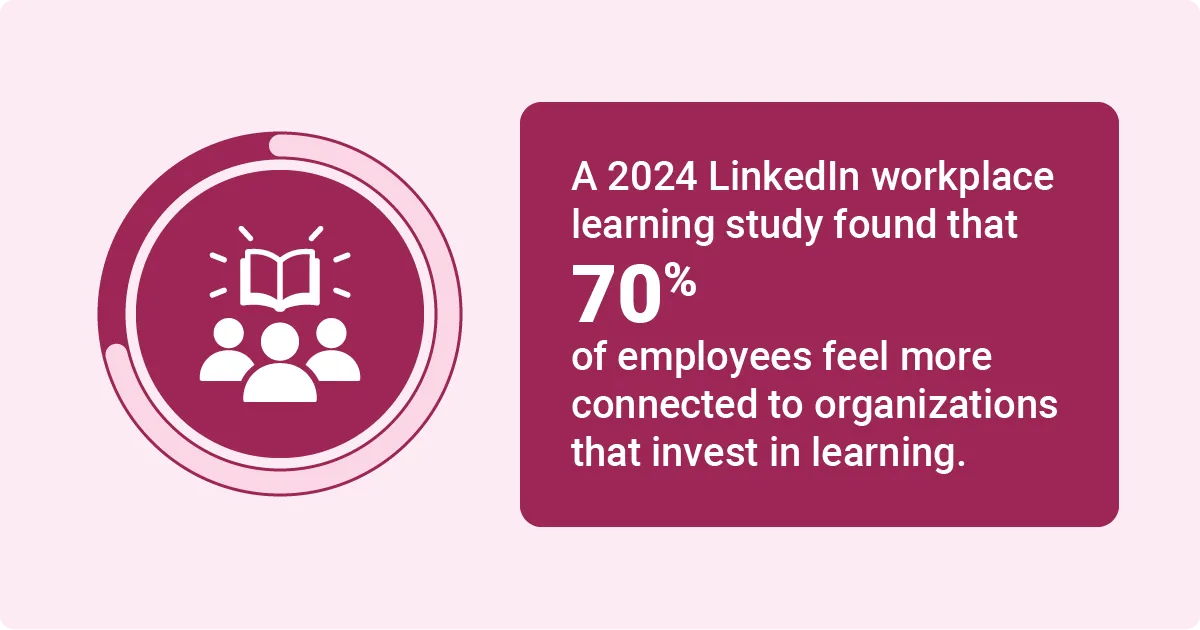
A 2024 LinkedIn workplace learning study found that 70% of employees feel more connected to organizations that invest in learning. That means professional development benefits packages can help boost retention. Possible benefits worth considering include:
- Learning and development reimbursements
- Mentorship and career coaching
- Conference stipends
- Personal development budgets – Deloitte’s non-job-related employee incentives program, for example, reimburses employees up to $1,000 for personal pursuits and interests, as reported by HR Grapevine in “'Makes a huge difference': Deloitte staff can now spend $1k on Lego in the name of wellbeingOpens in a new tab.”
6. Personalized and lifestyle benefits
Personalized lifestyle benefits indicate to employees that you care about their experiences outside of work. Some benefits that can help you show your appreciation include:
- Lifestyle Spending Accounts (LSAs): These accounts reimburse employees for everyday wellbeing expenses such as gym memberships.
- Benefits menus and stipends: These benefits work well for organizations looking to personalize their packages. Rather than offering identical benefits to everyone, let employees choose from a list of pre-approved options.
- Kindle + e-book stipends: These allowances help employees access books and digital learning resources that support both professional development and personal growth.
- House cleaning: This benefit can help employees balance work and life. Slate has recently added a cleaning services benefit following a LinkedIn post by Christina Le, the company’s Head of Marketing, that connected clean homes to employees’ wellbeing.
- Bucket-list lottery: Digital marketing agency Propellernet runs a “Dream Ball” program in which each employee writes down a bucket-list item and tosses the piece of paper into a gum dispenser. Propellernet then holds a draw for one person to pursue their dream, once the company achieves a target.
- Home office, ergonomic solutions, and connectivity stipends: Such stipends are especially valuable for remote and hybrid employees because they help them set up comfortable workspaces.
7. Employee recognition programs
New hires who receive 4+ awards have a 96% retention rate, according to a Workhuman® and LinkedIn case study titled “7 Ways Social Recognition Improves Your Business.” On the other hand, employees who don’t get any recognition are 2x more likely to look for new roles.
Peer-to-peer recognition
Empowering employees with the tools they need to celebrate each other’s contributions and achievements can foster a stronger sense of community, resulting in lower attrition rates. That’s exactly what happened after Eaton invested in Social Recognition®, Workhuman’s ROI-guaranteed employee recognition solution. The solution allows employees to share and receive recognition, reducing voluntary turnover by 2x.
Milestone and service awards
Recognizing employees’ tenure or contributions to your organization makes them feel valued, which can boost their loyalty. Morgan Truck Body implemented a cross-departmental Social Recognition program, allowing employees to recognize each other’s services and management to identify exemplary workers for rewards such as promotions.
Through this program, the company has registered significantly lower turnover rates – only 6.3% of recognized employees have left since its implementation.
Manager-to-employee recognition
Visible acknowledgment of service from organizational leaders makes employees feel seen. While manager-to-employee recognition might seem difficult, British Airways is proof of its advantages. The enterprise implemented CEO-led appreciation and peer-to-peer recognition through Above & Beyond – powered by Workhuman’s Team Awards, Service Milestones®, and Inclusion Advisor. This strategy has increased employee net promoter score (eNPS) by 60 points.
Recognition is especially impactful when paired with monetary or experiential benefits because it becomes more memorable. You could offer non-tangible benefits, such as PTO, or run a points-based redemption program that allows employees to earn tangible rewards for their achievements. The Workhuman Store, available in 180+ countries, lets employees redeem points for merchandise, gift cards, travel, hotels, and charitable donations.
Values-based recognition and spot awards
Recognizing and awarding employees for demonstrating organizational values in real time is one of the best ways to motivate them. Pfizer offers proof. The biopharmaceutical company partnered with Workhuman to launch Bravo, a recognition platform that has helped maintain employees’ adherence to company values by facilitating on-the-spot recognition.
The most unusual employee benefits companies offer
The incentive theory of motivation suggests that human behavior can be shaped by external rewards. Find what resonates with your employees, and you might have cracked the code for better performance, engagement, and retention. To achieve these goals, companies sometimes offer unusual employee perks tailored to their workers’ specific needs.
Some employers also design employee benefits based on their company values, resulting in outside-the-box perks. Here are some of the most unique benefits offered by companies:
- Airbnb: Offers $2,000 in annual travel credit to cover Airbnb stays, as per a 4 Day Week job listing, letting employees live out the company’s primary offering
- Trupanion: Offers employees three days of bereavement leave if they lose a pet and 100% insurance coverage for one cat or dog, according to Anna Berentson, Trupanion’s Talent Acquisition and DEI Senior ManagerOpens in a new tab
- Salesforce: Gives employees seven paid days of volunteer time off to reinforce the company’s culture of giving back to society
- Patagonia: Allows workers to take up to two months of paid sabbatical to work for environmental groups of their choice, according to Circle Economy
How unique employee benefits drive retention
A 2018 compensation and benefits study by Workhuman, “Increasing Employee Retention,” found that salary and benefits account for only 9% of employees’ turnover reasons. On the other hand, unique and personalized benefits often have an outsized impact on retention.
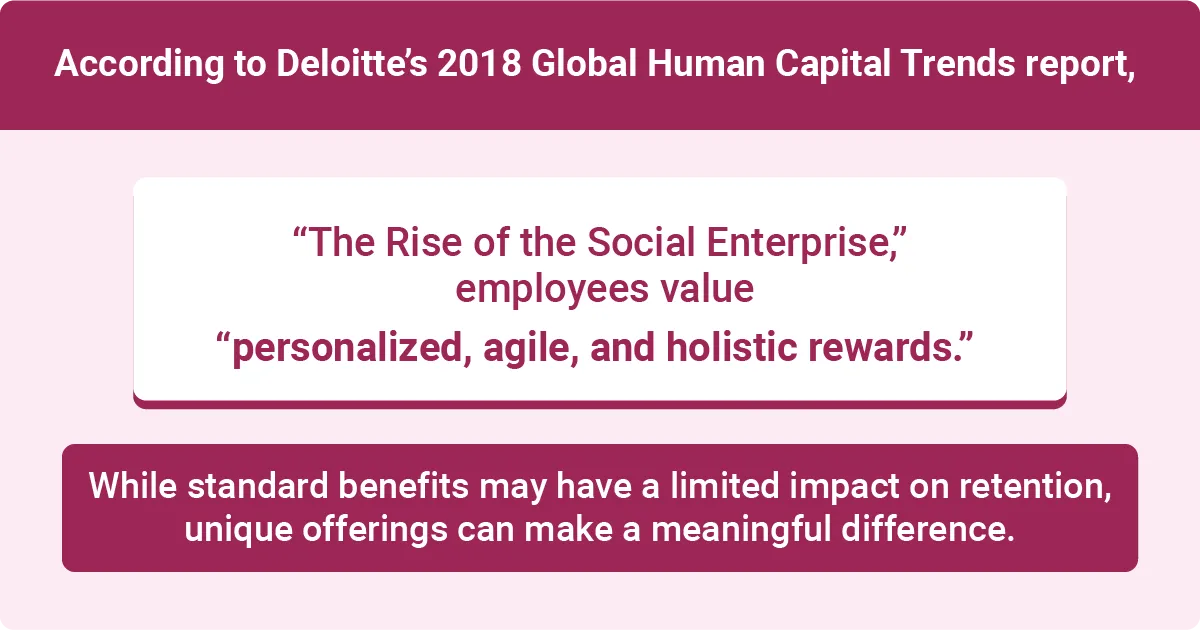
However, despite understanding how incentives drive behavior, the Deloitte study found that only 8% of companies consider their employee rewards programs “very effective” at personalization. To differentiate yourself in a market where employers stick to generic perks, you need to tailor your benefits for retention.
Which benefits move the retention needle
Employee benefits don’t influence retention equally. The most effective perks address the following fundamental employee needs:
- Flexibility: A 2025 International Workplace Group (IWG) hybrid working productivity report found that flexible working conditions can reduce voluntary turnover rates by up to 30%.
- Financial wellness: PwC’s 2026 Employee Financial Wellness Survey reports that financial stress is a top concern for 57% of employees. As such, programs that help manage financial challenges have a significant impact on retention.
- Recognition: According to 2024 research from Gallup, “Employee Retention Depends on Getting Recognition Right,” well-recognized employees are 45% less likely to leave their organizations.
Generational and life-stage differences
Employees at different life and career stages have varying priorities.
For instance, Gen-Zers, still in the early stages of their careers, value benefits that support skill development, career progression, and financial stability. Millennials, who are typically in the middle stages of their careers, prefer benefits that promote career and family growth, such as fertility support and flexible work arrangements.
Older workers in the late stages of their careers value retirement-focused benefits, such as phased retirement plans. They also place great value on recognition for their services.
The business case: How unique benefits affect the bottom line
The value of unique company perks isn’t theoretical. These benefits translate into actual business outcomes that can improve your bottom line.
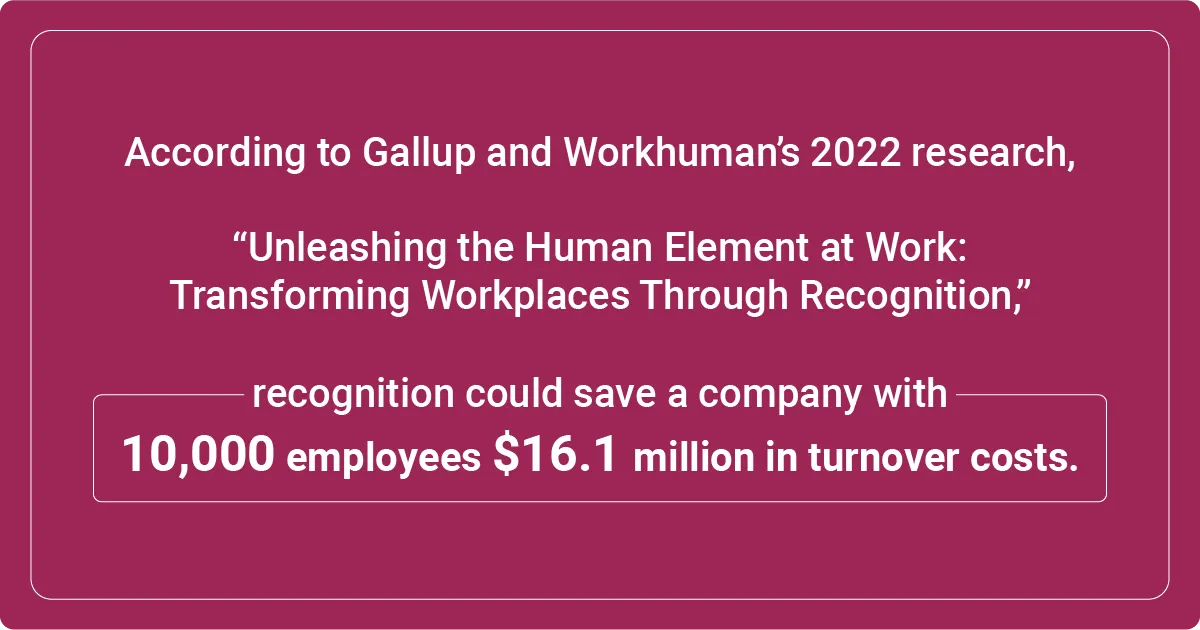
According to 2022 research from Gallup and Workhuman titled “Unleashing the Human Element at Work: Transforming Workplaces Through Recognition,” recognition can result in $16.1M in turnover savings for a 10,000-employee company.
A Merck case study also found that well-recognized new hires are 5x less likely to leave their organizations. With SHRM’s piece “The Myth of Replaceability: Preparing for the Loss of Key Employees” reporting that “the cost of replacing an employee can range from 50% to 200% of their annual salary,” a low turnover rate translates to more cost savings for your business.
Unique perks can also offer businesses:
- Higher productivity: Flexibility and wellness programs reduce employee stress and burnout, often resulting in productivity gains.
- Better recruitment outcomes: Unique benefits can attract top talent and reduce your time-to-hire.
- Reduced healthcare spending: Proactive health and wellness measures, such as gym stipends, can reduce the risk of illnesses.
- Lower absenteeism: Benefits such as caregiving support can reduce employees’ need to take unplanned leave.
Unique employee benefits for small businesses (affordable and low-cost options)
Small businesses often operate on limited budgets and with small departments. These limitations can make it difficult to implement employee benefits such as long sabbaticals or on-site mental health support. Fortunately, there are numerous low-cost options that can be effective in boosting retention.
Tax-advantaged structures for small employers
- Individual Coverage HRAs (ICHRA) and Qualified Small Employer HRAs (QSEHRA) for health benefits: They’re both tax-deductible, which is a win for employers. However, QSEHRA is only available to companies with fewer than 50 full-time employees.
- Savings Incentive Match Plan for Employees (SIMPLE) IRA and Simplified Employee Pension (SEP) IRA for retirement: Employer contributions to these plans are tax-deductible as business expenses.
- Section 125 cafeteria plans: These IRS-approved employer benefits reduce employees’ taxable income and employers’ payroll obligations.
- Commuter benefits: According to the Lively blog “,5 Reasons You Should Offer Your Employees Commuter BenefitsOpens in a new tab” these benefits can lower your Federal Insurance Contributions Act (FICA) tax liability by roughly $300 per employee annually.
Low-cost, high-impact, unique benefits
Not all impactful retention-focused benefits require significant financial investment. These are some affordable, high-impact offerings:
- EAPs – costs can range between $12 and $40 per employee per year, as per the Employee Assistance Society of North America
- Remote or flexible working capabilities
- Peer-to-peer recognition programs
- Modest wellness, fitness, learning, or caregiving stipends
- Voluntary-contribution benefits that unlock group-rate benefits are especially great for benefits such as pet insurance coverage
Non-monetary benefits that build loyalty
Some unique employee benefits don’t require any direct spending on your part. These include:
- Public employee acknowledgments and spotlights – could be on an internal platform or social media
- Control over how employees do their work
- Mentorship pairings matched based on employees’ career goals
- Additional PTO for special days such as birthdays and anniversaries
- Blocks of uninterrupted rest hours or no-meeting days
How to choose and implement unique benefits
Your employee benefits program design determines how effective your offerings are in retaining employees. For optimal results, maintain a dynamic, tailored program and make sure employees understand what you’re offering.
A survey-first approach
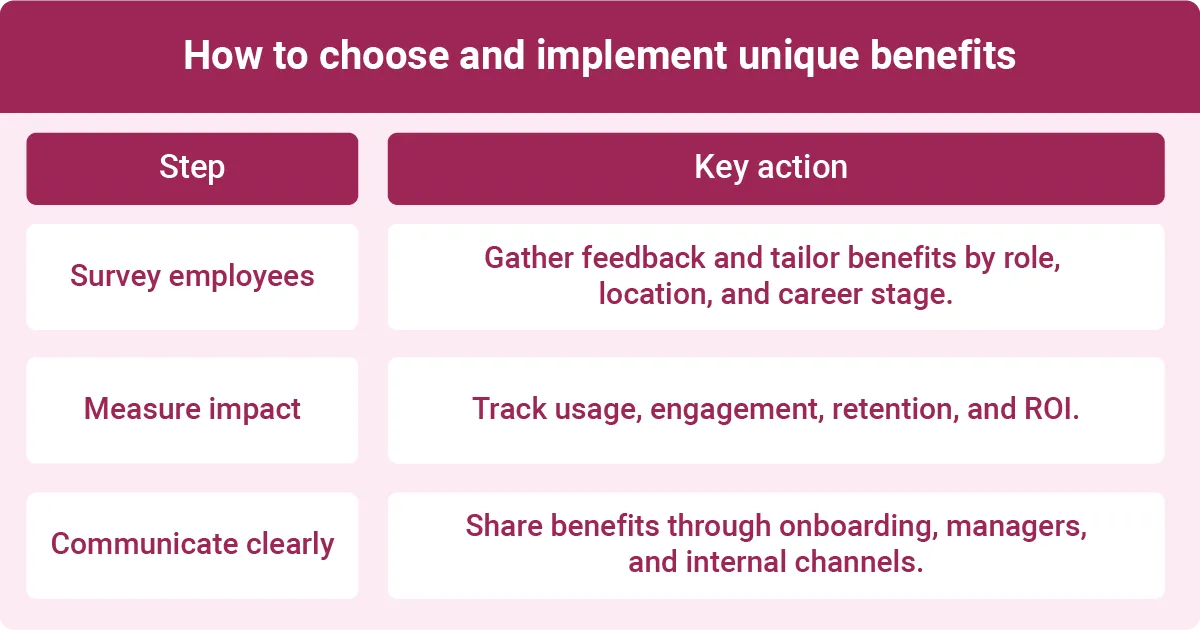
What works for one organization won’t automatically work for yours – at least not in the same way. Find out which benefits work best for your company by asking employees what they want, need, and prefer. Then, tailor benefits based on your findings and budget.
Measuring benefit effectiveness
Track benefit utilization rates, run surveys that ask employees how likely they are to recommend your organization, monitor employee engagement, and compare the number of voluntary resignations recorded before and after your program. Compare benefits’ costs versus value as well, and stick with perks that offer positive returns on investment.
Communicating unique benefits to employees
Let employees know about your perks across all available touchpoints – orientations, monthly or annual meetings, training sessions, manager briefings, intranet, employee portals, and collaboration tools. Communication is especially vital for new hires, people undergoing transitions covered by your benefits (such as new parents), and employees who achieve tenure milestones.
FAQs
What are unique employee benefits?
Unique employee benefits are perks that go beyond traditional offerings such as legally mandated PTO and health insurance. They typically vary across organizations because HR teams tailor them to employees’ unique needs and preferences. For example, a company with many recent graduates might have a student loan repayment benefit.
What companies offer the most unique employee benefits?
Companies with unique benefits include:
- Propellernet: “Dream Ball” program that gives employees a chance to check off items from their bucket lists
- Trupanion: Gives employees bereavement leave for their pets
- BrewDog: Offers “pawternity” leave to employees with new puppies or rescue dogs
- REI: Provides additional PTO to encourage employees to spend time outdoors
What are some creative employee benefits examples?
Creative employee benefits address employees’ specific needs, interests, and lifestyles instead of mirroring popular packages. They can also reinforce the company’s values. Popular options include four-day workweeks, fertility support, home office setup stipends, lifestyle spending accounts, pet-related offerings, paid time off for volunteer work, and recognition for upholding company values.
What unique employee benefits improve retention?
The most effective employee benefits typically meet three core employee needs and wants: flexibility, financial wellness, and recognition. They include hybrid work options, additional PTO, student loan repayment assistance, earned wage access, financial coaching, peer-to-peer recognition, service awards, and manager-led appreciation.
What are affordable, unique employee benefits for mid-size companies?
Some affordable benefits options for mid-sized companies include:
- EAPs
- Tax-advantaged health coverage and retirement plan solutions such as ICHRAs and SIMPLE IRAs
- Section 125 cafeteria plans
- Peer recognition initiatives
- Additional PTO for special occasions such as birthdays
- Internal mentorship programs
- Remote or hybrid work arrangements

Ryan Stoltz
Ryan is a search marketing manager and content strategist at Workhuman where he writes on the next evolution of the workplace. Outside of the workplace, he's a diehard 49ers fan, comedy junkie, and has trouble avoiding sweets on a nightly basis.
Recommended for you