
How to Identify Leadership Potential: 9 Signs and a Proven Process
by Ryan Stoltz
Last updated
10 min read

Table of contents
- What is leadership potential?
- Why identifying leadership potential early matters
- 9 signs of leadership potential in employees
- How to identify leadership potential: a 6-step process
- The biases that hide your future leaders
- How Workhuman Future Leaders™ identifies leadership potential with real data
- Frequently asked questions
- Find your future leaders before someone else does
Share this article
Every organization has future leaders sitting in it right now. The challenge is knowing how to identify leadership potential before it's too late: a high-potential analyst leaves for a competitor, a quietly influential team lead gets passed over, or a senior role gets filled externally when a strong candidate may already be inside the organization.
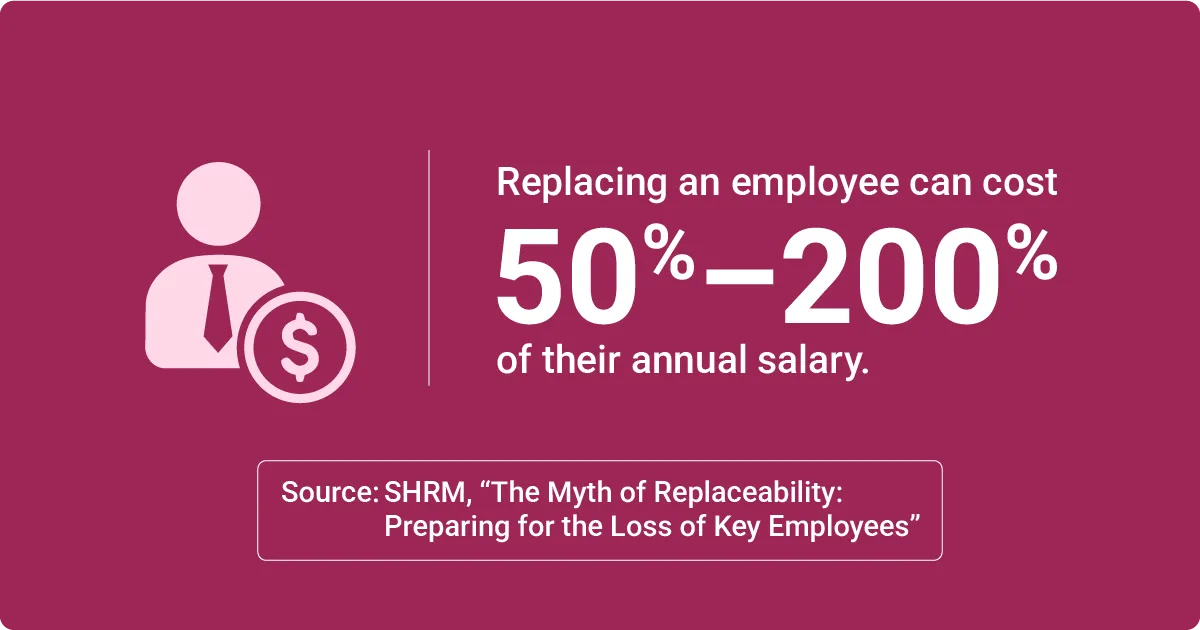
The cost of getting this wrong is steep. SHRM’s “The Myth of Replaceability: Preparing for the Loss of Key Employees” estimates that replacing an employee costs 50% to 200% of their annual salary, and “There Are Significant Business Costs to Replacing Employees,” by the Center for American Progress, found that for senior and executive roles it runs as high as 213%.
The risk doesn't end once the seat is filled, either: “Successfully transitioning to new leadership rolesOpens in a new tab,” by McKinsey, reports that 27% to 46% of executive transitions are regarded as failures or disappointments two years later, and “Heidrick and Struggles study of 20,000 searches highlights need for onboarding improvements,” by PrimeGenesis, found 40% of executives hired at the senior level are pushed out, fail, or quit within 18 months.
Meanwhile, people who could potentially grow into those roles may already be on the payroll, demonstrating leadership behaviors that traditional talent processes don't always capture.
What is leadership potential?
Leadership potential is an employee's capacity to grow into roles of greater scope, influence, and responsibility, and to succeed once they get there. It's a forward-looking measure. It asks not "how well is this person performing today?" but "what could this employee's leadership trajectory and timeline look like?"
That distinction matters because leadership potential is often confused with two things it is not:
- Current performance: Your top salesperson or star engineer may or may not make a great leader. Performance tells you someone excels in their current role. Potential tells you they can excel in a bigger, different one.
- Ambition or visibility: The person who speaks up most in meetings or lobbies hardest for promotion isn't automatically your strongest future leader. Potential can also show up through quieter forms of influence, including being someone colleagues seek out for help or someone who helps others perform at their best.
Some of the more popular talent frameworks break leadership potential into a few core dimensions: the ability to learn and grow (learning agility, cognitive skills), the aspiration to take on more (drive, motivation for leadership rather than just title), and engagement with the organization (commitment, alignment with values).
A person needs all three. Ability without aspiration produces a great individual contributor. Aspiration without ability produces a risky promotion.
Why identifying leadership potential early matters
The problem isn't that leaders don't see the value. Mercer found that 68% of C-suite executives believe better identification of high-potential talented employees could unlock greater performance.
Yet the same report on the current crisis in leadership found that only 37% of HR leaders say their current high-potential identification and succession planning works well. Getting leadership identification right isn't just a nice-to-have for HR.
It can have broader implications for hiring, retention, the strength of an organization's leadership pipeline, and business outcomes. It has direct, measurable business consequences.
Internal pipelines can reduce reliance on external hiring. External senior hires can carry significant recruiting costs and may need time to learn the organization, its people, and its culture. When a significant share of outside executive hires underperform or leave within two years, every internal leader you successfully develop is both a cost avoided and a risk reduced.
Internal promotions also carry institutional knowledge, existing relationships, and cultural fluency that take time for external candidates to acquire.
Leadership opportunities can support retention. Many high-potential employees have a sense they can develop into leaders. If they don't see a path upward inside your organization, they may look for one outside it. High-potential employees with good track records and a hunger to level up are exactly the types most attractive to competitors. Identifying them early in your organization lets you invest in their growth before someone else does.
Tracking leadership potential strengthens succession planning. Fewer than a third of CHROs say their organization excels at selecting the right leaders. Periodic talent reviews provide an important snapshot, but employees and organizational needs continue to evolve between review cycles.
Bias can shrink your talent pool. When potential is identified informally, often based on who a manager notices or who fits an existing leadership mold, organizations can overlook capable people. A structured, evidence-based approach widens the pool and produces a leadership bench that reflects the full talent of the workforce.
9 signs of leadership potential in employees
Leadership potential can show up in observable behaviors long before someone holds a formal leadership title. Here are nine signs to watch for:
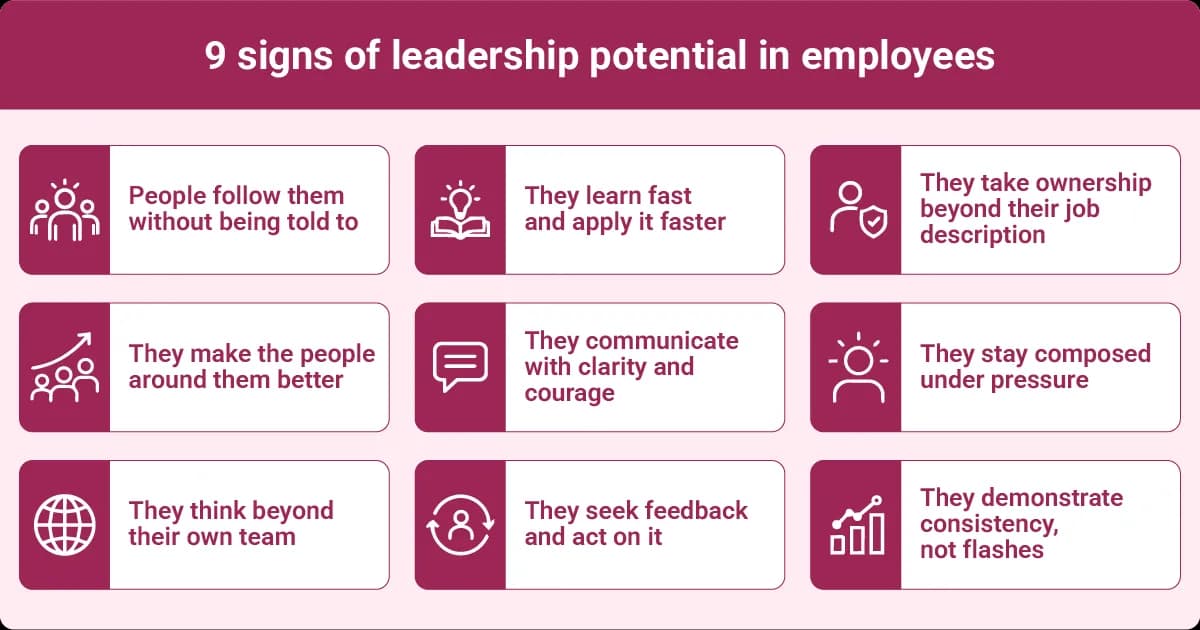
1. People follow them without being told to
Influence without authority can be one of the clearest signals of leadership potential. Notice who colleagues turn to with questions, who informally coordinates work across teams, and whose opinion others seek out. Employees who can build trust and influence others without a formal title may already be demonstrating many of the qualities associated with effective leadership skills.
2. They learn fast and apply it faster
Learning agility, the ability to absorb new information, extract lessons from experience, and apply them in unfamiliar situations, is one of the strongest research-backed predictors of leadership success. High-potential employees understand their knowledge gaps and areas of weakness and actively develop new skills.
Over time, they may ask more insightful questions and demonstrate an ability to learn from mistakes rather than repeat them.
3. They take ownership beyond their job description
Future leaders act like owners before anyone asks them to. They flag problems outside their lane, volunteer for the messy project no one wants, and think about outcomes for the team and the business rather than just their individual scorecard.
4. They make the people around them better
Watch for the employee who onboards new hires without being assigned to, shares credit generously, coaches struggling teammates, and celebrates others' wins. Leadership is fundamentally a multiplier role, and the people who instinctively multiply others are telling you something important.
5. They communicate with clarity and courage
High-potential employees can explain complex issues simply, tailor a message to the audience, and, critically, say hard things respectfully. Someone who can deliver honest, constructive pushback to a senior person, and hear the same in return without getting defensive, is demonstrating an important leadership skill.
6. They stay composed under pressure
Deadlines slip, projects fail, priorities change. Future leaders know how to manage stress without passing it down. Emotional steadiness in turbulence is what teams often look for in a leader before anything else, and you can observe it most clearly when things actually go wrong. Pay attention during the hard weeks, not the easy ones.
7. They think beyond their own team
Potential leaders connect their work to the bigger picture and understand how it supports the overall business strategy. They understand how their function affects others, build relationships across departments, and frame decisions in terms of what's good for the business.
8. They seek feedback and act on it
Asking for feedback is common. Acting on it visibly is not. Employees who treat criticism as data, close the loop on what they heard, and demonstrably change are showing the emotional intelligence, self-awareness, and humility that leadership roles demand at every level.
9. They demonstrate consistency, not flashes
One heroic project doesn't equal leadership potential. Future success can be found in the steady, repeated demonstration of these behaviors across different situations, teams, and levels of pressure.
Consistency over time can provide stronger evidence of a genuine emerging leader than a single standout moment, and it's something one-off assessments and annual reviews may not fully capture.
How to identify leadership potential: a 6-step process
Spotting the signs is the starting point. Turning observation into a reliable, repeatable system takes structure. Here's the process.
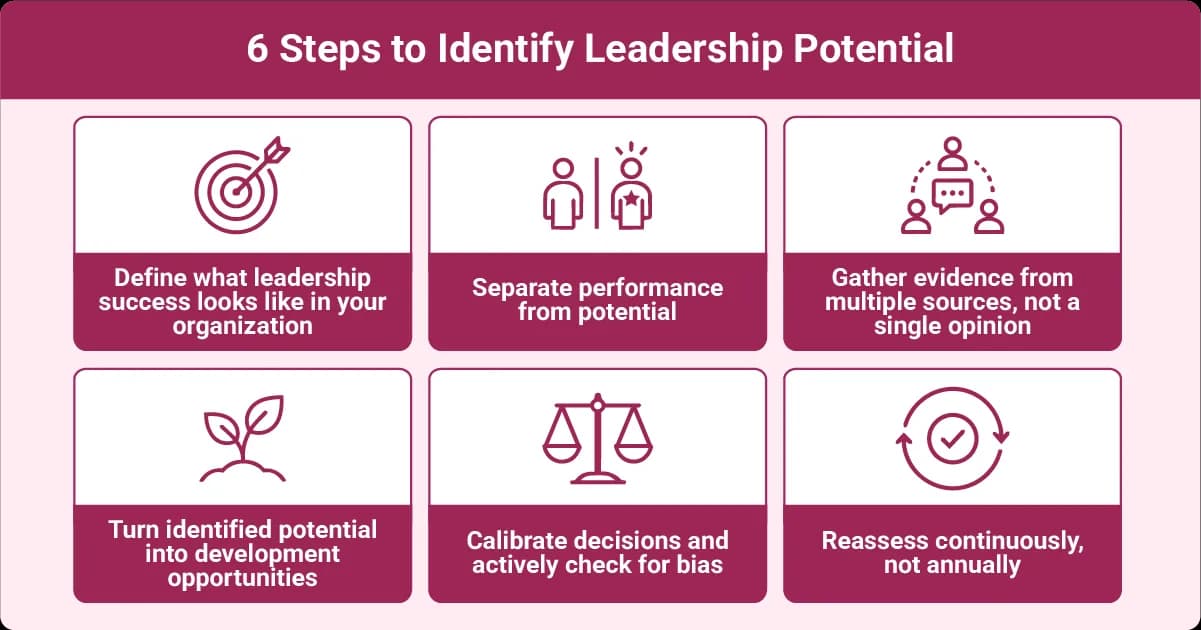
Step 1: Define what leadership success looks like in your organization
Generic lists of leadership attributes and competencies are a weak foundation because leadership is contextual. What makes someone’s leadership style effective at a fast-moving startup differs from what works in a heavily regulated enterprise.
Start by studying your own successful leaders: what behaviors, decisions, and relationships actually distinguish them? Build your criteria from that evidence, not from a template.
Step 2: Separate performance from potential
Use a framework, such as the classic 9-box grid, as one example, that assesses performance and potential as distinct dimensions. Two employees can perform equally well today and have very different capacities for broader leadership.
Results show what someone accomplished in a particular context. Behavioral signals — including how they collaborate, influence others, learn, and operate across boundaries — help reveal whether their impact can scale.
Define what evidence counts for the potential axis, such as learning agility, influence, aspiration, and the behaviors above. This helps prevent one of the most common leadership-identification mistakes: assuming your strongest individual contributor is automatically your strongest future leader.
Step 3: Gather evidence from many sources, not one opinion
A single manager's assessment provides a limited lens and can also introduce individual bias. Widen the aperture:
- Peer input and 360-degree feedback reveal influence and collaboration that managers can't see.
- Recognition data can reveal who colleagues repeatedly turn to for expertise, who creates impact across team boundaries, who elevates others, and who consistently demonstrates company values in the way they work.
- Detailed recognition messages can capture signals about good leadership skills, relationships, projects, strategic initiatives, and business impact that rarely appear together in an annual review.
- Validated assessments of cognitive ability, personality, and situational judgment add objective signals.
- Skip-level conversations surface how work actually gets done below the surface.
The goal isn’t to replace performance reviews, 360 feedback, assessments, or succession planning. It’s to widen the aperture. These systems provide important information about what someone has done; continuous behavioral signals can add an earlier view of what someone may be becoming capable of.
Step 4: Turn identified potential into development
Identifying a future leader is only useful if you give them opportunities to become one. Use stretch assignments, cross-functional projects, mentorship and sponsorship, structured rotations, peer cohorts, and frequent feedback to expose emerging leaders to increasingly complex challenges.
Step 5: Calibrate decisions and actively check for bias
Bring managers together to review candidates against the same criteria with evidence on the table.
Ask the uncomfortable questions directly: Does our high-potential list reflect the diversity of our workforce? Are we rewarding visibility or impact? Would we rate this same behavior differently coming from someone else? Collaboration can surface inconsistencies and potential bias in talent decisions.
Step 6: Reassess continuously, not annually
People grow, roles change, and new talent joins. A high-potential list compiled every 12 months can quickly become outdated. Build regular check-ins on your pipeline into your talent rhythm, and treat identification as an ongoing process rather than an annual event.
The biases that hide your future leaders
Even well-designed processes leak. These are the failure modes to guard against:
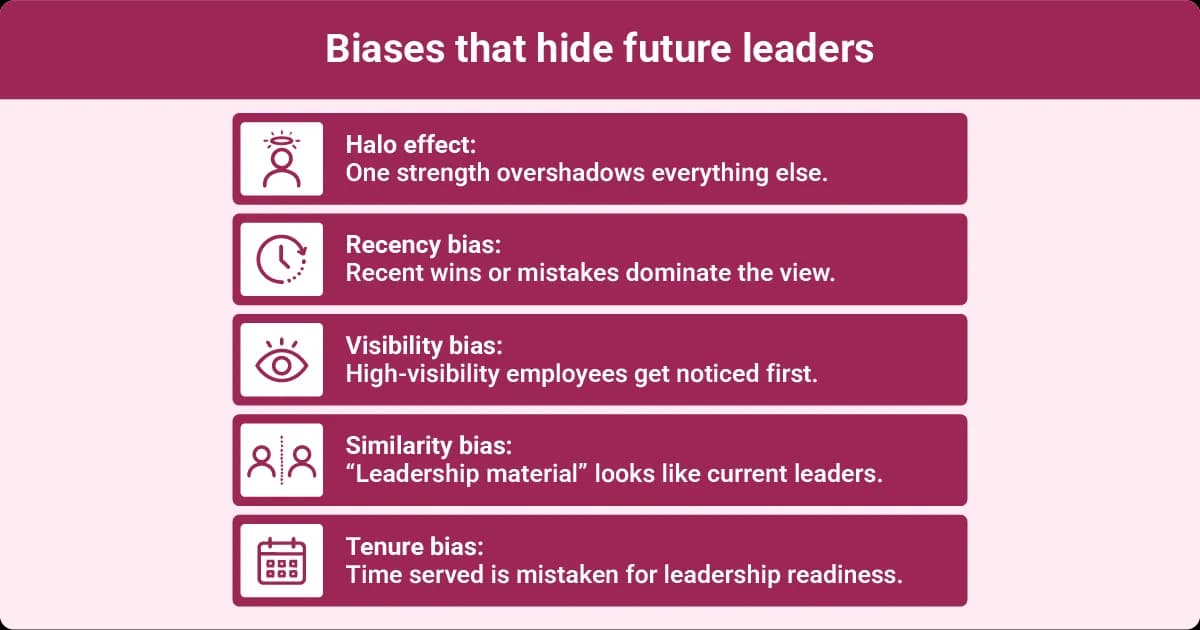
- The halo effect: Excellence in one visible area (sales numbers, technical brilliance) gets mistaken for excellence in everything, including leadership.
- Recency bias: One great recent quarter outweighs years of evidence, or one recent stumble erases them.
- Visibility bias: Employees close to decision-makers, in headquarters, or in high-profile functions get noticed; remote, frontline, and quietly effective people don't.
- Similarity bias: "Leadership material" quietly becomes "resembles our current leaders," which recycles the same profile and narrows your bench.
- Tenure bias: Time served gets treated as evidence of readiness, while high-potential earlier-career employees wait in line.
The common thread: these biases can become harder to detect when relying on scheduled managerial impressions and limited data. Continuous behavioral signals can give talent leaders another source of information to consider alongside traditional talent processes.
How Workhuman Future Leaders™ identifies leadership potential with real data
This is where the traditional playbook hits its ceiling. Even a disciplined process built on reviews, 360s, and calibration meetings still runs on periodic snapshots and human recall. Thousands of everyday moments where employees influence, help, and elevate each other may not make it into traditional talent discussions.
Workhuman's Future Leaders™ was built to close that gap. It turns an organization's recognition data, the continuous stream of peer-to-peer appreciation, awards, and acknowledgments flowing through Workhuman's platform, into a living, predictive model of leadership potential.
Here's how it works:
- It maps what leadership success looks like in your organization. Workhuman's proprietary Ascend AI analyzes your people data to build a leadership blueprint specific to your company, mapping behavioral signals against the traits of your own successful senior leaders rather than a generic template.
- It spots rising talent in real time. The model continuously reads signals like recognition patterns, cross-functional collaboration, and peer acknowledgments to surface employees who are consistently demonstrating leadership behaviors, including the quietly influential people who may be less visible through traditional processes.
- It recalibrates as things change. As employees grow and organizational dynamics shift, the model updates, providing a more current view of the pipeline than a point-in-time annual talent review.
- It provides evidence behind its recommendations. Future Leaders surfaces the evidence behind its recommendations, helping talent leaders understand why someone has emerged as a potential leader rather than relying on an opaque score. Mercer US Digital Advisory Lead Mike Brennan points specifically to its transparency and bias-aware design as important to clients.
The result, in Workhuman's words: organizations can know their future VP+ leaders up to four years before they hold the title. As Workhuman CEO Eric Mosley put it at launch, "Now companies can know who their next generation of senior leadership will be years earlier, with a level of confidence no traditional process can match."
Early reactions echo that. Lisa Monaco, SVP and Head of Employee Experience at Moody's, described it this way: "As a leader, I'm constantly pushing us to move from reactive talent decisions to something more predictive, and this is exactly what enables that."
And Mercer's US Digital Advisory Lead Mike Brennan called it "like a talent radar that cuts through the fog of familiarity," pointing to its transparency and bias-aware design as exactly what clients are looking for.
For organizations already running recognition programs, this is the payoff of all that data: everyday moments of appreciation can become additional evidence, helping provide a real-time view of leadership potential and enabling talent leaders to develop their leadership pipeline based on behaviors employees are already demonstrating.
Frequently asked questions
What is the difference between high performers and high potentials?
High performers excel in their current role. High potentials have the ability, aspiration, and engagement to succeed in larger, more complex leadership positions in the future. While the two groups can overlap, strong performance in a current role doesn't necessarily indicate readiness or potential for leadership.
How early can you identify potential leaders?
Earlier than most organizations do. Leadership behaviors like influence, learning agility, and elevating others can emerge before an employee is considered for a formal leadership role. Tools that analyze continuous behavioral data, like Workhuman's Future Leaders, can surface likely future senior leaders up to four years before they hold the title, giving you a long runway to develop them.
What is the best tool for identifying leadership potential?
The best approach combines a structured process (clear criteria, multi-source evidence, calibration) with data that captures how employees actually behave day to day. Assessments and 360s add valuable signals, but recognition-based platforms stand out because they draw on continuous, organic peer evidence alongside these periodic inputs, providing another perspective on leadership potential.
How do you identify leadership potential in remote employees?
Remote employees are especially vulnerable to visibility bias, so rely on evidence rather than presence. Peer recognition, cross-functional collaboration patterns, and outcomes of stretch assignments all travel across distance in a way that hallway impressions never did. Data-driven identification can level the field for distributed teams.
Find your future leaders before someone else does
Your next generation of leaders is already in the building. They're the people colleagues quietly rely on, the fast learners, the ones making everyone around them better. The organizations that win the next decade will be the ones that can see those people clearly, invest in them early, and give them more opportunities to grow.
You can start today: define what leadership means in your organization, look past performance ratings to behavior, widen your evidence beyond a single manager's opinion, and check your process for bias. And if you want to add a continuous, predictive view to your existing talent processes and pipeline, see how Workhuman's Future Leaders works and start building your 2030 leadership team now.

Ryan Stoltz
Ryan is a search marketing manager and content strategist at Workhuman where he writes on the next evolution of the workplace. Outside of the workplace, he's a diehard 49ers fan, comedy junkie, and has trouble avoiding sweets on a nightly basis.