How to Boost Employee Morale at Work: Practical Strategies That Actually Work in 2026
Table of contents
- What is workplace morale, and why does it matter?
- Recognizing the signs: How to identify low morale
- Quick wins: Simple ways to improve team spirit immediately
- Strategic approaches: Comprehensive morale-building strategies
- Employee engagement activities that drive morale
- Employee morale strategies for remote and hybrid teams
- Rebuilding employee morale after organizational challenges
- How individual contributors can improve team morale
- Measuring success: tracking high employee morale over time
- FAQs
If your team’s engagement, retention numbers, or productivity are sinking, the reason is often obvious: morale. Low morale manifests in missed deadlines, rising absenteeism, quiet quitting, and a general sense that people are just there for the paycheck.
While it's easy to dismiss morale as a soft metric, the business impact is anything but. The Gallup research titled “What Is Employee Engagement, and How Do You Improve It?Opens in a new tab” shows that high morale correlates with lower turnover, stronger performance, and better customer outcomes. The challenge for HR leaders and managers in 2026 isn't whether to prioritize morale, but how to improve it in meaningful, lasting ways.
This guide explains how to boost morale at work, including diagnosing morale issues and implementing and measuring the success of evidence-based interventions. You'll find practical strategies to start today, long-term approaches for resilience, and metrics to prove return on investment (ROI).
Morale isn't frosting; it's infrastructure.
What is workplace morale, and why does it matter?
According to the Encyclopedia of Industrial and Organizational Psychology, workplace morale “refers to employees' shared attitudes toward and identification with the elements of their job, working conditions, fellow workers, supervisors, and general management. As a group-level term, morale is akin to the affective climate of an organization.”
High morale means employees feel supported, optimistic, connected, and motivated. Low morale means they're disengaged or simply counting down the hours.
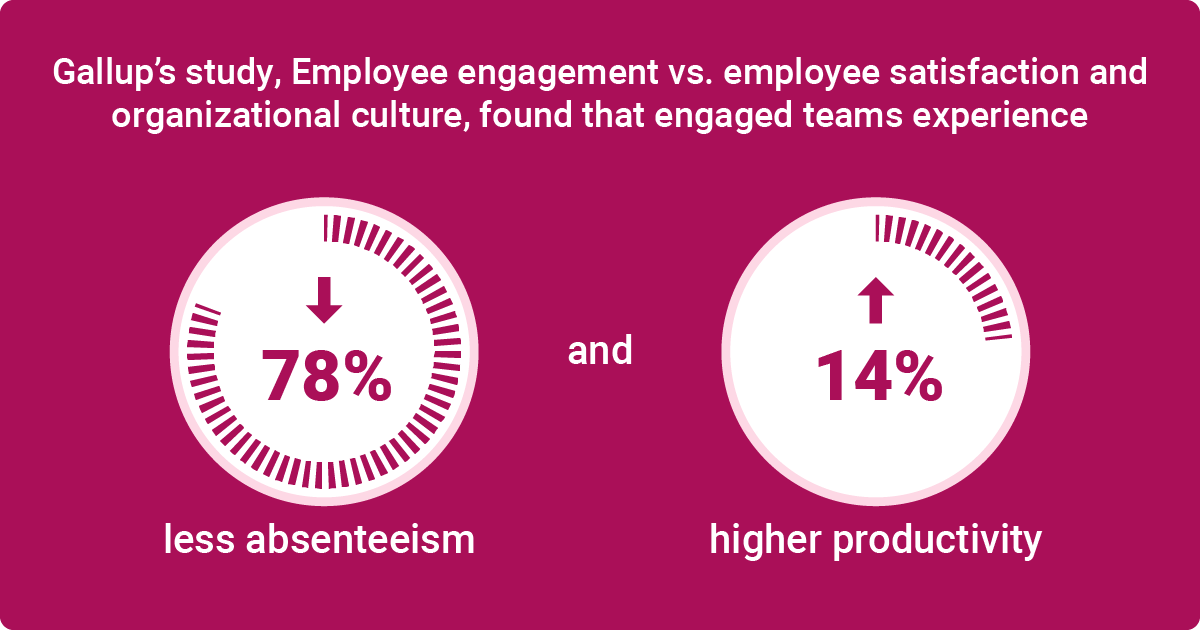
Organizations with strong morale experience measurably better employee retention, higher productivity, improved employee engagement, and better overall performance. Gallup, in its recent study, “Employee Engagement vs. Employee Satisfaction and Organizational Culture”, found that business units with an engaged workforce experience 78% less absenteeism and 14% higher productivity.
On the other hand, low employee morale costs companies money. Kreischer Miller, via their article “The True Costs of High Employee Turnover”, reported that turnover expenses alone can reach 30-250% of an employee's annual salary. Add in absenteeism, decreased output, and higher error rates, and the cost rises further.
Intrinsic vs. extrinsic motivation: The psychological foundation
When considering ways to boost employee morale at work, it’s essential to understand what drives people.
- Intrinsic motivation is doing work because it's interesting, meaningful, or fits your personal values; it’s about autonomy, mastery, and purpose.
- Extrinsic motivation is doing work mainly for external rewards like compensation, benefits, bonuses, or status.
Both types work together to sustain morale. It’s bad business to rely only on extrinsic rewards, as people will stay only as long as the paycheck is competitive. Relying solely on intrinsic motivation, on the other hand, ignores that people have bills to pay. The strongest morale strategies, as per the article “The Contribution of Reward Systems in the Work Context”, combine both: pay people fairly and give them meaningful work, autonomy, and growth opportunities.
Morale vs. engagement vs. satisfaction
These three concepts overlap but aren't interchangeable:
- Morale: A group of employees' overall attitude, spirit, and collective emotional state (such as happiness and confidence)
- Engagement: An employee's emotional commitment, enthusiasm, and willingness to go the extra mile for their company
- Satisfaction: An employee's positive feeling about their job and its conditions (such as pay, work-life balance, and colleagues)
You can have satisfied employees with low morale: content enough to stay, but not excited or energized. We'll unpack the concepts of morale, engagement, and employee satisfaction in more depth later in this article.
Recognizing the signs: How to identify low morale
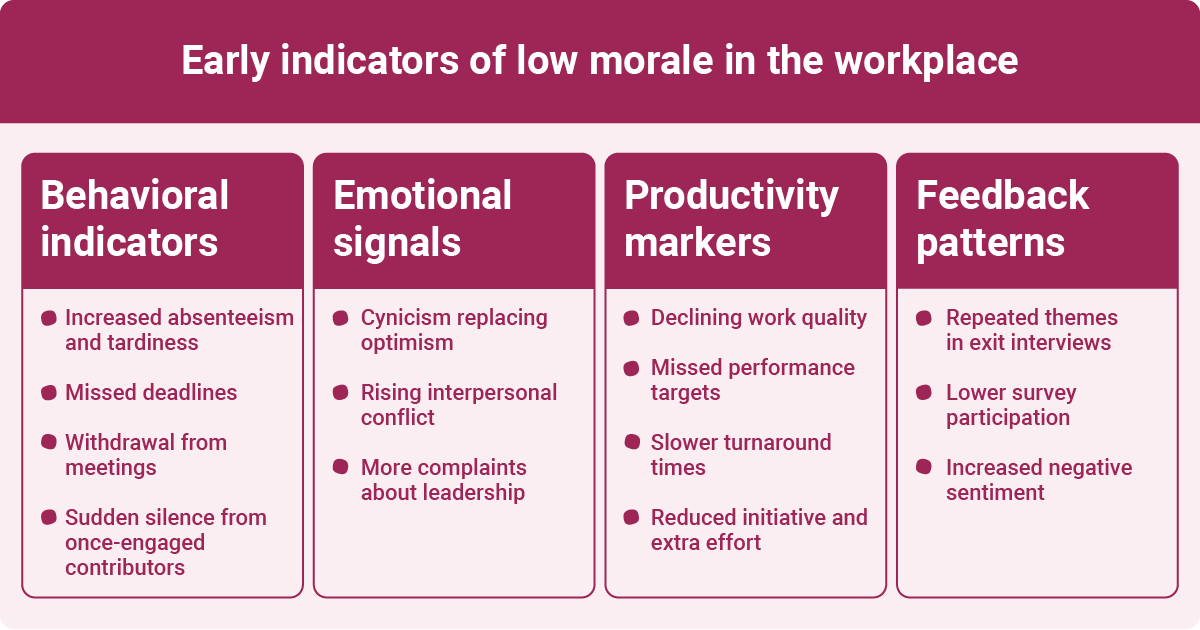
Low morale emerges in patterns of behavior, emotional signals, and lessening productivity.
- Behavioral indicators: Increased absenteeism, tardiness, missed deadlines, withdrawal from meetings, sudden quiet from former enthusiastic contributors.
- Emotional signals: Cynicism replaces optimism; increased interpersonal conflicts or leadership complaints.
- Productivity markers: Declining output quality, missed targets, slower turnaround times, less initiative-taking, decreased above-and-beyond behavior.
- Voluntary feedback patterns: Consistent exit interview themes, declining survey response rates, and increased negative sentiment.
Without intervention, low morale can precede voluntary turnover, as evidenced by Gallup in the article “42% of Employee Turnover Is Preventable but Often Ignored”.
Root causes of poor employee morale
The research paper, “Job morale: a scoping review of how the concept developed and is used in healthcare research”, indicates that several organizational and psychological factors influence workplace morale, including leadership quality and style, feedback and incentives, job autonomy, and the nature of employee-management relationships.
Tools for measuring and tracking morale
Improving morale is impossible without first gauging its severity over time. You can use various tools to measure and track employee morale. Examples include surveys and employee feedback tools, direct and qualitative methods, like one-on-one meetings and focus groups, key performance indicators (KPIs), and metrics, which we'll explain in more detail near the end of this guide.
Another helpful morale-tracking tool is Workhuman® iQ™, which mines recognition data for insights into cultural health and people dynamics. The AI Assistant responds to inquiries about trends across departments, providing easy-to-digest summaries without requiring data analysts.
Get the most from your recognition program with Human Intelligence®. Harness the combined powers of AI and recognition to surface insights into people dynamics, cultural health, employee performance, and skills.
Our new AI Assistant proactively coaches you to monitor and improve the effectiveness of your recognition program. Use open-ended prompts to generate reports and highlights that can be quickly put into action.
Check out Workhuman's latest product innovationOpens in a new tab →
Quick checklist: Common signs of low morale
- Noticeable drop in participation during meetings or optional events
- Increase in absenteeism and late arrivals over weeks or months
- More frequent complaints or negative humor directed at leadership
- Declining work quality and missed deadlines
- Reduced peer-to-peer recognition
- Higher turnover or employees exploring external opportunities
Quick wins: Simple ways to improve team spirit immediately
Providing your team with an immediate morale boost isn't as tough as you might think. Public recognition in meetings costs nothing and has instant impact. Flexible scheduling or surprise early release days give people back control, and autonomy indicates trust. Asking for your team's input on small decisions restores agency.
You might consider dedicated deep-work time blocks with no meetings, which gives your people the ability to focus on important work. You can also create visible momentum by celebrating small wins; the frequency of this recognition matters far more than the size of the award.
Socialization can also improve morale. Encourage informal social connections by scheduling coffee chats between team members or creating virtual remote-team hangouts.
Zero-budget morale boosters
Consider these budget-friendly practices for improving employee morale:
- Peer recognition programs using existing tools
- Skill-sharing sessions
- Walking meetings
- Team traditions or rituals
- Regularly explaining the "why" behind projects
- Connecting tasks to the bigger mission
- End the week or quarter with a quick “win review”: What moved forward? What did we learn? Who helped unblock it?
Fun and creative morale boosters
Playfulness at work can provide a much-needed morale boost. Some ideas include:
- Themed dress-up days
- Surprise treats or catered lunches
- Office pets or pet visitation days
- Gamifying mundane work
- Laughter initiatives
- Celebrating personal milestones and achievements
- Office plants and greenery
Budget-tiered morale ideas: Free, low-cost, and investment options
- Free: Meeting-based win reviews, flexible scheduling, peer-learning swaps, public recognition
- Low-cost ($0-500): Recognition points redeemable for rewards, team lunch, books, office plants, branded swag
- Medium-cost ($500-5,000): Catered events, professional development, team outings, wellness subscriptions
- Higher investment ($5,000+): Bonuses, benefits upgrades, retreats, sabbatical programs
To justify investment, calculate the cost of replacing one employee, which, according to the Gallup article, 'This Fixable Problem Costs U.S. Businesses $1 Trillion,Opens in a new tab' can range anywhere from one-half to double the employee's annual salary.
If spending a few dollars (or a few hundred) can prevent even one departure, it's still preferable to avoid the cost of turnover. Frame it as retention insurance.
Strategic approaches: Comprehensive morale-building strategies
Quick wins count, but they won't fix systemic issues. Thoughtful strategies address underlying conditions that affect morale. Although these strategies may take some time to implement, doing so will benefit your company in the long term.
For example, fair, competitive compensation must be the baseline before you begin adding in perks and extras. Transparent communication increases trust and morale, so holding town halls and scheduling open office hours goes a long way.
Google's Project Aristotle research found that psychological safety was the most important factor in high-performing teams. Psychological safety comes from leaders who normalize learning from failure, encourage dissent, and admit mistakes.
Research on self-determination theory shows that motivation hinges on autonomy, so give people project ownership and flexibility. Show employees how their efforts contribute to the organization's success and goals.
Design inclusive, equitable policies that promote belonging. Developing an action plan for employee engagement helps turn strategies into a concrete roadmap.
Manager actions: What leaders can do today
- Conduct one-on-ones focused on well-being and career aspirations, not just tasks.
- Practice active listening and clarify next steps.
- Advocate for your team using data.
- Model work-life balance through visible boundary-setting.
- Provide specific, timely feedback.
- Empower employees with ownership.
- Share context and practice transparency.
- Remove obstacles proactively.
Professional growth and career paths
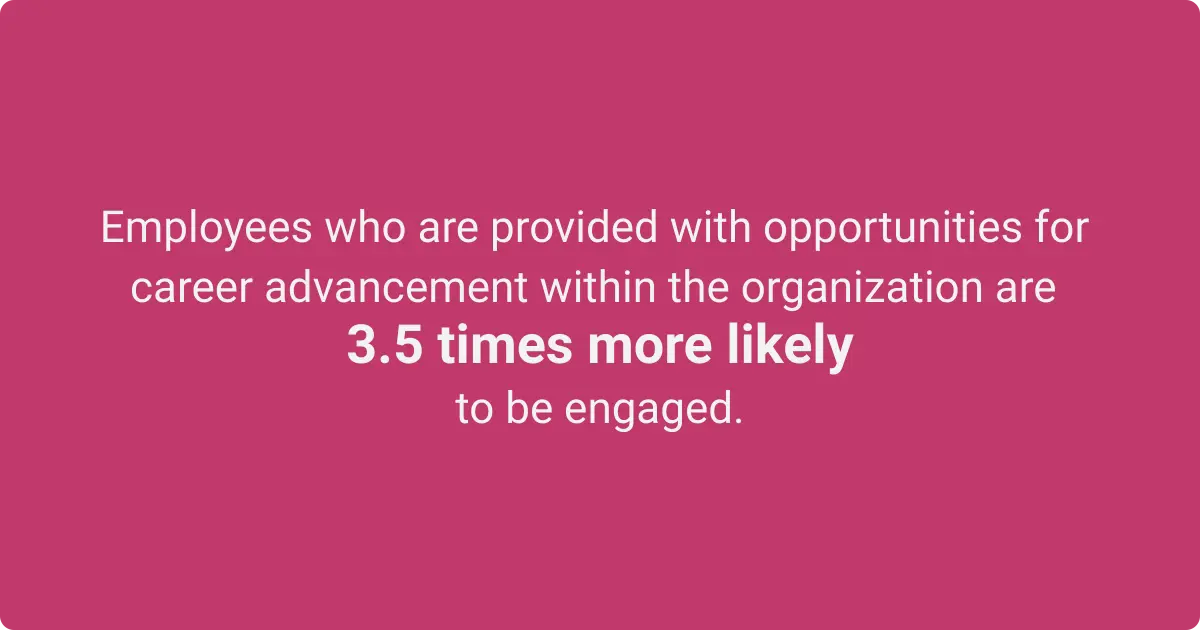
Invest in your employees' growth and development. When people see a potential future at your organization, they'll invest themselves in the present.
Offer training aligned with current and future aspirations. Lay out career paths and progression criteria. Implement mentorship programs and ongoing learning opportunities. Provide project rotations that build new skills. Discuss growth regularly, one-on-one.
The role of employee recognition in morale
Employee recognition and engagement go hand in hand. Recognition is a powerful tool for boosting employee morale. Regular recognition has more impact than a "good job" here and there.
Specificity increases its impact, so it's important to describe the behavior or outcome being recognized and the positive effect it has on the company or team.
When you provide recognition based on the individual's preferences, such as public shout-outs for one and a private expression of gratitude for another, it feels more authentic than a formulaic approach.
Recognition is a great way to reinforce a positive workplace culture by linking it to the company's values and helping employees see how they embody those values. And while leader recognition is great, encouraging peer recognition shows your team the value of a shared culture of appreciation.
To understand how strategic recognition drives morale, learn more about employee engagement and recognition.
Workhuman's Recognition Advisor is an AI coaching tool that evaluates message authenticity and connection to company values and guides you to write specific, meaningful recognition.
Work-life balance policies that support morale
Protect employees against burnout with:
- Flexible start and end times
- Mandatory lunch breaks
- Meeting-free focus blocks
- Generous PTO policies with leadership modeling time off
- Right-to-disconnect policies
- Sabbatical options
- Family-friendly policies like parental leave
Inclusion and belonging as morale drivers
Inclusion and belonging policies drive positive employee morale by creating a sense of belonging, psychological safety, and fairness. Here's how key DEI initiatives help keep employees engaged:
- Representation in leadership shows employees they belong.
- Employee resource groups provide support and networking.
- Equitable, transparent pay and promotion processes build trust. Inclusive language and accessibility ensure full participation.
- Cultural celebrations build understanding.
- Anonymous reporting mechanisms with clear follow-up give safe channels.
- Regular training focused on everyday behaviors creates lasting change.
Employee engagement activities that drive morale
Engaging your employees in meaningful ways positively affects morale. You can encourage and strengthen bonds between employees by facilitating cross-functional collaboration. You can also send them to team-building workshops or social events like volunteer days, allowing them to connect as people.
Show the people that you care about employee wellbeing by implementing wellness initiatives and their intellectual stimulation by forming learning communities, such as book clubs or speaker series.
For more ideas, check out this expanded list of employee engagement activities for work that supplement quick wins.
Team-building vs. individual rewards: Which works better?
Team building activities develop cohesion but risk excluding remote or introverted employees. Individual rewards provide personalized recognition but risk creating competition. A hybrid approach works best. Context matters—new teams may need more team-building, while established teams may appreciate individual recognition more.
Physical wellness and work environment improvements
Wellness initiatives benefit employees in countless ways, from improving their physical and mental health to fostering a stronger connection to their workplace and boosting morale. Consider providing:
- Mid-workday fitness classes
- Standing desks and ergonomic equipment
- Natural lighting and biophilic design
- Healthy snacks
- Quiet rooms for decompression
- Active commute incentives like bike storage, shower facilities, or transit subsidies
Employee morale strategies for remote and hybrid teams
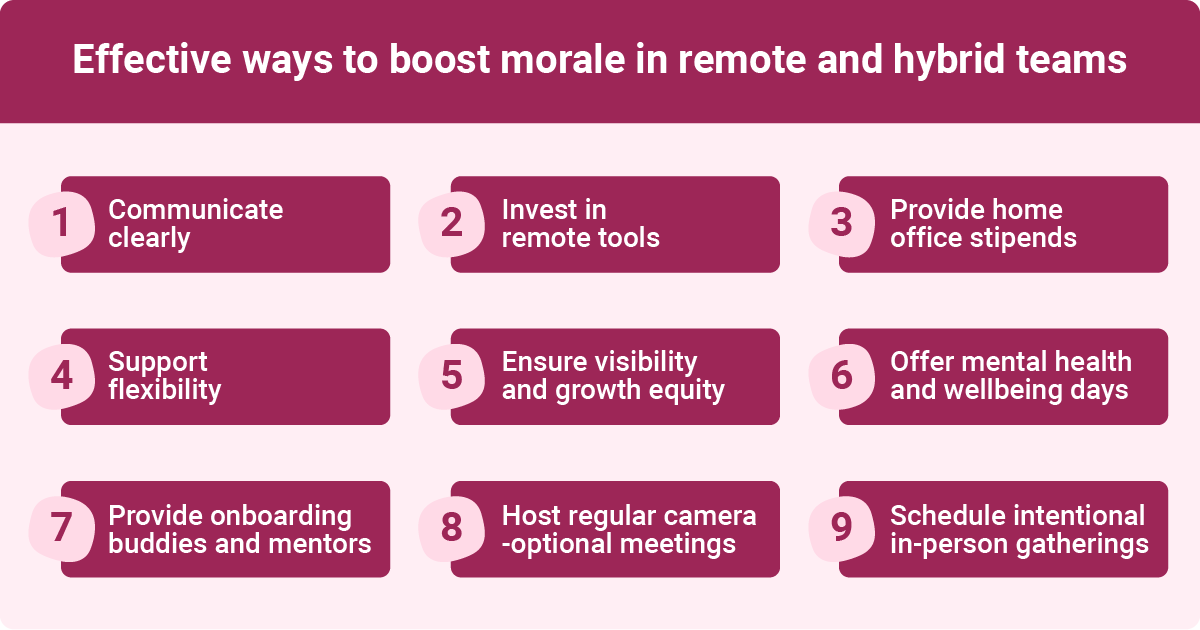
Morale isn't just an in-person workplace issue. It affects remote and hybrid-schedule employees just as deeply. Some morale-lifting approaches that work particularly well for distributed teams include:
- Overcommunicating to compensate for the lack of ambient awareness
- Investing in collaboration technology, implementing virtual recognition walls, and creating virtual water cooler moments through collaboration channels
- Providing home office stipends or equipment upgrades to create comfortable, productive remote workspaces
- Implementing flexible scheduling that honors personal peak productivity times and caregiving responsibilities
- Ensuring visibility and growth equity between remote and in-office employees
- Giving mental health days and wellbeing days that leadership explicitly encourages and models
- Providing onboarding buddies and mentors for new remote hires to reduce isolation and hasten integration
- Hosting regular camera-optional meetings and asynchronous updates to reduce video fatigue while staying connected
- Scheduling intentional in-person gatherings when possible
This guide on how to keep remote employees engaged offers more morale-boosting techniques for distributed teams.
Workhuman's integrations with Microsoft Teams, Slack, and Outlook enable employees to give and receive recognition without leaving their primary communication tools. The lightweight design supports common workflow actions to address remote challenges.
- Deep, enterprise-grade integrations, including Workday and SAP, designed to support clean data flow, high adoption, and long-term scalability.
- Strong Slack, Microsoft Teams, Viva, and Outlook integrations that embed recognition naturally into daily work — making it easy for employees to participate without changing behavior.
- Through integrations with LinkedIn and Viva Engage, employees can share recognition moments to extend reach beyond the platform, fueling greater emotional impact and increasing employer brand.
- Built for complex, global HR environments, where data accuracy, global equity, governance, compliance, and robust analytics matter.
- Integrations designed for outcomes, not just check-the-box connections — ensuring recognition data can actually be leveraged with other data sources for reporting, insight, and decision-making.
Rebuilding employee morale after organizational challenges
Crisis damages morale in many ways. Addressing your employees' concerns in an honest, timely way is essential.
- Address the post-layoff survivor's guilt: Acknowledge emotions and provide counseling resources.
- Communicate transparently: Keep your staff up to date to reduce uncertainty, especially regarding direction.
- Meet one-on-one frequently: It will allow you to address individual concerns.
- Practice and celebrate quick wins: Small victories help restore confidence in leadership.
- Plan workload redistribution: Prevent burnout among your remaining staff.
- Perform stay interviews: They will help you better understand retention risks.
- Encourage recommitment to mission: Provides stability during uncertainty.
Talogy, in the article “Transparency in leadership: The key to workplace trustOpens in a new tab”, reported that organizational transparency during downsizing predicts trust, which affects retention. Employees appreciate honesty, even when the news is difficult, as per Forbes’ “Honesty Can Feel Risky, But It's The Only Way To Lead Teams Properly”.
How individual contributors can improve team morale
Emotional contagion spreads rapidly through networks and creates ripple effects, as per the Frontiers research “Emotional Contagion: A Brief Overview and Future Directions”. One person can change the overall workspace mood by building positive peer relationships. These contributions help:
- Practicing peer recognition and thanking colleagues publicly
- Maintaining a positive attitude and solution-oriented mindset
- Offering proactive help to overwhelmed teammates
- Participating actively in team activities
- Providing constructive feedback through appropriate channels
- Modeling desired behaviors regardless of title
- Scheduling informal check-ins outside project work
- Sharing knowledge generously
- Addressing conflicts directly and respectfully
- Inviting new team members into conversations
Measuring success: tracking high employee morale over time
You can't prove ROI if you're not measuring. Tracking morale requires both quantitative metrics and qualitative signs.
- Leading indicators like survey scores, participation rates, eNPS scores, and feedback volume predict future outcomes.
- Lagging indicators like voluntary turnover rates, absenteeism, and productivity metrics demonstrate business impact.
- Qualitative signals like exit interview themes, unsolicited feedback, and internal referrals add context.
Benchmark against industry standards and your company’s historical data. Establish measurement cadence, such as through monthly pulse surveys, quarterly deep dives, and annual comprehensive studies. You can even create a dashboard that amalgamates morale, engagement, and business KPIs.
Key engagement metrics provide detailed guidance on which engagement and morale figures to track over time and how to interpret trends.
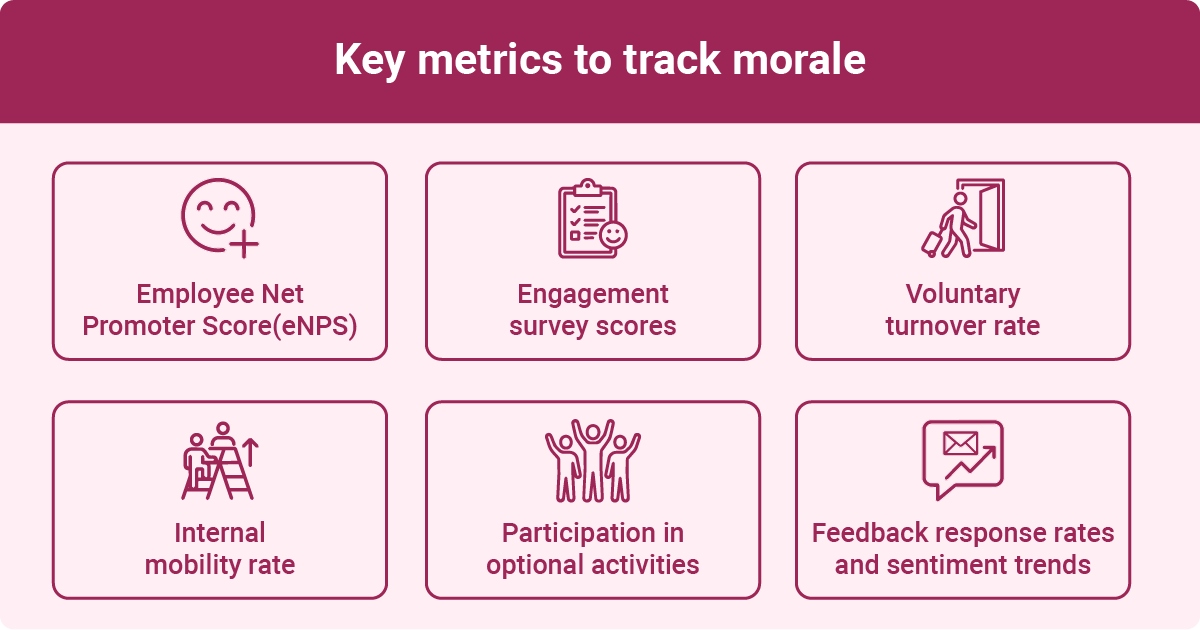
Key metrics to track
Several specific metrics reliably indicate morale health:
- Employee Net Promoter Score (eNPS): Measures employees’ likelihood to recommend the workplace
- Survey scores: Provide information about job satisfaction, work-life balance, leadership, and company culture
- Recognition reach and rates: Shows how people are connected to one another across the org
- Voluntary turnover rate: Indicates dissatisfaction and low morale
- Internal mobility rates: Indicate career growth opportunities
- Participation rates in optional activities: Demonstrates engagement
- Response rates and sentiment trends in feedback channels: Indicate areas for improvement
Connecting morale to business outcomes
Correlation isn't causation, but documenting relationships between morale and business results helps justify investment. For example, you can connect morale metrics with revenue per employee or productivity indicators over time.
Analyzing morale trends alongside customer satisfaction helps identify parallels. Calculate ROI by comparing investment costs with estimated turnover savings. Track innovation metrics before and after major initiatives. Before and after key interventions, document any noticeable productivity changes.
FAQs
What are the most common signs of low employee morale?
The most common signs include increased absenteeism and tardiness, declining participation in meetings or activities, more frequent complaints about leadership, missed deadlines or declining work quality, and reduced enthusiasm.
You might also notice more interpersonal conflicts, lower survey response rates, or consistent negative exit interview themes. The key is distinguishing temporary lows from ongoing patterns that last weeks or months.
How does employee recognition impact workplace morale?
Recognition is one of the most reliable tools for boosting morale. Employees who receive regular recognition are significantly less likely to look for new jobs. Recognition satisfies a fundamental human need to feel valued. The most effective recognition is frequent, specific, timely, and aligned with organizational values.
How can managers use communication and transparency to boost morale without a budget?
Communication and transparency cost nothing but deliver quantifiable improvements. Increase one-on-one frequency, focusing on your employees’ career aspirations and well-being. Practice active listening.
Share context about decisions and priorities, so people understand the "why" behind changes. Hold regular team meetings to share organizational updates. Practice appropriate transparency about challenges rather than pretending everything is perfect.
How long does it take to see improvement after implementing morale-boosting strategies?
The timeline varies based on severity and interventions. Quick wins like public recognition or flexible scheduling can improve morale within days or weeks. Strategic approaches like bolstering psychological safety or improving communication typically take three to six months to show measurable impact. After major challenges like layoffs, rebuilding morale often takes six months to a year. The key is combining quick wins with longer-term strategies.
About the author
Ryan Stoltz
Ryan is a search marketing manager and content strategist at Workhuman where he writes on the next evolution of the workplace. Outside of the workplace, he's a diehard 49ers fan, comedy junkie, and has trouble avoiding sweets on a nightly basis.