Flat Organizational Structure: How to Assess Fit, Implement Frameworks, and Avoid Common Pitfalls
Table of contents
- What is a flat organizational structure?
- Flat vs. hierarchical vs. matrix: Understanding the differences
- Advantages of flat structures
- Disadvantages of flat structures
- How communication and leadership work in flat organizations
- What types of organizations benefit most from a flat structure?
- Flat organizational structure examples: What companies have a flat hierarchy structure?
- How recognition supports flat structures
- Best practices for implementing and scaling a flat management structure
- Implementation checklist: Transitioning to a flat structure
- How to achieve career growth in a flat corporate structure
- The future of flat organizational culture
- Is a flat organizational structure right for your company?
- FAQs
Your team keeps waiting on approvals that slow down launches. Talented employees leave because they feel disconnected from decision-making. You know something needs to change, but you are not sure if dismantling middle management layers will solve the problem or create new ones.
A flat organizational structure removes middle management tiers to give employees direct access to leadership and faster decision-making authority. Also called a flatarchy or horizontal structure, this model emphasizes autonomy, collaboration, and decentralized decisions and control over traditional top-down hierarchy.
For some organizations, it unlocks speed and innovation. For others, it creates coordination chaos and career frustration. This guide explains what flat structures actually are, how they compare to hierarchical and matrix models, and when they work versus when they fail.
You will learn the real benefits and trade-offs, see examples from companies like Valve and W.L. Gore, and get a step-by-step implementation framework with assessment tools to determine if flattening hierarchy makes sense for your organization right now.
What is a flat organizational structure?
A flat organizational structure (sometimes called a flat hierarchy) is an organizational design with few or no layers of middle management between frontline employees and senior leaders. The goal is to reduce “vertical” reporting layers so information, decisions, and responsibility move faster through the business.
In practice, flatter organizations tend to rely on wider spans of control, meaning one manager supports a larger group of employees than in a traditional “tall” hierarchy. That dynamic often shifts day-to-day leadership from close supervision to coaching, prioritization, and removing obstacles.
Types of flat organizational structures
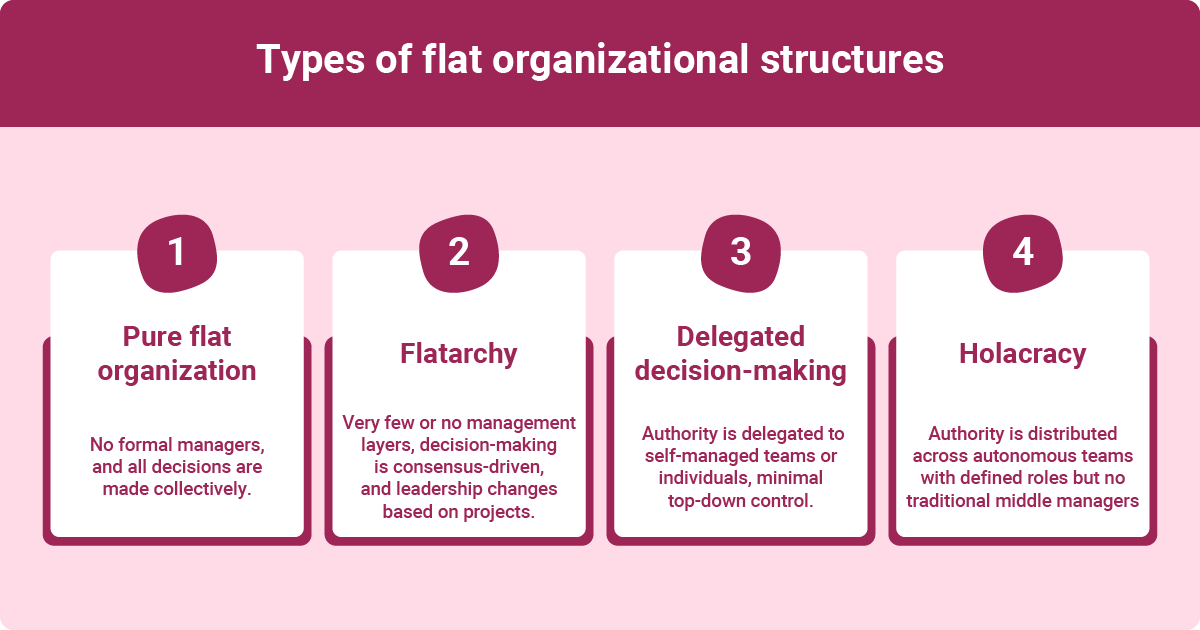
There is no formal classification of flat organizational structures, but companies vary in how they implement them:
- Pure flat organization: No formal managers, and all decisions are made collectively.
- Flatarchy: Very few or no management layers; decision-making is consensus-driven, and leadership changes based on project or task needs.
- Delegated decision-making: Authority is delegated to self-managed teams or individuals, and there is minimal top-down control.
- Holacracy: Authority is distributed across autonomous teams with defined roles but no traditional middle managers; rules replace hierarchy, and roles are regularly reassessed in governance meetings.
Key characteristics of flat organizations
These are the primary characteristics defining what a flat hierarchy is:
- Minimal hierarchy: typically two to four organizational levels total
- Wide span of control: managers overseeing larger teams instead of multiple layers of supervisors
- Decentralized decisions and authority: decision-making pushed to lower levels, giving employees more autonomy
- Open communication: fewer barriers between leadership and employees for faster, fluid communication
- Role fluidity: employees often wear multiple hats
- Team-focused approach: emphasis on collaboration, shared goals, and employee growth
Flat vs. hierarchical vs. matrix: Understanding the differences
Understanding the differences between the common organizational structures helps you position flat structures relative to familiar alternatives and choose the right model for your business. Each model serves different organizational needs and sizes and has advantages and drawbacks.
Flat vs. hierarchical structure
A hierarchical organizational structure is the traditional organizational structure where there is a clear chain of command. Think of a hierarchical structure as a pyramid, with fewer executives at the top who have the most power.
At each subsequent layer of the pyramid, employees have a distinct level of authority and responsibility. In this structure, organizational departmentalization is key, as distinct functional areas like marketing, sales, and finance operate with their own leadership and decision-making authority.
Generally, this structure is very formal, with high oversight and well-defined roles and advancement paths. It’s essentially the opposite of a flat organization structure in nearly every way, especially when it comes to:
- Decision speed: flat enables faster, decentralized decisions; hierarchical provides more oversight
- Communication: flat encourages direct exchange; hierarchical uses formal channels
- Scalability: hierarchical scales more predictably; flat faces coordination challenges at scale
- Employee autonomy: flat maximizes independence; hierarchical provides clear direction
- Role clarity: hierarchical offers well-defined paths; flat requires adaptability
Flat vs. tall organizational structure
A traditional tall organizational structure is like a mega-hierarchical system with many hierarchical levels, usually more than six layers in large enterprises. A single manager in a tall organization may only be responsible for a handful of employees, whereas in a flat organization, that same manager may be responsible for a dozen or more highly independent employees.
Multiple levels of hierarchy make for "telephone game" delays, while a flat organizational structure enables direct access. A tall structure can be slow to change and address challenges, but its layers of oversight are helpful for compliance-heavy environments.
Keep in mind that organizational height is a spectrum, and most organizations fall between pure flat and pure tall.
Flat vs. matrix structure
In a matrix organizational structure, employees may report to multiple managers. For example, an employee may report to a project lead and the departmental head. At first glance, this structure seems convoluted, but it’s useful for cross-functional work and enables resource sharing across projects.
The simple structure and reporting lines of a flat organizational structure can give small or innovation-focused teams the benefit of clear ownership and minimal role confusion. Matrix structures can be more challenging to navigate, but they work well for project-driven enterprises. Companies don’t have to reshuffle teams every time they take on a project.
You might also like: Functional Organizational Structure: Examples, Fit Assessment, Model Comparisons, and Implementation
Advantages of flat structures
Specific benefits of a flat structure may vary depending on your organization's industry and size, but there are several reasons to implement this structure.
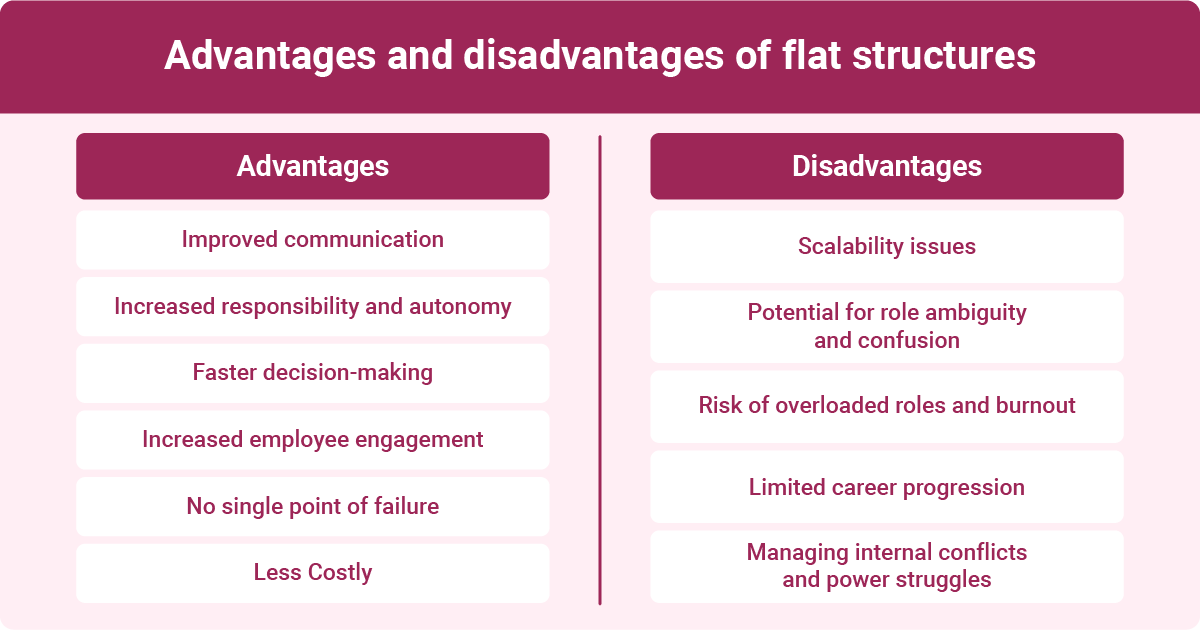
Improved communication
Less hierarchy and fewer management positions mean that communication tends to be more direct and efficient. Employees don’t have to go through multiple layers of teams and managers, so there are fewer chances for information to get distorted or lost in the shuffle.
For example, a team member may notice customer confusion around a new service offering and share this feedback directly with design and product teams. Teams can quickly adjust messaging or features in response and move forward.
Increased responsibility and autonomy
Because there are fewer layers of managers and levels of authority, employees take more responsibility and accountability for their roles. Holding the power to achieve results themselves and voice their thoughts creates a positive work experience for employees and can enhance the organization's financial performance.
Faster decision-making
Flat organizational structures reduce or eliminate long approval chains, allowing teams to act fast. Decisions don’t need to be escalated through multiple layers of management. Typically, employees closest to the work have the most relevant context, and flat organizational structures empower them to make informed decisions without waiting for top-down sign-off.
This agility is especially valuable in volatile environments, where speed can be a competitive advantage. Organizations can respond more quickly to market shifts or serious roadblocks.
Increased employee engagement and motivation
When layers of hierarchy are reduced, employees have greater control over how they work and greater visibility into decision-making. They gain a clearer connection between their contributions and organizational outcomes.
That autonomy directly fuels motivation. Employees are more engaged when they feel trusted to problem-solve and shape their own work experience rather than simply executing top-down directives.
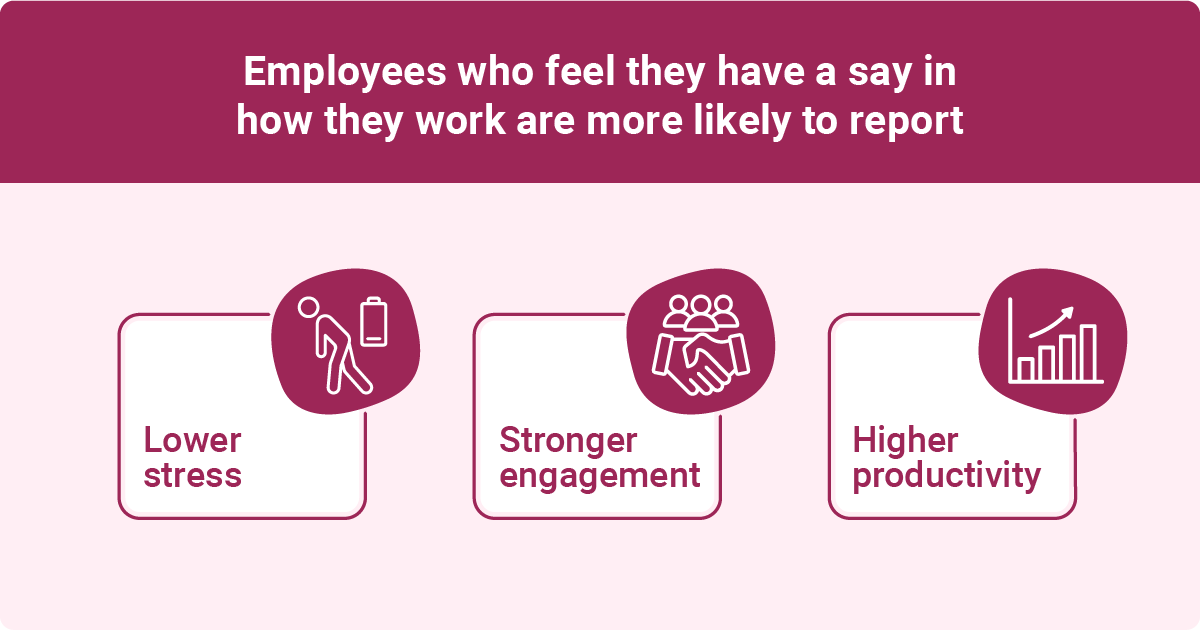
Employees who feel they have a say in how they work are more likely to report:
· Lower stress
· Stronger engagement
· Higher productivity
In flat structures, employee input often extends beyond work arrangements into day-to-day priorities and collaboration. This sense of responsibility increases job satisfaction because employees see tangible impact from their efforts, not just an endless list of completed tasks.
No single point of failure
In a flat organizational structure, responsibilities and knowledge are shared across teams rather than concentrated in one role or individual. This reduces the risks of over-dependence on a single decision-maker. Work can continue smoothly even if someone is unavailable or leaves the organization.
Less costly
Less bureaucracy often gives companies the ability to cut costs as they focus more on productivity and less on over-management. Flat organizations may benefit from:
- Reduced management headcount and payroll savings
- Lower administrative overhead
- Fewer approval layers reduce operational drag
- Faster decisions that translate into measurable cost efficiency
Disadvantages of flat structures
While it offers benefits, a flat organizational model that’s incorrectly structured or improperly maintained can lead to problems down the road.
Scalability issues
A pure flat organization can be difficult to scale past a certain point. Once a company grows larger, the selective use of holacracy or delegated decision-making may become a more practical and efficient approach.
Potential for role ambiguity and confusion
The broader and more fluid roles common to flat organizational structures can blur ownership and accountability. Without documented responsibilities, employees may be unsure who owns specific outcomes. This ambiguity can lead to important work falling through the cracks.
Some level of role definition is necessary to ensure everyone understands where responsibilities begin and end.
Risk of overloaded roles and burnout
Flat organizational structures sometimes concentrate responsibility across fewer roles, increasing the risk of employee overload and burnout. With fewer managers to distribute work and step in when workloads become unmanageable, employees may take on expanded duties without clear boundaries or adequate support. Over time, this can lead to long hours and a stressful work environment.
Workhuman® research shows that increased workload and feeling undervalued are two of the strongest contributors to burnout, and flat structures can unintentionally amplify both if not well managed. Without intentional safeguards, such as workload visibility and regular check-ins, high-performing employees may shoulder disproportionate responsibility.
And for more information on easing employee burnout in the future of work, check out this white paper.
Limited career progression
The fewer hierarchical levels in flat organizational structures naturally reduce the number of traditional management roles. This may limit visible pathways for promotion. Even employees who are gaining skills, more responsibility, and higher pay may feel stalled without a set growth path.
Managing internal conflicts and power struggles
One of the more challenging disadvantages of a flat organizational structure is the potential for power struggles. Without a clear chain of command, it may be unclear who has the final say when disagreements arise. If left unaddressed, internal conflicts can undermine collaboration and trust.
Successful flat organizations counter this risk by establishing clear decision rights. Agreed-upon structure, even in flat models, prevents standard disagreement from escalating into persistent power struggles.
How communication and leadership work in flat organizations
Communication best practices
In a flat organizational structure, communication is designed to move side to side across teams, not primarily up a chain of command. That shift can speed problem-solving, but it also raises the “information processing” load on teams, so you need intentional systems, not just fewer managers. Running agile meetings is one such system that ensures continuous alignment across teams, providing a structured approach to communication and problem-solving.
In this structure, transparency in communication becomes a critical element to ensure clarity and alignment across all levels.
Strong flat orgs typically treat transparency as shared infrastructure:
- Document decisions in the open (team wikis, shared project hubs, lightweight decision logs) so context travels without relying on a manager as the “human router.”
- Default to async updates (written status notes, short Loom-style recaps) to reduce meeting creep while keeping everyone informed.
- Use cross-functional channels (topic-based Slack or Teams channels) to coordinate work that spans teams, and define norms for escalation and response times.
- Keep alignment rituals predictable (all-hands, weekly standups, monthly retros), so teams stay connected without constant check-ins.
This is also where integrated tools matter. Workhuman Cloud Integrations, for example, support recognition, check-ins, and feedback directly in collaboration spaces like Microsoft Teams and Slack, which helps reinforce culture in the same horizontal channels where work happens.
Leadership in flat organizational structures
Leadership doesn’t disappear in flat organizations. It changes. Leaders focus less on command-and-control and more on vision, clarity, coaching, and removing obstacles. These are core leadership skills that enable leaders to foster a collaborative and high-performing environment. In practice, that often looks like servant leadership: creating the conditions for teams to do their best work, modeling transparency, and inviting healthy challenges.
Because conflict cannot be “kicked up the ladder,” flat orgs also rely on clear peer-based norms for resolving disagreements, including defined decision owners, explicit escalation paths, and regular retrospectives to reset expectations.
What types of organizations benefit most from a flat structure?
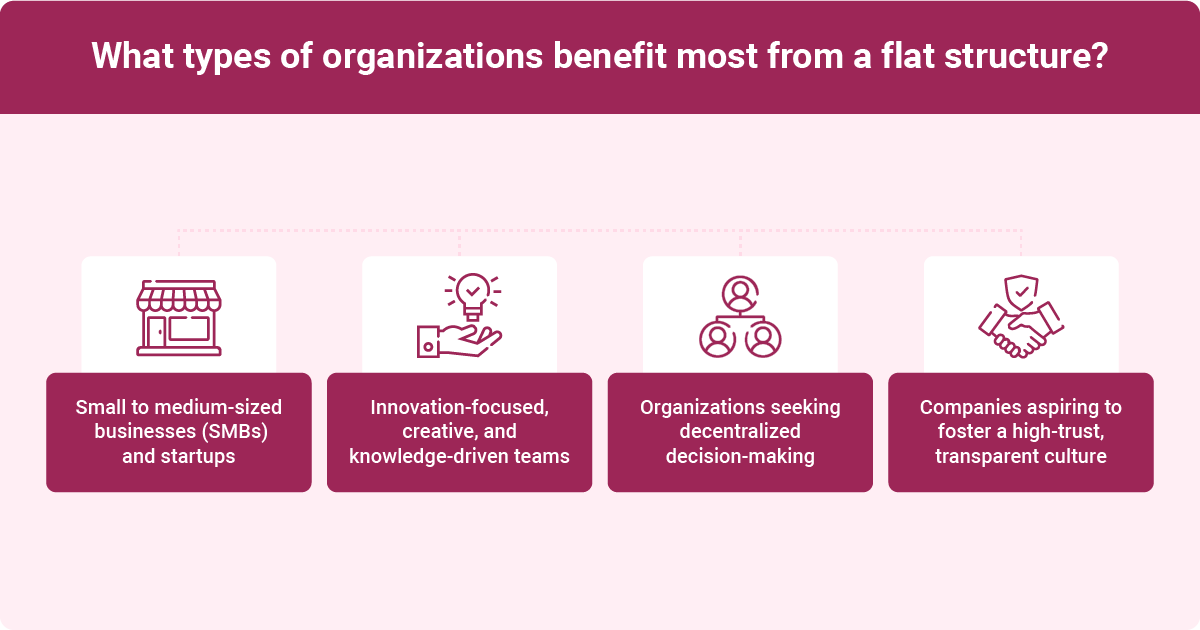
A flat organizational structure is most likely to be appropriate for:
- Small to medium-sized businesses (SMBs) and startups that need speed and flexibility
- Innovation-focused, creative, or knowledge-work teams where expertise is distributed
- Organizations wanting decentralized decisions made close to the work and the customer
- Companies with or aspiring to a high-trust, transparent culture
Flat organizational structure examples: What companies have a flat hierarchy structure?
Companies across industries and with a wide variety of workplace challenges and solutions use a flat structure to improve productivity, decision speed, and more.
Recent research, “Why Horizontal Organizations Don’t Fall Flat: Organizational Structure Shapes Perceptions of Egalitarianism and Company Warmth,” suggests that perceived organizational flatness also shapes how companies are viewed externally. Customers often view flat companies with warmth and trust, seeing minimal hierarchical layers of management as a sign of a forward-thinking organization.
Technology sector examples
Flatter structures are often adopted in knowledge-intensive and creative tech companies where expertise is widely distributed:
- Valve Corporation: Researchers in the Journal of Organizational DesignOpens in a new tab cite this gaming company as having no formal hierarchy policy.
- GitHub: During its growth phase, the company followed a relatively flat structure and added more management layers as complexity increased.
- Automattic (WordPress): Its distributed teams work with high autonomy and minimal hierarchy
Traditional industries adopting flat models
Beyond tech startups, a variety of companies have applied variations of flat or self-managed structures in certain contexts, even in more traditional and highly regulated industries:
- W.L. Gore: The manufacturer has had a lattice structure since 1958, with long-running use of distributed leadership.
- Morning Star: This self-managed company in an industrial food processing setting has roles defined through peer agreements.
- Buurtzorg: Researchers from the Global Advances in Integrative Medicine and Health, in their article, ‘Buurtzorg Nederland: A Global Model of Social Innovation, Change, and Whole-Systems Healing’, reviewed these self-managing nursing teams in the Netherlands, with limited managerial layers that deprioritize the typically complex healthcare bureaucracy.
Lessons from failed or abandoned flat structures
Not all flat organizational experiments succeed. These examples show that outcomes depend more on implementation and context than structure alone.
Online apparel company Zappos adopted holacracy as a formal flat structure. But the transition led to resistance and increased turnover for staff seeking clearer roles and career paths.
GitHub ended up introducing more management layers after initially pursuing a flatter model. Growth and coordination challenges made additional structure necessary to maintain employee clarity.
Flat organizational structures are not universally effective, nor are they a quick fix. Success depends heavily on:
- cultural fit
- clarity of roles/decision rights
- leadership maturity
- thoughtful implementation
Flatness works best as a deliberate design choice adapted to the organization’s size, industry, and people, rather than as a rigid ideology.
How recognition supports flat structures
In a flat structure, the challenge isn’t that people can’t make decisions. It’s that they can’t always see enough of the organization to make good ones. When you remove layers, you remove some of the built-in “routing” that managers used to provide: who’s doing what, where blockers live, who to pull into a problem, and which teams are quietly carrying the load.
That’s where recognition can help provide lightweight culture infrastructure.
Anyone-to-anyone recognition strengthens the network. In flatter models, work depends a lot on lateral trust. Peer-to-peer recognition creates “permissionless” connection across teams and geographies, helping employees build relationships that don’t rely on reporting lines.
Over time, that reduces the isolation that can show up when people have more autonomy but fewer formal touchpoints. Workhuman data shows that broader recognition reach (being recognized inside and outside your team) correlates with materially lower turnover — and recognition from both inside and outside the team is associated with the lowest turnover in one large cross-functional customer dataset.
It builds intra- and interdepartmental clarity. Flat orgs can get messy when responsibilities are distributed but invisible. Recognition moments—when they’re specific—create a searchable, social record of who contributed, how, and with whom.
That helps teams find expertise, understand dependencies, and onboard new people faster without adding layers back in. Workhuman iQ can also surface patterns of collaboration and “how work gets done” across teams, giving leaders a more realistic picture of flow than an org chart can.
It gives leaders visibility without re-centralizing control. Flat doesn’t mean leaderless — it means leaders need different signals. Recognition data can highlight emerging influencers, collaboration hotspots, and where effort is concentrated, so leaders can remove obstacles and allocate resources without rebuilding approval chains.
This is a core idea behind Human Intelligence: using recognition as high-quality human data that reveals skills, performance, collaboration, and cultural health.
It reinforces the behaviors that make flat work. If you want autonomy, you have to reward the behaviors that protect it: good prioritization, cross-team help, knowledge-sharing, constructive conflict, and ownership. Recognition is one of the simplest ways to make those “invisible” behaviors visible and repeatable — especially when it’s tied to values and reinforced in the flow of work (in integrations like Slack/Teams).
Best practices for implementing and scaling a flat management structure
Org culture, company size, and industry will shape how you implement a flatter model, but these best practices apply in most cases.
Assess your organization's needs and culture
Before implementation, you need to determine whether a flat structure aligns with your goals and operational requirements. A thoughtful workplace culture assessment helps leaders understand whether trust, autonomy, and shared accountability already exist or need to be developed.

1. Evaluate cultural connection and engagement: A strong cultural connection is closely linked to higher engagement, better retention, and stronger performance. Use surveys, feedback, and check-ins to understand employee connection.
2. Examine how work and decisions actually happen: Ask where decisions are made, how teams collaborate, and how information flows across the organization. Flat management structures work best when shared purpose and autonomy already exist.
3. Assess operational requirements and constraints: If your organization relies heavily on rigid controls, strict approvals, or formal chains of command, a fully flat model may create friction rather than efficiency.
4. Determine the right structural fit: Decide whether a flat or hybrid management structure is the best fit.
These steps help leadership ensure that a flat management structure reinforces business strategy rather than undermines it. When structure and culture are aligned, organizations are better equipped to scale flat principles sustainably and foster a more engaged, unified workplace.
Establish clear policies and procedures
Flat management structures still require structure, just not excessive hierarchy. Clear policies and procedures provide the guardrails that teams need to make decisions. This includes defining:
- How decisions are made
- Who owns which types of decisions
- How accountability is shared across teams
Equally important are communication and conflict-resolution frameworks. In flat organizations, disagreements are usually resolved through dialogue rather than top-down authority, so clear escalation paths and documented norms for collaboration are necessary.
Invest in employee training and development
Equipping employees with the skills for autonomous decision-making and growth has plenty of benefits that help prepare employees for a flat structure:
- Engagement: Strength-based learning and development can increase employee engagement by 23%.
- Performance and productivity: 72% of employees say their performance would improve with more corrective feedback from managers.
- Retention: Offering employee development programs can lead to 34% higher retention rates.
Foster a culture of trust and open communication
Building a flat organization takes more than structural change; it requires psychological safety. A key element of this is building trust in leadership, as employees must feel that their leaders are approachable and supportive in order to freely share ideas and concerns.
When employees feel safe to ask questions and share ideas without fear of blame or retaliation, then trust and open communication can flow. This environment is especially critical in knowledge-based work, where idea-sharing drives performance.
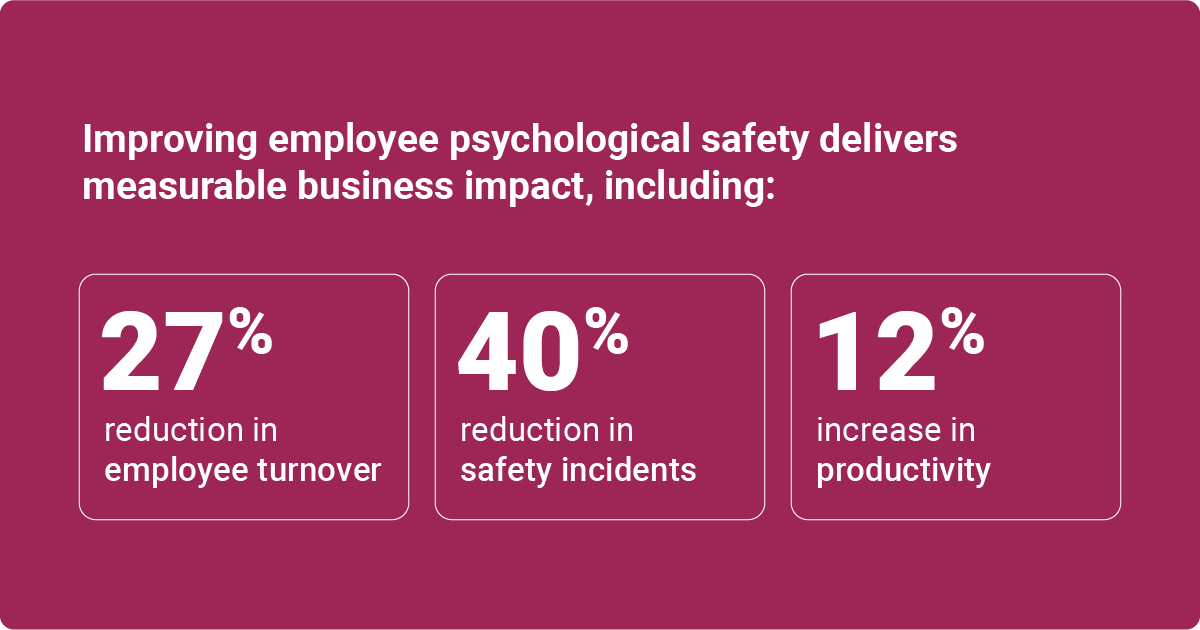
Workhuman research shows that improving employee psychological safety delivers measurable business impact, including a 27% reduction in employee turnover, a 40% reduction in safety incidents, and a 12% increase in productivity. To foster a safe and healthy workplace culture, leaders must model openness themselves.
Clear communication norms and consistent recognition can reinforce the message that speaking up is not only safe but expected.
Utilize self-management tools
Self-management tools reduce ambiguity without adding extra bureaucracy. Platforms designed for decentralized organizations help formalize autonomy by giving teams visibility into roles, responsibilities, decision rights, and priorities.
Tools such as Holaspirit support flat and hybrid organizational models by enabling role clarity, distributed governance, transparent decision-making, and continuous alignment across teams. These platforms act as a shared source of truth, and when paired with strong culture, training, and leadership support, self-management tools allow flat organizations to scale without losing clarity.
Implementation checklist: Transitioning to a flat structure
Moving to a flatter model is less about “removing layers” and more about redesigning how decisions, information, and accountability flow. Use this checklist to keep the change deliberate and measurable (not just structural).
Before you start
- Secure active executive sponsorship and resourcing (time, budget, comms support).
- Run an organizational readiness assessment (culture, skills, manager capacity, risk areas).
- Document the current state: org chart, role scope, decision authorities, and bottlenecks.
- Define success metrics (e.g., decision cycle time, engagement, retention, customer outcomes).
- Communicate the “why” early and often; identify and train change champions.
- Select pilot team(s) with clear goals, guardrails, and leadership commitment.
During transition
- Set transparent communication norms (where updates live, response expectations, escalation paths).
- Implement a decision framework (RACI, DACI, consent-based decisions) and document decisions.
- Build peer accountability: peer feedback, 360s, retrospectives, and clear team commitments.
- Train for self-management (prioritization, conflict resolution, facilitation).
- Reassign or redesign middle-management roles thoughtfully (coaching, enablement, ops leadership).
- Monitor coordination weekly; run monthly retros and adjust compensation/career frameworks.
Post-transition evaluation
- Compare decision speed and execution quality vs. baseline.
- Survey engagement, clarity, and workload; track voluntary attrition and internal mobility.
- Review business outcomes (customer satisfaction, quality, revenue/efficiency, where relevant).
- Identify where added structure is needed (hybrid teams, clearer governance).
- Use analytics to validate what’s working: Workhuman iQ™ can surface trends in cultural health, program performance, skills, and DEI signals to guide course-correction with data—not guesswork.
Workhuman iQ can transform your understanding of the employee experience with AI-powered social analytics to unlock data-driven strategy. It's the kind of intel you’ve always wanted, delivered in a way that anyone can use.
How to achieve career growth in a flat corporate structure
In these types of organizational structures, learning to grow is not as simple as in hierarchical organizations, but it is possible. Use these strategies to help:
- Demonstrate the ability to take the initiative
- Acquire new skills and assume diverse responsibilities
- Cultivate strong relationships with colleagues across different teams and levels
- Regularly seek feedback from peers and supervisors to identify areas for improvement
- Look for mentorship opportunities
The future of flat organizational culture
The future of flat culture is likely to be defined by remote workplaces made up of distributed teams and a growing reliance on high-performing, team-driven execution. Distributed teams depend on autonomy, trust, and shared accountability rather than constant oversight, making flatter models especially effective for maintaining productivity and alignment across locations.
At the same time, many flat organizations aren’t completely manager-less. Leaders are embracing hybrid organizational structures that preserve the benefits of flatness while adding sufficient structure for effective coordination. These models provide:
- Clear purpose and shared goals, so teams understand what success looks like
- Defined decision rights, reducing ambiguity and stalled execution
- Psychological safety, encouraging ideas, accountability, and innovation
- Regular feedback and check-ins, ensuring alignment without bureaucracy
Rather than slowing teams down, this intentional structure helps teams sustain performance. From a leadership standpoint, the shift changes the role of management. Leaders in flat organizational cultures embrace key leadership qualities, acting as facilitators and empowering their teams.
Their focus is on removing obstacles and supporting wellbeing, ensuring teams have the tools and information needed to succeed. When done well, research shows this approach strengthens engagement and resilience organization-wide.
Want more statistics like this on building high-performing teams? Download our guide, "5 Ways to Activate the Power of Teams," and find out how to cultivate a more connected and productive culture.
Looking ahead, the most successful companies will treat flat organizational culture as a strategic design choice, not a one-size-fits-all philosophy. Flatness will be applied where it accelerates innovation and decision-making, while a more hierarchical structure will be implemented where scale, compliance, or complexity requires it.
Is a flat organizational structure right for your company?
A flat organizational structure encourages faster decision-making, stronger employee engagement, improved communication, and greater autonomy across teams. The model isn’t for every organization, however, as without clear roles and support systems, organizations may face employee burnout and challenges with conflict.
But for businesses where work is knowledge-driven, teams are comfortable with autonomy, and leadership is committed to psychological safety, a flat structure unlocks speed and innovation. It’s not a one-size-fits-all solution, but with the right support and process, a flat organizational structure can send your business to the next level.
See also: What is a Divisional Structure? Key Benefits, Challenges, and Real-World Examples
FAQs
What is the main difference between a flat and hierarchical organizational structure?
A flat organizational structure has few levels of management and tends to push decision-making closer to the people doing the work, relying on wider spans of control, peer coordination, and transparent information-sharing.
A hierarchical organizational structure has multiple management layers, with clearer reporting lines and decisions more often flowing up and down the chain of command. In short, flat optimizes for speed and autonomy; hierarchical optimizes for clarity, control, and scalability.
Can large companies successfully use flat organizational structures?
Yes—but usually as a hybrid. Large companies can adopt flat principles (decentralized decisions, empowered teams, fewer layers) within business units or product lines, but many eventually introduce more structure to manage complexity, risk, and coordination at scale. Large organizations that succeed tend to pair “flat where it helps” with clear governance (decision rights, escalation paths, portfolio prioritization).
Do flat structures save money on management costs?
They can, but it’s not guaranteed. Fewer management layers may reduce some salary overhead and bureaucracy. However, savings can be offset by new needs: stronger enablement roles (ops, program management), better tooling, more investment in training, and sometimes higher “coordination costs” if teams spend more time aligning. The real ROI depends on execution quality and whether faster decisions and higher engagement improve outcomes.
What industries are best suited for flat structures?
Flat structures tend to work best in industries and teams where:
- Work is knowledge-based, and expertise is distributed (software, product, design, R&D, consulting).
- Speed and experimentation matter (startups, digital products, creative agencies).
- Teams can operate with measurable outcomes and strong collaboration norms More regulated or safety-critical environments (health care delivery, aviation operations, heavy manufacturing) often use flatter elements in teams, but usually retain a clearer hierarchy for compliance and risk management.
What happens to middle managers when transitioning to a flat structure?
Ideally, middle managers don’t “disappear”—their work changes. Common paths include:
- Player-coach roles (leading key initiatives while mentoring)
- Enablement leadership (operations, systems, process, cross-team coordination)
- People development specialists (coaching, talent, learning)
- In some cases, roles are eliminated or consolidated, but a strong transition plan for reskilling and clarifying new career paths is needed early to reduce uncertainty.
How does employee recognition support a flat organizational structure?
In a flat organization, the main risk is around coordination and connection. With fewer layers, teams need clearer signals about who’s contributing, where work is happening, and how decisions and collaboration are flowing across departments.
Done well, recognition helps by:
- Strengthening peer-to-peer connection (anyone can recognize anyone, not just managers).
- Making invisible work visible (cross-functional help, knowledge-sharing, unblockers).
- Reinforcing the behaviors flat structures rely on (ownership, transparency, collaboration).
- Giving leaders healthier visibility into the org without rebuilding approval chains (patterns of collaboration and influence).
The key is to be specific, recognizing concrete behaviors and outcomes, not vague praise. When recognition is frequent, values-based, and shared across teams, it becomes a lightweight “signal layer” that helps flat organizations stay aligned as they scale. Platforms like Workhuman can also aggregate those recognition moments into human data signals that show how work is actually getting done across teams.
How long does it take to transition to a flat organizational structure?
Most transitions take 3–12 months for an initial rollout, with 12–24 months to stabilize behaviors (decision-making, accountability, performance, career frameworks). Timing depends on company size, geographic distribution, role complexity, and how much you’re changing beyond the organization.
About the author
Ryan Stoltz
Ryan is a search marketing manager and content strategist at Workhuman where he writes on the next evolution of the workplace. Outside of the workplace, he's a diehard 49ers fan, comedy junkie, and has trouble avoiding sweets on a nightly basis.