
What is a Divisional Structure? Key Benefits, Challenges, and Real-World Examples
Last updated
7 min read
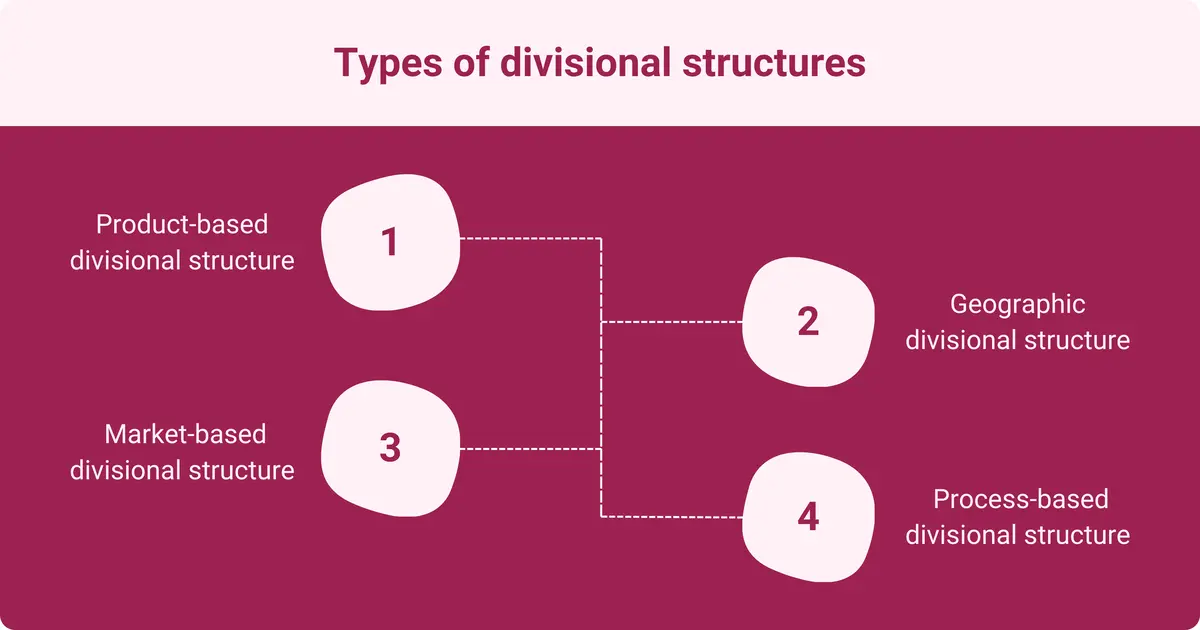
Table of contents
- What is a divisional structure?
- What are the four types of divisional structures?
- What are the key characteristics of a divisional organizational structure?
- Divisional structure vs. other organizational structures
- What are the advantages and disadvantages of a divisional structure?
- Examples of divisional organizational structures
- Conclusion
Share this article
Your company’s growth might actually be slowing you down - and your organizational structure could be the culprit.
As your organization scales, the structures that once fueled your growth might now be holding you back. Perhaps decisions feel slower, teams are more disconnected, and strategies are harder to execute. Sound familiar? If so, it’s time to rethink your organizational structure.
Divisional structures offer a powerful business strategy, giving your teams the agility and focus they need to thrive, whether by product line, geography, customer segment, or process. But while adopting this model can supercharge your growth, it also introduces unique complexities and challenges.
In this guide, we'll break down exactly how divisional structures work, explore the compelling benefits they deliver, highlight common pitfalls to avoid, and show you real-world examples of successful implementations. Keep reading to uncover how shifting to a divisional structure can unlock new levels of efficiency, innovation, and strategic clarity across your entire organization.
What is a divisional structure?
Each division operates independently, with dedicated resources, leadership, and decision-making capabilities, empowering teams to respond quickly and effectively to their unique market demands and customer needs.
Having multiple autonomous divisions significantly enhances agility and operational efficiency, allowing each division to deeply understand and strategically target specific product lines, regional market dynamics, or distinct customer segments.
Especially suited for organizations with diverse offerings or a global presence, a divisional structure helps your teams move swiftly, implement targeted strategies, and stay ahead of evolving market trends, ultimately driving stronger business performance and a more connected, human-centered workplace culture.
What are the four types of divisional structures?
How you segment your business can shape how efficiently it operates and how effectively it adapts to market needs. Divisional organizational structures offer flexibility and focus, and there are four primary ways to organize them: by product, geography, market, or process.
These organizational design strategies empower teams with the autonomy and resources needed to deliver focused, accountable performance.
Product-based divisional structure
A product-based divisional structure organizes the company around specific product lines, with each division functioning like a business unit. Each product group typically has dedicated leadership, resources, and go-to-market strategies.
This model enables teams to focus on the unique business functions, innovations, and customer expectations for each product category—supporting faster decision-making and more targeted execution.
Take Samsung, for example - one of the clearest company hierarchy examples of how a product-based divisional structure can deliver agility and specialization across product lines.
Its operations are divided by major product categories:
- Consumer Electronics
- Device Solutions
- IT and Mobile Communications
This structure allows each division to operate with deep product expertise and deliver more relevant experiences for end users.
Geographic divisional structure
In a geographic divisional structure, the business is segmented by physical regions or territories. Each division manages operations based on the distinct needs of its region, including cultural preferences, market trends, regulatory environments, and local competition.
This model is particularly effective for multinational organizations that serve diverse audiences across the globe. McDonald’s exemplifies this approach, structuring its operations into regions such as:
- North America
- Europe
- Asia-Pacific
- Latin America
This enables regional teams to tailor offerings and strategies to resonate with local customers—driving stronger relevance and engagement.
Market-based divisional structure
A market-based structure, also known as customer-segment or industry-focused segmentation, is centered around the audiences you serve. Each division is designed to meet the needs of a distinct customer group, allowing for deeper insight and more relevant product development, sales strategies, and service models.
This structure is ideal for businesses that serve multiple industries or customer types. Adobe, for instance, structures its divisions by audience:
- Enterprise Solutions
- Creative Professionals
- Consumer Products
Each division aligns its priorities around the evolving needs of that customer segment, making it easier to personalize experiences and deepen loyalty.
Process-based divisional structure
This approach is ideal for organizations where cross-functional collaboration and process integrity are critical. Boeing applies this structure by segmenting its operations into:
- Design
- Manufacturing
- Quality Control
Each group operates with specialized expertise, streamlining the path from idea to execution and driving consistent outcomes at scale.
What are the key characteristics of a divisional organizational structure?
A divisional organizational structure is defined according to its grouping of business activities and resources into semi-autonomous units. Each one focuses on a specific product line, market, customer group, or geographic region. Here are its key characteristics.
1. Semi-autonomous divisions
Each division operates with its own leadership, goals, and financial resources. This autonomy allows teams to act quickly and tailor strategies based on what their unique customer base or market segment needs most.
2. Product, market, or geographic focus
Divisions are aligned around key business drivers, such as products, customer groups, or geographic regions. This structure supports highly targeted strategies and fosters innovation by enabling different divisions to go deep into their area of focus.
3. Decentralized decision-making
Decision authority is distributed across the organization, reducing bottlenecks and increasing speed to action. Divisional leaders are empowered to make strategic and operational decisions within their scope, helping the business stay agile in a rapidly changing environment.
4. Profit and loss accountability
Each division functions as its own profit center, managing its own revenue, expenses, and performance outcomes. This drives a culture of ownership and accountability, key drivers of long-term business success and strong employee engagement.
5. Dedicated resources and functions
This form of departmentalization in business ensures that each division maintains its own core functions—like HR, finance, and marketing. While this can result in resource overlap, it enables teams to work with speed and precision, tailoring decisions and processes to their specific business unit needs.
6. Performance measurement and accountability
Regular performance evaluation at the divisional level ensures that every unit stays aligned with organizational goals. This structure creates transparency, enabling leaders to identify what’s working, what’s not, and where to invest for greater impact.
7. Enhanced specialization and expertise
Because each division is focused on a defined area, teams develop deep domain knowledge that fuels innovation and customer-centricity. This expertise leads to higher-quality output and a more connected, mission-driven internal culture.
8. Scalability and flexibility
Among today’s corporate structure models, divisional structures support business growth by making it simple to add new units as the market evolves, without disrupting existing operations. This flexibility empowers organizations to test multiple offerings, enter new regions, or pivot quickly in response to change.
Divisional structure vs. other organizational structures
Choosing the right organizational structure shapes how your teams operate, make decisions, and deliver results. While a divisional model offers strategic focus and autonomy, other structures may prioritize collaboration, speed, or resource efficiency. Here’s how the divisional structure compares to six common corporate structure models:
Divisional vs. functional organizational structure
Both functional and divisional structures encourage strong intra-team communication, but differ in focus, authority, and resource allocation.
A divisional structure, on the other hand, organizes teams around outcomes—by product line, geographic region, or customer segment. Each division operates more independently, with its own leadership, budget, and performance goals. This approach promotes strategic accountability and responsiveness at the segment level.
In short:
- Functional = centralized, efficiency-driven
- Divisional = decentralized, performance-driven
Divisional vs. flat organizational structure
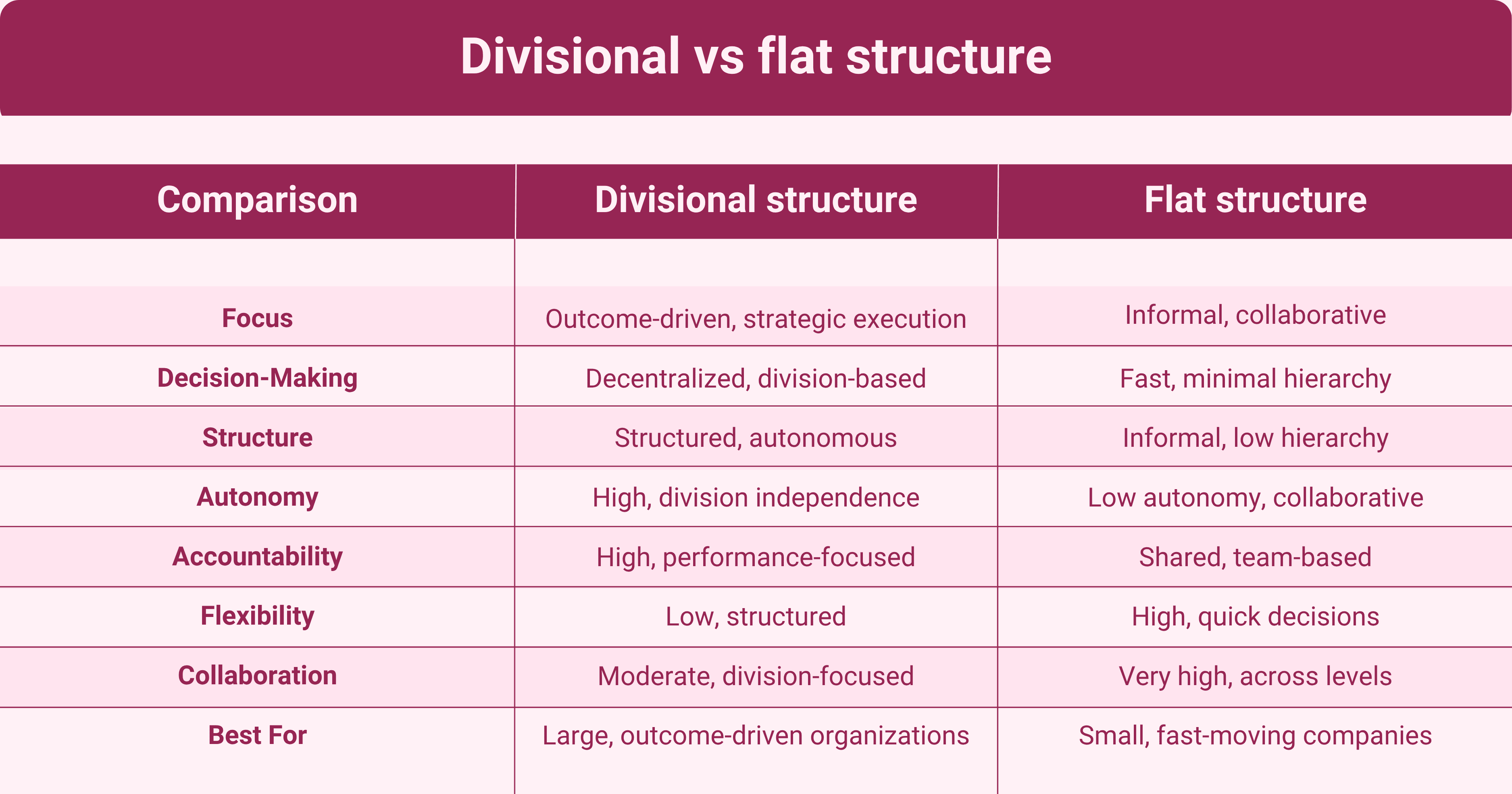
Flat and divisional structures both aim to increase agility—but they take different routes.
A flat structure minimizes hierarchy, promoting broad, cross-functional collaboration and faster team-based decision-making. It’s ideal for smaller companies or those looking to reduce bureaucracy and empower individuals across the board.
By contrast, a divisional structure maintains more defined units, each with its own leadership and formalized processes. While not as horizontal, this hierarchical structure offers clarity, control, and accountability at the segment level.
Key distinctions:
- Flat = informal, collaborative, fast-moving
- Divisional = structured, autonomous, strategically segmented
Divisional vs. agile structure
Agile and divisional models both prioritize adaptability—but serve different organizational needs.
Agile structures are built for speed, customer responsiveness, and innovation. Cross-functional teams collaborate in short cycles, often with shared authority and dynamic resource allocation. The emphasis is on flexibility, experimentation, and continuous feedback.
A divisional structure supports strategic execution at scale, with dedicated resources and leadership for each business unit. While less fluid than agile teams, divisions are highly focused on outcomes and long-term accountability.
Comparison highlights:
- Agile = iterative, flexible, cross-functional
- Divisional = strategic, autonomous, outcome-oriented
Divisional vs. matrix structure
A matrix structure combines functional and project-based models. Employees report to both a functional manager and a project or product leader, creating dual reporting relationships.
This approach supports strong collaboration and resource sharing but can introduce complexity and decision-making challenges.
A divisional structure avoids dual reporting by clearly defining leadership at the division level—streamlining accountability and execution.
Summary:
- Matrix = shared authority, high collaboration
- Divisional = singular leadership, performance focus
Divisional vs. team-based structure
A team-based structure organizes work around cross-functional teams that form, disband, or reconfigure depending on business needs. It’s designed for fast decision-making, innovation, and agility.
In contrast, divisional structures are more stable and aligned to long-term business lines or regions, promoting ownership, consistency, and deep domain expertise.
Breakdown:
- Team-based = flexible, project-centric
- Divisional = consistent, strategically segmented
Divisional vs. network structure
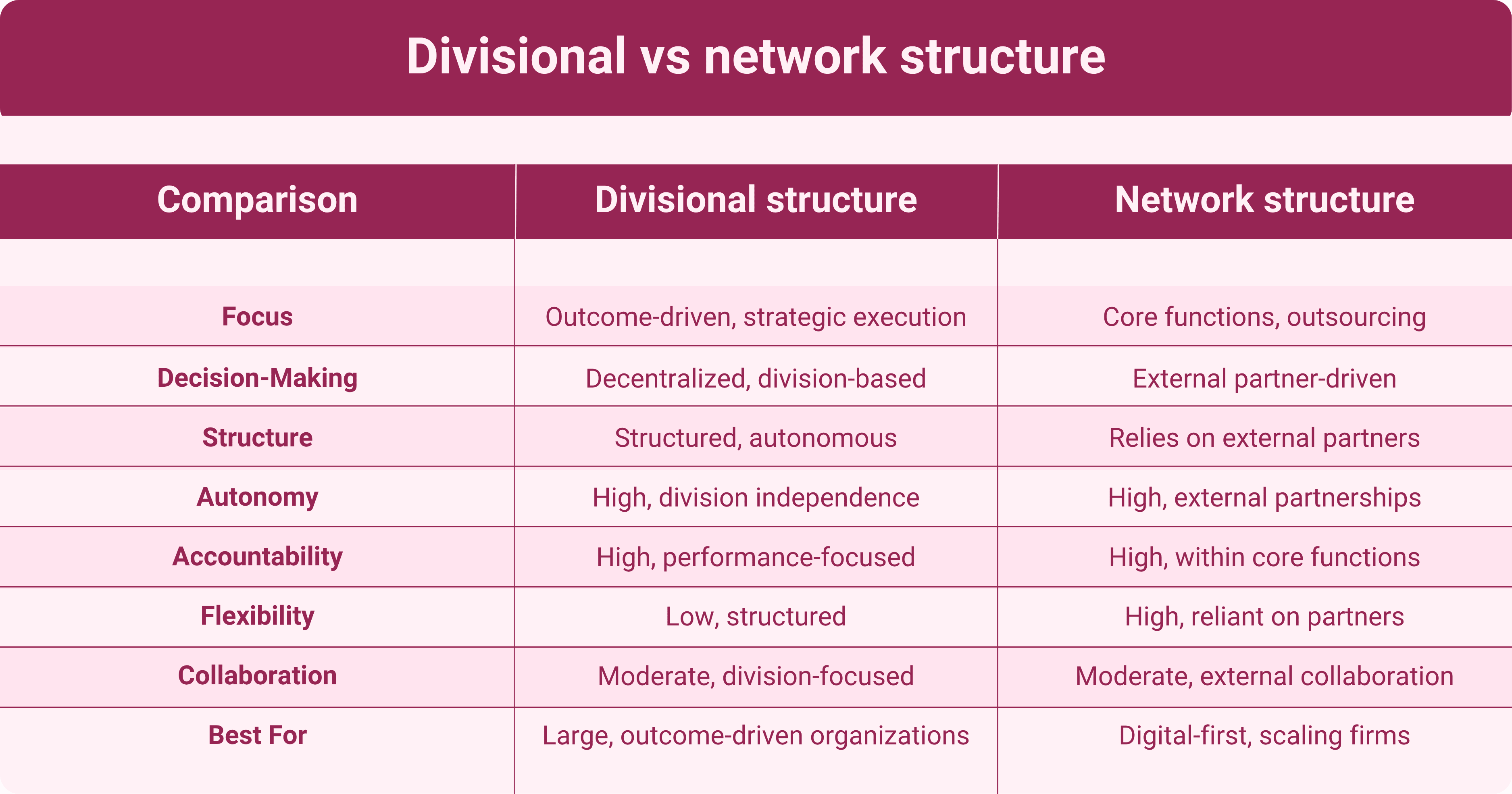
Network structures focus on the organization’s core capabilities while outsourcing non-core functions to trusted partners, vendors, or freelancers. This structure thrives in digital-first or rapidly scaling companies.
Divisional structures keep more operations in-house, fostering internal expertise and cultural consistency across units.
Takeaways:
- Network = flexible, partner-driven
- Divisional = structured, internally resourced
By understanding these structural differences, HR leaders and business decision-makers can design organizations that not only support business goals but also foster a culture of accountability, innovation, and inclusion.
What are the advantages and disadvantages of a divisional structure?
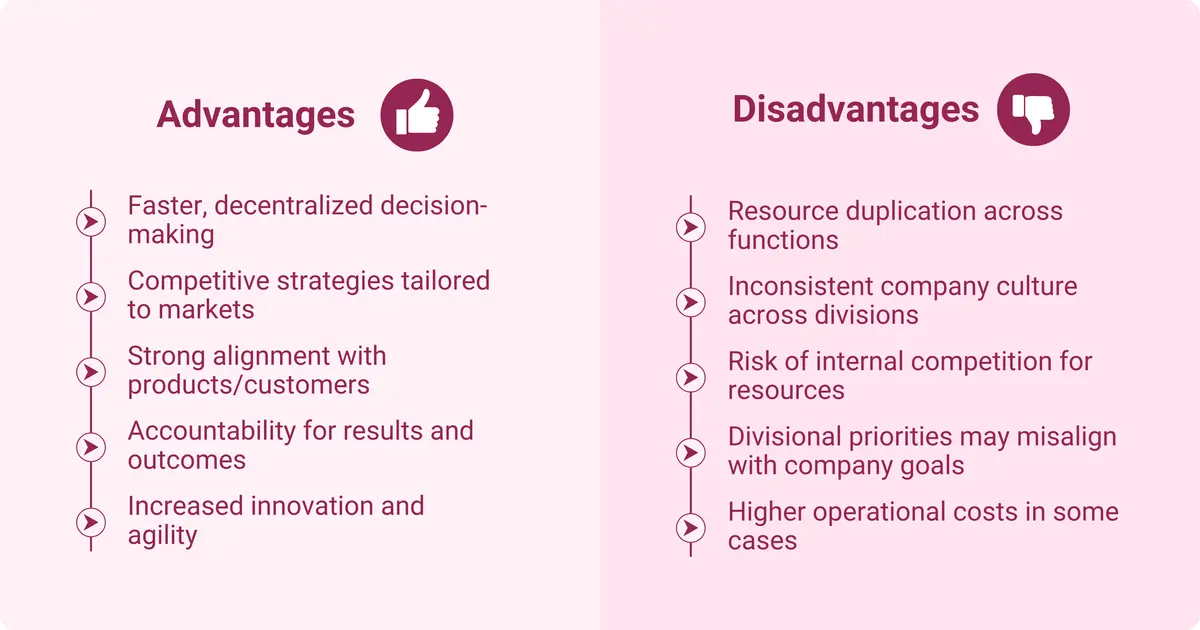
Divisional structures create focus, flexibility, and ownership, but like any organizational model, they come with trade-offs. Assessing corporate culture, along with the potential upsides and challenges, can help you determine if this structure aligns with your growth strategy, culture, and resourcing model.
Key advantages
The autonomy and specialization that define divisional structures can offer meaningful business benefits, particularly for large organizations operating across diverse product lines or geographical locations.
Key disadvantages
While divisional structures create autonomy, that same independence can create friction, inefficiencies, or fragmentation if not managed with intention.
- Duplication of resources Separate teams for HR, finance, marketing, and operations across specific divisions can increase costs and complexity, especially in leaner organizations.
- Inconsistent culture and experience When divisions operate in silos, maintaining a unified company culture or shared values becomes more difficult. This can lead to inconsistent employee and customer experiences.
- Internal competition for resources Without clear governance, divisions may compete for budget, talent, or visibility—reducing collaboration and creating organizational tension.
- Divisional priorities over company-wide goals Leaders may prioritize divisional KPIs at the expense of broader strategic alignment and company values, making it harder to move the organization forward as one unified team.
Examples of divisional organizational structures
If you want inspiration on how to use this structure in your company, here are some divisional organizational structure examples from companies you know.
General Electric
A good example of a divisional organizational structure for companies with multiple product lines is General Electric (GE), which groups its business into units like Commercial Engines, Defense and Systems, and Propulsion and Additive Technologies.
Each division focuses on a particular market or segment, offering one of the most recognizable company hierarchy examples in action through a clearly segmented structure. This makes GE more agile and competitive in each sector it inhabits.
Tesla
Tesla doesn't publish an organizational chartOpens in a new tab or public list of senior leaders, but we know that its organizational structure is functional-divisional, broken up into:
- Energy engineering and production
- Automotive
- AI/software
Tesla benefits from the divisional organizational structure by having less bureaucracy compared to many other companies of similar size. Divisional organizational structure also helps the electric automaker increase the speed of communication among different layers of management, with positive implications on decision-making and flexibility of the business.
Amazon
Amazon is a great example of adapting to changes in the workplace. Though it started as an online bookstore, it expanded to various other areas that led to it using a product-based divisional structure to focus on major business areas, including:
- Retail
- Amazon Web Services
- Advertising
- Kindle
- Prime Video
Conclusion
As organizations grow and diversify, divisional structures offer a powerful way to stay focused, move faster, and deliver outcomes tailored to specific customer segments, products, or markets.
By shifting toward a decentralized management structure, organizations empower teams with greater ownership and the agility to act on real-time opportunities.
But the structure itself is evolving. As company culture shifts toward transparency, agility, and connection, many organizations are rethinking traditional hierarchies - flattening layers and enabling more direct communication between teams and leadership.
This evolution makes divisional structures even more agile and human-centered, aligning better with the speed and expectations of today’s workplace.
Staying ahead means designing with both strategy and culture in mind. When implemented intentionally, a divisional model can do more than support growth; it can fuel long-term performance, engagement, and organizational resilience.

Workhuman Editorial Team
More by Workhuman Editorial TeamRecommended for you