
Best Employee Wellness Software: Top 8 Platforms (2026)
by Ryan Stoltz
Last updated
10 min read
More and more, HR leaders are adding wellness perks — such as gym stipends, meditation apps, and step-challenge platforms — to their benefits packages. The goal is to reduce burnout, disengagement, and turnover.
But those problems can persist when wellness programs focus primarily on individual habits and activities rather than the workplace conditions that shape how employees feel at work. Employees may have more wellness resources and still feel unseen, undervalued, and disconnected.
Your search for the best employee wellness software should go beyond fitness trackers to platforms that treat workplace wellbeing as a holistic, culture-level outcome. In this guide, we rank the eight best employee wellness platforms for 2026 based on each platform's strengths, the rewards and integrations it offers, and realistic pricing expectations.
What is employee wellness software?
Employee wellness software is a platform that helps your organization deploy, manage, and measure programs that support employees' wellbeing, including mental and physical health assessments, according to G2. These platforms take a holistic approach, addressing multiple dimensions of employee health, including physical, mental, financial, and social wellbeing instead of focusing on a single area.
Employee wellness programs typically include common building blocks, such as:
- Health risk assessments
- Workplace wellness challenges
- Habit tracking
- Educational content
- Incentives and rewards
- Program analytics
Modern employee wellness software integrates with wearables and HR systems, making it easier to manage corporate wellness programs, automate data collection, and keep employees engaged.
Watch out for confusing corporate wellness platforms with Employee Assistance Programs (EAPs). While EAPs provide confidential support and services for employees dealing with personal or work-related challenges, wellness software generally focuses on ongoing wellbeing and engagement across the workforce.
Employee wellness platforms often overlap with culture and recognition tools because wellbeing extends beyond physical and mental health. Even with a physically and mentally fit workforce, employees can still experience burnout or disengagement when they feel overlooked, undervalued, or disconnected from their colleagues.
In fact, "Using Recognition to Uplift Wellbeing and Daily Emotions," by Workhuman and Gallup, notes 49% of U.S. employees now say they experience significant stress on a typical day, with one in five employees globally reporting they experience loneliness. A broad approach that connects wellness with culture and recognition addresses cultural factors that can contribute to employee wellbeing.
"The State of Workplace Culture and Connection 2026Opens in a new tab," by HR Research Institute, also links culture to retention, with 83% of employees citing culture and the people as the main reasons they stay at a workplace. Consequently, modern wellness programs combine health initiatives with recognition and belonging strategies to address the cultural factors that influence how employees feel at work.
Organizations invest in workplace wellness programs to boost productivity and engagement, reduce absenteeism and health risks, and build a positive workplace culture that supports retention. These platforms also make the efforts measurable through participation and health-risk reporting.
The 8 best employee wellness platforms
Each employee wellness software platform has unique strengths and is suited to different workforce needs. Some are enterprise health navigation suites, while others are gamified activity trackers or tools that focus on mental health, fitness access, or culture-level wellbeing.
To help you narrow down your options, we evaluated the eight best employee wellness software based on wellbeing coverage, engagement mechanics, integrations, analytics, review-site ratings, and enterprise readiness.
1. Workhuman
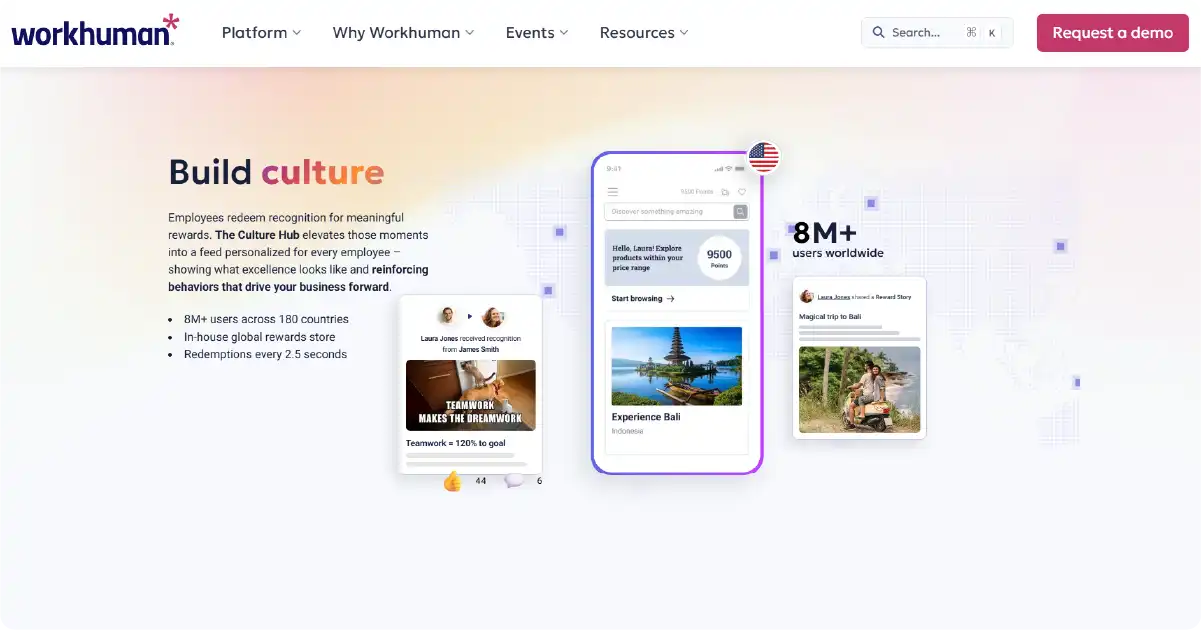
Best for: Organizations looking to improve employee wellbeing by addressing the cultural factors behind burnout and disengagement.
Why it stands out: Workhuman approaches wellness through recognition, and for a good reason. When your workforce feels seen, valued, and connected, it may experience lower burnout and higher engagement. In fact, "Amplifying Wellbeing at Work and Beyond Through the Power of Recognition," by Workhuman and Gallup, found that workers who receive high-quality recognition are up to 90% less likely to report burnout.
Key features:
- Social Recognition™ for peer-to-peer appreciation helps employees feel valued and connected.
- Service Milestones™ and Life Events™ celebrations build a sense of belonging.
- Workhuman iQ™ analytics shows how recognition impacts engagement and retention.
- Inclusion Advisor™ coaches for more inclusive, human interactions.
- The global rewards marketplace provides reward options that employees value.
- Admin Hub supports program management at enterprise scale.
Rewards available: Gift cards, merchandise, experiences, and charitable donations through a global rewards marketplace
Integrations: Microsoft Teams, Slack, Outlook, Workday, SAP SuccessFactors
Pricing: Custom pricing
Consider Workhuman if you want culture-level change with measurable engagement outcomes alongside any wellness program.
2. Wellable
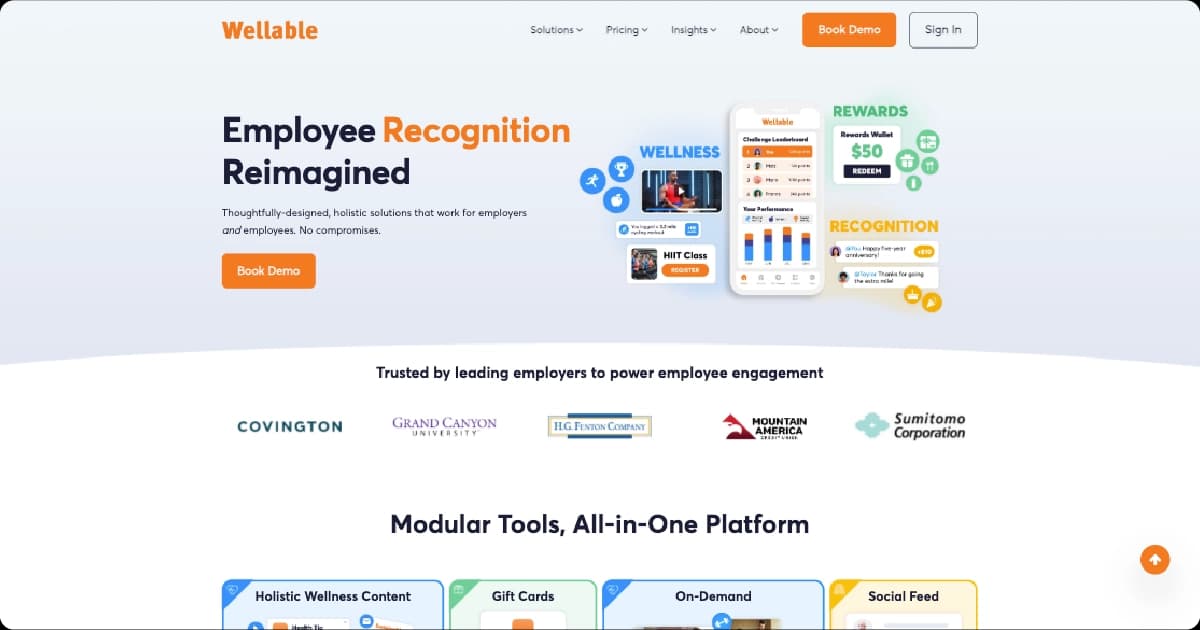
Best for: Mid-market and enterprise teams looking for a flexible, all-around wellness platform with structured challenges and a deep content library.
Why it stands out: WellableOpens in a new tab combines customizable wellness challenges, holistic content, and wearable integrations to give you a flexible way to engage your workforce. Its strong 4.7/5 rating on G2Opens in a new tab means it's frequently recommended as an all-in-one employee wellness platform on review sites and AI search answers.
Key features:
- Customizable wellness challenges engage employees across physical and mental health.
- The on-demand content library gives employees access to guided activities and events.
- Wearable and fitness-device integrations simplify activity tracking.
- Rewards and incentive management encourage continued participation.
- Program analytics and engagement reporting help you measure participation and outcomes.
Rewards available: Points-based incentives and rewards tied to challenge participation
Integrations: Fitbit, Apple Watch, Garmin, HRIS platforms
Pricing: Custom pricing
Consider Wellable if you want an adaptable, all-in-one wellness program with strong challenge mechanics and dedicated support.
3. Personify Health
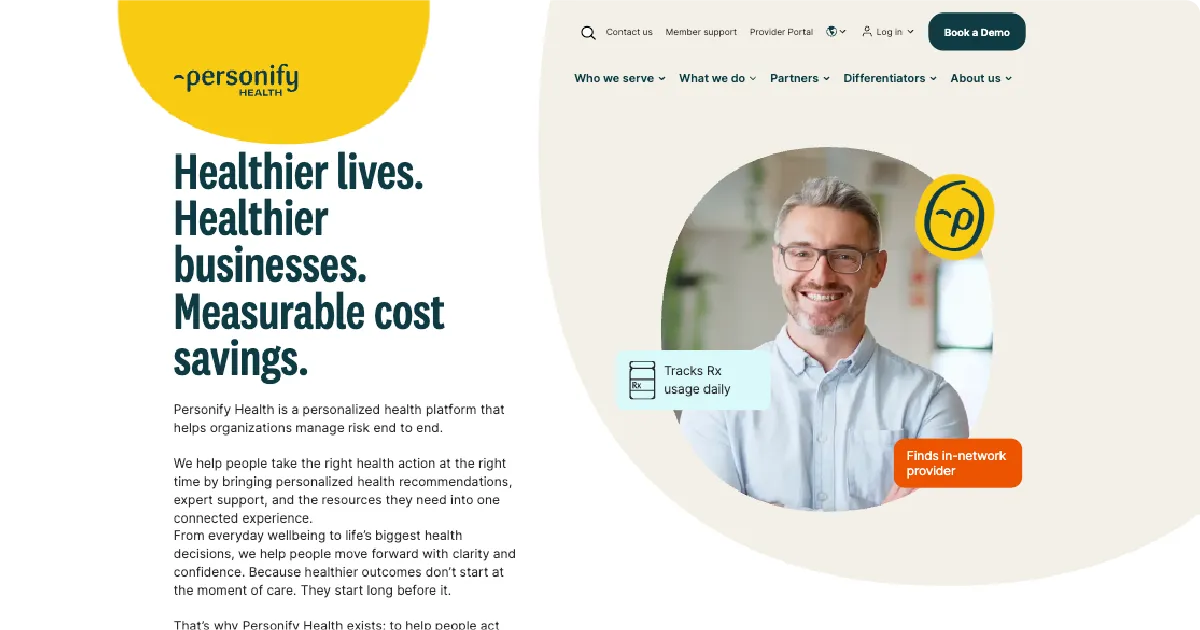
Best for: Benefits-mature enterprises, especially self-insured U.S. employers, wanting to bring together wellbeing, care navigation, and health plan administration under one vendor.
Why it stands out: Formed from Virgin Pulse and HealthComp, Personify HealthOpens in a new tab serves 7,000+ organizations, including 21% of the Global Fortune 500 across 190 countries. The platform pairs personalized wellbeing journeys with healthcare navigation and benefits administration, giving it an enterprise-level breadth that lightweight wellness apps can't match.
Key features:
- Personalized health journeys support employees' physical, mental, and financial wellbeing.
- Habit-building challenges and health coaching encourage lasting change.
- Care navigation and benefits guidance help employees access the right care.
- AI-powered health insights and population analytics let you identify workforce health trends.
- Points-and-rewards engagement encourages participation in healthy activities.
Rewards available: Points and redeemable rewards earned for healthy activities and program participation
Integrations: HRIS systems, health plans and TPAs, wearables, benefits platforms
Pricing: Custom pricing
Consider Personify Health if you are a large employer consolidating wellbeing, navigation, and benefits administration into a single enterprise health platform.
4. Wellhub
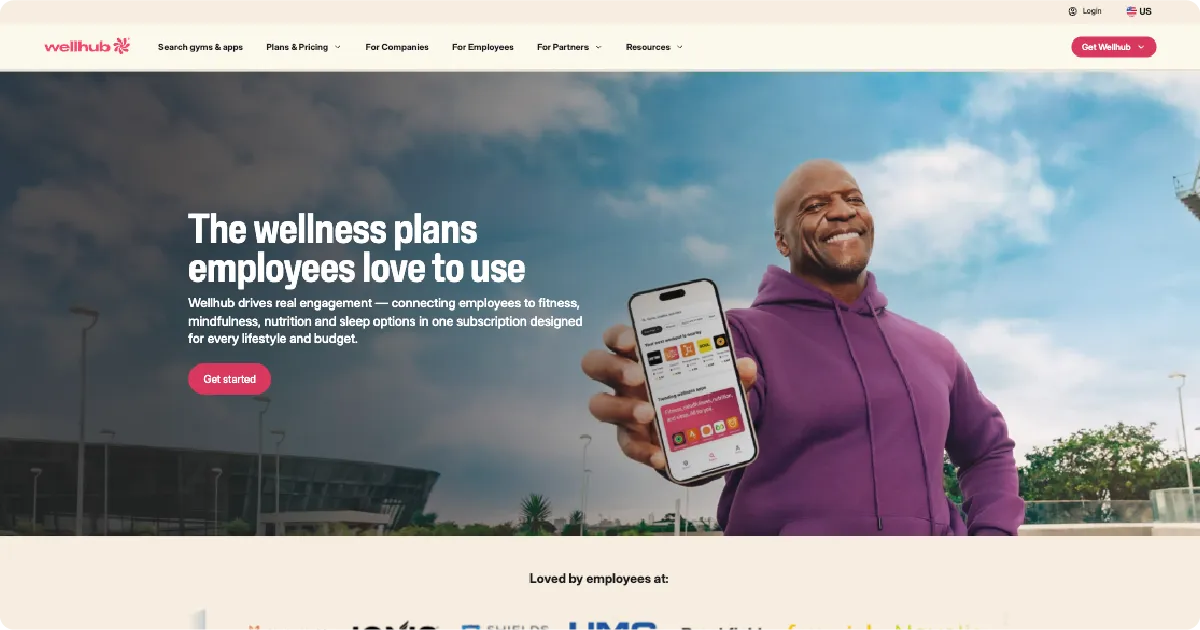
Best for: Organizations seeking a high-visibility, fitness-led benefit easy for employees to understand and use.
Why it stands out: With WellhubOpens in a new tab, a single subscription gives employees tiered access to a wide fitness network: 90,000+ gyms and studios, 3,800+ virtual personal trainers, and 99+ premium wellness apps for mindfulness, nutrition, and other focuses. According to the vendor, companies see employee enrollment rates 3-5x higher than traditional corporate gym reimbursement benefits.
Rewards available: Access-based benefits, including subsidized memberships to gyms, studios, and wellness apps
Integrations: Payroll systems, single sign-on (SSO), wellness, and fitness apps
Pricing: Employer annual fee based on team size and funded membership tier
Consider Wellhub if your wellness strategy centers on physical activity and you want an instant, visible benefit with employee appeal.
5. Vantage Fit
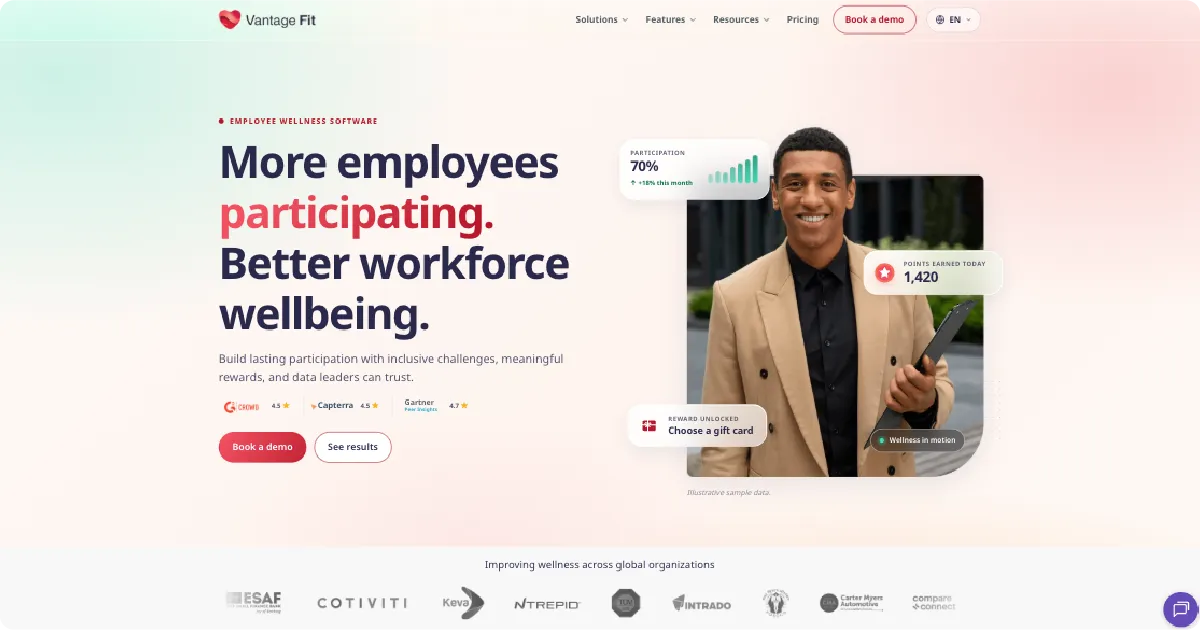
Best for: Teams wanting gamified physical-health engagement including step challenges, leaderboards, and rewards, with fast setup and budget-friendly pricing.
Why it stands out: Vantage FitOpens in a new tab uses step tracking, wellness scoring, mood tracking, and redeemable rewards to turn everyday activities into a team competition, encouraging healthy habits among employees. While it has an overall 4.5/5 Capterra ratingOpens in a new tab, the platform scores a 4.6/5 value-for-money ratingOpens in a new tab, with users repeatedly citing it for transparent, affordable pricing and fast deployment.
Key features:
- Step, team, and custom wellness challenges
- Wellness scoring and leaderboards
- Mood, nutrition, and hydration tracking
- Syncing with wearable devices
- Gift-card rewards and HR analytics
Rewards available: Redeemable points and real gift-card incentives for completing challenges and healthy activities
Integrations: Fitbit, Apple Health, Google Fit, Vantage Circle recognition suite
Pricing: Around $1 per user per month, with challenge-based and annual options
Consider Vantage Fit if you want measurable activity-based engagement at a low per-employee cost.
6. Wellness360
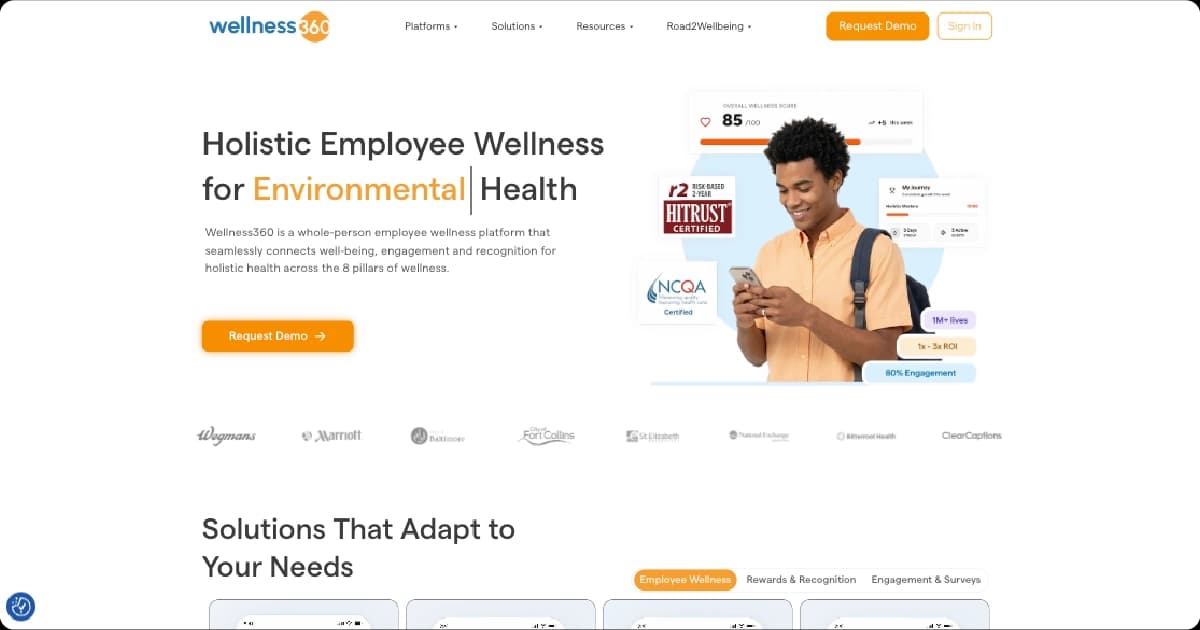
Best for: Enterprises running holistic, multi-pillar wellness programs that need customizable white-labeling and security compliance.
Why it stands out: Wellness360Opens in a new tab structures programs around eight pillars of wellness, including physical, emotional, social, nutritional, sleep, occupational, environmental, and financial health. Certifications via HITRUST r2 and NCQA mean enterprise-level security and compliance. You also get AI-driven health risk assessments and deep HR analytics to help you identify risks and measure program outcomes.
Key features:
- 8-pillar whole-person wellness framework
- AI-driven health risk assessments
- White-label and customization options
- Gamified challenges and rewards tracking
- Advanced analytics and ROI reporting
Rewards available: Configurable rewards and incentive tracking tied to program participation
Integrations: wearables, HRIS platforms, benefits systems
Pricing: Custom pricing
Consider Wellness360 if data security certifications and holistic program structure are the most important features.
7. Headspace
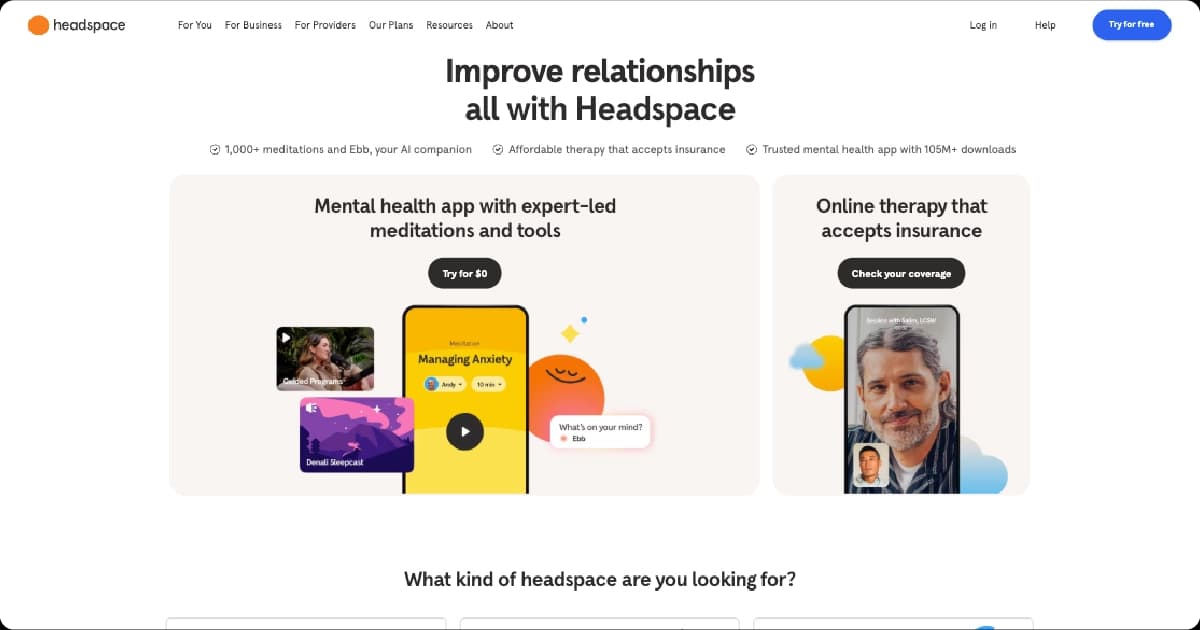
Best for: Organizations making the core of their wellness strategy mental wellness and burnout prevention.
Why it stands out: HeadspaceOpens in a new tab has brought its popular meditation and mindfulness product into the workplace, complementing physical wellness initiatives with holistic employee health.
With over 105 million downloads and a 4.8/5 rating from over 974,000 users on the Apple App StoreOpens in a new tab, this platform combines broad consumer trust with robust wellness offerings. Guided meditations, sleep content, expert coaching, and employee assistance tools make it the recognized standard option for programs that put mental wellness first.
Key features:
- Guided meditation and mindfulness library
- Content supporting sleep and focus
- Expert coaching and clinical care options
- Employee assistance program tools
- Organizational wellbeing reporting
Rewards available: Content-access benefit centered on premium app membership rather than points-based rewards
Integrations: SSO, EAP, and benefits platforms, HR communication tools
Pricing: Custom pricing
Consider Headspace if you want to offer mental health support with a brand employees already trust.
8. YuMuuv
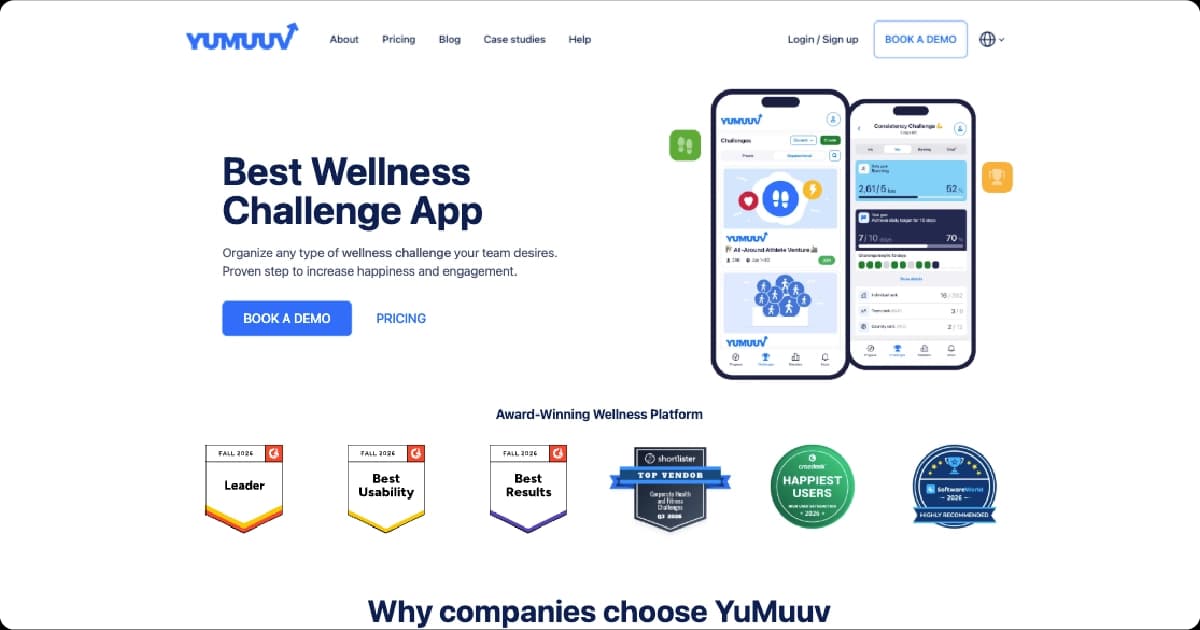
Best for: Teams looking for simple, social wellness challenges with minimal admin overhead and a fast rollout.
Why it stands out: YuMuuvOpens in a new tab makes it easy for organizations to run multi-device team challenges with real-time engagement. This wellness software for employers has a 4.7/5 rating on CapterraOpens in a new tabbased on hundreds of reviews that highlight ease of use and quick implementation.
Key features:
- Individual and team wellness challenges
- Real-time multi-device activity tracking
- Simple admin setup and management
- Social motivation and habit-building mechanics
- Engagement reporting
Rewards available: Employer-configured, challenge-based prizes and incentives
Integrations: Fitbit, Apple Health, Google Fit, Garmin
Pricing: Custom pricing
Comparison table
| Platform | Best for | Key rewards/features | Pricing |
| 1. Workhuman | Recognition-powered wellbeing and culture change | Social Recognition, service milestones, Workhuman iQ analytics, global rewards marketplace | Custom pricing |
| 2. Wellable | All-around wellness programs | Custom challenges, content library, wearable integrations, incentive management | Starts at $100/month ($4/user/month, 25-user) |
| 3. Personify Health | Enterprise wellbeing plus benefits navigation | Personalized journeys, health coaching, care navigation, points and rewards | Custom pricing |
| 4. Wellhub | Fitness-led, high-visibility benefit | 90,000+ gym network, 99+ wellness apps, tiered memberships, virtual training | Employer annual fee based on team size and funded membership tier |
| 5. Vantage Fit | Gamified activity challenges on a budget | Step challenges, wellness scoring, leaderboards, gift-card rewards | Starts at $250 for 25 employees for a 4-week single challenge |
| 6. Wellness360 | Holistic multi-pillar programs with compliance needs | 8-pillar framework, AI health risk assessments, white-labeling, ROI analytics | Custom pricing |
| 7. Headspace | Mental health and mindfulness first | Guided meditation, sleep content, coaching, EAP tools | Custom pricing |
| 8. YuMuuv | Simple social challenges, fast rollout | Team challenges, multi-device tracking, real-time engagement, simple admin | Custom pricing |
How much does employee wellness software cost?
According to Wellable, “How Much Does a Corporate Wellness Program Cost?” employee wellness software typically costs $1 to $8 per employee per month (PEPM), with some current pricing guides citing up to $12+ for feature-rich tiers. But a full wellness program with coaching and incentives layered on top costs more.
You'll find pricing in tiers such as:
- Basic challenge platforms running from $1 to $5 PEPM
- Mid-range platforms running from $5 to $15 PEPM
- Comprehensive enterprise suites with coaching and biometrics reaching $15 to $50+ PEPM
Be careful to distinguish the cost of wellness software from the total cost of your program early on. Your full program may include coaching, biometric screening, incentives, and software, which can push your budget to between $150 and $1,200 per employee per year. If you're a first-time buyer, these numbers can be surprising.
You also need to budget for line items and add-ons that don't appear in the software quote, such as biometric screening, which can cost between $36 and $80. Health coaching can cost you around $140 to $165 for a six-session package, while an incentive budget can come to $299 to $800 per employee annually.
Factors that impact your employee wellness quote
Rates will vary depending on:
- The vendor's billing model: Eligible-employee vs. active-user pricing will affect your total cost.
- Workforce size: Teams under 100 employees often pay higher per-person rates or a monthly minimum.
- Contract length: Longer contracts may come with different prices or discounts
- Premium modules: Features such as analytics, white-labeling, and SSO may cost extra or sit in higher pricing tiers
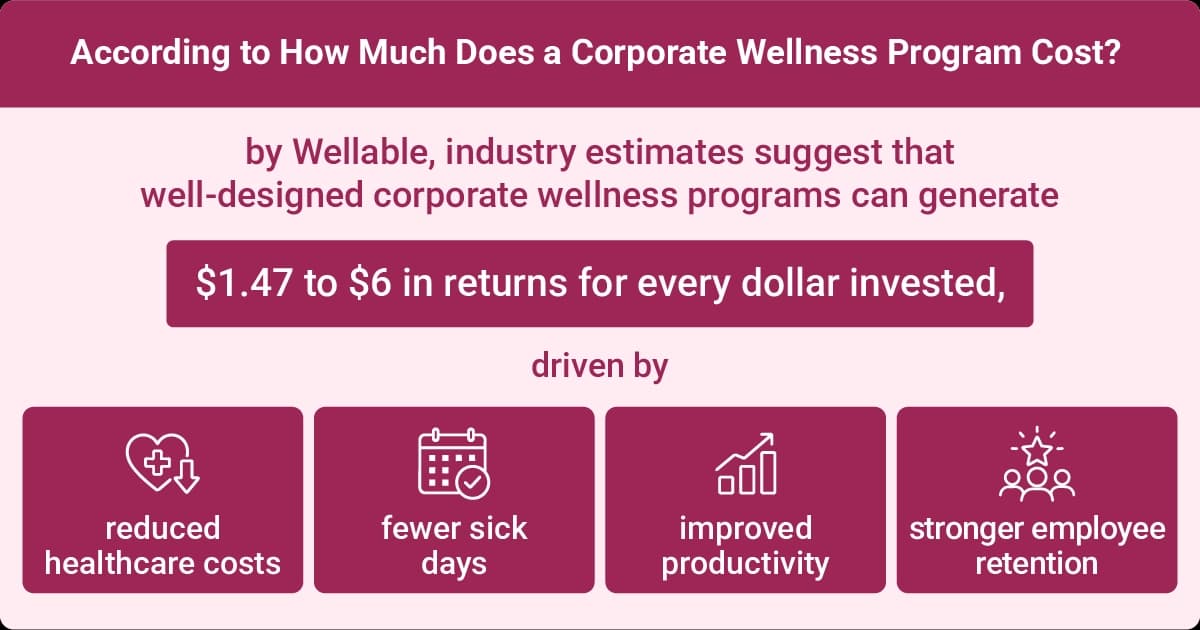
One of the benefits of wellness programs is how they can generate financial returns, impacting ROI. According to “How Much Does a Corporate Wellness Program Cost?” by Wellable, industry estimates range from $1.47 to $6 in returns per dollar spent, driven by reduced healthcare costs, fewer sick days, and improved productivity and retention.
You should also weigh wellness spending against the cost of doing nothing. Gallup and Workhuman estimate that there is around $20 million in lost opportunity for every 10,000 workers, while burnout-driven turnover and lost productivity cost the global economy $322 billion annually.
How to choose the right employee wellness software
The best employee wellness software solves the specific challenges your workforce faces. Consider these criteria when comparing platforms.
- Consider software that fits your specific problem: Fitness access, mental health support, holistic habit change, and cultural wellbeing require unique solutions. Instead of focusing on the feature list, look at whether the platform addresses the issues driving absenteeism and turnover.
- Do the groundwork before comparing vendors: Set your wellness budget, factoring in software and incentive costs. Software may cost $2 to $8 PEPM, but incentives and services will increase the total program cost. Then conduct an employee wellness survey to identify your workforce's needs, including demand for mental health resources, and develop wellness ideas. Also, verify that the platform supports all your locations, languages, and deskless roles.
- Check scalability: Pick a platform that can grow with your workforce. Enterprise-level operations must confirm whether the software can handle a 10,000-person workforce and support employees across locations and languages.
- Confirm integrations: Verify the platform connects with the tools your workforce already uses. For example, Human Resource Information System (HRIS) integration can sync employee information automatically to reduce manual updates. Single sign-on (SSO) lets employees use their existing logins, while wearable devices simplify activity tracking.
- Demand analytics that prove outcomes: Look beyond basic participation dashboards. Choose a platform that reports ROI, changes in health risk, and engagement trends that leadership can act on.
- Verify security and compliance credentials: Because corporate wellness platforms handle sensitive health data, verify HIPAA compliance and certification such as HITRUST and NCQA.
- Use review sites as a validation layer: Check G2, Capterra, and Gartner Peer Insights to verify a vendor's claims about their platforms. But let your workforce's needs, not just the review scores, guide your final decision.
If your employees feel unseen at work, your wellness initiatives can fail. Always evaluate how a platform, or a recognition program alongside it, addresses belonging and appreciation, rather than activity alone.
According to "Amplifying Wellbeing at Work and Beyond Through the Power of Recognition," by Gallup and Workhuman, employees who receive fulfilling recognition are 90% less likely to report being burned out at work always or very often, and up to 10x as likely to strongly agree they belong.
"Using Recognition to Uplift Wellbeing and Daily Emotions," by Workhuman and Gallup, shows that high-quality recognition fulfilling at least four of five strategic pillars makes employees 66% less likely to experience loneliness. Connection and recognition features deserve real weight when scoring platforms for distributed teams.
FAQs
How long does it take to implement employee wellness software?
Implementing employee wellness software takes anywhere from a few days to several months, depending on the platform's complexity and its integrations with your existing systems.
How do you measure the ROI of an employee wellness program?
To measure the ROI of an employee wellness program, compare the program's costs to measurable outcomes such as:
- Lower healthcare expenses
- Reduced absenteeism
- Higher productivity
- Improved employee retention
Track these metrics before and after launching the program to identify changes and calculate the financial impact.
What is the difference between employee wellness software and an EAP?
Employee wellness software generally focuses on ongoing wellbeing and engagement across the workforce, while EAPs (Employee Assistance Programs) provide confidential support and services for employees dealing with personal or work-related challenges.
Can employee wellness software work together with an employee recognition program?
Yes, employee wellness software and employee recognition software can complement each other. Wellness software addresses physical, financial, and habit-based wellbeing, while recognition programs address the cultural drivers of employee engagement, motivation, and belonging.
Which employee wellness software features matter most for remote and hybrid teams?
Distributed teams may benefit most from an employee wellness platform that offers:
- Robust virtual wellness activities
- Flexible scheduling
- Mobile access
- Personalized resources
- Engagement tracking

Ryan Stoltz
Ryan is a search marketing manager and content strategist at Workhuman where he writes on the next evolution of the workplace. Outside of the workplace, he's a diehard 49ers fan, comedy junkie, and has trouble avoiding sweets on a nightly basis.
Recommended for you