
Employee Points Reward System: How It Works and How to Design One
by Ryan Stoltz
Last updated
10 min read
Table of contents
- What is an employee points reward system?
- How does an employee point rewards system work?
- Why do points beat one-size-fits-all rewards?
- How do you design an employee points reward system?
- What are examples of employee points reward systems in action?
- What are the common pitfalls of employee points reward systems?
- How do you measure a points reward system's health?
- FAQs
Share this article
When a team member hits a major goal or goes the extra mile for a client, they deserve recognition for their efforts. An employee points reward system lets you track these contributions and offer meaningful rewards they actually value.
This system offers more flexibility than traditional recognition programs, enhancing employee morale through more frequent and personalized recognition. HR leaders often splurge on ad hoc bonuses, annual awards, or yet another coffee mug with the company logo. But generic gifts often fall flat, even when they're given with the best intentions.
That's especially true for global and hybrid teams. Employees from different regions may not have access to the same rewards, or their bonus might not be worth as much in local currency.
An employee points reward system is designed to let employees choose how they're recognized and redeem points for personalized rewards. This guide explains how to set up a fair system, avoid common issues, and track the right metrics.
What is an employee points reward system?
Managers and peers can award points to recognize an employee's accomplishments. For example, a sales rep could grant 20 points to a colleague who helped them close a high-stakes deal. Top Employee recognition software also makes it easy to automatically give points for work anniversaries and other milestones. This tool tracks these points as digital currency, so you don't need to manually update a spreadsheet.
A traditional employee recognition and rewards program often involves one-off bonuses and sporadic employee-of-the-month awards. By contrast, a points-based reward system lets employees earn recognition throughout the year. Points also accumulate, giving them more incentive to keep putting their best foot forward over time.
Common categories of redeemable employee incentives include:
- Charitable donations
- Experiences, such as a concert or trip
- Extra time off
- Gift cards
- Merchandise
How does an employee point rewards system work?
An employee reward point system allows your team to earn digital points for milestones and contributions. They can view their balance as points accumulate over time and redeem them for rewards from a catalog. These rewards typically have different values, so employees who earn more points can claim better incentives.
Designing this system involves:
- Defining earning criteria
- Awarding points in real time
- Accumulating points in a visible balance for each employee
- Allowing employees to redeem points from a catalog
- Reviewing data to make sure the system is meeting the business's goals
Timeliness is key. When you award points soon after a specific behavior, it creates meaningful recognition and reinforces that the company values that type of action. This can make the employee and other team members more likely to repeat it in the future.
While managers and peers award points, HR handles the administrative side. Employee rewards software makes it easy to set budgets and approve rewards, so you don't have to worry about spending too much. It also automates report generation to help HR keep track of budgets, rewards, and employee engagement.
Earning points
You can use many triggers to award points, including:
- Completing training
- Demonstrating company values
- Manager spot awards
- Peer recognition
- Reaching goals or milestones
Assign different point values to specific actions so you can reward employees more generously for high-impact achievements. For example, a new hire might receive 50 points for completing onboarding, while a project lead gets 75 points for solving a major problem.
Accumulating and tracking points
All the points an employee earns get added to their personal balance. This lets them save for higher-value rewards instead of receiving a one-time award for each achievement.
Choose a recognition platform that lets employees track their own balances whenever they want. This visibility helps motivate them to keep achieving and makes employees feel valued, especially when they can see that they're close to an incentive they've been eyeing.
Redeeming points
Employee point system rewards may include monetary rewards, merchandise, experiences, donations, time off, and more. The ability to choose their own rewards makes each redemption feel more personal and valuable. A parent might choose extra vacation time, while an avid traveler could go for a scuba-diving excursion or historical tour.
Why do points beat one-size-fits-all rewards?
Points-based recognition is more effective than generic rewards because it gives employees the freedom to choose incentives that are genuinely meaningful to them. It also allows you to recognize their contributions more frequently and adds more transparency to the entire rewards process.
Choice is one of the biggest benefits of a points system. Employees can browse a catalog to pick out a specific item they value instead of getting the same cash bonus as their coworkers. Workhuman® research, “What’s Wrong With Cash and Debit Cards in Recognition?,” shows that employees who choose a tangible gift or experience perceive it as three times as valuable as an equivalent cash-value reward.
Plus, “Cash Is Not King,” a Workhuman study, shows that cash rewards tend to blend into paychecks and get spent on bills. That means the moment of recognition quickly gets forgotten. On the other hand, non-cash rewards are public and easier to share. For instance, an employee could post photos from an experience in their department's Slack channel.
Points also work better for global and distributed teams than one-size gifts. Recognition platforms like Workhuman have global rewards catalogs with local redemption options. These make it easy for team members in different countries to choose relevant incentives. You also don't have to worry about figuring out international shipping or currency conversions.
Increased frequency is another benefit of using rewards and recognition to acknowledge employee contributions throughout the year. Organizations may only give cash bonuses and other large gifts once or twice a year.
With a points-based reward system, you can recognize small moments throughout the year. For one leading pharmaceutical company, frequent recognition correlated with 15% lower turnover.
A visible points system also improves transparency. Employees understand which contributions get recognized and have equal opportunities to earn points. That can reduce the risk of perceived unfair favoritism at the workplace that sometimes happens with ad hoc gifting.
How do you design an employee points reward system?
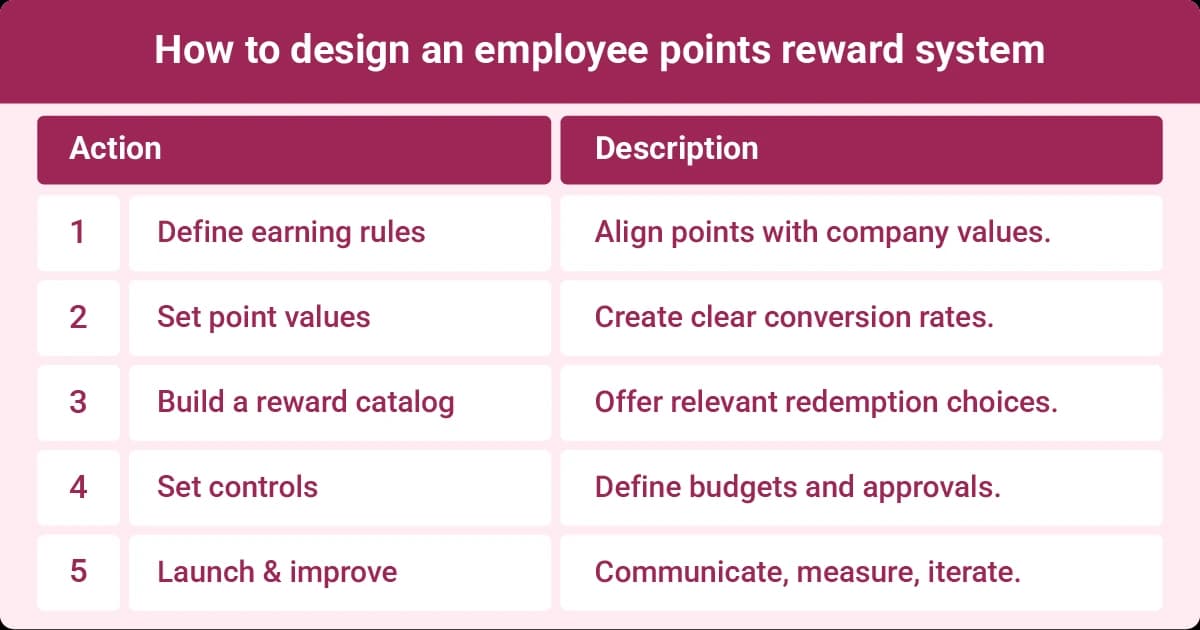
Before you start building your employee points reward system, take the time to spell out your company values and program goals. Use these priorities to create earning rules and decide who can give points. You should also set a budget and clearly communicate how the program works before launch.
1. Set earning rules that reflect company values
The last thing you want to do is accidentally reward the wrong behavior. Review your company's values and goals to help you decide which behaviors and achievements will earn points. If a contribution doesn't fit the organization's priorities, it probably shouldn't qualify for points.
Offer multiple ways to earn points so employees in all roles can participate. These paths could include collaboration, performance, learning, and milestones. For example, a sales rep might earn points for meeting a revenue goal, while an engineer could get rewarded for completing a new certificate.
2. Assign point values and conversion rates
Not all contributions have the same impact. Create a tier system with different values for each category, such as:
- 100 points for small, everyday recognitions
- 500 to 1,000 points for mid-size achievements
- 2,000 to 5,000 points for large milestones
For full transparency, publish a simple, consistent point-to-value conversion. This could be as simple as 100 points equaling $1 or whatever makes sense for your budget.
3. Build the redemption catalog
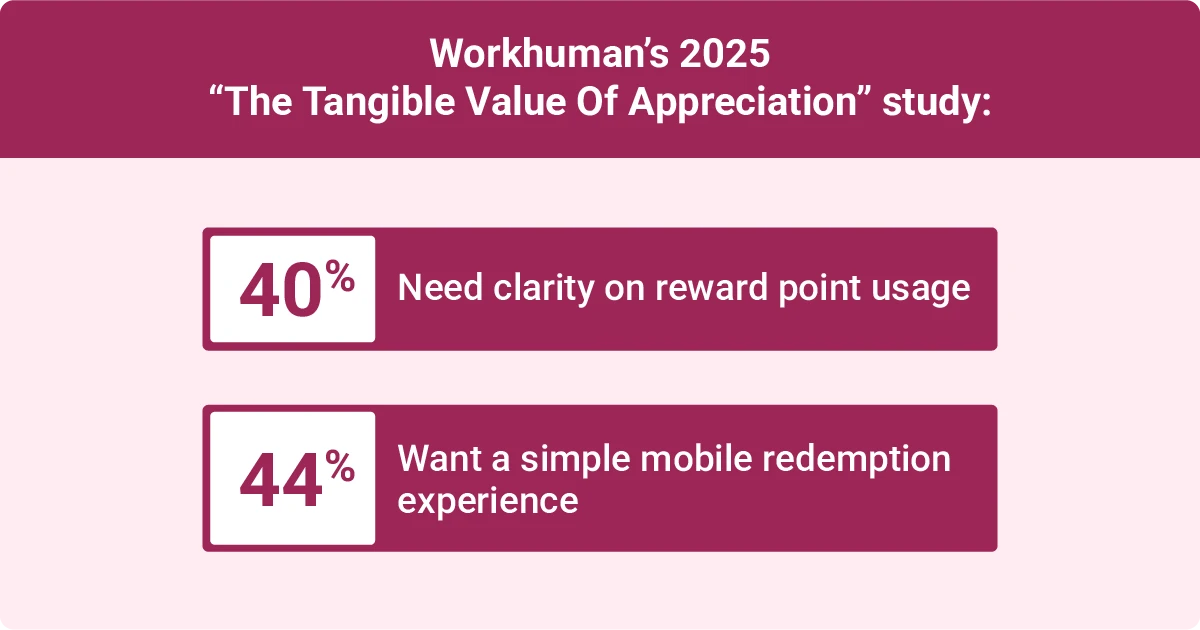
As you design your rewards catalog, focus on clarity and accessibility. In a 2025 Workhuman study, “The Tangible Value Of Appreciation,” 40% of employees said they wanted clear guidance on what their points can buy. The survey also found that 44% believe a simple, mobile-friendly process is key to an enjoyable redemption experience.
There are many different ideas for employee rewards for companies, so include a healthy mix. Some people love gift cards and merchandise, while others may prefer to donate to their favorite charity. Other popular options include time off and experiences.
According to “5 Benefits of a Rewards Store Built to Drive Engagement,” by Workhuman, global teams can benefit from a rewards store that fulfills rewards in their countries. It should also calibrate award values for different standards of living. An excellent incentive in one country might not be worth much in another.
Workhuman's Social Recognition™ is a points-based program with a global redemption store. Employees can choose from millions of rewards across more than 150 countries. The catalog includes locally curated merchandise with in-country fulfillment for 95% of employees for easy shipping. The software calibrates award values automatically and offers support in over 40 languages.
4. Set budgets, caps, and approval workflows
Control spending by setting a per-employee budget. You could also limit the frequency of rewards, such as only allowing a manager to award 10,000 points per quarter. This makes it easier to predict spending and can help prevent favoritism.
Before you launch your points-based reward system, you should also decide whether to include:
- A minimum redemption threshold
- Approval rules for high-value awards
- Expiration dates for points
Some organizations allow points to roll over indefinitely. However, if you don't set any limits, unredeemed balances could turn into a financial liability. After a few years, you might have multiple employees trying to redeem thousands of dollars' worth of points at once, straining your budget.
5. Communicate, launch, and iterate
It's natural for employees to feel excited about a rewards system, especially as they browse your shiny new catalog. But don't let hype overshadow transparency.
Make sure your team has realistic expectations by clearly explaining how earning points and redemption work. That way, they won't feel surprised if their points expire or they can't give their colleague 1,000 points for a funny joke.
You should also document all rules in a spot where everyone can access them, such as the company handbook or knowledge base.
If possible, pilot your rewards system with a single group or department. Observe their earning and redemption behavior over several months, and adjust point values as necessary. A trial run can make the difference between a successful program and one that quickly goes stale.
What are examples of employee points reward systems in action?
Point-based reward systems can have many different structures and triggers, depending on which types of behavior you want to reward. You might award points based on performance, milestones, wellbeing, development, or all of the above. In every case, employees can redeem these points for rewards.
Popular employee points reward system examples include:
- Performance: Managers award points when employees meet or exceed work-related goals. For instance, a worker might earn 250 points for finishing a project ahead of schedule or 500 points for hitting a sales target.
- Peer-to-peer: Instead of relying on managers, every employee receives a small point budget that they can use to thank their colleagues for support. If Jessica helps Kate fix a software bug, Kate could give her 20 points to show her appreciation.
- Milestones: Recognition software can automatically award points for work anniversaries and to celebrate meeting safety or quality goals. Each year of service might be worth 100 to 500 points to reward tenure.
- Learning and development: HR leaders can reward growth by giving employees points when they complete training. Earning a new certificate might net 300 points, while a one-hour AI workshop is worth 25 to 50 points.
- Wellbeing: Managers can encourage their teams to invest in their health by giving points for participating in wellbeing challenges. For example, someone who attends 30 fitness classes in a month might earn 100 points.
What are the common pitfalls of employee points reward systems?
Points fatigue and stale catalogs
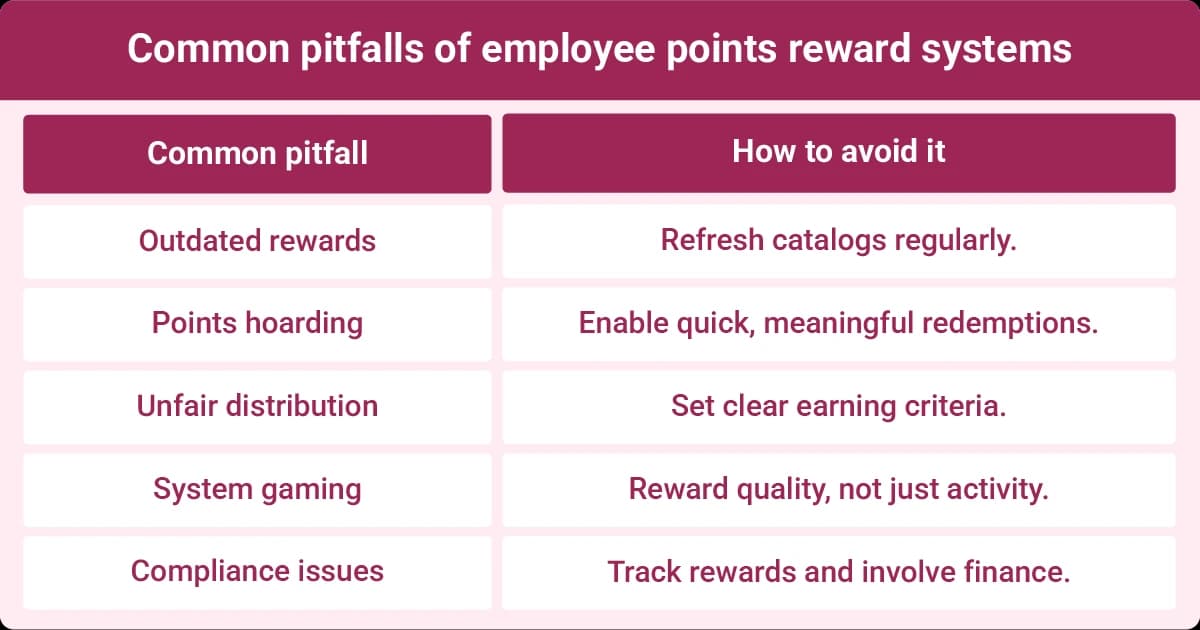
Nothing kills enthusiasm like an outdated rewards catalog filled with old products and no-longer-trendy experiences. Your rewards program could also fade from memory if communication drops off after the big launch.
Fix: Survey your employees about their rewards preferences and refresh the catalog often, especially around seasonal moments.
Points hoarding and delayed value
When employees spend months or years amassing points, it delays gratification. In fact, they may not remember why they earned their points by the time they redeem them. Such hoarding weakens the connection between positive behavior and reward, which may reduce employee motivation.
Fix: Offer appealing low-tier rewards and reasonable thresholds so employees can get value out of their points quickly.
Perceived unfairness and favoritism
Employees quickly lose trust if they notice that managers award points inconsistently or favor certain roles. This could also lead to resentment between colleagues. For instance, one employee may refuse to give points to a coworker if they believe that individual already has an unfair advantage.
Fix: Publish objective criteria for earning points, enable peer-to-peer awarding instead of depending solely on managers, and keep a close eye on distribution for anomalies.
Gaming and unhealthy competition
Some points-based systems accidentally encourage employees to prioritize quantity over quality. For instance, if you offer 100 points for every fixed bug, programmers might rush through fixes, creating more problems in the long run. They might even look for loopholes, like sneaking bugs into the code themselves so they can "fix" them later.
Fix: Avoid creating competitive leaderboards, limit how many times employees can earn points for high-frequency actions, and require approvals where necessary.
Tax and compliance blind spots
You might assume that all rewards are tax-free, but that's not necessarily true. In the United States, the Internal Revenue Service typically considers gift cards and other cash-equivalent rewards as taxable income under "De minimis fringe benefitsOpens in a new tab.”
Fix: Loop in your finance and payroll team when you're designing your rewards system, and always track reward values for reporting.
How do you measure a points reward system's health?
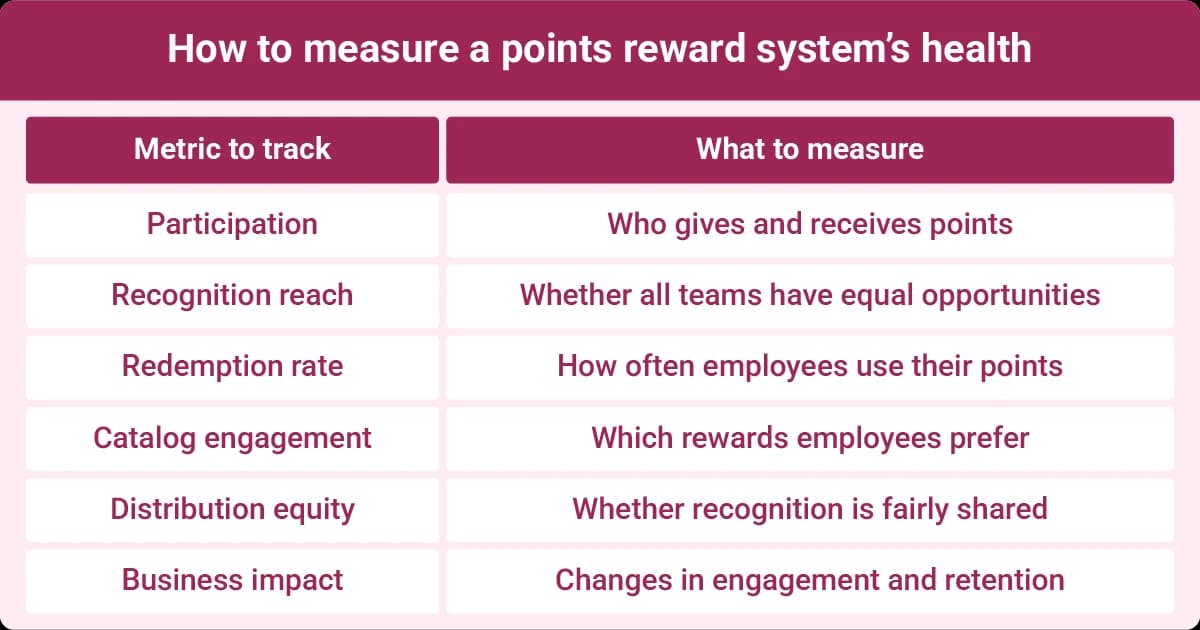
Employee recognition platforms can include built-in analytics and reporting tools for tracking the health of your points-based reward program. Monitor participation, redemption, distribution equity, engagement, and employee satisfaction to make sure your program is meeting your goals. You can also use this data to spot areas for improvement.
Participation and recognition reach
- Who gives and receives points: If only managers give points, you're not getting the most out of your program. Encourage peer-to-peer recognition with fun contests, public recognition, or weekly reminders to show appreciation and motivate participation.
- Recognition reach: Some teams or roles may have fewer natural earning opportunities, especially if they work remotely. Make it a point to create earning criteria that allow them to participate.
Redemption rate and catalog engagement
- Redemption rate: “The Tangible Value of Appreciation,” a 2025 Workhuman study, found that frequent redeemers report 34% more belonging. Even a single reward redemption doubles positive feelings toward a recognition program, with 11 or more redemptions growing that attachment nearly 7x. If employees have rising unredeemed balances, you may need to add new incentives or lower spending thresholds.
- Which catalog categories get used: Employees often skip stale or irrelevant categories. Replace them with more exciting rewards that meet your team's preferences.
Distribution equity and business impact
- Recognition distribution: Audit how points get distributed across your organization to look for teams or roles that get overlooked. Encourage managers to recognize diverse achievements to help close gaps.
- Employee retention and engagement metrics: Track how these metrics change before and after you launch your rewards program. This data can help you demonstrate your initiative's return on investment.
FAQs
Are employee reward points taxable?
Reward points have no inherent value outside your organization, so they're not treated as taxable income when they're awarded. However, employees in many jurisdictions, including the United States, may need to pay tax if they redeem their points for cash or gift cards. Tax regulations vary by region, so consider consulting an accountant before you launch your program.
Do employee reward points expire?
Whether points expire depends on how you structure your employee reward system. Some organizations roll points over indefinitely, making it easier for employees to save up for high-value rewards. Others set an expiration date to encourage people to redeem points frequently and avoid unexpected expenses.
What is the difference between employee recognition and rewards?
Employee recognition is any action that shows your appreciation for an employee's contributions. Meanwhile, rewards are the tangible incentives that you give for specific achievements. A public shout-out in the company's Slack channel is recognition, while the gift card you hand the employee is their reward.
How often should you update an employee points reward system?
You should review your reward system for employees regularly to make sure it's meeting your team's needs. If employees aren't redeeming rewards, your catalog may be unappealing or your criteria for earning points could be too strict. Gather worker input and make changes as necessary.
Can employees earn points for activities beyond performance, like wellness or learning?
Many rewards programs offer points for behaviors and milestones beyond performance. If your organization values professional development, let employees earn points for training and gaining credentials. If promoting wellness is a top priority, give points for completing fitness challenges and other health-oriented activities.

Ryan Stoltz
Ryan is a search marketing manager and content strategist at Workhuman where he writes on the next evolution of the workplace. Outside of the workplace, he's a diehard 49ers fan, comedy junkie, and has trouble avoiding sweets on a nightly basis.
Recommended for you