
Employee Loyalty Program: Definition, Types, and Steps
by Ryan Stoltz
Last updated
9 min read
Table of contents
- What is an employee loyalty program?
- How is an employee loyalty program different from a customer loyalty program?
- What are the types of employee loyalty programs?
- What are the key elements of an effective employee loyalty program?
- How do you build an employee loyalty program?
- How do you measure employee loyalty and whether your program works?
- What are the latest trends in employee loyalty programs?
- FAQs
Share this article
Even when pay is competitive and perks keep growing, HR leaders are watching experienced employees quietly disengage and eventually leave.
An employee loyalty program is a structured company initiative that rewards employees for their ongoing commitment, performance, and tenure. The goal is better retention, stronger engagement, and higher morale.
Isolated gestures of appreciation don't add up to real commitment on their own. A program works because it's consistent, based on clear criteria, and tied to what the company actually wants to reinforce.
This article covers what an employee loyalty program is and how it's different from a customer loyalty program. It also covers the main program types and elements, a step-by-step approach to building such a program, and the metrics that show whether a program is working, such as tenure, retention, and eNPS (employee net promoter score).
What is an employee loyalty program?
The program runs on a reciprocal cycle. Employees invest effort, skill, and commitment, and the employer responds with financial and non-financial incentives. Employee loyalty isn't simply a measure of tenure or job satisfaction. It reflects an emotional and psychological connection to an organization and its values.
HR glossaries like Humaans and InMoment define employee loyalty the same way: the commitment and dedication employees feel, plus their willingness to go above and beyond.
The business case is simple. A loyalty program can cut high employee turnover rates and the hiring costs that come with turnover, lift employee morale and productivity, strengthen company culture, and turn employees into real brand advocates.
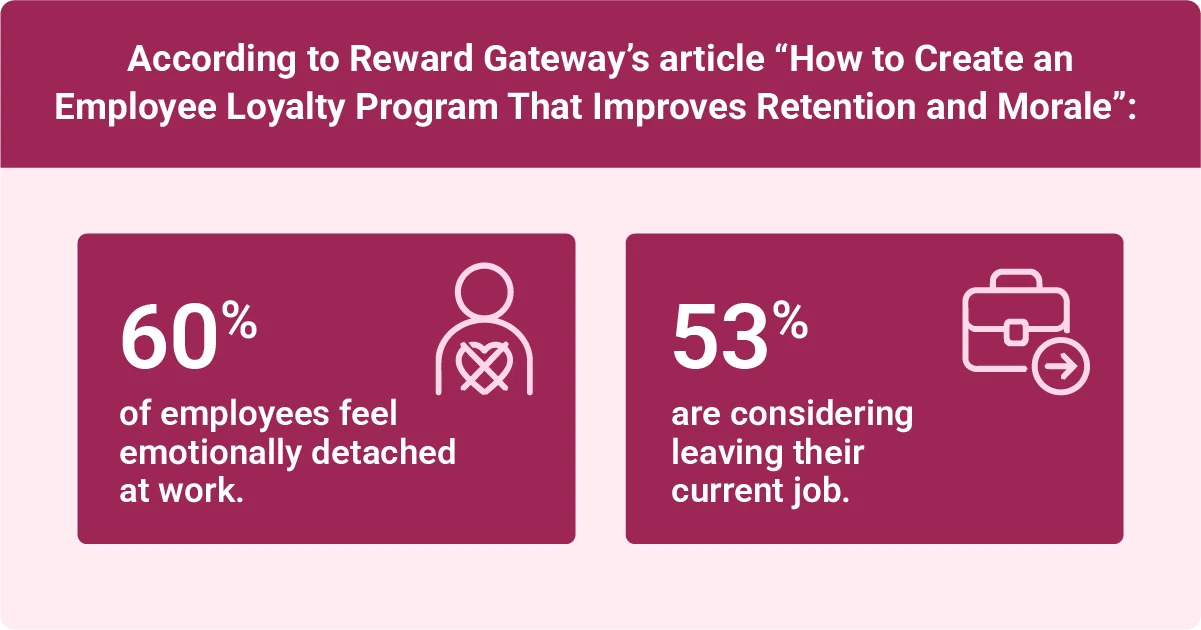
Employee loyalty programs matter even more since the pandemic. “How to create an employee loyalty program that improves retention and moraleOpens in a new tab,” by Reward Gateway, found that 60% of employees feel emotionally detached at work, and 53% are considering leaving their current job.
How an employee loyalty program works
- Set the triggers. The program defines what earns employee rewards, like tenure milestones (1, 3, 5, 10 years), employee performance goals, values-driven behavior, mentoring, peer recognition, or referrals.
- Track and nominate. Managers, colleagues, or the platform itself log recognition moments and add up points or milestones in real time.
- Distribute the reward. Employees get anything from an instant public shout-out to points they can redeem for flexible perks.
- Measure and adjust. The company tracks participation, retention, and engagement, then refines its criteria and rewards over time.
How is an employee loyalty program different from a customer loyalty program?
An employee loyalty program and a customer loyalty program run on the same basic logic: reward the behavior you want repeated. Employee programs reward tenure, performance, and values-aligned behavior. Customer programs reward repeat purchases.
The two use different currencies. Customer programs lean on discounts and points for purchases. Employee programs lean on recognition, paid time off, development budgets, and milestone awards. They're measured differently too.
“The Psychology of Points,” a report from the Incentive Research Foundation, notes that points-based employee programs borrow heavily from consumer loyalty mechanics, which is part of why the two get confused.
“The Importance of Employee Loyalty in the Workplace,” by InMoment, frames it well: employee loyalty and customer loyalty are connected, and loyal employees drive the success of the whole business.
What are the types of employee loyalty programs?
There are five main types of employee loyalty programs: tenure-based service awards, recognition-based programs, points-based programs, benefits-based programs, and equity or ownership programs. Most companies get the best results by combining a couple of these instead of relying on just one.
- Tenure-based programs (service awards): These reward people for sticking around, with milestone bonuses, extra PTO, anniversary gifts, and public recognition at 1, 3, 5, and 10 years.
- Recognition-based programs: Peer-to-peer shout-outs, manager-led praise, and spot awards tied to contribution, collaboration, mentoring, or living out company values.
- Points-based programs: Employees earn points for achievements and milestones, then redeem them for gift cards, experiences, time off, charitable donations, or other tangible rewards.
- Benefits-based programs: Perks that grow with tenure, like sabbaticals, more flexibility, and wellness benefits.
- Equity and ownership programs: Stock grants, vesting schedules, and profit sharing that tie long-term reward to staying with the company.
Many companies also layer on tiered or gamified structures, like bronze, silver, and gold levels, so progress stays visible, and recognition becomes a habit.
Examples of employee loyalty programs in practice
Here are a few examples of how loyalty programs engage employees and keep them from leaving.
- A points-based recognition system, where peer and manager awards build toward a redemption catalog of gift cards, experiences, and donations.
- Service milestone celebrations that mark work anniversaries with awards, public recognition, and a moment to celebrate.
- Development-linked loyalty, including learning stipends, funded certifications, mentorship access, and sabbaticals for long-tenured employees.
- Wellness and flexibility perks used as loyalty rewards, like extra PTO, flexible scheduling, and wellness stipends.
What are the key elements of an effective employee loyalty program?
The key elements of an effective employee loyalty program are a balanced reward mix, frequent recognition, fairness and transparency, accessibility for a wide array of roles at a company, alignment with company values, and rewards employees have the option to personalize.
Skip these and a program ends up feeling like a perk list, not something that builds real loyalty.
A balanced reward mix matters because non-financial recognition drives a lot of employee engagement. “Money can’t buy your employees’ loyalty,” by McKinsey & Company, notes that up to 55% of engagement comes from non-financial recognition alone. But recognition still needs real weight behind it.
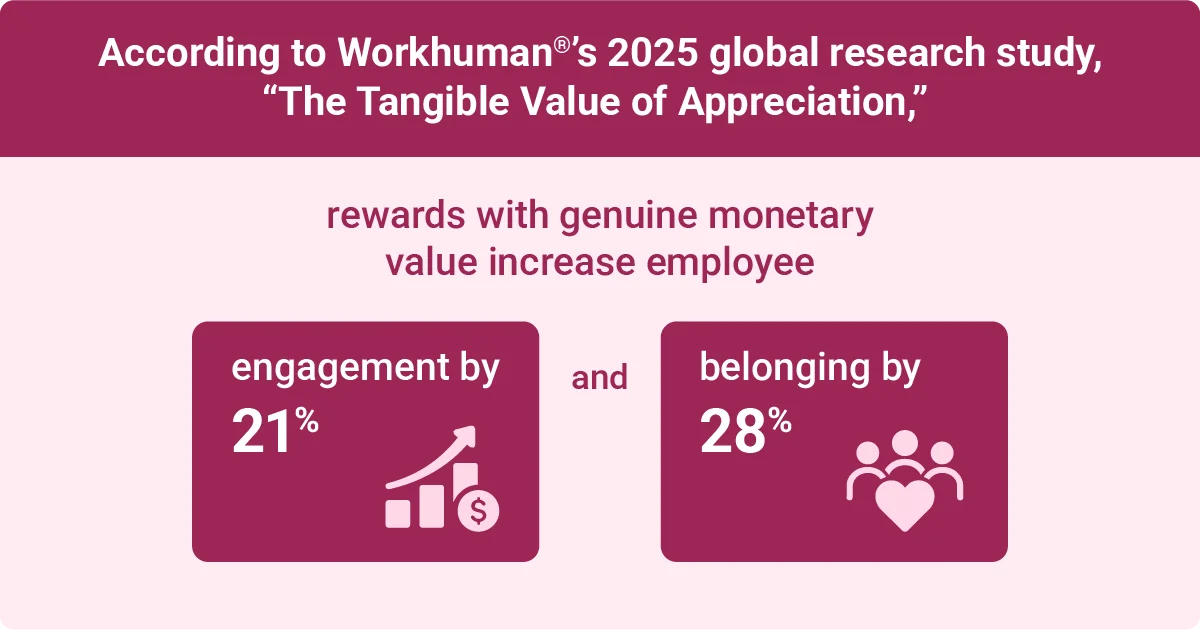
“The Tangible Value of Appreciation,” a 2025 global research study by Workhuman®, found that when rewards carry genuine monetary value, engagement rises by 21% and a sense of belonging rises by 28%.
“The Human-Centered Workplace: Building Organizational Cultures That Thrive,” by Gallup and Workhuman, also notes that recognition needs to happen in layers, not just once a year.
Everyday peer shout-outs, quarterly spot bonuses, and milestone celebrations all work together. Annual-only service awards leave too much time between moments that matter.
Because loyalty is local, manager capability makes or breaks a program. Managers need to recognize consistently, have real career conversations, and personalize recognition to motivate employees instead of treating it like a checklist.
Personalization matters too. SHRM's research, “How Flexible Rewards Programs Boost Employee Engagement,” shows employees prefer options over a one-size-fits-all approach. A mismatched reward, like a coffee mug for a project that saved real money, doesn't land the way it's meant to.
The reward mix: Monetary, non-monetary, and social recognition
A balanced mix covers four areas. Monetary rewards include spot bonuses, milestone bonuses, profit sharing, and gift cards. Non-monetary rewards include extra paid time off, flexible scheduling, wellness stipends, and sabbaticals.
Social recognition covers public shout-outs, peer-to-peer praise, and team celebrations. Career growth rounds it out through learning budgets, funded certifications, mentorship, and internal mobility pathways.
Fairness, transparency, and accessibility
Fairness starts with published eligibility rules and reward criteria. Vague standards like "a loyal attitude" invite doubt, so it's better to define specific, observable behaviors instead. Tracking reward distribution across teams and demographics also helps catch favoritism early.
Accessibility matters just as much. Programs need mobile-first access, multilingual support, and parity for non-office roles so every worker can participate equally.
“The Tangible Value of Appreciation,” by Workhuman, found that 44% of employees say a simple, mobile-friendly redemption process is the most enjoyable part of getting an employee reward point system.
How do you build an employee loyalty program?
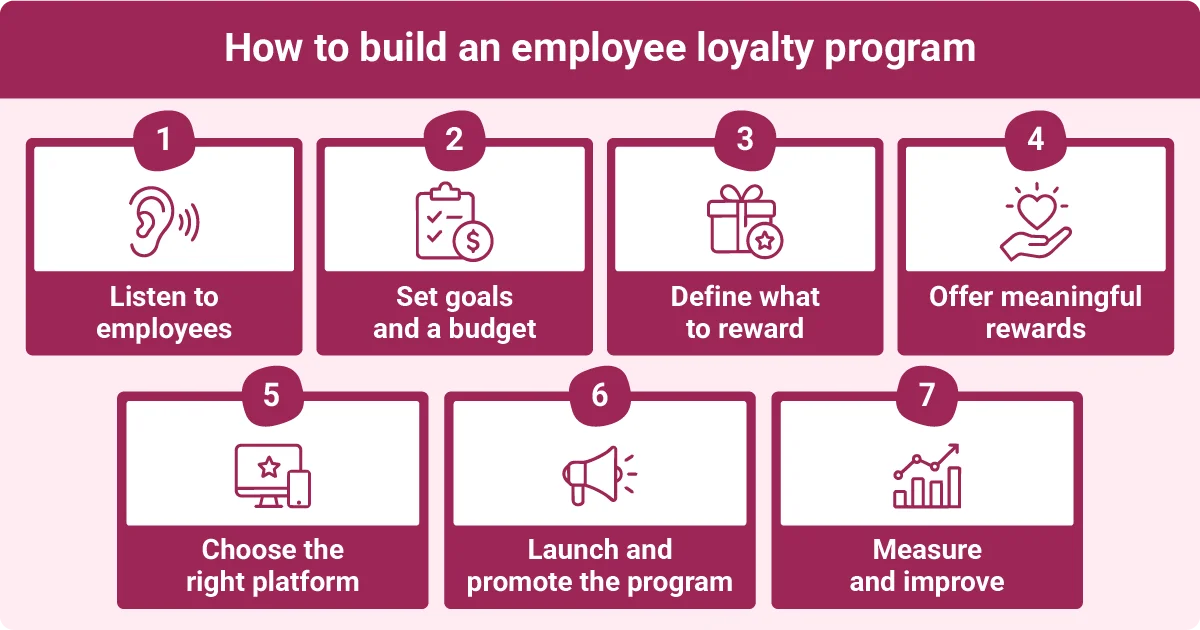
You build an employee loyalty program by listening to employees first, setting goals and a budget, defining what behaviors to reward, choosing a varied reward mix, picking a platform, launching with real communication, and measuring results so you can make adjustments if needed.
This approach shows up consistently across HR research on the topic.
- Listen first. Gather input through engagement surveys, focus groups, one-on-ones, and exit interview data before you design anything.
- Define goals, KPIs, and budget. Pick one to three measurable outcomes, like cutting voluntary turnover or raising recognition frequency, and set a sustainable budget. Programs that put about 1% of payroll toward recognition micro-bonuses tend to see the highest return, according to “13 Lessons Learned: Best Practices on Recognition Program Strategy, Design, Change Management, and Success Metrics,” by Workhuman.
- Identify the behaviors and milestones to reward. Cover performance results, values-driven behavior, mentoring, referrals, and service milestones, all with clear and consistent criteria.
- Choose a varied reward mix. Span monetary, experiential, recognition, and development categories so employees can find something that's actually meaningful.
- Select a delivery platform. Build recognition into tools employees already use, so participation doesn't take extra effort.
- Launch and promote it. Run a full communication campaign before, during, and after launch, and have leadership model the behavior first. “13 Lessons Learned: Best Practices on Recognition Program Strategy, Design, Change Management, and Success Metrics,” by Workhuman, found that recognition from managers a few times a month makes employees up to twice as likely to be thriving at work.
- Measure and iterate. Track participation, eNPS, and retention, gather quarterly employee feedback, and adjust your criteria and rewards as you go.
It's worth segmenting the program by employee group too. Frontline and corporate teams, new hires and long-tenured staff, and remote and onsite employees don't all respond to the same design.
A program should be built around real retention drivers, like fair pay, trust, growth, and flexibility, because these factors influence employee satisfaction and are not just part of reward initiatives designed to keep workers at a company.
A Workhuman study, “13 Lessons Learned: Best Practices on Recognition Program Strategy, Design, Change Management, and Success Metrics,” also found that employees who get high-quality recognition are 45% less likely to have left two years later, which is part of why this approach works.
Common mistakes that undermine loyalty programs
Even well-funded programs can fail if the basic elements create a misalignment with a company’s values. These are the mistakes that show up most often; each one quietly erodes the trust a loyalty program depends on.
- Relying on transactional, generic, top-down perks instead of authentic, timely, personal acknowledgment.
- Using vague criteria that end up looking like favoritism, instead of published rules and tracked distribution.
- Sticking to annual-only recognition, when everyday and quarterly layers carry most of the engagement value.
- Treating rewards as a substitute for fair pay, good management, and real career growth.
How do you measure employee loyalty and whether your program works?
Loyalty shows up in two ways.
Behavioral loyalty metrics cover signals related to how employees act: voluntary turnover, employee retention rate, average tenure, internal mobility, referral rates, absenteeism, and presenteeism.
Attitudinal loyalty data cover what people feel: eNPS, survey items on trust and pride, and themes from stay interviews.
Core employee loyalty metrics: Tenure, retention, and eNPS
A few core metrics tell you most of what you need to know.
- Average tenure shows how long employees remain with the organization and can reveal changes in workforce stability.
- Voluntary turnover and 12-month retention show whether employees are leaving at different rates after the program launches. Voluntary turnover is particularly relevant because it isolates employee-initiated departures.
- eNPS measures employees' willingness to recommend their organization as a place to work. The standard calculation uses one 0-to-10 question:
- Promoters: 9–10
- Passives: 7–8
- Detractors: 0–6
The eNPS score is the percentage of Promoters minus the percentage of Detractors, producing a score between -100 and +100.
- Participation and utilization show whether employees and managers are actually using the program. Recognition frequency and reward redemption can reveal whether the program is becoming part of everyday employee experience.
Other useful indicators include internal mobility, employee referrals, absenteeism, and survey responses about trust, pride, and intent to stay. Stay interviews can add qualitative context that numbers alone cannot provide.
You should segment your results by department, manager, location, and relevant employee demographics. A healthy overall participation rate can conceal weak adoption in one part of the organization.
Do employee loyalty programs actually work?
The evidence holds up. “21 employee recognition statistics worth memorizing,” by Reward Gateway, links formal recognition programs to 31% lower turnover, and a Salt Labs analysis of six companies and 60,000 employees, “Unlocking Employee Retention— Reducing Turnover With Salt Rewards PlatformOpens in a new tab,” found 62% lower turnover among reward platform participants specifically.
Workhuman and Gallup research, “The Human-Centered Workplace: Building Organizational Cultures That Thrive,” shows the same pattern: employees with the best recognition experiences have the lowest turnover.
Workhuman's research, “13 Lessons Learned: Best Practices on Recognition Program Strategy, Design, Change Management, and Success Metrics,” adds another angle. Employees who received high-quality recognition were 45% less likely to have left within two years, echoing the same retention effect from a different data set.
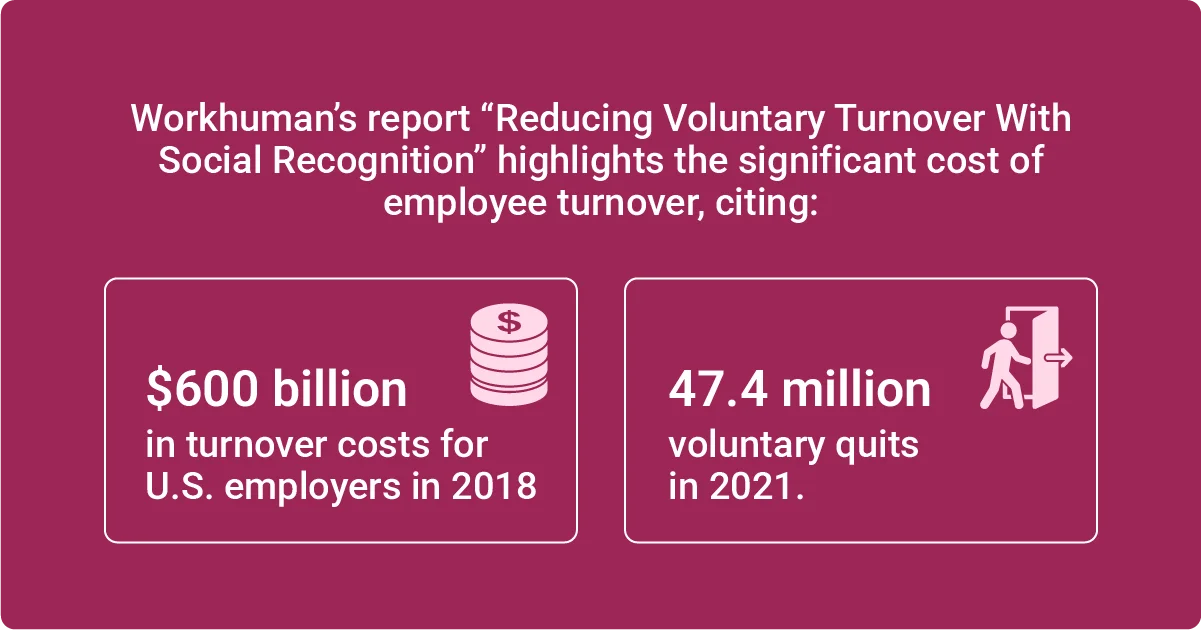
That evidence matters because the cost of getting this wrong is real. “Reducing Voluntary Turnover With Social Recognition,” by Workhuman, highlights that turnover cost U.S. employers $600 billion in 2018. The report also points out that 47.4 million people quit voluntarily in 2021.
Well-designed programs also show gains in engagement and productivity. But it's worth remembering that correlation isn't causation. Testing with before-and-after comparisons and holdout groups is what actually tells you whether your program is the cause.
What are the latest trends in employee loyalty programs?
The latest trends in employee loyalty programs include AI-powered personalization, real-time micro-recognition, lifestyle spending accounts, and treating career growth and financial wellbeing as loyalty levers in their own right.
The overall shift is away from static perks and toward personalized, ongoing retention strategies that boost employee motivation.
- AI-powered personalization: Tools now match reward programs to individual preferences, nudge managers toward timely recognition, flag overlooked contributors, and run fairness checks across teams.
- Real-time micro-recognition: Frequent, in-the-moment appreciation through Slack, Teams, and meetings is replacing annual-only awards. Employees recognized weekly are 2.6 times more likely to perform at their best, and peer-recognized employees are 33% more likely to feel a sense of belonging, according to “20 employee recognition statistics for HR leaders,” by Achievers.
- Lifestyle Spending Accounts: Digital wallets employees can put toward whatever fits their life, from pet insurance to student loan repayment to mental health apps.
- Career growth as a loyalty lever: Learning budgets, mentoring, internal mobility, certifications, and upskilling can make career development part of an employee loyalty program. SHRM's “2026 talent trends” have highlighted internal mobility, mentoring, and upskilling as important areas for organizations.
- Financial wellbeing as a loyalty driver: Equity programs, retirement support, and financial wellness tools are increasingly tied to engagement and retention.
- Total rewards integration: Employee loyalty programs increasingly sit alongside pay, benefits, wellbeing, recognition, and development as part of a broader total rewards strategy. WorldatWork's “2026 Total Rewards Leadership” report identifies strategic alignment with organizational goals as a major driver of reward effectiveness.
- Support for hybrid, remote, and frontline teams: Mobile-first, multilingual, instantly delivered recognition makes sure distributed and deskless employees aren't left out.
These trends matter because engagement is still low overall. Only about 21% of employees globally are engaged at work, according to Gallup’s “State of the Global Workplace 2026” report, which is exactly the gap loyalty programs are trying to close.
The direction is clear: loyalty programs are becoming more personalized, accessible, and integrated with the wider employee experience.
FAQs
Do employee loyalty programs really reduce turnover?
Yes. Companies with formal recognition programs see 31% lower turnover than those without one, and platform participants in one large-scale study saw 62% lower turnover. Results depend on execution, though. Personalized, timely programs tied to real company values outperform generic perk catalogs.
What should an employee loyalty program reward?
Reward a mix of tenure milestones, performance results, and values-driven behavior, like mentoring, collaboration, and referrals. The best programs combine long-term milestones with everyday recognition, rather than only marking anniversaries once a year.
What are best practices for implementing an employee loyalty program?
Start by listening to employees, then set clear goals and a sustainable budget. Choose a varied reward mix, publish transparent criteria, train managers to recognize consistently, and measure participation and retention so you can adjust over time.
How much of an employee loyalty program should be monetary versus non-monetary?
There's no fixed ratio, but non-financial recognition drives up to 55% of engagement, so it shouldn't be an afterthought. The most effective programs blend monetary rewards, like bonuses, with non-monetary recognition, growth opportunities, and flexibility.
What is the best reward system for employees?
There's no single best system. A hybrid approach, combining tenure-based milestones, points-based flexibility, and frequent social recognition, tends to outperform any one type on its own, especially when employees can choose rewards that matter to them.

Ryan Stoltz
Ryan is a search marketing manager and content strategist at Workhuman where he writes on the next evolution of the workplace. Outside of the workplace, he's a diehard 49ers fan, comedy junkie, and has trouble avoiding sweets on a nightly basis.
Recommended for you