
Employee Engagement Trends in 2026: What Is Changing and What HR Should Do
by Ryan Stoltz
Last updated
11 min read
Table of contents
- What is happening to employee engagement right now?
- Why has manager enablement become the defining engagement trend?
- Why have clarity and trust in leadership become top engagement drivers?
- How is continuous listening replacing the annual engagement survey?
- How is AI changing employee engagement tools and employee expectations?
- How are hybrid and frontline engagement trends diverging?
- Why are wellbeing and engagement converging into one agenda?
- How is recognition becoming a primary engagement driver?
- What does engagement data maturity look like in practice?
- FAQs
Share this article
Current employee engagement trends reveal a disconnect: Employees are staying in their jobs, but that doesn't mean they're engaged. While turnover remains relatively low, engagement scores have declined, raising important questions about how connected, motivated, and supported employees feel at work.
For HR leaders, the challenge is understanding what's driving this disconnect and identifying which employee engagement strategies can be most effective in strengthening motivation, connection, and commitment in today's workplace.
This article explores the trends reshaping employee engagement in 2026, what the latest research reveals, and how organizations can respond.
What is happening to employee engagement right now?
Employee engagement is experiencing a global paradox: Turnover remains relatively low, yet employees are reporting declining levels of engagement. This disconnect suggests that workforce stability doesn't necessarily reflect how motivated, connected, or satisfied employees feel at work.
The numbers behind the decline
According to Gallup's “State of the Global Workplace 2026Opens in a new tab” report, global employee engagement declined to 20% in 2025. This level is its lowest since 2020 and the second consecutive annual decline, with no region of the world improving. The report explains that the cost to the world economy in lost productivity amounted to $10 trillion.
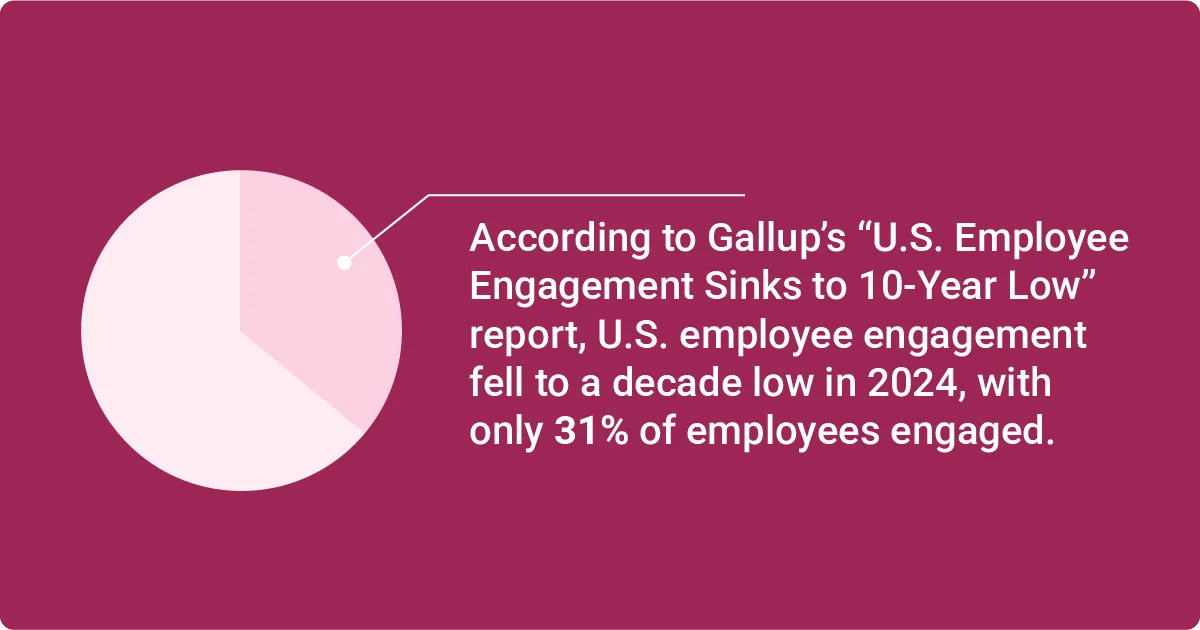
Gallup identifies declining manager engagement as a significant contributor to falling engagement rates worldwide and in the U.S. This suggests that the downturn may reflect deeper organizational challenges, and could be structural (long-lasting) instead of cyclical (temporary).
Why low turnover can hide engagement risks
Low quit rates can hide latent risk because they alone aren’t markers of how connected employees are to their organizations. According to Quantum Workplace’s report, “Beyond HR Metrics: The Untapped Potential Hidden in Employee Engagement Trends 2026,” U.S. quit rates reached 2% in 2025, with employees’ intent to stay rising faster than other engagement metrics.
At the same time, the factors influencing workplace engagement are shifting. Perceptyx's “What Is Employee Engagement and Why Have Its Drivers Changed?” draws on a longitudinal analysis of more than 20 million global employee survey responses and finds that confidence in leadership and effective change management have become increasingly important engagement drivers.
While belonging and feeling valued remain important to the employee experience, these findings suggest employees are placing greater emphasis on organizational stability and leadership effectiveness amid ongoing uncertainty.
For HR leaders, the takeaway is that low turnover and headline engagement scores alone may not tell the full story. Tracking employee sentiment, confidence in leadership, internal advancement opportunities, and manager effectiveness can provide a more complete picture of workforce engagement and help organizations refine their employee engagement strategies.
Why has manager enablement become the defining engagement trend?
Manager enablement has become a critical employee engagement priority as declining manager engagement creates challenges for the teams they lead. With managers overseeing larger teams and navigating increasingly complex responsibilities, organizations must ensure they have the support, resources, and tools needed to keep employees engaged.
Widening spans of control and the great flattening
Gallup research, “State of the Global Workplace 2026,” shows that manager engagement fell from 27% to 22% between 2024 and 2025. This decline is more pronounced than that of individual contributors; as a result, the engagement gap between managers and frontline workers has also decreased.
Gallup also estimates that managers account for at least 70% of the variance in team engagement that appears in employee engagement scores across business units.
The amount of responsibility managers now have also plays a role here. In “Span of Control: What's the Optimal Team Size for Managers?” Gallup notes that average direct reports rose from 10.9 in 2024 to 12.1 in 2025, a roughly 50% increase in team size since Gallup’s first tracking of the metric in 2013.
Another relevant factor is the great flattening, as organizations reduce layers of middle management and expand the responsibilities of remaining managers.
Gallup suggests four questions that can evaluate the ideal spans of control:
- How engaged is the team?
- How much time does a manager spend on individual contributor work?
- Do managers have the right talent for the role?
- Do managers give employees insightful, periodic feedback?
What manager enablement looks like in practice
Instead of motivational messaging, HR-led manager enablement should focus on providing team leaders with:
- Clear operational priorities and expectations
- Effective coaching frameworks
- Resources to relieve workload challenges
- Communication and guidance ahead of organizational changes
Accessible records of recognition allow managers to draw on contributions captured in the moment instead of relying on data gathered months before during periodic performance reviews. These insights can support more timely, specific feedback and meaningful conversations about employee performance and development.
HR should also measure manager engagement separately, as its own segment, rather than grouped with overall employee engagement to better identify challenges and target support where it's needed.
Why have clarity and trust in leadership become top engagement drivers?
Clarity and trust in leadership have become increasingly important engagement drivers as economic uncertainty, technological change, and organizational restructuring reshape the workplace. Employees want greater stability, transparency, and confidence in how their organizations navigate change.
The driver shift from belonging to confidence in leadership
What employees value in the workplace has shifted from the preferences they had just a few years ago.
From 2016 through 2024, belonging and feeling valued ranked among the leading drivers of employee engagement. However, Perceptyx's longitudinal analysis, “Employees Prioritize Organizational Stability Over Feeling Valued at Work for the First Time in a Decade,” notes that change-management effectiveness and confidence in senior leadership overtook those factors in 2025.
This shift doesn't diminish the importance of belonging and feeling valued. Instead, it suggests that employees are placing greater emphasis on organizational stability and effective leadership amid ongoing uncertainty.
Workplace uncertainty can increase anxiety, undermine employees' sense of control, and contribute to change fatigue. Without a clear understanding of how the business reacts to changing processes or technology, employees are susceptible to these concerns.
According to “Change Fatigue: A Guide For Managers and Team Leaders,” by Prosci, change fatigue refers to mental and psychological exhaustion due to constantly shifting or overlapping organizational changes without enough time to process them.
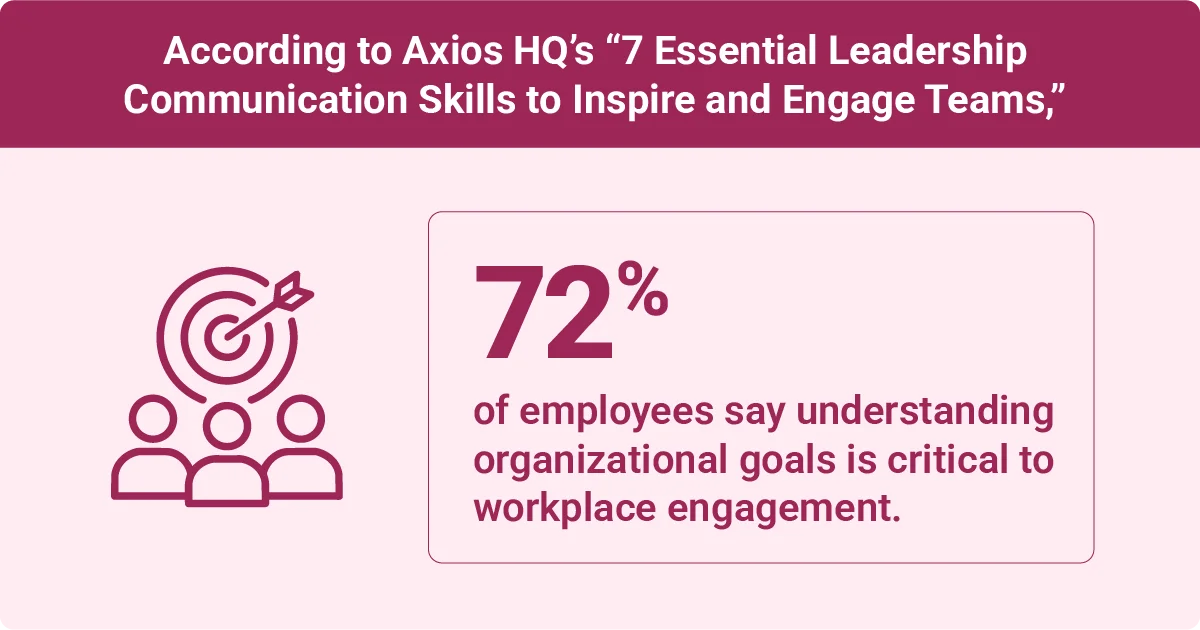
Clear communication can help address these challenges. 72% of employees say that understanding organizational goals plays a critical role in workplace engagement, according to an Axios HQ insight, “7 essential leadership communication skills to inspire and engage teams.”
For HR leaders, the takeaway is that building belonging and recognition should go hand in hand with providing operational clarity and transparent communication.
Making clarity operational
HR leaders can help organizations build trust by identifying where uncertainty, ineffective communication, and poorly managed change are affecting the employee experience.
Managers play an essential role in translating organizational priorities into clear expectations, explaining the reasoning behind decisions, and creating opportunities for employees to ask questions and provide feedback.
Trust can grow when employees understand not only what is changing, but why—and when leaders demonstrate that employee feedback has informed decisions and actions.
How is continuous listening replacing the annual engagement survey?
Continuous listening is supplementing the annual engagement survey, not replacing it. While annual surveys provide valuable organizational benchmarks, relying on them alone can leave HR teams responding to challenges months after they emerge.
By gathering feedback more frequently, organizations can identify emerging concerns, respond to changing employee needs, and demonstrate that feedback leads to meaningful action.
The continuous listening stack
SHRM’s “Performance Management: Key Components and How Organizations Implement ItOpens in a new tab” addresses the shift and warns that HR teams could miss growth opportunities. According to “Building Scalable Employee Listening Systems in the AI Era,” by SHRM, and “Voice of the Employee Solutions Reviews and Ratings,” by Gartner, the continuous listening stack should include:
- Baseline: Annual engagement surveys
- Short-interval tracking: Pulse surveys or continuous pulse checks
- Milestone monitoring: Moments that matter and exit and stay interviews
- AI-assisted analysis: Tools that analyze employee feedback and survey responses to identify recurring themes and emerging concerns, with appropriate privacy safeguards.
- Qualitative dialogue: AI-enabled or traditional focus groups and listening tours
- Always-on/direct channels: Digital suggestion boxes, ongoing feedback pipelines, and manager one-on-ones to discuss performance and wellness
Lifecycle listening can include structured feedback checkpoints at 30, 60, and 90 days, along with check-ins following promotions, role transitions, and other significant employee milestones.
Should the annual survey survive?
Yes. “Annual Employee Engagement Survey: Myths, Benefits, and Best Practices,” by Perceptyx, suggests a nuanced hybrid model in which annual engagement surveys provide comprehensive, organization-wide insights, supplemented by more frequent pulse and lifecycle surveys.
Targeted pulse surveys are then layered on top for specific subsets or the whole organization. These temperature checks can occur monthly or quarterly to follow up on hot topics or new engagement action plans.
Always-on lifecycle surveys capture employee sentiment during moments that matter: work anniversaries, onboarding, leaving, and other milestones.
Closing the loop faster
The Listen, Act, Communicate cycle helps organizations turn employee feedback into meaningful action. Collecting feedback without responding to it can create frustration, increase survey fatigue, and undermine trust in leadership.
“Don’t request feedback only to ignore it, report reminds employers,” by HR Dive, states that not acting on employee feedback can hurt more than not asking for it in the first place. How quickly organizations respond with action is a critical program metric; it allows workers to remain confident in their managers’ handling of their feedback.
How is AI changing employee engagement tools and employee expectations?
AI is changing how employee engagement platforms work, creating new opportunities and challenges for organizations. AI-powered tools can help analyze employee feedback, identify sentiment patterns, and surface emerging engagement concerns. At the same time, employees may feel uncertain about how AI will affect their roles, job security, and workplace expectations.
AI inside the engagement toolset
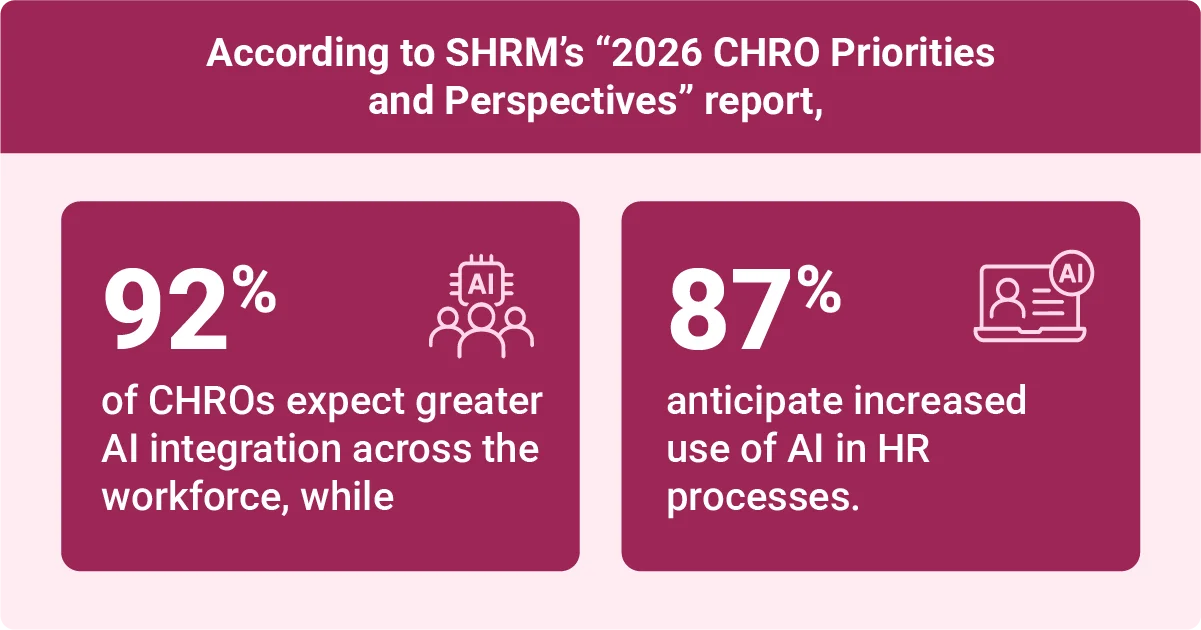
The SHRM “2026 CHRO Priorities and Perspectives” report shows that 92% of CHROs believe that greater AI integration across the workforce is bound to happen. 87% expect larger AI use in HR processes.
“How to leverage AI in employee engagement,” by IBM, highlights the benefits of leveraging AI as part of employee engagement. By analyzing large-scale open-text responses, tracking employee sentiment and personalizing internal communications, AI tools help organizations respond more quickly to emerging concerns.
AI as an engagement risk
According to “AI in the Workplace: New Research on Performative AI,” by Visier, 48% of workers have exaggerated their use or expertise in artificial intelligence to satisfy leadership and keep up with expectations.
Their wariness stems from arguments that AI will render their jobs obsolete, with job security a constant worry. However, their reluctance can be owed to an unclear AI strategy, how their roles will change, and what will be expected from them, instead of the technology itself.
The role of managers is to facilitate open communication about their AI strategies to address any employee worries. Supportive and transparent managers are a critical factor in employees’ effective adoption of AI, according to “Why Managers Are the Key to AI Adoption,” by ROI Communication.
How are hybrid and frontline engagement trends diverging?
Hybrid and frontline employees face different engagement challenges. Hybrid workers often navigate questions about flexibility, collaboration, and proximity bias, while frontline employees may face barriers related to scheduling, communication, and access to workplace resources, leading to higher burnout and turnover.
What changed in hybrid engagement
Hybrid arrangements are dominant for remote-capable roles; Gallup’s “How to Manage Hybrid and Remote Teams: A Gallup Strategic Guide” places 52% of U.S. remote-capable employees in hybrid work models. Fully remote workers make up 26%, while fully on-site professionals are at 22%.
Hybrid employee satisfaction isn’t automatic: manager capability, role clarity, and proximity bias impact engagement rates. When these factors are optimal, going to the office becomes a way to build relationships instead of clocking in and out.
Yet, SHRM research, “CHRO Priorities and Perspectives,” shows that 50% of CHROs expect return-to-office (RTO) mandates to become more prevalent. This pressure creates significant tension amongst hybrid workers, hurting engagement scores.
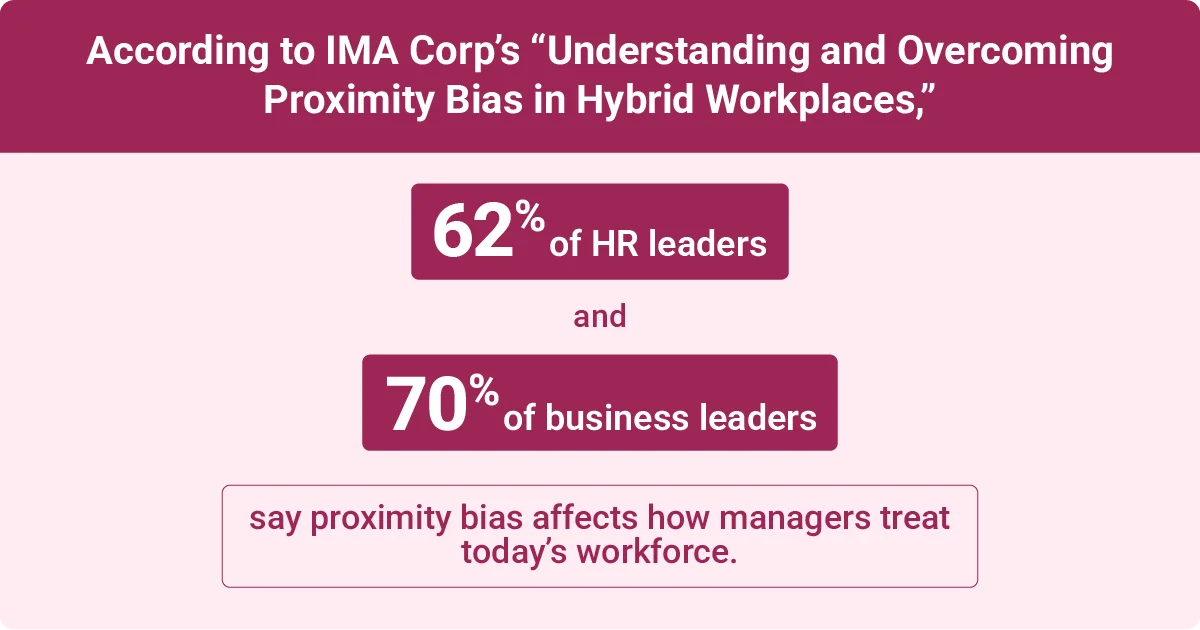
Also, according to an IMA Corp report, “Understanding and Overcoming Proximity Bias in Hybrid Workplaces,” 62% of HR leaders and 70% of business leaders say that proximity bias actively affects how managers treat the modern workforce.
The engagement question that HR needs to raise is whether fairness and purpose are being prioritized over a worker’s location.
The frontline engagement gap
Deskless workers can face unique engagement challenges. They’re often excluded from organizational communications, recognition programs, and disconnected from the company’s mission, which can increase churn.
The penalty of frontline disengagement is severe. According to “42% of Employee Turnover Is Preventable but Often Ignored,” by Gallup, replacing a frontline employee costs 40% of their annual salary.
“Frontline Workers Want Flexibility Too,” by Gallup, notes that frontline workers are asking for more flexibility regarding shift predictability, scheduling autonomy, and time control. Since it’s harder to reach management about these requirements, frustration grows among frontline employees.
Mobile-accessible communication and recognition tools can help organizations reach frontline employees more consistently, complementing direct communication from managers and team leaders.
The following table explains the divergence in hybrid and frontline engagement trends:
Since the two populations move independently, management must segment engagement data by work model and by frontline vs. desk-based. HR should draw engagement-related conclusions from each separately, instead of an organization-wide score.
Why are wellbeing and engagement converging into one agenda?
Employee wellbeing and engagement are increasingly interconnected as organizations recognize that workload, staffing, flexibility, and manager behavior directly shape the employee experience.
According to “Amplifying Wellbeing at Work and Beyond,” by Gallup and Workhuman®, employee wellbeing relates to whether an employer makes workers feel fulfilled in the workplace in every way that counts, not just the physical.
From wellness programs to work design
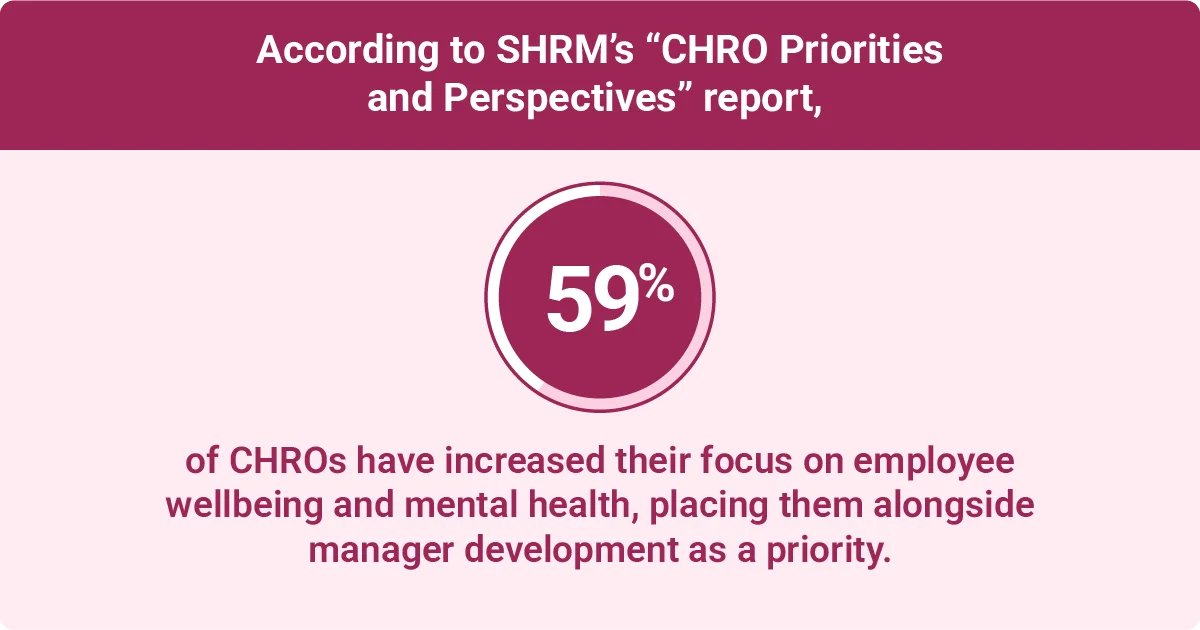
The SHRM “CHRO Priorities and Perspectives” report reveals that 59% of CHROs have arranged for a greater focus on wellbeing and mental health, prioritizing them alongside manager development.
Whenever there’s a problem with any of these drivers, wellness benefits only treat the symptoms. “Why most workplace wellbeing & mental health programs fail – and how to fix themOpens in a new tab,” by Kyan Health, says that wellness programs offer one-size-fits-all solutions. This is why generic wellbeing programs are underperforming and producing disengaged employees.
Personalization is the better wellness approach that can boost employee recognition and engagement by factoring in each worker’s role, workload, and protected deep-work time.
Frontline workers have different burnout drivers than the desk-based population. They’re subject to long work hours, additional tasks at the same pay, and stressful customer interactions rather than meeting load or always-on messaging.
HR needs to review burnout indicators, workload data, and time-off utilization alongside survey data, not as a separate wellbeing report.
How is recognition becoming a primary engagement driver?
Employee recognition remains an important driver of engagement, but how organizations deliver it is evolving. Rather than relying solely on occasional awards or manager-led appreciation, organizations are increasingly emphasizing frequent, meaningful, and peer-to-peer recognition.
It doesn’t sit beside engagement, but is rather one of the mechanisms that produce it.
From annual awards to continuous acknowledgment
Continuous acknowledgment is more effective than annual awards as an engagement driver. When context is fresh, immediate validation leaves a more lasting impression.
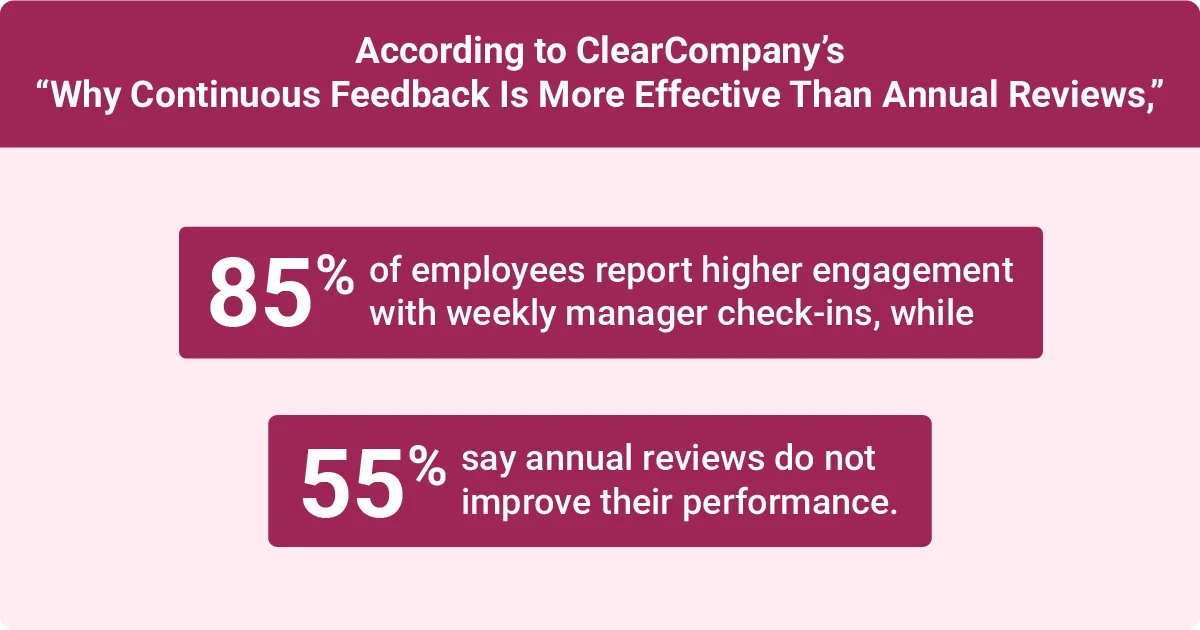
“Why Continuous Feedback Is More Effective Than Annual Reviews,” by ClearCompany backs this up: 85% of employees report higher engagement when they check in with their managers weekly. The same research shows that 55% of workers say their annual reviews don’t improve their performance.
Peer-to-peer recognition can strengthen employees' sense of belonging, reinforce meaningful contributions, and support the workplace connections associated with engagement and retention.
“Peer-to-Peer Recognition Systems and Their Impact on Employee Commitment: A Case-Based Exploration of Culture, Motivation, and Retention,” via ResearchGate, explores how peer recognition can support employees' sense of belonging, competence, and value alignment.
This can complement manager-led appreciation by allowing employees to acknowledge contributions and collaboration that might otherwise go unnoticed.
This is an important finding for deskless and frontline workers, where engagement is typically low. Feeling constantly seen by senior leaders is a key driver of engagement that isn’t related to location or flexibility.
“Transforming Workplaces Through Recognition,” a Gallup and Workhuman finding, describes what happens when recognition is done right. Employees are four times as likely to be engaged, 73% less likely to feel burned out “always” or “very often,” and 56% less likely to be watching for other opportunities.
Recognition data as an engagement signal
Recognition data can complement traditional engagement surveys by revealing patterns in how employees collaborate, contribute, and acknowledge one another over time:
- Coverage by team and shift (cross-functional collaboration)
- Reciprocity
- Equity gaps
- Manager-level patterns
Recognition is also tied to the manager enablement trend. HR’s role is to segment recognition coverage by shift, team, and location before adding another layer of engagement initiatives.
What does engagement data maturity look like in practice?
Engagement data maturity means moving beyond headline scores to understand how employee experiences connect to organizational outcomes. This requires more frequent measurement, meaningful segmentation, and consistent follow-through.
“Recognition as a Strategic Lever: Driving Data-Driven Decisions and True Business Impact,” by Everest Group and Workhuman, explains the contrast between traditional and strategic approaches to engagement data. Frequent recognition showed a 10% decrease in turnover, with peer and manager recognition reporting 13% against 35% for employees getting no recognition.
Leading indicators versus lagging ones
Leading engagement indicators can help organizations identify emerging retention risks before employees decide to leave. “How to predict employee turnover and improve team retention,” by Compono, names the following warning signs:
- Shifts from a person's behavioral baseline
- Plummeting engagement data gathered by pulse surveys
- Role and personality misalignment
- Manager and team mismatch
- Employee retention metrics
- Productivity metrics
- Employee turnover
- Successful hires
Segmenting before concluding
According to “Proving the Value of Employee Engagement,” by ROI Institute, HR professionals are increasingly expected to prove engagement ROI (using retention, productivity, and business outcomes) instead of gauging individual sentiments. However, that approach could be giving an illusion of stability.
HR teams should monitor leading indicators regularly, segment findings by employee population, and track changes in engagement drivers alongside broader business outcomes.
FAQs
1. How often should HR teams measure employee engagement?
HR teams should measure employee engagement through a layered listening strategy. This strategy must consist of both a deep annual survey and shorter, more frequent surveys that take place on a monthly or quarterly basis.
Event-triggered surveys should be used to track reactions to major policy updates, leadership transitions, restructuring efforts, or mergers and acquisitions.
2. Do employee engagement trends differ by industry or region?
Yes, employee engagement trends can differ by sector or region. “2025 Gallup World Poll,” by Gallup, reports 31% of employees engaged in the U.S. and Canada, compared to only 12% engagement in Europe.
Steady risers (like finance or manufacturing) have higher engagement rates than struggling industries (construction or professional services), according to “Employee Engagement by Industry: Sector Benchmarks,” by Perceptyx.
3. What are the 5 C's of employee engagement?
The 5 C’s of employee engagement are Care, Connect, Coach, Contribute, and Congratulate. All these core engagement elements must work in harmony to create a work environment where each employee feels valued, motivated, supported, and recognized.
4. What is the difference between employee engagement and employee experience?
Employee experience is the worker’s journey through an organization, from their initial interest in an open position to their eventual departure.
Employee engagement is a major part of that lifecycle. It describes an employee’s psychological needs that must be met during their time at a company to complete their work tasks well.
5. How should HR leaders decide which engagement trends to act on first?
HR leaders should first review their most recently gathered data to understand the most critical gaps and issues within the organization. Looking at turnover rates, employee performance metrics, and pulse surveys is a good place to start.
They must then prioritize trends that directly target core business objectives while also considering expenses, any required technology, and time constraints.

Ryan Stoltz
Ryan is a search marketing manager and content strategist at Workhuman where he writes on the next evolution of the workplace. Outside of the workplace, he's a diehard 49ers fan, comedy junkie, and has trouble avoiding sweets on a nightly basis.
Recommended for you