
6 Best Company Culture Software Platforms for 2026
by Ryan Stoltz
Last updated
12 min read
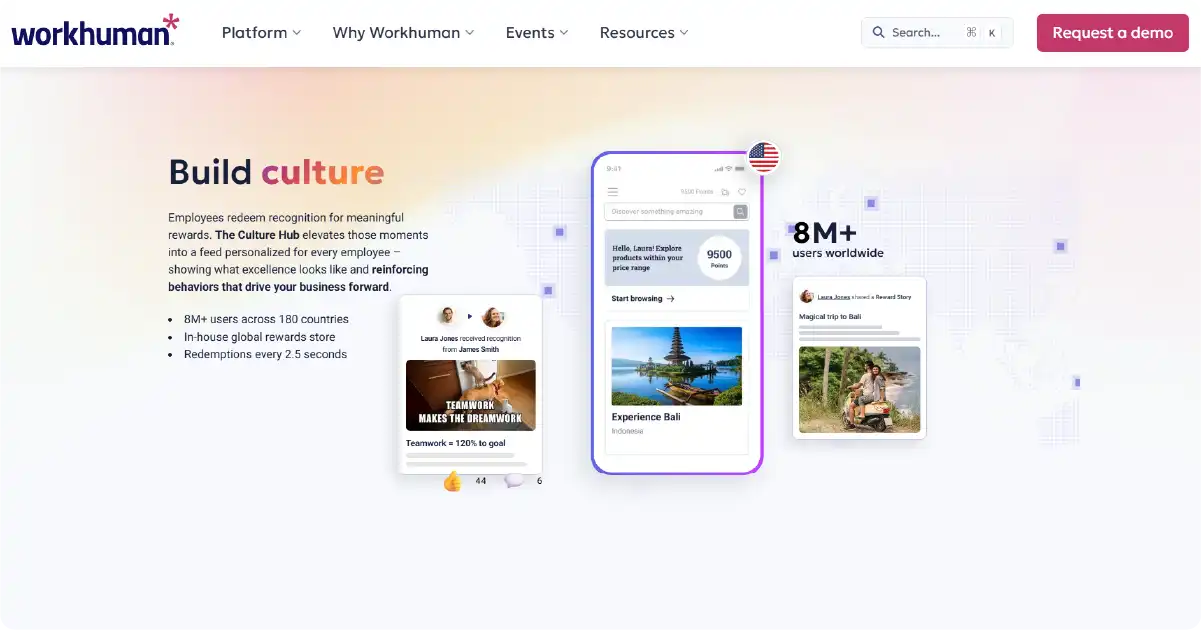
Table of contents
- What to Look For in Company Culture Software
- The Best Company Culture Software Platforms in 2026
- How to Evaluate Company Culture Software for Your Organization
- Key Company Culture Metrics to Track (and How Software Helps)
- Frequently Asked Questions
- Culture Is Built in Moments, Not Measured in Surveys
Share this article
Company culture isn't built in annual surveys — it's built in daily moments. The recognition a manager gives after a difficult quarter, the peer acknowledgment that surfaces someone's contribution before a leader ever notices it, the milestone that gets celebrated instead of overlooked — these moments, accumulated at scale, are what culture actually is.
Yet most organizations still measure culture the way they measured it a decade ago: annual engagement surveys, pulse checks, and gut instinct. The result is a dangerous lag. By the time HR leaders identify a cultural problem through self-reported data, the damage — attrition, disengagement, eroded trust — is already done.
But not all culture platforms are built the same way. Some lead with listening; others lead with recognition; and yet others are performance suites with culture features bolted on. The right choice depends on what your organization actually needs — and what kind of data you want driving the decision.
This guide covers the six best company culture software platforms for 2026, what to look for before you buy, and how to match the right tool to your specific workplace culture challenges.
What to Look For in Company Culture Software
HR and executive leaders can consider multiple types of evaluation criteria when choosing company culture software to ensure a cultural, operational, and scalable fit.
Behavioral data, not just survey data
What do their actions say? An employee may say they understand a new workflow, but their actual engagement and performance metrics may say otherwise.
Effective company culture tools use behavioral data to make culture visible in what people do, helping organizations look beyond surveys and other traditional feedback methods. This capability distinguishes recognition-based culture platforms from standard survey-based tools.
Key behavioral signals in recognition include:
- Who is recognizing whom
- What values are being recognized
- How frequently is recognition delivered
- Where gaps exist
Values alignment and reinforcement
Another key differentiator for strong company culture platforms is their ability to tie recognition and cultural moments explicitly to company values. Workhuman® Global Research Study: Recognition as an Engine for Strategy revealed that employees are five times more likely to feel very personally invested in strategic initiatives if recognition is tied to those priorities.
Strategic employee recognition spotlights the behaviors, practices, and milestones that leaders currently prioritize the most. These behaviors could be reaching a sales goal, earning consistently high reviews, or double-checking data before sending it to another department.
Values-tagging on recognition moments establishes a behavioral record of what the organization actually rewards rather than just what it says it rewards. Values tagging is especially beneficial when it's timely and specific, with quick responses to positive behaviors along with clarity about exactly what values are being rewarded, says “Employee Recognition: Low Cost, High ImpactOpens in a new tab”, an article published in UAMS by Gallup.
Continuous signals versus point-in-time measurement
Lagging indicators, such as annual or even quarterly engagement surveys, primarily look backward when evaluating engagement, productivity, and culture. Organizations that only rely on these insights may not notice key issues impacting workplace culture until it's too late.
Company culture software should provide continuous, real-time visibility into a healthy company culture, not only periodic snapshots. This active approach lets HR leaders immediately respond to concerns, significantly expanding their ability to foster a stronger culture backed by the organization's key values. This way, HR isn't checking in once every few months but every week (or even every day).
Manager enablement
Company culture lives and dies at the manager level. Culture isn't defined by a mission statement or a single policy — it's driven by the actions, reactions, and decisions made by leadership.
Trust-based culture platforms that give leaders additional support and insights are more effective than platforms that treat culture as a top-down or HR-led initiative. The best employee experience software gives managers visibility into:
Some of the best workplace culture software is built to scale with your organization. Personalized recognition models leverage insights based on your teams' sizes, while customized pricing structures make sure pricing is cost-effective, to maintain a positive return on investment (ROI). This scalability ensures you don't need to replace your software as your business grows or pay more for a program that's larger than you currently need.
The Best Company Culture Software Platforms in 2026
Many modern workplace tools support company culture in different ways, whether by creating survey experiences or using artificial intelligence (AI) to deliver in-depth employee analytics. The top tools actively guide HR and other leaders through the process, teaching them ways to improve company culture with continuous recognition or various other strategies.
While your best choice depends on your organization's unique needs, many of the best company culture software solutions combine different behavioral and people-centric strategies. This holistic approach deepens leaders' visibility into company culture, helping them react quickly and effectively as they continuously foster a healthy workplace culture.
1. Workhuman
- G2 rating: 4.7/5
- Pricing: Custom pricing reflecting scale, reach, and impact
- Best for: Mid-market to global enterprise organizations
- Notable clients: Pepsico, Cisco, Merck, Morgan Truck, Eaton, British Airways, Citizens Bank
- Key features: Social Recognition®, Culture Hub, Workhuman iQ, AI-driven recognition experiences, Application Programming Interface (API), and the market's only ROI Guarantee
Workhuman is not strictly a culture management solution, but it is a powerful operating system for measuring and managing culture. It is the only platform in this category built on the premise that recognition is the foundation of culture — not a feature within a broader HR suite. It's one of the best platforms for mid-market to large enterprise organizations where culture is a strategic priority.
Most culture platforms start by listening, such as through surveys and pulse checks, and then add recognition as an afterthought. Workhuman starts with recognition as the primary data generation source and then builds culture intelligence on top of it.
Key features of Workhuman's employee recognition platform include:
- Social Recognition: Recognition doesn't always need to be behind closed doors. Public and social recognition can serve as organizations' cultural heartbeats, tying peer, manager, and executive recognition to company values. This also creates a continuous record of what behaviors, achievements, and milestones the organization actually rewards.
- Human Intelligence™ analytics: Recognition data can surface cultural insights by showcasing:
- Which employees are connected
- Who is at risk
- Where value alignment is strong or weak
- Where recognition equity gaps exist by team, location, or demographics
- Where employees could use additional support and guidance
- Conversations and continuous performance development: Workhuman treats recognition as part of a broader, ongoing dialogue between managers and employees rather than as standalone events, enabling continuous communication and performance development.
- Service milestones: Instead of administrative checkboxes, turn employee lifecycle moments, such as onboarding, sales goals, and anniversaries, into culture-building moments. (Now also available as a standalone solution.)
- Pulse survey and eNPS capability: Combining behavioral data with listening data is more powerful than using one on its own. With Workhuman, HR leaders can leverage surveys and employee net promoter scores (eNPSs) alongside recognition data for unmatched recognition and engagement insights.
- Global scale: Workhuman serves clients in more than 180 countries with multiple language options, enterprise HR information system (HRIS) integrations, and a large global rewards market.
While it lacks the capabilities of a dedicated Objectives and Key Results (OKR) platform, Workhuman does support quarterly goal-setting and structured performance reviews, called Reflections. Combining these features with Workhuman's core recognition and culture capabilities makes it a complete people platform.
| Pros | Cons |
| Provides unrivaled insights into behavior, culture, and performance with Human Intelligence | Lacks structured OKR tracking and complex goal hierarchies |
| Combines behavioral data and listening data for powerful, actionable insights | Is best suited for mid-market and enterprise organizations seeking strategic, culture-focused recognition |
| Supports international and distributed teams with global scalability | |
| Let's leadership use behavioral data, not just survey scores | |
| Transforms ordinary lifecycle moments into opportunities to build culture and drive engagement |
2. Culture Amp
- G2 rating: 4.5/5
- Pricing: Custom pricing based on employee count and chosen modules
- Best for: Mid-market to enterprise organizations
- Notable clients: Major League Baseball (MLB), NASCAR, Ticketmaster, Etsy, Canva, Yelp
- Key features: Industry-leading engagement tools, performance management, and 360-degree feedback
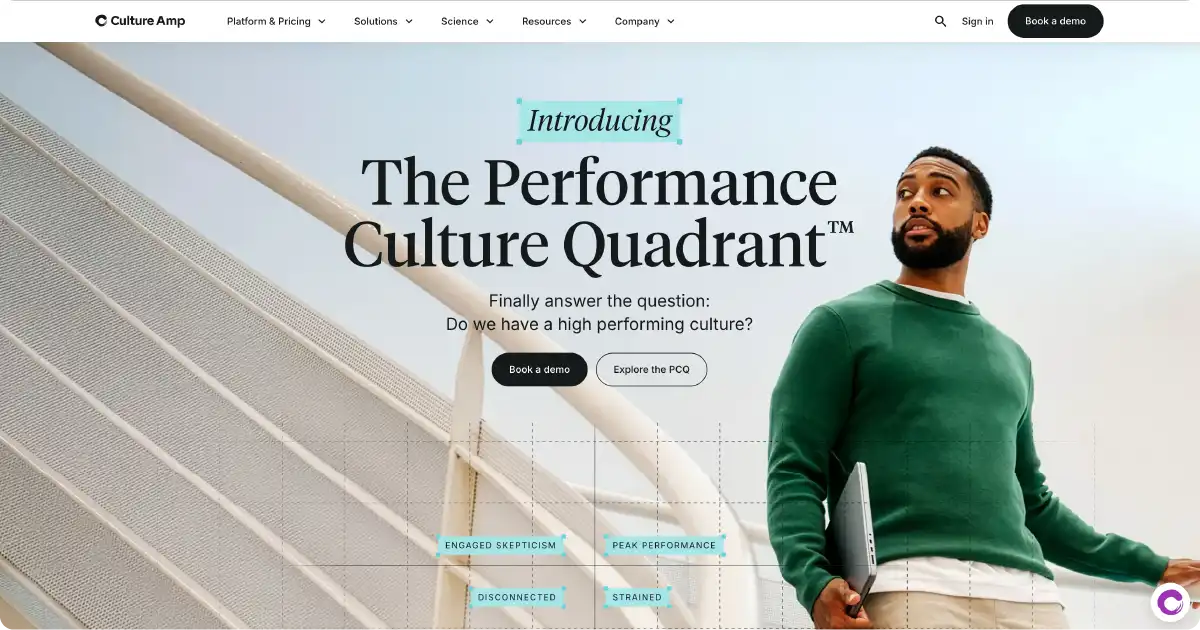
It's best suited for organizations that want to lead with measurement and listening and for people analytics teams that need more depth in their survey methodology.
| Pros | Cons |
| Focuses survey designs on actionable next steps instead of simple data collection | Often gets difficult to navigate because of its complex UI that's not intuitive |
| Gives leaders more control and insights into their survey processes with industry-leading survey customization | Is not suited for smaller teams because of its steep pricing structure |
| Emphasizes holistic research for employee motivation, pride, recommendation, and commitment when measuring engagement | Doesn't prioritize recognition capabilities as much as other platforms, despite having recognition features |
| Supports actionable team recognition using deep, manager-facing insights |
3. Lattice
- G2 rating: 4.7/5
- Pricing: Per-seat, per-month pricing structure with modular add-ons and minimum contract costs
- Best for: Mid-market organizations
- Notable clients: National Public Radio (NPR), Guinness World Records, Duolingo, Discord, Linktree, Robinhood
- Key features: Unified talent management, Lattice AI, Lattice Grow, and OKR
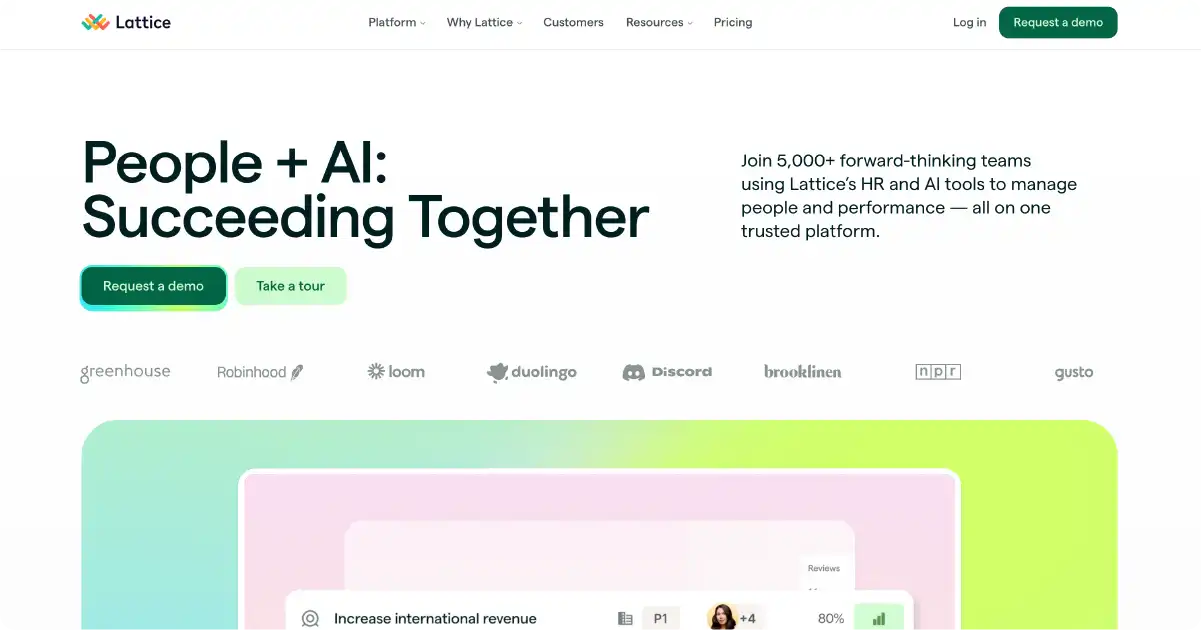
Lattice is a strong performance management and goal-setting platform that has expanded its capabilities to also focus on engagement and culture. Lattice's culture play is built around the connection between employee feedback, goals, and engagement, letting leaders track company culture as if it's a coherent story.
However, its recognition and behavioral culture data don't offer the same level of depth as other company culture tools. This creates potential limitations for small and enterprise organizations or for businesses with significant company culture needs.
Despite Lattice being priced at a near-enterprise level, most Lattice users on G2 work for mid-market businesses. Lattice's company culture software is best for those organizations that want an integrated performance and culture platform with structured OKR tracking, or for organizations already using Lattice for performance, who want to extend into culture measurement.
| Pros | Cons |
| Improves OKR tracking and goal-setting with strategic structures and goal hierarchies | Per-seat pricing, modular add-ons, and a minimum annual contract of $4,000 make Lattice difficult to justify for smaller organizations and a significant investment even for mid-market buyers |
| Supports increased employee participation with proper implementation, thanks to its user-friendly interface | Recognition and behavioral culture data are noticeably thin relative to the platform's price point — Lattice tracks what employees are working toward, but offers limited visibility into how culture is actually being built day to day |
| Tracks and develops insights for ongoing feedback and goal progress using Lattice AI | Customization options for goal-setting modules and review templates are constrained, which can force organizations to adapt their workflows to the platform rather than the other way around |
| Helps organizations support and define career paths for employees for continuous professional growth |
4. Leapsome
- G2 rating: 4.8/5
- Pricing: Modular- and subscription-based pricing structure
- Best for: Mid-market organizations
- Notable clients: Spotify, TicketSwap, Chili Piper, Monday.com
- Key features: 360-degree feedback, AI copilot, and OKR
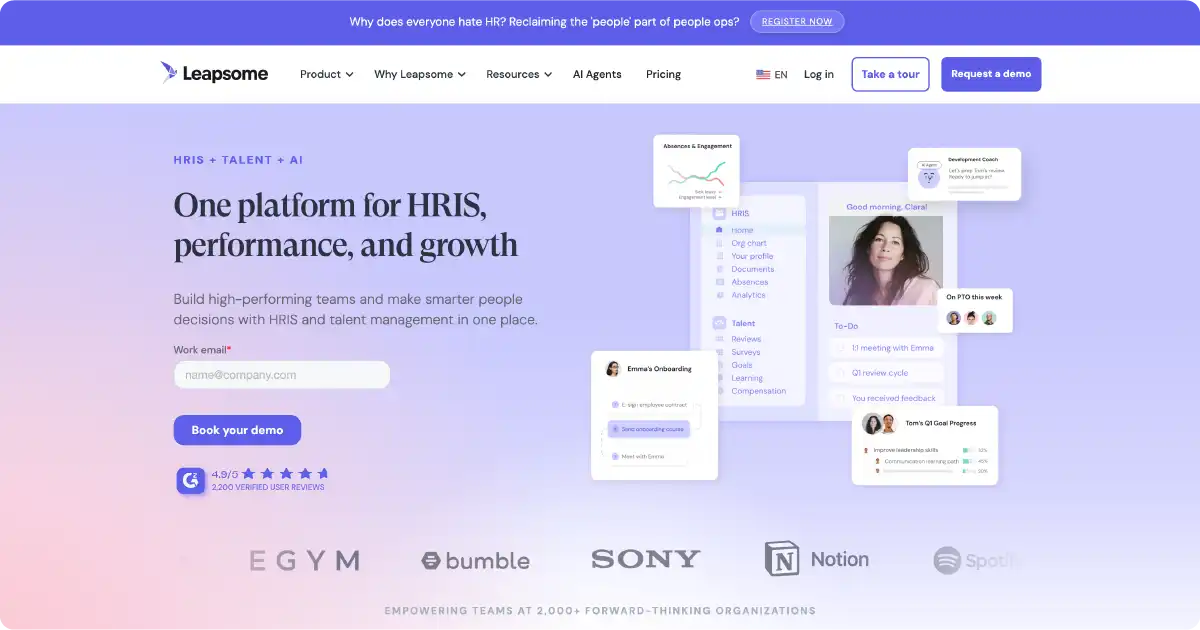
Founded in Germany in 2016, Leapsome's strengths are its people enablement and engagement capabilities, as well as structured OKR tracking and complex goal hierarchies. The platform combines goal-setting, reviews, learning, and employee engagement surveys with a clean user experience (UX). Its culture story is built around continuous feedback and development.
| Pros | Cons |
| Combines performance reviews, surveys, OKR data, and more into a single UI | Pricing is prohibitive for smaller organizations and difficult to scale cost-effectively as headcount grows |
| Elevates feedback and insights using Leapy, its embedded AI copilot | Leapsome has no recognition-first architecture — behavioral culture signals like peer acknowledgment patterns, values reinforcement, and real-time engagement trends are largely absent, meaning leaders get structured feedback data but limited visibility into how culture is actually lived |
| Supports deeper reporting with highly customizable templates and goals | The goals module lacks API support, requiring significant manual effort to maintain |
| Offers better visibility into culture and behaviors by linking performance data to employee development. | The UI, while clean in appearance, generates frequent notifications and can make surfacing relevant data more time-consuming than it should be |
5. Microsoft Viva
- G2 rating: 3.6/5 (Viva Engage); 4.5/5 (Viva Insights); 4.6/5 (Viva Glint)
- Pricing: Per-user and per-month pricing structures for individual apps and the full Microsoft Viva package
- Best for: Large enterprise organizations
- Notable clients: AT&T, Ford, Hertz, Levi's, NFL, Premier League, Best Buy
- Key features: Viva Engage, Insights, Glint, and Topics
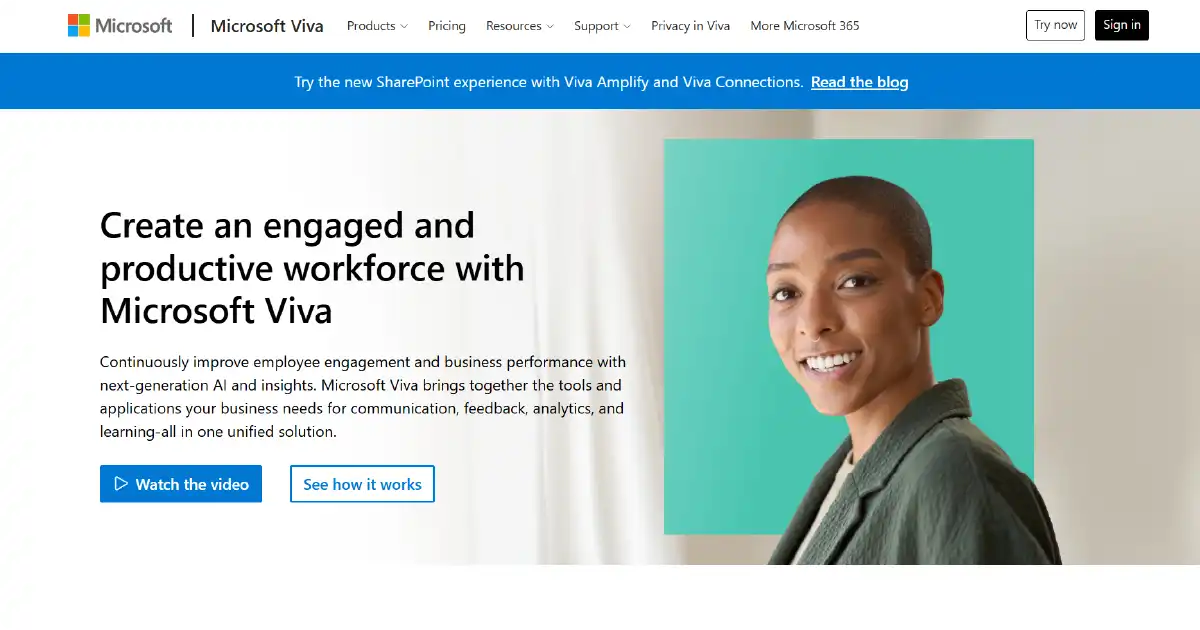
Microsoft Viva is well-suited for organizations deep in the Microsoft 365 ecosystem because it's built directly into Microsoft Teams, Outlook, and other tools. Key components of Microsoft Viva include the following:
- Viva Engage: Social connection and community
- Viva Insights: Employee well-being and collaboration analytics
- Viva Glint: Employee engagement surveys in a platform acquired from LinkedIn
The culture story is distributed across modules, not unified in one place. This approach can be beneficial if you're already in the Microsoft stack, but it can be complex to configure and maintain for organizations without strong information technology (IT) support. Microsoft Viva is generally best for large enterprises that are standardized on Microsoft 365 and want culture tools embedded in their existing digital workplace.
| Pros | Cons |
| Simplifies implementation by integrating with workflows that use Microsoft 365 | Raises significant privacy and employee monitoring concerns — particularly for CHROs navigating trust-sensitive cultures — because of the depth of behavioral and collaboration data Viva Insights collects |
| Delivers built-in, actionable insights with Viva Insights | Challenging for HR and administrators to implement without strong IT support, and requires ongoing configuration to maintain across modules |
| Automatically organizes organizational data, expertise, and knowledge | The distributed, multi-module architecture means culture data lives in separate tools rather than a unified view, making it difficult to surface a coherent cultural picture without significant integration work |
| Fosters a sense of community and connection with Viva Engage | The UI can be complex and notification-heavy, risking employee fatigue rather than engagement |
6. Qualtrics EmployeeXM
- G2 rating: 4.4/5
- Pricing: Customized pricing model based on employee count and program specifications
- Best for: Mid-market to enterprise organizations
- Notable clients: Hilton, Yamaha, Shake Shack, Zillow, DollarShave, University of Denver
- Key features: Continuous listening, AI insights, 360-degree feedback, and personalized manager coaching
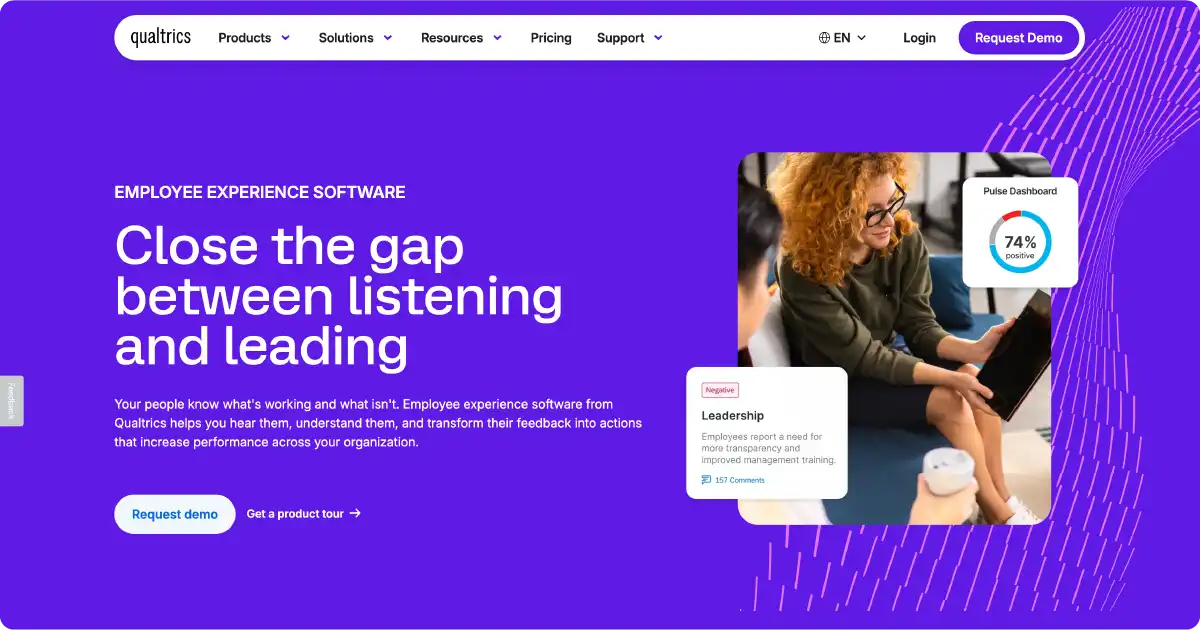
Qualtrics EmployeeXM is an enterprise-grade experience management platform built primarily around the "listen, understand, act" methodology. Where most culture platforms on this list start with behavior and layer listening on top, Qualtrics inverts that model — surveys, lifecycle feedback programs, and structured listening are the core product, with analytics built to make sense of that data at scale.
For organizations with dedicated people analytics teams, complex multi-country listening program requirements, or existing investment in the Qualtrics XM ecosystem, EmployeeXM is a genuinely powerful tool. For organizations that want culture software to actively build culture, not just measure it, the platform's listening-first architecture is a fundamental limitation rather than a feature gap.
| Pros | Cons |
| Combines employee sentiment and operational data for deeper, AI-supported culture insights | Is not cost-effective for smaller businesses and many business models |
| Continuously "listens" to behavioral trends with pulse surveys and automated tracking | Gets challenging to navigate with a steep learning curve, especially for HR and administrators |
| Supports managers with personalized AI coaching and guidance | |
| Offers deeper insights into employee experience drivers |
How to Evaluate Company Culture Software for Your Organization
Narrowing down the top company culture software to a single "right choice" necessitates a closer peek at your organization's unique needs.
If your primary problem is that "we don't know what's actually happening in our culture" ...
Recognition-based platforms, such as Workhuman, prioritize behavioral data and continuous signals over a cadence of surveys.
These tools take you straight to real-time cultural intelligence without requiring employees to self-report. They also offer a necessary "listening layer" for periodic deep dives.
If your primary problem is that "our managers aren't driving culture" ...
Platforms such as Lattice and Workhuman give managers actionable, team-level visibility into recognition patterns, engagement signals, and milestone moments.
Manager adoption is the culture lever most organizations underestimate. Platforms that embed into tools managers already use, such as Teams and Slack, and offer mobile accessibility, will outperform those requiring a separate login.
If your primary problem is that "we need to prove culture ROI to the C-suite" ...
Platforms such as Leapsome, Lattice, and Workhuman connect culture data to business outcomes. They offer guidance on how to build company culture and which company culture metrics to track, including retention, productivity, eNPS, recognition frequency, and attrition correlation.
Key Company Culture Metrics to Track (and How Software Helps)
Measuring company culture requires organizations to track various behavioral and engagement metrics. Here are a few to keep in mind as you think through your choice of platforms.
- Recognition frequency and equity: Tracking by team, location, tenure, and demographic lets you easily differentiate factors impacting culture.
- Manager participation rate in recognition: Monitoring real-time recognition and feedback participation offers deeper insights into implementation and impact.
- Retention data: AI-driven platforms offer insights into how retention correlates with recognition activity, letting you track more metrics than you could with a spreadsheet or annual survey.
- eNPS: Company culture software monitors eNPS trends over time, including how it's correlated with recognition activity.
- Values alignment rate: The percentage of recognition moments explicitly tagged to a company value, such as "innovation" or "customer focus", out of all recognition moments given in a period. Tracking which values are most and least recognized reveals whether the behaviors your organization says it prioritizes are the ones it actually rewards.
- Cultural connectivity: Advanced platforms offer a network analysis of who is recognizing whom to identify isolated teams or individuals.
Frequently Asked Questions
1. What is company culture software, and how is it different from an engagement survey tool?
Broadly speaking, company culture software refers to technology that continuously creates and reinforces culture through recognition, connection, and behavioral data. Rather than asking employees to self-report how they feel, these platforms capture what's actually happening — who is recognizing whom, which values are being reinforced, where engagement is strong, and where it's breaking down — in real time.
The most effective culture platforms treat surveys as a supplemental input rather than the primary data source. The primary source is behavior: the daily accumulation of recognition moments, manager interactions, and values-aligned actions that reveal what an organization actually rewards, not just what it says it rewards.
2. How does employee recognition build company culture?
Employee recognition tied to company values can create a behavioral feedback loop in teams. Employees notice what behaviors and practices the organization actually values through strategic rewards and recognition moments. Meanwhile, managers can develop habits of recognizing and acknowledging employees' achievements, and in turn, cumulative data from employee recognition software creates a real-time picture of organizations' cultural health.
3. Can company culture software work for remote or hybrid teams?
Digital-first recognition and culture platforms support distributed teams by allowing culture-building moments to happen beyond the physical office space and traditional work hours. For instance, asynchronous recognition doesn't require employees and leaders to directly interact; instead, it allows employees and peers to view feedback and redeem rewards on their own schedules and as their workload allows.
Culture-focused recognition software also seamlessly integrates with software, systems, and workflows that hybrid and remote organizations already use, such as Slack, Teams, and SAP. Beyond supporting adoption and ease-of-use, these integrations provide real-time engagement and behavioral insights, as well as other data, that help remote managers maintain cultural visibility that they'd otherwise risk losing.
4. How do you measure the ROI of company culture software?
Holistically measuring the ROI of company culture tools requires organizations to track multiple key metrics, including:
- Reduction in voluntary attrition
- Improvement in eNPS
- Increase in recognition frequency
- Manager participation rates
- Correlation between recognition activity and engagement scores
Workhuman's Human Intelligence analytics are specifically designed to surface and connect these metrics. The AI-powered system transforms recognition into unparalleled, real-time insights about program participation and impact — and also about behavior, connection, alignment and organizational strengths —helping drive measurable engagement, retention, and cultural development.
5. What's the difference between company culture software and performance management software?
Performance management software, such as Lattice and Leapsome, focuses on goals, reviews, and structured feedback cycles, often only offering backward-looking, manager-initiated insights. On the other hand, culture software focuses on continuous, peer-driven, values-aligned moments that shape how it actually feels to work at an organization.
Some platforms, such as Workhuman, aim to do both. The best company culture platforms integrate with performance tools instead of trying to replace them, speeding up adoption and participation by fitting into workflows employees already follow.
Culture Is Built in Moments, Not Measured in Surveys
The organizations with a thriving company culture don't just measure culture more frequently — they build it continuously, through an accumulation of recognized moments, reinforced values, and human connection that compounds over time. The right software doesn't replace that work; it creates the infrastructure for that work to happen at scale, across teams, time zones, and organizational layers.
What separates the platforms on this list isn't features — it's philosophy. Survey-first platforms tell you what employees think about your culture. Behavior-first platforms show you what your culture actually is. The best choice for your organization depends on which problem you're actually trying to solve: measuring culture after the fact, or actively shaping it in the moments that matter.
Ready to see how Workhuman helps organizations build culture through recognition? Book a demo today.

Ryan Stoltz
Ryan is a search marketing manager and content strategist at Workhuman where he writes on the next evolution of the workplace. Outside of the workplace, he's a diehard 49ers fan, comedy junkie, and has trouble avoiding sweets on a nightly basis.
Recommended for you