How to kickstart Data Governance using OpenMetadata
Introduction
Hi, I’m Donal, a Data Governance Architect with over 15 years’ experience working across a range of data roles. I love helping organisations make sense of their data and turning it into something truly valuable, with a focus on creating practical, business-friendly governance frameworks that actually work in the real world.
At Workhuman, I’m part of the Data Architecture team, where we define and drive the enterprise data architecture vision and strategy. Our team shapes the data ecosystem through standards for data ingestion, quality, and scalable system design, and we’ve also established a Data Governance program to ensure that data across Workhuman is securely accessible, trusted, and well-understood. Outside of work, I’m a dad to two young boys who keep me on my toes and remind me that a little chaos can be great too!
In this article, I want to share how we kicked off a Data Governance pilot using OpenMetadata, the challenges we faced along the way, and some practical tips that helped us demonstrate early value and gain momentum across the organisation.

Overview
Data Governance is no longer a luxury - it’s a necessity. As organisations increasingly rely on data to drive decision-making and to enable AI initiatives, ensuring that data is accurate, discoverable, and well-managed becomes critical. But establishing a governance framework aligned with business requirements can be a significant challenge.
That was exactly the situation we faced. With no formal Data Governance in place, we struggled with inconsistent data definitions, siloed knowledge, and limited visibility into where data lived or who owned it. This manifested itself through limiting our ability to maximise the value of our data in support of business lead strategic activities. So, the need for governance was clear. But there was uncertainty on how to begin along with a natural reluctance to commit to expensive, enterprise-grade supporting solutions without first demonstrating value.
So, we turned to open source. We chose OpenMetadata as our starting point - a lightweight, flexible, and community-driven platform that allowed us to take our first meaningful steps without heavy investment. Our initial focus was simple but strategic: to build a data catalog to centralise metadata, improve data discoverability, and lay the groundwork for broader governance initiatives.
This article shares how we kicked off a data governance pilot using OpenMetadata, including tips for success, the challenges we met along the way, and how we demonstrated early value to build momentum across the organisation.
Implementation
To bring our pilot to life and following a proof-of-concept exercise, we deployed OpenMetadata in a Kubernetes environment and integrated with our AWS hosted data lakehouse platform, which includes S3 for storage, Redshift for data warehousing, QuickSight for analytics and reporting, and dbt for data transformation and modeling. Our data platform proved to be the ideal place to start developing our catalog as it provided a unified view of our data landscape, enabling us to capture metadata across key systems. Our implementation is illustrated below.
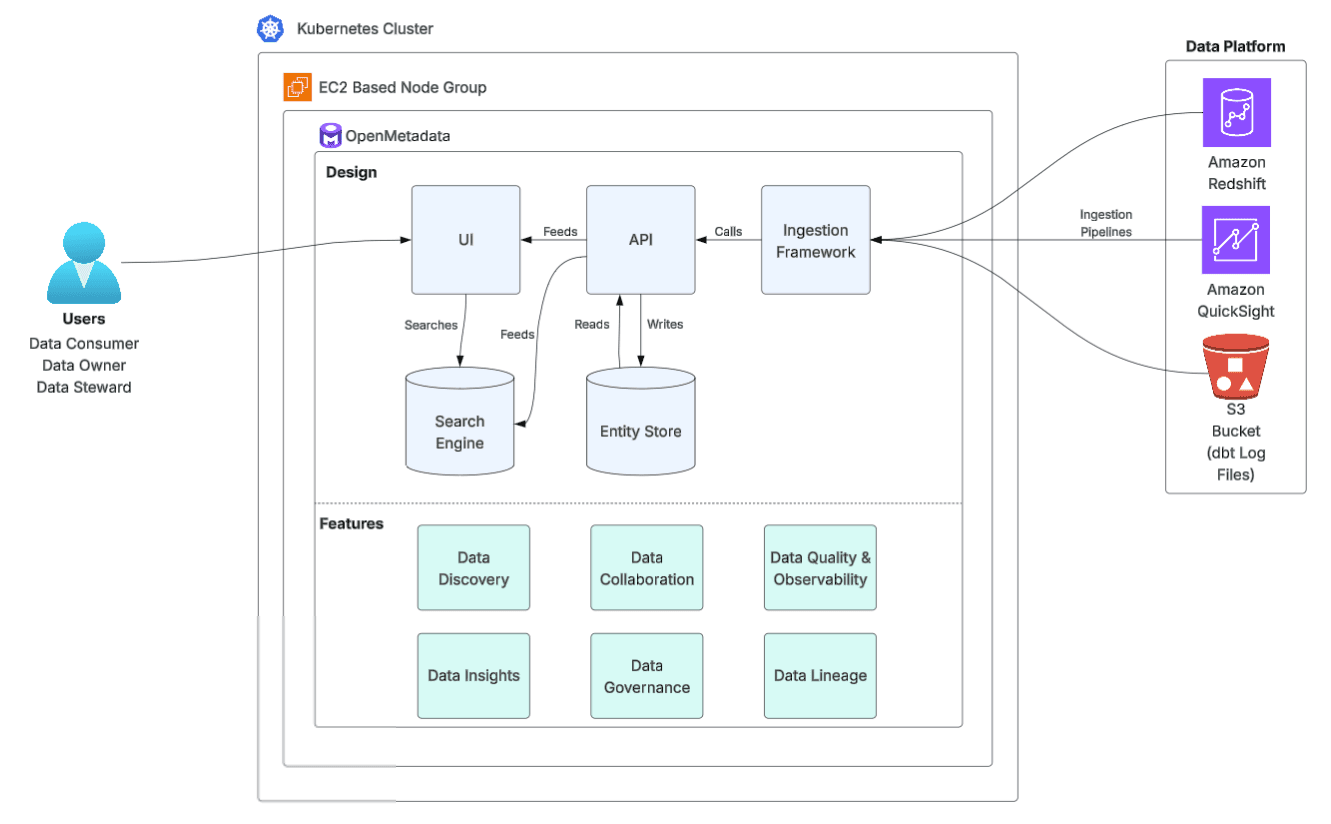
Next, we identified a set of manageable, high-impact use cases that offered the potential for tangible business value and clear demonstration of success. Once the use case was chosen and the related data objects identified, we developed a structured implementation plan with defined milestones covering key activities such as establishing connections, ingesting metadata and the systematic cataloguing of prioritised datasets. This phased approach ensured steady progress and allowed for early feedback and adjustment.
Challenges
During our pilot, we faced several challenges that required careful attention and adaptation. These were:
- Our deployment steps highlighted the importance of hardening the K8s environment by creating separate node groups for each application and enabling auto-scaling and node repair to ensure stability and performance.
- We encountered version-specific (v1.6.4) issues, such as complications with postgress master password shielding, which required troubleshooting and workarounds.
- Additionally, version compatibility with modules like OpenSearch posed integration hurdles that needed resolution.
Addressing these challenges was key to strengthening our deployment.
Tips for Success
While we acknowledge that Data Governance should be business-aligned, distinct from data management, and supported by early executive sponsorship, gaining understanding was challenging and buy-in was elusive. To overcome this and initiate the program, we adopted a flexible approach to these principles.
Our approach was characterised by a practical and data management focused means to develop the first-cut data catalog. This tangible initiative allowed us to demonstrate the value and intent of data governance in a visible, results-oriented way. By showcasing real benefits, the catalog is serving to spark interest and engagement, creating the foundation for broader sponsorship of activities that will ultimately drive business value.
Based on our experience in doing so, several key strategies made our pilot more effective and could help others looking to kick start Data Governance in a similar way. These include:
1. Start Small. Focus on a Known Problem Area
Rather than trying to boil the ocean, we began with a narrow, well-understood use case where success was almost guaranteed. We chose a high-impact dataset and by focusing our efforts here, we were able to deliver value quickly, making it easier to build momentum.
2. Tailor the Message to Your Audience
Not everyone sees metadata the same way. For engineers, the value was in understanding schema changes. For analysts, it was about faster data discovery and data lineage. For business users, it was confidence in using the “right” data. We learned early on that it’s important to explain the benefits of OpenMetadata in language each persona understands, and to tailor demos and presentations accordingly. This helped drive broader interest and engagement.
3. Start with the Catalog
The data catalog proved to be the ideal entry point into OpenMetadata and an effective first step on the road to governance. It’s one of the easiest components to set up and delivers immediate, visible value (centralising metadata, improving discoverability, and clarifying ownership). OpenMetadata’s built-in connectors made it relatively simple to ingest metadata from our existing systems, allowing us to get up and running without heavy customisation.
4. Plan Milestones
Take the time to carefully plan your implementation and adopt a methodical approach to achieving milestones. Our initial pilot timeline was ambitious, and as environment setup and application deployment began to impact delivery dates, we quickly adjusted our project plan. Breaking broader milestones into smaller, manageable tasks helped maintain focus, drive progress, and foster a stronger sense of achievement.
By starting small, speaking the right language to the right people, and choosing the right starting point, we were able to turn a resource light pilot into a steppingstone toward scalable data governance.
Wrapping Up: From Pilot to Progress
Despite the initial challenges, our OpenMetadata pilot proved to be a critical turning point in our journey toward better Data Governance. By starting small, targeting a real problem area, and focusing on delivering tangible value, we were able to demonstrate the power of metadata management in action.
The pilot didn’t solve all our challenges, but it laid a clear, practical foundation for governance. We showed that with the right approach (and without major upfront investment) it’s possible to make meaningful progress. Along the way, we also learned that deploying enabling technology and engaging in the practicalities of data management, like the catalog, was unavoidable to generate interest and build trust in the process.
Most importantly, the pilot helped shift the conversation from abstract ideas about governance to real, observable benefits that we can illustrate to senior business stakeholders. With this momentum, we’re now in a stronger position to engage with that cohort to demonstrate the value that Data Governance adds to the delivery of strategic initiatives. We have a path forward to mature our governance framework, expand adoption, and continue to build a culture that values data as a shared, strategic asset.
Without our humans, it’s just work.Opens in a new tab
About the author
Donal McCoy
Donal McCoy is a Data Governance Architect with over 15 year’s experience working across a range of data roles.
I love helping organisations make sense of their data and turning it into something truly valuable. My focus is on creating practical, business-friendly governance frameworks that actually work in the real world. Outside of work, I’m a dad to two young boys who keep me on my toes and remind me that chaos can be great too!