
Your Employees Are Using AI. Now What?
Last updated
4 min read
Someone on a creative team has two weeks to prepare for a photo shoot. There are decisions to make, a shot list to develop, and little room for back-and-forth. A colleague suggests using AI to sketch the shots so everyone can see what they’re working toward.
The sketches help the team make decisions and become useful references on set. Later, someone writes a recognition message thanking that colleague for the idea, the support, and the collaboration that helped the shoot succeed.
That account appears in Workhuman’s 2026 Recognition Intelligence Report as a small window into a much bigger question leaders are trying to understand on at scale: what happens after employees start using AI?
A dashboard might show that someone opened a tool. A recognition message explains what they accomplished with it, and why another person cared.
AI is showing up in the work people appreciate
The report’s language analysis examines 2,620,471 English-language recognition messages from 35 Workhuman customers across seven industries, spanning January 2025 through June 2026. Within that record, AI and digital themes increased from about 1.6% of recognition messages in January 2025 to 3.8% in June 2026, with the sharpest increase occurring in the first half of 2026.
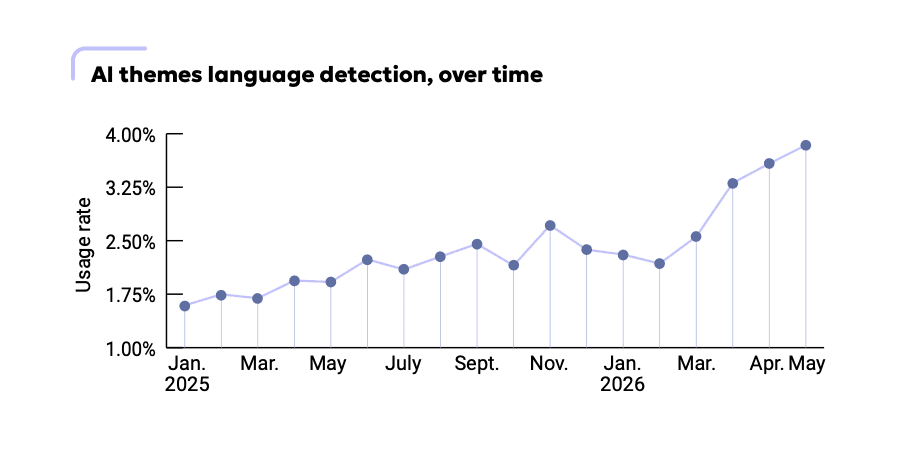
Those figures describe the language of recognition, rather than the percentage of employees using AI. What they show is that AI and digital work are becoming more visible in the contributions colleagues choose to acknowledge.
That’s useful because a technology rollout can generate plenty of activity before anyone has a clear sense of its value. Employees might complete training, try a few prompts, and return to familiar routines. Elsewhere, a team might quietly find an application that saves a difficult project.
Both could register as adoption, but leaders need enough context to tell those experiences apart.
And as the report puts it: “What a usage dashboard cannot easily tell you is why a particular contribution mattered or how experimentation is spreading.”
Recognition gives leaders another place to look for those answers.
Useful applications often start with an ordinary problem
The photo shoot example is compelling partly because it’s so familiar. Who hasn’t had a deadline approach with questions left unanswered? The team needed consensus. Someone found a way to make that easier.
The recognition message describes the contribution directly:
“he proactively suggested using AI to quickly mock up and sketch our shot list, which helped us move fast and make smarter, more confident choices.”
There’s a business outcome in that description: faster preparation and better-informed decisions. There’s also an explanation of how it happened. The employee identified an appropriate use for AI, brought the idea to the team, and helped colleagues move forward.
For leaders responsible for digital transformation, that level of detail is critical. It gives them a practical example to investigate and, potentially, share. Another team preparing a shoot could learn from it. A manager could ask what made the sketches useful, where they needed refinement, and whether the approach would work again.
Recognition can help those discoveries travel beyond the people who were there.
Different work produces different signals
The report also shows why organizations should be thoughtful about what they expect AI adoption to look like.
AI language detection rates in recognition messages varied by industry: 6.5% in technology, 2.4% in banking and finance, 2.1% in biotech and pharmaceutical, and 1.0% in manufacturing. These are rates of detected language in recognition messages, not workforce adoption rates or rankings of transformation success.
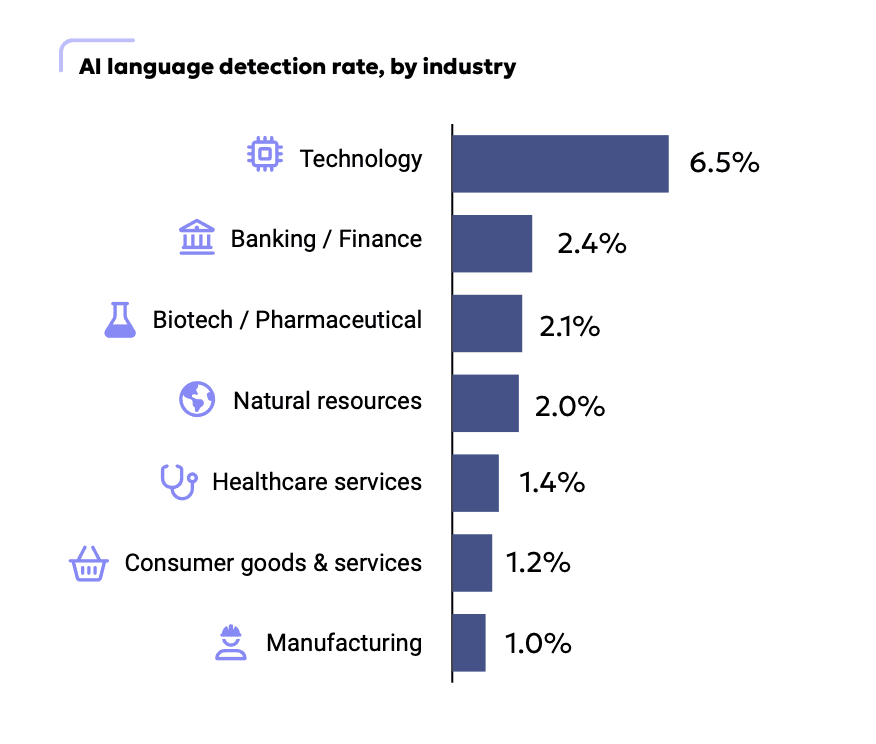
A manufacturing employee and a software engineer have different working environments, tools, and opportunities to use AI. Their colleagues may also describe valuable contributions differently.
A useful starting point is to ask what’s changing within the work itself. Where are employees finding applications? Who is helping others learn? Which experiments are producing something colleagues value enough to recognize?
Those questions give an organization a more grounded way to explore its own progress than assuming every industry, function, or team should follow the same pattern.
Employees need room to ask the basic questions
Learning a new tool can be awkward, especially when everyone seems expected to know how it works already.
Someone has to ask whether an output is accurate. Someone has to admit that an experiment didn’t help. And someone needs to feel comfortable saying that a task still requires human judgment, even when there’s pressure to move faster.
The report connects those everyday behaviors with psychological safety:
“People are more likely to experiment productively when they can ask basic questions, admit uncertainty, challenge an output, or flag a risk without feeling that doing so will carry a social cost.”
That has practical implications for managers. When an employee catches a misleading result or helps a colleague understand a tool’s limitations, acknowledging that contribution tells the team something about what good AI use looks like.
The same goes for sharing an unsuccessful experiment. There can be value in helping the next person avoid the same dead end.
Recognition gives managers a way to make those contributions visible, alongside the examples that save time or improve an outcome.
Pay attention to the human work around the technology
A closer analysis of five technology companies found a modest positive relationship between AI-related recognition and recognition of efficiency, along with a positive relationship with collaboration. Supportiveness showed a relatively flat relationship, while critical thinking showed a negative directional relationship.
The report is explicit about the limits: these are aggregated observations from a small sample and should be interpreted as directional only. They don’t establish that AI causes any of those changes.
They do raise useful questions. If collaboration is appearing alongside AI-related work, what are people doing together? If critical thinking is less visible, is it happening without being recognized, or does it need more attention?
Those are questions leaders can explore with their own teams and data. Recognition provides a starting point for the conversation.
Look for the contribution worth repeating
The next useful question after “Are people using AI?” is often “What did it help them do?”
The answer might be a better-prepared photo shoot, a clearer decision, or a colleague who now feels confident enough to try something new, and getting those details matter. They help organizations understand which practices deserve support and which lessons are worth sharing.
The report captures the distinction well: “Where AI adoption asks whether people are using the technology, recognition intelligence can begin to show what they are doing with it that others find valuable.”
Employees are already noticing those contributions. Recognition messages give leaders a chance to notice them, too.