
What Happens After Someone Speaks Up?
Last updated
4 min read

Table of contents
- The response becomes part of the lesson
- What colleagues notice adds another layer
- Sometimes it starts with a question about a handoff
- The small mistakes count, too
- Connecting those moments to the wider employee experience
- Make sure people know their contribution mattered
Share this article
An employee notices something wrong. Speaking up will mean more work for the team, and probably some frustration. They could assume someone else has already checked it or simply keep the process moving. Instead, they speak up.
In an anonymized recognition message featured in Workhuman’s 2026 Recognition Intelligence Report, a colleague describes exactly that situation. An employee spotted an issue others had missed and worked with quality assurance to address it, even though the team had to repeat part of the process. Their actions avoided potential contamination.
The message ends with a thank-you that gets to the heart of psychological safety:
“Thank you for having the courage to speak up and do the right thing, even when doing so would cause short-term pain.”
The issue mattered. So did the response. Someone made sure the employee knew that raising the concern was a contribution worth recognizing.
The response becomes part of the lesson
Most people can remember a time they weighed whether to say something at work. Maybe a deadline looked unrealistic, an instruction was unclear, or everyone seemed comfortable with a decision that didn’t quite make sense.
In those moments, people have more to consider than whether their observation is correct, but also how it will land
The report draws on Amy Edmondson’s frameworkOpens in a new tab, defining psychological safety as a shared belief that a team is safe for interpersonal risk-taking. In everyday terms, that means being able to ask questions, admit mistakes, raise concerns, and challenge established thinking without fear of embarrassment or punishment.
Those expectations take shape through experience. A manager’s invitation to speak candidly matters, and so does what happens when someone takes them up on it.
When a concern leads to irritation or dismissal, people have reason to hesitate next time. When someone acknowledges the effort and explains why it helped, the team sees how speaking up can be inconvenient and still valued.
Recognition makes that response visible.
What colleagues notice adds another layer
Workhuman has studied psychological safety since 2021, using Edmondson’s validated scale in survey research across tens of thousands of employees. Across every study, employees recognized recently have reported meaningfully higher psychological safety than those who haven’t been. The report says that gap has held steady for five years and appears among employees who give recognition as well as those who receive it.
The new report approaches the subject from another direction: examining whether behaviors associated with psychological safety appear in what colleagues recognize.
Its language analysis covers 2,620,471 English-language recognition messages from 35 customers across seven industries. Psychological-safety language appeared in approximately 9.8% of messages in January 2025 and 11.1% in June 2026.
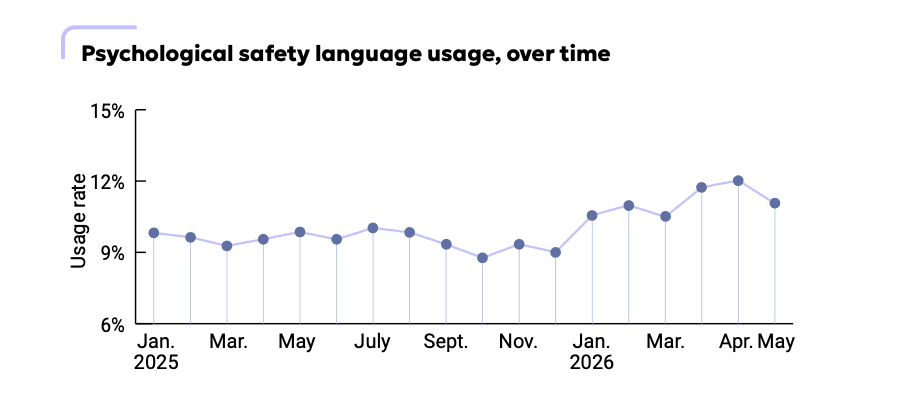
That change needs context. The report notes that rates can fluctuate with seasonality and other variables. These are signals in recognition language, rather than a direct measurement of how safe employees feel. Their value lies in helping organizations track which behaviors people notice and reinforce over time.
The report explains the relationship simply:
“Survey data captures perception. Recognition language captures observed behavior.”
Together, they give leaders more to work with. A survey can reveal that employees hesitate to raise concerns. Recognition messages can offer examples of where colleagues are responding well, what they appreciate, and which practices might be worth exploring further.
Sometimes it starts with a question about a handoff
One recognition example describes an employee who kept asking questions when expectations and reality didn’t line up. Those conversations helped uncover a problem and led to a solution that made ownership across shifts more visible.
The colleague writing the message recognized the persistence involved:
“Continue to use your voice to bring focus to where we can improve within the department. We cannot shy away from these important discussions.”
Anyone who has worked through a confusing handoff will understand the value here. Unclear ownership can leave people chasing answers or making assumptions about who is handling what. Getting clarity often requires someone to keep asking after the first explanation falls short.
The recognition acknowledges that effort. It also gives the employee a reason to continue.
For managers, there’s a useful question in this example: do employees hear that their questions helped? A problem may get resolved and everyone moves on, leaving the person who raised it unsure whether they were helpful or difficult. A specific thank-you can remove that uncertainty.
The small mistakes count, too
Another message concerns a shared slide deck that someone accidentally disrupted. A colleague stepped in to fix it while another kept the meeting moving.
The person who made the mistake described the response this way:
“With grace and poise, no blaming or finger pointing, she accepted my mistake and simply asked to have time to work on correcting it immediately during our individual meeting.”
It’s an ordinary mishap, which makes it a useful example. Most working days contain more awkward handoffs and damaged slides than dramatic moments of courage. Those smaller experiences give people plenty of opportunities to learn how their team handles mistakes.
Here, the employee could acknowledge what happened and accept help. The recognition then named the patience and professionalism that made the situation manageable.
A leader reading that message learns something a completed presentation would never reveal: how colleagues treated each other while getting it finished.
Connecting those moments to the wider employee experience
The report also looks at what happens when recognition is analyzed alongside an organization’s own workforce data.
Moody’s Corporation partnered with the Workhuman iQ team to explore connections between recognition, psychological safety, engagement, and retention. Teams with high recognition activity scored 7.5 points higher on the company’s internal psychological safety survey than teams with no recognition activity.
That relationship doesn’t establish that recognition alone caused the difference. It does show why connecting these sources is useful. The survey provides employees’ assessment of their environment. Recognition adds context about the contributions and interactions people value within it.
For an organization trying to understand its own results, that creates an opportunity to ask more specific questions. What are highly active teams recognizing? Are employees thanked for raising concerns? Do messages acknowledge people who make room for questions or respond constructively to mistakes?
The answers can help leaders identify practices worth discussing and supporting.
Make sure people know their contribution mattered
Psychological safety asks something of the person who speaks up, but it also asks something of everyone listening.
Managers and colleagues have opportunities to respond well every day: taking a question seriously, helping someone recover from an error, or thanking an employee who catches a problem that slows everyone down.
Recognition gives those responses a lasting, visible form. It lets someone say what happened, why it mattered, and what they appreciated about the person’s judgment or care.
The employee who raised a concern shouldn’t have to guess whether the inconvenience was worth it. Tell them what they helped protect. Tell them what the team learned.
That response may become part of how they decide what to do next time.